
All posts by Gautam Bhan

Silence as Sedition

A true measure of being democratic is not the cycles of elections – it is the dignity given to disagreement, to dissent. Why must we dignify dissent? There are the arguments that we hear everyday: so that the views of the majority cannot silence the voices of a few; so that no one view or institution may becomes so dominant as to become authoritarian; and the value of freedom of speech and expression in and of themselves. Any memory of the Emergency in 1975-77 is testimony to why any of these are important. Yet there is a more fundamental reason why dissent is the cornerstone of a democracy: it is the action of a free citizen.

Speech is an action. An action within a democratic framework – an action that simultaneously shows a continuous faith in the polity, the state and the people even as one (often virulently) disagrees with it. An action that keeps a democratic system alive. You dissent as a citizen, in the name of your constitution. You dissent because you have the freedom to do so – not a freedom you have been “given” but one that you possess because you, as part of the people, are sovereign. This is more important than what we are taught in our textbooks – being able to voice our disagreement is as central as the ability to walk to a ballot box and cast our vote. This is a freedom we give to each other as democratic citizens and that we must protect, especially when we disagree.

Continue reading Silence as Sedition

On the Day of the Games

On the morning of the Games, what should many of us — who have dissented against them in different ways and forms — make of our dissent?

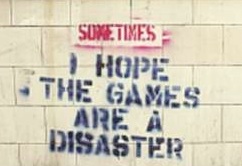
Let me begin with a confession. I am one of the authors of this graffiti that dots some of South Delhi and, ironically, remains on the wall opposite the main entrance of the JLN stadium, though now its probably hidden under a hoarding of Shera who appears to be not nearly as endangered as his real life inspiration:

It was a few months ago when the Games fervour was just beginning. The magnitude of all that they would become hadn’t quite sunk in. The graffiti felt, at that time, like a momentary defiance that opened up some space to breathe in a city where the deafening and deadening drum rolls that precede any spectacle were inching closer. You could hear them. You could tell that soon little else would be audible.

Continue reading On the Day of the Games

To Delhi

I had used Baudelaire for the post pasted below because on the day  I sat to write about the CWG, nothing I wrote made any sense or captured my frustration other than the poem. Yet, as an email I got this morning reminded me, I have partially substituted one injustice with another. Since good critiques are so wonderfully rare and this one voiced so well, I cite the email below (with permission) as an amendment to my own post since my agreement with its charges are complete:

“Dear Gautam,
I was disappointed to read your post on Kafila , the one where you posted an extract from Baudelaire [http://kafila.org/2010/09/25/to-delhi/]. It is very tiring to read of woman / the feminine as characterized by caprice and associated with luxury + cruelty.
Even if it is Delhi , the city, that one is supposed to read as the woman, unfeeling, capricious, this still ties up with the discourse around women as the consumers of luxury goods, thus responsible for the exploitation resulting from the production / trade of these goods. [Off the top of my head – look at Pope’s Rape of the Lock , Gray’s goldfish-enamoured cat, and the sequel to Love Story – Oliver’s Story with the woman who works for the sweatshop-patronising firm]. I don’t see how the sexism in this piece can be excused or explained away. And to quote it without atleast pointing out the problems in it?

Also, isn’t caprice a problem in itself? Aren’t you disappointed in the reporting that characterizes the Commonweath expenditure as resulting from the caprice of a few in power? Without exploring the systems, structures of thinking/ideology that make such expenditure possible in the first place? Without connecting this, the commonwealth-exploitation, to the histories of similar exploitation?

Yes, it is possible to see that you were highlighting injustice and class – but –
the piece ends up valourizing a man who feels what – pity? guilt? A little shame. Shame is so comfortable – he can occupy moral high ground, diss the woman, use the services of the cafe, and do nothing after that.

I hope your work goes okay.
Best wishes,
Akshi.”

The original post:

“Oh!  You want to know why I hate you today.

Continue reading To Delhi

Creative Destructions

Part of a Series. See here.

In January of this year, I had taken a friend to Mumbai. One of the places we went to was Lower Parel – I wanted to show him what I could of the Mills. You could still see the Mills then, if not in the same form. The same compounds now housed small galleries and boutiques. There were advertisements for a ‘mills culture tour’, sold as something in between a bar hop and an art gallery cruise. I knew big clubs had opened here, as had malls. Phoenix Mills was Mumbai’s version of Delhi’s DLF Emporio – all the major global brands were there. Even here, however, I remember laughing and pointing out to him that some of Bombay’s stubborn egalitarianism remained. Armani was next to Addidas. Rohit Bal next to a paper store. Unlike in Delhi where no non-hyper-elite brand could get near DLF Emporio, in Bombay, even Armani couldn’t buy space away from Adiddas.

Continue reading Creative Destructions

Statement on the death of Dr Srinivas Ramachandra Siras under suspicious circumstances

FOR IMMEDIATE RELEASE – 7th April, 2010

News reports on several media channels have just reported the death of Dr Srinivas Ramachandra Siras, 64, Reader and Chair of Modern Indian Languages at Aligarh Muslim University. According to reports, Dr Siras’ body was found “in mysterious circumstances” with bleeding from the mouth in his home in Aligarh.

Dr Siras, as is known, had recently fought against his unlawful and unethical suspension from AMU on the grounds of “gross indecency”. After decades of teaching, he was suspended merely a few months before his retirement on the basis of videotapes filmed by intruders into own home without his consent in a blatant and homophobic violation of his privacy. Right after, he said: “I have spent two decades here. I love my University. I have always loved it and will continue to do so no matter what. I wonder if they have stopped loving me because I am gay.” Continue reading Statement on the death of Dr Srinivas Ramachandra Siras under suspicious circumstances

Whose Morality is This?

From the Hindustan Times this morning.

Saleem Kidwai, Nivedita Menon, Mary John, V. Geetha, Shilpa Phadke and 13 other teachers and academics from universities across India.

We, as teachers and academics from universities across India, read with outrage and dismay that Dr Shrinivas Ramchandra Siras, reader and chairman of  Modern Indian Languages at the Aligarh Muslim University (AMU) was suspended for having consensual sex with someone of the same sex within the privacy of his home.

What made the press report that came out on Thursday in certain sections of the media particularly shocking was that there were either cameras placed by students within Dr Siras’ house or television reporters got into the house and made a video film of the alleged incident that was then passed on to the university authorities. The university authorities instead of going by the constitutionally recognised right to privacy within the four corners of one’s house have instead chosen to act against Dr Siras. Continue reading Whose Morality is This?

A Republic of Cities

From the Indian Express this morning.

Independent India was built, imagined and judged by its villages; by gram swaraj. The nation was rarely, if ever, imagined by its founders to be led (Chandigarh aside) by its cities. Cities were spaces of the other — of colonial empires and cantonments, of a modernity that had come first in the garb of colonialism — separate from the “inner” nation, which, authentic and unsullied, lived on in the villages. As Nehru once famously said: “we want to urbanise India’s villages; not take away the people from villages to towns.”

This ambiguity over the city and the reductive stereotypes it inhabits has had a long innings; and yet has begun to change. The urban has begun to rise not just demographically but politically, electorally, socially, culturally and economically to become the defining problem space of the ‘new India.’ Cities, for better and worse, have caught our imagination.

City Walls that Talk

[Part of  a Series. See For Movement]

On Austerity

In the 1990s, when I first understood economics, austerity was a word that scared me. It represented a paradigm that I associated with the story of Zambia in the late 1980s. Zambia had one of the more functional public health systems in Africa in the late 70s and early 80s. It then became IMF’s test case for user fees in health care and the rest of the story is familiar one of user fees, loss of access and a systemic worsening of care in an already incredibly poor country. “Austerity” was [and is] in economics of a certain tune, not about economy class travel and eliminating excess photocopying. It was about tightening state expenditure, usually to pay off large scale debts. It was part of Structural Adjustment and the attack on “big” African government, part of the shock transitions of Eastern Europe.

In one of its shades, then, austerity is the slow dismantling of the welfare state. It is not the stance — as the UPA would have you believe — that one takes in some notion of deference to the reality of poverty, it is the cause of some of that poverty in the first place. Every time one government or any other calls for “austerity drives” of any kind, the shadow of this austerity still haunts them. The austerity that causes poverty is also rooted within these calls, though more quietly.

Continue reading On Austerity

The Snub

[Part of  Series. Introduction: For Movement]

Tanger, Morroco, June 2009

Sometimes you just have to seek the travel moment. Yes, the best moments are unexpected, everyday, hidden. Sometimes though, the textbook travel guide moments, mass produced as they are, still work. Try this for a classic travel guide must-do: you drive down to the south of Spain, get to a ferry, put your car in the hold and cross the water in an hour long ride from Europe to Africa. West to.. well… not West. Continent to Continent. Universe to Universe. It’s a [good] travel writer’s worst nightmare and a travel publisher’s wet dream.

Continue reading The Snub

On the Eve of Pride. Are We Going the Right Way: Akhil Katyal

This is a guest post by AKHIL KATYAL

Topicality is a homage one pays to the short-term memory that the new media both triggers and complains against in its customers. In the long-term of course, where trend is all important, the topical is only a category of the banal. But it is under the shelter of such a necessary topicality – the topical is always necessary – that I hope to sneak in a scandal.

Everyone is talking about the queer pride marches that are going to happen in four cities in India at the end of this month. Most liberal reportage is obviously supportive, if not triumphant. For these cities themselves, it is seen as a step into a liberal urban culture which tolerates, even enjoys difference. All the talk about the ‘gay community’ or ‘lgbt community’ that the Indian media – and the activists – have been dabbling in for at least a decade now, seems to be reaching its logical climax: the community is expressing itself. Every city seems to have its own pet lgbt community or at least aspires to.

Continue reading On the Eve of Pride. Are We Going the Right Way: Akhil Katyal

Inside Teheran – 03

Guest post by a friend via Monica Narula and the Sarai Reader list, with thanks.

June 15th/16th, 2009

I accidentally broke two glasses and a bowl. Yesterday, I was visiting a good friend of mine, K., who lives in the City Center, around the corner from Tehran University, between  Enghelab and Azadi Square. I was in the midst of kicking my legs up to stretch out onto the couch and my clumsy foot hit the edge of the small table nearby, knocking two glasses and a bowl onto the tile floor. My head was turned away when the accident happened, so the sound of so much glass breaking really took me and N., who had also come with me, by surprise.
Continue reading Inside Teheran – 03

Inside Teheran – 02

Guest posted by a friend via Monica Narula and the Sarai Reader list, with thanks. Apologies for formatting.

June 14th, 2009

8:45 PM

It‟s still less than ten days before the official beginning of summer. Although the weather may be warm and the blossoms are gone, it is, according to the position of the Earth in relation to the Sun, spring. Tehran Spring. A period of political liberalization under a Reformist government, backed by popular approval against the Soviet-backed Socialist system in Czechoslovakia in 1968 has come to be known as the Prague Spring. Infamous for the brutality of the Soviet and Warsaw Pact tanks rolling into the city of Prague eight months after President Alexander Dubcek loosened restrictions on speech, the media and travel, millions of demonstrators were crushed within seconds, although they remained peaceful the entire time. Czechoslovakia remained occupied by Soviet military forces until 1990, when the Socialist system collapsed. The Prague Spring may have not been successful from a populist, anti-authoritarian perspective, but it indicated a trend, rising in Europe and the world at the time, that unrest existed on many levels: cultural, economic, social, and, most importantly, ideological. The demonstrations in Prague temporarily shadowed the International Marxist movement, popular amongst intellectuals in Western Europe, as the USSR proved once again that the utopian yearning for revolution had seceded to authority hungry for control. During the early months of the Prague Spring, inspired by the Socialist reformist experiment in Czechoslovakia, students in Paris and other Western European cities set the university ablaze, workers went on strike, and the bureaucracy collapsed.

Continue reading Inside Teheran – 02

Inside Teheran – 01

From a friend via Monica Narula and the Sarai Reader List, with thanks.

June 13, 2009

9:05 PM

The satellite signal for BBC Farsi just turned off. I had spoken a few minutes earlier with my father and forgot where I was and that probably my phone call was being monitored. In fact, about 5 minutes into my phone conversation, I heard a faint click on the phone and my father‟s voice all of a sudden sounded very far away, muffled, as if he were on conference call. I was reminded by my friends in the other room that I should be a bit more prudent about what I say and how I say it – maybe it wasn‟t such a good idea to start off my conversation with “There‟s been a revolution”. We‟ve been camping out at home for the past 48 hours. Last night we were awake, in front of the television until 6AM. Slept in until noon and since then, we‟ve been on high alert, full of testosterone, exchanging our disappointment, confusion, worries, nervousness interspersed with information, hear say, opinions and the occasional, very necessary, joke. The house has turned into a news room, all of our computers open and
connected to the internet.

Continue reading Inside Teheran – 01

Spaces of Forgetting

[Part of a Series. Introduction: For Movement]

Lisbon, June 2009

From the outside, it looks like a lovely building. Broad and imposing, with a certain faded but still palpable elegance. Like all buildings are at some point in their lives in all cities, it is surrounded by construction gates. The sign says that it is to become, like more and more buildings in more and more cities, luxury condominiums. I think of a friend’s words at a conference a few days before. In the contemporary, he said, inequality is made through making the city. The Portuguese word for “building” is edificio, from the Latin aedis, or dwelling, which itself comes from the Sanskrit inddhh – to burn. Aedis and facere [to make] together make aedificium, to build a dwelling around a hearth, around fire. The word is close to aedes, or temple. It also skirts around aedificare and hence the English “edify” – to improve spiritually. A lot is built in building a building. Continue reading Spaces of Forgetting

The Empire’s Old(er) Clothes

[Part of a Series. Introduction: For Movement]

Porto, Portugal, June 9th, 2009

Porto, the second city of Portugal, reminds me constantly of Bombay. Not in the way I thought it would, or the way I think the Portuguese would like it to. Mothership cities of Empires past are moments of origin. Origins in search of which the colonies were to be re-made. We are post-colonial now, though my fingers would rather type past-colonial in a Freudian slip that I wish was true. Still, the edges of empire have frayed since Indian began shining, Singapore and Dubai became newer horizons and the peripheries of the cities at the centres of Empire became more visible. Yet cracked original moulds are moulds still. Even as no mothership city – Paris, London – ever manages on closer examination to be the origin we once imagined it to be, their centres still hold inklings of the moulds. A sweep, a façade, a boulevard, a constant air of entitlement, a setting of terms, an unthinking confidence. Cracked moulds are moulds still. Enough, at least, for an slightly-unresolved-though-vaguely-global Indian imagination like mine to lower its gaze and hunch its shoulders just a little. Then, of course, I catch myself, remember to think rather than feel, auto-critique my moment of doubt, intellectually collect several counter-arguments and shine once more. And this is why I avoid, whenever possible, traveling to Europe – the baggage allowance isn’t enough to cover all the shit it rakes up inside me.

Continue reading The Empire’s Old(er) Clothes

For Movement

Reading Fernando Pessoa in Portugal [being the good traveller I am], I get chided on page three itself. Writing about Soares, one of Pessoa’s heteronyms, and Pessoa himself, the translator writing the preface says to me as I sit on the train from Porto to Lisbon staring at the country going by:

“Like Pessoa, Soares never goes anywhere, for he can journey to the infinite in a ride across town on the tram. “If I were to travel,” he says, “I’d find a poor copy of what I’ve already seen without taking one step.”

I look up from The Book of Disquietitude to my laptop screen where I’ve begun writing the first of a series of pieces for Kafila on travel, the cities that I have just left behind and those I am headed towards. I think of a boy in another city by another bay who once said the same thing to me. I think of the hours I spent planning this trip. I realize that I’m already dreaming of the next one even as I’m on this one. I sulk for a moment. I feel bereft of imagination; a victim-consumer of a Lonely Planet travel guide that I do not even own. The backpack on the luggage rack above stares at me accusingly. I plead guilty.

It occurs to me that there is a need for another preface. A because. An I travel because. To silence Pessoa’s baleful glare at me that has become my baleful glare at myself. So here goes.
Continue reading For Movement

Slumdog as aesthetic

The Oscars have passed us by, leaving us with moments that op-ed writers could possibly only dream up: bollywood dancers on an Oscar stage; two of the three nominees for Best Song being sung in a language nearly the entire audience couldn’t even identify let alone speak; the English-speaking of the bevy of ‘India’s children’ translating the English questions into Marathi for the ‘kid from an actual slum’ in a we’re-all-one-across-the-ocean-moment; and, of course, the most harmonious moment of India-is-England-is-India convergence since the founding of the East India Company. It’s an embarrassment of riches.

So what does any of this have to do with slums? Let me be clear: this is not a tirade against the movie in any way. It actually isn’t about the movie at all. It is though about the one thing that the movie has brought back into our attention but that, somehow, no one actually seems to be talking about – that thing called the slum. Slumdog and the debates, protests, and celebrations around it, in equal measure, seem to beg a question: how do we, as Indians who are not Danny Boyle, think about the slum? How should we? Can Slumdog teach us a trick or two about our own backyards?

Continue reading Slumdog as aesthetic

Truly important questions

On another first day, with its inevitable attempts to divide things into new and old at the end of all the “rapid change” that the world apparently is going through at every second of every news channel’s life, a [to me, lovely] reminder that times have not changed all that much:

Google reports that urban Indians top “how to” search in 2008 was “how to lose weight.” But, at number two, shyly sneaking in was: “how to kiss.”

now there is something worth learning in 2009.

A Pre-Emptive Defence of an Idea of India

As I write, the siege is not yet over. These words may thus appear to some to be premature, to others alternatively unpatriotic or blasphemous. Perhaps this is precisely the reason to write them now: a pre-emptive defence of what will and has already begun to emerge as the next siege: calls for security, for intelligence, forsurveillance, for safety, for blame, and for control.

Continue reading A Pre-Emptive Defence of an Idea of India

A Letter from America

I was out all night in Oakland, California, last night. One of the most “dangerous” cities in the country, crime statistics say. Usually, that’s always code for historic black neighborhoods. This one is no different. Close to us are some of the districts and towns worst hit by the foreclosure crisis: one in three homes in parts of California are now owned by banks and not people. A generation of voters in this district remember what it was like not being able to vote because they were black. This is part of the America that has elected Obama. Continue reading A Letter from America