
I am very fond of the movies, especially Malayalam movies. Particularly, comedy films in Malayalam. I was born in a family in which humour was cherished. There are jokes from my childhood which still make me laugh — for example, the one told by my maternal uncle who was a medical student back then, fifty years ago. His best friend, also a medical student, was a chap who seemed to specialise in unfailingly failing in every single exam he appeared for. One day, my uncle visited his friend’s home — it was an old ancestral seat. In the yard of that stately home, a well-fed billy goat was grazing calmly. The friend’s father sat on the veranda of the house and gazed at the animal chewing at the jackfruit leaves and said, “We need to make a good biriyani out of this fellow, after my son passes his exam!” Apparently, the goat heard this; he lifted his head and offered a wry smile! When I recreate this scene in my mind years after I first heard it, I still burst out laughing.
Continue reading Crime Foretold? Part 2 – Dileep Movies and the Normalisation of Putrid Jokes: Gayatri DeviCategory Archives: Bad ideas
The Elite Criminal Man and the Self-Curated Criminal Man: Criminality and Misogyny in the Dileep Case
The verdict in the actor-assault case of 2017, delivered a few day back in the Ernakulam Principal Sessions Court, did not surprise anyone, except the extremely naive. Not just because of the difficulties in proving conspiracies, but also because the trial court seemed so unbelievably biased against the survivor all through and actually in favour of the accused. The man accused of conspiring against the female actor and hiring a gang of thugs to abduct and rape her in a moving vehicle, Dileep aka Gopalakrishnan, is an actor in the Malayalam industry. But he is also accused of being a notorious fixer in the Malayalam movie industry, the go-to person for people who want to get things done — someone who bends things to their will, cuts through all institutional procedure and safeguards using invisible chains of influence and violence. The verdict convicted the six men who actually committed the crime – and declared that the prosecution had not proven Dileep’s involvement in the crime. In other words, the man escaped for entirely technical reasons — or the blind spots of the law.
Continue reading The Elite Criminal Man and the Self-Curated Criminal Man: Criminality and Misogyny in the Dileep CaseCountering Propaganda against the ASHA Workers’ Struggle in Kerala: A Response by Anamika A. and others
Rejoinder written collectively by Anamika A, Archana Ravi, Ayana Krishna D, J Devika, Divya G S, Gayatri Devi, Shraddha Jain, Shradha S and Srimanjori Guha
[This piece was written in response to a flagrant misrepresentation of the ASHA workers’ ongoing struggle in Kerala, by Binitha Thampi and Varsha Prasad, which appeared in the Economic and Political Weekly early this month, titled “Labouring on the Margins: ASHA Workers’ Protests in Kerala and Working-class Solidarities” (Oct.4, 2025, LX, 40, 13-17). A group of us — scholars, activists, artists and others who have been closely following the struggle since its beginning — wrote a rejoinder to it. The EPW editor verbally agreed to consider it, but the edit desk insisted that it be subjected to the same peer-review process (as their special articles, it seemed). Commentary pieces, as those who have published in the EPW earlier know, were dealt with at the editorial desk, and the editor was back then obviously competent to judge whether a rejoinder to a commentary piece was a fair one or not. Now that seemingly requires a review process! That does not suit us simply because this atrocious piece of slander is aimed at an ongoing struggle, at the lives of struggling women workers, by other women steeped in academic, social, and political privilege. There is, then, the need to respond quickly, to defend the struggle from the verbal equivalent of a shower of stones thrown at it. At the same time, the very fact that B Thampi’s and V Prasad’s piece, which parrots the CPM troll position in each line and trips over themselves several times empirically and theoretically, has clearly not been subjected to peer-review by the same EPW editorial, for it would definitely would not have got published like it is now — biased in the extreme.
Continue reading Countering Propaganda against the ASHA Workers’ Struggle in Kerala: A Response by Anamika A. and othersNot Another Salacious Sex Scandal, Please: Althea Women’s Collective Statement on Mainstream Public Discussions of Complaints against Rahul Mankoottathil
[ A translation of the statement from the Kerala Feminist Forum is appended to ours. Both are translated by Gayatri Devi, a member of Althea.]
The way political parties and mainstream media in Kerala have framed the public discussion on the complaints against Rahul Mankoottathil comes as a real shock to anyone who sees Malayali women as citizens with equal rights and equal dignity, and to those who are committed to the welfare of children.
Continue reading Not Another Salacious Sex Scandal, Please: Althea Women’s Collective Statement on Mainstream Public Discussions of Complaints against Rahul MankoottathilDark Shadows of Emergency!
How they have become arsenal for the majoritarian Hindutva forces to convert the sovereign, independent, secular, socialist republic into a Hindu Rashtra.
25 th June 2025 happened to be the fiftieth year of the internal emergency imposed by the then Indira Gandhi regime. Much has changed during all these years but till date we are still far away from a balanced review of that period.
What really prompted Indira Gandhi to declare emergency , whether drive for personal power was the key factor, as has been reiterated multiple times…..
On the other hand, whether it could be said that she correctly perceived how sinister forces in the subcontinent were hell bent on sabotaging the democratic experiment at the behest of imperialist powers , who were even found to be provoking police and security forces to pursue their dubious agenda.
No doubt such a holistic review is a need of the hour but one thing cannot be denied that the biggest beneficiary of this whole exercise has been the Hindutva rightwing forces who are keen to transform India into a Hindu Rashtra
[ Read the full article here : https://www.mainstreamweekly.net/article15924.html]
Women’s Work is the Central Issue in Kerala today, from Cine-workers to ASHA workers
The nauseatingly patriarchal attack by the CITU State Secretary K N Gopinath on the striking ASHA workers sets a new low, but it is not unexpected. K N Gopinath’s ugly, sexually-coloured remark was about the BJP MP Suresh Gopi’s visit to the protest site. After the police pulled down the did not allow the tarpaulin shelters, the striking workers continued the strike in the pouring rain. The MP distributed umbrellas to the workers. Gopinath said that he knew that the MP distributed umbrellas, but he did not know if “he distributed kisses” there. When questioned, he admitted that the reference was to a sexual harassment complaint against the MP. The man kept defending his offensive remark, in his own admittance a sexually-coloured one, even when questioned strongly by journalists.
Continue reading Women’s Work is the Central Issue in Kerala today, from Cine-workers to ASHA workersFast and Fallacious: The CPM Acolyte’s Guide to Confusing People
As the ASHA workers’ strike continues today despite pouring rain today, they have been subjected to a new line of attack. The BJP MP, Suresh Gopi, visited the protest site the other day. Nothing earth-shaking happened. No grand announcements of benefits were made; the striking workers did not hesitate to signal to him that he was speaking from a position of power, and hence the words offered were not enough.
Continue reading Fast and Fallacious: The CPM Acolyte’s Guide to Confusing PeopleWho’s Lying? Condemn the Brazen Attack on S Mini: Althea
As the ASHA workers’ resolve continues to remain unbroken in the third week of their struggle, the CITU leadership in general and the CPM cyber spokesmen in particular are losing their cool completely. S Mini is a familiar figure to people in Thiruvananthapuram in the many battles for justice that we have witnesses over the past twenty years . She is among the few women in Kerala who have embraced a full public life without desire for power, status, or visibility. The organisation she is part of, the SUCI, has long suffered ridicule. The big bully of left politics in Kerala, the CPM, has long tried to pick on them. Like all bullies, the latter keeps talking of how small they are.
Continue reading Who’s Lying? Condemn the Brazen Attack on S Mini: AltheaDigital Currency Panic in Kerala: How a Fictional Feature in Kerala Newspapers Triggered Real Fears: T T Sreekumar
[This is a guest post by T T Sreekumar]
On 25 January 2025, major newspapers in Kerala carried an advertorial on their front pages, styled as an imagined news feature from the year 2050. While a corner warning noted it was not actual news but a creative feature tied to a seminar by a deemed to be university, the format closely mimicked a genuine front-page report. The headline announced the ban of currency notes and a complete shift to digital currency starting February 1st, complete with fabricated names for officials such as the Reserve Bank Governor and opposition leaders. Despite slightly altered typography, the resemblance to legitimate news was convincing enough that many readers overlooked the disclaimer and were deeply alarmed.
Continue reading Digital Currency Panic in Kerala: How a Fictional Feature in Kerala Newspapers Triggered Real Fears: T T SreekumarFeminist Solidarity in the Times of the Hema Committee Report
The Hema Committee Report has led to a welcome flurry of feminist activism in Kerala, both among the mainstream feminists as well as others. All political viewpoints within Malayali feminism have stood strongly with the WCC and sought to further their fight, with the implicit agreement that the WCC should not perceived as responsible for all further work.
Continue reading Feminist Solidarity in the Times of the Hema Committee ReportThis is what a (minor) Revolution feels like: Thoughts on the Collapse of AMMA in Kerala
So, the AMMA vanishes.
Letting out one last enormous lie (sigh) that it was taking ‘moral responsibility’ for the allegations of sexual violence and harassment against the shameless men that it protected , the monster passed, with all the executive members resigning together. A new executive committee will be elected two months later by the general body, they said.
Continue reading This is what a (minor) Revolution feels like: Thoughts on the Collapse of AMMA in KeralaA Prayer for a Healing State: Thoughts on the Disaster at Wayanad, Kerala
—-
I don’t have to offer any details of what happened at Wayanad. It is the worst disaster of its kind, or perhaps of any kind, that has ever happened in Kerala. But how could it have been so unexpected to the Malayali mainstream? This is what galls me.
Continue reading A Prayer for a Healing State: Thoughts on the Disaster at Wayanad, KeralaWhen NHRC also Celebrated Manusmriti
The trend of legitimising hierarchy and sanctifying caste oppression has been rising in the past decade.
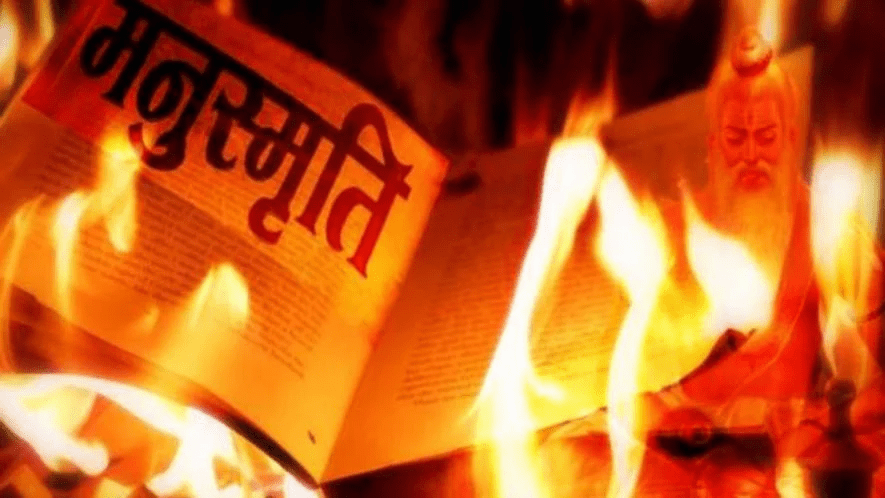
It is the firm opinion of this conference that Manusmruti, taking into consideration its verses (statements) which undermined the shudra caste, thwarted their progress, and made their social, political, and economic slavery permanent, and by comparing them with the principles enunciated in the above part of the manifesto of birthrights of the Hindus, is not worthy of becoming a religious or a sacred book. And in order to give expression to this opinion this conference is performing the cremation rites of such a religious book which has been divisive of people and destroyer of humanity…
(Resolution at Mahad Conference, December 25, 1927, Page 351, Mahad: The Making of the First Dalit Revolt’ – Anand Teltumbde, Aakar Books, 2015)
( Read the full article here :https://www.newsclick.in/when-nhrc-also-celebrated-manusmriti)
A Winning Strategy in Thrissur: Understanding Suresh Gopi’s Victory
So Suresh Gopi, persistent in his effort to ‘take Thrissur’ (his own words), has finally managed to win the Thrissur seat in the 2024 Lok Sabha elections. I have been deluged with messages and queries from friends outside expressing shock and surprise.
Continue reading A Winning Strategy in Thrissur: Understanding Suresh Gopi’s VictoryTime for a Judicial Enquiry into the Violence in Haldwani!

The sounds raised by Bulldozers demolishing ‘illegal Mosque and Madarasa’ in Haldwani, on 8 th February evening, which have resulted in few deaths and injuries to several people which includes even policepersons as well, are now over.
Peace seems to be returning and life seems to coming back to normal ..
No doubt violence of any kind cannot be justified and people’s opposition to government’s steps should always remain in the bounds of constitution…
……Question arises, whether a judicial enquiry preferably under a retired judge of the Supreme Court will be ordered so that a clear picture of the whole incident emerges and one may better comprehend, how an area which was site a peaceful mass movement merely a year back, a movement which was joined by civil society activists, writers etc, suddenly changed colour.
Jorg Haider to Geert Wilders : Far-right Normalised in Europe

Jorg Haider. Image Courtesy: Wikimedia Commons
Jorg Haider, a far-right Austrian politician who died in 2008, is largely forgotten. It is also forgotten that merely two decades ago, he was considered a very dangerous man in Europe, whose ascent to power had prompted rare European Union unity aimed to thwart his ambitions.
Twice elected as governor of the southern state of Carinthia, Haider—who opposed immigration and was critical of Islam and Muslims—once praised the Nazi regime’s “employment policies”.
His Freedom Party of Austria allied with another party, the OVP, which allowed Haider to become the country’s chancellor. But the possibility of a ‘right-wing extremist’ ruling a European Union member country prompted the other 14 members to join hands punitively against Australia, putting Haider out of the chancellorship race.
The European Union stuck by the 1997 Treaty of Amsterdam principles and emphasised that nobody would be allowed to “breach them”.
Many European countries threatened to recall envoys from Austria, and some said that Austria could be shunted out of the union if the need arose. The Belgian foreign minister at the time said, “Europe can very well do without Austria. We don’t need it.
After much water has flown down the Thames, the Rheins, the Danubes and all other rivers of Europe, the world has Geert Wilders in the Netherlands, a “political earthquake”, whom some consider more extreme and fanatical than Haider. But Wilders’ views on immigration and Islam cause no similar outrage in European capitals today.
Wilders’s party, which promised to ban mosques and compared the Quran with the infamous Mein Kampf, has won 37 seats in a 150-member Parliament. It is now the number one party in the country’s parliament.
( Read the full text here)
Surviving the Suresh Gopis and their Gender-Insults
At a media interaction on 26 October, the Malayali actor-turned-politician tried to turn his reel-life into real life. Once known mainly for his cine-avatar as the perpetually-angry, elite-justice hungry, thoroughly-misogynist ‘hero’ characters (yes, despite some better roles), Mr Gopi behaved with unbelievable condescension towards a woman journalist who asked him a question. Instead of answering her in a meaningful and civil manner, he turned into one of his obnoxious on-screen avatars. He put his hand on her shoulder and addressed her as ‘mole’ (daughter, literally, but also a condescending reference used by male lovers/husbands to refer to their loves/wives). She was clearly unhappy with the gesture, and backed away. Probably because the man has now become actually indistinguishable from the rotten, stinking masculinity he represents on-screen — knowingly or otherwise — he put his hand right back on her shoulder.
Continue reading Surviving the Suresh Gopis and their Gender-InsultsKeraleeyam, Or Narcissus Laughing
This evening I walked in the gaudily-lit main streets of Thiruvananthapuram among the crowds gaping at the show that is on, under the name of Keraleeyam or the Essence of Kerala.
Continue reading Keraleeyam, Or Narcissus LaughingRecalling Jimutavahana: Reflections on ‘Keraleeyam’
The first week of the coming month of November will witness a huge public festival in Kerala organized by the ruling power through the government called ‘Keraleeyam‘. It begins on 1 November, celebrated every year as the ‘Kerala Piravi Dinam’ or the day of Kerala’s birth, marking the amalgamation of the three Malayalam-speaking regions into a single unit, a cherished dream of many in early twentieth century Kerala. The organizers of this celebration claim that this massive show seeks to highlight Kerala’s achievements which they hint, have an unbroken continuity from the twentieth century to the present. They claim to have furthered it, and not frittered it.
Continue reading Recalling Jimutavahana: Reflections on ‘Keraleeyam’Same Sex Marriage, Welfarism and the Indian Supreme Court: Thoughts from Kerala
When I read the Supreme Court Bench’s disappointing judgment on same-sex marriage, it was a line from Lalithambika Antharjanam’s autobiography that came to my mind. Remembering her youthful struggles against the barbaric oppression of women in the traditional Malayala brahmin caste, she wrote: “Never had my heart trembled so hard than when I placed my hand on that forbidding door”. She was referring to the terrifying, dehumanising, violent structure of restrictions under which Malayala brahmin women lived. Over centuries, she says, innumerable women had battered it with their heads. Until one day it collapsed at a small push, soaked with their blood and tears.
Continue reading Same Sex Marriage, Welfarism and the Indian Supreme Court: Thoughts from KeralaThe Body Politic of Family Loyalty :’Kerala ‘ at the IAWS Conference, Thiruvananthapuram
An unlikely phantom seemed to hover over me as I hung around the Government Women’s College at Thiruvananthapuram where this year’s Annual Conference of Indian Association of Women’s Studies was on last week. ‘Unlikely’, because the conference is usually a platform in which this spectre is thoroughly examined, counted, listened upon, critiqued, reimagined etc etc — and therefore one would imagine that it would not dare to tread in in such spaces.
Continue reading The Body Politic of Family Loyalty :’Kerala ‘ at the IAWS Conference, Thiruvananthapuram KAFILA - COLLECTIVE EXPLORATIONS SINCE 2006