Category Archives: Bad ideas

Black and Blue: A Short Story by Saunvedan Aparanti

This is a guest post by SAUNVEDAN APARANTI

[Based on Gujarat Dalit flogging. It chronicles the fictionalised life of one of the victims.]

What comes to your mind when you think of India? If you’ve been seduced by films, books, pictures and anglophile Indians over the last century then you will no doubt paint a happy picture. You might romanticise the poor yet happy people, the colours, the cuisine, the attire, the mystics, the music, the dance, the cacophony, the heat and the sensory overload of this one country. The only colour missing in your picture will be any shade of black because black is a colour that India hides.Black is a colour that India detests whether it be the colour of your skin or the colour of the sewer that you’re lowered in. A bottomless pit is where you will find the true colour of India. Continue reading Black and Blue: A Short Story by Saunvedan Aparanti

Kashmir, Summer 2016: Angana Chatterji

Guest Post by Angana Chatterji 

In 2011, I had written an essay on Kashmir entitled: “The Militarized Zone,”which was published in an anthology on Kashmir (Verso Books).

What was apparent then is all too real now. I reproduce an edited fragment here today, in solidarity with Kashmiris who are being asphyxiated in their land and subjected to life under conditions akin to collective internment, and their allies across India who are being intimidated to conserve the silence. Speaking up on Kashmir is inevitably accompanied by fear for many even as silence is a betrayal of humanity. Continue reading Kashmir, Summer 2016: Angana Chatterji

Cow Vigilantism as Terror : New Socialist Initiative

Guest Post by  New Socialist Initiative

Can the Saffron Establishment ever wash its hands of the growing menace?

(For Hindi version, click the link http://nsi-delhi.blogspot.in/2016/07/blog-post_26.html)

( Courtesy : Cartoonist Satish Acharya, https://www.facebook.com/cartoonistsatishacharya/)

Cow vigilantism which has received tremendous boost since the ascendance of BJP at the centre got its first fitting reply in Gujarat recently. The way in which a self-proclaimed Gau Rakshak Dal – owing allegiance to Shiv Sena – attacked a group of Dalits in Una (11 th July 2016) who were skinning a dead cow, publicly flogged them, led them to the police station charging them with cow slaughter and even circulated a video of the whole incident on social media to spread further terror, has caused tremendous uproar. Continue reading Cow Vigilantism as Terror : New Socialist Initiative

बरवक्त यहां ‘गाय’ कानून तोड़ने का सुरक्षित तरीका

cow politics

..उना, गुजरात की इस घटना ने पूरे देश को स्तब्ध कर दिया है. पिछले दिनों इस मसले पर बात करते हुए गुजरात सरकार के चीफ सेक्रेटरी जीआर ग्लोरिया ने गोरक्षा के नाम पर चल रही गुंडागर्दी को रेखांकित किया. उन्होंने बताया कि समूचे गुजरात में दो सौ से ज्यादा ऐसे गोरक्षा समूह उभरे हैं जो ‘अपने हिंसक व्यवहार के चलते और जिस तरह वो कानून को अपने हाथ में लेते हैं, उसके चलते कानून और व्यवस्था का मसला बन गए हैं.’

ग्लोरिया ने अपने बयान में यह भी जोड़ा कि ऐसे समूहों के खिलाफ हम सख्त कार्रवाई करनेवाले हैं क्योंकि भले ही यह ‘स्वयंभू गोभक्त हों मगर वास्तव में गुंडे हैं.’ शहर से गांव तक फैले उनके नेटवर्क तथा स्थानीय पुलिस के साथ उनकी संलिप्तता आदि बातों को भी उन्होंने रेखांकित किया.

ध्यान रहे कि यह पहली दफा नहीं है जब गोरक्षा के नाम पर बढ़ रही असामाजिक गतिविधियों की तरफ संवैधानिक संस्थाओं या उनके प्रतिनिधियों की तरफ से ध्यान खींचा गया हो. अभी ज्यादा दिन नहीं हुआ जब पंजाब-हरियाणा हाईकोर्ट ने भी इसी बात को रेखांकित किया था.

अदालत का कहना था कि ‘‘गोरक्षा की दुहाई देकर बने कथित प्रहरी समूह जिनका गठन राजनीतिक आंकाओं एवं राज्य के वरिष्ठ प्रतिनिधियों की शह पर हो रहा है, जिनमें पुलिस भी शामिल है, वह कानून को अपने हाथ में लेते दिख रहे हैं.’..

( Click here for complete article : http://hindi.catchnews.com/india/protection-of-cow-violation-of-law-1469285844.html/fullview)

Where Judges Lead Societies Astray: Bobby Kunhu

This is a guest post by BOBBY KUNHU

Background

That subjective morality influences judicial interpretation of law is a given. But, this influence has to remain within the paradigm set by the law and cannot operate outside it or breaking it. So there are two moralities that effect the outcome of any case, one the morality of the law itself and second how the morality of the judge works in the interpretation of the law. It is in this context that judicial attitude towards sexuality has to be analyzed. And for this first the entrenched patriarchy of the legal profession has to be acknowledged. The best evidence for this is the representation of women at every level of the profession from the bench to senor advocates to advocates on record to the lowest echelons of the bar and judicial bureaucracy.
Indian law with respect to sexuality is in a Victorian time warp. It continues to criminalize any sexual activity that is not penile-vaginal penetration, so much so that till recently when the definition of rape was amended and the Protection of Children from Sexual Offences Act was enacted this was the paradigm of penalizing non-consensual sexual predation. Add to it the ingredients of individual judges’ patriarchy and accumulated religious and social conditioning.

Continue reading Where Judges Lead Societies Astray: Bobby Kunhu

URGENT ACTION / APPEAL regarding deteriorating political and humanitarian situation in Jammu and Kashmir

On behalf of  JAMMU KASHMIR COALITION OF CIVIL SOCIETY [JKCCS]

To:

  1. Zeid Ra’ad Al Hussein, United Nations High Commissioner for Human Rights
  2. Christof Heyns, Special Rapporteur on extrajudicial, summary or arbitrary executions
  3. Juan Ernesto Mendez, Special Rapporteur on torture and other cruel, inhuman or degrading treatment or punishment
  4. Maina Kiai, Special Rapporteur on the rights to freedom of peaceful assembly and of association
  5. David Kaye, Special Rapporteur on the promotion and protection of the right to freedom of opinion and expression


From:

Jammu Kashmir Coalition of Civil Society [JKCCS]

Srinagar, Indian-administered Kashmir

July 16, 2016 

Re.: URGENT ACTION / APPEAL regarding deteriorating political and humanitarian situation in Jammu and Kashmir

 Excellencies,

  1. With grave concern and urgency we write to you today to bring to your immediate attention the ongoing State violence and repression against civilians in Jammu and Kashmir including repeated attacks on medical services, particularly hospital ambulances, carrying the dead and critically injured civilians. Jammu and Kashmir once again faces a humanitarian crisis that requires urgent international attention and intervention.
  2. With the presence of an estimated 7, 00,000 armed forces, Jammu and Kashmir is today the most militarized zone in the world and its civilians have faced widespread and systematic attacks at the hands of Indian State forces over the last 26 years. Thus far, the region has seen the commission of human rights violations, including war crimes that have resulted in70,000+ killings, 8000+ enforced disappearances and innumerous cases of torture and sexual violence. The armed forces, through special legislation but more importantly due to direct political support of the Indian state, enjoy total impunity and to date not a single armed forces personnel has been prosecuted for criminal actions in civilian courts of law. Continue reading URGENT ACTION / APPEAL regarding deteriorating political and humanitarian situation in Jammu and Kashmir

[Audio] Funky Protest Music: Delhi Sultanate on Music, Politics, and Cultural Appropriation

Earlier this month I caught up with Delhi Sultanate, a member of the SkaVengers – a Delhi based reggae ensemble – around the launch of their new album XX or Double Cross to talk about their music, the unlikely journey of Udham Singh, a Indian revolutionary best known for assassinating General Dyer, and “Why Reggae?”.

Apart from the interview below, we’ve also got links to some of their music – listen, learn and enzoy.

 Here’s the video for Frank Brazil


Police in Kashmir Raid Newspaper Bureaus, Detain Employees, Seize Copies: Prabodh Jamwal

Guest Post by Prabodh Jamwal

Two of Kashmir’s leading newspapers, Kashmir Times and Rising Kashmir said that Jammu and Kashmir police raided their office on Saturday night, seized their printed copies and arrested their employees – a clear act of choking and gagging media in crisis-hit Kashmir valley. Copies of other newspapers, including Kashmir Reader and Kashmir Observer were also seized and their circulation prevented.

Continue reading Police in Kashmir Raid Newspaper Bureaus, Detain Employees, Seize Copies: Prabodh Jamwal

Bangalore Police Revoke Permission for Protest on Kashmir: Greeshma Aruna Rai

Guest Post by Greeshma Aruna Rai, with Women against Sexual Violence and State Repression (WSS), Peoples’ Union for Civil Liberties (PUCL) & Karnataka for Kashmir Forum.
Police has revoked the permission which they had given yesterday to hold a democratic protest in solidarity with Kashmiris in Bangalore by concerned citizens and activists. This is another way in which the State shows its true colours to all Indian citizens who are against State repression and State colonialism in Kashmir.
Permission for today’s protest condemning atrocities on the people of Kashmir has been revoked by the Karnataka State Police. They have threatened us with legal action if we proceed.

As organisers we have been bombarded by the police, demanding that we withdraw this demonstration.

As we publish this message, the 11th day of curfew continues and valley remains awash with the blood of Kashmiris.
Today’s protest is postponed. We, however, refuse to be stifled by the very same state that is ravaging Kashmir. We have resolved to move against the actions of the Police. We’ll be releasing a Press Note shortly while discussing other options to challenge this.

[ Shortly after this post was uploaded, the organizers of the protest held a press conference where they released the following statement.]

Continue reading Bangalore Police Revoke Permission for Protest on Kashmir: Greeshma Aruna Rai

Statement On the Unfolding Situation in Kashmir : NSI Delhi Chapter

Guest Post by New Socialist Initiative, Delhi Chapter

The valley of Kashmir is on the boil again. Forsaking the so-called normal routines of their lives, people are on the streets. Not just young men, but even children and women are out, challenging the military might of the Indian state. Any fear of the police and army appears to have been discarded. Police stations and even CRPF camps have been attacked. A popular upsurge, it is energised by mass fury. Forty people have lost their lives in one week at the hands of the Indian security establishment. Hundreds of others have suffered serious eye and other injuries from presumedly ‘non-lethal’ pellets used by the police. While people are out confronting the police, para-military and army, the other organs of the Indian state in Kashmir, the elected government and its bureaucracy, elected members of the legislature, panchayats, etc. are in a rathole, fearing public appearance. It is just the people of Kashmir valley versus the institutions of organised violence of the Indian state.

While the immediate cause of popular anger is the killing of Hizbul Mujahideen militant Burhan Wani, reasons for this anger go much deeper and have a longer history. The stifling and repression of the Kashmiri people’s right to self-determination stands at the root of this conflict. This repression has taken on extreme violent forms. For twenty five years now, the Kashmir valley has been among the most militarised places in the world. More than half a million troops of Indian army and para-military forces have been stationed in the state and its border with Pakistan. Rashtriya Rifles and CRPF camps dot the land scape. Highway checkpoints and random searches are part of everyday life. Thousands of men have disappeared, been picked up by security forces, thrown in the black hole of interrogation camps, often ending up in unmarked graves. The hated AFSPA gives Indian security forces legal cover to assault basic rights of Kashmiris to live a life of elementary dignity. If an average valley resident is alienated from the normal practices of the Indian state such as elections and its administrative initiatives, s/he harbours deep resentment against the presence of Indian security forces in their homeland. This resentment has erupted in mass protests again and again.

Continue reading Statement On the Unfolding Situation in Kashmir : NSI Delhi Chapter

Citizens’ Protest in Delhi Against Killings of Kashmiris by the Indian State

Several hundred people from all walks of life (Civil Rights Activists, Labour Activists,  Peace Activists, Feminists, Queer Activists, Advocates, Students, Workers, Artists, Writers, Academics, Filmmakers,Independent Left Activists, and unaffiliated individuals across generations, from Jammu & Kashmir, from Delhi, and from other parts of India) gathered this afternoon (July 13, 2016) for a silent protest march and meeting at Jantar Mantar, to protest against the last three days of brutal assault by police, paramilitaries and armed forces in the Kashmir valley that have left 35 dead, several blinded (especially due to the indiscrimnate use of pellet guns) and scores of people critically injured over the last three days.

The protestors at Jantar Mantar wore black bands, and carried signs condemning the state’s violence. The protestors carried signs with the names of each of the thirty six individuals who have been identified as having died over the last three days. Each sign identified a deceased person by name, the town or village they were from, and asserted that they “will not be forgotten“. In this way, this corner of India’s capital bore witness to each person, man, woman or child killed by the Indian state since troops began firing into protests that began to mourn the extra-judicial assassination of Burhan Wani three days ago.

This slideshow requires JavaScript.

Continue reading Citizens’ Protest in Delhi Against Killings of Kashmiris by the Indian State

The Killings in Kashmir: Kavita Krishnan

Guest Post by KAVITA KRISHNAN

An appeal to the conscience of every Indian citizen – to tune down the shrill media noise for a bit, take a step back from the easy, packaged ‘discourse’ being dished out, and ask try and ask ourselves some uncomfortable but necessary questions. 

I am being asked by various persons in the media to comment on my apparently ‘controversial’ and ‘shocking’ claim that Burhan Wani’s killing was extra-judicial’ and must be probed. Let me begin with a few remarks about this issue.

For most Kashmiris, it may not matter all that much whether or not Burhan Wani was killed in a ‘fake’ encounter or a ‘genuine’ one. What matters is that the Indian State killed him – just as it has killed and is killing so many other Kashmiri youngsters. Their grief, their rage, does not depend on the authenticity or otherwise of the encounter. They have no expectations of due process or of justice from the Indian State. It it civil liberties activists who – in what sometimes feels like an exhausting, futile exercise – demand that due process be followed, that the mandates of the Indian Constitution be respected, that the armed forces in conflict areas be held accountable.

Continue reading The Killings in Kashmir: Kavita Krishnan

Kashmir Burns, Again

A hundred and twelve lives, most of them young, some very young, were lost in Kashmir when the army, paramilitaries and police forces opened fire on several occasions from June to September in 2010. That was only six years ago. The latest reports indicate that around twenty three lives have already been lost in the last two days alone, in the aftermath of state troopers, soldiers and paramilitaries firing at funeral protests, after Burhan Wani, a twenty two year old insurgent, who had acquired the aura of a folk hero in Kashmir, was killed in an ‘encounter’, along with two of his associates, on Friday morning in a village in Kokernag.

Several more people have sustained serious injuries. The body count is likely to rise. Curfews have returned, phone and internet links are suspended, but nothing seems to keep people from spilling out onto the streets, and unlike previous instances, the communications ban seems to be unworkable. No one can pretend that Kashmir is not in crisis, again, today.

The people in power, at the state and the centre, were different in 2010. Omar Abdullah, then chief minister of Jammu and Kashmir, was offering mealy mouthed rationalizations for killing kids then, while Mehbooba Mufti, was weeping crocodile tears. It is the other way round right now. Omar is being ‘sensitive’, Mehbooba, who the roll of the dice has placed in the position of chief minister now, is ’sullenly’ presiding over a badly timed by-election victory. Prime Minister Manmohan Singh was silent then, Prime Minister Narendra Modi is playing percussion instruments in Africa now. If Nero played the harp while Rome burnt, Modi beats drums while Kashmir goes up in flames.

Continue reading Kashmir Burns, Again

Kashmir Under a State of Emergency: JKCCS

Guest Post by JKCCS : Jammu & Kashmir Coalition for Civil Society

Since the extra-judicial execution of Commander Burhan Wani and two other members of Hizbul Mujahideen, Indian armed forces and Jammu and Kashmir Police have used excessive force to thwart the mourners from protesting and participating in the funeral processions of the slain militants. So far, around 17 civilians have been killed in Islamabad, Kulgam, Shopian and Pulwama districts, while as more than 350 people have been injured from across all districts of the Kashmir valley. There are reports that CRPF and Police have been involved in the destruction of movable and immovable properties. Curfew has been strictly imposed in all districts of Kashmir, but people are defying the curfew at various places.

It is shocking and painful that Indian armed forces have yet again unleashed terror on the mourners and protesters, resulting in massive civilian casualties. The police and armed forces appear to have free hand to kill, injure, torture and destroy property. The government of India and Jammu and Kashmir lack the will to institute a crowd control policy, which can ensure no or minimized civilian casualties. On the one hand armed forces are preventing the injured to be ferried to hospitals, at the same time senior police officials without any credible investigations have begun to accuse the dead and the injured for their own bloodshed. Additional Director General of Police, S.M. Sahai, yesterday in the press conference accused the protestors of looting the weaponry from the Police Station Damhal Hanjipora and then for using it against the police men. Government should reveal the names of those police personnel who were injured by the firearm used by the civilians and where are they being treated; otherwise Mr. Sahai claim is part of the regular government psy-ops. Continue reading Kashmir Under a State of Emergency: JKCCS

[Kafila Audio] Dilli Tha Jiska Naam: Recollections of a Forgotten City

Last week I caught up with Shubhum Mishra, a cartographer/geographer/urban planner, in Sundar Nursery – a Mughal garden turned  colonial green house spanning 70 acres in the heart of Delhi – that shall should be open to the public sometime next year.

Shubhum has just transliterated Intizar Husain’s famous book – Dilli Tha Jiska Naam – from the original Urdu/farsi script to devnagari, in the hope of making this incredible resource more accessible to north Indian readers. In this conversation he reads excerpts from the book and I asked him why modern Indian cities are so spectacularly ugly.

Listen in for a fascinating description of Chandini Chowk and “Old Delhi” – back from when “Old Delhi” was the only Delhi around.  Shubhum will respond to comments on the site. His book is now available in most book stores around the city and you can buy it here


Moral Police-Police!


The Kerala police has once more revealed how utterly unreconstructed it is since colonial times, in their brutal attack on transgender people in the city of Kochi. Stuck in 19th century Victorian morality on the one hand, and in the unabashed sense of power that only colonial authority can bequeath, these policemen thought it perfectly alright to use violence to correct what they perceive as a ‘moral problem’, sex work and that too, by transgendered persons. Continue reading Moral Police-Police!

पवित्र किताब की छाया में आकार लेता जनतंत्र

भारतीय लोकतंत्र: दशा और दिशा को लेकर चन्द बातें

Never Be Deceived That the Rich Will Permit You To Vote Away Their Wealth
– Lucy Parsons


..लोग सोच रहे हैं कि आखिर जनतंत्र हर ओर दक्षिणपंथी हवाओें के लिए रास्ता सुगम कैसे कर रहा है, अगर वह ‘युनाईटेड किंगडम इंडिपेण्डस पार्टी’ के नाम से ब्रिटन में मौजूद है तो मरीन ला पेन के तौर पर फ्रांस में अस्तित्व में है तो नोर्बर्ट होफेर और फ्रीडम पार्टी के नाम से आस्टिया में सक्रिय है तो अमेरिका में उसे डोनाल्ड ट्रम्प के नाम से पहचाना जा रहा है। वैसे इन दिनों सबसे अधिक सूर्खियों में ब्रिटेन है, जिसने पश्चिमी जनतंत्र के संकट को उजागर किया है।

ब्रिटेन को यूरोपीयन यूनियन का हिस्सा बने रहना चाहिए या नहीं इसे लेकर जो जनमतसंग्रह हुआ, जिसमें सभी यही कयास लगा रहे थे कि ब्रिटेन को ‘अलग हो जाना चाहिए’ ऐसा माननेवालों को शिकस्त मिलेगी, मगर उसमें उलटफेर दिखाई दिया है; वही लोग जीत गए हैं। और इस बात को नहीं भुला जा सकता कि जो कुछ हो हुआ है उसमें प्रक्रिया के तौर पर गैरजनतांत्रिक कुछ भी नहीं है। दक्षिणपंथ के झण्डाबरदारों ने ऐसे चुनावों में लोगों को अपने पक्ष में वोट डालने के लिए प्रेरित किया है, जो पारदर्शी थे, जिनके संचालन पर कोई सवाल नहीं उठे हैं।

( For full text of the article click here : https://sabrangindia.in/article/pvitra-kitab-ki-chaaya-mein-aakar-leta-hai-jantanta)


सी पी एम के भीतर जनतांत्रिक विरोध के अधिकार का प्रश्न – जगमती सांगवान के बहाने

सी पी एम या भारतीय कम्युनिस्ट पार्टी (मार्क्सवादी) पिछले दिनों अपनी एक सदस्य की वजह से खबर में रही. अनुशासनहीनता के कारण जगमती सांगवान को पार्टी से निकालने का निर्णय किया गया,ऐसी सूचना उसके वक्तव्य में दी गई है. जगमती पार्टी की केन्द्रीय समिति की सदस्य थीं.

जगमती सांगवान को पार्टी से निकाला बाद में गया, केन्द्रीय समिति की बैठक के दौरान ही पहले वे बाहर निकल आई थीं और प्रेसवालों के सामने पार्टी छोड़ने का ऐलान कर दिया था.लेकिन कम्युनिस्ट पार्टी में ही नहीं,किसी भी पार्टी में शायद ही किसी सदस्य को खुद पार्टी से अलग होने का गौरव लेने दिया जाता रहा हो! यह फैसला पार्टी ही कर सकती है कि सदस्य का रिश्ता पार्टी से कैसा और कितना लंबा होगा.इसलिए कम से कम इस आधार पर सी पी एम की आलोचना करने के पहले पार्टियों के तंत्र की आलोचना करने की आवश्यकता होगी. Continue reading सी पी एम के भीतर जनतांत्रिक विरोध के अधिकार का प्रश्न – जगमती सांगवान के बहाने

Outsmarting the Informal City

In an online documentary archive called Delhi Digest, Saleem Shakeel, founder of an e-waste recycling company in the city, speaks to the camera about e-waste. The setting is familiar. Mr Shakeel sits on the single chair in what looks like a small, partially built room of exposed red brick. There are piles of objects which, like the room itself, appear used or discarded. If you conjured up an image of “informal” and “waste,” this is pretty much what you think of. Ashish Nandy would perhaps describe an outsider’s view of it it as he once did for the way we see the “slum”: all that stubbornly refuses to bow out of modernity’s way. It’s hard to imagine technology here, let along big data or smart solutions.

Yet as Mr Shakeel speaks, it is precisely technology and data that flood your mind. He describes how e-waste circulates through circuits and geographies in the city that we rarely see. Sophisticated flows of work and labour are ready when the computer comes, each finely skilled and discerning. Different workers take the different parts – CPU goes one way, the keyboard another. They break further: mother boards, drives, power supply, wires, the iron, the gold chip. Every last bit is used, and its use is determined by the current market’s daily prices. No two days, says Mr Shakeel, are the same; you have to know, and you have to be ready to adjust. Information – that less glamourous cousin of “data” – flows quickly, endlessly, in many modes and forms. The circuits are opaque, but they work.

Continue reading Outsmarting the Informal City

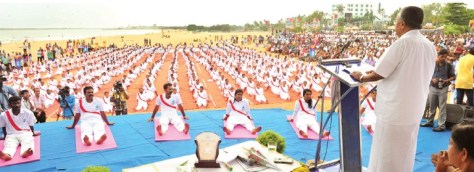
Saffronization, Yoga and the Kerala Left: CP Geevan

Guest post by CP GEEVAN

There are many ways in which ‘saffronization’ is being carried out at various levels. It takes the form of virulent battles at one extreme and persistent soft-campaigns at the other. It really does not require deep skills in socio-political analysis to see this entire spectrum of insidious divisive politics – all of that are in the clearly visible band. Surprisingly, the CPI(M) seems to have taken the attitude of a friendly match when it comes to certain variants of soft-saffronization, pretending not to see what is going on behind often innocuous-sounding things like Yoga – the latest weapon being deployed in the saffronization campaign. Instead of questioning the premises of this misplaced ‘national celebration’ and its belligerent imposition that defines the Modi government move, the party has chosen to play a friendly match by wholeheartedly joining the soft-saffronization race.

Pinarayi Vijayan at CPI-MK's Yoga event
Pinarayi Vijayan at CPI-MK’s Yoga event

The CPI(M, Kerala syndicate) has, in many ways, outperformed the RSS in Kerala so much so that the hyper-active media in Kerala had very little to report on how BJP and RSS celebrated yoga day in God’s Own Country. It seemed the Sanghis were pleasantly surprised at the saffronization of the CPI(M) itself! May be, the CPI(M) is gloating over how it out-smarted the Sanghis at their own game but that is not how it works in the world of everyday politics. For their part, the Sanghis could find nothing to object to in the way the new government in Kerala celebrated yoga. It seemed the Gods came to the CPI(M) party headquarters to pay obeisance to the newly enthroned in their glorious new clothes, new language, new style, new gait, new approach, and, of course, some inklings of a new, disquieting politics.

Continue reading Saffronization, Yoga and the Kerala Left: CP Geevan

Love in the Time of Public Despair: Remembering Kamala Surayya

31 May passed like any day in present-day Kerala – filled with the cacophony of mediocrities and expressions of greed, envy, and hate which have become the new normal. No wonder, then, that most people did not remember that this was the poet Kamala Das/Madhavikkutty/ Kamala Surayya’s death anniversary. I cannot help recollecting that I had predicted that this would happen: that people here would celebrate her death, display sickening sentimentality, and then quickly forget. In life and in death, Surayya never received the critical attention that she deserved as a thinker, nor did those interested in progressive left politics take her forays into politics seriously. In these times of despair, one must, however, turn to her …

Read more on:

http://www.thehindubusinessline.com/blink/know/seeking-rhyme-in-reason/article8737506.ece