Category Archives: Bad ideas

A memorable evening with Vidya Charan Shukla

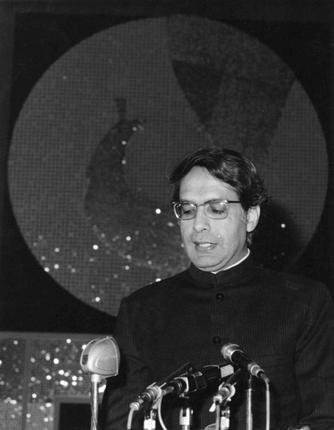
In this January 3, 1977 photo, V.C. Shukla, Union Minister of Information and Broadcasting inaugurates the sixth International Film Festival of India in New Delhi. The Justice Shah Commission of Inquiry which went into the Emergency execesses, had mentioned Shukla's name in its report. Photo: The Hindu Archives / TheHindu.com
In this January 3, 1977 photo, V.C. Shukla, Union Minister of Information and Broadcasting inaugurates the sixth International Film Festival of India in New Delhi. The Justice Shah Commission of Inquiry which went into the Emergency execesses, had mentioned Shukla’s name in its report. Photo: The Hindu Archives

By SOHAIL HASHMI: Though the East and the West have great differences in issues cultural, in one matter they are like twin brothers. Both insist we should not speak ill of the dead. This does not apply to Changez Khan, Hitler and Mussolini. Some would add a few more to the list, but there are chances of violent disagreements on some of those names.

There have been honourable deviations from this haloed creed and if my memory serves me right,  at least one of them has been attributed to The Bard, who made Mark Antony declare at the funeral of Caesar, “Friends Romans and Countrymen, we have gathered here to bury Caesar and not to praise him,” or words to that effect.

These were some of the confused musings that floated to the top of the mind when I heard the news of V.C. Shukla’s passing away. Does the fact that he is dead or the dastardly fashion in which death stalked him and ultimately consumed him, give him an escape from his deeds?

It is a commentary on our justice delivery system that V.C. Shukla, one of those who belonged to the coterie that ran the Emergency establishment for Mrs Gandhi, did not spend a long time behind bars for his acts of commission as Minister of Information and Broadcasting. Some of his achievements as Minister of Information included snapping power supply to newspapers critical of the Emergency, introducing Draconian censorship, banning magazines and newspapers, and sealing printing presses that dared to publish anything critical of the infamous Mrs G or her Emergency regime. Continue reading A memorable evening with Vidya Charan Shukla

The Fatherly Sphinx and the Riddle of the Researcher: Anirban Kapil Baishya and Darshana Sreedhar

This is a guest post by ANIRBAN KAPIL BAISHYA and DARSHANA SREEDHAR

Ratan Tata Library, Delhi School of Economics…3rd June, 2013. The time was 11:30 AM, the weather outside, a little more than merely hot. The head librarian sat in his armchair in an air-conditioned room, a television screen playing back CCTV footage from each and every corner of the library. Continue reading The Fatherly Sphinx and the Riddle of the Researcher: Anirban Kapil Baishya and Darshana Sreedhar

Welcome the Two-Year Under Undergraduate Programme at Delhi University

Harish Kumar Trivedi’s article on the proposed four-year undergraduate programme at Delhi University, “Is Delhi University Dying?” (TOI May 29th 2013), for all its rhetorical flourishes, makes in fact a single point – the need for change. He is not alone in this belief; who could possibly be against reform? Who would want to stick their necks out in these breathless times and say, “Stop, why so fast?”

Many, many right-thinking people, actually, as the absolute barrage of criticism against the FYUP has shown. From the ordinary undergraduate teacher to academic and executive councils, committees of courses, and internationally renowned scholars, writers and academics. Now, there can be two responses to the range and variety of criticism that has been expressed. One would be to engage with it, based on the reasonable assumption that so many people involved with a profession cannot be entirely wrong. The other response is of the kind Professor Trivedi makes – to make an a priori argument for “change”. I say a priori because in fact there is only one, short paragraph in the article that discusses the possible advantages of the new system. One, that the new system ends the distinction between pass and honours courses. Two, that even if students exit after two years, they will still earn a “university qualification”. Three, it allows college teachers to frame a course in the fourth year.

Continue reading Welcome the Two-Year Under Undergraduate Programme at Delhi University

White Women in the Indian Imagination: Alexandra Delaney

This is a guest post by ALEXANDRA DELANEY: 

“Yeah, Indian guys think white girls are easy”, a British-born Indian remarked nonchalantly to me this week. Normally I’d be shocked by such gross racial stereotyping (of Indians) but in this case I’m inclined to agree. Not because Caucasian women by their very skin colour or cultural preferences are any more promiscuous than their South Asian sisters, but because of their sustained portrayal as loose and morally deficient. The image of the sexually liberated and ‘easy’ white woman runs deep in the Indian imagination, a perception which is drip-fed by the country’s all-pervading mainstream media.

The brutal rape and murder of an Indian student in New Delhi last December followed by numerous sexual attacks on foreign women has sparked international outrage. This year alone, a Chinese woman was date-raped in New Delhi, a Korean woman was raped after being drugged in Bhopal, a Swiss tourist was gang-raped by five men in Madhya Pradesh while holidaying with her husband, and a British woman broke both her legs after jumping off a hotel balcony to avoid an alleged sexual attack by the hotel’s manager. These incidents have led to a shift in how tourists perceive India, resulting in a 25% fall in foreigners travelling to the country and a 35% reduction in women travellers, reports New Delhi-based Associated Chambers of Commerce and Industry. Continue reading White Women in the Indian Imagination: Alexandra Delaney

Promises and Perils of FYUP: An Appeal to Students and Citizens: Sunny Kumar

This is a guest post by SUNNY KUMAR At the current moment, Delhi University is caught in a tremendous crisis. On the one hand, the DU administration is hurriedly forcing through the Four Year Undergraduate Programme (FYUP). On the other hand, students, teachers, intellectuals and all those concerned with education are opposing it. The DU administration has declared that all students taking admission in DU will enter a four year honours degree. Within this FYUP scheme, if students wish they can leave at the end of two years with a Diploma or at the end of three with a Bachelor degree (without honours). It is only at the end of four years that they can leave with a Bachelor (Hons) degree. Teachers and academics have raised many valid objections about the way in which this tectonic shift is being imposed on DU. Here, we will not belabour many of the arguments that have been made effectively elsewhere. Instead, we will mainly address the Vice Chancellor’s two central claims – of greater employability and flexibility – being made in defence of the FYUP.

To understand the new scheme better, let us look at what will be taught under FYUP.

Will the FYUP, with the above course content and its multiple exit options truly make students more employable? Will it help them get better jobs or give them extra advantage in choosing future academic options? Let us look at some of the facts: Continue reading Promises and Perils of FYUP: An Appeal to Students and Citizens: Sunny Kumar

Breasts, cancers and the ethics of reptiles: Ramray Bhat

This is a guest post by RAMRAY BHAT  Two weeks ago, tucked in between lurid details of spot-fixing during IPL matches, and an inordinate attention to how Sanjay Dutt spent his first few moments in jail, was an important bit of news about a high profile American movie actor having undergone preventive surgery in order to escape a future encounter with breast cancer. The source of the information was an op-ed written by the actor in The New York Times.

The mainstream Indian media not quite knowing how to report this kind of information first presented it in the blandest fashion and then hurried to the closest cancer hospital to interview its surgeons. The social media took the expected route of initially spouting knee-jerk reactions some of which were misogynous and offensive. The response later evolved into a division between two camps. One hailed the actor for being courageous. The other criticized her for a variety of reasons such as her choice of undergoing surgery without being afflicted with the disease, and her soft advocacy for a detection procedure that is out of the economic reach of a majority of women in her own country, let alone those from the third world. Ruth Fowler’s article from the left-leaning Counterpunch adopted a cavalier tenor and chided the actor for her op-ed with what seemed like nitpicking arguments.

Continue reading Breasts, cancers and the ethics of reptiles: Ramray Bhat

Of Gandhi and a Godfatherly Copyright Offer- Part 2: Shamnad Basheer and Lawrence Liang

This is the second part of an earlier post in which we refuted the claims made by the International Federation of Reproduction Rights Organisation about the ongoing copyright case filed against Delhi University and Rameshwari Photocopy Services. A group of students (ASEAK) and academics (SPEAK) have separately impleded themselves in the suit.

Gandhi, Karan Johar and Cafes?

The FRRO recycles the insidious idea that the cost to students of paying the license fee for course packs would be the equivalent of an ‘evening in a student café’. This naïve assumption could be the result of watching too many Karan Johar films in which all Indian campuses look like Riverdale and all students wear Gucci and Nike. Click here for a contrary perspective

For sure, there are a number of rich Indian students who probably spend way more on cafes than they do on books (forgive them father for they know not what they do). But when we think of articulating copyright norms, what kind of student should serve up as our policy addressee? The urban upper middle class creamy layer student who constitutes but a miniscule proportion of the totality or ones from lower economic strata that constitute the vast majority?

Continue reading Of Gandhi and a Godfatherly Copyright Offer- Part 2: Shamnad Basheer and Lawrence Liang

PUCL statement condemning the Maoist massacre in Darbha Valley

This statement was put outby the PEOPLE’S UNION FOR CIVIL LIBERTIES on 26 May, and the one below it on 25 May by PUCL’s Chhattisgarh unit

PUCL Condemns Killings of Congress Party leaders, their PSOs and Ordinary Villagers by Maoists in Dharba Ghati of Sukma District, Chhattisgarh

The PUCL strongly condemns the ambush of a Congress party election cavalcade by the dalam of the CPI(Maoist) party at Dharba Ghati area in Sukma district of Chhattisgarh on Saturday, 25th May, 2013, resulting in the death of 28 people including Congress party leaders, their personal security officers and ordinary villagers of the area. PUCL denounces as totally unacceptable, the abduction, kidnapping and subsequent killing in cold blood of the Congress party President of Chhattisgarh, NK Patel, and his son Dinesh. The Maoists also killed Mahendra Karma, the founder of the dreaded Salwa Judum, and his security guards. Continue reading PUCL statement condemning the Maoist massacre in Darbha Valley

Statement condemning the Maoist politics of murder Chhattisgarh

We, the undersigned, strongly condemn the horrific massacre of leaders and workers of the Congress Party and the security forces accompanying them, carried out by the CPI(Maoist) in Chhattisgarh on Saturday. We also wish to express our deepest condolences to the families of all those killed in the convoy of Congressmen returning from an election rally at Sukma in Bastar dtrict.

The killing of senior state Congress leaders and their cadre is particularly barbaric and reprehensible as they had, in the course of the Maoist ambush, become captives or had surrendered voluntarily. This is tantamount to cold-blooded murder of prisoners in custody, an act that goes against all norms even in a state of civil or international war. The targeting of a political party in this fashion by the Maoists is also highly disturbing. Continue reading Statement condemning the Maoist politics of murder Chhattisgarh

Of Gandhi and a Godfatherly Copyright Offer: Shamnad Basheer and Lawrence Liang

In an op-ed in the Hindu, we highlighted an egregious copyright law-suit slapped against Delhi University and its photocopier by leading foreign publishers. The IFFRO (International Federation of Reproduction Rights Organisation) and its partner organisations which collect moneys on behalf of publishers issued a response to this piece, expectantly touting the virtues of acquiring a copyright license from them.

Unfortunately, owing to space constraints, we could only offer a pithy rebuttal to their response in the Hindu.

Below is a more elaborate version of our rebuttal.

(For those who came in late, here is a short jingly version of what this law suit is really about)

For those interested in tracking the case, see updates on SpicyIP

An Irrefusable Offer:

In their response, the IFRRO and its counterparts once again offer the option of a tantalizingly cheap copyright license, repeatedly stressing the “reasonableness” of their offer.

Continue reading Of Gandhi and a Godfatherly Copyright Offer: Shamnad Basheer and Lawrence Liang

Hindutva in Karnataka: Experiments in Terror

Image

(Note: This article is a chapter of the book ‘Five Years of Saffron Rule in Karnataka’ Edited by Ambrose Pinto S.J., Manak Publications, Delhi, P. 338, 2013)

..Here it is enough to point out that Hindutva is not identical with what is vaguely indicated by the term Hinduism. By an “ism” it is generally meant a theory or a code more or less based on spiritual or religious system. But when we attempt to investigate into the essential significance of Hindutva, we do not primarily and certainly not mainly concern ourselves with any particular theocratic or religious dogma or creed..
 
 (V.D. Savarkar, Hindutva, Delhi: Bharti Sahitya Sadan, sixth edition, 1989, pp3f) Continue reading Hindutva in Karnataka: Experiments in Terror

How to respond to a legal notice from The Times of India

Shamnad Basheer shows the way:

We strongly object to the vile language and the highly aggressive tone used in the notice. We can respond in kind, but we choose to be a bit more civil with you.

You choose to issue this highly malevolent letter, hoping to intimidate us into a meek apology. Unfortunately, while the meek may inherit the earth, they are bound to be shown no favour by corporate powerhouses such as your client.

So, let’s cut to the chase and explore your alleged grievances articulated rather flatulently in over seven pages of a highly intemperate legal notice.

Read the full story at Sans Serif.

Shamnad Basheer for PM!


Goodbye Asgharsaab : Remembering Asghar Ali Engineer

Image

Mera azm itna buland hai ki paraye sholon ka darr nahin

Mujhe khauf aatish e gul se hai kaheen yeh chaman ko jala na de.

(“My intentions are so high that I am not afraid of the unknown blaze

 I am afraid of the fire of the flowers lest it burn the garden  – Shakil Badauni )

 I will never forget the sips of tea I shared with Asgharsaab in a tea shop at Wardha more than a year ago. I had hardly any premonition at the time that this would be my last meeting with him. Continue reading Goodbye Asgharsaab : Remembering Asghar Ali Engineer

In Search of a Liberal Education

The article below represents the full, expanded text of a piece that just appeared in EPW here. I am posting the full version here in its entirety both because I hope it will begin a distinct discussion that allows us to reflect on what can be done in the current moment within DU as well as to give voice to the expanded argument.

Some texts are wonderful to teach with. In one, Ravi Kanbur writes about the “nature of disagreement” about poverty reduction. He asks: “how can people with seemingly the same ends disagree so much about means? How can seemingly the same objective reality be interpreted so differently?”[1] As a teacher, his questions allow one to teach skills – reason, logic, argument and critique— as well as demonstrate an ethical imperative that should guide not just our intellectual lives but our everyday lives as citizens: how do we understand and engage with a dissenting perspective?

Kanbur’s question is an excellent example of the kind of critical and analytical skills a liberal education offers. Today, Delhi University [DU] is seeking to create a core curriculum – a Foundation of eleven required courses – that repeatedly refers to this idea of a liberal, core education as part of a new Four Year Undergraduate Programme [FYUP]. These eleven courses are required for all students in DU regardless of their degree subject. Further, should they take a two-year diploma option, they would represent the lion’s share of what some students will learn in their entire time at university. These courses have a clear aim: “multi-disciplinary” education that will “strengthen the educational base of the students in relation to the grand challenges facing India” and ensure that students “acquire both key knowledge and ability.” [2] Core to this restructuring effort is an emphasis on “skills and employability.” In a recent interview, Vice-Chancellor Dinesh Singh lays his cards out on the table: “Absolutely. That’s one of the games here. To get our students to be employable.” This is particularly important, he goes onto argue, for the students taking the two-year diploma: “In two years’ time, we also give them some knowledge-based skills, at least their employability goes up.”[3]

Continue reading In Search of a Liberal Education

Sign Petition on the Custodial Killing of Khalid Mujahid

Image
Order CBI enquiry into the Custodial Killing of Khalid Mujahid
 
: Arrest the guilty Police Officers without delay

Khalid Mujahid, proclaimed by the police as one of the executors of the serial blasts that rocked UP courts in November 2007, died in police custody yesterday (18th May 2013). This young man, with no past medical record, the police claim died of sudden medical complications, on his way back to Lucknow prison, having made his appearance in court in Barabanki in connection with the serial blasts case. In 2011, a report, Torture in India, had documented how custodial killings were rampantly passed off as sudden medical complications and natural deaths (ACHR, p. 8). Continue reading Sign Petition on the Custodial Killing of Khalid Mujahid

Kerala apologizes for Sreesanth: Sajan Venniyoor

This is a Guest post by our sports correspondent, SAJAN VENNIYOOR:  In an unprecedented gesture, the state of Kerala has apologized for what it calls “the darkest chapter in our history”, Shanthakumaran Sreesanth.

downloadIn the face of overwhelming criticism that it did nothing to prevent Sreesanth, the state’s Chief Minister and Governor, in a joint statement, apologized formally for the crime against those bits of humanity that watch cricket, and admitted collective responsibility for Sreesanth. “It is time for us to acknowledge that Kerala civil servants, sports administrators and other Malayalis took part in Sreesanth.” Continue reading Kerala apologizes for Sreesanth: Sajan Venniyoor

Citizen-Students and the University: Sanjay Kumar

 Image

The proposed 4-year undergraduate degree programme of the Delhi University is being pushed through in undue haste without adequate debate and public discussion. The special emphasis on Foundation and Integrating Mind, Body and Heart courses, controversial components of the 4-year scheme, is indicative of an extra-academic zeal. The pedagogical thinking behind these courses is authoritarian and against the spirit of liberal citizenship.

Typically students under the 10+2+3 system of education in the country enter the university at the age of seventeen or eighteen. Time spent in the university helps students transition to adulthood. While there, they attain the legal age that confers citizenship rights and duties on them. The way they are treated in classes and in college and university offices; the rules of conduct they are expected to follow; and the extent and form of recognition they receive as adult citizens from the university– all have a lasting influence on how they imagine their citizenship. University life also involves informal and formal associations with other students and with teachers and staff. The form, purpose and operative principles of these associations shape the affective and cognitive behaviour of students, which partially determine the kind of public sphere they build later in life. This note discusses the recent developments in Delhi University and their implications for students from the perspective of citizenship. Continue reading Citizen-Students and the University: Sanjay Kumar

Of Education and Democracy in India: Preeti Chauhan

This is a guest post by Preeti Chauhan Now that the cat is out of the bag and the four year undergraduate programme(FYUP) is being criticized and thereby being discussed threadbare by some of the leading scholars of the country, one needs to also think of its relationship with the current state of democracy in India. The manner in which FYUP is being pushed through crushes the very idea of a university and with it the ideals and ideas of democracy.

Even if one assumes and believes that the “Academic Congress” held last year in the University gave a go ahead to change the existing three year undergraduate programme to FYUP and frame courses accordingly, then also the way the University administration has functioned goes against the very values that the University of Delhi or for that matter any university is supposed to promote. Continue reading Of Education and Democracy in India: Preeti Chauhan

Burma – Lest We Don’t See, A Genocide Is In The Making: Bonojit Hussain

“We have to ask ourselves whether we may have over-romanticized its (Burmese pro-democracy movement within and outside of Burma) battles against the junta as a broader quest to bring pure, universal human rights to Burma, when in fact we had little evidence of a wholesale commitment to the principle of tolerance.” – Francis Wade (Thailand based Journalist and a keen observer of developments in Burma)

Since the summer of 2012 Burma has seen pogroms, massacres, riots of unprecedented scale against religious minorities, the latest being on the 30th April. Few hundreds have been killed and few hundred thousands have been rendered homeless.Much has been talked about how it is a ploy by the hardliners in the army and the post-reform government to stall further reforms. It might be true to a large extend, but the silence of the pro-democracy opposition is intriguing. While many from the “pro-democracy” camp have remained either silent or ambivalent; many others have shown that they actually belong to the ranks of fundamentalist who in the pretext of unfounded “sense of self-victimization” are fomenting a near genocidal situation in the country.  Continue reading Burma – Lest We Don’t See, A Genocide Is In The Making: Bonojit Hussain

Sarabjit, Sanaullah, you and me

sarabjit2

I met Sarabjit Singh’s brave lawyer Awais Sheikh in Delhi some months ago, where his book was released. He was very confident Sarabjit wouldn’t be hanged. As was Justice (Retd.) Katju, who launched the book. Justice Katju said there was no point campaigning for Sarabjit’s release until the Pakistan elections were over. I got a similar impression of optimism from people who had been following the Sarabjit case.

Well, they were right. Sarabjit wasn’t hanged. But hanging is only one way of killing. Continue reading Sarabjit, Sanaullah, you and me

Hefazat-e-Jamaat, Nothing Else : On the Recent Developments in Bangladesh

Image


Talibaner aar ek naam – hefazat-e-Islam!” (Another name for Taliban, Hefazat-e-Islam)               

– Slogan raised at Shahbagh square


To such a degree has Religion fuelled conflict, complicated politics, retarded social development and impaired human relations across the world, that one is often tempted to propose that Religion is innately an enemy of Humanity, if not indeed of itself a crime against Humanity. Certainly it cannot be denied that Religion has proved again and again a spur, a motivator and a justification for the commission of some of the most horrifying crimes against Humanity, despite its fervent affirmations of peace. Let us, however, steer away from hyperbolic propositions and simply settle for this moderating moral imperative: that it is time that the world adopted a position that refuses to countenance Religion as an acceptable justification for, excuse or extenuation of – crimes against Humanity.

(Wole Soyinka, Source: http://www.granta.com/New-Writing/Religion-Against-Humanity)

I

The above quote was part of a long intervention made by Wole Soyinka, Nigerian writer, recipient of the 1986 Nobel Prize in Literature, and the first one from Africa, as part of UNESCO International High Panel, in a Conference on the Culture of Peace and Non-Violence.(21 September 2012) . The immediate context for Soyinka’s speech – was the desecration and destruction of centuries old tombs of Muslim saints in Timbuktu, Mali by radical Islamist group Ansar-al Dime which had ‘discovered’ them to be unIslamic. There were rumours  that the ‘invaluable library-treasures of Timbuktu may be next.’ on their agenda. Cautioning people about the fact that “[t]he science-fiction archetype of the mad scientist who craves to dominate the world has been replaced by the mad cleric who can only conceive of the world in his own image, proudly flaunting Bond’s 007 credentials – License to Kill.” he urged leaders to “..[u]nderstand this, and admit that no nation has any lack of its own dangerous loonies, be they known as Ansar-Dine of Mali, or Terry Jones of Florida, the earlier they will turn their attention to real issues truly deserving human priority. “

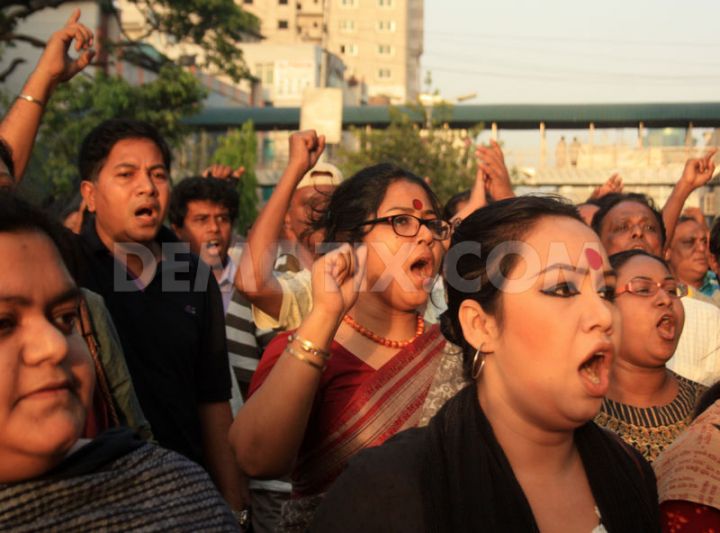
One was reminded of Soyinka’s words when one was witness to the march organised by the newly emergent group Hefazat-e-Islam ( can be loosely translated as ‘Defenders of Islam’) on the streets of Dhaka, capital of Bangladesh and the consequent mayhem that followed.  Continue reading Hefazat-e-Jamaat, Nothing Else : On the Recent Developments in Bangladesh