Category Archives: Bad ideas

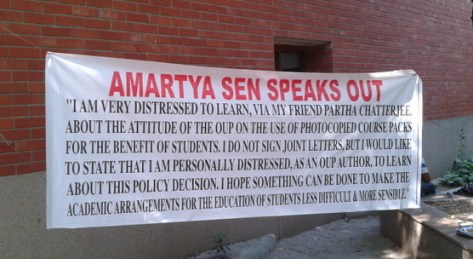
Authors and academics for equitable access to learning material

Three large academic publishers – Oxford University Press, Cambridge University Press and Taylor & Francis – have filed a petition in the Delhi High Court claiming copyright infringement with regard to the course packs used by students of Delhi University in a number of disciplines.  It is clear from DU’s stance in court that they are  distancing themselves from the  photocopier, thus clearing the way for the Court to pass an injunction staying the sale of course packs. It is absolutely critical now  for academics and authors to step up our campaign in support of our students’ access to learning materials:

Please sign the on-line petition at the link below:

“…As authors and educators, we would like to place on record our distress at this act of the publishers, as we recognize the fact that in a country like India marked by sharp economic inequalities, it is often not possible for every student to obtain a personal copy of a book. In that situation the next best thing would have been for multiple copies of the book to be available in the library so that students are able to access these books without any difficulty. But given the constraints that libraries in India work with, they may only have a single copy of a book and in many instances, none at all. The reason we make course packs is to ensure that students have access to the most relevant portions of the book without which we would be seriously compromising their education….”
The Beginning of the Middle of the End: Haseeb Asif

Guest post by HASEEB ASIF

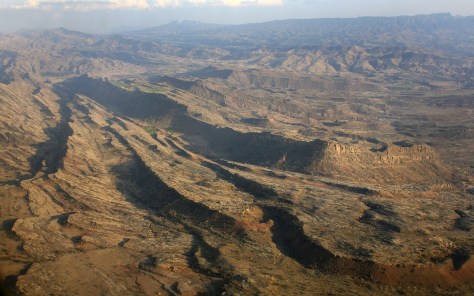
Pakistan’s remote North Waziristan tribal area is seen from the air Feb. 17, 2007. Photo by John Moore/Getty Images

One day as I walked to the market to buy some eggs, I noticed strange graffiti on a wall. Emblazoned in red paint was an invitation to join the fight against zionist subversion, western imperialism and painful hemorrhoids; the end having been muddled with a physician’s note.

It was an open call to Jihad by a militant Islamic organization. Jihad! The camaraderie, the righteousness, the third degree burns; it’s all I’d ever wanted. I was tired of being oppressed. There I was, in the prime of my youth, jobless, eggless, with subnormal visual acuity and four strands of the dengue virus, and who was to blame? I could imagine the conversation with my therapist.

“Doctor, I’m moody, I can’t sleep and I never seem to have enough energy to do anything.”

“Why, I believe you’re suffering from oppression”

I called their toll free number and signed myself up. They sent me a brochure and a medical plan; both had pictures of the same mutilated bodies.

‘Jihad summer camp, three months, graduating candidates get a certificate of martyrculation and up to 72 virgins in heaven (note: amount varies according to stock), HEC accredited, facial hair mandatory’.

I consulted with my parents, my mother was thrilled; she’d always wanted a martyr in the family. Father just grunted and made a time honoured gesture with his middle finger.

Two days later a brother Mehsud showed up at my door, he’d been sent by the organization to escort me back to their base.

“It’s a great thing you’re about to do, brother.” I was only packing my clothes. Continue reading The Beginning of the Middle of the End: Haseeb Asif

The Iron Lady of Jharkhand: Mahtab Alam on Dayamani Barla

Guest post by MAHTAB ALAM

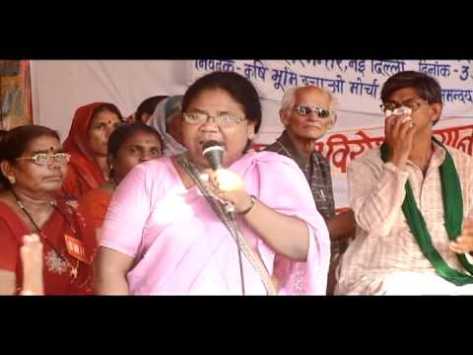
The journalist turned anti-displacement, tribal, woman activist from Jharkhand Dayamani Barla, better known as the Iron lady of Jharkhand amongst people’s movements and activists, or simply as Dayamani Di was granted bail by a local court in Ranchi on Thursday afternoon. She was sent to Jail on Tuesday in fourteen days judicial custody, after she surrendered before the court in a matter of 25 April 2006. Six years ago, she was charged under various sections of the Indian Penal Code (IPC), including Section 148 (rioting, armed with deadly weapons), for participating in a protest demonstration, which blocked the road, demanding job cards for rural laborers under the celebrated National Rural Employment Guarantee Act (NREGA). She had availed bail at that time from the concerned police station and the matter was almost closed one. Continue reading The Iron Lady of Jharkhand: Mahtab Alam on Dayamani Barla

A statement on the arrest of 13 political activists in Tamil Nadu

Tamil Nadu has always had a very high handed police, infamous for extrajudicial killings, torture and arbitrary arrest of political dissidents of all hues. In recent times, thanks to the popular Koodankulam agitation the authoritarian ways of the state police seems to have acquired a ‘nuclear’ edge.

On 6 October 2012, as 13 senior members of the Peoples Democratic Republic Party met at a school in Kundrathur near Chennai city they were all arrested by the ‘Q Branch’, as the local intelligence bureau is called in Tamil Nadu. The arrested members and supporters of the party have been since remanded to judicial custody in Vellore central prison and a case under section Cr. L.A 17 (1) registered against them. Continue reading A statement on the arrest of 13 political activists in Tamil Nadu

Dronacharyas All

Caste Discrimination in Higher Education


For Bhalchandra Mungekar, ex-vice chancellor of Bombay University and ex-member of the Planning Commission, the exercise of looking into allegations of caste discrimination faced by scheduled caste students at Vardhman Medical College, Delhi, has been extremely disturbing. As the single-member committee appointed by the National Scheduled Caste Commission, it was important that he examine every aspect of the case and ensure that the guilty were brought to book.

Dr Mungekar discovered to his dismay that not only were the 35 scheduled caste students failed repeatedly in one particular subject – physiology – but the authorities had not even bothered to meet them to look into their complaints. He had to resort to RTI to seek information and approach the high court to ensure their rights as equal students. As his report puts it, the faculty of the said department ‘resorted to caste-based discrimination and neglected the duties assigned to them, not by omission but by commission’. Even other administrative people, including the head of the institution, had not seen fit to intervene. Not only did the students lose years because of this apathy, shockingly, the same authorities were guilty of showing leniency towards general category students. While they had no qualms about barring scheduled caste students from taking their examinations due to lack of attendance, four students from the general category, who were detained for inadequate attendance, were allowed to take the examination.

Dr Mungekar, who has finally submitted his report, has put forward wide-ranging recommendations. Apart from asking the authorities to pay compensation of Rs 10 lakh to students Manish and others who had moved court — underlining the fact that ‘the mental trauma that they were/are made to undergo is not measurable in terms of money’ — he has demanded that legal action under the Scheduled Caste and Scheduled Tribe (Prevention of Atrocities) Act, 1989 be taken against former Principal V K Sharma and his then colleagues Professor Shoma Das, head of the physiology department, Principal Jayshree Bhattacharjee and Raj Kapoor, professor of physiology, and a liaison officer. Continue reading Dronacharyas All

An open letter to the jury of The Economic Times Awards for Global Excellence: G. Ananthapadmanabhan

This open letter has been put out by G. ANANTHAPADMANABHAN of Amnesty International (India)

Dear Mr Deepak Parekh, Mr Kumara Mangalam Birla, Mr K V Kamath, Mr Kris Gopalakrishnan, Mr A M Naik, Ms Chanda Kocchar and Mr Cyril Shroff,

We at Amnesty International India are deeply disappointed by your decision to give the Economic Times Business Leader of the Year 2012 award to Mr Anil Agarwal, Chairman of Vedanta plc.

The Business Leader award is given to individuals who have demonstrated “a strategic direction for success, and pursued a vision”. But Vedanta, in its efforts to have a bauxite mine opened at the Niyamgiri hills in Orissa and expand an aluminium refinery near Lanjigarh, has demonstrated an utter lack of both leadership and vision. What it has shown instead is a brazen disregard for Indian law and an utter lack of respect for the rights of local communities. Continue reading An open letter to the jury of The Economic Times Awards for Global Excellence: G. Ananthapadmanabhan

To Build A Bridge in Kashmir: A fable by Abhijit Dutta

Guest post by ABHIJIT DUTTA

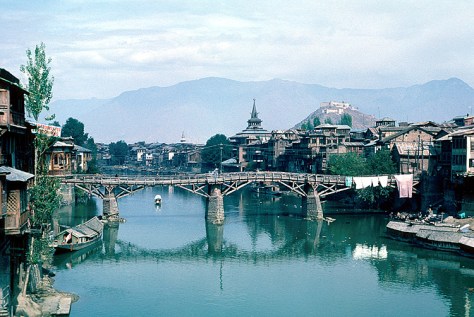
Once upon a time, a young politician – young enough to have a ‘baba’ appended to his name – came to Kashmir to build a bridge in Srinagar. Now as anyone who knows Srinagar knows, the city is filled with bridges. Some are famous, like Gawkadal, some are pretty, like Zero Bridge, and some are simply without charm, like the Abdullah Bridge that goes from fountain square to Rajbagh. There are several others too, each with their own unique character, their own unique relation to the Jhelum.

When he was told about the many bridges in Srinagar, the politician shouted, “I want to build a bridge.”

“But we don’t need a bridge,” said a man softly to him, wanting not to embarrass this well-meaning man who had come to Kashmir from aafar. In response, the young politician turned around and shouted once again: “I want to build a bridge.” Continue reading To Build A Bridge in Kashmir: A fable by Abhijit Dutta

The intruders were not found in possession of any objectionable material apart from a large cache of fish

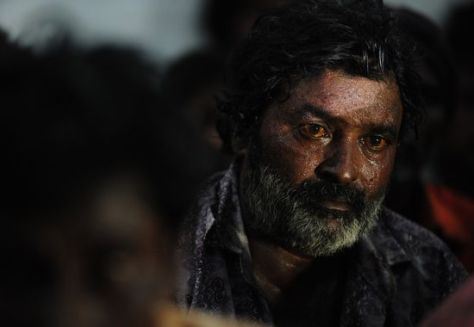
An arrested Indian fisherman sits at a police station in Pakistan’s port city of Karachi on October 1, 2012. Pakistan maritime security agency arrested 33 Indian fishermen and seized five boats for allegedly fishing illegally in Pakistan’s territorial waters. By Asif Hassan/AFP/Getty Images.

The insensitive governments of India and Pakistan are not moved even when one of their citizens dies in the other country, especially if the citizen was a poor fisherman arrested for the crime of inadvertently crossing a maritime boundary.

After 23 days of lying in the morgue of Ahmedabad’s Civil Hospital, the body of 32 year old Nawaz Ali Jat will finally reach Karachi on Monday by a Pakistan International Airlines flight. His family waited 14 years for his return, but they didn’t even get to know when he died of kidney failure on September 8. Continue reading The intruders were not found in possession of any objectionable material apart from a large cache of fish

How not to handle online hate speech in India

The first amendment to the Indian Constitution, passed in 1951, allows the government to impose “reasonable restrictions” on a citizen’s right to freedom of speech and expression, in order to protect “the interests of the sovereignty and integrity of India, the security of the State, friendly relations with foreign States, public order, decency or morality or in relation to contempt of court, defamation or incitement to an offence”.

The means to impose these “reasonable restrictions” are described in several sections of the Indian Penal Code (IPC) and the Code of Criminal Procedure (CrPc). Section 298 of the IPC makes punishable words uttered “with the deliberate intent of wounding religious feelings”; section 504 addresses “intentional insult with intent to provoke breach of peace”; section 153 makes punishable speech acts that lead or could have led to rioting; section 295A could land you in jail for three years over “deliberate and malicious acts, intended to outrage religious feelings”; section 153B permits the punishment of speech acts that question any social, religious or linguistic group’s allegiance to the Constitution of India or that such a group be denied Constitutional rights. Read more…

Expired Explosives and Health of Kudankulam: Anoo Bhuyan

Guest post by ANOO BHUYAN

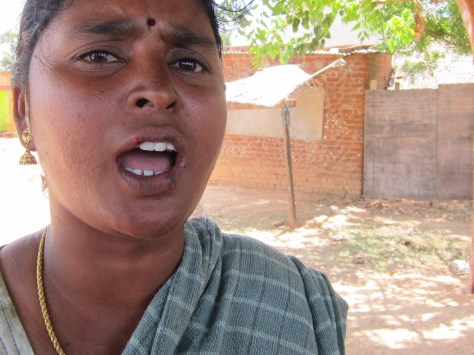
Anitha spits blood and wipes her lips as she talks to me. A few sentences later, a large blister on her lips begins to glisten with blood again, and she has to spit it out one more time. Hundreds of villagers at Idinthakarai have similar clusters of blisters on their lips. They say that they developed the sores as a reaction to the tear gas that was used during the clash that took place between police and protesters who were protesting the Kudankulam Nuclear Power Plant. This event occurred on tenth September. Nearly a week later, the sores continue to remain fresh and open, and a scab does not seem to be forming for any of those who were involved in the clash.

Anitha 


Continue reading Expired Explosives and Health of Kudankulam: Anoo Bhuyan

GPS and receipts will not stop Delhi’s auto-wallahs from overcharging: Simon Harding

Guest post by SIMON HARDING

Last week, the Delhi High Court gave the go-ahead for the compulsory installation of GPS systems and printers in the capital’s auto-rickshaws by dismissing petitions against the policy from auto unions (download judgement .pdf here). The GPS kits are supposed to allow the Transport Department to track the movement of Delhi’s autos. The printer will provide the passenger with a fare-receipt, which will show the distance travelled and the amount paid. The policy will eliminate over-charging and will provide “secure and transparent travel” to the capital, claims The Hindu.

Sadly, the installation of GPS systems will do little to address the problem of over-charging. On the contrary, it may actually exacerbate it. Continue reading GPS and receipts will not stop Delhi’s auto-wallahs from overcharging: Simon Harding

Evidence, Consensus and Policy: Kaveri Gill on the curious case of changes proposed in India’s public health policy

Guest post by KAVERI GILL

The world of development is as prone to fashions as any other. In recent times, ‘evidence-based policy’ has become the new gold standard, following hot on the heels of participation and ownership of policy processes and outcomes by academics, activists and civil society groups. This applies within nation states, especially of the global South. India today epitomises such objective and bottom-up democratic largesse in favour of the ‘aam admi’- for largesse it is, make no mistake – with a near constant refrain of the avowed aim of ‘inclusive growth’. And yet, does it really?

Or is politically correct discourse and seemingly open decision-making processes in the social sector sphere merely dangerous fig leaves for seismic and opaque shifts in policy, which have very little to do with evidence and even less to do with broad-based consensus? Rather, they are an outcome of fixed ex-ante views – which may be termed as a distinct partiality to the Chicago School of Economics – about the path to a fictitious endpoint of a mainstream development paradigm, which itself is faith-based. It is not justified by theory or a heterodox reading of the empirical experiences of presently developed countries, let alone latecomer developing nations which are, for various exogenous and endogenous reasons, likely to have different trajectories altogether. I refer here to the hackneyed line about faster growth being pursued as a necessary, if not sufficient, condition for eventual trickle down, no matter that the ‘dur khaima’ of an equitable society is never arrived at! Continue reading Evidence, Consensus and Policy: Kaveri Gill on the curious case of changes proposed in India’s public health policy

A statement against the arrest of Punjabi publishers and editors for publishing the poetry of Babu Rajab Ali

Names of signatories given at the end; for more details on the campaign, see Whitewashing History

The arrest of two Punjabi publishers and two editors for reprinting old books of poet Babu Rajab Ali which allegedly contained some then used caste names, under the Prevention of Atrocities Against Scheduled Castes and Scheduled Tribes Act, is a totally thoughtless, callous and ruthless action taken by the Punjab government.

We understand that Mr. Amit Mittar of Tarak Bharti Prakashan and Mr. Ashok Garg of Sangam and editors Mr. Jagjeet Singh Sahoke from Moga and Mr. Swatantar from Samana, were arrested by the police on September 15 at the behest of the Punjab government. This is absolutely against academic freedom. Continue reading A statement against the arrest of Punjabi publishers and editors for publishing the poetry of Babu Rajab Ali

Stuck Between Gandhi and Cultural Crap: Papilio Buddha Reveals Much

Sometimes a minor cut on the surface of the skin will do to reveal the rot beneath. This is precisely what the film Papilio Buddha, made by the New York-based Malayalee film-maker Jayan Cherian, which draws broadly upon contemporary caste politics in Kerala, has achieved for us. In fact, its achievement on this count is simply amazing. At a single stroke, it has brought to light several stinking sores above which Malayalees, especially many Malayalee intellectuals who  occasionally don the garb of public intellectuals, strut. Continue reading Stuck Between Gandhi and Cultural Crap: Papilio Buddha Reveals Much

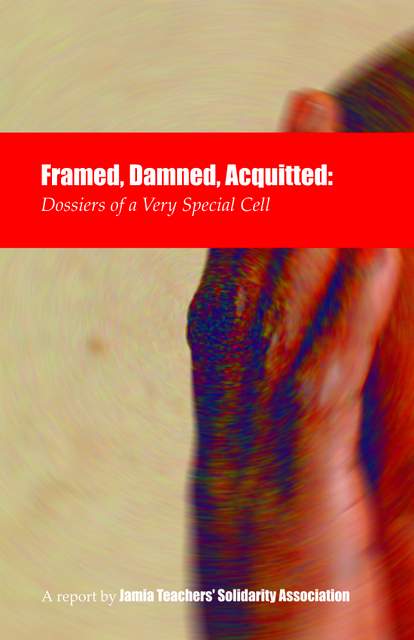
JTSA responds to Delhi Police’s comments on their report “Framed, Damned, Acquitted”

This guest post by the JAMIA TEACHERS’ SOLIDARITY ASSOCIATION is a response to the Delhi Police’s comments on their report, “Framed, Damned, Acquitted”

Did you think that the Special Cell or the Delhi Police would introspect on its ways after the publication of Framed, Damned, Acquitted? How wrong you were. It is now attempting desperately to defend the indefensible by hiding behind a maze of statistics, ignoring the real questions that the report has raised: namely the brazen and systematic violation of all established legal norms and due process. Continue reading JTSA responds to Delhi Police’s comments on their report “Framed, Damned, Acquitted”

Academic Publishers – An Insider’s perspective: Anonymous Contributor

I am posting an email I received this morning by someone who works at a leading multinational academic publishing house and hence wants to remain anonymous which raises very important points relevant to the ongoing debate about copyright, photocopying and the practices within academic publishing. (Thanks to anonymous contributor for this)

Also for more detailed discussions please see the following posts at spicyip by Amlan Mohanty (1, 2,) Shamnad Basheer (1, 2) and Prashant Reddy 1

Hello Lawrence,

In his Op-Ed in today’s Hindu, Sudhanva Deshpande referred to your work, and soon, I stumbled upon your articles at Kafila and the general discussion on the blogosphere. As someone who worked for a few years in a leading multinational academic publishing company, I thought I might — if this doesn’t sound too pretentious — offer some more ammunition to you. What I have to say may not be immediately relevant to the DU case, but I hope you’ll have the time to read. Continue reading Academic Publishers – An Insider’s perspective: Anonymous Contributor

‘Big Ticket’ Reforms and Bigger Deceptions: Shankar Gopalakrishnan

Guest post by SHANKAR GOPALAKRISHNAN

When the country’s rulers have to tell barefaced lies to get their policies through, you know that there’s something wrong. Consider the recent “big-ticket reforms,” of which the two biggest (in terms of direct impact) have been the diesel price hike and the opening of the retail sector to FDI. The diesel hike, we’re told, was a “tough decision” necessary to “prune subsidies.” Except that diesel isn’t subsidised in this country. To repeat: there is no subsidy on diesel in India. As for FDI in retail, the Cabinet statement on the policy cites four justifications, accompanied by a “Studies show…” claim. Except that the data in the government’s sole study on the issue does not support three of these four justifications. As for their much touted “safeguards”, at least one has been said to be illegal by the Commerce Ministry itself, while the very same CCEA meeting diluted a similar safeguard for single brand retailers. Continue reading ‘Big Ticket’ Reforms and Bigger Deceptions: Shankar Gopalakrishnan

Letter to the Editor, Times of India: Narmada Bachao Andolan

This guest post by CHITTAROOPA PALIT is the text of a letter to the editor of the Times of India, which the paper has not published
Subject: Rebuttal to the story “Reality bites: Khandwa’s made-for-TV protest” published in Times of India.

Dear Sir,

We are shocked to read the story “Reality bites: Khandwa’s made-for-TV protest” in your esteemed newspaper, which has been published with prominence. The story is false and fabricated. The journalist did not meet any Mehtab Singh but she quoted him. The journalist did talk to my colleague and senior activist of NBA Mr. Alok Agarwal but chooses not to quote him. It may be noted that the OB van and a team of your own group Times Now was there at satyagrah site all the time covering live from 6th September but none of these issues were raised.

Continue reading Letter to the Editor, Times of India: Narmada Bachao Andolan

Aseem Trivedi and the guardians of good taste

There’s a time for everything. When a cartoonist is being arrested for his cartoons, for cartoons that caused no harm, incited no violence, killed no people, then do you discuss his art or his incarceration? Continue reading Aseem Trivedi and the guardians of good taste

I am a Hindu and I am not a terrorist

I am a Hindu and I am not a terrorist. Don’t get me wrong. Not all Hindus are terrorists and not all terrorists are Hindus. Heck, all Hindus don’t even subscribe to the political ideology called Hindutva. No, I am not saying all Hindutvawaadis are terrorists or that all terrorists are Hindutvawaadis. Let’s get this straight: terror has no religion. Continue reading I am a Hindu and I am not a terrorist

Defying Manu, Bowing to Mammon

On The Silent Emergence of Dalit Capitalism

It was 14 th April 2012, when dalits in different parts of the country (as well as abroad) were celebrating 121 st birth anniversary of Babasaheb Dr Bhimrao Ambedkar, the legendary son of the oppressed. Thousands of  people had congregated at statue of Dr Ambedkar situated near Parliament itself as they have been doing on every such occasion. It was a festive type of atmosphere where one could find book stalls on the way – where one could browse through books on different topics all geared to bring about a social transformation in India – cultural performances by small groups going on uninterruptedly, volunteers had put stalls to provide water to all the visitors.

And Delhi was no exception. One could witness similar gatherings in different parts of the country where people gather on their own to celebrate the life of Dr Ambedkar. Close watchers of such gatherings – where state patronage is not the deciding factor – would emphasise why this phenomenon need to be closely understood and comprehended by sociologists of our times that even fifty six years after his demise there has not been a let up in his popularity. In fact, he happens to be one of those rare leaders of the first half of 20 th century whose birth anniversary as well as death anniversary is still celebrated as people’s festival.

On this day at a place not very far from the ongoing celebrations in Delhi a different type of meeting was being held which was attended by a motley combination of dalit activists, dalit enterpreneurs as well as few top bureaucrats. It was an occasion to float DICCI Venture Capital Fund, (DVCF) a For-Profit company whose aim was to support India’s Dalit entrepreneurs. In fact, 121 smartly dressed Dalit entrepreneurs cut a 121-kg birthday cake in honour of B R Ambedkar, and announced the launching of the (VC) fund. Continue reading Defying Manu, Bowing to Mammon