Category Archives: Bad ideas

The Banality of Shame

BANAL: everyday, ordinary, commonplace

SHAME: the  painful  feeling  arising  from  the  consciousness  of  something  dishonourable done  by  oneself  or another


Jana gana mana adhinayaka jaya he

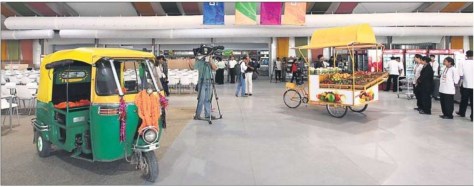
An auto-rickshaw and a street hawker’s pushcart as showpieces in the Commonwealth Games Village dining hall

* MCD to raze dhabas on Games route: It doesn’t matter if you are running your business legally or illegally. If your shops fall on the route of a Games event, chances are that you will have to shut shop. A shop and taxi stand in front of Bal Bhawan — which have been running for 20 years — were demolished by MCD on Saturday and the civic agency is planning to raze all dhabas  functioning along the stretch in the coming days even as the dhaba owners claim that they have been paying rent to MCD.

Continue reading The Banality of Shame

Kashmir, September 2010. The Reichstag Fire (dispersed) Redux ?

(Apologies for cross posting on the Reader List)

As if by magic, those who had hidden themselves for the past few months in Kashmir are leading mobs and setting schools and public buildings on fire. And many more people have died tragic and unnecessary deaths. This time, unlike in the past, the blame must be squarely shared between those who fired the bullets, and some of those who led the incendiary crowds. Perhaps Kashmir has just entered a new and darker phase, brandishing a burning torch. This situation, in order not to be irreversible, needs the urgent and sane attention of Kashmiris themselves, and of all those who wish Kashmir and its people well.

We could do well by way of beginning by turning our attention to a surprising detail hidden within the reports of the recent events of arson. National Conference apparatchiks, who did not even dare appear in public till recently for fear of being attacked for their role in sustaining the occupation of Kashmir by India’s armed might, are now allegedly seen openly goading mobs of zealots to burn down a school in the name of the defence of religion. If this is true, the what we are witnessing is the realization by them of a wonderful opportunity to wear new costumes and speak new lines in the unfolding theatre of the moment.

Continue reading Kashmir, September 2010. The Reichstag Fire (dispersed) Redux ?

Dressing and Death-Threats in Kerala : Re-former Man’s Second Coming?

(cross-posted on www.countermedia.in)

Shamshad Hussain, J. Devika

The death threats received by a young woman student of engineering, Rayana R Khazi, a native of Cherkalam in Kasaragod, over a period of the past ten months, have been in the news in Kerala recently. The threats which were issued over the phone, on the streets, and by letters, have demanded just one thing: Rayana should comply with ‘Islamic dress-norms’; she should don the purdah. She has received four threatening letters. Of these, three issue death-threats, outright. The fourth is in the form of a warning that offers lengthy advice. One of these says: you have not heeded many warnings issued. We, Muslim brethren, will now decide your fate. This letter, which begins and ends in the name of Allah, is unsigned. Continue reading Dressing and Death-Threats in Kerala : Re-former Man’s Second Coming?

India and the Kantipur Saga

New Delhi is ranged against not only Nepal’s biggest political party but also its largest media house.

First published in The Hindu, 2 September 2010

The Indian Embassy in Kathmandu is in the middle of a controversy. It stands accused, yet again, of ‘gross interference’ and ‘attacking press freedom in another country’, and faces censure from a parliamentary committee, politicians across the spectrum, and civil society groups. Last week, sections of the media, including Kantipur television which is a part of the larger Kantipur group, reported that a product of Dabur Nepal was substandard and contained harmful substances. On August 27, the embassy said, “Indian joint ventures have informed the embassy they have been approached by such media houses for advertisement and are being threatened with negative publicity if those requests are not met.” It termed the news reports as ‘baseless adverse publicity against products of such ventures’ and said such allegations in the past had proven to be false.

Organisations representing media owners, which included the Kantipur publisher, immediately condemned the statement, said media is free to choose its content, and cautioned the embassy to ‘respect diplomatic norms and values of press freedom’. The embassy reacted again, saying the statement by media organisations would have been more credible if backed by a condemnation of unethical practices adopted in eliciting advertising revenue from Indian joint ventures. Since then, the Parliament’s international relations and human rights committee has instructed the government to seek a clarification from the Indian envoy for the embassy’s statements and termed it as blatant interference in free press.

Continue reading India and the Kantipur Saga

University Community for Democracy on relay hunger-strike against CWG evictions

We have had an earlier post on the University Community for Democracy which was formed in the wake of the arbitrary and authoritarian eviction of students from the hostels of Delhi University for the Commonwealth Games, but which raises wider questions about the “reckless logic by which the city is being re-made”.

This is their latest press release, followed by their letter to the National Commission for Women.

University Community for Democracy

PRESS RELEASE 10/08/10

The University Community for Democracy is initiating a RELAY HUNGER STRIKE FROM  9 AM TO 9 PM, 12TH AUGUST THURSDAY ONWARDS at the Arts Faculty Main gate, North Campus. Each day there will be five people (teachers, students and researchers) who will be on a hunger strike, as well as many others who will sit in solidarity.

The University Community for Democracy has been challenging a number of decisions taken by both Delhi University and the government with regard to the commonwealth games for over a month now. The Forum is deeply concerned by the gross violations of rights that the city has witnessed in the name of the Games and condemns the irresponsible manner in which Delhi is being prepared for this mega- event.

Continue reading University Community for Democracy on relay hunger-strike against CWG evictions

Creative Destructions

Part of a Series. See here.

In January of this year, I had taken a friend to Mumbai. One of the places we went to was Lower Parel – I wanted to show him what I could of the Mills. You could still see the Mills then, if not in the same form. The same compounds now housed small galleries and boutiques. There were advertisements for a ‘mills culture tour’, sold as something in between a bar hop and an art gallery cruise. I knew big clubs had opened here, as had malls. Phoenix Mills was Mumbai’s version of Delhi’s DLF Emporio – all the major global brands were there. Even here, however, I remember laughing and pointing out to him that some of Bombay’s stubborn egalitarianism remained. Armani was next to Addidas. Rohit Bal next to a paper store. Unlike in Delhi where no non-hyper-elite brand could get near DLF Emporio, in Bombay, even Armani couldn’t buy space away from Adiddas.

Continue reading Creative Destructions

Have I Joined the Popular Front?

In the past few weeks, I have been asked over and over again, not always in jest, if I had joined the Popular Front. I am not surprised. The police investigation around the violence against the college teacher at Muvattupuzha has broken all previous records in not only the violation of human and civil rights, but also in the silence of Kerala’s enlightened intellectuals. If I recall right, only Nandigram evoked such a dense and deliberate silence from them. No wonder, anyone who speaks up against the manner in which the police is being armed and authorized against ‘bad muslims’ is immediately dubbed a supporter of the Popular Front. But I am intrigued by this simple question, by which the entire history of that person’s engagement with discussions around religion and the state is erased. Continue reading Have I Joined the Popular Front?

Kashmir Comes to Jantar Mantar

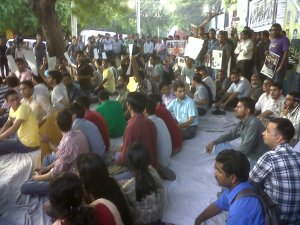
A view of the crowd at Jantar Mantar - image taken on a cell phone camera

Last evening I went to Jantar Mantar after many years. It is a road I pass often, looking at the sad and melancholic little protests that line the kerb, whispering to an indifferent Capital the million mutinies of our banana plantation republic.

Last evening was different. There were perhaps four to five hundred people, many, but not all Kashmiri, men and women, who had gathered to protest against the wanton destruction of life in the Kashmir valley by the security apparatus of the Indian state in the last few weeks and months. 45 civilian deaths in 8 weeks signals a state losing its head. Especially when the deaths occur when the police and paramilitaries fire live bullets on unarmed or stone pelting mobs. When stones, or unarmed bodies are met with ammunition, you know that the state has no respect whatsoever for bare life. That this should happen in a state that calls itself a democracy should make all of us who are its citizens reflect on how hollow ‘democracy’ feels to the mother or friend of a young boy or girl who is felled by a ‘democratic’ bullet.

Continue reading Kashmir Comes to Jantar Mantar

Pushing the Kashmiri to the wall, again

[An edited, shorter version of this article by me appeared last week in The Friday Times, Lahore.]

In the first week of June, I sat at a shopfront with a group of shopkeepers of Kalarus, a small town in Kupwara district in north Kashmir. In 1999, they collected money and bought land for a martyrs’ graveyard, one of many such in Kashmir. Whenever the Indian army killed militants trying to infiltrate from Pakistan to the Indian side of the Line of Control, they would hand over the bodies to the Kupwara police, who would give it to these people to bury after the autopsy.

“Look up at the mountain peak,” said one of them, “It is snow clad all twelve months. It is the LoC, 70 kms from here. Do you think anyone would cross that wearing the traditional Kashmiri Khan dress?” And yet, most of the hundred odd bodies in the graveyard had come wearing clothes unfit for snow. And, most of them had so many bullet marks on the face that they were unidentifiable. Continue reading Pushing the Kashmiri to the wall, again

Dear Chattisgarh Police, Are You Mad?

Javed Iqbal of The New Indian Express on being targeted by the Chattisgarh Police as being on the side of the Maoists:

A High Court lawyer from Mumbai was in Dantewada a few days ago and had gone to the police station to speak to the police and understand the ground realities of Dantewada. SSP Kalluri accused him of being a Naxalite informer, and had him locked up in the police station. He was eventually let off the same evening, visibly shaken, after some frantic phone calls.

The very fact that the Chhattisgarh police would rather target civil society activists, opposition party workers and journalists than investigate the Maoists, is explicit proof of their incompetence. A kind of fascinating wife-beating syndrome, where they can’t get the Maoists, so the insecure, frustrated police will go after soft targets like journalists, activists and opposition party members.

They arrested CPI party workers for the attack on Audesh Singh Gautams home, and adivasi CPI leader Manish Kunjam confirmed the same. He, himself, has no police security. It was withdrawn by the police months ago even though there have been numerous threats to his life. He has been openly critical of the Salwa Judum that roams around Bastar, armed to its teeth, and has spoken up against corporate land grab, supporting and helping to organize the anti-displacement movements across Bastar.

Now, according to the police press release that implicated Lingaram Kodopi, Nandini Sundar, Medha Patkar and Arundhati Roy, I’ve been mentioned as someone who had gone with the Maoists, ‘videographing’ their failed assassination attempt on Audesh Singh Gautam.

Forget that they police don’t know the difference between a ‘photographer’ and a ‘videographer’. Forget that the police don’t know that at 1:00am there’s no light, and videography and photography is useless. And I believe the Maoists have infra-red cameras? Why? Because they’re ‘infra-red’? [Read the full post]

In Kashmir, everyone’s losing the plot: Peerzada Aashiq

Guest post by PEERZADA AASHIQ

Everyone is losing its plot in Kashmir — be it separatists, mainstream political parties, New Delhi or Pakistan. The biggest losers in the unarmed but stone-laden street uprising are Pakistan and separatists.

The failure of Pakistan in shifting paradigm of new realities in Kashmir can be gauged from its dwindling influence over separatists’ spectrum. It failed to unite fractured separatists to its 1992-like unified forum politics despite placing in half-a-dozen interlocutors between warring factions of the All Parties Hurriyat Conference led by Sayed Ali Shah Geelani and Mirwaiz Umar Farooq.

Its influence over separatists’ spectrum has been wavering and waning. It was after former Pakistan President Pervez Musharraf pick-and-choose policy that saw separatists cocooning and ensconcing their politics as per the public mood in Kashmir. If Musharraf’s four-point formula convinced moderate Mirwaiz Umar Farooq, many hard-liners like Sayed Ali Shah Geelani and United Jehad Council chief Sayed Salahuddin rejected it. Continue reading In Kashmir, everyone’s losing the plot: Peerzada Aashiq

But what is a flag march?

Protest not allowed, this is Kashmir

So far in 2010, ‘security’ forces have killed 32 innocent Kashmiris, sometimes not even in a protest. Far from investigating these killings and promising justice, India has banned protest in Kashmir, which is what curfew amounts to, and even the media is not allowed to function. Curfew passes have been canceled even for journalists – there were no newspapers this morning. 12 photojournalists have been beaten up. Newspapers have been BANNED!

The Delhi media reports that the army has been brought into Srinagar for an indefinite period, and that the army staged a flag march. However, what is a flag march? It can’t be a security measure to deal with terrorists because there is complete curfew. The army has been asked to strictly impose the curfew. People are dying because they are not allowed to go to hospitals. After killing 32 innocent people what does “maximum crackdown” by 1,700 Indian troops in Srinagar mean? And if not even a bird is allowed on the streets, who or what is the flag march for? Continue reading But what is a flag march?

If you’re still wondering why Kashmir is protesting and demanding azadi…

Birthday Wishes from the Hindustan Times

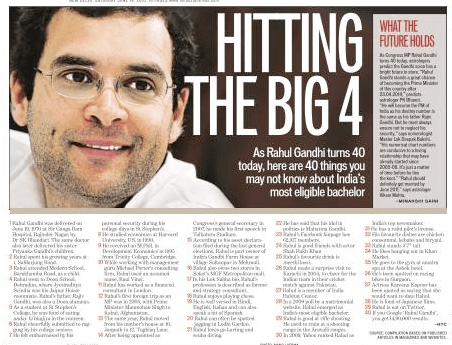
The Hindustan Times marked Rahul Gandhi’s fortieth birthday by tell us 40 things we “may” not know about “India’s most eligible bachelor”.

Nothing surprising about this. Why, don’t you remember how they told you 54 things about you didn’t know about Mayawati on Mayawati’s 54th birthday six months ago?

See also:
Why Hindol Sengupta Needn’t Fear Mayawati
Happy Ambedkar Jayanti

“Caste census will increase incidence of Japanese encephalitis”: Sociologist

Just four years ago, during “Mandal II”, everyone opposing the extension of OBC reservations to central educational institutions were saying we don’t even know how many OBCs there are. Now, when there is a proposal to count the OBCs, these voices are not to be heard. Just like “Mandal II”, a new term, “caste census” has been invented, as if the census already does not count the Scheduled Castes. The term “caste census” is used repeatedly in a way that suggests that a secular, progressive pro-development exercise is being sullied, polluted, by this monster of caste because of those uncouth cow belt politicians. Chee chee!

Obfuscation and intellectual dishonesty are in order. So, a lot of bullshit is being written about “caste census” to prevent us from knowing just how many of us are OBCs, to prevent the Other Backward Classes from entering the privileged spaces of the upper castes. This one takes the cake: Continue reading “Caste census will increase incidence of Japanese encephalitis”: Sociologist

SMS booklets – guidelines for messaging addicts: Rafay Mahmood

SMS Books[Sent to us by S. Akbar Zaidi, this article by RAFAY MAHMOOD was first published in The News of Pakistan. We are reproducing the this brilliantly funny report of the complete absence of boundaries between different forms (sms, print, internet) and the eclectic urge to take and assemble, to crack jokes, to create poetry – all in the service of the joy of life.]

“Tum Bijli, Pani or Train ko Rote ho Faraz / Is Mulk Mae Tau Toofan Bhi Time Per Nahin Aata”… This message was circulated all over the city when cyclone Phet  proved to be an anti-climax for Karachiites by arriving late and then changing course before it hit the city’s coast. The brains behind this poetic gem is ‘Faraz’, who baptizes every new cell phone with one of his socially relevant yet romantic poetic masterpieces. He is a legend, the undisputed king created by messages being forwarded on cell phones.

The Short Messaging Service (SMS) plays a key role in our lives today and the SMS culture has not only redefined the identity of people like Faraz but has also spawned the creation of an SMS book industry. Continue reading SMS booklets – guidelines for messaging addicts: Rafay Mahmood

‘The Moral Obligation of Indian Civil and Political Society’: Rekha Chowdhary on Fake Encounters in Kashmir

Guest post by REKHA CHOWDHARY

With another incident of fake encounters in Kashmir, it is a moment of introspection for the political and civil society of India. For all those who are proud of Indian democracy, it is a moment to reflect as to how this democracy fares for the people in Kashmir. It is important to note that democracy does not remain limited to the electoral choices and the extent and intensity of competition in the formation of government – it also involves the political and civil rights of people. Even when democracy has been restored in Kashmir in its procedural form and is kicking in the form of intensely competitive politics, its substantive effect is missing. The right to life is the minimum that is provided by any democracy, the range of rights however goes much beyond this and involves the basic civil liberties as well. However, the way the hapless innocent persons were cruelly murdered in Nadihal in north Kashmir and declared as militants – it is the denial of the minimum. It is not only the murder of three people, it is also the murder of Indian democracy! Continue reading ‘The Moral Obligation of Indian Civil and Political Society’: Rekha Chowdhary on Fake Encounters in Kashmir

A Public Service Announcement: Rukavat ke liye Khed Hai

Dear Readers,

There has been some consternation in the ranks regarding delays in comment moderation. If you do not see your comment up immediately, it is not because Central Committee has suddenly issued gag orders (we knew it!), we are becoming “un-democratic” (tyrants!), “authoritarian” (fascist bastards!), or coy (the dynamite of true revolutionaries is too much for our bourgeois souls). It is simply because all except one administrator are currently out of action.

Please have some sympathy for the lone Kafila elf, and desist from sending us 300 emails a day about Kafila’s sudden pact with the devil. Normal services will resume shortly :)

And Now, Fears of ‘Intellectual Jihad’!

Hameed Chennamangalur’s recent article in the Mathrubhoomi Weekly (16 May) in Malayalam seems to have set alight a new round of fears about the ‘hidden agenda’ of Muslim extremism . Over the past weeks many friends, mostly left-liberals, have been urging me to take heed of the warning issued by Chennamangalur, a well-known, long-time critic of Muslim identity politics.

The article that has sparked off such worries takes a line that is quite familiar: it accuses the Jamaat-e-Islami in Kerala of pursuing their ‘hidden agenda’ of establishing the dominance of radical Islam through secular means. Chennamangalur argues that the Jamaat has ‘penetrated’ the space of radical activism through its all-male youth organizations such as the Solidarity Youth Movement, and through setting the terms of radical activist debate through its popular weekly magazine, the Madhyamam. Its recent efforts at discussing such ideas as Muslim feminism, and Muslim feminist thinkers such as Amina Wadood and Fatima Mernissi can only be regarded as cover-ups for a strategy through which it seeks to displace the more liberal and plural Muslim League — something he finds worrying in the present context in which the Jamaat is making a bid to enter local governance through contesting the forthcoming panchayat elections in Kerala. He laments that the radical intellectuals in Kerala are becoming mere pawns of this strategy; they do not see, for instance, that despite all the support that the Madhyamam offers dalit intellectuals, it remains biased heavily towards upper-caste Muslims, unlike the Communist Party in Kerala, which, he claims, offered upward mobility and political presence to dalit leaders in its fold. Continue reading And Now, Fears of ‘Intellectual Jihad’!

There’s a khap panchayat next to your house

So when he khap panchayats of Haryana got Kurukshetra MP Navin Jindal to air their views to the Parliament, as he likes to put it, the story became simpler. Now it was one individual (Jindal) vs. modern India. Now it was an educated babalog neta letting us down. How could you? Now one didn’t have to enagage with the khap panchayats themselves. It could now be given more ai time and column space than when the khap panchayats were getting same-gotra couples killed.

Now, a ‘section’ of the Arya Samaj in Haryana says it won’t allow Arya Samaj temples to be used for marriage of same-gotra couples, or for any marriage without the consent of not only both sets of parents but also the entire village. Outrage is in order, though perhaps “shocker” is not a great word. Continue reading There’s a khap panchayat next to your house

Murder, not accident

“At the airport and blah =_= Only thing to look forward to is the rain.” That was Harshi’s last tweet. She was travelling to Mangalore to attend a wedding. She might have been able to enjoy the rain had it not been for the negligence of the negligence of the guardians of civil aviation in India. The crash, then, must be called murder, not accident.

This was no accident, but the direct result of deliberate failure of officials at the highest level in the Director General of Civil Aviation, Airports Authority of India, Ministry of Civil Aviation and the Government of Karnataka for allowing this 2nd runway to be built in criminal negligence of applicable norms and standards. Such a strong charge is being made as the likelihood of this kind of a crash (the worst case scenario) was predicted. A series of Public Interest Litigations were fought by the undersigned to stop the construction of this 2nd runway in Mangalore airport on grounds that the design simply did not conform to the most basic national and international standards of airport design. The PILs also highlighted that the airport does not conform with the most minimum safeguards for emergency situations – particularly during landings and takeoffs, and could not have emergency approach roads within a kilometre on all sides of the airport as required. [Environment Support Group]