
There is no room for doubt anymore that the landmine attack on a bus plying on the Dantewada-Sukhma road was planned and executed by the CPIM (Maoist). About 36 people have died, a majority of them civilians. This was not a mistake.The Maoists have said this was a calculated attack to target the Koya Commando wing of the SPOs. This means that the Maoists knew there were civilians on board. The Maoists have taken responsibility for the attack and in a statement to the press, Ramanna has said they “deeply regret the loss of civilian lives”. Continue reading On Maoist Regret
Category Archives: Bad ideas
Adivasis allege torture in anti-Naxal operations
Seventeen Adivasi villagers of Samna in Orissa’s Narayanpatna block
claim that they were brutally assaulted in custody last week, an
allegation the police have denied.
According to the villagers, they were picked up on May 9, as part of a
joint operation conducted by the Orissa and Andhra Pradesh police
along the inter-State border, airlifted to a police station in Andhra
Pradesh and held in custody for three days before being released on
May 14.
“Uniformed policemen surrounded our village on Sunday morning [May 9],
when we were leaving for the market,” said Nachika Jaddo, one of those
who were picked up. “Seventeen men, including two dokras [old men]
were rounded up, beaten up and then dragged to a spot 2 km away.”
Continue reading Adivasis allege torture in anti-Naxal operations
On Alleged Maoist Atrocities
While I have on several occasions expressed my disgust at the way in which the Government of India is conducting it’s ‘Operation Green Hunt’, I have to say that the news of the attacks by alleged Maoists in Chattisgarh, in which 6 villagers have been killed, and more recently a bus, with several civilians (and some special police officers) has been bombed, is deeply disturbing.
It is a totally different matter from attacking men in uniform, (such as the CRPF jawans who were attacked not so long ago, resulting in 76 casualties). Though I do not support any war, including the Maoist initiated ‘Peoples War’ or for that matter, the Government of India’s ‘Operation Green Hunt’, in any war, armed men in uniform in a combat zone are fair targets. The death of the 76 CRPF jawans, though regrettable, is not in any way different from the death of any guerrila soldiers in the PLGA in any combat operation. I refuse to be blackmailed into thinking of such an event as an evidence of Maoist ‘atrocities’.
Nandini Sundar – Will counting caste reduce inequality?
Nandini Sundar’s recent Op-Ed for The Hindu on caste-enumeration in the latest round of the census. Read the entire article here.
But come back with your comments – what do you think about caste–enumeration?
Yesterday when the census enumerator visited, I asked him how he felt about the current debate on counting caste in the census: “Not comfortable at all”, he said, “I don’t even like asking whether someone is SC/ST or Other, leave alone what their caste is.” But, he added, “caste is an inescapable reality of Indian society.”
The debate on counting caste in the census has not moved on from 2001, when opinion was equally divided. Supporters of caste enumeration argue that census categories merely reflect existing classifications, and that only the census can provide the figures necessary to map inequality by caste. Opponents argue that the census does not mirror but actively produces social classifications and ways of thinking. They point to the history of mobilisation around caste in the census and the consequent dangers of both distorted data and increased social tensions. In neither case has much thought been given to how the data might be used, the different kinds of figures needed for different purposes, or alternative ways of collecting the required data. Read the rest of the article here
The ban on SIMI and Indian democracy
Dr Shahid Badar, national president of Students Islamic Movement of India, recently decided not to contest any more the ban on SIMI, his stated reason being:
“to put an end to this mindless, futile, unequal, unethical and unjust exercise in which the Government has shamelessly used the Judiciary to achieve its ends of casting a shadow of criminality on the entire muslim community. I have therefore chosen not to contest the declaration of the central govt.”
This is the full text of the affidavit filed by him before the Unlawful Activities (Prevention) Tribunal.
‘Boycott of Israel would not serve any useful tactical purpose’: Amitav Ghosh

The British Committee for the Universities of Palestine (BRICUP) and Pakistanis for Palestine amongst others have appealed to the novelist Amitav Ghosh to decline the Israeli Dan David Prize he is being given jointly with Margaret Atwood.
The BRICUP open letter to Ghosh reads:
It’s surprising to have to raise Israeli colonialism with a writer whose entire oeuvre seems to us an attempt to imagine how human beings survived the depredations of colonialism. Gosh, even the Dan David judges like the way you evoke ‘the violent dislocations of people and regimes during the nineteenth and twentieth centuries’.
Those making him this appeal have reminded him of his rejection of the Commonwealth Writers’ Prize in 2001.
Give below is Ghosh’s response to the appeal: Continue reading ‘Boycott of Israel would not serve any useful tactical purpose’: Amitav Ghosh
Auto-rickshaws in Delhi: Why Sheila Dikshit’s comments are misguided
Guest post by SIMON HARDING
As every Delhite knows, taking an auto journey in the capital is not a pleasant experience. Drivers speed off at the very mention of your home or office, leaving you stranded on the roadside. When an auto-wallah finally agrees to go where you want, he steadfastly refuses to run by the meter and instigates a minute or so of stressful haggling. You arrive at your destination frazzled, irritated and over-charged. This situation has not gone unnoticed. Chief Minister, Sheila Dixshit recently announced plans to phase out the auto-rickshaw after five decades of service. Auto-rickshaws are “not a good option”, she complained, auto-wallahs “harass” passengers and up to half are plying the streets “illegally”. With the Commonwealth Games fast approaching, the eyes of the world will soon turn to Delhi. Auto-rickshaws do not fit with the CM’s desire to see visitors return home “with the impression that they have been to a truly civilised city”. She promised futuristic battery powered taxis, which thrilled middle class Delhi.

But before the auto-rickshaw and the much-maligned auto-wallah can be condemned, we must look at how the auto-rickshaw sector in Delhi operates: at the rules, regulations and policies, which govern the livelihoods of the city’s 80000 or so auto-drivers. Some questions need to be answered: why are Delhi’s auto-wallahs so greedy and grumpy? Why won’t they switch on the meter? Why do so many ply “illegally”? Continue reading Auto-rickshaws in Delhi: Why Sheila Dikshit’s comments are misguided
Whose Morality is This?
From the Hindustan Times this morning.
Saleem Kidwai, Nivedita Menon, Mary John, V. Geetha, Shilpa Phadke and 13 other teachers and academics from universities across India.
We, as teachers and academics from universities across India, read with outrage and dismay that Dr Shrinivas Ramchandra Siras, reader and chairman of Modern Indian Languages at the Aligarh Muslim University (AMU) was suspended for having consensual sex with someone of the same sex within the privacy of his home.
What made the press report that came out on Thursday in certain sections of the media particularly shocking was that there were either cameras placed by students within Dr Siras’ house or television reporters got into the house and made a video film of the alleged incident that was then passed on to the university authorities. The university authorities instead of going by the constitutionally recognised right to privacy within the four corners of one’s house have instead chosen to act against Dr Siras. Continue reading Whose Morality is This?
A response from a Sri Lankan friend: Priya Thangaraja
By PRIYA THANGARAJAH
The last two days have left me like I have just come from a storm and I dont even feel the tingling of rain drops on me. But this began long before. The state media I hear showed movies of Idi Amin and Hitler and a constant barrage of pro Mahinda Rajapakse propaganda. “they were brainwashed” is what I am hearing. I agree with everyone that its not like we had a better option. A military man who got rid of many when asked to get rid of one cant be the harbinger of a new era. Continue reading A response from a Sri Lankan friend: Priya Thangaraja
The absurd theatre of Sri Lanka, applauded by India
Every time I go to Sri Lanka, my historical sensibility gets heightened. I still remember this huge hoarding of Mahinda Rajapaksa ‘lovingly’ holding an old woman, obviously Tamil as she was wearing a pottu. That woman could be one of the 2.5 lakh people who have lost their homes, belonging and land in the war. She could be part of the other lakhs who have lost all of this in the more than twenty-five years of war.
The day before yesterday, 26th January, was the first ‘free’ election ‘after the war’. During the months before the election, 700 incidents of violence were reported, leading to the death and injury of many. Yesterday, as the results rolled out, chaos hit the streets of Colombo. We don’t even have enough information about what happened in the rest of the country yesterday. Rumours were floating about. I shall not dwell on the rumours and provide them legitimacy, although I am tempted to, as some of them are shocking and could be true. Ethics come in the way. Continue reading The absurd theatre of Sri Lanka, applauded by India
The Suicide of Sense
Mumbai has been in the grip of a wave of student suicides this past month. According to the Mumbai Mirror, as many as 25 suicides have taken place in the city in the new year, most of which have been by students. As expected, the media has tripped over itself reporting every sordid and tragic detail of the students’ personal lives, and public anxiety in Mumbai is climbing to the level of all-round hysteria. The general consensus is that there is too much pressure on young minds from schools and parents; the Maharashtra State government has reacted by issuing directives to all eight regional education boards in the state asking principals to arrange workshops to identify depressed students and urge them to seek psychiatric help. State education minister Balasaheb Thorat has promised a stress-free curriculum in school boards, and followed this up by a new rule that allows failure in one subject for an overall pass result in the SSC. A south Mumbai hospital has recruited a former depressive who has a history of three suicide attempts to counsel others against suicide. The Thane Mental Hospital has in the meanwhile gone one step ahead and created what they call a ‘20-minute anti-suicide psycho drama skit’ to be performed on the streets and in educational institutions. According to hospital superintendent Dr. Sanjay Kumavat, the skit will focus on the trauma that family members go through when a child commits suicide, and the ‘problems created by such a situation’ (Mumbai Mirror Jan 18th 2010) – this will hopefully prevent them from taking the proverbial ‘drastic step’.
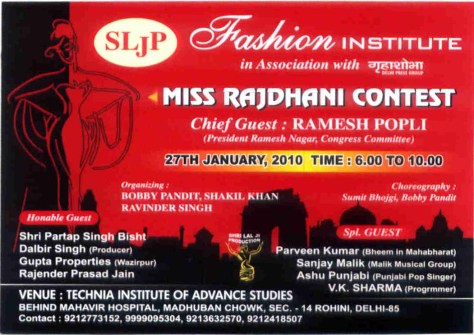
Miss Rajdhani Contest
Enemy Property
There have been several news reports recently about attempts by the builder Mafia to capture properties near the Jama Masjid in Shahjehanabad (popularly, known as old Delhi) to build a 100 room hotel. Reports have also suggested the involvement of a local politician, though the politician has refuted the allegations very firmly.
This piece is not about the builder mafia or the local politician, but about another issue that has cropped up during the investigation of the attempted land grab. It has been found that the ownership of one of the properties is under dispute and a case has been going on for close to two decades.
The reports say that the disputed property belongs to the “custodian of enemy properties”. Even a cursory reading of the reports would reveal the identity of the original owners of these properties. The original owners of these properties were Muslims of Delhi.
Muslims, who had lived in Shahjehanabad for generations, some for centuries like the families of my ancestors. Continue reading Enemy Property
Inaugurated: The Malabar Moral Police!
The dastardly attack on the eminent writer Paul Zachariah by the DYFI in the CPM fortress of Payyanur in north Kerala on 10 January has been roundly condemned across the political spectrum in Kerala. Zacharia was heckled and abused at a literary seminar organized by a publisher for criticizing the moral policing practiced by the official left in Kerala. He condemned the recent DYFI-PDP joint ‘moral action’ against the Congress leader Rajmohan Unnithan and a Sewa Dal leader which, according to the the DYFI leadership, were ‘provocative’. Zacharia was accosted by a gang of men when he was about to leave Payyanur and openly threatened. He was told that such talk was not permitted in the left bastion of Payyanur; when the threat did not produce the desired reaction, they resorted to physical intimidation, and relented only after the intervention of the organizers who are CPM sympathizers, and other writers present there. The day after, prominent leaders in the CPM, including the Chief Minister and the Minister for Education, condemned the action. Continue reading Inaugurated: The Malabar Moral Police!
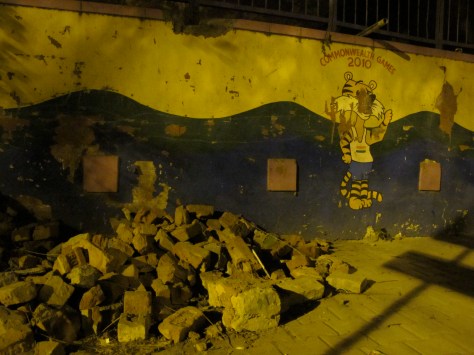
City Walls That Talk II
This image comes to us from Anand Vivek Taneja
Protest and Terrorism, Is there a Difference?
Sufiya Madani of the PDP has been granted conditional bail by the Ernakulam Sessions Court Judge after a tense wait following her arrest on 17 December. She was remanded to judicial custody by the first class magistrate court at Aluva which had refused her bail. Meanwhile, the mainstream media went on a speculation-spree, even publishing ‘evidence’ that she had abetted terrorism and violence — the burning of a bus owned by the Tamil Nadu Road Transport Corporation at Kalamassery in 2005 during protests against the PDP leader Abdul Nasser Madani’s (Sufiya’s husband) continued detention in the Coimbatore jail . Continue reading Protest and Terrorism, Is there a Difference?
Who’s at ‘Jihad’? : ‘Love Jihad’ and the Judge in Kerala
It looked as if the controversy over ‘Love Jihad’ ( ‘jihad defined as ‘war by other means’) had blown over with state authorities in Kerala and Karnatake denying that such a threat ever existed.The Central Government informed the Kerala High Court early this month that there was no such thing and that the term ‘love jihad’ was being used by the media.However, today, the Kerala High Court openly voiced its scepticism of police reports, claiming that the reports were inconsistent and citing various technical flaws.The Court claims that it is abiding by the secular spirit of the Indian Constitution: it agrees that the freedoms to choose one’s faith and one’s partner in marriage are fundamental rights. However, it feels that the present instances of marriage and conversions that have been brought to its attention are not the exercise of freedom by individuals — specifically, by young women, though the Court does not say it that way. It is difficult to imagine a more anti-Muslim and anti-woman position; and it is a serious matter that the muddle-headed reasoning of the judge has been uncritically circulated in the dominant media.
Continue reading Who’s at ‘Jihad’? : ‘Love Jihad’ and the Judge in Kerala
Bhopal Disaster, Corporate Responsibility and Peoples’ Rights
2 December 2009 will mark the 25th anniversary of the Bhopal disaster. It was the night of 2nd December 1984 when over 35 tons of toxic gases leaked from a pesticide plant in Bhopal, owned by the US based multinational Union Carbide Corporation (UCC)’s Indian affiliate Union Carbide India Limited (UCIL). In the next 2-3 days more than 7,000 people died and many more were injured. Over the last 25 years at least 15,000 more people have died from illnesses related to the gas exposure. Today, more than 100,000 people continue to suffer from chronic and debilitating illnesses, for which treatment is largely ineffective. The disaster shocked the world and raised fundamental questions about government and corporate responsibility for industrial accidents that devastate human life and local environments. Yet 25 years later, the survivors and various organisations are still fighting for justice. Issues of plant site, toxic wastes and contaminated water have not been resolved. And strikingly, no one has been held to account for the leak and its appalling consequences. Bhopal is not just an incident of industrial disaster and human suffering from the last century. It is very much an issue of the present century of corporate accountability, peoples’ rights and government responsibility. The lack of mandatory laws and norms governing multinationals, legal complexities, and government failures are serious obstacles in ensuring justice for the people of Bhopal, and for the victims of corporate complicity in crimes against environment, peoples’ lives and safety. Continue reading Bhopal Disaster, Corporate Responsibility and Peoples’ Rights
Tilting at Wind Mills Aren’t We
The Jamiat Ulama-e-Hind Conference held recently, has raised Cain through one of the 25 resolutions that were passed at the conference. The kind of noise that has been generated by this resolution has virtually air-brushed the other resolution out of reckoning. Did the remaining 24 resolutions not deserve closer scrutiny, especially in view of the fact that many of these resolutions had taken off from the recommendations of the Sachar Committee report.
The 24X7 “News” channels that claim to keep us updated on developments even before they occur, have by and large concentrated all their energies on this one resolution which claims that the “Singing of Vande Maatram is Un-Islamic”. Given the kind of attention that this resolution has already received, it may be worth our while to talk about some of the other resolutions before getting into the raging debate of Vande Maatram. Continue reading Tilting at Wind Mills Aren’t We
The Pleasure of Release
While there is always the thrill of holding people hostage against their desire, the Maoists, of late, seem to have discovered the pleasure of release.
Having spanked the state into submission by beheading Francis Induwar; by freeing policeman Antindranath Datta and “peacefully” vandalizing the Bhubaneswar-New Delhi Rajdhani, the Maoists appear to be signaling a new phase in their troubled relationship with the State.
Now that the State and the media know that the Maoists are capable of taking the pleasure equals pain principle to its logical climax, freeing hostages and good-naturedly scribbling slogans on trains appears like a far more civilized way of fomenting revolution.
Just yesterday, Prime Minister Manmohan Singh and Congress President Sonia Gandhi expressed their willingness to break free from the handcuffs of current discourse and engage with those who abstain (from violence).
Maoist leader Kishenji has insisted that while the rebels shall not lay down their arms, talks with the West Bengal and Central Governments must be preceded by the unconditional release of all prisoners taken captive since military operations began in Lalgarh in June, a withdrawal central forces from the area and a declaration of ceasefire by both sides.
In the meantime, the Home Minister, P.Chidambaram, has warned that he can keep his velvet gloves on for only so long; thereafter it’s steel fisting all the way. The victims of military operation shall inevitably be the poor tribals who have love for neither State nor rebel. Now if only the Maoists would take themselves in hand.
First published in the Hindustan Times
Violence in Consumerism’s Own Country
As the stories of the DHRM and those of the successful negotiations with which the Chengara land struggle has ended continue to unfurl in the Malayalee media, contradictory messages about Dalit political struggle continue to reverberate in Kerala. Dalits have been markedly reserved about the outcome of the talks with which the land struggle at Chengara has ended. Laha Gopalan, the leader and chief negotiator, has openly declared that the settlement was a hurried one, and that he agreed to it mainly out of fear of violence, given that the divisions have been created among the landless people at Chengara, whose patience has worn thin. Meanwhile, the DHRM’s violence continues to offer opportunities for potshots at Dalit politics. The Kerala Chief Minister, for instance, issued ‘warnings’ against ‘identity politics’ on Gandhi Jayanti, as if ‘identity politics’ were the same as ‘violence’.
 KAFILA - COLLECTIVE EXPLORATIONS SINCE 2006