Category Archives: Capitalism

The Body-politic and Death of the Farmer: R Umamaheshwari

Guest Post by R. UMAMAHESHWARI

Until now suicides happened in an almost invisible ‘intimate’ ‘psychic’ space of the farmer and his (almost always it was a male) loneliness and pain and anguish; we only got to know of it after the act was committed. But for the first time, a farmer committed suicide in full public view, and his body was consumed by the world at that moment of his committing the act. In a leading Hindi newspaper, the following day, there was a photograph, on the front page. The images showed the gradual metamorphosis of a living man, with a profession (that of a farmer), with a history and a family turning into a mere dead body. The photographer had actually recorded this metamorphosis, image by image in sequence, second by second. Not a moment had been left out. (See Amar Ujala, dated 23rd April 2015) With one loop the man, named Gajendra, became yet another body; yet another dispensable body, to be consumed by the entire nation through photographs and TV images. It was the signifier of our times: an act in the theatre of the absurd that democracy has come to be. The farmer will increasingly be ‘seen’ when he dies. Continue reading The Body-politic and Death of the Farmer: R Umamaheshwari

Piketty and the Economic Crisis in the Euro Zone: Cenan Pirani

PikettyGuest post by CENAN PIRANI

Though the US has seemingly bounced back from the 2008 financial crisis, southern European countries like Portugal and Greece are currently dealing with debt situations that were once only characteristic of the “developing world”. In order to stabilize their economies after the 2008 crisis these European countries took on a series of IMF and European Central Bank loans in which rates of interest were higher than the countries’ rates of GDP growth, thus stagnating their economies for the foreseeable future.

This situation that currently befalls these countries’ economies was explained by Thomas Piketty in a recent interview he gave for the major Portuguese newspaper, PÚBLICO. Piketty, who has become a prominent public intellectual due to the popularity of his recent work, “Capital in the 21st Century”, was in Portugal this week in order to discuss the economic future of the country with some of its political figures. Besides outlining the problem, he discusses possible courses of action for the countries to release themselves from perpetual debt and austerity. These ideas ironically enough come out of the paths once carved by those now economically dominant countries in the Euro Zone, specifically France and Germany. Continue reading Piketty and the Economic Crisis in the Euro Zone: Cenan Pirani

CPI(M)’s 21st Congress – A Schizophrenic Outcome: Prasenjit Bose

Guest post by PRASENJIT BOSE

Lost on the high seas?,
Lost on the high seas? Image courtesy CPI(M) 21st Congress site

Far from transparently and decisively resolving the issues which plague the Party and the Left movement in India, the twenty first Congress of the CPI(M) has yielded a schizophrenic outcome. The purported ‘political line’ adopted by the Party Congress and the ‘unanimous’ choice of the new general secretary are quite contradictory, which will only perpetuate the ideological-political incoherence that has gripped the CPI(M) and may further contribute to its organizational disarray.

When the central committee of the CPI(M) met in October 2014 to discuss a medium term ‘review of the political tactical line’ (PTL) in the light of the electoral reverses suffered by the Party, a politbureau (PB) member had moved a dissent note on the document presented by the PB. That note had argued against the very need to review the PTL and had instead held faulty implementation of the political line driven by ‘subjectivism’ of the leadership mainly responsible for the setbacks suffered by the CPI(M), alongside persistent organizational deficiencies. The elevation of the dissident voice within the outgoing politbureau as the new general secretary of the party raises the question whether the ‘review of the political tactical line’ and ‘political resolution’ adopted in the Congress have the support of the majority within the party? Or will the ‘political line’ adopted in the Party Congress give way over time to political opportunism in the name of ‘flexible tactics’, with the CPI(M) joining hands with the discredited, anti-people Congress in the name of fighting the communal, big corporate-backed, reactionary Modi regime? Continue reading CPI(M)’s 21st Congress – A Schizophrenic Outcome: Prasenjit Bose

Whatever happened to 15-M Movement? Atharva Pandit

Guest post by ATHARVA PANDIT

[Against the background of Spain’s recent criminalizing of public protests and the first ever hologram demonstration (see Kafila post by Geeta Seshu) against it, this article revisits the major eruption in 2011, that eventually laid the ground for the emergence of a new political force in Spanish politics]

15M, image courtesy El Tecolote

Spain, seems to be a country that is still shaping itself. Somewhat like a nation that wants to come to terms with its past, unlike many other countries that have gone through a traumatic history and have finally emerged through the political passions – admittedly misdirected – of their distant past. Spain seems like it is yet to come to terms with a civil war that forged its legacy in millions of Spanish minds and the future generations of the country. The fascist forces that staged a coup, and consequently, went on to purge about 150,000 of its citizens in summary executions, far surpassed some of the worst dictatorships that the world has witnessed, including that of Pinochet’s in Chile and of Videla’s in Argentina.

Continue reading Whatever happened to 15-M Movement? Atharva Pandit

Why are we always Encroachers? Tribal farmers in Khammam District, Telangana: Vasudha Nagaraj

Guest Post by VASUDHA NAGARAJ

Korsa Subba Rao, a man from Koya tribe, cultivates about three acres of forest land in a village in Khammam district. His family has been doing so for several generations. Subba Rao has a ration card, voter identity card, Aadhar Card and a NREGA job card. However, for the land that he tills, he has no papers whatsoever. Ironically the only evidence he has is an FIR issued by the Forest department. For committing a forest offence of encroaching into the forest – cutting down trees and putting it to podu cultivation.

Like Korsa Subba Rao, in Khammam district, there are thousands of farmers belonging to Koya, Konda Reddis and Lambadi tribal communities cultivating one to four acres in forest lands. Most of them have been cultivating since the times of their forefathers. Often this is their only income. However, factors such as scanty rain, untimely rain or pest can drastically reduce this income. The prevalence of malaria and other mosquito borne diseases also adds to the toll.

Here, it needs to be understood that forest lands do not always imply green forests. A forest land can be dense forest, moderate forest, shrub growth and also barren land. In Khammam district, thousands of acres of forest lands have been put to cultivation since several decades. But any cultivation of forest land is considered to be illegal, as it is an offence as per the AP Forest Act, 1967. In this scheme of things, the tribal farmers are seen as “encroachers”. The irony is that they are encroachers inspite of being the original inhabitants of the land. Because of this illegality and because of the power of the Forest Department to register criminal cases, the tribal farmers live in a constant fear of eviction from their lands. Continue reading Why are we always Encroachers? Tribal farmers in Khammam District, Telangana: Vasudha Nagaraj

The Sin and the Error : Ravi Sinha

Guest Post by RAVI SINHA

…it takes an error to father a sin. ─ J. Robert Oppenheimer[1]

Future historians of India may well describe the past year as a year of political sin. This was the year in which the man who had earlier presided over the Gujarat Carnage was awarded the ultimate prize. The year saw an election that touched a new low marked by shallowness, vulgarities and lies – in no small measure by the labors of the man himself. Equally appalling have been the exertions of a large class of literati and glitterati to portray philistinism and inanities spouted by the most powerful mouth as wisdom of a visionary leader.

An entire country seems to have gone blind – unable to see that the emperor has no clothes. In this age of incessant television it should be obvious to anyone that the supreme leader does not carry conviction even when enunciating relatively higher banalities. He is at his natural best only when he mocks someone as a shehzada or slanders and vilifies an entire community through phrases such as ame paanch, amara pachees. It is an irony of history that the republic which had Nehru as its first prime minister has one now for whom even common mythology is too cerebral. He must vulgarize Pushpak Viman and Ganesha and reduce them to quackeries of aviation and surgery.

Misfortune of the nation goes beyond the man. Forces of the diabolic housed in the hydra-headed Parivaar can now accomplish the impossible. They can now occupy the political center stage without leaving off the lunatic fringe. They can adopt Gandhi without renouncing Godse; erect world’s tallest statue of a leader who had punished their forefathers for assassinating Gandhi; even co-opt Bhagat Singh without batting an eyelid about what he stood for and what he had to say about ideologies like theirs. They can further refine the art of doublespeak. Their “statesmen” can pave the way for corporate plunder and call it sab ka vikas (development for all). Their “ideologues” can advocate sab ka saath (inclusion of all) by exhorting Hindu women to give birth to a minimum of four children each, lest Hindus are reduced to a minority “in their own country”. Continue reading The Sin and the Error : Ravi Sinha

“Those Backward People” – Arun Jaitley and a Long Ugly History

Two days ago, Finance Minister Arun Jaitley sought to make a special mention of “poor, dalits, tribals, backwards, those who are landless.” The occasion was the the Land Acquisition Bill, which,

“we are bringing, as per that the industrial corridors which would be set up in the country, those backward people, the 300 million landless people would get employment opportunities,”

First, Mr Jaitley, what exactly is the mechanism your government proposes by which the “backwards” released from the land will be absorbed into industry? Is there a guarantee by the industry owners? Is there a provision for skill training in the same industrial corridors? Are there ITI institutes being set up? Forget these, is even primary or secondary education going to be expanded so that farmers’ children, at some point in the distant future can take advantage of the supposed industrial boom? Continue reading “Those Backward People” – Arun Jaitley and a Long Ugly History

Acche Din Are Here Again!

U Turn on Pictorial Warning on Tobacco Products

picture courtesy : WHO

 ..Government is set to defer indefinitely the implementation of notification for increasing the size of pictorial warning on tobacco products beyond April one, when it was to come into force. ..The notification regarding amendment to the Cigarettes and Other Tobacco Products (Packaging and Labelling) Rules, 2008 sought increase in the size of specified health warning from the current 40 per cent to 85 per cent of the principal display area of the package of tobacco products.

(http://zeenews.india.com/news/health/health-news/govt-set-to-defer-tobacco-pictorial-warning-notification_1568427.html)

The week gone by has brought back smiles on the face of Tobacco Corporates.

Thanks to the latest U turn by the Modi government, Acche Din would continue unabated for them. The non-transparent manner in which the decision was taken and the media was kept in the dark has raised further eyebrows. It was only on the evening of 24 th March that while talking to the media, the health minister J P Nadda had assured them that there is no rethink in the government on introducing pictorial warnings covering 85 per cent of packaging for tobacco products from April 1 and within few hours of this interaction he left for Beijing. Continue reading Acche Din Are Here Again!

Bread and Roses in Kerala today – the Kalyan Sarees Women Workers’ Struggle, and an Appeal on Women’s Day-Eve: Malavika Narayan

This is a Guest post by MALAVIKA NARAYAN

Drive through any road in Kerala, one sees enormous showrooms of silks and jewellery, glittering with all the riches they contain.

Who says that the Kerala model of development is slow on growth and only high on human indicators? The most literate ‘progressive’ state is evidently doing well enough in business and investment too it would seem. We are also an expanding consumer market now, willing to finally shed some of that humility and simplicity once perceived to be characteristic of us. We have what claims to be Asia’s biggest mall, and other international chains setting shop here. In Maveli’s land, there really appear to be no poor or oppressed who would destroy this image of perfection. Continue reading Bread and Roses in Kerala today – the Kalyan Sarees Women Workers’ Struggle, and an Appeal on Women’s Day-Eve: Malavika Narayan

The Land Ordinance (now Bill) is Bringing Back the Colonial Legacy: NAPM

Statement from National Alliance of People’s Movements

The Real Battle is between Farmers and Land Grabbing Corporates and BJP, not between Bharat and Pakistan!

16633316162_2fcb9a5538_n

Protest Against Land Ordinance, February 2015 Delhi

Image courtesy Joe Athialy

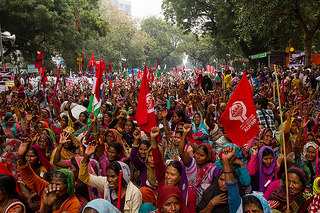
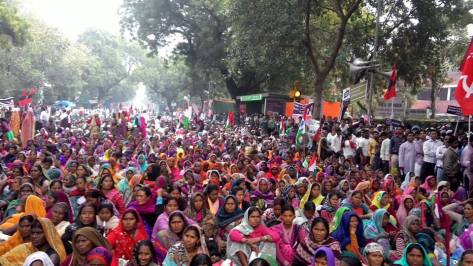
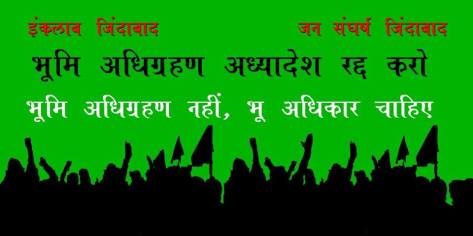
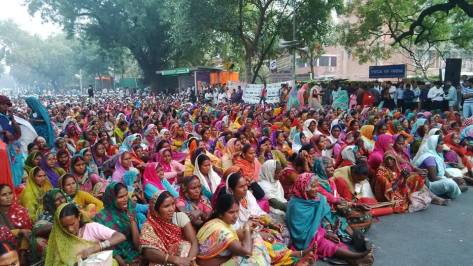
Forcible land acquisition has always been an issue of life and death for millions of people in India, not only farmers but also agricultural laborers and fish workers. With the Land Ordinance it has become a political hot potato. More than 350 people’s organizations gathered at Parliament Street on February 24th, with 25,000 people from Gujarat to Orissa to Assam, and from Himachal Pradesh to Tamil Nadu and Kerala. This show of strength has forced the political parties to take a stand on the issue, leading to heated debates and discussion on the floor of the Parliament. The Ordinance, now Bill, reflects the anti-farmer and anti-poor move of un-democratically amending the 2013 Act on Land Acquisition and Rehabilitation, killing its very spirit and purpose.

The Ordinance brought in by the NDA government just after the Winter session of the Parliament came to an end was an obvious imposition on the country’s common people, of the colonial legacy of a perverted vision of development through an unjust and undemocratic modus operandi. The Ordinance is an attempt to open up the land that is the life support, source of livelihood and shelter for India’s toiling masses, to wealthy investors, including big corporations and builders. Its intention is to forcibly divert India’s agricultural land at the cost of food security, giving a free hand with no ceiling to the private companies as well as private entities i.e. private trusts and expensive profit-making educational and health institutions. The intention is to benefit private interests in the name of public interest.
Continue reading The Land Ordinance (now Bill) is Bringing Back the Colonial Legacy: NAPM

Massive protests against Land Acquisition Ordinance at Jantar Mantar

For updates on the protest, visit Abki Baar Humara Adhikar

11017480_669849169804507_5254527374248079527_n


poster


women

Images courtesy Abki Baar Humara Adhikar

War and the Lightness of Being Adivasi – Security camps and villages in Bijapur, Chhattisgarh: PUDR

Report produced by PEOPLE’S UNION FOR DEMOCRATIC RIGHTS

Between December 26th and 31st 2014, a PUDR fact-finding team visited 9 villages of Bijapur district, Chhattisgarh to ascertain reports of arrests, intimidation and harassment, including sexual abuse by security forces who are stationed there to fight the Maoists. Predominantly Adivasi villages, the residents of Basaguda, Kottaguda, Pusbaka, Lingagiri, Rajpeta, Timmapur, Kottagudem, Korsaguda and Sarkeguda, narrated the daily acts of violence and violations committed by armed personnel residing in security camps. Apart from documenting the continuance of ‘area domination’ by the security forces, the report draws particular attention to:

  1. The large number of ‘permanent warrants’ issued against the populace, of which a significant number is declared as ‘absconders’. A rough estimate indicates that as many as 15-35,000 people live under the threat and fear of these warrants in Bijapur alone.
  2. The lawless conduct of the armed personnel and Special Police Officers (SPOs) who routinely raid, beat, loot, detain and compel the Adivasi villagers to perform ‘begar’ (free labour) at the security camps. Instances of sexual torture were also noted.
  3. The impossibility of lodging FIRs against the security forces as against the rising number of arrests of villagers who languish in jails. Continue reading War and the Lightness of Being Adivasi – Security camps and villages in Bijapur, Chhattisgarh: PUDR

A Chance for Social Change Like Never Before: Shankar Gopalakrishnan

Guest post by SHANKAR GOPALAKRISHNAN

For those who don’t like Modi-Sangh politics, February 10th was a day of joy. When this note was drafted a month ago, the provisional title was “This is No Time for Despair.” But last Tuesday has not only dented Modi’s invincible image – it has also dented the sense of being besieged. Since May 2014, almost every progressive force in the country has been on the defensive. The AAP’s politics and the popular tsunami that drove it to power have shattered this gloom.

But the key question at this point – is the eventual defeat of the NDA in an election the only goal? I argue that here that that is just the beginning. The end of this period – which, notwithstanding February 10th, is obviously some time away – will offer a space that has not existed in Indian politics in decades. Whether that space gets used or not will depend on how the struggle develops in the interim period.

The potential of this period is rooted in three basic flaws that the current ruling coalition (between big business and the Sangh) suffers from. First, its key forces are fundamentally myopic and delusionary in character. Second, it is internally contradictory – the two pillars of this formation will undercut each other in organisational (not just political or rhetorical) terms. Finally, it embodies a peculiar combination of organisational strength and political weakness. Continue reading A Chance for Social Change Like Never Before: Shankar Gopalakrishnan

AAP Victory and the Challenges of a New Politics

Let me say it once again, the AAP victory cannot be understood outside the post-ideological moment. I have argued earlier on Kafila (here and here), that one of the key features of AAP was its post-ideological character – one that moved relentlessly beyond many verities of 20th century ideologies and binaries like state versus market, or religious/communal versus secular and so forth. To reiterate, this formation represents the spirit of the moment that is itself post-ideological.

At Ramlila maidan, courtesy New Indian Express

But it is also time perhaps, to underline that post-ideological does not mean post-political. At least, not any longer. There is no doubt that a politics of AAP is gradually and clearly coming into view – but it is a politics whose edifice is being built from the bottom up. It does not derive from any settled ideological blueprint that comes ready-made – a blueprint around which a politics is then sought to be constructed. That was the project of all 20th century ideologies, which had already divided the world into neat camps and made the divisions into permanent battle lines. Ideologies became repositories of Truth – universal and unchanging, taking away from politics the very contingency and fluidity that defines it. Ideology, in other words, was fundamentally anti-political. In parenthesis, it may be relevant to point out that that is why, perhaps, Marx himself celebrated the Paris Commune by underlining that the workers “had no ideals to realize, no blueprints to which the world must conform”; they merely had to set free the new forces that were challenging the old order. Socialism in the 19th century was not yet an ideology in that sense. Continue reading AAP Victory and the Challenges of a New Politics

Fact-Finding Committee on Lay Offs at Tata Consultancy Services Releases Report

The following is the text of the report released by the Fact Finding Committee that investigated the issue of lay-offs at the Tata Consultancy Services. The committee, which released its report on 6 February in Chennai, consisted of the following members:

Fact finding committee press conf , Chennai

Mr. BRP. Bhaskar, Senior Journalist and Human Rights Activist, Thiruvananthapuram;

Dr. M.Vijayabaskar, Assistant Professor, MIDS, Chennai;

Adv. Bobby Kunhu, Legal Expert, Salem;

Ms. Chandrika Radhakrishnan, Software Professional and Labour Rights Activist, Chennai

Continue reading Fact-Finding Committee on Lay Offs at Tata Consultancy Services Releases Report

Murdering Democracy in Kerala : the Latest

Secularism and socialism can be thrown out, so says the Hindutvavadi. Among those who protested against this suggestion were, of course, the Congress. But then, increasingly, many of us who live in  Congress-ruled Kerala are unable to tell the Congress from the BJP as they have thrown out not just secularism and socialism but even minimal forms of liberalism. For our rulers seem as adamant as the BJP in forcing down our throats at least a softer version of Hindutva, reinforced with protection to shameless plunder of public resources and repressive police measures. Now young people and activists in Kerala, many of who were active in many protests including the Kiss Protests, are being pursued and hounded by the police. Apparently, a few people who participated in the latest edition of the Kiss Protests, the Lovefest, were hounded by the police for having been seen in the vicinity of a police station repeatedly! The most convenient excuse is pursuing the Maoists, a fear that is easily excited in our fattened and lazy middle classes. By the way, I am actively considering saving some money by ending my subscriptions to newspapers. In fact it is not being on FB which makes me feel out of touch with the world these days. Two leading human rights activists, Thushar Sarathy and Jaison Cooper, have been arrested and the papers are busy covering that shameful and utterly criminal waste of our common resources, the opening ceremony of the National games.

I am not surprised at all, having been an observer of local politics. In Kerala, after the Left-Right differences in politics came to an end, what we have seen is the transformation of our politics into a neofeudal space inhabited by powerful male leaders and their craven followers vying for power. Because the discourse of social development still lingers and the oppositional civil society has not yet given up, entry of predatory capital from national or global sources has not been easy. However, a whole generation of NRI — Malayali –capitalists based in the Gulf countries who essentially manage the wealth of the rulers there have been able to enter Kerala unimpeded.It is this group which is increasingly taking over our resources in overt and covert ways, legally and illegally. These capitalists themselves are interesting — their transnational belonging needs to be studied. They have apparently managed to become part of the non-democratic political systems in the Gulf countries, entering the lower levels of the court there, as juniors who help manage the rulers’ wealth. And from that position of strength, they now work to systematically undermine everything that Malayalis hold dear : our welfarist democracy, social development achievements, our rich ecology. Continue reading Murdering Democracy in Kerala : the Latest

Modi, Barack and a once sovereign nation

The sheer misery, the excruciating embarrassment, of  watching the Prime Minister of a sovereign (but not secular or socialist) nation desperately, inappropriately, capering about to show off his imagined intimacy with an American President who steadfastly kept his distance and his dignity, is now passing. Time does heal all wounds. (And hopefully, as Groucho Marx put it, Time will also wound all heels) [1]

But the burning question remains – is Modi more shameless than he is ignorant? Much has been said about Modi’s suit that exceeds the worst excesses of the late unlamented Marie Antoinette. Vrinda Gopinath points out:

While the last world leader to don such a suit (it costs around 15,000 sterling pounds or Rs 15 lakhs today) was deposed Egyptian tyrant Hosni Mubarak, it certainly out-dazzled Obama’s working dark grey suit (to cut down on non-vital decisions, the US Prez only wears grey and blue ). However, if Modi was thinking hip-hop bling and ice accessories (his fave diamond Movado watch), it certainly got Obama to make a mention at the President’s banquet when he foxily pointed out how a newspaper back home wrote, “Move aside, Michelle Obama. The world has a new fashion icon.” It must have not passed Obama’s notice that Modi had changed his attire thrice that day.

securedownload

Continue reading Modi, Barack and a once sovereign nation

Climate Change – Keep the Climate, Change the Economy: Sagar Dhara

Guest post by SAGAR DHARA

Contrasting outcomes of recent global warming meetings

Two recent meetings on global warming, one scientific and the other political, are of great public interest as they have a bearing on human society’s future course to become a sustainable global community. The meetings stand in sharp contrast with each other in terms of the clarity of their outcomes.

The first meeting was held by the Intergovernmental Panel on Climate Change (IPCC), a body of over 2,000 scientists. IPCC released its fifth assessment’s synthesis report in Copenhagen end-October 2014. The report states unequivocally that “Human influence on the climate system is clear.” Further, it warns that the emission of another 1,000 Giga tonnes1 (Gt) of carbon dioxide (CO2), referred to as the carbon space, is likely to raise average global surface temperatures by 2oC above pre-industrial times. This is considered dangerous to the environment and human society.

Since the industrial revolution began in the mid-18th Century, humans have used 35% of the known 1,700 Gt of conventional fossil fuel reserves, and cut a third of the then existing 60 million km2 of forests to emit 2,000 Gt CO2. The consequent 0.85oC average global temperature rise over pre-industrial times has triggered significant changes in the physical, biological and human environments. For example, rainfall variation has increased, extreme weather events are more frequent, pole-ward migration of species is noticeable and their extinction rate is higher, human health, food and water security are at greater risk, crop yield variations are higher, a 19 cm mean sea rise and a 40% reduction in Arctic’s summer ice extent have occurred over the last century, glaciers have shrunk by 275 Gt per annum in the last two decades, and social conflicts have increased. Continue reading Climate Change – Keep the Climate, Change the Economy: Sagar Dhara

Where Have all the Swings gone?

School kids hold up a sign given to them by activists at a demonstration at Langata Primary Road School.Photo Courtesy : Brian Inganga/AP

Who ‘stole’ our playground ?

There are occasions when simple questions raised by innocent people – even by kids – invite brutal wrath of the authorities. The kids of Langata Road Primary School in Nairobi learned it a very hard way.  Back from Christmas vacations when they found that the playground of the school – which provided them enough space to unwind themselves – has just ‘disappeared’ behind ‘iron walls’ with security people guarding it, they had raised this simple question. Sympathetic teachers had told them that a dominant politician in Nairobi, who wanted space to park cars of people visiting a neighbouring mall owned by him, has ‘taken over’ their playground.

Definitely it was not an unusual event – at least in Nairobi which happens to be one of the fastest growing real estate markets in the world – where real estate mafias are so powerful that with the connivance of political masters they are able to ‘acquire’ vacant or unmarked land plots without much difficulty. And land belonging to public schools is considered ‘under threat’ of land sharks as it is not properly delineated to them.

But nobody could have predicted that the kids in Langata School would prove to be biggest stumbling block in their ‘peaceful’ expansion and would literally ‘make history’. As rightly pointed out by an analyst these kids did what ordinary Kenyans are rarely able to do: defend disappearing public space. Continue reading Where Have all the Swings gone?

Farmers’ Suicides and Fatal Politics: Vasanthi Srinivasan

Guest Post by VASANTHI SRINIVASAN

With depressing regularity, the newspapers have been reporting farmers’ suicides in many states. Recently, P Sainath wrote on BBC that around 296,438 farmers have committed suicide since 1995. He also mentions that cash crop cultivators of cotton, sugar cane, vanilla, pepper, groundnut etc account for the bulk of those suicides. According to a PIL heard by the Supreme Court in December 2014, around 3146 farmers in Maharashtra have committed suicide this year. Of course, farmer’s suicides only account for a fraction of all suicides reported in India. Besides, farmer’s suicides are a global phenomenon. The litany of woes is also familiar to readers, namely rising indebtedness, crop failures, falling prices, natural disasters etc.

And yet the meaning of these suicides, if any, is worth reflecting upon.

Politicians, who are used to massive debts, seem to think this is an ‘extreme step’ on the part of farmers. In 2003, the then Union Minister for Agriculture hinted that indebtedness alone may not be causing the ‘extreme step’, and that ‘family problems’ may also be a reason. In Karnataka, the Veeresh committee report had earlier identified depression, alcoholism and marital discord rather than the rising debt as the relevant causes. Never one to lag behind, the hi-tech Chief Minister of Andhra Pradesh Chandrababu Naidu  announced compensations and proposed to get psychiatrists to rural areas. One scholar has pointed to the increasing isolation of cultivators and high levels of anxiety about failure suffered by some farmers [1]. These attempts at ‘personalizing’ the farmers’ problems may be necessary but not sufficient as long as other factors remain unexplored – increasing cultivation costs, crop failures, water shortages and falling product price. Citing the high figures of suicides (204) in Maharashtra for 2014 until April, followed by Telangana (69 until October), the Times of India  (dated Nov 26, 2014), reported that the present Central government admitted indebtedness as a possible factor.  There are also calls to increase monetary compensation to families affected by such suicides.   Continue reading Farmers’ Suicides and Fatal Politics: Vasanthi Srinivasan

The Other America: Martin Luther King

January 19th was Martin Luther King Day. To honour him, here is the recording of his famous The Other America speech at Stanford in 1967.

Too many, far too many tragic resonances with 21st Century India. 

There are literally two Americas. One America is beautiful for situation. And, in a sense, this America is overflowing with the milk of prosperity and the honey of opportunity. This America is the habitat of millions of people who have food and material necessities for their bodies; and culture and education for their minds; and freedom and human dignity for their spirits. In this America, millions of people experience every day the opportunity of having life, liberty, and the pursuit of happiness in all of their dimensions. And in this America millions of young people grow up in the sunlight of opportunity. But tragically and unfortunately, there is another America. This other America has a daily ugliness about it that constantly transforms the ebulliency of hope into the fatigue of despair. In this America millions of work-starved men walk the streets daily in search for jobs that do not exist. In this America millions of people find themselves living in rat-infested, vermin-filled slums. In this America people are poor by the millions. They find themselves perishing on a lonely island of poverty in the midst of a vast ocean of material prosperity.

The one difference being that in 21st Century India, there are lonely islands of prosperity in the midst of a vast ocean of deprivation, human misery and injustice.