Category Archives: Capitalism

Of Dirt and Cleanliness – Swachh Bharat Abhiyan: Nityanand Jayaraman

Guest post by NITYANAND JAYARAMAN

108544214-defecation_6The Swachh Bharat Abhiyan (Clean India Campaign) is powerful in its simplicity, and problematic for the same reason. The absence of complexity in the presentation of the campaign, and the inherent contradictions between Modi’s consumerist growth agenda and SwachhBharat’s objectives fuels my skepticism and raises many questions: Which parts of India will be cleaned, which not and why not? What will we do with the wastes we remove? Where will we put it?

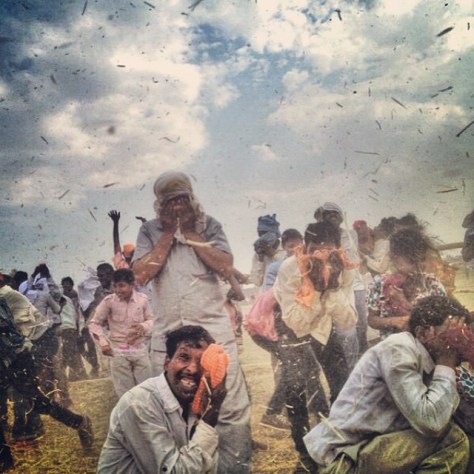
If cleanliness is to be the result, dirt would have to be the starting point. In a 1966 classic called “Purity and Danger,” anthropologist Mary Douglas points out that “If we can abstract pathogenicity and hygiene from our notion of dirt, we are left with the old definition of dirt as matter out of place. . .It implies two conditions: a set of ordered relations and a contravention of that order.”

Cleanliness is a loaded word particularly in the Indian context with a notion of caste that is fine-tuned around social and physical interpretations of pure and impure, clean and unclean. Cleanliness, in this context, can be achieved by keeping the clean and the unclean separate.  Continue reading Of Dirt and Cleanliness – Swachh Bharat Abhiyan: Nityanand Jayaraman

‘Red Carpet’ in Forests: Kamal Nayan Choubey

Guest post by KAMAL NAYAN CHOUBEY

16737_32027

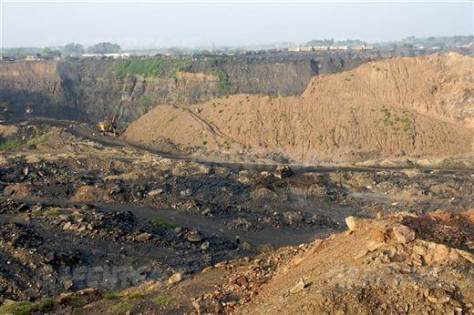
View of the Rajapur Mining Project in Jharia from Bokahapadi village

The Narendra Modi led National Democratic Front (NDA) government had promised, even before its inception, to increase investment in the country and lay down the ‘red carpet’ for investors and corporates. The process of fulfilling that promise started with the formation of NDA government and under the leadership of Mr. Prakash Javadekar, the Ministry of Environment and Forest (MoEF) working overtime to ensure huge investment in the forests for the high growth rate of the economy. Within hundred days of the formation of the government MoEF has given environmental clearance to 240 of 325 projects that had been in limbo as the previous government slowed down the process of giving clearances to various projects due to a variety of reasons. The Government has estimated that these clearances would lead to the investment of 200,000 crore rupees and it would help to revive the economy. In this whole process, the Forest Advisory Committee (FAC) decided on the diversion of 7,122 hectares of forest land into revenue land for the various development projects. It is pertinent to ask, has Modi Government followed the procedure established by law while taking these decisions? Are these decisions in consonance with the promise BJP made to the tribal population, of more decentralized power? Could these decisions empower those communities who have been facing historical injustice from both colonial and post-colonial Indian state? Can we say that this kind of development model would work as a long term strategy to control Maoist violence in the most of the tribal dominated forest areas? Continue reading ‘Red Carpet’ in Forests: Kamal Nayan Choubey

Indian tea is laden with pesticides: Greenpeace India

downloadTrouble Brewing – Pesticide Residues in Tea Samples is the result of an investigation carried out by Greenpeace India to understand the situation concerning the use of pesticide usage in tea, which is a quintessential part of Indian culture and critical to the economy. The study has found residues of hazardous chemical pesticides in a majority of samples of the main brands of packaged tea produced and consumed in India. Over half of the samples contained pesticides that are ‘unapproved’ for use in tea cultivation or which were present in excess of recommended limits. The report underscores possible implications for health and the environment, which is both unnecessary and avoidable. While it highlights the fact that the tea industry is stuck on a pesticides treadmill, it suggests that tea companies, which are critical stakeholders in the tea industry, take the necessary steps in moving away from pesticides while adopting a holistic approach is best way forward. Continue reading Indian tea is laden with pesticides: Greenpeace India

Fast Track to Troubling Times: The Ghadar Alliance

1400132554-1045_1

A promise fulfilled? File photo from scroll.in of what was left in the wake of Modi’s helicopter on the election campaign trail (Image by Ravi Mishra)

The first 100 days of the Modi government points to emergent disaster, says this report by The Ghadar Alliance, a US-based educational/watchdog coalition created by concerned citizens in the wake of the BJP victory. The report points to the Economy, Religious Extremism and Human Rights as areas of biggest concern, and is released on the eve of Modi’s visit to the USA as Prime Minister of India.

The entire report can be downloaded at Fast Track to Troubling Times.

In a press release, The Ghadar Alliance said:

The report is the first independent ‘people’s’ report to be published since Modi came into office, and identifies the economy, religious extremism and human rights as grave areas of concern. Continue reading Fast Track to Troubling Times: The Ghadar Alliance

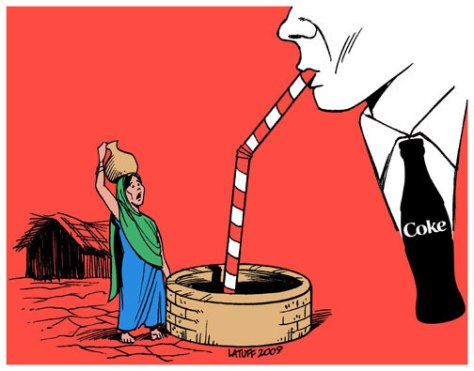
Narmada waters for Coca Cola – really, how much more development can we take?

cokeindiaFarmers who have for three decades non-violently protested the brutal ousting from their lands for the dam project on the Narmada river have been castigated for being anti-development. The dam would bring water to the thirsty, to the parched agricultural lands around it, we were told. Continue reading Narmada waters for Coca Cola – really, how much more development can we take?
The Indian Illusion: Shashank Kela

Guest post by SHASHANK KELA

Some time ago, I wrote an article seeking to dissect certain myths about Indian politics – and the class that dominates it, despite protestations to the contrary, the middle-class.[1] It is one of the habits of this class to see, and self-pityingly portray itself as victim – of mass politics, reservation policies, the great unwashed, of politicos bent upon appeasing the poor at the cost of sound principles and policies. Its conviction, of course, is that India was great, and on the cusp of becoming so again. This unfading glory is no more to be disputed than the existence of the sun, although opinions differ upon the precise placement of our golden age.

To the rabid fanatics of Hindutva, it resides in an unspecified Vedic time, when Hindus (not Indians) mysteriously succeeded in inventing aeroplanes, dynamite, nuclear weapons, the wheel, zero, and what have you (and mysteriously losing most of these wonderful things). To the Nehruvians, it is the age of Akbar, Ashoka, Harsha, periods of syncreticism and unique tolerance, where people of different faiths lived together peacefully and a composite culture flowered. To them, and to Gandhians, it also resides in the figure of Gandhi and the tradition of practical spirituality. To the fanatics of Islam, it is probably the age of Alauddin Khilji, the reign of Aurangzeb, and so on.

The never-ending debate about India’s pasts contains a diversity of opinions; however, on its future destiny, these begin to converge. The RSS and BJP believe, for example, that India is destined to become a great industrial power. So did Nehru, and assorted Indian Marxists. Indeed, it is an article of faith for the burgeoning middle-class (mostly, but not entirely Hindu) that India can, should and will equal China to become a great power, economic and military (thus leaving Japan and South Korea in the dust). Continue reading The Indian Illusion: Shashank Kela

Of Money-in-the-Blood and Blood-Money: Ravi Sinha

Guest Post by Ravi Sinha

Recently, the Indian Prime Minister had occasion to report to the Japanese on his genealogy and haematic chemistry. Addressing a house-full of corporate honchos in Tokyo he declared, “I am a Gujarati, money is in my blood”. One does not know what percentage of Gujaratis would feel insulted by such a description. It can be asked, perhaps more meaningfully, if great civilizations are created by money-in-the-blood types and one may wonder if Gujarati greats such as Narsi Mehta, Narmad, Govardhan Ram or Gandhi, too, had money flowing in their blood.

There is also some irony in the situation – prime minister of a country with the largest number of world’s poor boasting about ‘money in the blood’ to the richest men of a country that has, in the post-war decades, made more money per capita than any other on the planet. This prime minister can be accused of many things but not of lacking in hubris unencumbered by learning and cultivation.

One may wonder about something else too. The Indians may deserve their new prime minister and all his speeches – on the Independence Day, the Teacher’s Day and on all the other days. After all, they have elected him. But what have the Japanese done to deserve this? What forces them, despite the depth and dignity of their civilization, to lap up such crassness and banality?

The answer can be given in one word – money. Continue reading Of Money-in-the-Blood and Blood-Money: Ravi Sinha

A civil-war is on the doorstep of India: Interview with Kancha Ilaiah by Mahmood Kooria

This is a guest post by Mahmood Kooria

We are publishing an English translation of an important interview of the intellectual and academic Kancha Ilaiah, conducted by Mahmood Kooria for the Malayalam weekly Mathrubhumi. While what I see as Professor Ilaiah’s underestimation and perhaps misreading of the historic role of the Communists in Indian politics leaves me severely uncomfortable, especially when he exonerates the right from commensurate charges of elitism, his framing of Hindustva and Modi’s appeal within the great stream of caste in the subcontinent is brilliant and thought-provoking, as always. 

Kooria conducted the interview as well as translated it in to English. His introduction is as follows, “At a time when there was no any such discussion, in 2002 Professor Kancha Ilaiah predicted that Narendra Modi will be the prime-ministerial candidate of Baratiya Janata Party. It has come true and now Modi is in the office. At this point, I talked with him at Moulana Azad Urdu University Hyderabad where he chairs the Centre for the Study of Social Exclusion and Inclusive Policy. In the conversation, he talked about the future of Modi government and he predicted that a civil war is going to break out in India if Modi does not cater the needs of backward classes. A Malayalam-version of this interview was published in the Mathrubhumi Illustrated Weekly (August 24, 2014).”

Mahmood Kooria: Ten years ago you wrote that Modi will be the prime ministerial candidate of BJP. What would be your response as your prediction has come true?

Kancha Ilaiah: Well, at that time I was predicting that based on the Left parties’ indifference to understand the caste question. The caste question is not been seriously taken by the Left parties. And, after Mandal, the BJP and the RSS wings started looking at caste-question seriously because when Babari Masjid was demolished they mobilized a lot of backward classes. Though they oppose Mandal reservation, they wanted the backward classes to be part of the Hindu religion. Around 1994, a non-Brahmin called Rajju Bhaiya became the Sarsanghchalak of the RSS. Then he recruited a large number of backward classes, large number of youth, and he promoted the people like Narendra Modi, Uma Bharati at that time. Earlier, the first backward-class chief minister of Uttar Pradesh was a BJP man: Kalyan Sing. He was the chief minister in 1992 when the Babri Masjid was demolished.

The Sangh Pariwar was responding to the backward class demands more. But the Left or the Congress was not responding to the OBCs. The Congress was responding to the Dalits and Muslims. There was upper caste all the time on the top. So, when Narendra Modi became the chief minister and this whole atmosphere was created, I was writing a column in The Hindu. I thought that this seems to be cause/course of India, since the Hindu religion is surviving because of the backward classes. It is inevitable for the Hindutva organizations that they will have to project an OBC for the prime-ministership. But there was resistance from within itself. It is not that the Brahmins have given up the principle of varna-dharma. After that article came and of course after my writing Why I am not a Hindu itself, the backward classes even within RSS seemed to use that material for their advantage. The communists did not use or recognize it. The question of labour and caste which I have been consistently raising, which was also part of their theory, they did not care about. So the Communist Party remained tightly under the control of upper castes.

Continue reading A civil-war is on the doorstep of India: Interview with Kancha Ilaiah by Mahmood Kooria

If Gail Omvedt is Katherine Mayo, then Sugatha Kumari is …? Thoughts on Salman’s Predicaments

Salman Zalman is a young man from Kerala who has recently been arrested for an alleged act of disrespect towards the Indian National Anthem. As an observer in Kerala, I think young people like him who choose to get involved in public struggles for justice face a number of predicaments that were perhaps not so severe for my generation when we were young. For this reason, I do feel that members of my generation, those of us alive to public issues, need to be more open to the challenges that public-minded younger people face today. Continue reading If Gail Omvedt is Katherine Mayo, then Sugatha Kumari is …? Thoughts on Salman’s Predicaments

Who is guiding Modi’s economic thinking and what is their background?: Aditya Velivelli

Guest post by ADITYA VELIVELLI

The Modi government’s actions over WTO are a case of much ado about nothing. They have pointedly created a false perception over a non-issue so as to appear pro-poor. Modi said “Do we choose feeding our poor or getting good press world-wide?” Turn this statement around and one gets to see the truth of the matter. The real attempt here is “How to masquerade as pro-poor and get good press in India by using WTO?”

This demonstration of concern for the poor helps Modi’s government in implementing ultra-neoliberal economic policies in the coming months. To understand the game-plan one should only look at the people guiding Modi’s economic thinking. Continue reading Who is guiding Modi’s economic thinking and what is their background?: Aditya Velivelli

How Goldman Sachs Got it Wrong on Football, The World Cup and Economics: Tushar Dhara

Guest Post by TUSHAR DHARA

In May this year the investment banking powerhouse Goldman Sachs released a report that predicted Brazil would win the FIFA world cup. The prediction relied on statistical modelling and used tools like “Regression Analysis”, “Poisson Distribution”, “Stochastic model” and “Monte Carlo Simulation”. In other words, the methodology is incomprehensible to anyone except those with an advanced degree in Statistics or Econometrics. In hindsight, the prediction looks silly, given the 7-1 score line in the semi-final match between Germany and Brazil. However, the report is a perfect example of the failures of modern economics, particularly the financial voodoo economics pushed by the likes of Goldman Sachs.

When “The World Cup and Economics 2014” was released on May 27 it gained a lot of press publicity globally. The report predicted that Spain would reach the semi-final stage and lose to Argentina, which would lose to Brazil in the final. Goldman’s research division analyzed reams of data, including about 14,000 matches since 1960, national teams’ Elo rankings, average goals scored per team, home country and home continent advantage. To be sure, the report states that the predictions are just “probabilities” of teams advancing. Still the report states, “The most striking aspect of our model is how heavily it favours Brazil to win the World Cup”, and, “the extent of the Brazilian advantage in our model is nevertheless striking.” Continue reading How Goldman Sachs Got it Wrong on Football, The World Cup and Economics: Tushar Dhara

Lobbying for a tax-free banana republic: Aditya Velivelli

Guest Post by ADITYA VELIVELLI

POST-BUDGET UPDATE ADDED AT THE END OF THE POST (JULY 12, 2014)

Consider that an individual bought a house in 1992, made a few modifications, added a garden etc. and rented it out for the next 15 years. This would have brought the individual a steady stream of income over that 15 year period.  In 2007, the individual decides to sell the house and it fetches a much larger sum than it was bought for (considering real estate prices went up quite a bit during 1992-2007). The income tax department sends a bill for 20% of the sale price. This is the long term capital gains tax and applies to both residents of India as well as non-residents.

Now consider this.

In 1992 the Hutchison Group of Hong Kong invested in the Indian mobile telecom industry through a joint venture later named Hutchison Essar Ltd or HEL. By 2006, Hutchison expanded its presence into 23 mobile telecom circles.

In 2007, the Hutchison Group’s 67% controlling interest in HEL was indirectly sold to Vodafone for an amount of USD 10.8 billion. This transaction occurred through Vodafone’s purchase of shares in a Cayman Islands (offshore) entity. It was a calculated attempt by Hutchison and Vodafone to avoid paying tax on capital gains. Continue reading Lobbying for a tax-free banana republic: Aditya Velivelli

An Endless Budget Session, Even Before it Begins: Shambhu Ghatak

Guest post by SHAMBHU GHATAK

“You can fool some people some times but you can’t fool all the people all the time”

So goes one of the famous lines of Bob Marley’s song that draws upon statement by Lincoln. Perhaps the same can be said about the new BJP government because it seems that this time there will be nothing new left to be presented during the upcoming Union Budget. Most of the things to be presented by the Finance Minister have gradually been placed even before the actual budget could see the light of the day (on 10 July). In fact, the entire stretch since the Government took power can be termed as a long, extended budget session – a session in slow motion.

Just think about the policy decisions announced or showcased by the new Government so far—allowing 100% foreign direct investment (FDI) in defence sector (to boost technology transfer and employment growth, so to speak); reforming environmental clearance (to avoid discrepancies, end red-tapism and ensure transparency) by making the process online; raising import duties on sugar by more than double and extension of existing sugar export subsidy of Rs 3,300 per tonne (to help the sugar mills) till September besides raising the mandatory level for blending cane-based ethanol in petrol from 5% to 10%; allowing hike in price of non-subsidized cooking gas (LPG) by Rs 16.50 per cylinder (which is partly attributed to the crisis situation in Iraq); and raising train fares by 14.2% & freight rates by 6.5% in the month of June prior to the just-presented Rail Budget, among other things. Continue reading An Endless Budget Session, Even Before it Begins: Shambhu Ghatak

FDI in E-commerce – Under cover of the ‘honeymoon’ period: Aditya Velivelli

Guest Post by ADITYA VELIVELLI

Although Mr. Modi has said that he has not had the luxury of a ‘honeymoon’ period, recent news headlines say otherwise. For instance PTI carried this headline on June 7: “Modi hailed as new ‘fashion icon’ by American media” and Christian Science Monitor has “Modi 2.0: How India’s new prime minister may have evolved” without waiting to evaluate Mr. Modi’s performance over the coming months.

One should look beyond these headlines to see what the new Government is up to under cover of the ‘honeymoon’ period.

Reuters reported on June 4 that the Modi Government will be allowing FDI in online retail or business to consumer (B2C) e-commerce during the upcoming budget session in July. FDI in e-commerce would mean foreign entities such as Ebay, Amazon and Walmart can start selling their inventories directly, and can have their own supply chains. No comment or analysis has been offered by the news media or the opposition parties so far. Neither was attention paid to the multiple instances of opposition from retailers body CAIT. Continue reading FDI in E-commerce – Under cover of the ‘honeymoon’ period: Aditya Velivelli

From Baghdad to Bolangir – Labour Laws in India: Saba Sharma

Guest post by SABA SHARMA

From the crisis in Iraq, a story is emerging of 40 construction workers in Mosul who have gone missing, some reports claim because they were trying to escape from the city and were captured by militants in the process. Many of these workers, feared kidnapped by ISIS, refused both their employers’ and the Indian government’s help to evacuate, as many have not been paid up to five months’ wages. Another report reveals that a group of 46 nurses from Kerala, working in a hospital in Tikrit, have refused to leave despite an offer from Delhi to help them evacuate. They need the money, as do their families back at home, so they would rather move to a safe zone in Iraq than return. Two nurses in the same hospital, who are on holiday in India, told the BBC that they would return despite the travel advisory issued by India advising citizens not to travel to Iraq. For them, failing to return means defaulting on loans taken to pay recruitment agents.

A few days before, on June 16, the NDA government announced that it was looking at liberalizing labour laws, primarily to make easier the retrenchment of workers. The UPA, and former PM Manmohan Singh in particular, also had labour law reform as an agenda, propelled by constant laments from industry saying ‘obsolete’ labour laws hindering growth and holding back the economy. The Vansundhara Raje government is already amending some state-level acts in Rajasthan to ‘liberate the corporate sector from the shackles of stringent requirements of the laws’, as one report put it.

Continue reading From Baghdad to Bolangir – Labour Laws in India: Saba Sharma

When Are Foreign Funds Okay? A Guide for the Perplexed

The Intelligence Bureau has, as we know prepared a document, updating it from the time of the UPA regime (which had reportedly started the dossier) indicating large scale foreign funding for subversive anti-development activities. Such as claiming that you have a greater right to your own lands and to your livelihood than monstrous profit-making private companies. Or raising ecological arguments that might stand in the way of the profits to be made by private corporations and the corrupt state elite, from mining, big dams, multi-lane highways and so on.

The IB report, signed by IB joint director Safi A Rizvi — alleges that the “areas of action” of the foreign-funded NGOs include anti-nuclear, anti-coal and anti-Genetically Modified Organisms protests. Apart from stalling mega industrial projects including those floated by POSCO and Vedanta, these NGOs have also been working to the detriment of mining, dam and oil drilling projects in north-eastern India, it adds. 

Imagine – working against the interests of POSCO and Vedanta! Is there no end to the depraved anti-nationalism of these NGOs!

These folks must have made millions of dollars

narmada

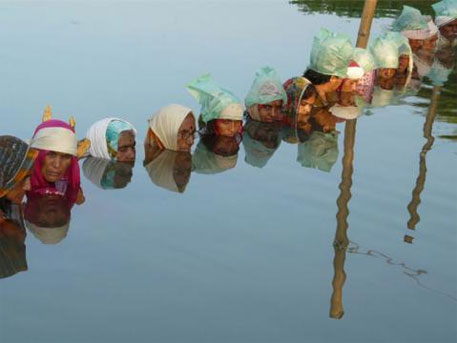
In 2012, people affected by the Omkareshwar and Indira Sagar dams protested the raising of dam storage levels by staying in neck-deep water for over a fortnight (Photo: Narmada Bachao Andolan). 

The average observer of Indian politics – being like me, not as sharp as the IB – might be a little befuddled by this apparently anachronistic allergy of two successive governments and its intelligence gathering organization, towards foreign funding, in an era in which the slightest slowing down of the pace of handing over the nation’s resources to multi-national corporations,  is termed as “policy paralysis”, and attacked as detrimental to the health of the mythical “Sensex”. Older readers might remember that the  inspiring slogan of the legendary Jaspal Bhatti’s Feel Good party was Sensex ooncha rahe hamara.

This post is just to help you figure out then, when it is Okay to applaud foreign funding and when it is not – because otherwise you might post something on your FaceBook page that attacks foreign funding when it is actually Okay – and then how stupid and anti-national you’ll look.   Continue reading When Are Foreign Funds Okay? A Guide for the Perplexed

Airing the unheard from Polavaram: Mohammed Omais Shayan

Guest post by MOHAMMED OMAIS SHAYAN 

As the Nation is welcoming its 29th state, Telangana is upbeat with hope of starting a new chapter of progress. Amongst the jubilations in Telangana, voices of people affected by the Polavaram dam are being lost. “Dam’ned”, a film by Saraswati Kavula is an attempt to air the unheard voices. It’s a must watch for all concerned as the movie touches the links of people, land, livelihood and development. The film aims to bring ground realities through interviewing the people of the affected region, technical and environmental experts. Before getting into content of the film, a very brief introduction of the project.

Polavaram project is going to be the largest dam in terms of number of people being displaced. The dam will be constructed at Polavaram village in West Godavari district of Andhra Pradesh. The dam aims to irrigate 2910 km2 of area in Andhra Pradesh [1]. It will also provide drinking water to Vishakapatnam City and many villages besides water for industries in Vizag. The project aims to transfer 80 TMC water from Godavari to Krishna basin. The dam will submerge 300 villages of Andhra Pradesh, Chattisgarh and Orissa. This submergence area will cover 3,500 acres of biodiversity rich forest and also partially submerge the Papikundulum wildlife sanctuary [2]. The people living in these areas are predominantly ‘adivasis’ belonging to Koya and Konda Reddy tribes.

Continue reading Airing the unheard from Polavaram: Mohammed Omais Shayan

Ideas to Occupy Economics – A Note on Michal Kalecki: Pranjal Rawat

Guest post by PRANJAL RAWAT

A revolution of sorts is on the cards for the students of economics amidst a great surge of international support for radical restructuring of the subject and its pedagogy. From the politically incorrect ‘Non-Autistic Economics’ movement to the Post-Crash Society in Manchester to the Jadavpur University Heterodox Economics Students’ Association (JUHESA) in Kolkata we see an underlying common theme. The narrowness of the neoclassical economics is being criticized. Take for instance what the preamble of JUHESA has to say about Neoclassical Economics, “Students have rightly found it appalling that a theory which could neither predict nor suggest remedies to the biggest recession in more than half a century, continues to be taught as the sole approach to economic analysis the whole world over.” This so-called revolution will remain just a source of media income and wash over without changing much, unless scholars of economics take it upon themselves to destroy the inertia and raise arms against the old order. Revolutions exists only in retrospect, the rest is all popular gossip. For that purpose, it would do well to draw strength from the life and work of Michal Kalecki (1899 – 1970), a post-keynesian economist, whose work has remained relevant for a period longer than it took for American economy to recover from the Great Depression only to crash in the Great Recession. Continue reading Ideas to Occupy Economics – A Note on Michal Kalecki: Pranjal Rawat

Looking back – and forward – from Modi’s election: Shashank Kela

Guest post by SHASHANK KELA

So now the gloves are off. For the BJP, that is, whose victory in these elections gives India not only its most right-wing government, but, more to the point, a prime minister to the right of his party – more laissez faire, openly contemptuous of minorities, authoritarian in style. What the party, and Narendra Modi, will make of its – and his – comprehensive victory will soon be apparent, but the omens are far from good. Working in a coalition and under the supposedly moderate leadership of Atal Behari Vajpayee, the BJP between 1998 and 2004 achieved quite a lot – not just in the cultural wars that are its forte, but also in terms of putting economic “reform” on steroids. Now that it is being advised by that distinguished dispenser of received opinion and tireless self promoter, Dr Jagdish Bhagwati – an economist whose ignorance of history and the methods through which economic development was actually achieved in almost every successful industrial economy from Great Britain in the 16th and 17th centuries to South Korea in the 20th (cue: protectionism and lots of effective government intervention) is stupendous even by the low standards of the discipline – all bets are off. Continue reading Looking back – and forward – from Modi’s election: Shashank Kela

Dead Men (of Gujarat) Tell No Tales: Madhumita Dutta and Jagdish Patel

Guest Post by  MADHUMITA DUTTA AND JAGDISH PATEL 

Amidst a plethora of articles published, trying to explain Mr Narendra Modi’s nation-wide popularity leading to BJP’s eventual electoral win in the 2014 parliamentary elections, a column by Mr Swaminathan S Anklesaria Aiyar in Times of India caught our attention. In his usual style, exuding confidence, Mr Aiyar attributed Mr Modi’s victory in states like Uttar Pradesh and Bihar to “the message carried home by migrant workers in Gujarat”

Apparently Mr Aiyar found his “biggest, credible explanation” (for Modi’s win) while on a pre-election tour in these states where he quizzed the villagers about Modi. Villagers who were otherwise skeptical of the “vultures who came around promising the moon at election time” were swayed by the ‘tales of good governance’ that migrant workers brought home from Gujarat.

While Mr Aiyar doesn’t explain what these ‘tales’ are since he confesses that these are ‘not very detailed or specific’, one wonders who are these migrant workers that Mr Aiyar refers to?  And might it be possible that there are other ‘tales’ that are never fully told by the workers when they come visiting families after long periods of time? Continue reading Dead Men (of Gujarat) Tell No Tales: Madhumita Dutta and Jagdish Patel

The Modi Mandate – A Belated Response to S Varadarajan: Pradip Datta

Guest post by PRADIP KUMAR DATTA

Siddharth Varadarajan’s article raises some very important dilemmas before Modi which is really a rehearsal of the development versus welfare debate now bound to be exacerbated with the runaway capitalism that Modi promises to unleash.

But it raises another important question. Can we simply forget the past and get on with the future? Can we join the futurist chorus of Modi and his Thatcherite – Reaganite followers? Can an electoral mandate, even one as powerful as this, remove permanently the memory of 2002?

The immediate analogy comes with the anti Sikh riots followed by the 1984 verdict. 1984 returns every election to haunt the Congress even after they have made a Sikh prime minister for 10 years. Some historical memories are very stubborn and refuse to leave off the haunting of the future. It is not as if there have not been many riots. But only some riots achieve a historically emblematic status that remove them from the realms of simple memory alone. Some events become symbolic rallying points and they invite an excess of documentation, of witness testimonies, of cultural representations, all of which memorialize and fix them in chronology as a rupture in time that can never quite be bridged by the stitchings or blurrings of popular oral memory alone. In such events the archive becomes memory. Continue reading The Modi Mandate – A Belated Response to S Varadarajan: Pradip Datta