Category Archives: Capitalism

Copyrights versus The Right to Copy – A Normative Perspective: Rajshree Chandra

Guest post by RAJSHREE CHANDRA

For those not familiar with the recent spate of events at Delhi University; and for those who may have missed Lawrence Liang’s post, here’s a bird’s eye view: Impatient with an old gargantuan University’s obsolete ways, the authorities have attempted a make-over. As in all make overs, the old structure is retained but glossed over with cosmetic changes so as to appear ‘new’. So we have new hip courses, new syllabi content for old courses, new reading lists, new reading packages, new exam system, semesters and so on. Making all transitions possible of course, is a team of make-over artists. At one end of the set up are photocopiers like Rameshwari Photocopy Service located within the renowned Delhi School of Economics and Sociology; and at the other end, we the teachers. Reading material – by way of recommended articles, papers, chapters – was provided to the photocopiers by University faculty, who then made copies of them, segregated them year wise and instruction wise. The first page specified the semester for which the reading material was relevant, the ‘max marks’, the course objective and the syllabus all clearly outlined. Only after they were thus meticulously detailed were they spiral bound with the customary blue plastic cover and voila! Teachers and students alike had accessible reading and teaching material for all the new jazzed-up-courses. Emails circulated by departments instructed the college departments to use and recommend these dossiers; phone numbers of relevant photocopiers were given; and before long an entire chain of dissemination of this ‘new knowledge’ was established. It was all ‘official’. But more importantly, it was affordable, effective and terribly efficient. There was just one problem – it was in violation of the copyright law! The Rameshwari photocopiers were the new pirates!

Continue reading Copyrights versus The Right to Copy – A Normative Perspective: Rajshree Chandra
Drugs in 3(d) and What Matters in the Novartis Case at Supreme Court: Dwijen Rangnekar

Guest post by DWIJEN RANGNEKAR

Background

Glivec (called Gliveec in the US) is a drug for chronic myelogenous leukaemia (CML) – a rare and debilitating form of cancer. A Novartis drug, it has been heralded as a sign of pioneering pharmaceutical research. And, no doubt, it is a ‘life-saving’ drug; though, it also has to be taken life-long. Most narratives of the research pathways of Glivec gloss over the 40+ years of publicly funded and conducted research that isolated the cause, a BCR-ABL oncogene, and performed the initial clinical research that identified a promising candidate (STI 571 – imatinib mesylate). Novartis, the Swiss-headquartered pharma transnational, proceeded to synthesise and test STI 571, which in 1993 was patented. Further research found that a beta crystalline form of imatinib mesylate was more stable – and this was also patented (in 1997) and approved in the US in 2001. In 1998, a patent application for this beta crystalline form was filed in India – and this is in dispute here.

Section 3(d) is a provision in India’s patent law – and is unique to India; though, as explained in the article, it reflects a wider authorship of global public concern. The section was introduced in the third amendment to Patent Act, 1970 (i.e. The Patents (Amendment) Act, 2005) when India was fulfilling its final commitments to patent-related obligations at TRIPS. Written in technologically neutral language, 3(d) seeks to deny the availability of patents where a ‘new form of a known substance … does not result in the enhancement of the known efficacy of that substance’. This, along with other provisions, would hopefully make it more difficult to patent trivial and incremental modifications to a drug; thus, extending patent terms and delaying entry of generic alternatives. Continue reading Drugs in 3(d) and What Matters in the Novartis Case at Supreme Court: Dwijen Rangnekar

Notes from the warfront: Maruti workers ‘on trial’: Rakhi Sehgal

Guest post by RAKHI SEHGAL

Friday, 17 August 2012  – Gurgaon Civil court

There is a ‘list of 162’ workers that has not been disclosed but which forms the basis for the police to either arrest or let go of Maruti workers once they are picked up. The family members of these 162 are being harassed and intimidated and being visited thrice a day by local police, sometimes accompanied by Gurgaon police – at times 12-15 police show up.

After they pick up one of the workers (who is on this list of 162) he is processed as an accused under the same FIR 184 under which the union leaders and the earlier batch of 91 workers were arrested.  The FIR names 55 workers and then says ‘500/600 others’, so anyone being picked up is being processed as part of this unnamed 500/600 others.

Under intense questioning by Advocate Rajender Pathak, the SHO Manesar PS, Om Prakash Bishnoi, admitted that the ‘list of 162’ is based on a list given by management. Although Adv. Pathak requested that the judge note this point, the judge did not do so. Instead the judge merely directed that the statements of the SHO are unsatisfactory and has asked him to come back on 22 August with more satisfactory explanations. Continue reading Notes from the warfront: Maruti workers ‘on trial’: Rakhi Sehgal

The Nightmare of the Chaavunilam and the Illusions of Well-Meaning Scholars


Chaavunilam (“Dead Land”)is the title of one of Sarah Joseph’s well-known short-stories in Malayalam. In it she relates a myth of devastation and revival — it describes a scene of terrible devastation through the eyes of the last woman left there, the Mother — who witnesses the terrible violence between her children which leaves the earth shattered, verdure destroyed, and which ends in the death of all the combatants. This is the tale of her immense suffering — she is torn apart by birthing-pains, at the same time as she is devastated by the death of all her children. Continue reading The Nightmare of the Chaavunilam and the Illusions of Well-Meaning Scholars

Of Shopfloors and Newsrooms: Faiz Ullah

Guest Post by FAIZ ULLAH

It’s that time of the year. Newsrooms of television news broadcasters are buzzing. Human Resource (HR) professionals may choose to see it as the culmination of a significant process called performance appraisal, but for young news producers and journalists – a decidedly young species – it’s time to see that overdue promotion or promised increment in remuneration. Sometime during the beginning of last financial year these young professionals must have set up their ‘specific and measurable’ KRAs, or Key Result Areas, by using formulaic proformas sent to them by the HR department. This year, a few months ago they would’ve again got a mail from the HR department asking them to revisit those excel sheets with their line supervisors and have their performances graded on the scale of 1 – 10 or some such. Every story filed, every source cultivated, every special ‘half-hour’ show done must reflect on this document. ‘Domain expertise and knowledge’, ‘integrity’, ‘self-discipline’ and ‘adaptability’ are some of the ‘competencies’ against which the supervisors are required to assess the performance of their subordinates additionally. What don’t find mention on these appraisal forms are day to day frustrations that are part and parcel of a news professional’s job and anxieties that permeate his/her larger lifeworld.

Continue reading Of Shopfloors and Newsrooms: Faiz Ullah

Molecular Socialism – A Possible Future for Left Politics

The end of the twentieth century saw the collapse of soviet-style state-socialism and the beginning of neo-liberalism’s triumphal march, which has ravaged the planet in a little over two decades. The destruction of the earth has proceeded with renewed vigour since, as has the dispossession of the poor. Cities have been re-made for the luxury living of the rich and the upwardly mobile middle classes. And for their luxury, for their ‘free movement’ across the city and beyond, settlements of the poor have had to make way, as shopping malls, freeways and expressways began defining the new imagination of the city.

If it took soviet-style socialism close to six-seven decades to finally face mass rejection, the neoliberal order has taken far less time. Faced with major opposition movements across the Western world, from the Occupy Wall Street movement to the Indignados in Spain and Greece and powerful new political formations in many parts of South America, the neoliberal order no longer seems as unchallengeable as it used to till just some time ago. Its advent on the horizon came as a new kind of theology that brooked no dissent. It came to us apparently telling us some elementary truths about ourselves and the world we inhabit. And it was quite amazing to see the speed with which the new religion gained converts in those early years. Continue reading Molecular Socialism – A Possible Future for Left Politics

The Hooter Marks Time

Each morning, factory hooters call out to India’s 50 million industrial workers, many of whom stand by their stations and repeat a single set of tasks with unerring regularity until the hooter sounds again to signal the end of the first shift and the start of another.  Manufacturing provides employment to just 11 percent of India’s workforce, but the sector and its workers are seen as a bellwether for the economy as a whole.

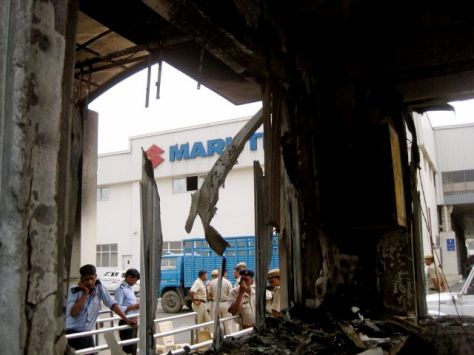
Last week, a senior general manager in Maruti Suzuki’s Manesar plant was killed and several managers injured in a violent confrontation between workers and management, prompting national dailies to speak of the “bad old days of militant trade unionism”.   Yet, industrial unrest is at historic lows in terms of numbers of incidents and man-days lost. In 1973-74, nearly 3,00,000 strikes were called just prior to the Emergency; 2010 saw just 429 such incidents, according to data from the V.V. Giri National Labour Institute.

What accounts for this shift? Has the Indian factory become a safer, better-paid and more secure workplace?

Data suggests the opposite: Today, Indian workers are paid less in real terms than they were fifteen years ago, have less job security, and yet are less likely to strike. Workers in Haryana’s industrial belt suggest that the incident at Maruti Manesar signals the end of the all-powerful union capable of controlling the factory floor, rather than its return. Instead, industry’s reliance on casual workers has created informal leaderless networks that operate outside the framework of strikes and settlements that undergird union activity. Read more

Maruti workers produced in district court: Anumeha Yadav

Guest post by ANUMEHA YADAV

In Manesar 25 July court

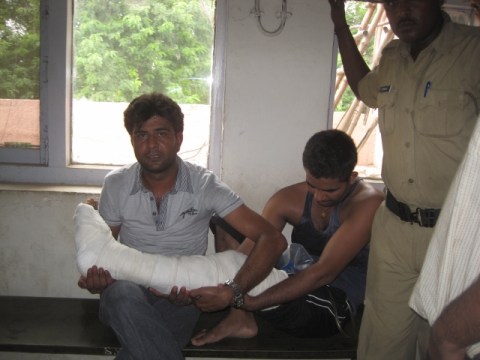
Satbir, a 28 year old worker, was among four workers from Maruti’s Manesar plant produced by Haryana police at the district court in Gurgaon on Wednesday afternoon. Satbir has multiple fractures in his left leg and was taken to the civil hospital from the court room. “I fell while trying to flee the plant. I was in the morning Shift A; we had stayed back because we heard the union leaders were meeting the management to negotiate the reinstatement of a worker,” he recounts. “The violence began after 7 pm, I don’t know why it started. Gate 1 was closed. I feared that I may get attacked in the rioting and the confusion. I and two of my colleagues tried to jump off the back wall but I fell,” he says. Continue reading Maruti workers produced in district court: Anumeha Yadav

The year climate change became common sense: Jacob Sebastian

Guest post by JACOB SEBASTIAN

 Is 2012 the watershed year for climate change? The year it ceases to be a ‘dodgy concept’ and transforms into painful reality?

Some facts to consider:

 *The United States – particularly the food basket that is the American Midwest, is facing its “worst drought” since the 1950s, and is expected to last all summer. US agricultural secretary Tom Vilsack told the media: “If I had a rain prayer or a rain dance I could do, I would do it.” The US is the world’s second biggest food producer, after China, but more importantly, one of the biggest exporters of food.

*Prices of the four key crops: Corn, wheat, sugar and soybean have risen 44%, 48%, 22% and 26% over the last month. The United States produces 41% of the world’s corn and 38% of the world’s soybeans. The two crops comprise two of the four largest sources of caloric energy produced and are thus critical for world food supply. Continue reading The year climate change became common sense: Jacob Sebastian

Resisting Caste Violence – Facing Brutal Repression: NTUI on Maruti-Suzuki

Statement issued by NEW TRADE UNION INITIATIVE on the incidents at Maruti-Suzuki’s Manesar Plant

Dated 19 July, 2012, New Delhi

The present spate of violence at the Manesar plant of Maruti Suzuki as a fallout of a protest by workers against a casteist comment made by a supervisor at a dalit worker reflects the continuing use of ‘caste’ as a method of subordination and oppression reflecting the persistence of deeply rooted primordial structures of society that complement capitalist exploitation. When co-workers protested, the management suspended the abused worker and refused to re-instate him and instead resorted to brutal violence, orchestrated by goons, against the workers and targeting the union leaders.

It is important to note that the Maruti Suzuki management is yet to constitute the Grievance Redressal Committee and the Welfare Committee at its Manesar plant which was agreed upon after the last dispute in October 2011. The present dispute is a well planned instigation by the management to systematically derail the ongoing negotiations on the Charter of Demands submitted by the Maruti Suzuki Workers Union in April 2012 and to discredit the sustained and united struggle of the workers at the Manesar plant. Continue reading Resisting Caste Violence – Facing Brutal Repression: NTUI on Maruti-Suzuki

Some Reflections on Capital and the Workers’ Movement After Manesar

Workers’ Violence and Corporate Violations of Law

It has been a long time in the making. The violence at Maruti-Suzuki’s Manesar plant on 19 July 2012, that led to the ghastly killing of the general manager, Awanish Kumar Dev was waiting to happen. While the killing was gruesome, I believe this is merely a ‘freeze shot’ of a larger film that has been playing for a very long time now. While it is the media’s wont to focus only on these moments of spectacular violence and then dish out reports from handouts provided by managements and the police, sometimes, such moments of conflagration do illuminate what has been in the dark for so long.

What follows below is an attempt to think through some of the issues that seem to me to lie at the bottom of the violent event. The ‘violent event’ here is not simply what took place in Maruti-Suzuki’s Manesar plant now; it is rather a shorthand for the whole series of such conflagrations that have been taking place over the past few years in the National Capital Region (NCR) – starting with Honda Motors and Scooters 2005,  Graziano Trasmissioni 2008, and many others since – Rico Auto Industries, Pricol Ltd and so on. The struggle in Honda Motors that had been brewing for a long time had eventually spilled over into a series of public protests with severe police violence in the full glare of the media. Things have never been the same in the entire belt since. Rico Auto Industries incident in September-October 2009 subsequently became an important milestone – galvanizing as it did a number of other workers’ strikes. There it had started when the workers struck work after 17 of their colleagues had been dismissed ‘on disciplinary grounds’. Actually, the workers rightly felt that this was to quash their attempt to form a union. And while the workers were protesting at the gate, a group of hired goons attacked them, killing one of the workers and injuring many others. In the Graziano Trasmissioni the issue of contention was the reinstatement of 136 dismissed workers which led to a massive unrest in the unit in Greater NOIDA, leading eventually to an incident not very different from the present one. Continue reading Some Reflections on Capital and the Workers’ Movement After Manesar

What set off the violence at Maruti’s Manesar plant?: Anumeha Yadav

Guest post by ANUMEHA YADAV

Photos by Anumeha Yadav

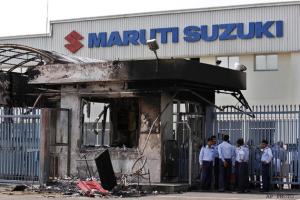
The year-long industrial conflict at Maruti Suzuki India Limited (MSIL), India’s largest automobile manufacturer’s Manesar plant turned violent on 18 July. At 3:30 pm on Wednesday afternoon, representatives from Maruti Suzuki Workers’ Union and the Maruti management had met to discuss the reinstatement of Jiya Lal, a permanent worker who had been suspended that morning after an altercation with his floor supervisor. Lal is a Dalit and alleges that he had reacted when the supervisor made derogatory casteist remarks against him. The workers were protesting that the management had been unfair, suspending Lal from service while merely sending the supervisor home on leave for a few days. Continue reading What set off the violence at Maruti’s Manesar plant?: Anumeha Yadav

Maruti Suzuki Manesar Workers – Casteist Attack and Repression

The following is a statement issued by the Maruti Suzuki Workers’ Union (MSWU) on 19 July following violence and repression at the Manesar plant yesterday.

The Manesar factory of Maruti Suzuki

The Maruti Suzuki Workers Union (MSWU) is anguished at the recent developments in Maruti Suzuki plant, IMT Manesar where the management has resorted to anti-worker and anti-Union activities in a pre-planned manner leading to violence and the closure of the factory yesterday.

We have had a long tough struggle with the strong unity of our permanent and contract workers to establish and register our Union last year, and had recently as of April 2012 submitted our Charter of Demands to the management of Maruti Suzuki, and the process of negotiation for wages and other demands was underway. However the management has done its utmost to derail the process since long and is trying to break the back of the spirit of unity of the workers and the legitimacy of the Union.

Continue reading Maruti Suzuki Manesar Workers – Casteist Attack and Repression

Fallacious perceptions of development – a tribal view from Jharkhand: Richard Toppo

Guest Post by RICHARD TOPPO

Almost a century ago, Katherine Mayo published a book titled ‘Mother India’ that criticized the Indian way of living, and Rudyard Kipling  spoke of the ‘White Man’s Burden’. These writings reflected the colonial perspective that what colonizers did was in the best interest of the colonized people. Consequently, most well-meaning citizens of colonial powers were alienated from the horrible plight of the colonized. Purpose well served – unopposed exploitation.

Years later, independent India seems to walk the same line. The tribal communities in central areas of Jharkhand, Orissa and Chhattisgarh have faced rampant exploitation, displacement and dispossession from their resources at the hands of the state. However, the government has successfully produced  an illusionary perception of ‘development’ that has alienated the middle classes of India from the miseries of tribals. As a result, the government in alliance with corporate interests ruthlessly exploits the tribal population, almost unchallenged by other sections of  society. Continue reading Fallacious perceptions of development – a tribal view from Jharkhand: Richard Toppo

Olympics, Art and the Orbit of Capital : Anirban Gupta Nigam

Guest post by ANIRBAN GUPTA NIGAM

The facts:

In 1992,  Prijedor – a mine in a place called Omarska in Bosnia – was transformed into a concentration camp by Bosnian Serb forces. The number of Bosnian and Croat people held in the camp varies between at least 3,334 and 5000-7000. Many of them – around 700-800 by some accounts, many thousands by others – were murdered.

A little over a decade later, in 2004, the world’s largest steel producing company, ArcelorMittal took control of 51% of the Ljubija mining complex, of which the mine of Omarska is a part. In the former concentration camp where thousands had been detained and many brutally killed, mining activity has now resumed. A year later – 2005 – ArcelorMittal promised it would financially back and oversee the construction of a memorial for the victims at Omarska. They never did. Not only that, according to some reports ArcelorMittal recently enclosed the space around the mine, denying people entrance and effectively privatising a place of great trauma and violence for exclusive reasons of commerce.

Meanwhile the company, through the artistic prowess of Anish Kapoor, spearheaded the construction of a massive public art monument meant to become one of the symbols of the forthcoming London Olympics. The Olympic Tower – also known as the ArcelorMittal Orbit – has, from its very beginning, been subject to both massive criticism and support. The back and forth over its status as genuinely “great art” or “fascistic gigantism” and a “waste of public money,” has centred on how people respond to the physical structure, as well as on the merits and demerits of having a large corporate house direct a public art initiative of this kind. On the 14th of April this year, Mladen Jelača, Director of ArcelorMittal in Prijedor, verified to Milica Tomic (from the Monument Group in Belgrade) and Eyal Weizman (professor in Goldsmiths, University of London) that iron from the same ore that was mined in Omarska had indeed been used in the construction of the ArcelorMittal Orbit.

Continue reading Olympics, Art and the Orbit of Capital : Anirban Gupta Nigam

Creating Happiness – Rijul Kochhar

Guest post by RIJUL KOCHHAR


It is a minute and a half long, and from the moment you see it, you will know that there is something sinister about it—a scenario of forced forgetfulness. It is displacement incarnate, and what is it doing, this aesthetic of obscenity? Is this retribution or charity, or retribution through charity, the developmental discourse of murderous sustainability through erasure? You will be puzzled and worried, harried and then it will make you sleep again in pious numbness, for isn’t the world—its deep blue sky and crystal fluid and cleansing sunlight, and bright flowery faces, its innocent time—just so beautiful! You will find that you cannot respond to it, physically, humanly, for it is not receptive to the organic. It cannot be mediated. It is a ghoul, perched to haunt and hypnotize us out of the memory of its past terrors. You remember, lenore, and wasn’t it to be nevermore? It is an electrical transmission and nothing more, or is it? It is a triumph of pre-postmodern, oily chic, so cloaked in ancient blood, that the blood has caked and turned black and fallen off, revealing the identical colour of the master’s heart, now you see it, now you don’t. The laceration has been hidden by the three-day apoptosis—the extra-cellular matrix, the forgetful memory’s collagen. But you will need to dig outward and inward from here, and very deep. It is there on my screen, this light of blood-lust, “Vedanta: Creating Happiness”, and every time a new or repeated tale from half way across the world is beamed, news every quarter of an hour, this monstrosity accompanies those facts like some leech feeding on reality. You remember Sontag, and isn’t she who had her way with those words: “Now there is a master scenario available to everyone. The color is black, the material is leather, the seduction is beauty, the justification is honesty, the aim is ecstasy, the fantasy is death.”

Continue reading Creating Happiness – Rijul Kochhar

कॉरपोरेट और मीडिया का नया खेल: विनीत कुमार

आदित्य बिड़ला समूह ने इंडिया टुडे, बिजनेस टुडे जैसी पत्रिकाएं प्रकाशित करने वाली कंपनी लिविंग मीडिया इंडिया के साढ़े सत्ताईस फीसद शेयर खरीद लिए हैं। इसकी बदौलत टीवी टुडे नेटवर्क, जिसका 57.46 फीसद लिविंग मीडिया के पास था और उस पर मालिकाना हक अरुण पुरी का ही है, अब उसमें भी आदित्य बिड़ला समूह का व्यावसायिक दखल हो गया है।

Continue reading कॉरपोरेट और मीडिया का नया खेल: विनीत कुमार

Jaya Hey to Jai Ho to Jayate: Sumana Roy

Guest post by SUMANA ROY

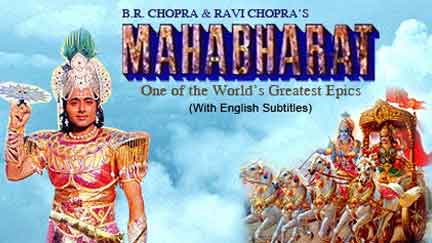
I watch Satyamev Jayate on Doordarshan. The word ‘National’ below the Doordarshan logo seems rather appropriate for Aamir Khan’s show about issues of mass frustration. In one of the many interviews that prefaced the airing of his show, the kind of airgun shooting that now heralds any and every kind of release – films, books, television shows, automobiles, increasingly, even babies – Aamir Khan said that he argued with channel producers who wanted to give it a prime-time slot: ‘I wanted to telecast my show on Sunday morning. I want each family to watch the show and connect with it. We have watched Ramayana and Mahabharata and it used to come on Sunday morning. The shows created a different atmosphere’. Continue reading Jaya Hey to Jai Ho to Jayate: Sumana Roy

How Essar, Teamwork Productions and the Chhattisgarh government changed the lives of Dantewada’s children

Any moment now I expect India’s litfest mafiosi to describe this article on the ‘Essar Kahani Utsav’ by Akshay Pathak as an ‘attack on free speech’:

Money was not the only thing coloured there. Long pieces of cloth in different colours hanging outside the venue— in classic Teamwork Productions style (the event management company organising this festival)—conjured a sense of celebration. The packaging was good. It mostly is—like that of the DSC Jaipur Literature Festival, also organised by the same company.

The mood inside, though, didn’t match. That is, if you set aside the sight of visibly uninterested festival organisers and district administrators finding ways to pat their backs. And there was certainly no festive air around the 600-odd Adivasi children who had travelled hours on foot and buses to hear stories on an empty stomach—“the district administration miscalculated the numbers”, the organisers explained to me later, and so they had run out of food for the children. [Read the full article.]


National Appeal on Koodankulam Becomes a Rallying Point for Solidarity Actions Across India

The “Urgent Appeal to the Conscience of the Nation on Koodankulam” open for signatures on DiaNuke.org was released yesterday, May 20th,  in New Delhi, Mumbai and Kolkata. Concerned people and activists are planning release events and readings of the appeal

India Gate, Delhi

in Chennai, Bangalore, Pune, Hyderabad and other cities in coming weeks. Grassroots organisations are distributing the appeal as pamphlet, translated in regional languages.

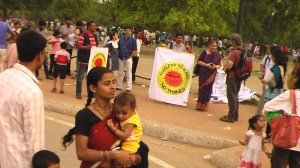
This Sunday, Vandana Shiva, renowned environmentalist and eco-feminist, released the national appeal on Koodankulam at the India Gate in New Delhi. Releasing the appeal, she expressed her anguish on the undermining of democracy by the Indian government in its pursuit of nuclear energy. Inviting NIMHANS doctors to ‘treat’ the mindset opposing nuclear energy projects is reflective of the nuclear-obsessed government’s contempt for its own people and their concerns, she said. Continue reading National Appeal on Koodankulam Becomes a Rallying Point for Solidarity Actions Across India

The Great Indian Media Hoax Of Self-Regulation: Ruchi Gupta

Guest post by RUCHI GUPTA

[This post was initially published in the Times of India and removed from their site soon thereafter.]

With a comfortable gap of time after the revelations of paid news, private treaties and the Radia tapes, the media is once again on the offensive to guard its independence. The trigger this time is a private member’s bill, the Print and Electronic Media Standards and Regulation Bill, 2012. The proposed legislation has been widely and energetically panned by the industry, with the Congress subsequently distancing itself from the Bill. The Bill is not available in the public domain; however based on news reports, some provisions could perhaps lend themselves to state censorship. While the merits of the Bill are debatable, what is striking is the complete lack of self-consciousness with which the media termed the attempt as an attack on democracy, without addressing its own corruption and its deleterious impact on democracy. Continue reading The Great Indian Media Hoax Of Self-Regulation: Ruchi Gupta