Category Archives: Capitalism

POSCO and the People: Ayush Ranka and Arati Choksi

This is a guest post by ARATI CHOKSI with photographs by AYUSH RANKA

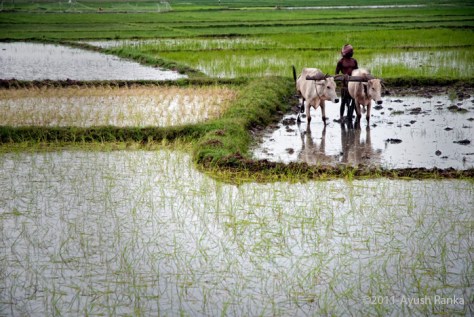
01. Odisha is scarcely known to most people as the state of rich agriculture. It is more famous for it's floods and droughts which occur once in a while. However, the entire state, barring a few small regions, is rich with fertile soil and apart from betel leaves and cashew, food grains like rice, wheat, jowar and pulses are also grown

POSCO catapulted out of nowhere into the periphery of my imagination last year. On May 15, 2010, in a brutal show of aggression and violence, armed police battalions attacked unarmed protesters at Balitutha opposing a forceful takeover of their lands by the state for a POSCO steel plant. Members of police force set fire to shops, eateries and thatched homes, including the dharna site of people’s peaceful protest. Police fired upon unarmed protesters with rubber bullets. One person died, and hundreds were severely injured in this firing, many of these were women and the elderly. Continue reading POSCO and the People: Ayush Ranka and Arati Choksi

Speed and Control at Manesar: Why is the Maruti-Suzuki Management Keeping Workers Out of Its Factory

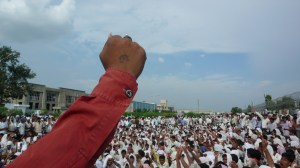
Protest Meeting at Maruti-Suzuki Factory, Manesar, September 01, 2011

Manesar is an emerging industrial hub roughly fifty kilometers from Delhi. Factories rise along the co-ordinates of a neat grid, overshadowed by the rocky Aravallis. The world is made here – cars, bikes, semiconductors, automotive parts, electronics, telecommunications equipment. Manesar has a little bit of everything. Even a bomb data analysis centre and a brain research lab and a military school and a heritage hotel. On a Maruti Swift, speeding down National Highway 8 towards Jaipur, you could make it to Manesar from Delhi, through Gurgaon, in less than an hour. Maruti’s ads are all about speed and control. Speed and control will cruise you to Manesar.

Continue reading Speed and Control at Manesar: Why is the Maruti-Suzuki Management Keeping Workers Out of Its Factory

Maruti Struggle Continues Despite Repression: Statement

The following is a statement issued by the MARUTI SUZUKI EMPLOYEES UNION (MSEU) on 1 September 2011
The management of Maruti Suzuki Industries Limited, Manesar plant (Plot 1, Phase 3A) has terminated 11 and suspended 38 workers on 29th and 30th August 2011, on completely fabricated charges of go-slow in production and that workers have been ‘undisciplined’. It is doing this as a continuation of harassing workers for our struggle for the right of Union formation and other legitimate rights from June 4th to 16th. It is using brute police force to intimidate us, and is also continuing to pay and use bouncers and lumpen force to continuously threaten us. The management is also spreading a rumour that the production has resumed yesterday 31 August through a handful of contract workers, some supervisors, engineers and robots. This disinformation campaign has also been splashed across the media.

Continue reading Maruti Struggle Continues Despite Repression: Statement

Our Corruption, Our Selves: Arjun Appadurai

This is a guest post by ARJUN APPADURAI

Partha Chatterjee and Shuddhabrata Sengupta rightly argue that “corruption” is indeed a new Indian label for “the lives of others”. The East German Stasi also surely saw their vigilance as directed against the politics of “the enemies of the people”, except that in their case the state and the party were seen to contain all the good people, with the bad people choosing to remain in the unmobilized parts of civil society. Hence the pro-Hazare gatherings certainly have some of the disturbing echoes of mass rallies under Hitler and Stalin with the working and middle-classes adoring a mediocre and Chaplinesque figure who promises a new wave of moral cleansing. Continue reading Our Corruption, Our Selves: Arjun Appadurai

Are We Talking to the People Who Are Out on the Streets? – Kavita Krishnan

Guest post by KAVITA KRISHNAN  (Editor, Liberation)

The people saying ‘I am Anna’ or ‘Vande Mataram’ are not all RSS or pro-corporate elites. They’re open to listening to what we have to say to them about corporate corruption or liberalization policies. The question is – are we too lofty and superior (and prejudiced) to speak to them?

Throughout the summer, student activists of All India Students’ Association (AISA) and Revolutionary Youth Association (RYA) engaged in this painstaking exercise for months. They campaigned all over the country, in mohallas, villages, markets where there is no visible Left presence. No, these were not areas of ‘elite’ concentration – mostly middle, lower middle or working class clusters, or students’ residential areas near campuses. In most places, people would begin by assuming they were campaigners of Anna Hazare. When students introduced their call for the 9 August Barricade at Parliament, they would be asked, ‘What’s the need for a separate campaign when Anna’s already leading one?’ They would then explain that they supported the movement for an effective anti-corruption law to ensure that the corrupt don’t enjoy impunity. But passing such a law could not end corruption, which was being bred by the policies that were encouraging corporate plunder of land, water, forests, minerals, spectrum, seeds… They learnt to communicate without jargon, to use examples from the state where the campaign was taking place. They would tell people about the Radia tapes, and the role of the corporates, the ruling Congress, the opposition BJP, and the media in such corruption.

Continue reading Are We Talking to the People Who Are Out on the Streets? – Kavita Krishnan

Hazare, Khwahishein Aisi: Desiring a new politics, after Anna Hazare and beyond corruption

Hazare, khwahishein aisi, ke har khwahish pe dam nikle
bahut nikle armaan, lekin, phir bhi kam nikle

Hazare, so many desires, that every desire takes our breath away
so many hopes, and yet so few

(with due apologies, for liberties taken, to Mirza Asadullah Khan Ghalib, sometime poet and native of Delhi)

On the ninth of april, this year,  I wrote a posting on Kafila titled – ‘At the Risk of Heresy : Why I am not Celebrating with Anna Hazare Tonight‘. A little more than four months later, I have to say I have not yet found reasons to celebrate. But I am not in mourning either. What follows is my attempt to think this through, in all its contradictory character. For once, I am not even trying to be consistent. If my argument occasionally faces two directions at once, it is probably because I feel the needs to be double faced in order to understand a double-faced moment. When all the talk is only of the need for honesty, one might want to stake a claim to being double-faced, if only for the sake of breaking the moral monotony.

Continue reading Hazare, Khwahishein Aisi: Desiring a new politics, after Anna Hazare and beyond corruption

What is right-wing about the anti-corruption movement? – Saroj Giri

Guest post by SAROJ GIRI


A draft for discussion

A ruling class contradiction is being played out as anti-corruption movement. It is however politically articulated as ‘a movement of the people’ with possibly a space for the left to intervene. Can the tide be turned against the right-wing upper classes?

“What we are witnessing (the anti-corruption movement) is nothing short of a revolution. Only on two earlier occasions in recent memory such grand scale people’s participation was recorded. The first was under Loknayak Jayaprakash Narayan in mid-seventies. The second was during the Ayodhya movement, in the early nineties, propelled by L K Advani’s historic Rath yatra.” This is the RSS Organiser magazine (August 21-28, 2011).

“The anti-corruption movement must resist repression in every form and align itself with the struggles for democratic transformation in India. Only then can it defeat the UPA Government’s efforts to defend corruption and unleash repression, and expose the BJP’s false claims of championing democracy and resisting corruption.” This is the CPIML Liberation (ML Update, 07-13 June 2011)

Continue reading What is right-wing about the anti-corruption movement? – Saroj Giri

Beyond ‘Middle Class’ and ‘Corruption’: Jeebesh Bagchi

Guest post by JEEBESH BAGCHI

I have been thinking that If we drop “corruption” and “middle class”  we may find some other way to understand what we sense unfolding from Ramila grounds and television studios.

The term middle class has bloated so much that it now holds within it Narayan Murthy to Shekhar Gupta via Nandan Nilekani to a student in Sonepat to all people in this list and on facebook.  And on the other hand corruption seem to have bloated much further in which commissions from infrastructure deals (in lakhs of crores), commissions for arms deals, someone delaying papers, to admission costs, to a hawker buying some uninterrupted time in the street (20 rupees) is all melted down.

Could one start from some other point? Continue reading Beyond ‘Middle Class’ and ‘Corruption’: Jeebesh Bagchi

New Trade Union Initiative on Anti-Corruption Struggle

We are reproducing below a statement issued by NTUI

NTUI Statement On the Fight Against Corruption

Workers’ life and work experiences are very different from those of the middle class and the ruling elite; so is their experience with corruption. For the middle class, corruption is a mechanism to accelerate government procedures in the public or private sectors. For the working class, corruption deepens their experience of subordination. Instances of corruption that are directly experienced by the working people are the result of the unequal power relations that govern workers’ daily interaction with public institutions and is therefore contributing to a sense of distrust and loss of faith in these institutions. There can be little doubt that corruption affects the working class disproportionately more than it affects economically more privileged sections of society.

Continue reading New Trade Union Initiative on Anti-Corruption Struggle

Indian Academics Urge Divestment from POSCO: Sign petition

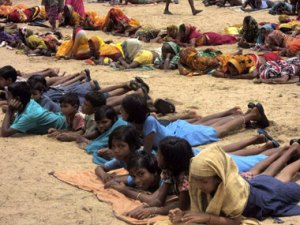
Children and women of Gobindpur village in  Jagatsinghpur district form a human chain to stop the forces from destroying their homes

The US-based Mining Zone Peoples Solidarity Group (MZPSG) has been working on an international solidarity campaign as part of the anti POSCO campaign in Orissa. They  launched a divestment campaign some months ago aimed at four retirement funds, all of which have significant investments in POSCO.

One of these is the TIAA CREF, that is, the US-based Teachers Insurance and Annuity Association – College Retirement Equities Fund, a financial services non-profit organization that is the leading retirement provider for people who work in the academic, research, medical and cultural fields.

As part of the campaign 600 US based faculty wrote to TIAA CREF some weeks ago, asking it to divest from POSCO. They are now seeking support from faculty based in India, expressing solidarity with their US -based colleagues and pressing upon TIAA CREF the urgency of the need to divest from POSCO.

Please consider signing the petition using the link provided below.

PLEASE DO NOT SIGN IN AS ANONYMOUS.

Indian Academics Urge Divestment from POSCO

If you do sign, please forward this to at least five to ten colleagues and friends working in your university or any other Indian university/college.

Please note that the signatures page will be updated manually by the admin, so you may not see your signature immediately on signing the petition.

Statement on the Martyrdom of Shehla Masood

To add your name to this statement write to Akhlak Ahmad – syed.akhlak at gmail dot com

16 August, 2011

“I am proud to be an Indian. Happy Independence Day.”

– Shehla Masood, 15 August, 2011

Gandhi “the purpose of civil resistance is provocation”. Anna has succeeded in provoking the Govt and the Opposition. Hope he wins us freedom from corruption. Meet at 2 pm Boat Club Bhopal”
– Shehla Masood, 16 August, 2011 few minutes before her martyrdom

Shehla Masood, a Madhya Pradesh based civil rights and environmental rights activist was was shot dead by an unidentified person in front of her residence in Koh-e-Fiza locality in Bhopal around 11 AM on 16th August, 2011.

We the undersigned aghast at the irony that tigers, tribals, trees and civil rights and environmental rights activists are being hunted and killed in the same manner. Continue reading Statement on the Martyrdom of Shehla Masood

Democracy, Populism and the ‘Middle Class’: The Return of ‘Anna Hazare’

[This is a considerably expanded version of an article that was published in Himal May 2011. It is being re-published, elaborated and updated, in the context of the farcical draft of the Lokpal Bill roduced by parliament and the threatened round 2 of the movement. – AN]

Corruption – a Systemic Affair?

Let me start with an ’emperor’s new clothes’ kind of question: What is a systemic understanding of ‘corruption’? What is a political understanding about corruption as opposed to say, a touchy-feely ‘moral’ problem? Yes, some of these phrases are straight from Arundhati Roy’s ‘When Corruption is Viewed Fuzzily’, published in the Indian Express on 30 April. But my question is not directed only at her. She represents – at least on this issue – a much wider consensus among sections of the radical intelligentsia.

Roy herself has left nothing to the imagination as to what she means:

“Among the millions of understandably furious people who thronged to Jantar Mantar to support Anna Hazare and his team, corruption was presented as a moral issue, not a political one, or a systemic one — not as a symptom of the disease but the disease itself. There were no calls to change or dismantle a system that was causing the corruption. Perhaps this was not surprising because many of those middle-class people who flocked to Jantar Mantar and much of the corporate-sponsored media who broadcast the gathering, calling it a “revolution” — India’s Tahrir Square — had benefited greatly from the economic reforms that have led to corruption on this scale.”

To her, the system that lies at the root of corruption is embodied in the ‘economic reforms’, which have led to corruption on this scale. I have no way of measuring the scale – though I might be inclined to agree with her that in my living memory, I have not seen so much compressed into such little time-space – from CWG to l’affaire Niira Radia to Adarsh Housing scam and the Bellary brothers – not to speak of the daily corruption in land acquisitions that dot the landscape of the country. Nonetheless, I do remember that something like the Bofors scandal or the ‘irresistible rise’ of Dhirubhai Ambani – all predate the ‘economic reforms’. And of course, I will not even try to mention the innumerable cases of corruption from Nagarwala onwards – including political corruption that led to big mass movements in Gujarat and Bihar in the 1970s. Those were the days when Mrs G proclaimed that ‘corruption is a global phenomenon’. To me saying corruption is systemic and must be analyzed ‘politically’ (whatever that means), sounds pretty much the same.  So, if neo-liberalism is responsible for corruption, how do we explain the instances mentioned above? How do we understand the great socialist states which secreted corruption from every pore? What does a ‘systemic analysis’ of corruption really tell us?

However, Arundhati Roy was making this point, it seems to me, not in order to analyze the phenomenon of corruption but to comment on the Anna Hazare movement and its ‘character’:

“When corruption is viewed fuzzily, as just a touchy-feely “moral” problem then everybody can happily rally to the cause — fascists, democrats, anarchists, god-squadders, day-trippers, the right, the left and even the deeply corrupt, who are usually the most enthusiastic demonstrators.”

Continue reading Democracy, Populism and the ‘Middle Class’: The Return of ‘Anna Hazare’

The Values of Property

The recently announced Rajiv Awaas Yojana (RAY) has brought back an old ghost to debates on how to allow the urban poor a foothold into the city and the possibility of upward mobility. The central policy initiative of the Ministry of Housing and Urban Poverty Alleviation is the most significant contemporary attempt to address urban poverty through providing housing to the urban poor. The “slum-free city” is back. Now more than ever, then, it is time to ask: what is a “slum-free city”?

Continue reading The Values of Property

The Lord’s riches are not the Lord’s riches

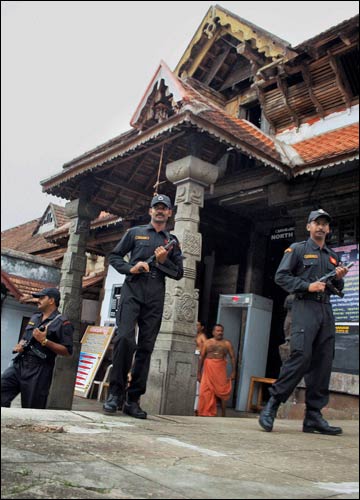
Photo credit: Press Trust of India

Giving a historical background of why the Sree Ananta Padmanabha Swamy temple in Thiruvananthapuram came to have these riches, Malavika Velayanikal writes in DNA:

True, the bags of gold coins, diamonds, precious stones, 18-feet-long gold necklaces, jewellery weighing many kilograms, and solid-gold statues of gods and goddesses landed in the vault via the king. But in reality, the temple treasury was nourished by the sweat and blood of the masses as well.

One of the main sources of the royal income was taxes. They were incredibly high for the lower castes, with marriages, childbirth and even death being taxed. Country boats, ploughs, carts, umbrellas, headscarves, why, even a moustache, were taxed. Mothers were allowed to breastfeed their newborns only after they paid the ‘mulakaram’ (breast-tax) to the local lord, who would then grant permission. [Must read]

But you won’t hear this said too often because, as Appu Esthose Suresh reports in Mint:

“If the government makes any move, then the believers will protest and BJP will support the people,” he (a temple staff member) was quoted as saying by news agency PTI.

It is precisely the fear of antagonizing a section of the Hindus that is forcing the state government to be cautious.

“This government does not have the courage to go against Hindu sentiments,” said P.R.P. Bhaskar, a political observer. “It will move in a direction which will accommodate the royal palace.”

“The Left Front gained Hindu votes for two reasons. Firstly, its traditional vote base consists of Hindus and a perception that Christian and Muslim votes are moving towards the Congress and its allies had led to a consolidation of Hindu votes. This might help the government change that perception a bit,” he added. [Link]

Hindu appeasement. That’s what will come in the way of a just, fair, pro-people decision about what should be done wit the temple wealth.

Counting the Cost: Industrialism, Capitalism, Socialism

Guest Post by SHASHANK KELA

Years ago, after the fall of the Berlin wall and the collapse of communism, a faux philosopher announced the end of history. What he meant was the permanent victory of capitalism and its correlate, liberal democracy. Unfortunately history has an unkind habit of rolling right along, throwing a sucker punch at intervals – remember Gordon (No Boom and Bust) Brown? The triumph of laissez faire capitalism has been celebrated since the ’80s (when the term Reaganomics was coined for redistributive policies that blithely transferred wealth to the rich). Until the crash of 2008-09 set the cat amongst the pigeons; and sent the semi-converted scurrying back to Keynes – and Marx (especially in Germany where the sales of his books suddenly soared). However after a state bailout of unprecedented proportions, that had the satisfactory effect of restoring the position of the wealthy, especially the bankers and financial whiz kids who had caused the crash, the dust settled down. In the industrialized west, discontent seethes beneath the surface, but the dictum that the experts – the bankers, the CEOs, the policymakers (who swap roles seamlessly) – are right still holds. The majority must accept a decline in their standard of living and the prospects, such as they were, of job security so that growth can continue and the minority prosper even more opulently. This, of course, has long been the received wisdom in India, where, ever since the ’80s, full consensus was reached on the fact that the middle-class is the only class that matters – the rest can go hang. Continue reading Counting the Cost: Industrialism, Capitalism, Socialism

Cities and Infrastructure – The Road Widening Saga in Bangalore

This evening, I was sitting in a coffee shop and writing about the sociology of information, how information is mired in relationships and how trust, suspicion and social relations develop in the course of circulation and exchange of information. As I was beginning to disentangle the complex web of legitimacy and regulations surrounding information, a friend called to inform that some activists and citizens had been arrested for protesting against the tree felling and road widening at Sankey Road in the northern part of Bangalore. In the last few days, the conflict regarding road widening and tree felling at Sankey Road got strong coverage in the media because citizens began gathering around the trees and the roads to prevent authorities from felling the trees. Despite this, the authorities went about felling the trees for widening the roads. The activists and protestors were clearly becoming a nuisance for the government officials and institutions who have not been able to execute the works. Hence, today, at some point, some of our activist friends were arrested on the false charges that they had assaulted public officials in their conduct of ‘government’ duty. The charges were filed under section 343 or 353 CrPC which also implied that the arrest was non-bailable. Over the course of the evening, news went about on FaceBook and Twitter about these arrests, and people from in and around Sankey Road were called to silently protest at the Aiyyappa Temple where the trees were being felled for enabling the road widening. The arrested activists and citizens were released from jail and all the charges against them were ‘dropped’ at about 6 PM. The court also granted a stay order on the tree felling around the same time, with further hearings and orders to arrive on Monday. Continue reading Cities and Infrastructure – The Road Widening Saga in Bangalore

A Free Man

Mohammed Ashraf is short and stubby, with a narrow but muscular chest and small, broad hands balanced on strong, flexible wrists. But Ashraf does not grudge the throw of the dice that has made him a safediwallah with a mazdoor’s body. A small man’s body can do things that a slenderchamak-challo cannot even contemplate.

A small man carries the ground close to him wherever he goes, even as he hangs along the side of a building three storeys high. The memory of the ground that allows him to crawl into crevices, perch on narrow ledges and balance on wobbly parapets. A short man knows the limits of his body, the extent of his reach, the exact position of his centre of balance. Unlike the tall man, he holds no illusions regarding his abilities or his dimensions; he will never overreach, overextend or overbalance.

A Free Man, my first book, should be in stores this July. Read the rest of the excerpt

Arindam Chaudhuri, Silchar

When I read The Caravan‘s cover story on Arindam Chaudhuri some months ago, I wondered when he was suing them. And he’s done it! While a court injunction has made The Caravan remove the story from theire wesbite, you can read it thanks to Google cache. No wonder Chaudhuri’s sued Google India as well! Given below is the full text of the press release put out by The Caravan. Unlike when Chaudhuri took on bloggers in 2005, I’m glad it is an organisation with the resources to fight the case and take him head on – not to say that requires some spine as well. After you’re done reading the release below, entertain yourself with all the Arindam jokes on Twitter.  

IIPM’s Rs500-million lawsuit against The Caravan
In response to our February profile of Arindam Chaudhuri, the IIPM has sued The Caravan. Here’s why we’re fighting the suit. Continue reading Arindam Chaudhuri, Silchar

“Report the news. It is not news that there are poor people in India.”

In the morning today The Independent‘s Asia correspondent, Andrew Buncombe, blogged his disagreement with Arundhati Roy’s statement that foreign journalists in India have been asked not to report bad news. As a foreign journalist in Delhi he had faced no such censorship from his editors or the government here.

Buncombe made his case strongly: Continue reading “Report the news. It is not news that there are poor people in India.”

Coke Studio India – the first six songs

So the unanimous verdict is that Coke Studio India (first aired on the Friday that went by) is no match for Coke Studio Pakistan [Wikipedia]. For some it’s been like an India-Pakistan match – I’ve seen Indian congratulate Pakistanis on Twitter for the ‘Coke Studio victory’ and others ask Indian musicians and singers to listen to Pakistani singers and hang themselves. For most, this was not surprising – Coke Studio Pakistan has showcased some of the best music you’ve heard in recent times and it raised the bar too high for Coke Studio India. There’s also the problem of Bollywoodisation of music in India, of dumbing down, producing music aimed at the marriage market and livening up the moods of those stuck in traffic. A celebrity culture has taken the passion out of music in India – it does not seem to come from deep within. New popular music in India leaves you with the kind of feeling that a mall does. Loud and empty.

Continue reading Coke Studio India – the first six songs

Corruption, the New Caste: Thomas Crowley

Guest post by THOMAS CROWLEY

In the mainstream coverage of the Ramdev hullabaloo, there has been, unsurprisingly, little substantive discussion about corruption itself: its fundamental causes; its widespread effects; the viability of different plans to combat it. Who would want a dry, intellectual discussion of the root causes of corruption when we can stare uneasily at pictures of Baba Ramdev holding a sword and wait with bated breath for his holy army to congregate?

But let’s – for the moment – take seriously Ramdev’s proposal that the death sentence be meted out to India’s corrupt. If the press is to be believed – especially the foreign press – this may just mean killing every Indian. For, implicit in many media reports is the assertion that corruption is part of the Indian psyche, an essential component of what it means to be Indian. In this sense, corruption serves the same conceptual role as caste: it essentializes an ever-changing historical phenomenon, freezing it in time and obscuring its economic and political roots. Much as the British taught Indians and foreigners alike to understand India predominantly in terms of caste, modern commentators are encouraging both desis and firangis to conceptualize India as the land of unending corruption. (Of course corruption has not replaced caste as a mode of understanding India; the fascination with caste still runs deep.)

Continue reading Corruption, the New Caste: Thomas Crowley