Sometimes, thankfully, one does not need to write an over-long post to make a point.
Everybody knows how the entire television media has been giving enormous airtime to BJP and its allies giving vent to their outrage on the condemnable police action on Baba Ramdev’s ‘Yoga Camp’ in the Ramlila Maidan in New Delhi. One woman, named, Rajbala is still seriously injured. No casualties have been reported so far.
So what do you think happened when the police assaulted a gathering of satyagrahis with lathis? Here’s what happened to some people I met from such a gathering.
Tulsibai, 45+, was hit on her stomach and wrist.
Manglubai, about 40, was hit on her buttocks.
Rajkumaribai, who didn’t know her age, had a deep wound on the upper part of her thigh that she showed us shyly.
This statement about today’s events in Jagatsinghpur, Odisha, comes from theCAMPAIGN FOR SURVIVAL AND DIGNITY
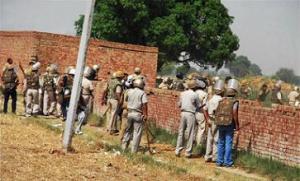
Today, more than a thousand armed police besieged the gram panchayat of Dhinkia in Jagatsinghpur District of Orissa to crush the resistance to the POSCO steel plant. For the entire day thousands of people sat in the heat, where several people (including children) and even two policemen fainted. At noon the Collector declared their protest “unlawful” and subsequently loudspeakers blared threats about use of tear gas, lathi charges, “those engaging in unlawful protests being dispersed” continuously for four hours. Efforts were made to divide the protesters as well. The protesters remained firm. Eventually, perhaps afraid of the heavy media presence and unable to break the will of the people, the police withdrew. The people have left some of their number on guard, fearful of the police’s return at any time. Continue reading POSCO: Lies, Crimes and Atrocities→
Update of anti-POSCO People’s Movement as on 10th June 2011, 12 noon.
· Police and protesting public are face to face now: Twenty platoon police forces with officers have already reached at the boarder of Govindpur village where more than 2000 villagers are protesting against the forceful land acquisition by government of Odisha for POSCO through 24X7 vigil.
· Protesters are determined to resist any use of force by the government and police forces. Even women and children have come to the forefront as they form the first two shields of protection.
· Senior police officers, with arms and weapons, are threatening people to dismantle through loud speakers. We will let you know the development here
Kindly call the following authorities to lodge your protest.
RTI activist Subhash Agrawal has obtained correspondence between the then sports minister Mani Shankar Aiyar, and Prime Minister Manmohan Singh, that shows the PM was informed about the scam as early as October 2007. And did nothing. You can download here (.pdf, 4.2 MB) the 52 pages long RTI reply Agrawal got from the PMO.
Factory owners buckle under pressure – Locked out mills to start from June 3
New Delhi, June 2. Workers in Gorakhpur achieved a major victory in their struggle when the factory owners agreed to start the two locked out mills from June 3 and take back the dismissed workers. 12 of the 18 workers will join work immediately and the remaining 6 will be taken back after a domestic enquiry. The workers also forced the owners to accept that no one from the management will be in the enquiry committee; it will have two members from the office staff and one workers’ nominee.
The decision was taken at negotiations held till late night at the district magistrate’s residence. The two owners of the VN Dyers and Processors yarn mill and textile mill, the district magistrate and deputy labour commissioner and seven workers’ representatives were present at the meeting.
These two mills in the Bargadwa area of Gorakhpur were illegally locked out since April 10. Around 500 workers work in both of these mills owned by the Ajitsaria family having an annual turnover of more than 150 crores. 18 workers of these two mills were dismissed by the owners. The workers were agitating for reinstatement of their colleagues and restarting the factories.
The mainstream Western media that celebrated the democracy movements in the Arab world not very long back, is relatively silent now. For, then it was the Arab youth’s striving for the ‘western values’ of democracy that it was celebrating. Now that the cry of ‘democracy’ is arising from its very midst, it does not seem to quite know what to do. From May 15 on, for almost two weeks Madrid and other Spanish cities have been witnessing some of the largest demonstrations in recent memory. Protesters have thronged the Puerta del Sol, virtually camping there. As government forces started cracking down, demonstrations began to grow in an ever expanding scale spreading to many other Spanish cities. When the government moved to ban demonstrations on May 20, in the run up to the regional and municipal elections, the protests acquired an even more militant form. A ‘snapshot’ of the rallies in defiance of the ban:
The initial protests against the planned multibillion euro bailout plan for banks, austerity measures and against high unemployment almost 45 percent among the youth), according to reports, were not very large but when the government responded by arresting several activists and demonstrators, things started going out of hand. That was the ‘spark that lit the prairie fire’. As Ryan Gallagher’s report in the New Statesmanput it:
A demonstration against the arrests was organised in the city’s main square, Puerta del Sol, and numbers soon snowballed when word got out over the internet. What began as a group of fewer than a hundred activists reached an estimated 50,000 within less than six days.
The protesters whose arrests had sparked the initial demonstration were released and immediately returned to the square. By the time they arrived, the demonstration was no longer just about their treatment at the hands of the police. It was about government corruption, lack of media freedom, bank bailouts, unemployment, austerity measures and privatisation.
I am posting the Editorial of the latest issue of dissenting dialogues, a social justice magazine on Sri Lanka. The lengthy Editorial discusses the situation two years after the war and the much debated UN Panel Report on accountability for crimes committed towards the end of the war in Sri Lanka.
The May 2011 Issue also has an interesting article by Kanishka Goonewardena on the political economy of World Cup cricket titled, Space, time and cricket: from M.C.C to M-C-M’. The article engages the work of C.L.R. James, David Harvey and Giovanni Arrighi while discussing the shift of cricket (and) capital to India.
“But it is unlikely that such a review exercise will to lead to the kind of “reformed” Left that its critics are rooting for — a Left tamed by its defeat into accepting the set of economic policies that, in the name of growth, intensify and create new inequalities; a Left subdued… The relentless pressure being put on the Left today is precisely to give up its class approach, to adapt itself to neo-liberal realities represented by the set of policies popularly referred to by workers as LPG — liberalization, privatization, globalization”
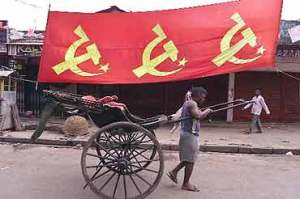
The op-ed piece by Brinda Karat is a brave effort at self defense after almost 5 days of uncomfortable silence following one of the most humiliating defeats in the history of the left movement in India. The article, defensively titled ‘The Left will endure’, is revealing in a number of ways. One that the CPI (M) has nothing much left to say, and two, that most of what it says is an expression of many of the beliefs that the Left Front continues to hold, or at least professes to hold – even with all evidence against the same – in review of its performance in West Bengal.
But, before an analysis, it is necessary to point out that Karat’s use of the term ‘The left’ is also a little problematic as it cannot be said with certainty that all people or parties associated with the color red are willing to call the CPI(M) brand of politics their own, and, definitely, not all of them are necessarily in position at the moment to feel the need to say that ‘ the left will endure’.
What the article attempts is to argue:
That the defeat of the Left Front in Bengal was somehow a defeat because of the values that the Left Front professes to hold – equal and sustainable growth, labor rights, class approach to issues, and its refusal to accept foreign capital, etc.
That the critics have written the Left Front off, and are attempting to browbeat them into neo-liberal submission.
That the Left Front record in Bengal has been most applaudable in terms of its commitment to people, secularism, growth, and maintaining a thriving democratic culture in Bengal inspite of the lack of a strong opposition.
Most of the above are only ‘theoretically’ true, and meet reality only at a tangent.
ममता की संघर्ष गाथा जीत का जश्न बन कर कोलकाता की जिस राइटर्स बिल्डिंग में प्रवेश कर रही है, उसके गलियारों में कुछ वक्त के लिए ही सही, सन्नाटा-सा तैर गया होगा। यादें उभर आई होंगी। चौंतीस साल का साथ पत्थरों तक के लिए कम नहीं होता। वे मूक दीवारें एक इतिहास की गवाह हैं। एक अपराजेय-से लगते लंबे दौर की; जिसने चुनावों के सात समंदर पार किए; अभेद्य लाल दुर्ग के तिलिस्म को खड़ा किया। अब लोकतंत्र में सबसे लंबे शासन का एक अंतर्राष्ट्रीय कीर्तिमान विदा हो गया। विदाई इतनी करुण और क्रूर कि पिछले मुख्यमंत्री विधानसभा की ड्योढ़ी तक नहीं पहुंच पाए। तैंतीस में से पच्चीस मंत्री विधानसभा से बेदखल हो गए। माकपा बंगाल विधानसभा में कांग्रेस से भी छोटी पार्टी हो गई।
2008 से एक के बाद एक पंचायत, संसद, नगरपालिका चुनाव हारने के कारण इस नतीजे में आश्चर्य की कोई बात नहीं बची थी। सड़क चलते राहगीर तक को पता था क्या होने वाला है। मगर व्यापक वाम से जुड़े बुद्धिजीवियों और पार्टी के भीतर के ही बौद्धिकों तक के आलोचनात्मक विश्लेषण माकपा की आंखें नहीं खोल सके। वाम मोर्चे को बंगाल में अपनी अपरिहार्यता के तर्क पर इतना यकीन था कि उसने अपने लिए आश्चर्य और धक्के का सृजन कर लिया। उसके लिए यह ‘अभूतपूर्व उलटफेर’ हो गया। आलोचकों को मुंहतोड़ जवाब देने की फितरत माकपा को आखिरकार जिस आश्चर्यलोक और रंजो-गम के गढ़हे में ले गई, उससे सावधान रहने की चेतावनी देते हजारों लेख अखबारों, पत्रिकाओं, ब्लॉगों में कदम-कदम पर बिछे थे।
Enquiry Committee Report on HPV Vaccine Projects – Of Undeniable Violations and Unidentifiable Violators
Sarojini N and Anjali Shenoi
Sama – Resource Group for Women and Health
This is in continuation with our previous post (17 May 2010) on the Human Papilloma Virus (HPV) vaccine ‘Demonstration Projects’ conducted by an American NGO PATH, in collaboration with the Indian Council of Medical Research (ICMR) and the two state governments of Andhra Pradesh and Gujarat. These projects have raised several pressing questions related to the ethics of biomedical research in India and the deflection of public health priorities in a context where the influence of the pharmaceutical industry is increasing.
Following strong opposition by civil society groups and a member of parliament, these ‘projects’ were temporarily suspended by the Ministry of Health and Family Welfare (MoHFW). At the same time, the Ministry also appointed a Committee to enquire into the “Alleged irregularities in the conduct of studies using HPV vaccine” with a time frame of three months to submit its report.
A year later, the report submitted by the Committee has identified several deficiencies in the planning and implementation of the project such as ambiguity in the nature and purpose, implementation of the projects, “the need for continued pharmacovigillance of the HPV vaccine” etc.
[This was a note titled ‘We Still Need Feminism’ which I wrote on March 31 on my Facebook page; I thought it relevant to re-post it here as it appears that an ‘honour killing’, of a sort — an ‘honour suicide’ — may have actually surfaced in Kerala. More on that in the next post]
In JNU, last week, some of us were noticing how there seemed to be a notable increase in the numbers of students, both women and men, from the Hindi heartland. It is interesting, said one of my friends, that the deterritorialised university spaces in Delhi can no longer back off from directly confronting the tensions through which these societies now live through. “Look at that girl,” she said, pointing to a sprightly young woman, a bright student who I’d briefly met earlier,”she comes from a family that’d kill her if she married out of her gotra. And she is involved with a young man who’d not even of her region. We must fear the worst and prepare to confront evil.” For a brief moment, in my fright, I thought, well, at least we don’t have honour killings in Kerala. Honour kidnappings, yes, but I haven’t heard of too many honour killings. Maybe honour killings are still on their way here (like dowry deaths were, in the 1980s, when I was growing up into a young woman). We have some time to rally against them. Continue reading Young Women in Kerala : Between Empowerment and Death? — Part I→
Kahan le Chale ho... (image courtesy Small Strokes)
Ham wahaan hain jahaan se hamko bhee kuchch hamaaree khabar naheen aatee
Roughly translated literally, this famous couplet of Ghalib’s would mean: “We are at that place from where we do not get any news about ourselves”. A somewhat surreal place to be in! It is not just that you are holed in, a place where you are cut off from the world and no longer get any news of the outside – say Plato’s Cave. This descent is into a Cave from where you get no news about yourself! You are in a state of incommunicability with your own self. Clearly, a Self that is deeply at odds with itself.
This is clearly the place where the Bengal communists have descended. Else, who could not have seen the avalanche coming? Even when they lost the 2009 parliamentary elections, they thought that they lost because those sitting in Delhi’s AK Gopalan Bhawan chased the chimera of the Third Front (and they have been repeating this till yesterday, everyone from Buddhadeb to Gautam Deb)! Of course that was a chimera but to delude yourselves that your defeat had nothing to do with your own doings, that ‘the people’ oh love you soo – that is only possible when you have descended into that surreal space. The interesting thing is that apart from the self deluding communists of the CPM brand, even the ordinary person on the street knew what was coming. Continue reading We Are Where We Know Not What Befalls Us… in Bengal!→
For the last few days, a few lines from Sahir Ludhianivi’s long poem Parchhaiyan, have been repeatedly coming back to me. A poem that I had read ever so often in my early youth and thought I had long forgotten, suddenly reappeared in a flash. Here go some of the lines (not really in the order in which they appear in the poem, but in the order in which they came to me):
Villages turned into police camps
चलो कि चल के सियासी मुक़ामिरों से कहें/ कि हमको जंगो-जदल के चलन से नफ़रत है
कहो कि अब कोई क़ातिल इधर अगर इधर आया/ तो हर क़दम पर ज़मीन तंग होती जाएगी
हर एक मौजे-हवा रुख़ बदल के झपटेगी…
ये खेत जाग पड़े, उठ खड़ी हुईं फ़सलें/ अब इस जगह कोई क्यारी न बेची जाएगी
[Roughly translated: Come let us tell the political gamblers/ that we hate the business of war and strife
Let us tell them that if a murderer dares to come hither/ The land will shrink with each step
Every wave of the air will turn turn against you
These fields have come alive, with the crops swaying on them
No more shall even a bed (of the field) be sold]
Though Sahir’s poem was written as a protest against war, some of these lines resonate with other, more immediately relevant matters. Ironically, Sahir was protesting against the war mongers pillaging civilain populations but here we are, with the new war mongers of our times: what else is the neo-liberal dream but that of pillage and loot of civilian populations by armed forces of civilian governments. And as they, ‘is hammam mein sab nange hain‘! [All are naked in this in this bathhouse]: From Buddhadev Bhattacharya of West Bengal to Mayawati of Uttar Pradesh – spokespersons all of the oppressed! And it makes little difference whether it is a BJP-led NDA government in power at the Centre or a Congress-led UPA.
The workers of Ankur Udyog Ltd., a factory in the Bargadwa industrial area in Gorakhpur, eastern UP were attacked by goons called by the factory owner the morning of 3 May. At least seven workers were seriously injured in firing by the goons. Apparently, the factory owners of Gorakhpur have been very angry with the workers for attending the May Day rally at Jantar Mantar, Delhi and one of them suspended 18 workers as soon as they went to resume work. The workers protested against this and the factory owner sent hired goons who fired on the workers injuring 19 of them. The workers had cornered the goons inside the factory but the police came and took them away and let them free. FIRs have been registered from both sides.
May Day rally- workers' charter movement
As the tension and repression of the factory owners and the district administration mounts, the workers have planned to go on Satyagraha from May 8 (tomorrow) and the administration is determined to not let it happen. We have received messages saying that trade union organizers fear for the life and safety of the workers and their leaders. The voice of protests from many forums and due to the incident being covered by the local media, the administration has refrained from taking any one sided action till now. But conspiracies are being hatched behind the scenes. Its not a distant reality that the leaders might be killed in fake encounters, or slapped with false charges or lynched by mobs instigated by the factory owners or Adityanath’s goons.
The summary of preliminary findings of the first pan-India survey of sex-workers is now available on-line. 3000 women from 14 states and 1 UT were surveyed, all of them from outside collectivised/organised and therefore politically active spaces, precisely “in order to bring forth the voices of a hitherto silent section of sex workers.”
The significant finding is this: About 71 percent of them said they had entered the profession willingly.
(The data on male and transgender sex workers has not been processed yet).
The study was conducted by Rohini Sahni and V Kalyan Shankar under the aegis of the Center for Advocacy on Stigma and Marginalisation (CASAM), supported by Paulo Longo Research Initiative (“a collaboration of scholars, policy analysts and sex workers that aims to develop and consolidate ethical, interdisciplinary scholarship on sex work to improve the human rights, health and well being of women, men and transgenders who sell sex.”). The study was supported by a large number of groups, organizations and individuals in each state, who helped to conduct the surveys.
This background is important, because it appears to be a study that is well grounded, and drawing on large networks of local interconnections.
In response to the Union Environment Ministry’s decision, given below are two press releases, from POSCO Pratirodh Sangram Samiti and Campaign for Survival and Dignity
POSCO PRATIRODH SANGRAM SAMITI
(based out of villages Gadkujang, Nuagaon and Dhinkia in Erasama block of Jagatsinghpur district, Odisha. )
A Mercenary Minister and a Lying Government Cannot Crush Our People
Money Worth More to Government than Truth, Law and Justice; but the Corrupt and the Criminal Will Not Triumph
2 MAY 2011: Today, in a sanctimonious order riddled with lies and distortions, the Environment Ministry allowed thePOSCO project to proceed. The livelihoods of 4000 families (over 20000 people) and the laws of the land have been sold to the highest bidder. Certain facts should be brought to the notice of the public: Continue reading Two statements on the Environment Ministry’s ‘forest clearance’ to POSCO→
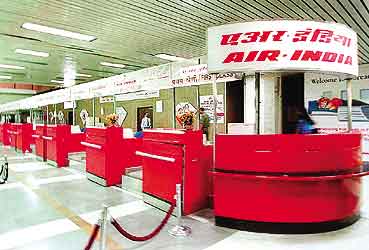
Many moons ago, when our sweet little dupleix in Dover Lane was enlarged into a three storey house to make space for a tenant, our first tenant was an Indian Airline pilot. Similarly, many modern condominiums in our locality were being rented out to pilots and air hostesses. This was a mark of Dover Lane having arrived as a respectable colony in Ballygunje from its rather modest middle class veneer. The airlines are always looked upon as a creamy layer of the middle class; offering prospects and possibilities that are matched only by the IT, bureaucracy and the army. It has the class of being high salaried, élan of professional excellence and the allure of a closed group cadre. In other words, it has the best of all worlds notwithstanding the attraction of international travel with sops like free tickets for dependent members of the family. The pilots, who are the core of this sector, are on strike in India’s only public sector in the aviation sector, namely Air India. Continue reading A government that wants to destroy its own airline?: Susmita Dasgupta→
These fragmentary reflections on the historical relationship between the middle-class and the state may help to place the brouhaha over Anna Hazare in a fresh perspective.
No one celebrates capitalism quite as enthusiastically as your average (well, all right, above average) Marxist historian. Few conservative encomiums on the subject have the lapidary elegance of Perry Anderson’s Lineages of the Absolutist State, or the remorseless logic of Robert Brenner’s celebrated paper on the origins of capitalism.[1] This line goes back all the way to Marx in whose work praise of capitalism and execration of its effects are perpetually balanced.
Capitalism’s motor is the bourgeoisie or the middle-class. Its ancestors – the burghers of the medieval west European town and large landowners in the countryside – transformed the crisis of feudalism into opportunity with the help of the state. The result: mercantilism, enclosures, poor laws; the reorganization of agriculture on rational, commercially profitable lines. The cumulative effect of these developments was to extinguish avenues of subsistence hitherto available to the poor, throwing them on the market as sellers of their labour. Continue reading The Middle-class and the State: Shashank Kela→
Nations build memorials to the Unknown Soldier. A militarized imagination in which the glory of the Nation is embodied in a nameless and faceless figure who courts death. This faceless Unknown Soldier must die so that the myth of the nation can live, and a mythical National Interest devastate the everyday lives of the powerless.
This May Day, let us sing to the memory of the Unknown Worker – celebrated by no one, not even in abstraction! The faceless figure on whom rest our lives of luxury, our ‘growth’ and the profits of the bourgeois. I borrow the the term ‘unknown worker’ from Susie Madrak.
may day rally in istanbul's taksim square
Let us, we who have no nation – antinationals, postnationals, aliens, refugees, immigrants, undocumented workers, development refugees – sing the strains of the Internationale. Let us recall the days when the poetry of the International truly belonged to the ‘wretched of the earth’, the time when the Internationale was not yet taken over and made into the official anthem of nations, parties and governments. The long winter of party-state-nation appropriations of the voices of struggle, that set in more than a century ago, and once again imprisoned them, may be nearing its end.


 Guest post by SUSMITA DASGUPTA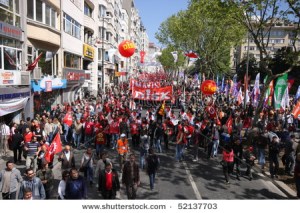
 KAFILA - COLLECTIVE EXPLORATIONS SINCE 2006