Category Archives: Centre watch

Free Waqar Ahmad

The text below comes from the FREE WAQAR CAMPAIGNfreewaqar.org

Waqar Ahmad Moharkan was born in Indian-held Kashmir in 1990. Currently, he is a final year student of Bachelor’s in Commerce at Srinagar’s Islamia College of Science and Commerce. Waqar was arrested on 4 October, 2011, during a raid on his house in Lal Bazaar on charges of participating in protests in the Downtown area of Srinagar. Waqar was arrested by police personnel from MR Gunj station. The court allowed his bail application on 23 October, 2011. Instead of being released, he was rebooked by same police station and shifted to Central Jail under judicial remand on 15 December, 2011 and suddenly slapped with the draconian Public Safety Act (PSA). Continue reading Free Waqar Ahmad

A Flawed Democracy – The Case for Proportional Representation in India: Srinivasan Ramani

Guest post by SRINIVASAN RAMANI

Times of India graphic

For all the chest thumping and tomtoming about the Samajwadi Party’s emphatic victory – winning 224 seats out of 403 in the UP Assembly elections – a true reflection of the mandate is to be seen in the individual vote shares of the four main (“effective”) parties in the elections (the Bahujan Samaj Party – Bhartiya Janata Party, the Samajwadi Party, and the Congress – in alliance with the Rashtriya Lok Dal). Data from the Election Commission of India website shows the following in terms of vote shares:

Continue reading A Flawed Democracy – The Case for Proportional Representation in India: Srinivasan Ramani

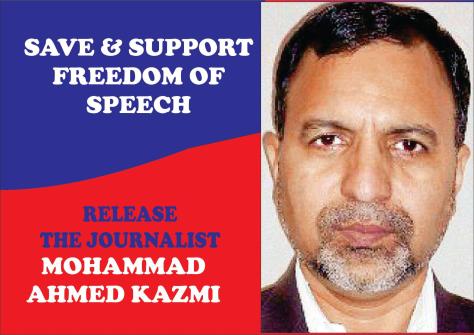
On the arrest of Mohammad Ahmad Kazmi

On 7 March, Delhi Police arrested Delhi-based journalist Mohammad Ahmad Kazmi on charges of being part of the plot to kill an Israeli diplomat’s wife in Delhi on 13 February. Many have expressed concern that Kazmi is being falsely implicated. Give below is the text of a letter to the Delhi Police Commissioner by the DELHI UNION OF JOURNALISTS, followed by a statement from the INTERNATIONAL FEDERATION OF JOURNALISTS, and thereafter by a statement issued by a group of citizens.

    9 March 2012 

The Commissioner of Police,
Delhi Police,
New Delhi

Sir: Continue reading On the arrest of Mohammad Ahmad Kazmi

Joint Statement on police atrocities and state repression on anti-POSCO struggle

See names of signatories below; please send your endorsement to asit1917 at gmail dot com

We strongly condemn the attack on and illegal abduction by the Odisha police of Umakanta Biswal, a famer belonging to Dhinkia village of Odisha, and an active member of POSCO Pratirodh Sangram Samiti (PPSS), that has been engaged over the last six years in resisting the forcible acquisition of their land by the Odisha government for handing over to the South Korean multinational corporation POSCO. This incident, which occurred on 2nd March 2012, is the latest in the series of atrocities inflicted by the Odisha government and by hired goons associated with the government and the POSCO company, on the people of these villages. Umakanta Biswal, who was engaged in agricultural activity in his paddy field at the time of his abduction, was pursued by a group of armed plainclothes policemen on a motorbike, and shot at when he tried to escape. He has reportedly been kept in Paradip prison, and has not been produced in front of a magistrate within 24 hours of his arrest, as is required under law. We have cause to fear that he is being tortured in police custody, and are gravely concerned about his safety. Continue reading Joint Statement on police atrocities and state repression on anti-POSCO struggle

The Unique Identity of a Standing Committee – The UID in Parliament: Taha Mehmood

This long guest post by TAHA MEHMOOD, who has been independently  researching surveillence, biometrics and identification techonologies for a long time dissects the discussion and discourse around the Unique Identification Database scheme of the Government of India

  1.   The Discreet Charm of UID

The January 2012 issue of The Economist, a magazine published from London, has an article on India’s national ID card scheme, titled, The Magic Number. The article focuses on how UID is progressing. The  brave hero of the story is of course Nandan Nilekani and villain is ‘India’s stubborn home minister, P. Chidambaram,’ who ‘is now blocking a cabinet decision to extend the UID’s mandate, which is needed for the roll-out to continue’. According to the unnamed author of the article, ‘Indian politics hinge on patronage—the doling out of opportunities to rob one’s countrymen. UID would make this harder. That is why it faces such fierce opposition, and why it could transform India.’ This article appeared in The Economist days after the report of Standing Committee of Finance was released. What went on in the deliberations of this standing committee?

Continue reading The Unique Identity of a Standing Committee – The UID in Parliament: Taha Mehmood

Everything you wanted to know about the great Kingfisher Airlines scam but didn’t know who to ask

This slideshow requires JavaScript.

All your queries will be answered here.

Caste Discrimination in Cyclone Thane in Tamil Nadu and Pondicherry: NDW-NCDHR

A preliminary report of an investigation into caste discrinimation with regard to Cyclone Thane by National Dalit WatchNational Campaign for Dalit Rights  conducted on 18, 19 January 2012

Cyclone Thane

Cyclonic Storm Thane was the strongest tropical cyclone of 2011 within the North Indian Ocean. Thane initially developed as a tropical disturbance within the monsoon trough to the west of Indonesia. Over the next couple of days the disturbance gradually developed further while moving towards the northwest, and was declared a Depression during December 25, before being declared Cyclonic Storm Thane during the next day. As it was named, Thane started to turn towards the west under the influence of a subtropical ridge of high pressure before its development slowed down during December 27, as a strong outflow and marginally favourable sea surface temperatures fought with persistent vertical wind shear. After its development had slowed down during December 27, Thane became a Very Severe Cyclonic Storm during December 28, before as it approached the Indian states of Tamil Nadu and Andhra Pradesh, it weakened slightly. Thane then made landfall early on December 30, on the north Tamil Nadu coast between Cuddalore and Pondicherry and rapidly weakened into a depression.

Cuddalore and Vilipuram Districts in Tamil Nadu and Pondicherry were the worst affected due to Cyclone Thane. All roads in these three districts are line by wreckage of fallen trees including large tracts of Casuarina plantations completely wiped out. The only trees that seem to have withstood the fury of the cyclone seems to be the Borassus flabellifer or the Palmyra Palm. According to government estimates at least 39 people have been killed by this cyclone in Tamil Nadu and 7 in Pondicherry. Apart from the loss of life, the Cyclone left huge destruction in terms of livelihood, particularly agricultural livelihood and ripped apart the green cover in these already arid districts.

Continue reading Caste Discrimination in Cyclone Thane in Tamil Nadu and Pondicherry: NDW-NCDHR

How India Makes E-books Easier to Ban than Books (And How We Can Change That): Pranesh Prakash

Without getting into questions of what should and should not be unlawful speech, this guest post by PRANESH PRAKASH chooses to take a look at how Indian law promotes arbitrary removal and blocking of websites, website content, and online services, and how it makes it much easier than getting offline printed speech removed.

Banning E-Books is Trivially Easy
E-Books Are Easier To Ban Than Books, And Safer
Contrary to what Mr. Sibal’s recent hand-wringing at objectionable online material might suggest, under Indian laws currently in force it is far easier to remove material from the Web, by many degrees of magnitude, than it is to ever get them removed from a bookstore or an art gallery. To get something from a bookstore or an art gallery one needs to collect a mob, organize collective outrage and threats of violence, and finally convince either the government or a magistrate that the material is illegal, thereby allowing the police to seize the books or stop the painting from being displayed. The fact of removal of the material will be noted in various records, whether in government records, court records, police records or in newspapers of record.

By contrast, to remove something from the Web, one needs to send an e-mail complaining about it to any of the string of ‘intermediaries’ that handle the content: the site itself, the web host for the site, the telecom companies that deliver the site to your computer/mobile, the web address (domain name) provider, the service used to share the link, etc. Under the ‘Intermediary Guidelines Rules’ that have been in operation since 11th April 2011, all such companies are required to ‘disable access’ to the complained-about content within thirty-six hours of the complaint. It is really that simple.
Continue reading How India Makes E-books Easier to Ban than Books (And How We Can Change That): Pranesh Prakash

In the name of sovereignty: APDP

This release comes from the ASSOCIATION OF PARENTS OF DISAPPEARED PERSONS, the Bund, Amira Kadal, Srinagar – 190001, Jammu and Kashmir

Press Statement, 25th January 2012: On 17th October 2011, Association of Parents of Disappeared Persons (APDP) submitted an application for information under Right to Information Act 2009 to the office of the Public Information Officer of State Department of Home. The application was regarding unmarked graves and mass graves in all the districts of Jammu and Kashmir. The State Home Department vide its letter no: Home/RTI/2011/1659 dated: 24th October 2011, transferred the application to the office of Director General of Police, Jammu & Kashmir. Later Director General of Police, Mr. Kuldeep Khoda sent communiqué vide no. legal/RTI/III/98/2011-5590-91 dated 10th December 2011 to the SSP CID Headquarters, asking him to furnish a detailed report on this issue.

Today, on 25th January 2012, we have received a response from the SSP CID Headquarters vide letter no: CID/GB/RTI/2011/8756-58, in which the CID Department has informed us that the information regarding the unmarked graves and mass graves in all the districts of Jammu and Kashmir cannot be shared as the disclosure of the information, according to Jammu and Kashmir Police would be “prejudicial to the maintenance of public peace and tranquility, as the anti-national elements may use the same for incitement of commission of offence in the state”. The SSP CID Headquarters further states, “In the present security scenario it is quite imminent that consequences of such a situation would be highly prejudicial to the sovereignty, integrity and security of the state”. Continue reading In the name of sovereignty: APDP

Some Questions for the Maharashtra ATS Chief: JTSA

This release comes from the JAMIA TEACHERS’ SOLIDARITY ASSOCIATION

The Maharashtra ATS claims to have cracked the 13/7 blasts case. Its chief has revealed in a press conference that Indian Mujahideen was behind the Mumbai blasts. And yet, the Ministry of Home Affairs remains far from impressed—indeed, it appears rather irritated. And the press, also unusually, has been circumspect about his revelations. The ATS Chief says that he did not want to call a press conference. But the rumours about Naquee’s IB links were threatening the credibility of the ATS. Such were his compulsions when he launched into a monologue about the ‘breakthrough’ his team—under his guidance of course—had achieved.

Despite his loud proclamations however, there are few who are willing to buy the ATS’ arguments. Here are some issues for the ATS Chief to mull over: Continue reading Some Questions for the Maharashtra ATS Chief: JTSA

‘सलमान रूश्दी के कार्यक्रम रद्द होने पर निराशा’; PUCL regrets cancellation of Salman Rushdie’s visit to Jaipur

Given below is the text of a press statement issued today by the PEOPLE’S UNION FOR CIVIL LIBERTIES, Rajasthan. The Hindi original is followed by an English translation.

प्रेस विज्ञप्ति
सलमान रूश्दी के कार्यक्रम रद्द होने पर निराशा
दिनांक: 20.01.2012

सलमान रूष्दी के जयपुर आने के कार्यक्रम के सम्बन्ध में जब कंछ मुस्लिम संगठनों ने हिंसक विरोध की चेतावनी दी थी तभी पी.यू.सी.एल. ने तुरन्त उसके विरोध में अपना वक्तव्य दिया था और कुछ प्रभावषाली मुस्लिम संगठनो तथा उस समाज के प्रबुद्ध नागरिकों से सम्पर्क कर उनसे विस्तृत चर्चायें की थीं। उन्होने भी हमारे दृष्टिकोण को समझा था और किसी प्रकार के हिंसक विरोध के सम्बन्ध में अपनी असहमति भी प्रकट की थी। परन्तु वह सलमान रूष्दी का जयपुर आगमन पर अपने विरोध के स्वरो को मुखरित करने के अधिकार को सुरक्षित रखना चाहते थे। इसमें कोई आपत्ति भी नहीं हो सकती थी परन्तु ऐसे विरोध की सीमायें कहॉं तक हांेगी इस पर चर्चा जारी थी। इसी बीच सरकार की ओर से यह वक्तव्य दिया गया कि सलमान रूष्दी के आने से कानून और व्यवस्था की स्थिति बिगड़ सकती है। इसलिए उनके आने पर पाबंदी लगाने पर विचार किया जा रहा है। पी.यू.सी.एल. ने सरकार के इस रवैये का जमकर विरोध किया था और इस पर एक प्रदर्षन भी आयोजित किया था। मुस्लिम संगठनों से इसके बाद विस्तृत चर्चा हुई और उन्होने भी यह स्वीकार किया कि कानून और व्यवस्था की स्थिति नहीं बिगड़ने देगें। लेकिन लगता है कि सरकारों को यह प्रयास रूचिकर नहीं लगे और आज सलमान रूष्दी ने ई-मेल सन्देष भेेजकर अपना कार्यक्रम रद्द करते हुए यह कहा है कि उन्हें राज्य सरकार से सन्देष प्राप्त हुआ है कि कुछ उग्रवादी तत्व किसी अन्य प्रदेष से आकर उनकी जान लेने की कोषिष कर सकते हैं। हंालाकि उन्होने स्वयं इस प्रकार की खबर को सन्देहात्मक बताया है परन्तु अपना कार्यक्रम रद्द करने का यही कारण बताया है। Continue reading ‘सलमान रूश्दी के कार्यक्रम रद्द होने पर निराशा’; PUCL regrets cancellation of Salman Rushdie’s visit to Jaipur

Open Letter to Haryana CM on Forced Land Acquisition for Gorakhpur Nuclear Power Plant, Fatehabad

Farmers of Gorakhpur village hold a protest in Fatehabad against acquisition of their agricultural land by the Haryana government for a nuclear power plant in the area, August 2010. (The Tribune on-line)


January 16, 2012

Bhupinder Singh Hooda,
Chief Minister, Haryana
Chandigarh

Dear Mr. Chief Minister,

It was with gravest concern and misgivings that we heard of Section 9 of the Land Acquisition Act, 1894, being issued in Fatehabad, Haryana, to forcibly acquire land for the proposed Gorakhpur Nuclear Power Plant Project. This action by the Harayana State Govt. is completely unacceptable on the following two counts:

Farmers of Gorakhpur and nearby villages have been sitting in continuous opposition to the proposed nuclear power plant from August 2010. They are fighting for their right to life, livelihood and to safeguarding their fertile and irrigated, three-crop land, all of which will be severely threatened if the project were passed. The fact that a community is in such a long drawn and strong opposition to this project, is of crucial concern and cannot be ignored arbitrarily or repressed in democracy. Continue reading Open Letter to Haryana CM on Forced Land Acquisition for Gorakhpur Nuclear Power Plant, Fatehabad

PUCL condemns those opposing Salman Rushdie’s visit to Jaipur

This release comes from the PEOPLE’ S UNION FOR CIVIL LIBERTIES, RAJASTHAN

16 January 2012, Jaipur: PUCL strongly condemns Muslim organisations, the Congress and the BJP for opposing Salman Rushdie’s proposed visit to Jaipur

Some Muslim organisations have opposed Salman Rusdie’s participation in the Jaipur Literature Festival. Leaders of the Congress and the Bhartiya Janta Party have also come out strongly in opposition to Rushdie’s visit. Some newspaper reports have carried announcements that Rushdie could be forcibly prevented from coming and attending the literary event.

The opposition is not merely ideological but is also by threatening to disturb law and order. The Rajasthan unit of the PUCL expresses deep concern at such announcements. Such regressive threats are not only an attack on the individual’s right to freedom of speech and expression and a violation of rights granted by the Constitution of India. Such threats also promote communal disharmony, if not deliberately seek to widen communal rifts.  Continue reading PUCL condemns those opposing Salman Rushdie’s visit to Jaipur

Women’s groups stopped from meeting Soni Sori in Raipur

Press statement from Saheli, Delhi; Women Against Sexual Violence and State Repression (WSS), Delhi; WSS Orissa and Madhya Pradesh Mahila Manch, Bhopal.

A team of women representing various women’s groups from across the country were in Raipur on 12-13th January to meet Ms. Soni Sori, currently lodged in Raipur Central Jail. Ms Sori is a tribal school teacher who has been hounded by the Chhattisgarh Police as a Maoist conduit. She was arrested in October 2011 and was brutally assaulted sexually in police custody on the night of 8-9th October.

Even after applying for permission as per procedure and repeated requests to various concerned officials on 12th, the women were denied permission to meet her, despite already having an assurance from the Principal Secretary, Mr. Baijendra Kumar, during his visit to Delhi in October.For two whole days the team was shuttled from one authority to the other and back, with each and every official avoiding taking a decision or give in writing any denial or reasons for it. Finally, permission was denied on 13th citing `security’ concerns.

Read full statement here.

Jaypee and Mahyco as Indian Express sponsors: There is conflict of Interest here, Sir

[The following is a statement issued by concerned individuals regarding the sponsorship of the ‘Excellence in Journalism’ awards organized by the Indian Express.]

On January 10 and 11, 2012, half page advertisements in the Indian Express (IE) newspaper (at least in the Delhi edition) announced that on Jan 16, 2012 the IE Excellence in Journalism Awards will be given. The advertisement also said that the main sponsor is Jaypee Group and among other sponsors include the Mahyco Monsanto.

One may recall that Indian Express has been on a campaign mode advocating big dams in general. It has been specifically campaigning against the movements like the Narmada Bachao Andolan. In March April 2006 the paper specifically ran a campaign against NBA and also against the then Union Minister Prof Saifuddin Soz[1]. In Oct 2010 the paper ran a campaign for large hydro projects in the North East India when the then Environment Minister Jairam Ramesh held an open public hearing on these projects in Guwahati and then wrote to the Prime Minister, raising concerns about so many hydro projects being taken up in NE India and the impacts thereof.

Continue reading Jaypee and Mahyco as Indian Express sponsors: There is conflict of Interest here, Sir

Demanding a ban on visit of Salman Rushdie to India is outrageous: PUCL

This release comes from the PEOPLE”S UNION FOR CIVIL LIBERTIES

The People’s Union for Civil Liberties (PUCL) views it with deep concern that some organizations have demanded ban on entry of Salman Rushdie in the country. The present call is illogical, preposterous and untenable as the writer has visited the country for several times after the Satanic Verses book controversy. Continue reading Demanding a ban on visit of Salman Rushdie to India is outrageous: PUCL

Invisible Censorship – How India Censors Without Being Seen: Pranesh Prakash

Guest post by PRANESH PRAKASH

The Indian government wants to censor the Internet without being seen to be censoring the Internet. This article by Pranesh Prakash shows how the government has been able to achieve this through the Information Technology Act and the Intermediary Guidelines Rules it passed in April 2011. It now wants methods of censorship that leave even fewer traces, which is why Mr. Kapil Sibal, Union Minister for Communications and Information Technology talks of Internet ‘self-regulation’, and has brought about an amendment of the Copyright Act that requires instant removal of content.

Power of the Internet and Freedom of Expression
The Internet, as anyone who has ever experienced the wonder of going online would know, is a very different communications platform from any that has existed before. It is the one medium where anybody can directly share their thoughts with billions of other people in an instant. People who would never have any chance of being published in a newspaper now have the opportunity to have a blog and provide their thoughts to the world. This also means that thoughts that many newspapers would decide not to publish can be published online since the Web does not, and more importantly cannot, have any editors to filter content. For many dictatorships, the right of people to freely express their thoughts is something that must be heavily regulated. Unfortunately, we are now faced with the situation where some democratic countries are also trying to do so by censoring the Internet. Continue reading Invisible Censorship – How India Censors Without Being Seen: Pranesh Prakash

Bhopal, Media and a “Training Manual”: Shalini Sharma

Guest post by SHALINI SHARMA

It hardly needs any corroboration that the Bhopal Movement led by survivors of the world’s worst industrial disaster adheres to the principles of non- violence as dearly as they adhere to their demands of justice and accountability. However, on the 3rd of  December 2011, as thousands of Bhopal gas victims walked towards the city’s railway lines they had little idea that their act of civil disobedience, marking the 27th Anniversary of the disaster, would be sabotaged by the government and that they would be treated like a violent mob.

Anniversary actions are usually treated as rituals by the media. This occasion was different because even though chakka jaam (block the road) has been organised on several previous occasions, the call for blocking the trains or rail roko was an unusual decision. These survivor-led groups were asking the State government to provide the Supreme Court with the right data related to the number of deaths and actual extent of injuries due to the gas exposure.

Continue reading Bhopal, Media and a “Training Manual”: Shalini Sharma

This is the story of the monkeys of Delhi

From 2009 to early 2011, I lived in a south Delhi barsati which had an enormous terrace area. When I moved in, this open space looked sad and empty, so I spent many thousands of rupees doing it up with all kinds of plants. Then came the monkeys. A team of five to ten. On finding the kitchen locked, they would break the pots, and sometimes eat the plants. No flower was allowed to bloom.

I replaced the mud pots with heavy cement ones. The monkeys broke fewer of them but ate more shoots and leaves. They would come at night. Soon they’d come at dawn, and make such a commotion I’d wake up terrified. Mild banging on the door wouldn’t ward them off, nor would the other tactics I tried. I was afraid of them. They could be aggressive and strong and these traits were multiplied because they operated in gangs. I felt caged in the small room of my large barsati. All I could do was share my misery on Facebook. “Be careful,” a friend warned in a comment, “they once killed the deputy mayor of Delhi.” Read more…

Amitav Ghosh on Goa

Some musings here about the liberation of Goa from Portugese rule by India:

But the interaction between Portugal and India also produced vibrant cultural hybrids in architecture, music and food. Among the state’s most famous dishes is the spicy vindaloo, a curry whose name is thought to be a contraction of the Portuguese phrase “vinho de alho,” or garlic wine. Besides, as Mr. deSouza pointed out, Goa was where the influence of the Enlightenment and the Renaissance in Europe was felt much before it reached other parts of India. As a result, the practice of sati – or widows immolating themselves on their husbands’ funeral pyres – was abolished in Goa 200 years before the British banned it in the rest of India. [Naresh Fernandes]

And on Portugese language, 50 years after the Portugese were sent back to Portugal:

The popular history of the Portuguese period in Goa has largely been restricted to the gory tales of the initial conquest of the island of Goa, of the Inquisition, and the dramatization of the anti-colonial episodes in the territory’s history. To a large extent, this nationalist history dissuades Hindus from subaltern castes from studying the language. This has ensured that it is solely dominant-caste narratives that are incorporated into the histories of the territory, preventing alternative and liberatory narratives to emerge from a re-reading of the texts and narratives of the period of Portuguese sovereignty over the territory.  It is little known for example, that the knowledge of Portuguese is critical to the bahujan challenge to Hindu upper-caste groups’ monopolistic control of the Goan temples. This monopolistic control of the temples was forged in particular through these latter groups’ knowledge of Portuguese. [Jason Keith Fernandes]

Human Rights Review – Jammu and Kashmir in 2011: JKCCS

This release comes from the JAMMU AND KASHMIR COALITION OF CIVIL SOCIETY, the Bund, Amira Kadal, Srinagar 190001, (www.jkccs.net)

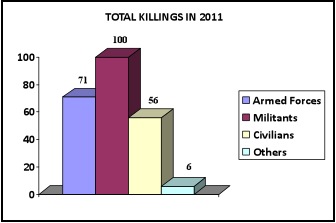
TOTAL KILLINGS

Year 2011 has just passed, and many have declared this year, a peaceful year in Jammu and Kashmir. Of course assertions of peace by various quarters are relative. Enforced silence cannot be construed as peace. Despite the hype of peace, people of Jammu and Kashmir have witnessed unabated violence, human rights abuses, denial of civil and political rights, absence of mechanisms of justice, heightened militarization and surveillance. The figures of violent incidents suggest that 2011 as usual has been the year of loss, victimization, mourning and pain for the people. Continue reading Human Rights Review – Jammu and Kashmir in 2011: JKCCS