Category Archives: Culture

Performing Heritage

By SOHAIL HASHMI: Navina Jafa’s Performing Heritage: Art of exhibit walks is one of few books dealing with the process of conducting heritage and culture walks in India. But the subject is a rapidly expanding and lucrative field that – until now – has not been very well understood.

Jafa is a student of history, a trained classical dancer, a conservationist and a heritage activist. Normally those with their fingers in too many pies end up mixing their metaphors, but this author specialises in inventing her own – the title of this book, for instance. Performing artists, performing acrobats, performing monkeys are terms that all of us are familiar with, but the concept of heritage that performs is more unusual.

The text exists simultaneously on two planes. The first locates heritage walks in the realm of public performances, distinguishing them from exhibitions in controlled environments like museums and art galleries. The second is more illustrative, and is presented as an explanation of the arguments being advanced across the first strand. Continue reading Performing Heritage

The Emperor’s Urs: Riddhi Bhandari

Guest post by RIDDHI BHANDARI
Photographs by SIDDHI BHANDARI

1-DSC_0180

When I first reached Agra for fieldwork, one of the first things guides and shopkeepers around the Taj Mahal told me about was the Urs: “Urs ke liye zaroor rahiyega. You must stay for the Urs. The Taj is different and worth seeing.” Continue reading The Emperor’s Urs: Riddhi Bhandari

Reading Violence in the Garo Hills : Rafiul Alom Rahman

This is a guest post by RAFIUL ALOM RAHMAN

The recent mob fury over the rumour of rape of a mentally challenged Garo girl and the consequent outburst of terror on migrant workers in Tura shouldn’t be read as a simple story of Garo men’s concern for women. If it was so, not so many labourers outside Tura would have been killed in cold blood by Garo miscreants. The claim that tribal society is free from the clutch of sexism, and that it is tribal women who face sexual abuse in the hands of non-tribals does not cut ice anymore. Continue reading Reading Violence in the Garo Hills : Rafiul Alom Rahman

‘Documentary Evidence of Sexual Relationship’: Is companionship necessary when adults cohabit?: Rukmini Sen

This is a guest post by Rukmini Sen The Madras High Court on 17th June 2013 has delivered a judgment where it unambiguously states that ‘the main legal aspect for a valid marriage is consummation’ (pg 13). Consummation of a marriage, in many traditions and statutes of civil or religious law, is the first (or first officially credited) act of sexual intercoursebetween two people, either following their marriage to each other or after a prolonged sexual attraction. Its legal significance arises from theories of marriage as having the purpose of producing legally recognized descendants of the partners, or of providing sanction to their sexual acts together, or both (last accessed 22nd June 2013). In a country like India, where Section 377 of the Indian Penal Code still exists (although decriminalization of consensual sexual acts between two adults in private has been declared by the Delhi High Court in 2008), what constitutes the status of consummation in a gay/lesbian union or when two heterosexual adults live together, when the legal significance of consummation is connected only with giving birth to a ‘legitimate’ child? What about relationships where there are willfully no children, biological, adopted or surrogate? This is one of the many questions that this judgment raises and leaves me more bewildered about my legal identity as a cohabiting partner in a heterosexual relationship.

Continue reading ‘Documentary Evidence of Sexual Relationship’: Is companionship necessary when adults cohabit?: Rukmini Sen

A memorable evening with Vidya Charan Shukla

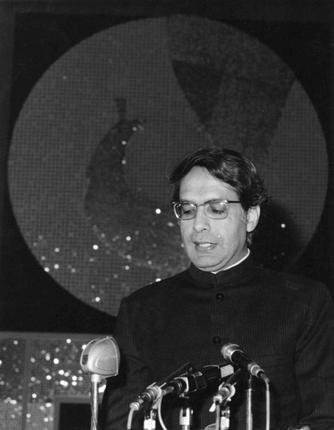
In this January 3, 1977 photo, V.C. Shukla, Union Minister of Information and Broadcasting inaugurates the sixth International Film Festival of India in New Delhi. The Justice Shah Commission of Inquiry which went into the Emergency execesses, had mentioned Shukla's name in its report. Photo: The Hindu Archives / TheHindu.com
In this January 3, 1977 photo, V.C. Shukla, Union Minister of Information and Broadcasting inaugurates the sixth International Film Festival of India in New Delhi. The Justice Shah Commission of Inquiry which went into the Emergency execesses, had mentioned Shukla’s name in its report. Photo: The Hindu Archives

By SOHAIL HASHMI: Though the East and the West have great differences in issues cultural, in one matter they are like twin brothers. Both insist we should not speak ill of the dead. This does not apply to Changez Khan, Hitler and Mussolini. Some would add a few more to the list, but there are chances of violent disagreements on some of those names.

There have been honourable deviations from this haloed creed and if my memory serves me right,  at least one of them has been attributed to The Bard, who made Mark Antony declare at the funeral of Caesar, “Friends Romans and Countrymen, we have gathered here to bury Caesar and not to praise him,” or words to that effect.

These were some of the confused musings that floated to the top of the mind when I heard the news of V.C. Shukla’s passing away. Does the fact that he is dead or the dastardly fashion in which death stalked him and ultimately consumed him, give him an escape from his deeds?

It is a commentary on our justice delivery system that V.C. Shukla, one of those who belonged to the coterie that ran the Emergency establishment for Mrs Gandhi, did not spend a long time behind bars for his acts of commission as Minister of Information and Broadcasting. Some of his achievements as Minister of Information included snapping power supply to newspapers critical of the Emergency, introducing Draconian censorship, banning magazines and newspapers, and sealing printing presses that dared to publish anything critical of the infamous Mrs G or her Emergency regime. Continue reading A memorable evening with Vidya Charan Shukla

Disinformation and Journalistic Ethics: A Letter from Harsh Mander

We are publishing below a communication received from Harsh Mander, a former member of the National Advisory Council, regarding misrepresentation of his position and his politics by no less a person than the editor-in-chief of the Indian Express. The misrepresentation could easily have been corrected, had the mistake been really a mistake but by not publishing the letter or even an editorial correction, newspaper and the editor seem to be acknowledging that the error was in fact, intended. In the language of the Cold War, acts such as these were called ‘disinformation’. 
Response to Mr Shekhar Gupta’s article ‘The Bleeding Heartless’ in the Indian Express, June 1 2013
 

In response to an article by Mr Shekhar Gupta ‘The Bleeding Heartless’ in the Indian Express, June 1 2013, I sent the letter reproduced below on 3 June 2013, which has not yet been carried by Indian Express. I try not to respond polemically to articles which disagree with my views on public policy or other issues, as these differences are perfectly legitimate in a democracy. And who is to be sure that I am right, and my critics are wrong? But this was different, because it utterly falsely described my ideological position on Maoism as sympathetic, whereas I have always been passionately and publicly opposed to all forms of violence, including Maoist violence. Moreover it linked this to my membership in the NAC, and through that by implication to the many pro-poor agendas I sought to bring into and support within the NAC in the two years that I was a member. Finally Indian Express did not check with me the full facts reported in the opinion piece. I therefore felt I should respond formally to the report. But since this response has not been carried, and on the other hand it is being publicly referred to by others as well, I felt it would be best to place this reply in the public domain. – Harsh Mander Continue reading Disinformation and Journalistic Ethics: A Letter from Harsh Mander

Old Films: Habib Tanvir

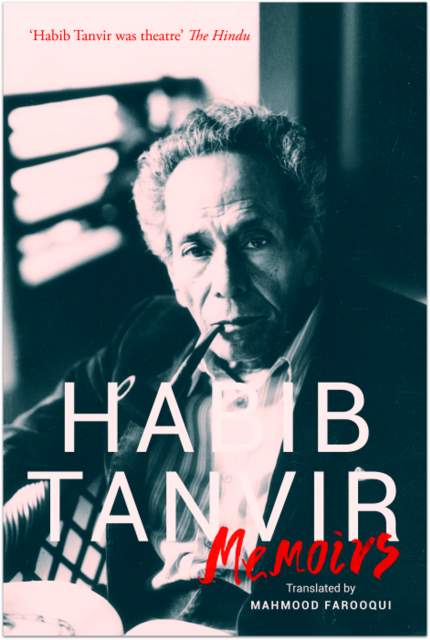
This is an excerpt from HABIB TANVIR’s Memoirs, translated by MAHMOOD FAROOQUI, to be released this evening 7 pm at the India Habitat Centre in Delhi.

1-habib-t-mahmood-cover
Memoirs by Habib Tanvir, translated by Mahmood Farooqui, Penguin Viking, Delhi, 2013; Rs. 599, pp. 400

First of all there was the bioscope. A woman wearing ghaghra and choli would roam around from mohalla to mohalla calling out to the children and gathering them at a chowk or in large courtyard, would take out a long stool from her arm pit and place it on the ground, would remove an octangular and muddy looking tin box from her head and place it on top which had a small mouth covered by a black cloth which the child would remove and peer inside. The women usually came from Rajasthan. The box would contain ten or fifteen cards of photographs, she would show them one after the other and also introduce them in a particular musical speech, ‘see the Rauza of Taj Bibi, see the Lal Qila of Dilli…etc.’ At one time only one child could see the pictures, which would be projected through a lens and lit up through a bulb inside the box which would make the photographs appear larger and more dramatic. When one child was through another would take his place. A large and restive crowd of children would be gathered around waiting their turn. Even the elders would be eager to see Hindustan through these pictures. She would charge two to three chhedams from everyone who took a peep. When the show was over, she would hawk her way to another mohalla. Continue reading Old Films: Habib Tanvir

Iqbal Chacha and a Voice from the Past: Sameer Khan

Guest post by SAMEER KHAN: Mr. Chaddha lived in my neighbourhood, a tall lanky elderly gentleman who looked young for his age. I would often see Mr. Chaddha come for a morning walk in our local park, but I stayed aloof, not having an interest in the elderly gentlemen in the park who were either part of laughter clubs or the local residents union.  Whenever I managed to struggle out of my bed for my morning exercise I would notice Mr. Chaddha walking ramrod straight like a soldier. He was never generous with his smiles and would simply nod his head whenever I greeted him.

One pleasant winter morning as I passed Mr. Chaddha in the park I was surprised to hear him call my name. I went towards him, and looking at me from his towering height he asked me, “Can you read and write Urdu?” Startled by the question I answered, “Uncle I can read Urdu but I am not too confident of my writing abilities.“

He said, “Well actually I want someone to write a letter for me in Urdu” Continue reading Iqbal Chacha and a Voice from the Past: Sameer Khan

The value of undergraduate education for ‘Other’ students: Sanjay Kumar

Guest post by SANJAY KUMAR.

We are a tired party after two days quick hike up to the base of IndraharPass in the Dhauladhar range. Half of the students are visually challenged, the other half have been painstakingly guiding them over tricky stretches of the trail. The bus for Delhi is three hours late. We are stretched over our carry mats, reclining on backpacks, on the pavement behind a row of buses at Dharamshala bus stand. The issue under discussion is Atheism. It hasn’t taken long for visually challenged students to split into firm believers who pray regularly, occasional/opportunist believers, agnostics and atheists. Arguments are both experiential and theoretical. During one particularly intense exchange an occasional believer asks a firm believer, “If there really is a God who is omnipotent, good and takes care of every one, then tell me why has he made us so that we can not see?” It is an old normative argument against the conception of God. Presumably Darwin turned atheist arguing similarly with himself after witnessing the pain of his infant daughter due to an incurable illness. Closer home, revolutionary Bhagat Singh gives a liberal juridical version of the argument in ‘Why Am I an Atheist?’ Believer’s reply is spontaneous, in a matter of fact way. “You know what, I find myself really fortunate in being visually challenged. Due to this I got a chance to study. Had it not been for this, I would have been selling sweets from my father’s push cart in our small town.”

Realities of life in a country like India have to be piercingly brutal for a talented young man to think that it is mainly through his physical disability that he got access to a decent education and moving out of a life of poverty. This note is intended to bring some consequences of such reality to the recent discussions on Kafila regarding education at Stephen’s College.

Continue reading The value of undergraduate education for ‘Other’ students: Sanjay Kumar

The Golchakkar of Premier Institutions: St. Stephen’s College as a Public Concern: N P Ashley

This is a guest post by N P Ashley: For a teacher, it feels strange to defend one’s workplace in public against the experiential remarks of an individual who happens to be in some ex-student capacity in the same college. “I didn’t like X’s classes” or “I found academic excellence in St. Stephen’s College a myth”  are statements that need no attempt to be disproven precisely because the writer, Thane Richard, makes no attempt to prove them in the first place. The narrative is anecdotal and validation is through “personal experience” which can only be countered, rather weakly, through other anecdotes. Hence, I won’t get into it. But there are certain methodological problems with the entire exercise, which, if not countered, will wrongly define the concerns of the readers.   Continue reading The Golchakkar of Premier Institutions: St. Stephen’s College as a Public Concern: N P Ashley

Of Angry Young Students and Education in India – A Response to Thane Richard: Aritra Chatterjee

This is a guest post by ARITRA CHATTERJEE: In his response to the article by some students of St. Stephen’s College, Thane Richard has raised a set of questions about the college, about the students participating in the present movement, about education in India and students’ voice in shaping education. He is critical about what he calls the lack of quality education, of a system where education is primarily about rote learning and conformity to structures of authority; in such a situation the promise of a good liberal arts education remains a mere promise and students migrate to the West in search of it. He also rues the lack of students’ voice in the education system, rhetorically asking, “Do students have any right?” He welcomes the students’ fight against the oppressive regime at St. Stephen’s College but views it as a movement that is too little too late and even that in “the wrong direction”. I shall respond to his views at two levels – at the level of education in the country as a whole, and that of the present movement at St. Stephen’s College. Continue reading Of Angry Young Students and Education in India – A Response to Thane Richard: Aritra Chatterjee

Academic Excellence and St. Stephen’s College: A response by Thane Richard

This is a guest post by THANE RICHARD

I recently read an article in Kafila – more like an angry, reflective rant – written by some students from St. Stephen’s College in Delhi.  To quickly summarize, the piece criticized the draconian views of the Principal of St. Stephen’s College regarding curfews on women’s dormitories and his stymying of his students’ democratic ideals of discussion, protest, and open criticism.  More broadly, though, the article’s writers seemed to be speaking about the larger stagnant institution of Indian higher education, overseen by a class of rigid administrators represented by this sexist and bigoted Principal, as described by the students.  The students’ frustration was palpable in the text and their story felt to me like a perfect example of what happens when an unstoppable force meets an immovable object.  Except Indian students are not an unstoppable force.  Not even close. Continue reading Academic Excellence and St. Stephen’s College: A response by Thane Richard

A Report from the Protests: Kavya Murthy

Guest post by KAVYA MURTHY.

In the middle of the day a few days ago, a group of around ten people held hands and blocked the traffic on the road opposite the police headquarters at ITO, Delhi, protesting and calling for the removal of the Police Commissioner after a young, young child  had been raped and the police had done nothing, not file an FIR, nor act.

In this instance, it was not only the brutality of the act that had shaken us up. A young child, five years of age, raped by neighbours, bad enough to hold one’s head in shame – yes. There was outrage. But there was also outrage that a police officer had tried to bribe the family of the girl – with two thousand rupees – to avoid filing an FIR. Then, to add insult to injury, a young woman protester slapped repeatedly by an impatient policeman, an Assistant Commissioner of Police no less, when she tried to get inside the hospital where the child was in a critical condition.

Why were we there, that afternoon outside the Delhi Police Headquarters? What had prompted people to gather at the AIIMS metro station the day the child was shifted there for care, what was being said, who was being addressed? Was it  a silent vigil, in hope that this little child does not meet the same fate as the 23 year old woman gang raped just a few months ago? Was it also to say,  this is not the first time it is happening after that fateful day on December 16, 2012? 363 rapes already in just around the NCR the last few months, and here we are again, not exactly happy to be standing outside in outrage thinking of a little girl with bottles in her vagina and terrible infections. Continue reading A Report from the Protests: Kavya Murthy

Why Delhi University’s Four Year Undergraduate Programme Should Not be Implemented with Irresponsible Haste


A Note Prepared at the Request of the Department of Higher Education, MHRD, Govt of India

Preamble:

Universities are meant to educate, that is, to teach students how to identify, understand and evaluate multiple points of view. Therefore, dissent, debate and argument are the core concerns of a University – they cannot be regarded as irrelevant irritations or acts of sedition. Debate cannot continue indefinitely, and must be responsible. But what constitutes responsible and well-considered criticism is inevitably a matter of judgement – it cannot be decided through assertion and counter-assertion. It is also inevitable that motives will be called into question. This is once again a matter of judgement, based on available evidence on who is speaking (what is their wider credibility beyond the immediate dispute?) and why (what do they stand to gain or lose by what they are saying?), and an overall sense of what is at stake in the issue. We invite such judgements.

Facts which are NOT disputed:

1. The proposed FYUP is the biggest, most far reaching change of curriculum in the recent (i.e., last 30-40 years) history of DU – it will replace every existing undergraduate course of study in every college and every discipline (professional courses & some other low-enrolment courses may be exceptions).

2. The first time that the FYUP was placed before any statutory body of the University was at the Academic Council meeting of Monday, 24 December, 2012. This meeting – to discuss the biggest curricular reform in several decades – was an Extraordinary meeting, called at 3 days’ notice, which was issued on Friday, 21 December, 2012 and delivered over the weekend, giving Departments no time to consider the proposal and formulate an informed response.

3. The structure of the FYUP presented to the Academic Council on 24 December had not been sent to the Committees of Courses at the Faculties or Departments, or to the Staff Councils of Colleges.

4. The Academic Council meeting of 24 December approved the FYUP with 6 dissents, including a written submission by the Dean, Faculty of Social Sciences, specifically requesting that the University take more time to think through this major change, and that a detailed White Paper on the FYUP be prepared and made public to enable the University community to respond to it.

5. The Executive Council meeting at which the AC approval of the FYUP was presented was held on Wednesday, 26 December, 2012, i.e. the next working day after the AC meeting of 24 December.

Continue reading Why Delhi University’s Four Year Undergraduate Programme Should Not be Implemented with Irresponsible Haste

Playback of a golden voice

In this country of almost a billion and a quarter you might find some people who have not heard of Mohammed Rafi. In such a scenario, My Abba: A Memoir, a book on the great singer written by his daughter-in-law Yasmin Khalid Rafi in its stream of conscience kind of technique, connects one to his life like no other book. Yasmin is writing about someone she idolised and loved, like only a daughter can. When she talks of him, a jumble of memories comes rushing back and surrounds her—the songs she liked, the music directors who worked with Rafi Saheb, his simplicity, his generousness, his love for his family, his insecurities, his inability to be flamboyant, the metamorphosis that transformed him into a great performer the moment he set foot on the stage. Continue reading Playback of a golden voice

On the social fabric in Narendra Modi’s Gujarat: Nilanjan Mukhopadhyay

This is an excerpt from the chapter, ‘The Enemy Within’ in NIIANJAN MUKHOPADHYAY’s book, Narendra Modi: The Man, The Times.

20130420-121828.jpg
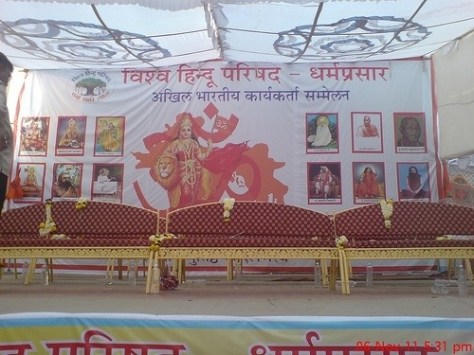
Stage set for a Vishwa Hindu Parishad function next to the Pirana shrine in Ahmedabad, 2011. Photo via twocircles.net

From the label of “Master Divider” in India Today in January 2003 to the tag of “The Great Polariser” in the Outlook in July 2012 — Narendra Modi’s image remained static: self-declared champion of one community of people. But the strain Gujarat faced in the course of his tenure has increased manifold. Wherever I travelled in Gujarat, there was a clear distinction between “us” and “them”. This difference was articulated by several Hindus every time the conversation veered in this direction. In contrast, counterparts among Muslims denied this. The disagreement with the hypothesis stemmed not from a belief and perception that they faced no discrimination but because of a “fear” that accepting such a viewpoint could be interpreted as levelling an allegation that they were being targeted — a risk no Muslim is willing to take after the post-Godhra violence.

Continue reading On the social fabric in Narendra Modi’s Gujarat: Nilanjan Mukhopadhyay

Debating the Attack on Presidency University: Pratyay Nath

Guest post by PRATYAY NATH.

This piece is in response to Waled Aadnan’s post on Kafila titled ‘Because Presidency is an Idea – All You Need to Know about What Happened at Presidency University’ (dated 15 April 2013). Mr. Aadnan’s well-written and succinctly argued piece is not an isolated voice; it echoes a dominant way of thinking that has been noticeable among the various protests against the recent incident of vandalism in the Presidency University (erstwhile Presidency College). Let me begin by stating, like many others already have, that the vandalism that happened in Presidency on 10 April 2013 should be condemned in the harshest of terms. My discomfort lies in some of the ways in which these condemnations are being articulated in the public domain over the past few days. I would suggest that the majority of the protests emanate from a sense of hurt delivered to the idea of eliteness of the educational institution in question, which cannot unfortunately be supported because it tries to detach this incident from the broader socio-political forces of our times by sensationalising the issue.  Continue reading Debating the Attack on Presidency University: Pratyay Nath

Spin Doctors, Propagandists and the Modi Make-over

Elsewhere on Kafila, we have published a 7000 word long response by Madhu Kishwar to Zahir Janmohamad’s open letter to her which appeared on 15 January, followed by Zahir Janmohamad’s response. Perhaps a few things need to be stated here clearly with respect to her ‘response’. It seems to me to violate every tenet of reasoned debate and argument and is replete with name calling and stereo-typing of not just the secularist ‘other’ [who is her real other, not the Muslim] but even of the adversary she is arguing with. So if Zahir is a  Muslim, he has to be X, Y, Z and has to be believing in A, B, C. Everything starts and ends in bad faith. But then that is what distinguishes Madhu Kishwar from others. She is in her element especially in relation to those whom she disagrees with. With her there can be no disagreement – you have to be sneered and jeered at, irrespective of whether you are a Medha Patkar or an Aruna Roy. I suppose these are matters of personal style and I shall not dwell on them further.

Let me rather, turn to some of the more substantive issues raised in Madhu’s response. Zahir has answered most of them but it seems to me that a couple of vital questions still remain. Even here, though, a caveat is necessary. I have great admiration for Madhu Kishwar’s battle in defense of the rikshaw pullers in Delhi and have often said so openly to her as well as others. However, I do know that it is possible to talk to her when only we agree, which is very rare. On matters that we disagree about, I have decided that I do not want to enter into any kind of an argument with her. In any case, large parts of her ‘response’ are like Modi’s PR handouts, served to us without any sense of critical examination. Therefore, what follows below is not my reply to her but my reactions to a set of allegations she has raised about whosoever is opposed to Narendra Modi – all lumped together in a breathtaking move of reductio ad absurdum, first as secularists , who are reduced to Leftists/ NGO activists and finally to Congress-supporters (because, she says in her Modinama1, the Congress has been equally responsible for all the riots till date). I therefore, lay my cards on the table at the outset: I am an inveterate Modi-hater (and a Congress-hater as well, if that makes sense to anyone in her dichotomized universe) and Kafila is a forum with a certain, if very broad, politics that, at the minimum rules out being pro-Modi. Continue reading Spin Doctors, Propagandists and the Modi Make-over

We are all Hari Sadu: Veena Venugopal

VEENA VENUGOPAL writes: Saw the ad about the horrible boss? The one in which the employee comes in with a new idea and in return he gets a load of sarcasm? And even when the boss likes the idea, he reveals it with an air of impudent superiority. Seen that one? What was it called? Hari Sadu?

Well, no. This ad is for a new brand of cookies; Gold Star, it is called. A male “attendant”/“peon”/“employee” comes in to a plush white room and serves a plate of cookies to Amitabh Bachchan. On biting into one, he realizes these are not his regular cookies. “Arre suno,” he calls because come on, he isn’t expected to know the name of all the people who serve him cookies at home. The employee admits they are new. “Maine socha ki…” (I thought…) he says at which Bachchan rolls his eyes and says, “aaj kal aap sochne bhi lag gaye?” (you have even started thinking now?). But then he realizes he likes the new ones and instructs the man, “ayenda yeh sochna band karo,” (please stop thinking in the future). Continue reading We are all Hari Sadu: Veena Venugopal

When the Vishwa Hindu Parishad went time travelling: Ilija Trojanow and Ranjit Hoskote

3_3

This is an excerpt from Confluences: Forgotten Histories of East and West by ILIJA TROJANOW and RANJIT HOSKOTE (Yoda Press, 2012). In defiance of the current tide of national and cultural neo-tribalism, the authors argue that the lifeblood of culture is confluence. No culture has ever been pure, no tradition self-enclosed, no identity monolithic. Employing a variety of approaches, ranging from the essayistic to the poetic, from rigorous historical analysis to the playfulness of fiction, they follow the journeys of stories, ideas, people and songs, and trace the umbilical connections between Europe and Asia, Zoroastrianism and Christianity, Western revolutionary thought and the annihilatory politics of Jihad and Hindutva. In this particular section, titled ‘Travelling Back in Faith’, history is presented through the prism of science fiction:

vhp2The Vishwa Hindu Parishad (VHP) is a powerful organization founded on the belief that the Hindu religion is eternal and unvarying, that it has existed in India for thousands of years (the VHP’s chronological estimates vary between 8,000 and 50,000 years), and that its essence has never been affected by any foreign influence or borrowing. Hinduism is unique to India, and India is a uniquely Hindu country: such is the logic of the VHP. And yet, occasionally, the VHP is assailed by a sense of doubt. It is all very well to thunder at Muslims and Christians in self-congratulatory public meetings, its leaders say to themselves, but it would be nice to have some proof with which to fight off the scoffing scientists. And so, as documents recently made available to researchers reveal, the high command of the VHP decided to sponsor a time travel project, sending a fact-finder back to the glorious Vedic age to collect evidence of how the ancestors of the Hindus performed their rituals, worshipped their gods, and conceived of their relationship to the Divine. Continue reading When the Vishwa Hindu Parishad went time travelling: Ilija Trojanow and Ranjit Hoskote

Nellie, Me and Impunity: Uddipana Goswami

This is a guest post by Uddipana Goswami

I was born around the time the Assam Movement started and grew up in an atmosphere of intense xenophobia. Everywhere, we heard anti-Bangladeshi slogans – which often translated into expressions of anti-Bengali sentiments. Our parents tried their best at home to protect us from such influences. We were sent to convent schools which often isolated us from whatever was going on outside the school walls. But we felt the tensions in the air and tasted the fear. We heard the names of places and people, killed, maimed, tortured.

Nellie was one such name we grew up with. There were others – Dhula, Gohpur, Phulung Sapori – where other genocides happened, but the name Nellie stayed with me. It fascinated me and brought to my mind the image of a distraught woman. Many years later, when I started researching the Muslim community of East Bengali origin in Assam, this amorphous image of Nellie started taking a definite shape. And it translated into a poem one day – ‘If Nellie Was the Name of the Woman’ (Northeast Review).

As I wrote the poem, I realized that I could myself be Nellie, a woman, battered, bruised and abused because of my ‘otherness’, because I could – and would – not sacrifice my ‘otherness’ in my quest for oneness within the institution of marriage.

Continue reading Nellie, Me and Impunity: Uddipana Goswami