
आखिर खुर्शीद अनवर ने ज़िंदगी से बाहर छलांग लगा ली.यह असमय निधन नहीं था. यह कोई बहादुरी नहीं थी. और न बुजदिली. क्या यह एक फैसला था या फैसले का अभाव? अखबार इसे बलात्कार के आरोपी एक एन.जी.ओ. प्रमुख की आत्महत्या कह रहे हैं. क्या उन्होंने आत्महत्या इसलिए कर ली कि उनपर लगे आरोप सही थे और उनके पास कोई बचाव नहीं था? या इसलिए कि ये आरोप बिलकुल गलत थे और वे इनके निरंतर सार्वजनिक प्रचार से बेहद अपमानित महसूस कर रहे थे? Continue reading खुर्शीद अनवर की आत्महत्या और कुछ सवाल
Category Archives: Culture
An Incomplete Reunion – Ruining the Post-Partition Party: Archit Guha
Guest post by ARCHIT GUHA
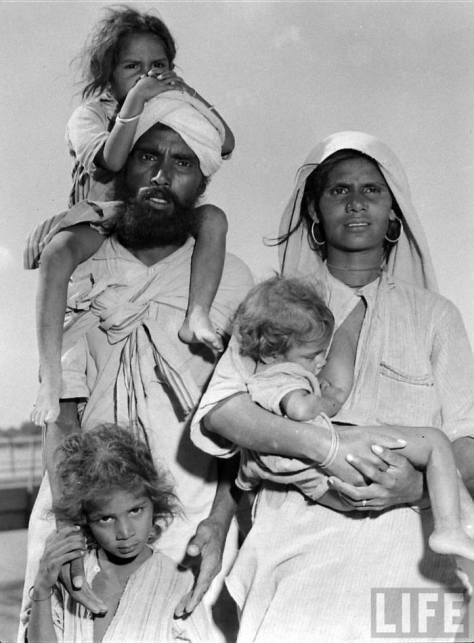
By this point, every Indian, Pakistani, and their grandfathers has watched the Google Partition ad, tears welled up in their eyes. For the uninitiated, Google’s recent advertisement tugs at heartstrings, telling the tale of two chaddi buddies, separated by Partition, and reunited by their grandchildren nearly seventy years later. When the ad went viral via Facebook, sitting thousands of miles away in America, I bawled as I watched the granddaughter listening to her grandfather’s nostalgic retelling of the idyllic life he led in Lahore, eating jhajhariya, with his buddy Yusuf, and his granddaughter’s instant Google fixes to reunite him with Yusuf in Delhi. Continue reading An Incomplete Reunion – Ruining the Post-Partition Party: Archit Guha
As a religious minority, I empathize with sexual minorities: M Reyaz
This is a guest post by M. REYAZ
The Apex Court judgment of December 11, putting aside the Delhi High Court order on decriminalisation of homosexuality, pertaining to Section 377 of the IPC has clearly divided into two ‘queer’ camps, where on one side besides LGBTS are those liberals extending their support to the LGBT cause, and on the other side, there are religious leaders and groups, who otherwise would not even see eye to eye with each other (what is ‘queer’ about this second camp is not so much its sexual orientation, as the strangeness of its banding together against queer people despite their antagonism toward each other).
Continue reading As a religious minority, I empathize with sexual minorities: M Reyaz
The State Manufactures Terrorism: KP Sasi
An Interview with activist-film-maker, K.P. SASI by Md. Eisa, Badre Alam Khan and Abhay Kumar.
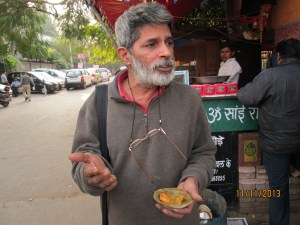
K.P. Sasi is a well-known social activist and filmmaker. In his several decades of activism, he has been associated with a number of social movements ranging from anti-globalisation and anti-nuclear movement to anti-death penalty struggles and the movements led by environmentalists and marginalised social groups such as Dalits, Adivasis, and Muslims etc. He has expressed his activism through making more than two dozen documentaries and a few feature films. But his two music videos —America, America and Gaon Chhodab Nahin, watched by lakhs of people, continue to motivate social and political activists standing against injustice and inequality. The lean and thin Sasi, who spots thick grey beard, is again in controversies for his latest spell of activism. Early in this year he screened a 94-minute long documentary Fabricated based on the life of Muslim leader from Kerala Abdul Nasar Madani, accused in Coimbatore and Bangalore serial bomb blasts. Fabricated has been the fruit of Sasi’s two years of hard work during which he did an extensive research, met a number of people and travelled thousands of miles and received threats as well. Why did he take so much pain and risk his life? Fabricated, in Sasi’s words, is an attempt to bring a ray of hope to thousands of innocent people, mostly Muslims, Dalits, Adivasis, oppressed nationalities, workers and others languishing in jails for years and decades under draconian laws such as Unlawful Activities Prevention Act (UAPA). Fabricated is mostly woven around the story of Madani, making a strong case that the Muslim leader of Kerala is innocent and has been jailed for years simply because has been framed. He has a charisma, a great skill of oratory and above all a vision of the uplift of the marginalised sections. In the early week of November, Sasi was in Delhi where Fabricated was screened at many places. After watching the documentary at Jawaharlal Nehru University, Md. Eisa, Badre Alam Khan and Abhay Kumar had a detailed interview with K.P. Sasi during which he went on a great length about a host of issues from state terror, human rights, Hindu right, caste, and class to the Muslim politics. The excerpts of the interview are as follows: Continue reading The State Manufactures Terrorism: KP Sasi
Delhi Magistrate orders FIR against woman for anti-Modi posts: Kavita Krishnan
Guest post by KAVITA KRISHNAN:
The footsteps of fascism can be heard – this time in the hallowed hallways of the national capital’s courts. A woman who filed an FIR against a man physically threatening her for her anti-Modi Facebook posts, found to her dismay that the Metropolitan Magistrate in the Tis Hazari courts let off the man accused of threatening her safety, while ordering an FIR against her instead! The media’s coverage of this outrageous incident has been, till now, biased and factually misleading.
Sheeba Aslam Fehmi, a journalist and a Ph.D. Fellow in JNU, received several threats by emails from one Pankaj Kumar Dwivedi, which warned her of ‘consequences’ and even demanded she meet the man so that he could ‘cleanse’ her of her ‘filth.’ Continue reading Delhi Magistrate orders FIR against woman for anti-Modi posts: Kavita Krishnan
Jurrat – 10 to 16 December 2013, Delhi
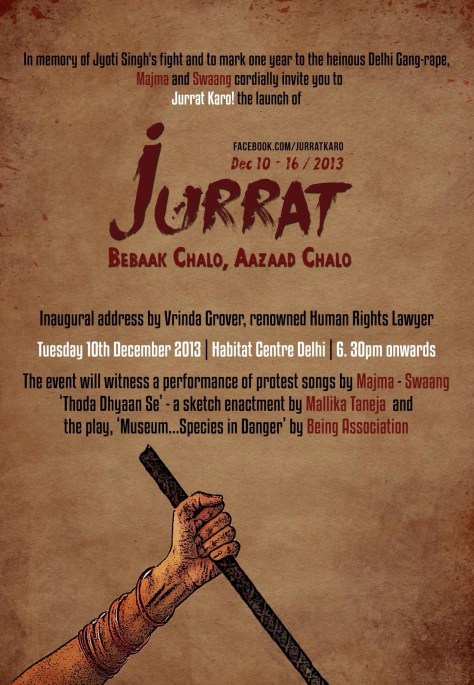
Majma and Swaang are organizing JURRAT – A week long campaign on violence against women, from Dec 10-16.
About Jurrat
On 16th December 2013 one year would have passed since the shameful, horrific and brutal gang rape of a 23-year-old girl in Delhi. And yet this whole year, city after city and village after village has screamed ‘Rape’ ‘Gang Rape’ in the months after the much publicized and condemned Delhi-gang rape. Continue reading Jurrat – 10 to 16 December 2013, Delhi
Petition to Withdraw the ‘Golden Mother’ Award by the University of Calicut
To
Prof. M. Abdul Salam, Vice-Chancellor, University of Calicut
Members of the Syndicate, University of Calicut
The University of Calicut has recently announced the institution of a ‘Golden Mother Award,’ with the stated objective of highlighting “the contribution of mothers to societal development and nation building and to provide exemplary models to youngsters.” Mothers in the age group of 50+ and who are actively contributing to their domains of service will be considered for awards in eighteen categories such as Art, Literature, Teaching, Social work, Politics, Administration, Media, Sports, Agriculture, Entrepreneurship, Engineering, Medicine, Research, Law and judiciary, Police and Banking, Nominations from educational institutions, trade unions, LSGIs, NGOs and other organizations or from individuals themselves are to be submitted to the Director, Centre for Women’s Studies at the University.
Firstly, this attempt to glorify motherhood is blatantly patriarchal, anti-woman, anti-democratic and a move that pulls society back to the mores of a traditional morality. It implies that a woman’s place is at home and that her principal responsibility (and hers alone) is giving birth to children and rearing them. It pays little heed to contemporary feminist critiques of motherhood as not primarily a biological destiny, one that is made problematic by conditions of poverty, deprivation and societal violence. In ignoring new forms of motherhood and parentage such as adoption, single mothers, and so on, it also upholds elitist, casteist, and patriarchal conceptions of family and womanhood. Continue reading Petition to Withdraw the ‘Golden Mother’ Award by the University of Calicut
A hunt, the aftermath, angry Indian men and a tragedy: Rahul Roy
Guest Post by RAHUL ROY
Nivedita Menon ends her commentary on the unfolding Tehelka sexual assault case in Kafila by asserting – “the time has come. It is now”. It should be, but is it? Are we witnessing the end game of an old Indian patriarchal sport called sexual assault? The sport is akin to another old game called the royal hunt that was an important part of elite political culture of South Asia. The rules of the sport were then as now heavily loaded in favour of the royal huntsman – weapons, support teams, timing, everything required for the thrill of a kill were with powerful men out to conquer. The expeditions however were not just about the kill. The sport was also a means of asserting authority over tracts of the wild and those that lived there and were by some misfortune not aware of prevailing authority structures. The royal hunt was an event to showcase to subjects the might, prowess and authority of the elite rulers. It was the stamping of power over human as well as animal kingdom. The royal huntsman could not but win. He could not but kill.
Continue reading A hunt, the aftermath, angry Indian men and a tragedy: Rahul Roy
PUCL Statement on Tehelka Sexual Assault Case
[We are publishing below the full text of the statement issued by the People’s Union for Civil Liberties, on the Tehelka case, which raises some important issues that have not received public attention yet.]
Press Statement on the Tehelka Sexual Assault Case
Dated: 2 December 2013
The PUCL
- Expresses Solidarity with the struggle of the Tehelka Journalist who raised her voice against Rape and Intimidation by the Ex-Editor Tarun Tejpal.
- Demands fair investigation and early charge sheet into the matter, from the Goa Police.
- Considers Six Day of Custodial interrogation of Tarun Tejpal granted by the Goa Judicial Magistrate Court unnecessary and invidious.
- Appeals that police custody and the case not become a tool in the hands of BJP administered Goa police to settle scores with Tejpal.
The People’s Union for Civil Liberties from the very beginning has supported the complaint of the woman journalist of Tehelka magazine who accused the editor of Tehelka, Tarun Tejpal, of rape and sexual assault. PUCL salutes her courage for breaking the silence on rape and sexual intimidation carried out by her senior colleague and editor. We have also admired the consistent and principled manner in which the young girl stated her case, initially via internal emails within Tehelka, and later on to the media, neither allowing vituperation or anger at the blatant violation of her body to sensationalise her case or to prevaricate about the fact of the offence having been committed. Through her dignified stand she stands as a model to all women who suffer similar sexual violence, that the dignity of a woman’s body cannot be a plaything for anybody howsoever influential and powerful they be. By the same token, we also denounce the vilification campaign carried out by Tarun Tejpal and his lawyers against the complainant by seeking to impute that the entire crime was actually a `consensual’ act or at trying to trivialise the crime by calling it “light hearted banter”.
Continue reading PUCL Statement on Tehelka Sexual Assault Case
Tehelka, Jhatka and now Tamasha:Satya Sagar
Guest post by Satya Sagar
Eight years ago I remember listening to Tarun Tejpal in Bangalore as he held forth on how the news media could change the world for the better. It was a gathering of journalism students from Catholic institutions around the country and Tejpal was impressive in his defense of media freedoms.
He was passionate, charismatic, extremely articulate and as Chief Editor of Tehelka- with some of the best stories of Indian journalism behind them- very credible too. After his speech Tejpal left in a hurry, like a star priest dashing off to his next flaming sermon and fawning audience. Continue reading Tehelka, Jhatka and now Tamasha:Satya Sagar
Feminists condemn the BJP lynch mob attack on Shoma Chaudhary
This is the text of the statement released yesterday condemning the attack on Shoma Chaudhary by a BJP mob led by Vijay Jolly.
We condemn the BJP lynch mob that attacked Tehelka managing Editor Shoma Chaudhuri’s house, physically jostling her at the entrance. Unsurprisingly, the BJP and right-wing forces in general have pounced upon the Tehelka sexual assault case to sweep attention away from the sexual crimes of their own Asaram Bapus and their Sahabs.
While Shoma Chaudhuri failed in her responsibility as an employer when approached by an employee complaining of sexual harassment within the organization, she is neither an accomplice nor an accessory to the crime of sexual assault of which the Tehelka Editor Tarun Tejpal is accused.
We also condemn the online harassment meted out to other women employees in Tehelka by the right wing brigade in the internet. Such harassment is only further evidence of the double standards of the right-wing forces who see this attack on the woman journalist as a political opportunity.
Sexual harassment and violence against women respects no political boundaries, and we are appalled that a party responsible for large scale violence against women should present itself as the saviour of women’s rights, and that, through a physical attack on a woman journalist. We recognize the distasteful political pre-election opportunism at work in these self-righteous stands by an ethically bankrupt party, and demand that Shoma Chaudhuri’s safety be assured by the state.
Nivedita Menon
Rohini Hensman
Ayesha Kidwai
Devaki Jain
Abha Bhaiya
Radhika Desai
Janaki Nair
Urvashi Butalia
Arundhati Dhuru Continue reading Feminists condemn the BJP lynch mob attack on Shoma Chaudhary
श्रीलंका और हम
श्रीलंका अभी खबरों में है. लेकिन ज़्यादातर हिंदी अखबारों को पढ़ने से आपको अंदाज़ नहीं मिलेगा कि सुदूर दक्षिण में स्थित इस नन्हें-से मुल्क में क्या कुछ हो रहा है जिससे हमारा भी रिश्ता है.वहाँ अभी‘कॉमनवेल्थ’ देशों का सम्मलेन हो रहा है और हमारे प्रधानमंत्री उसमें शामिल नहीं हो पा रहे हैं.श्रीलंका ने कहा है कि वह उनकी मजबूरी समझता है. तमिल राजनेताओं के हंगामे की वजह से प्रधानमंत्री ने अपनी जगह विदेश मंत्री को इस सम्मलेन में भारत का प्रतिनिधित्व करने को कहा है. इस सम्मलेन में श्रीलंका को अगले दो साल के लिए ‘कॉमनवेल्थ’ का नेतृत्व करने को कहा जाएगा. इस पर भारत को ऐतराज नहीं है और अब तक किसी और मुल्क ने भी अपनी आपत्ति दर्ज नहीं कराई है. Continue reading श्रीलंका और हम
उन्नाव का सोना और विश्वास के आगे समर्पण
अभी ज्यादा समय नहीं बीता जब एक दिन यह ज्ञात हुआ के नई दिल्ली में स्थित तथाकथित अग्रसेन की बावली को अगरवाल समाज के हवाले कर दिया गया है क्योंकि उन्होंने ए एस आई से यह कहा था के इस बावली का निर्माण महाराजा अग्रसेन ने किया था जो अगरवाल समाज के संस्थापक थे. उनका कहना था कि इसलिए अगरवाल समाज बावली की देखभाल करना चाहता है – आखिर बावली उनके संस्थापक की यादगार जो है. ए एस आई ने विधिवत ढंग से एक एम ओ यू (इकरारनामा) तैयार किया दोनों पक्षों ने उस पर हस्ताक्षर किये और बावली अग्रवाल समाज के हवाले कर दी गयी.
अग्रवाल समाज को शायद उस शिलालेख से भी ऐतराज़ था जो बावली के बाहर ए एस आई ने लगाया हुआ था और ऐतराज़ वाजिब भी था अग्रवाल समाज का “विश्वास” है के बावली महाराज अग्रसेन की बनवाई हुई थी और शिलालेख पर, जहाँ तक हमें याद है, यह लिखा हुआ था के ‘उग्रसेन की बावली के नाम से मशहूर इस बावली का निर्माण सल्तनत काल की वास्तुकला का एक सुन्दर नमूना है’. इस तरह की बात ज़ाहिर है अस्वीकार्य थी और फ़ौरी तौर पर भूल सुधार की आवश्यकता थी. लिहाज़ा भूल सुधार दी गयी. अब जो नया शिलालेख वहां लगाया गया है उस पर साफ़ साफ़ लिखा है के “इस बावली का निर्माण अग्रवाल समुदाय के पूर्वज, राजा उग्रसेन, द्वारा किया गया था.” यह अलग बात है के शिलालेख पर अंग्रेजी में इस बात को ज़रा अलग ढंग से इस तरह कहा गया है “ कहा जाता है के इस बावली का निर्माण अग्रवाल समुदाय के पूर्वज, राजा उग्रसेन, द्वारा किया गया था.” (यह भी दिलचस्प बात है कि राजा का नाम कहीं ‘उग्रसेन’ तो कहीं ‘अग्रसेन’ लिखा जाता आया है.) Continue reading उन्नाव का सोना और विश्वास के आगे समर्पण
Sehwan in Monochrome: Farid Alvie
Guest post by FARID ALVIE
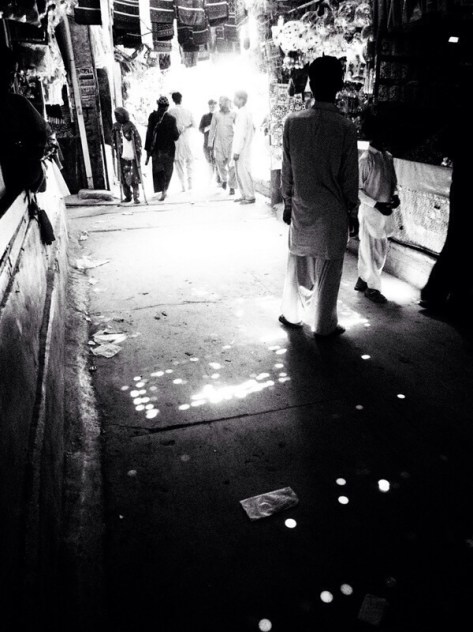
It could be other things. (It certainly was other things.) But it could quite as easily be its incomparable food and music that has drawn kings, foreign army generals, enlightened mystics and famous globe-trotters to ancient Sehwan. Standing on the west bank of the mighty Indus, Sehwan – or Siwasitan as Ibn Batuta describes it in his travel accounts – is most famous for being the place chosen by Hazrat Laal Shahbaz Qalandar to settle in in the 13th century. The shrine of the great sufi saint draws hundreds of thousands of people to its doors from all across Pakistan every year. The bazaar around the shrine plays host to a panoply of tongues and customs; the courtyard of the mazaar offering hospitality to visitors from out of town. The impressive gold dome of the shrine is the center from which all activity – cultural, social, religious, political – appears to emanate. Like many of Sindh’s other ancient towns, Sehwan is steeped in a history that continues to breathe.
Through the bazaar:
Inside Bodla Saeen’s shrine: Continue reading Sehwan in Monochrome: Farid Alvie
सामूहिक अपराध और जवाबदेही
मुज्ज़फरनगर की सांप्रदायिक हिंसा की जिम्मेदारी तय करने का मसला पेचीदा होता जा रहा है.क़त्ल हुए हैं,बलात्कार की रिपोर्ट है, घर लूटे और बर्बाद किए गए हैं.हजारों मुसलमान अपने घरों और गावों से बेदखल कर दिए गए हैं.यह सब कुछ अपने आप तो नहीं हुआ होगा.किसी भी अपराध के मामले में इंसाफ की प्रक्रिया की शुरुआत अभियुक्तों की पहचान और उनकी नामजदगी से होती है.मुज्ज़फरनगर के हिंदू ग्रामीणों को इस पर ऐतराज है.उनका दावा है कि शिकायतें, जो मुस्लिम उत्पीड़ितों ने दर्ज कराई हैं और जिनके आधार पर अभियुक्तों को चिह्नित किया गया है,गलत हैं.वे और उनके लोग निर्दोष हैं और इसलिए पुलिस को धर पकड़ की अपनी कार्रवाई से बाज आना चाहिए.
अभियुक्तों को गिरफ्तार करने गई पुलिस पर हमले किए जा रहे हैं और पकड़े गए लोगों को छुड़ा लिया जा रहा है.हथियारों के साथ औरतें सड़क पर हैं,कहते हुए कि वे अपने बच्चों और मर्दों के साथ नाइंसाफी नहीं होने देंगी.किसी तुलना के लिए नहीं,लेकिन ऐसे सामूहिक प्रतिरोध के बारे में राय कायम करने एक लिए क्या हम किसी दहशतगर्द हमले में शक की बिना पर किसी मुस्लिम बस्ती में की जा गिरफ्तारी के इसी तरह के सामूहिक विरोध की कल्पना कर सकते हैं?उस समय हम उसे उस समूह की अविचारित सामूहिक प्रतिक्रिया ही मानेंगे. Continue reading सामूहिक अपराध और जवाबदेही
Ka Tvam Baale? Kaanchana Maatha! Or, the University of Calicut experiments with the Grotesque!
Now let me confess, it is high-time in life that I got an award — I am 46, nearly. It isn’t really a question of whether I desire it or not. If you are in the business of reading and writing in Kerala then you MUST receive some award by mid-career — it’s a bit like experiencing nausea and tiredness in early pregnancy. You MUST have it, it is the surest sign of being pregnant, and sometimes to enjoy people’s kindness towards a pregnant woman, you need to get vomiting soonest possible. You can’t get into a conversation about pregnancy with other women without being able to recount your experience of being nauseous and tired. Continue reading Ka Tvam Baale? Kaanchana Maatha! Or, the University of Calicut experiments with the Grotesque!
Rajendra Yadav:An era passes on
Rajendra Yadav,the last surviving member of the trio of the Nai Kahani,a major trend in Hindi literature, is gone. The large crowd which assembled at the Lodhi Road crematorium to bid adieu to him consisted of people from different age groups,a fair number of them being youth and women, with diverse professional and political backgrounds. It demonstrated the huge popularity he had earned for himself in the last quarter of his life as the editor of Hans, a literary monthly in Hindi. Continue reading Rajendra Yadav:An era passes on
A Night at the Pow Wow: Jay Desai
This is a guest post by JAY DESAI
As I approached the brown fields at the foothills of the rugged San Bernardino Mountains, the rhythm of the foot- stomping grew into a crescendo. I was visiting the annual pow wow of the San Manuel Band of Serrano Mission Indians. Thousands of Natives from many of the 500 or so Indian nations of North America had gathered for three days of dance, song and celebration of their rich heritage. Above us, the autumn California sun had turned the barren high peaks into a shade of angry red at dusk. As the night fell, the enthusiasm of the dancers grew to match the vibrant colors of their traditional outfits and headdresses. My young niece, visiting from India, asked me if the dancers wore these dresses in their everyday lives and if yes, why she never saw them during her long travels through this vast country. She asked me if they were Americans. Continue reading A Night at the Pow Wow: Jay Desai
पड़ोसी और अजनबी
पड़ोसी कब पड़ोसी न रह कर अजनबी बन जाता है ? या वह हमेशा ही एक अजनबी रहता है जिस पर मौक़ा मिलते ही हमला करने में ज़रा हिचक नहीं होती ? हम अपना पड़ोस चुनते कैसे हैं? क्या पड़ोस मात्र एक भौगोलिक अवधारणा है? क्या जो भौगोलिक दृष्टि से हमारे करीब है, वही हमारा पड़ोसी होगा? पड़ोस चुनना क्या हमारे बस में नहीं? क्या पड़ोस कुछ–कुछ धर्म या भारतीय जाति की तरह है जिसके साथ जीवन भर जीने को हम बाध्य हैं? क्या पड़ोस का अर्थ हमेशा आत्मीयता ही है? क्या पड़ोस का मतलब एक दूसरे का ख़याल रखना,आड़े वक्त एक दूसरे के काम आना ही है? या यह रिश्ता अक्सर उदासीनता का होता है , जिसमें हमें दरअसल अपने पड़ोसी में दिलचस्पी नहीं होती? क्या इस उदासीनता के हिंसा में बदल जाने के लिए कोई भी कारण काफी हो सकता है? यह प्रश्न जितना शहर के सन्दर्भ में प्रासंगिक है उतना ही भारतीय गाँव के सन्दर्भ में भी पूछे जाने योग्य है. एक बार फिर, मुज़फ्फरनगर के गाँव में हुई हिंसा के बाद, पड़ोस के मायने पर बात करना ज़रूरी हो उठा है. Continue reading पड़ोसी और अजनबी
Dilemma of Indian Muslims After Partition: Yasmin Qureshi
Guest post by YASMIN QURESHI. Excerpts from this essay were read at an event organized by the Partition Archives project in Berkeley earlier this year.
Abbu’s family, like many other Muslims in India was torn between staying in their ancestral land and going to the new country founded for Muslims. The call for Pakistan and the Muslim League movement was more prominent in the elite or educated classes. For Abbu’s family it was a distant idea and life outside Dilli was inconceivable. But the partition wave didn’t leave them untouched and a few family members including Abbu migrated to Lahore. Lahore was chosen because they had heard it was similar to Dilli. A year in Lahore was enough for them to realize their heart was still in Dilli. Ghalib ki galiyan, echoes of azaans from Jama Masjid, pigeons flying above their roofs and the aroma of korma brought them back to the home their father had built.
The conflict of choosing between the newly founded nation states of India and Pakistan divided many families. Some of Abbu’s relatives shuffled between the two for many years till they were forced to make a choice by the governments in the 1960s. His elder sister’s family and a few other nieces and nephews decided to become Pakistani citizens.
For Muslims that stayed in India, the next few decades were years of fear and subjugation. Communal violence, often organized and manufactured by political parties or the right wing Hindu organization, RSS throughout the 1960s in cities where Muslims were in large numbers was a threatening message to the Muslims that if they choose to stay here they would have to live as a silenced minority with a constant reminder they were guilty of dividing India. Continue reading Dilemma of Indian Muslims After Partition: Yasmin Qureshi
Storm in a Calm IIT Campus Over a Sexual Harassment Case: Pronoy Rai
Guest post by PRONOY RAI
The serene, picturesque campus of the Indian Institute of Technology Guwahati has been witnessing some very noteworthy events in the recent past. According to reports in the popular media, a professor at the institute’s biotechnology department was accused of sending obscene text messages to his PhD student over her phone. Though the professor pleaded innocence, claiming that messages were sent from his sim card that was stolen, the local police found this hard to believe. The professor has also been accused of harassing the student during other instances on campus. Upon receiving the advice of the ‘Working Women’s Committee’ of the institute, the professor was recently suspended. This narrative constructs for us a simple, fair story of a just state-society system. A person breaks the law, and he is disciplined, as one would expect in a fair democratic society. If only that was the case.
The suspension of the professor was not immediately followed by the submission of the report, let alone the filing of complaint at the institute and with the local police. On August 13, Amingaon police in Assam arrested the professor for sending obscene text messages to a student. The arrest happened because the student had to file a FIR in order to request a telecom company to reveal the identity of the owner of the phone, from where the obscene messages being sent to her, were emanating. The delay in the inaction of the institute administration is unjustified, but perhaps not very inexplicable. Continue reading Storm in a Calm IIT Campus Over a Sexual Harassment Case: Pronoy Rai

