Category Archives: Culture

An act of Academic Compromise

The Delhi University academic council’s decision to drop A.K. Ramanujan’s essay, ‘Three Hundred Ramayanas’, from the prescribed readings for BA (honours) history and BA (programme) students, brings back memories of Bombay University’s move to remove Rohinton Mistry’s novel Such a Long Journey from the syllabus. The victimisation of art-historian Shivaji Pannikkar by Baroda’s Maharaja Sayajirao University is another long and painful story. The many, many cases of books and plays being proscribed by various governments form the general climate in which our universities operate. Continue reading An act of Academic Compromise

Navratri in Karachi

The report above is by Zanobia Ilyas, who writes: Continue reading Navratri in Karachi

Untitled: Najeeb Mubarki

Guest post by NAJEEB MUBARKI

I could have met Sebald.
I went to Britain in September 2001,
And he died in December.
East Anglia wasn’t all that far way
From London, nothing, really,
Is all that far away in Britain.
I could have met him, if I had known him
Then.
What I would have wanted to say, I think Continue reading Untitled: Najeeb Mubarki

Silent changes amidst terror in the Jungle Mahal of West Bengal: Kumar Rana

Guest post by KUMAR RANA

Nothing seems to have changed in the past quarter decade. Past Jhargram, the town in the woods, the metal road connecting Lodhasuli to National Highway No. 6 wraps itself in a shady serenity. At occasional intervals, the artificiality of a clamour, emitted by a motor engine, creates an unquiet irritation, murdering the resonance of the forest and interrupting its slumber. The bus-stops at Kalabani and Boria are as lonely as they used to be; Gar-Salboni, a roadside village, is stuck in its eternal search for a path to survival. The mud road that breaks from the main road to meet the villages Sirsi, Joalbhanga and Lab-Kush, is as tranquil as it had been 25 years ago. Past the lush green rice fields by the road begins the forest that hems the horizon. The leaves that have just had a splash of shower glistens with the brilliance of the sun.

— Last year it was different, whispered the road.

— Yes, I have heard of it – there had been a drought. And it was the same in the year before the last. It used to follow a cycle like this 25 years ago. Rain ensures the crop. Hunger rides free when there is a drought.

Continue reading Silent changes amidst terror in the Jungle Mahal of West Bengal: Kumar Rana

Desecrating Memory – The Paramakudi Police Shootings: V Geetha

Guest Post by V. GEETHA

Readers of Kafila might have heard of the horrific shootings that took place at Paramakudi and Madurai on September 11. Officially seven people died when police opened fire on dalits who had gathered to pay their respects to Immanuel Sekaran, a dalit leader who was brutally killed in 1957 in circumstances that pointed to the complicity of dominant caste thevars in carrying out this murder.  (The thevars are an important constituent of the ‘Mukkulathor’ complex of castes that includes the kallars and the maravars.) Subsequently, U Muthuramalinga Thevar, Forward Bloc leader was arrested in connection with Sekaran’s death – he stood trail and was released two years later, because the case against him was not established and proved. (Thevar was proud of his anti-communism and his Hinduism; to him he claimed that patriotism and theistic belief constituted his very vision, they were the ‘eyes’ through which he saw the world.) Continue reading Desecrating Memory – The Paramakudi Police Shootings: V Geetha

Gautam Book Centre

AK Gautam

It is the sort of place you will not find unless you are looking for it. Even if you find the address in Hardevpuri near Shahdara, you will not know where to knock. There is no signboard that will tell you this is Gautam Book Center. “A signboard will attract the attention of those who don’t like our books,” explains AK Gautam.

These are not books of pornography or an underground militia. These are books on caste.
Continue reading Gautam Book Centre

Out of Development’s Waiting Room, Out of Democracy: The Continuing Agony of the DHRM

[with inputs from Baiju John]

Faced with the never-ending agony to which the members of the Dalit Human Rights Movement (DHRM) in Kerala seem to be subject to, it appears that that the more familiar ways of marginalizing of dalit people in Malayalee people do not work anymore. The past few days have seen horrendous attacks on these people near the town of Varkala in Thiruvanathapuram district. The DHRM has accused the Siva Sena and the BJP of violence, but it appears that both the authorities and the press are equally and irremediably deaf. Continue reading Out of Development’s Waiting Room, Out of Democracy: The Continuing Agony of the DHRM

Where have the pilgrims gone?

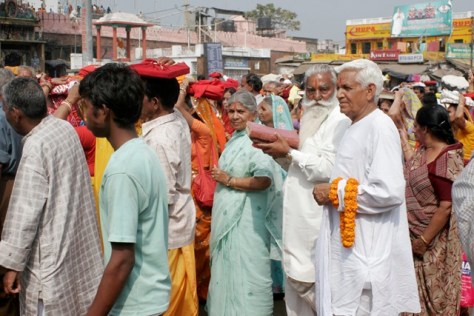
The Journey is an integral part of any pilgrimage, the manner in which it is conducted is crucial to the successful conclusion of the endeavour. An edited version of this article first appeared in the travel and culture magazine Terrascape, published from Delhi. Photos: Himanshu Joshi/Curun Singh

Pilgrims at Puri, outside Jagannath Temple

There is a scene in Mughal-e-Azam, the early 1960s blockbuster of a movie by K Asif, where Akbar and his queen, the mother of his first son Jahangir (wrongly identified by K Asif and also by Ashutosh Gowarikar as Jodha Bai) stumble through the hot sands of Rajasthan under the mid-summer day sun that seemed intent on drying up and burning everything in sight. The two are on a pilgrimage. The pilgrimage was to fulfill a vow that Akbar had taken.

What I have to say in this piece can best be prefaced by narrating the story of that vow. Continue reading Where have the pilgrims gone?

Killing poetry and other possibilities of life

The news of the ‘postponement’ of Harud, a literary festival scheduled to be held in Kashmir in September, should be read with concern by those who believe in, and fight for, the right to express themselves freely. How the self-righteousness of some fighters for democracy actually forecloses any possibility of democracy can be seen from this incident.

In a statement last week, the organizers of Harud explained that they were forced to put off their festival as there was a concerted campaign by some people on the Internet, on  Facebook and some other sites attacking the festival. According to these critics, “We fear, therefore, that holding such a festival would, willy-nilly, dovetail with the state’s concerted attempt to portray that all is normal in Kashmir. Even as the reality on the ground is one of utter abnormality and a state of acute militarisation and suppression of dissent, rights and freedoms.” Continue reading Killing poetry and other possibilities of life

In the Courtyard of the Beloved

*

In the Courtyard of the Beloved is a visual and aural portrait of Nizamuddin Auliya Dargah, a Sufi shrine in New Delhi, India. Made from over 18,000 still images and ambient sounds recorded on-site, rapid-fire bursts of kaleidoscopic imagery assemble into fractured collages.

Each day, hundreds of pilgrims travel by airplane, train, car, rickshaw and foot to reach this shrine, which honors a 12th century Sufi mystic who believed in drawing close to God through renunciation of the world and service to humanity. Beginning with imagery from these journeys, the film then enters the physical space of the shrine; a unique nexus of marketplace, social space and spiritual haven, where devotees come to offer their prayers and find a moment of reflection away from the din of Delhi traffic. As the sun sets behind the dome, musicians begin the qawwali, a style of Sufi devotional music that ranges from contemplative religious elegy to raucous crescendo.

Executive Producer Samina Quraeshi
Original tabla score by Suphala
Audio post-production by Paul Bercovitch
Produced by Sadia Shepard
Photographed and edited by Andreas Burgess

[via]

Harud Literature Festival ‘postponed’

I think it is sad that the Harud Literature Festival has been “postponed“. Sadder still is that the organisers are blaming those who asked very valid questions. All they needed to do was answer those questions and allay those concerns. Their response, two days after the release of the open letter, did not address those concerns. They even refused to withdraw, leave alone apologise for, the offensive word “apolitical”, or explain how they planned to be “apolitical” while “celebrating” literature in the midst of unmarked graves, militarised bazars and lanes, draconian laws, imprisoned teenagers and the state’s refusal to dispense justice. Continue reading Harud Literature Festival ‘postponed’

Anna’s ‘Second Azadi Movement’ via Satyakam and Rang De Basanti

At first Anna reminded me of this very unreasonable, uncompromising, ‘dry honest’ (a delicious Indianism, I guess) character of Satyakam in the eponymous film created by Hrishikesh Mukherjee in the late Sixties. He is so pathologically and pathetically honest that he does not even borrow the chair from the office downstairs when his boss, Sanjeev Kumar visits him. Dharmendra climbs stairs to meet Sanjeev Kumar at his residence only after having finished his work.

Transposed in the current scenario, the equation would be something like this:

Sanjeev Kumar = any one of us; Anna = Dharmendra. Historically of course we know that only Gandhi could be Gandhi, and not even Nehru could ever aspire to that special position in the people’s hearts even while we remind ourselves that a whole mass of little (good, bad, ugly) Gandhis contributed to the making of the one and only, most famous, Gandhi. Continue reading Anna’s ‘Second Azadi Movement’ via Satyakam and Rang De Basanti

Resisting The Popular

The drama that is being enacted in Delhi for the last one week, rather five months, has thoroughly exposed the intellectual hollowness of the political life of India. This moment would also be remembered as the lowest to which collective intelligence of a people can descend to. Critiquing people is not the job of the politicians or the media, not in our times at least . Gone are the days when you had a Mohan Das Karamchand Gandhi who could stand up to the masses and withdraw a popular movement risking their wrath or a Jawaharlal Nehru who commanded the authority to chide his own people. The days of Rabindra Nath Tagore are also over who had the courage to openly challenge, criticize a saint like Gandhi and write ‘anti-people’ novels like Ghare baire. If we have time and patience to turn the pages of our history , we would find that their criticism was an integral part of their long and continuous engagement with their people. Theirs was not a utilitarian relationship . People knew that they love them and care for them and that is why they never turned away from them.

The names we have mentioned above belong to an era when the grammar and vocabulary of popular politics were being transformed. They refrained from simplifying things and devised a language which people were challenged to learn. It was their inexhaustible trust in the intelligence of their people that encouraged them to constantly innovate and complicate rather than simplify. It was this air which a young man Bhagat Singh was breathing, who, going against the grains, wrote that violent methods were no substitute to popular political mobilisation, who knew that the appeal of Subhas Chandra Bose was dangerous and it was Nehru, with a scientific and internationalist outlook, he advised the youth to follow.

Continue reading Resisting The Popular

Benaam Shahidon ke Naam – शेहला मसूद के लिए: Tanzil Rahman

Guest post by Tanzil Rahman

Benaam shaheedoN ke naam (बेनाम शहीदों के नाम )

तंजील रहमान

For Shehla Masood, Niyamat Ansari , Amit Jethwa and many like them who are killed everyday across the world for daring to speak out the truth.

Ye Jang ruki thi kab  ये जंग कब रुकी थी

Ye jang to jaari hai  ये जंग तो जारी है

Ye jang hamaari hai  ये जंग हमारी है

Ye jang hamee’at ki  ये जंग हमी’अत की

Insaan ki qeemat ki  इंसान की कीमत की

Har ahl-e-hawas se hai  हर अहले-हवास से है

Har ahl-e-hakam se hai  हर अहले-हकम से है

Har zuml-o-sitam se hai हर ज़ुल्म-ओ-सितम से ही

Har jhoot se, nafrat se हर झूठ से, नफरत से ही

Auhaam se dahshat se औहाम से दहशत से है

Har rang ki zulmat se हर रंग की ज़ुल्मत से है

Ye jang to jaari hai ये जंग तो जारी है

Ye jang hamaari hai ये जंग हमारी है

Continue reading Benaam Shahidon ke Naam – शेहला मसूद के लिए: Tanzil Rahman

Songs After Independence

Guest Post by Indu Vashist

Click here for full broadcast: Songs After Independence

Acknowledging Independence day without nationalism, the hosts of Desi Dhamaka use Independence Day as a platform to explore contemporary social and political issues in South Asian. Featured are songs in Urdu, Hinglish, Tamil, Bengali, Punjabi, English, just to name a few. The artists featured range from Iqbal Bano singing to Faiz Ahmed Faiz’s lyrics to Indian Ocean, from Alisha Chinoy to Mohd Rafi, and much more.

Montreal based Indu Vashist and Srinath Baba are the hosts of Desi Dhamaka, a South Asian music show with a political and social twist. It airs on CKUT, a non-profit, campus-community radio station based at McGill University. CKUT provides alternative music, news and spoken word programming to the city of Montreal and surrounding areas, 24 hours a day, 365 days a year. Hear us at 90.3 MHz on the FM dial, 91.7 by cable, or listen on-line.

Parliamentary Sovereignty or an Active Citizenry? V. Krishna Ananth

Guest post by V. KRISHNA ANANTH*

The political class, cutting across the spectrum, is now being haunted by a spectre. Anna Hazare has captured the imagination of a cross section of the people and his campaign is certainly gathering support. It remains to be seen if this support translates into a movement on the streets and more so against the state machinery that is threatening to pull all the stops. The people have shown such courage in the past. That is another matter.

Team Anna’s decision to go ahead with protests against the draft Lok Pal Bill, as approved by the Union cabinet, has spurred a debate. The proponents of the draft bill as well as sections in the political arena who claim to oppose the Government are united against another round of fast by Anna Hazare; they call it blackmail and an attempt to usurp Parliament’s power to legislate. They also claim that the principles of democracy shall not be sacrificed.

A number of them are on record that the draft proposals are subject to amendments and that the power to propose amendments and decide on them shall rest with the elected representatives of the people. It is another matter that the Prime Minister, who heads the cabinet, qualifies as a representative of the people only because membership of the Rajya Sabha is considered as good as being a member of the Lok Sabha to remain a minister under Article 75(5) of the Constitution. In any case, the fact is that Dr. Manmohan Singh has claimed, in an affidavit, that he is ordinarily a resident of Assam! We all know the truth but that too is besides the point.

Continue reading Parliamentary Sovereignty or an Active Citizenry? V. Krishna Ananth

यहाँ से शहर को देखो …..

[यह लेख “बस्ती तो बसते बसती है” शीर्षक से आउटलुक हिंदी  के  स्वाधीनता विशेषांक में छपा है.]

अब जबके हर तरफ यह एलान हो चुका है के दिल्ली १०० बरस की हो गयी है और चारों ओर नई दिल्ली के कुछ पुराने होने का ज़िक्र भी होने लगा है, इन दावों के साथ साथ कि “दिल्ली तो सदा जवान रहती” है और “देखिये ना अभी कामनवेल्थ खेलों के दौरान यह एक बार फिर दुल्हन बनी थी”, वगेरह वगेरह, तो हमने सोचा के क्यों न इन सभी एलाननामों की सत्यता पर एक नजर डाल ली जाए, और इसी बहाने उस दिल्लीवाले से भी मिल लिया जाए जो इस अति प्राचीन/ मध्यकालीन/ आधुनिक नगरी का नागरिक होते हुए भी वैशवीकरण के झांसे में इतना आ चुका है के वो अपने आप को २१वीं शताब्दी के पूर्वार्द्ध में आने वाले आर्थिक संकट को पछाड देने वाले चमचमाते भारत देश की राजधानी का शहरी  होने का भरम पाले हुए है.

अब सब से पहले तो यह फैसला कर लिया जाए के नई दिल्ली है किस चिड़िया का नाम? पाकिस्तान के मशहूर व्यंग कार इब्न-ए–इंशा ने अपनी विख्यात पुस्तक उर्दू की आखरी किताब में एक अध्याय लाहौर के बारे में लिखा है.  इस अध्याय में इंशा कहते हैं “ किसी ज़माने में लाहौर का एक हुदूद-ए–अरबा (विस्तार) हुआ करता था अब तो लाहौर के चारों तरफ लाहौर ही लाहौर वाके (स्थित) है और हर दिन वाके-तर  हो रहा है”

एक फर्क है, इब्न-ए-इंशा के लाहौर में पुराना लाहौर और नया लाहौर दो अलग अलग चीज़ें नहीं हैं मगर दिल्ली के मामले में ऐसा नहीं है, एक समय था के नई दिल्ली में बाबू बसा करते थे और नई दिल्ली के पास शाहजहानाबाद था जो शहर था, अब नई दिल्ली वालों के हिसाब से पुराना शहर सिर्फ शादी के कार्ड, आचार मुरब्बे और हार्डवेअर खरीदने की जगह है, या उसे इस लिए बनाया गया है के उनकी पार्टियों के लिए बिरयानी, चाट, कुल्फी वगेरह मुहैया करवाए और जब उनके विदेशी मित्र या एन आर आई सम्बन्धी यहाँ आयें तो उन्हें इस जीते जागते संघ्राल्य के दर्शन करवा सकें. मुसलमान और सिख वहाँ धार्मिक कारणों से भी जाते हैं, मगर उनकी बात अलग है वो तो अल्प संख्यक हैं हम तो आम लोगों की बात कर रहे हैं.

Continue reading यहाँ से शहर को देखो …..

Tagore in film


That is a clip from The Postmaster (the first story in Teen Kanya, directed by Satyajit Ray).

Trisha Gupta on Tagore’s characters, seen better in films than in English translation:

In film after film, we see events through the eyes of the educated Bengali man trying to deal with a world that has either changed too much—or too little. The protagonist is often a young man from the city who arrives at a small provincial outpost, armed with a modern Western education and little else, his head full of glimpses of another world that seem only to succeed in cutting him off from everything around him. Continue reading Tagore in film

Speaking of Synthesis

This slideshow requires JavaScript.

Ask any first time visitor to Kashmir about their impressions and you will, in all likelihood, be inundated with superlatives about the landscape, the mountains, the greenery, the hospitality, the gardens, the lakes and what not, but there is one thing that both the first timer and the old Kashmir hand rarely talk about and that is the historical monuments of the valley. The mosques, shrines and ancient temples of the valley are rarely mentioned in all this recounting. I am as much guilty of this neglect as all the others that I have met, perhaps more guilty because I have been to Kashmir scores of times.

This piece is an attempt to make amends. The sites are far too many to cover in one article so I have decided to confine myself to a handful of structures and monuments that lie scattered in and around Srinagar. Hopefully there will be more occasions to write about the others soon. Before we commence this sight-seeing tour of Srinagar, let us start with a few words about the history of Srinagar and of Kashmir.

Continue reading Speaking of Synthesis

Seeking the Apadhasanchaarini/ The Malayalee Flâneuse

So, the moral police has struck again. The papers in Kerala have been full of news about how a young IT sector employee, Thasni Banu, was confronted by a group of goons while she was being dropped to work at night by a male friend, insulted, slapped several times, and warned that they will not allow Kerala to “become Bangalore”. She did not take it mildly and complained to the police, who rolled their eyes, hummed, and hawed, and as to be expected, went slower than usual. One of the goons who was apprehended was let off. The papers have indeed taken the issue very seriously — and so have the state government, which suspended the policeman who handled the affair shoddily. Continue reading Seeking the Apadhasanchaarini/ The Malayalee Flâneuse

Coke Studio India – the first six songs

So the unanimous verdict is that Coke Studio India (first aired on the Friday that went by) is no match for Coke Studio Pakistan [Wikipedia]. For some it’s been like an India-Pakistan match – I’ve seen Indian congratulate Pakistanis on Twitter for the ‘Coke Studio victory’ and others ask Indian musicians and singers to listen to Pakistani singers and hang themselves. For most, this was not surprising – Coke Studio Pakistan has showcased some of the best music you’ve heard in recent times and it raised the bar too high for Coke Studio India. There’s also the problem of Bollywoodisation of music in India, of dumbing down, producing music aimed at the marriage market and livening up the moods of those stuck in traffic. A celebrity culture has taken the passion out of music in India – it does not seem to come from deep within. New popular music in India leaves you with the kind of feeling that a mall does. Loud and empty.

Continue reading Coke Studio India – the first six songs