Guest post by AMRAPALI ‘TARA’ BASUMATARY
Another Report on the Gathering of the Night of 31st of December 2012/Ist January 2013 against Patriarchy in Delhi
Guest post by AMRAPALI ‘TARA’ BASUMATARY
Another Report on the Gathering of the Night of 31st of December 2012/Ist January 2013 against Patriarchy in Delhi
Two interesting articles:
Emer O’Toole in the Guardian CiF:
There’s something uncomfortably neocolonial about the way the Delhi gang-rape and subsequent death of the woman now known as Damini is being handled in the UK and US media. While India’s civil and political spheres are alight with protest and demands for changes to the country’s culture of sexual violence, commentators here are using the event to simultaneously demonise Indian society, lionise our own, and minimise the enormity of western rape culture. [Full article]
And Ananth Krishnan in The Hindu:
The rape case was one of the most discussed topics in Chinese microblogs over the past week, prompting thousands of posts and comments. By Sunday, however, the authorities appeared to move to limit the debate: on Monday, a search for the topic triggered a message on Sina Weibo – a popular Twitter-equivalent used by more than 300 million people – saying the results could not be displayed according to regulations. The message is usually seen as an indicator of a topic being censored by the authorities. [Full article]
Guest post by AAKSHI MAGAZINE

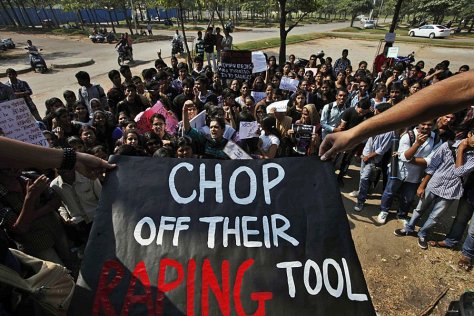
She was sitting among a group of young men and women at Jantar Mantar, shouting “Hang those bastards.” When the slogan lost its effectiveness, it turned to “We want Justice,” “Inquilab Zindabad,” and then “Bharat Mata ki Jai”. Borrowed and heard slogans, but they came from a very real place. “I work in Saket but live in Dwarka.” That is a long distance to travel especially at night. She nodded. “I don’t like it when my parents tell me to come home early just because other people are at fault,” she said anger rising in her voice. She didn’t know any of the people in the group she was sitting with. “We just met here. I had come with a friend who I can’t locate at the moment.” Continue reading The things you learn at a protest: Aakshi Magazine
[ B&W pictures, courtesy Chandan Gomes. Colour pictures and cell phone video footage, courtesy, Bonojit Husain, New Socialist Initiative ]
Dear young women and men of Delhi,
I am writing to you again because I have been listening to you. This is a strange time, when everybody is talking, and everybody is listening, and the unknown citizen, who could have been any one of you, has transformed us all.
I was with you last night, from five thirty in the evening to around nine at night, while we walked together from the Vishwavidyalaya (University) Metro Station to Vijay Nagar, Kamla Nagar and the North Campus of Delhi University. There were around twelve hundred of you. Several of you held candles. You made yourselves into a moving blur of light. As the shopkeepers of Vijay Nagar, as the rent collecting aunties of paying guest accommodations, as the men and boys and girls and women on the streets and in the verandahs looked at you in wonder, you looked back at them, many of you smiled and waved. I could see some people in the crowd lip-synch with your Hallabols.
[ video of the night march near Delhi University ]
Continue reading Notes from a Night Walk in Delhi University
Guest post by RAHUL ROY
I have been sitting quietly trying to finish my new film and had promised myself that I would not get side tracked and concentrate on the task at hand. But enough is enough. I am shocked and disappointed at the way men high jacked a protest that could have been and probably still is the most significant pouring out of women who may never have thought in their wildest dreams that they would be facing water cannons and cops giving them a chase with iron tipped sticks. I am sure it is a coming of age moment for many young women of the city of Delhi.
I am aware that there has been a fair bit of cynicism about middle class women running up and down Raisina Hill and whether it adds up to anything. It damn well does. The next time they see adivasis being chased down by the police in Chattisgarh or in Orissa a penny will drop. It already is, today there is an article by a 19 year old student form Lady Sri Ram College narrating her brush with Delhi Police at the Parlaiment Street Police station and quite significantly she adds that if they are capable of behaving the way they did with a group of ‘well connected’ college students in Delhi then what must be happening in the more remote areas of non metropolitan India. Continue reading What Do Men Have To Do With It?: Rahul Roy
Dear young women and men of Delhi,
Thank you for the courage and the honour you have brought to Rajpath, the most dishonorable street in our city. You changed Delhi yesterday, and you are changing it today. Your presence, of all twelve thousand of you, yesterday, on Rajpath, that street that climbs down from the presidential palace on Raisina Hill to India Gate, getting soiled by the excreta of the tanks and missiles on Republic Day each year, was for me a kind of purificatory ritual. It made a claim to the central vista of ‘Lutyen’s Delhi’ as a space for democratic assertion in contravention of the completely draconian, elitist and undemocratic prohibitory orders that make the heart of this republic, a zone of the death, not the life and sustenance, of democracy.
From now onwards, consider the heart of Delhi to be a space that belongs, first of all, to its citizens. Yesterday, when thousands of you gathered peacefully, intending to march up Raisina Hill to the president’s palace, you were charged with batons, tear gas and subjected to jets from water cannons. The violence began, not when protestors threw stones, but when the police started attacking people. Stones were thrown in retaliation. The television cameras that recorded what happened show us the exact chronology. The police were clearly under orders not to let people up Raisina Hill. Why? What is so sacred about Raisina Hill? Why can a group of unarmed, peaceful young people not walk to the gates of the president’s palace? So, lets be clear. Violence began when the state acted. Of course, the protest got hijacked by hooligans. But of course it had to be. When hooligans in uniform are let loose on an unarmed crowed, there can be no possibility of averting the possibility that hooligans out of uniform will respond in kind. Continue reading To the Young Women and Men of Delhi: Thinking about Rape from India Gate
Sri Pranab Mukherjee
President of India
Rashtrapati Bhavan
New Delhi – 110 004.
India
12 December 2012
Subject: Open letter regarding the resumption of executions in India
Dear President,
I am writing on behalf of Amnesty International regarding the recent resumption of executions in India after eight years, to urge the Indian authorities to immediately establish a moratorium on executions with a view to abolishing the death penalty. Continue reading An open letter to the President of India: G. Ananthapadmanabhan
This release was put out yesterday by the RIGHT TO FOOD CAMPAIGN
On the second day of the “Right to Food dharna” convened by the Right to Food Campaign, hundreds of poor women from across the country braved the morning cold and rain to assemble at Jantar Mantar and voice their concerns, including the demand for a universal PDS, universalization with quality of ICDS, universal maternity entitlements, universal pensions for single women, and crèche facilities at the workplace.
Women living in urban slums, on the streets, working on construction sites, agricultural workers, single women, women with young children from different states shared their experiences of struggle for food security and access to the Public Distribution System and other food-related programmes. Continue reading Aam Aadmi party learns from aam mahila
Dear Friends
Writing this to you to share the pain, the insult, the deep sense of deprivation that I feel at the end of IFFK 2012.
I am sure many of you would be surprised by this statement. I expect a barrage of irritated questions: didn’t the IFFK 2012 present a most delectable selection of films, and that too, of impeccable political correctness? Weren’t the passes delivered promptly? Weren’t the theaters all spruced up and respectable? Were the loos great this time? So what more do you want, you crude, loud-mouthed female, who was shouting and protesting most of the time? And in any case, why should you write at all to the volunteers, and not to the authorities if you plan to complain?

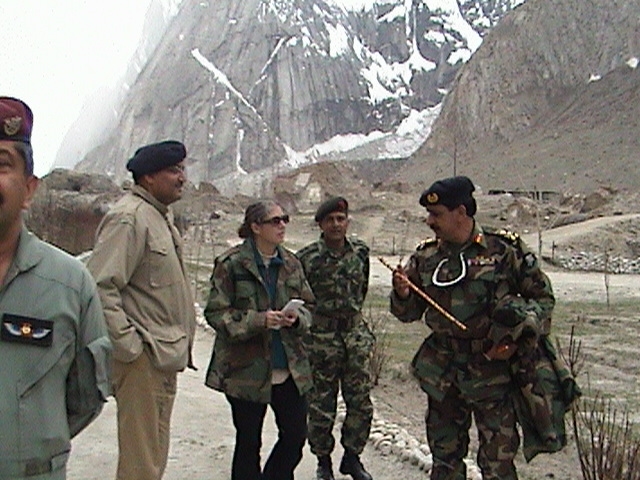
Myra MacDonald is a London-based journalist with Reuters and a long-time observer of South Asia. She tracks the turning points in Pakistan politics at the Pakistan: Now or Never. MacDonald is best known for her book on the Siachen conflict, Heights of Madness: One Woman’s Journey in Pursuit of a Secret War. Published in 2007, the research for the book took her to both sides of the conflict, on helicopter and on ground. She was bureau chief of Reuters in India in 2000-2003. She then took leave-of-absence to research the Siachen conflict, becoming one of the very few people to visit the war zone on both the Indian and Pakistani sides. She has given presentations on Siachen to the Royal Military Academy Sandhurst and to the International Institute for Strategic Studies in London. Amidst alarmist rumours that track-two parleys between India and Pakistan are urging India to ‘give up Siachen’, MacDonald tells Shivam Vij in an e-mail interview why resolving Siachen without resolving the Jammu and Kashmir dispute may not be easy.
Q1) The idea of demilitarising Siachen is being seen by some in India as a demand to hand Siachen over to Pakistan, or at the very least, to ‘lose’ the territory for which Indian soldiers have made great sacrifices. Do you agree with such an interpretation of demilitarising the glacier? Do you think India has real strategic advantage with its occupation of the glacier? Continue reading Can we solve Siachen without solving the Jammu and Kashmir dispute?
Guest Post by KAMAL CHOMANI
It has been for about 13 months I am living in Bangalore, India. I am here to study masters. India to me, as it is, is incredible. I feel as if I am at home. People here are friendly. My teachers and colleagues are just great. I have to confess that for a student that is his first time to leave his home for such a long time, certainly, will face many difficulties, but no difficulties have hurt me as much as a question of Indian people ‘where are you from?’
I am from Iraq, but Iraq is not my country. I cannot speak Arabic which is the official language the country. Luckily three more Iraqi people are with me who have helped me to manage my Arabic. My culture is different from Arabs. I don’t want to look like a nationalist, because I am telling the truth. I am a Kurd! My mother tongue is Kurdish. My homeland is Kurdistan.
So, who are the Kurds?

Kurds are the original inhabitants of Middle East. They are the biggest stateless nation around the world that they are still struggling for freedom and independence. They have been forgotten by the world.
Yes, Kurds are a forgotten nation of 40 million populations. In India, few people know who Kurds are. I am really surprised when some Indians ‘love’ Saddam Hussein, the former Iraqi president. Saddam has killed more than 300,000 Kurds. He used poisoned gas against Kurds and killed 5000 Kurds in only one hour in Halabja, which is known as Hiroshima and Nagasaki’s sister! He mass murdered more than 182,000 Kurds in Anfal (Genocide) operations. The Anfal case is going to be an international case. Sweden Parliament has just decided to recognize it as a genocide act against humanity. In UK, Kurdish people have started a huge campaign to make pressures on UK parliament to recognize as Genocide. Continue reading Kurdistan, a Forgotten Nation of 40 Million People: Kamal Chomani
An article titled “In Defence Of Israel” is being circulated to media-persons in India by the Spokesman of the Embassy Of Israel in Delhi. This article, published in Open magazine, was written by Jonas Moses Lustiger (a student based in Paris, who has earlier lived in India). The article names me specifically, and refers to mine and Aditya Nigam’s posts on Palestine in Kafila, but I was not interested in engaging with Lustiger’s largely ill-informed, propagandist and misrepresenting rant. But now that it appears we are responding directly to the Israeli state, I feel perhaps I should put some things on record.
(Our three posts on Kafila are Nakba and Sumoud, Living the Occupation and Imagining Post-Zionist Futures)
Let me begin by stating my complete agreement with Lustiger on three of his key statements in the Open article.
First:
It is true that Israel’s current government is one of the worst it has known and most of its citizens have lost hope for peace. It is also true that Israeli society is turning more racist, intolerant and ignorant of the suffering and existence of their immediate neighbours—Palestinians. Of course, the Palestinian people have been denied many rights and have been living under precarious conditions since Israel’s 1967 occupation of the West Bank and Gaza. True, they have been repeat victims of unjustifiable violence and a large proportion of Israeli politicians deny their claim to an independent land, even as Israel threatens the viability of a Palestinian state by wielding tools of colonisation.
Pretty much sums up our three posts on Kafila – what’s not to agree?
Second: Continue reading Sex, Lies and God’s Promise: Response to a Diatribe
The power of imagined communities was never so evident to us as on the other day, when a group of us — Malayalee people of different political affiliations — made our way to Idintakarai in southern Tamil Nadu. In many ways,we were representative of contemporary Malayalee society — we were from districts spanning the length and breadth of Kerala, had very vocally-expressed mutual differences of opinions and interests, and belonged to of different socioeconomic classes, faiths, and castes, were composed of local residents, NRIs, and Malayalees settled elsewhere in the country. Of course, we were also representative of the gender imbalances that characterize even the oppositional civil society here — there were just two women in a group of nearly thirty. We went there to express solidarity with the people of Idinthakarai who have been struggling valiantly against the monstrosity that the government of India is determined to foist on them — the Koodankulam nuclear power plant — and who have been described as traitors to the Nation by the very people who have ripped apart our sense of what a nation should mean to ordinary people. Continue reading Imagined Immunities: The Cure of Idinthakarai
This release was put out yesterday by the PEOPLE’S UNION FOR CIVIL LIBERTIES
The secretive and stealthy hanging of Ajmal Kasab in Pune’s Yerwada Prison yesterday, 21st November, 2012, brings to an end the legal process involved in trying Kasab for the brutal assault by trained terrorists from across the border on Mumbai, the commercial capital of India which left 166 persons dead.
The Mumbai carnage of November 2008, more popularly abbreviated to a single term `26/11,’ constitutes one of the most heinous and deliberate attempts in recent years to cause mass mayhem and terror in India. Kasab was the only member of the terrorist team sent from Pakistan apprehended alive; he was caught on film diabolically using his modern automatic weapon in a cold blooded fashion, killing numerous people. The hanging, and the trial and legal proceedings which preceded it, admittedly complied with existing laws which permit death penalty, and cannot be faulted as such. While it may be argued, as many do that the hanging will help in an `emotional closure’ to the families of victims of 26/11, there are others who point out that other key issues still remain to be addressed. Families of victims in specific, as also other concerned citizens, have pointed out that Kasab was only a foot soldier and not the mastermind, who still remain at large. Continue reading Abolition of Death Penalty – A Time for National Reflection: PUCL
Rejoice, fellow Indians. Ajmal Kasab has been hanged. But please excuse me, I am not joining you. Your cheering and hooting and hurrahs feel like a medieval lynch mob celebrating the death of the sinner and not the sin. Barbaric is the word that comes to mind.
This isn’t merely about the morality or aesthetic of capital punishment. I want to ask you: what did we just achieve? Ten terrorists had come to kill and be killed, to cause maximum damage of the sort that they surely knew they’d be killed. Nine of them were killed in direct encounter. Did we hail their deaths? Do we say their deaths were justice? So if we killed Ajmal Kasab four years later- “with due process” – what exactly have we achieved? Continue reading Why I was saddened by Kasab’s execution

Someday, we will count how many minutes it took for television in India to start baying for Afzal Guru’s blood (once again) after Ajmal Kasab was buried in Yerwada Central Jail in Pune.
A man called Mohammad Afzal Guru, son of Habibullah Guru, currently resident in Ward Number 6 of Jail Number 1 in Tihar Central Prison in Delhi will hang to satisfy the bloodlust of the Indian Republic, unless the President of India decides otherwise. This text is an attempt to make us think about this decision and its ramifications carefully.
Continue reading Satyameva Jayate? On the impending execution of Afzal Guru
While the media has reported most families of those who died in 26/11 as hailing the execution of Ajmal Kasab, Bollywood actor Ashish Chowdhry refuses to be one of them. His sister Monica and her husband were amongst those who were killed at the Oberoi trident hotel. Given below are screenshots of Chowdhary’s tweets. Read from the last tweet upwards. Continue reading A 26/11 victim who refuses to celebrate Kasab’s execution
Guest post by YUG MOHIT CHAUDHRY
Under Article 72 of the Constitution of India, the President’s power to grant mercy comes into play only after the judicial system has confirmed the death sentence. Therefore, the confirmation of the death sentence by the highest court is a condition precedent to the grant of mercy. Judicial confirmation of the death sentence does not put the convict beyond the pale or disqualifies him from mercy; in fact it renders him eligible for mercy. Arguments that Kasab deserved no mercy once the Supreme Court confirmed his death sentence are misconceived.
It is only the rarest of rare crimes that shock the collective conscience of society and are truly unpardonable that are given the death sentence. In our constitutional scheme, it is therefore only persons committing such crimes that are eligible for mercy and pardon. If they are to be excluded from the ambit of mercy by the mere fact of having committed truly unpardonable crimes, the President’s power of mercy has no meaning. Paradoxically, the very fact that Kasab had indeed committed an unpardonable crime is what renders him eligible for mercy. Continue reading The Power of Mercy: Yug Mohit Chaudhry on the execution of Ajmal Kasab
Guest post by PRANESH PRAKASH
This morning, there was a short report in the Mumbai Mirror about two girls having been arrested for comments one of them made, and the other ‘liked’, on Facebook about Bal Thackeray:
Police on Sunday arrested a 21-year-old girl for questioning the total shutdown in the city for Bal Thackeray’s funeral on her Facebook account. Another girl who ‘liked’ the comment was also arrested.
The duo were booked under Section 295 (a) of the IPC (for hurting religious sentiments) and Section 64 (a) of the Information Technology Act, 2000. Though the girl withdrew her comment and apologised, a mob of some 2,000 Shiv Sena workers attacked and ransacked her uncle’s orthopaedic clinic at Palghar.
“Her comment said people like Thackeray are born and die daily and one should not observe a bandh for that,” said PI Uttam Sonawane.
What provisions of law were used?
There’s a small mistake in Mumbai Mirror‘s reportage as there is no section “64(a)”1 in the Information Technology (IT) Act, nor a section “295(a)” in the Indian Penal Code (IPC). They must have meant section 295A of the IPC (“outraging religious feelings of any class”) and section 66A of the IT Act (“sending offensive messages through communication service, etc.”). The Wall Street Journal’s Shreya Shah has confirmed that the second provision was section 66A of the IT Act.
Section 295A of the IPC is cognizable and non-bailable, and hence the police have the powers to arrest a person accused of this without a warrant.2 Section 66A of the IT Act is cognizable and bailable. Some news sources claim that section 505(2) of the IPC (“Statements creating or promoting enmity, hatred or ill-will between classes”) has also been invoked.
This is clearly a case of misapplication of s.295A of the IPC.3 This provision has been frivolously used numerous times in Maharashtra. Even the banning of James Laine’s book Shivaji: Hindu King in Islamic India happened under s.295A, and the ban was subsequently held to have been unlawful by both the Bombay High Court as well as the Supreme Court. Indeed, s.295A has not been applied in cases where it is more apparent, making this seem like a parody news report. Continue reading Social Media Regulation vs. Suppression of Freedom of Speech: Pranesh Prakash
This post is the third of a series based on a visit by Nivedita Menon and myself to Palestine in mid-September 2012. The first two are Nakba and Sumoud and Waiting for the Third Intifada.
It was the 18th of September, our third evening in Ramallah. We were at the Ramallah Cultural Palace to listen to Palestinian youth bands perform. The place was teeming with people, mostly young, in their twenties and thirties. The hall was packed, the atmosphere so electric that even if Magid had not been there to explain, there was no way we could have missed the excitement and the anger that the songs evoked in the audience. Interestingly, not all the songs were about Zionist oppression and the travails of everyday life in occupied Palestine. When a song critical of the PA (Palestinian Authority) began, the hall went up in spontaneous applause, endorsing the sarcastic lyrics directed at PA that has lately been involved in carrying out repression on its own population.

The complexity of the current phase of the movement arises from the fact that now, the new forces of Palestinian liberation are arrayed, not merely against Israeli occupation but also against this entity called PA and the Oslo Accords that put in place the political arrangements that mark the division of territories today. An arrangement that was supposed to be merely an interim one lasting but a few years, until the question of Palestinian statehood could be settled, has become a quasi-permanent one that is seen to threaten the longer-term goal itself.
Continue reading Imagining Post-Zionist Futures – Israeli Apartheid and Palestinian Resistance III
Guest post by RAHUL VERMA

Even though Hiamchal Pradesh voted on November 4, Gujarat has been hogging all the limelight. The election in Gujarat is only in the third week of December. Gujarat captures our political imagination as a ‘role model state’ whereas Hiamchal Pradesh is just in our tourism agenda as a top holiday destination. It is hard for anyone to notice Himachal as a political entity among the big brothers like Uttar Pradesh, West Bengal, Bihar, Andhra Pradesh, Tamil Nadu, and Maharashtra. The irony is that some smaller states like Manipur and Nagaland still manage to get some attention because of violent manifestations of political choices in these states. Himachal Pradesh is absent from our discourses as the state is just ‘small’ and ‘beautiful’. However, the great turn around in Himachal over last two decades demands that India at least recognizes the “Himachal Pradesh model of development”. Continue reading Gujarat vs. Himachal Pradesh: Rahul Verma