Category Archives: Debates

Secret hanging a major setback: Human Rights Watch on the execution of Afzal Guru

Statement put out on February 9 by HUMAN RIGHTS WATCH

(New York) –The hanging in New Delhi of Mohammad Afzal Guru makes it more urgent for India to reinstate its previous informal moratorium on executions as a step towards abolishing the death penalty, Human Rights Watch said today. Azfal Guru, executed on February 9, 2013, was convicted for his role in the attack on the Indian parliament in 2001.

In November 2012, India ended its eight-year unofficial moratorium on executions when it hanged Ajmal Kasab, convicted for his role in the 2008 Mumbai attacks. Continue reading Secret hanging a major setback: Human Rights Watch on the execution of Afzal Guru

Some questions for comrade Karat on the killing of Afzal Guru: Satya Sivaraman and Manisha Sethi

Guest post by SATYA SIVARAMAN and MANISHA SETHI

Shri Prakash Karat,

General Secretary,

Communist Party of India (Marxist)

Dear Comrade,

Afzal Guru was hanged yesterday in utter secrecy, denied in his last moments the right to meet his wife and children one final time. Denied to him also was the ultimate judicial resort, due to every condemned convict after his/her mercy petition has been rejected.

The entire legal proceedings against Afzal were shot through with contradictions, fabrications and travesties of legal procedure. The Supreme Court bench that finally sentenced him to death did so to ‘appease the national conscience’ despite inadequate evidence of his role in the Parliament attack case.    Continue reading Some questions for comrade Karat on the killing of Afzal Guru: Satya Sivaraman and Manisha Sethi

Do we have the right to a peaceful protest?: Warisha Farasat

Guest post by WARISHA FARASAT, who was present at the peaceful Jantar Mantar protest against the execution of Afzal Guru

We have been finally denied even the basic right to a peaceful protest. Two incidents over the last week have proven that only the right wing Hindutva groups have the right to protest in this country; the unbridled right to disrupt all other peaceful protests; and to ensure that the civil liberties groups are pushed even further against the wall. Two days ago, a peaceful student protest against Narendra Modi’s speech at Delhi University was met with brutal response, which has been reported extensively. Today, as Shuddhabrata Sengupta has poignantly pointed in his earlier post there were peaceful silent protests against the secretive hanging of Afzal Guru, and also for the abolition of the death penalty from the criminal statute books at Jantar Mantar. But what unraveled thereafter was shameful. The police watched and participated while young and brave University students, several of them Kashmiri, were beaten up. I saw young women with scarves, which were seen as a marker of their identity being targeted, groped, beaten, humiliated, abused, and finally arrested. Other respected civil liberties activists, lawyers, and even journalists were abused, kicked, beaten, and their faces blackened. Continue reading Do we have the right to a peaceful protest?: Warisha Farasat

Four statements on the execution of Afzal Guru

Statement from the PEOPLE’S UNION FOR CIVIL LIBERTIES

The PUCL condemns the hanging of Afzal Guru in Tihar Jail early in the morning (9.2.2013) today.

The tearing hurry with which Afzal Guru was hanged, accompanied by the flouting of all established norms by not giving his family their legal right to meet him before taking him to the gallows, clearly indicates that there were political considerations behind taking this step. More shameful is the explanation of the Home department that the wife and family of Afzal Guru were intimated of the hanging by a mail sent by Speed Post and Registered Post. Decency and humanity demanded that the Union Government give prior intimation to the family and an opportunity to meet him. Such a surreptitious action of the government also deprives the family of Afzal Guru to right to seek legal remedy.

PUCL also condemns the repressive stand of the Delhi police in not allowing a group of people who were protesting against the hanging and detaining them in police stations. We are equally concerned by reports that right-wing goons were permitted by the police to use violence against the protestors. PUCL asserts the right of citizens to dissent and express their opposition to capital punishment in a peaceful manner. Continue reading Four statements on the execution of Afzal Guru

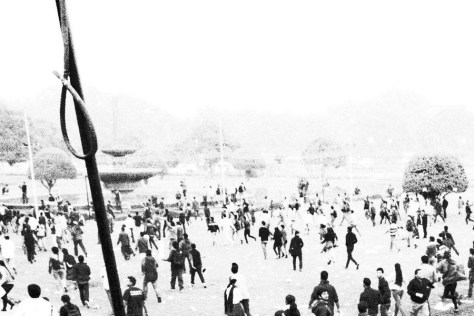
Bhag Modi Bhag: Three eyewitness accounts from a protest in Delhi University

Guest posts by CHANDAN GOMES, AKHIL KUMAR and an ANONYMOUS student; photographs by CHANDAN GOMES, SHAFAQ KHAN and MUKUL DUBE

Photo credit: Chandan Gomes

No Space for Dissent

by CHANDAN GOMES

On 6th January, 2013 the usually quaint Delhi University transformed into a battle ground of ideologies. The road leading to Sri Ram College of Commerce (SRCC) where Narendra Modi was invited to speak at the Sri Ram Memorial Oration stands witness to all that went wrong day before yesterday. Continue reading Bhag Modi Bhag: Three eyewitness accounts from a protest in Delhi University

Newslaundry ki dhulai: Kashif-ul-Huda

Guest post by KASHIF-ul-HUDA

In just a year, Newslaundry has achieved quite a following for its in-depth and hard-hitting interviews.  “Welcome to newslaundry – Sabki dhulai. You watch. We’re watching,” says the “About Us” page of this website. But the question is who will do dhulai of Newslanudry?

Newslaundry’s interview of eminent Islamic Scholar Asghar Ali Engineer makes you wonder what kind of preparation did Madhu Trehan did before doing this interview? How is this interview, asking stupid questions on the topic of women’s education, Salman Rushdie, purdah, etc., any different than idiots that play journalists on news channels? Continue reading Newslaundry ki dhulai: Kashif-ul-Huda

जहाँ वे सेतु बनते हैं: मिहिर पंड्‌या

Guest post by MIHIR PANDYA

गणतंत्र दिवस की सुबह। अौर उस सत्र का शीर्षक था ‘विचारों का गणतंत्र’। अशिस नंदी पहले उदाहरण द्वारा विस्तार से समझाते हैं कि क्यों एक सवर्ण एलीट का भ्रष्टाचार हमारी बनायी ‘भ्रष्टाचार’ की मानक परिभाषाअों में फिट नहीं होता अौर क्यों सिर्फ दलित का भ्रष्टाचार ही ‘भ्रष्टाचार’ नज़र अाता है। इसलिए जब वे यह कहते हैं कि भ्रष्टाचारियों का बहुमत वंचित जातियों से अाता है तो वह यह कहते हुए वापिस पुरानी बात दोहराना ज़रूरी नहीं समझते कि यहाँ दोष उनका नहीं, ‘भ्रष्टाचार’ की उस भ्रामक परिभाषा का है जिसमें एलीट का भ्रष्टाचार फिट ही नहीं होता। इसे वह अंत में जवाब देने के लिए मिले दो मिनट के समय भी दोहराते हैं कि उनके उक्त कथन को दो मिनट पहले कही बात के संदर्भ में देखा जाए। जैसा नंदी ने बाद में भी कहा, अौर उनकी अध्ययन शैली से परिचित लोग यह जानते भी हैं, वे किसी भी वक़्त यह नहीं कह रहे थे कि भ्रष्टाचार की कोई जाति होती है, बल्कि वे भ्रष्टाचार को पहचानने अौर निर्धारित करने की जो प्रचलित समाजदृष्टि है, उसके पीछे छिपी जातिवादी मानसिकता को पहचानने की अोर इशारा कर रहे थे। यह तर्क प्रणाली समझने में थोड़ी जटिल हो सकती है, लेकिन इसकी कोई वजह मुझे फिर भी नज़र नहीं अाती कि ठहरकर, ज़रा सा समय देने पर भी यह बात समझ न अाए। Continue reading जहाँ वे सेतु बनते हैं: मिहिर पंड्‌या

“The impunity of every citadel is intact” – the taming of the Verma Committee Report, and some troubling doubts

Legal activist Vrinda Grover said in the FeministsIndia e-list about the Ordinance: “The impunity of every citadel is intact – family, marriage, public servants, army, police.” In effect, she said, the Ordinance is simply the pending Criminal Law Amendment Bill 2012, widely criticized by women’s organizations, which has been sneaked in as law without debate or consultation, in Parliament or outside. Feminists activists are rightly suspicious of the sudden sense of “emergency” that has gripped the government, when it has ignored our demands for criminal law reform on sexual violence for over twenty years.

Here I will document two press releases issued by women’s groups, and draw attention to some troubling and unresolved debates within the women’s movement in India today. The post will conclude with a useful table comparing the Ordinance and the JVC Report, issued by the Ministry of Home Affairs. Continue reading “The impunity of every citadel is intact” – the taming of the Verma Committee Report, and some troubling doubts

Water Cannons, Tear Gas, Ordinance: How the State Responds to Protests Against Rape and the Justice Verma Committee

20130203-075541.jpg

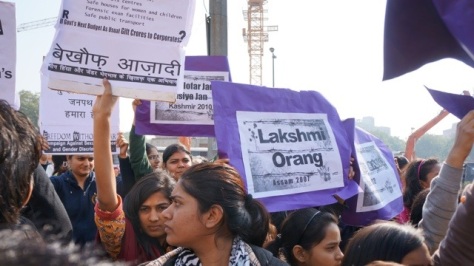
  • [ Protestors from the Bekhauf Azaadi/Freedom Without Fear Campaign Demanding Complete Implementation of the Justice Verma Committee Recommendations during the Freedom Parade to Reclaim the Republic on Republic Day, 26 January, 2012 in New Delhi. ]

So, first they come with water cannons and tear gas, and then they come with an ordnance.

Yesterday, the Union Cabinet decided to rush drafting an ordinance in response to the massive protests against rape and sexual violence that have been occurring ever since the 16th of December, 2012. According to preliminary reports, the ordnance, which will be signed into law by the President of India before Parliament even meets, flies in the face of the detailed and exhaustive list of recommendations made by the Justice Verma Committee (JVC) which had been hailed by the protesting young people and a large number of women’s organisations. In other words, the government feels no need to discuss the JVC in parliament. It feels no need to even give time and an opportunity for its recommendations to sink in, for there to be more thinking, more ideas, more awareness of the issues and questions at stake. No wonder, the government had so hastily pulled down the JVC report from its own websites after it had been released. Continue reading Water Cannons, Tear Gas, Ordinance: How the State Responds to Protests Against Rape and the Justice Verma Committee

Dear Pakistani friends, Put yourself in my shoes

I did not want to write this post.

There are enough Indian voices, from Times Now to Hindutva Online, who point fingers at Pakistan. Like M Ziauddin of the Express Tribune newspaper, I think that the two countries need more unpatriots – not people who ‘hate’ their own countries but who question their own nationalist narratives. People who ask: could we be wrong? Asking questions of yourself is difficult, and blaming the other is instant gratification of ego. Questioning yourself has long-term rewards in helping you make peace with yourself.

I am forced to write this piece because I continue to see well-meaning Pakistanis online continue to complain about the Bad Hospitality given by India to the Pakistani women’s cricket team in Cuttack in Orissa. The complainants online have included some of my Pakistani friends whom I know to be liberal, peace-loving and well-meaning, and who have clearly been influenced by some clever propaganda that is deliberately not showing them the full picture. Continue reading Dear Pakistani friends, Put yourself in my shoes

Is Prof Nandy a Holy Cow?: K Satyanarayana

We are posting below an interview of Dr K SATYANARAYANA on the issues arising out of the ‘Ashis Nandy case’. The interview was conducted by DALIT CAMERA and sent to us by RAVICHANDRAN

The interview raises some important issues that call for a reasoned public debate and we welcome this opportunity provided by this interview.

Ashis Nandy, Media and the Work of Acceleration: Anirban Gupta Nigam

Guest post by ANIRBAN GUPTA NIGAM

The hornet’s nest stirred by Ashis Nandy’s comments at the Jaipur Literature Festival might – hopefully – be dying down, but certain questions raised by the occurrences on the 26th probably require a little reflection on everyone’s part.

In the corporate and social media blitz, a lot of the details have been forgotten, excised and overlooked. Till yesterday it was not clear what his entire speech consisted of. The most quoted line from his talk at the festival is: “it is a fact that most of the corrupt come from the OBC, the Scheduled Castes and now increasingly the STs and as long as it is the case, the Indian republic will survive.” None of those attacking Nandy for being casteist or spewing hate-speech have in fact even attempted to explain the latter part of the quote: “as long as it is the case, the Indian republic will survive.” How is that a casteist statement? More importantly, media reproductions of his statement have excised a crucial disclaimer he himself gives at the beginning: “It will be an undignified, even vulgar statement, but it is a fact that most of the corrupt come from the OBC, the Scheduled Castes and now increasingly the STs and as long as it is the case, the Indian republic will survive.” Continue reading Ashis Nandy, Media and the Work of Acceleration: Anirban Gupta Nigam

Our memories come in the way of our histories: Gowhar Fazili

Guest post by GOWHAR FAZILI

Our Moon Has Blood Clots by Rahul Pandita; Pages: 258; Vintage Books, Random House, India; Price: Rs 499

Rahul Pandita’s book Our Moon Has Blood Clots must be looked at both as a personal account of suffering as well as a political project that implicitly and explicitly makes use of that suffering towards a particular end. The undertaking is a legitimate one on both counts.  What the book manages to achieve on each, warrants a fair and dispassionate assessment.

His narration of events experienced by the Pandits is a welcome exposition of subjectivity around a range of traumatic events, humiliations, killings and betrayals undergone prior to and after the outbreak of mass political rebellion in Kashmir in 1989. The events thus narrated, especially the account of the personal experiences of trauma do make one strongly identify with the suffering of the families involved and agree with the wide swathes of subjective anger and hurt shared by the community.  The chilling accounts of individual and mass killings and the circumstances that made them possible, call for collective self-reflection, remorse and atonement. This account also calls for serious reflection on the fragility of human associations and trust in exceptional circumstances that we normally take for granted.

The book as well as the promotional interviews around the book push the claim that not only certain militants but also many ordinary people, including those personally known to the victims, were responsible for the exodus through their acts of omission and commission.  This claim is substantiated through a range of indictments based on personal encounters with individuals, shared nuggets of information, as well as the interpretation of the larger political symbolism and slogans which were seen as a deliberate attempt to intimidate Pandits, and Pandits alone.  While it is difficult to deny that a number of individuals took advantage of those anarchic times to gratify personal hate and lust for loot, it makes for an overstatement to underplay the equally frequent narrative of mutual support between individuals that one gets to hear during conversations between the members of the two communities privately. Such underplay does violence to those aspects of shared memory.  Continue reading Our memories come in the way of our histories: Gowhar Fazili

Of Complicity and Contamination in the Neoliberal Academy: Oishik Sircar

Guest post by OISHIK SIRCAR

Many years back as a naïve leftist graduate student in Toronto I discovered the meanings of complicity and contamination through a most ordinary event. As someone who believed that no artistic work should ever have restricted access because of copyright, I bought an online software programme that could break copy protected DVDs. I would get film DVDs from the university library and use the software to copy them onto my hard drive. In the one year that I spent there, I copied over 1000 films. Over the years I have distributed many of these films to my students and friends, and have made extensive use of them in my teaching and workshops.

By the time I was nearing the end of my stay in Toronto, I wanted to figure out whether the software would work in India – so that I can continue my copyright breaking enterprise. I was delighted to find out that it would, as long as I paid to extend the software’s use for another year. And at the time of making this payment, to my utter surprise, I saw that this software was copyrighted. The fact that a copyright breaking software could itself have a copyright was bizarrely enlightening. The software was a tool to rip through the oppressive regimes of copyright, and in doing so it also sought recognition from that very language of privatizing innovation. It got me thinking whether we could ever espouse and practice a politics that is not a constant negotiation between complicity and contamination. Whether a search for a politics of purity is both foolish and counterproductive? My naïveté has been gradually undone through events that I have observed and experienced since then. While I can treat this as a process of acquiring wisdom, it is nevertheless a disturbing wisdom to possess. It has also left a feeling of yearning for utopia in this world of cruel contradictions.

After returning from Toronto, I shook off my naïveté with such force that I ended up with a job at a university funded by one of India’s largest steel companies whose operations have wreaked havoc in the lives of adivasi populations in several parts of India. Continue reading Of Complicity and Contamination in the Neoliberal Academy: Oishik Sircar

Corruption and Political Correctness: A Severe Case of Intellectual Laziness: Meera Ashar

Guest post by MEERA ASHAR

Ashis Nandy has been called, rather, accused of being, many things—sociologist, historian, political theorist, public intellectual, philosopher, psychoanalyst, leftist, centrist, right wing, Dalit, Christian, Brahmanical, casteist (he describes himself, more poetically, as an intellectual street fighter and reason buster)—but ‘politically correct’ has never been one of them.

This time, Nandy’s political incorrectness has cost him more than before. As in the past, he has been attacked by politicians and the popular media for presenting his analysis of social phenomena—for doing his job well. The response of the Indian intelligentsia to Nandy’s threatened arrest by the right wing government of Gujarat in 2008 was markedly different from the response now. The difference this time, of course, is that Nandy has not offended the right people. He is seen to have betrayed the marginalized. This time, he has been unfashionably politically incorrect. The similarity between the two episodes is the ‘freedom of speech’ brigade, which has dutifully stood by Nandy. But I shall turn to them later.

Continue reading Corruption and Political Correctness: A Severe Case of Intellectual Laziness: Meera Ashar

Ashis Nandy’s Predicament and Ours

For the past few days I have been preoccupied in one part of my mind in dealing with two reasons for anguish. The first reason has to do with the profound sense of disappointment and anger with which I heard Prof. Ashis Nandy, a man I consider to be a great teacher, friend and in possession of one of the finest minds of our time, commit himself in public to a flippant and vulgar position when speaking of the relationship between caste and corruption at the Jaipur Literary Festival.

I was saddened because Prof. Nandy’s statements do a great disservice to the suppleness and ethical integrity of his thinking, and represent one of those sadly paradoxical situations where an intellectual can become their own worst adversary. I am unambiguously critical of the Nandy who chooses to be pompously opinionated and misinformed at a forum like the Jaipur Literary Festival or while riding the hot-air currents of television especially because I remain a partisan of the Nandy who can be (when he chooses to be) one of the most thoughtful and insightful witnesses to our time in his writing. Continue reading Ashis Nandy’s Predicament and Ours

A Guide to Infantalising and Trivialising the Public sphere

It is no  coincidence that Salman Rushdie who remains the poster child of the censorship debate in India begins his celebrated Midnight’s Children with the twin image of the birth of a child and that of a nation. The rest of the novel traces the intertwined stories of the child’s growth with the political history of independent India. But if one were to extend this allegory taking into account the kind of public sphere that seems to exist in India 65 years after independence there seems to be something amiss about this metaphor of birth and subsequent growth into maturity. A strange malaise pervades the public sphere in India today, where it seems almost as if we have turned the natural cycle of growth around and the children of midnight appears to suffer from the malady of the protagonist in David Fincher’s film “The Curious case of Benjamin Button” where a man is born a mature adult but ages backwards and slowly slides into infantile regression. If we were to consider the unreasonable response to Ashis Nandy’s talk at the Jaipur literary festival as one in a long continuum of such cases where individuals are hounded for hurting sentiments of communities, the Indian public sphere sadly appears as a weak and sickly child suffering from irony deficiency. Continue reading A Guide to Infantalising and Trivialising the Public sphere

Why the Parliament should reject the standing committee’s recommendations on the Food Security Bill: RTFC

This statement was put out by the RIGHT TO FOOD CAMPAIGN on 24 January

The much awaited recommendations of the Standing Committee on Food, Consumer Affairs and Public Distribution on the National Food Security Bill are a letdown to those who wrote to the Committee urging it to ensure justice to the people of India.  The Committee despite taking a year since December 2011 when the Bill was tabled in the Lok Sabha, has undermined the goal of food security for all the people of India through its recommendations given to the Parliament on 17 January, 2013. Instead of moving forward, the Committee’s recommendations are a leap backward by removing even existing entitlements. If the Committee’s recommendations are to be legislated, then it is the Campaign’s reasoned position that it rather not have a food security law rather than accept one which: Continue reading Why the Parliament should reject the standing committee’s recommendations on the Food Security Bill: RTFC

PUCL Rajasthan condemns FIR against Ashis Nandy

This release was put out by the Rajasthan unit of the PEOPLE’S UNION FOR CIVIL LIBERTIES on 26 January

PUCL condemns the FIR lodged under sec. 506 IPC, criminal intimidation and 3-1(10) of prevention of atrocities against SC,ST 1989 against Prof. Ashis Nandy for his statements in a discussion at the Jaipur Literature Festival 2013 and the protest demanding his arrest.

From the reports we have received, he was not exhorting hate and not being casteist and was only making an academic point which means that nobody is free from corruption.

Proceeding criminally against him and arresting him is restricting academic freedom and academic debate. Now that he has apologised and regretted  what he has said the matter should be closed.

Prem Krishan Sharma, President
Kavita Srivastav, General Secretary

See also: Most of the corrupt come from SC/ST, OBCs: Ashis Nandy
Below: Video report from CNN-IBN and ABP TV video of Nandy’s press conference Continue reading PUCL Rajasthan condemns FIR against Ashis Nandy

The Justice JS Verma committee report

For a summary with commentary, see this guest post by Arvind Narrain.

Reclaiming the Republic from the Alleged Perpetrators of Violence

As I sit writing this, on the 26th of January, 2013, in various parts of the territory of the Republic of India, soldiers either already have, or are about to begin marching in formation. In New Delhi, the capital of India, their parade is accompanied by tanks, heavy artillery and replicas of nuclear warheads. In the part of the province of Jammu & Kashmir administered by the Indian Union, in several provinces of the north-east, and other areas where the writ of the state runs entirely on the basis of its armed might, Republic Day, as this date is called, is an occasion for search and cordon operations, ‘crackdowns’ and the creation of a Potemkin village like ambience in the zones (usually heavily guarded stadia) where the republic insulates itself from the public. In New Delhi, the naked, obscene exhibitionism on the axial avenue of Rajpath of a nuclear weapons power that maintains the second largest armed forces in the world, even as millions of its subjects subsist at sub-Saharan levels, is an annual ritual. Apparently, this ritual is conducted to commemorate the founding of the Indian republic through the coming into force of its constitution in 1950.

Continue reading Reclaiming the Republic from the Alleged Perpetrators of Violence