Category Archives: Debates

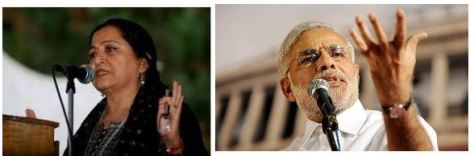
Moditharam at IFFK 2012 : An Open Letter to the Young People Who Volunteered at IFFK

 Dear Friends

Writing this to you to share the pain, the insult, the deep sense of deprivation that I feel at the end of IFFK 2012.

I am sure many of you would be surprised by this statement. I expect a barrage of irritated questions: didn’t the IFFK 2012 present a most delectable selection of films, and that too, of impeccable political correctness? Weren’t the passes delivered promptly? Weren’t the theaters all spruced up and respectable? Were the loos great this time? So what more do you want, you crude, loud-mouthed female, who was shouting and protesting most of the time? And in any case, why should you write at all to the volunteers,  and not to the authorities if you plan to complain?

Continue reading Moditharam at IFFK 2012 : An Open Letter to the Young People Who Volunteered at IFFK

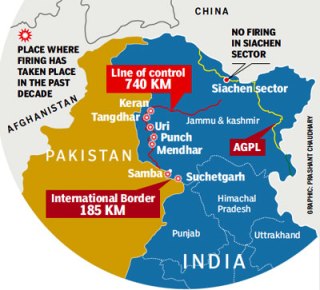
Can we solve Siachen without solving the Jammu and Kashmir dispute?

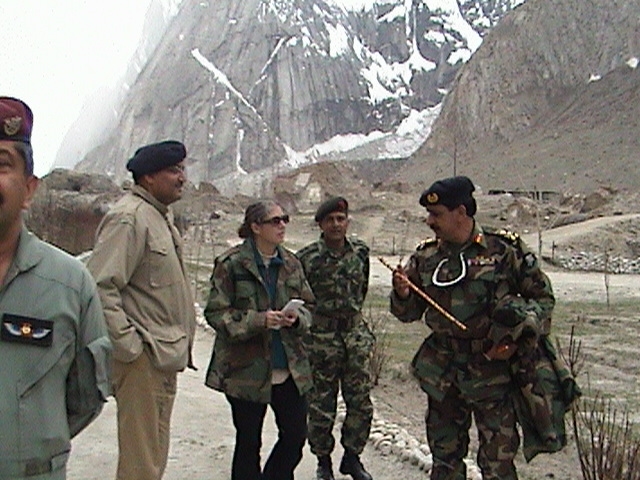
Myra MacDonald with Pakistani Army officers in the Gyari sector in 2004

Myra MacDonald is a London-based journalist with Reuters and a long-time observer of South Asia. She tracks the turning points in Pakistan politics at the Pakistan: Now or Never. MacDonald is best known for her book on the Siachen conflict, Heights of Madness: One Woman’s Journey in Pursuit of a Secret War. Published in 2007, the research for the book took her to both sides of the conflict, on helicopter and on ground. She was bureau chief of Reuters in India in 2000-2003. She then took leave-of-absence to research the Siachen conflict, becoming one of the very few people to visit the war zone on both the Indian and Pakistani sides. She has given presentations on Siachen to the Royal Military Academy Sandhurst and to the International Institute for Strategic Studies in London. Amidst alarmist rumours that track-two parleys between India and Pakistan are urging India to ‘give up Siachen’, MacDonald tells Shivam Vij in an e-mail interview why resolving Siachen without resolving the Jammu and Kashmir dispute may not be easy.

Q1) The idea of demilitarising Siachen is being seen by some in India as a demand to hand Siachen over to Pakistan, or at the very least, to ‘lose’ the territory for which Indian soldiers have made great sacrifices. Do you agree with such an interpretation of demilitarising the glacier? Do you think India has real strategic advantage with its occupation of the glacier? Continue reading Can we solve Siachen without solving the Jammu and Kashmir dispute?

Kurdistan, a Forgotten Nation of 40 Million People: Kamal Chomani

Guest Post by KAMAL CHOMANI

It has been for about 13 months I am living in Bangalore, India. I am here to study masters. India to me, as it is, is incredible. I feel as if I am at home. People here are friendly. My teachers and colleagues are just great. I have to confess that for a student that is his first time to leave his home for such a long time, certainly, will face many difficulties, but no difficulties have hurt me as much as a question of Indian people ‘where are you from?’

I am from Iraq, but Iraq is not my country. I cannot speak Arabic which is the official language the country. Luckily three more Iraqi people are with me who have helped me to manage my Arabic. My culture is different from Arabs. I don’t want to look like a nationalist, because I am telling the truth. I am a Kurd! My mother tongue is Kurdish. My homeland is Kurdistan.

So, who are the Kurds?

Kurdish community in Italy protesting for Ocalan's release. Photo courtesy demotix.com
Kurdish community in Italy protesting for Ocalan’s release. Photo courtesy demotix.com

Kurds are the original inhabitants of Middle East. They are the biggest stateless nation around the world that they are still struggling for freedom and independence. They have been forgotten by the world.

Yes, Kurds are a forgotten nation of 40 million populations. In India, few people know who Kurds are. I am really surprised when some Indians ‘love’ Saddam Hussein, the former Iraqi president. Saddam has killed more than 300,000 Kurds. He used poisoned gas against Kurds and killed 5000 Kurds in only one hour in Halabja, which is known as Hiroshima and Nagasaki’s sister! He mass murdered more than 182,000 Kurds in Anfal (Genocide) operations. The Anfal case is going to be an international case. Sweden Parliament has just decided to recognize it as a genocide act against humanity. In UK, Kurdish people have started a huge campaign to make pressures on UK parliament to recognize as Genocide. Continue reading Kurdistan, a Forgotten Nation of 40 Million People: Kamal Chomani

Sex, Lies and God’s Promise: Response to a Diatribe

An article titled “In Defence Of Israel” is being circulated to media-persons in India by the Spokesman of the Embassy Of Israel in Delhi. This article, published in Open magazine, was written by Jonas Moses Lustiger (a student based in Paris, who has earlier lived in India).  The article names me specifically, and refers to mine and Aditya  Nigam’s posts on Palestine in Kafila, but I was not interested in engaging with Lustiger’s largely ill-informed, propagandist and misrepresenting rant. But now that it appears we are responding directly to the Israeli state, I feel perhaps I should put some things on record.

(Our three posts on Kafila are Nakba and Sumoud, Living the Occupation and Imagining Post-Zionist Futures)

 Let me begin by stating my complete agreement with Lustiger on three of his key statements in the Open article.

First:

It is true that Israel’s current government is one of the worst it has known and most of its citizens have lost hope for peace. It is also true that Israeli society is turning more racist, intolerant and ignorant of the suffering and existence of their immediate neighbours—Palestinians. Of course, the Palestinian people have been denied many rights and have been living under precarious conditions since Israel’s 1967 occupation of the West Bank and Gaza. True, they have been repeat victims of unjustifiable violence and a large proportion of Israeli politicians deny their claim to an independent land, even as Israel threatens the viability of a Palestinian state by wielding tools of colonisation. 

Pretty much sums up our three posts on Kafila – what’s not to agree?

Second:  Continue reading Sex, Lies and God’s Promise: Response to a Diatribe

Imagined Immunities: The Cure of Idinthakarai

The power of imagined communities was never so evident to us as on the other day, when a group of us — Malayalee people of different political affiliations — made our way to Idintakarai in southern Tamil Nadu. In many ways,we were representative of contemporary Malayalee society — we were from districts spanning the length and breadth of Kerala, had very vocally-expressed mutual differences of opinions and interests, and belonged to of different socioeconomic classes, faiths, and castes, were composed of local residents, NRIs, and Malayalees settled elsewhere in the country. Of course, we were also representative of the gender imbalances that characterize even the oppositional civil society here — there were just two women in a group of nearly thirty. We went there to express solidarity with the people of Idinthakarai who have been struggling valiantly against the monstrosity that the government of India is determined to foist on them — the Koodankulam nuclear power plant — and who have been described as traitors to the Nation by the very people who have ripped apart our sense of what a nation should mean to ordinary people. Continue reading Imagined Immunities: The Cure of Idinthakarai

Abolition of Death Penalty – A Time for National Reflection: PUCL

This release was put out yesterday by the PEOPLE’S UNION FOR CIVIL LIBERTIES

The secretive and stealthy hanging of Ajmal Kasab in Pune’s Yerwada Prison yesterday, 21st November, 2012, brings to an end the legal process involved in trying Kasab for the brutal assault by trained terrorists from across the border on Mumbai, the commercial capital of India which left 166 persons dead.

The Mumbai carnage of November 2008, more popularly abbreviated to a single term `26/11,’ constitutes one of the most heinous and deliberate attempts in recent years to cause mass mayhem and terror in India. Kasab was the only member of the terrorist team sent from Pakistan apprehended alive; he was caught on film diabolically using his modern automatic weapon in a cold blooded fashion, killing numerous people. The hanging, and the trial and legal proceedings which preceded it,  admittedly  complied with existing laws which permit death penalty, and cannot be faulted as such.  While it may be argued, as many do  that the hanging will help in an `emotional closure’ to the families of victims of 26/11, there are others who point out that other key issues still remain to be addressed.  Families of victims in specific, as also other concerned citizens, have pointed out that Kasab was only a foot soldier and not the mastermind, who still remain at large. Continue reading Abolition of Death Penalty – A Time for National Reflection: PUCL

Why I was saddened by Kasab’s execution

Rejoice, fellow Indians. Ajmal Kasab has been hanged. But please excuse me, I am not joining you. Your cheering and hooting and hurrahs feel like a medieval lynch mob celebrating the death of the sinner and not the sin. Barbaric is the word that comes to mind.

This isn’t merely about the morality or aesthetic of capital punishment. I want to ask you: what did we just achieve? Ten terrorists had come to kill and be killed, to cause maximum damage of the sort that they surely knew they’d be killed. Nine of them were killed in direct encounter. Did we hail their deaths? Do we say their deaths were justice? So if we killed Ajmal Kasab four years later- “with due process” – what exactly have we achieved? Continue reading Why I was saddened by Kasab’s execution

Satyameva Jayate? On the impending execution of Afzal Guru

Someday, we will count how many minutes it took for television in India to start baying for Afzal Guru’s blood (once again) after Ajmal Kasab was buried in Yerwada Central Jail in Pune.

A man called Mohammad Afzal Guru, son of Habibullah Guru, currently resident in Ward Number 6 of Jail Number 1 in Tihar Central Prison in Delhi will hang to satisfy the bloodlust of the Indian Republic, unless the President of India decides otherwise. This text is an attempt to make us think about this decision and its ramifications carefully.

Continue reading Satyameva Jayate? On the impending execution of Afzal Guru

A 26/11 victim who refuses to celebrate Kasab’s execution

While the media has reported most families of those who died in 26/11 as hailing the execution of Ajmal Kasab, Bollywood actor Ashish Chowdhry refuses to be one of them. His sister Monica and her husband were amongst those who were killed at the Oberoi trident hotel. Given below are screenshots of Chowdhary’s tweets. Read from the last tweet upwards. Continue reading A 26/11 victim who refuses to celebrate Kasab’s execution

The Power of Mercy: Yug Mohit Chaudhry on the execution of Ajmal Kasab

Guest post by YUG MOHIT CHAUDHRY

Under Article 72 of the Constitution of India, the President’s power to grant mercy comes into play only after the judicial system has confirmed the death sentence. Therefore, the confirmation of the death sentence by the highest court is a condition precedent to the grant of mercy. Judicial confirmation of the death sentence does not put the convict beyond the pale or disqualifies him from mercy; in fact it renders him eligible for mercy. Arguments that Kasab deserved no mercy once the Supreme Court confirmed his death sentence are misconceived.

It is only the rarest of rare crimes that shock the collective conscience of society and are truly unpardonable that are given the death sentence. In our constitutional scheme, it is therefore only persons committing such crimes that are eligible for mercy and pardon. If they are to be excluded from the ambit of mercy by the mere fact of having committed truly unpardonable crimes, the President’s power of mercy has no meaning. Paradoxically, the very fact that Kasab had indeed committed an unpardonable crime is what renders him eligible for mercy. Continue reading The Power of Mercy: Yug Mohit Chaudhry on the execution of Ajmal Kasab

Social Media Regulation vs. Suppression of Freedom of Speech: Pranesh Prakash

Guest post by PRANESH PRAKASH

This morning, there was a short report in the Mumbai Mirror about two girls having been arrested for comments one of them made, and the other ‘liked’, on Facebook about Bal Thackeray:

Police on Sunday arrested a 21-year-old girl for questioning the total shutdown in the city for Bal Thackeray’s funeral on her Facebook account. Another girl who ‘liked’ the comment was also arrested.

The duo were booked under Section 295 (a) of the IPC (for hurting religious sentiments) and Section 64 (a) of the Information Technology Act, 2000. Though the girl withdrew her comment and apologised, a mob of some 2,000 Shiv Sena workers attacked and ransacked her uncle’s orthopaedic clinic at Palghar.

“Her comment said people like Thackeray are born and die daily and one should not observe a bandh for that,” said PI Uttam Sonawane.

What provisions of law were used?

There’s a small mistake in Mumbai Mirror‘s reportage as there is no section “64(a)”1 in the Information Technology (IT) Act, nor a section “295(a)” in the Indian Penal Code (IPC). They must have meant section 295A of the IPC (“outraging religious feelings of any class”) and section 66A of the IT Act (“sending offensive messages through communication service, etc.”). The Wall Street Journal’s Shreya Shah has confirmed that the second provision was section 66A of the IT Act.

Section 295A of the IPC is cognizable and non-bailable, and hence the police have the powers to arrest a person accused of this without a warrant.2 Section 66A of the IT Act is cognizable and bailable. Some news sources claim that section 505(2) of the IPC (“Statements creating or promoting enmity, hatred or ill-will between classes”) has also been invoked.

This is clearly a case of misapplication of s.295A of the IPC.3 This provision has been frivolously used numerous times in Maharashtra. Even the banning of James Laine’s book Shivaji: Hindu King in Islamic India happened under s.295A, and the ban was subsequently held to have been unlawful by both the Bombay High Court as well as the Supreme Court. Indeed, s.295A has not been applied in cases where it is more apparent, making this seem like a parody news report. Continue reading Social Media Regulation vs. Suppression of Freedom of Speech: Pranesh Prakash

Imagining Post-Zionist Futures – Israeli Apartheid and Palestinian Resistance III

This post is the third of a series based on a visit by Nivedita Menon and myself to Palestine in mid-September 2012. The first two are Nakba and Sumoud and Waiting for the Third Intifada.

It was the 18th of September, our third evening in Ramallah. We were at the Ramallah Cultural Palace to listen to Palestinian youth bands perform. The place was teeming with people, mostly young, in their twenties and thirties. The hall was packed, the atmosphere so electric that even if Magid had not been there to explain, there was no  way we could have missed the excitement and the anger that the songs evoked in the  audience. Interestingly, not all the songs were about Zionist oppression and the travails of everyday life in occupied Palestine.  When a song critical of the PA (Palestinian Authority) began, the hall went up in spontaneous applause, endorsing the  sarcastic lyrics directed at PA that has lately been involved in carrying out repression on its own population.

Liberation Graffitti on Wall in Ayda camp, Photos AN/NM

The complexity of the current phase of the movement arises from the fact that now, the new forces of Palestinian liberation are arrayed, not merely against Israeli occupation but also against this entity called PA and the Oslo Accords that put in place the political arrangements that mark the division of territories today. An arrangement that was supposed to be merely an interim one lasting but a few years, until the question of Palestinian statehood could be settled, has become a quasi-permanent one that is seen to threaten the longer-term goal itself.

Continue reading Imagining Post-Zionist Futures – Israeli Apartheid and Palestinian Resistance III

Gujarat vs. Himachal Pradesh: Rahul Verma

Guest post by RAHUL VERMA

Himachal Pradesh Chief Minister Prem Kumar Dhumal at an election rally in Mandi. PTI photo

Even though Hiamchal Pradesh voted on November 4, Gujarat has been hogging all the limelight. The election in Gujarat is only in the third week of December. Gujarat captures our political imagination as a ‘role model state’ whereas Hiamchal Pradesh is just in our tourism agenda as a top holiday destination. It is hard for anyone to notice Himachal as a political entity among the big brothers like Uttar Pradesh, West Bengal, Bihar, Andhra Pradesh, Tamil Nadu, and Maharashtra. The irony is that some smaller states like Manipur and Nagaland still manage to get  some attention because of violent manifestations of political choices in these states. Himachal Pradesh is absent from our discourses as the state is just ‘small’ and ‘beautiful’. However, the great turn around in Himachal over last two decades demands that India at least recognizes the “Himachal Pradesh model of development”. Continue reading Gujarat vs. Himachal Pradesh: Rahul Verma

Why is Naipaul Being Honoured?: Girish Karnad

This is the text of GIRISH KARNAD‘s speech at the Mumbai Literature Festival, as compiled by Outlookindia.com from various sources.

On Friday afternoon at the Tata Literature Live! festival in Mumbai, playwright Girish Karnad surprised audiences with an unexpected and spirited critique of Nobel laureate Vidia Naipaul. Naipaul was awarded the Landmark and Literature Alive’s Lifetime Achievement Award on October 31. Karnad was originally supposed to talk about “his life in theatre” in his session, but instead launched into a scathing critique of Naipaul and the conferral of the award to him

This is what he said at the festival:

At the Mumbai Literature Festival this year, Landmark and Literature Alive have jointly given the  Lifetime’s Achievement Award to Sir Vidia Naipaul.

The award ceremony held on the 31st of October at the National Centre of the Performing Arts coyly failed to mention that Naipaul was not an Indian and has never claimed to be one. But at no point was the question raised. Continue reading Why is Naipaul Being Honoured?: Girish Karnad

New Delhi: A heritage zone at 80!

In 1988 Lutyen’s Delhi, was declared a heritage zone by prohibiting building activity within the 26 square kilometre area out of the 43 Sq. Km. area that falls within the civic control of New Delhi Municipal Committee (NDMC). A move has now been initiated to get the entire area declared a World Heritage site.

The very logic of an area being declared a Heritage Zone should preclude any interference with the layout and design of the entire zone. Non-interference also means that, future building and development activity, if at all permitted, has to conform to the original parameters of design, materials, fittings and fixtures used, building techniques, landscaping and the kinds of trees planted in the heritage zone.

Even before the 1988 freeze on construction, there was a master plan for Delhi and it clearly identified the Lutyen’s Bungalow Zone as an area where high rises were not to be permitted.

The actual violations began when this rule was selectively relaxed beginning with permission given in the mid 70s to construct the high rise Sagar Apartments on Tilak Marg. High rises like Asha Deep and Dakshineshwar on Hailey Road followed shortly thereafter. Continue reading New Delhi: A heritage zone at 80!

दिल्ली बनाम बम्बई

भारत के दो महानगरों राष्ट्रिय राजधानी दिल्ली और बम्बई को यूनेस्को द्वारा विश्व धरोहर की सूची में नामांकित करने की तैयारियां चल रही हैं, कुछ मित्रों ने दिल्ली या बम्बई की बहस शुरू कर दी है जो वास्तव में पूर्णत: अनर्गल बात है.

में दिल्ली बनाम बम्बई के पचड़े में पड़ने के बजाये ये सवाल पूछना चाहता हूँ के ऐसा क्यों है के 65,436,552 की कुल आबादी और 6,74,800 वर्ग किलोमीटर के कुल क्षेत्रफल वाले फ्रांस में 35 स्थान, नगर, इमारतें प्राकृतिक स्थल आदि ऐसे हैं जो विश्व धरोहर की सूची में शामिल किये गए हैं मगर इस सूची में भारत का नाम केवल 29 बार ही आता है.

जो सवाल पूछना ज़रूरी है वो यह के सिर्फ दिल्ली या/और बम्बई ही क्यों? जोधपुर, जयपुर, अजमेर, इंदौर, उज्जैन, भोपाल, बनारस, इलाहबाद, लखनऊ, पटना, वैशाली, हैदराबाद, विदिशा कालिंजर, मदुरै, कांचीपुरम कलकत्ता और मद्रास क्यों नहीं ?, आप ने नोट किया होगा के बम्बई कलकत्ता और मद्रास के नए नाम में इस्तेमाल नहीं कर रहा हूँ और दिल्ली को भी देहली नहीं लिखा है. यह जान बूझ कर किया जा रहा है दरअसल विरासत कहीं अतीत में जड़ हो गयी कोई चीज़ नहीं है और इसलिए नाम बदलने की समस्त परियोजनाएं विरासत से छेड़ छाड करने की निन्दनीय प्रवर्ति का ही हिस्सा हैं. Continue reading दिल्ली बनाम बम्बई

Bootlegging Education – Four Strategies for Fighting Back

Yes, this is what we must do now on a large scale – bootleg education.

Thanks to the conjunction of new heights of intellectual bankruptcy with new regimes of intellectual property, a large scale attack on equitable access to education is upon us. A longer discussion on  ‘Intellectual property’ is required, but the immediate provocation for this post is of course the Delhi University photocopying case. Elsewhere on Kafila, there is a post that links to a petition by authors and academics on this issue. The case, very simply is this: three big corporate publishers, namely Oxford University Press, Cambridge University Press and Taylor and Francis have filed a petition in the Delhi High Court, claiming infringement of copyright with regard to course packs used by students. The offender against these giant publishers is a small photocopy shop in Delhi School of Economics. As many legal experts on intellectual property and the Indian copyright law have stated, this kind of photocopying is well within the framework of the law (See some of the discussion here and here).

At the moment, however, I am not concerned with the pure legality of the issue. The question of ‘course packs’ concerns the vital interests of our society as a whole. For there was a time when teaching at the college and university level was  conducted largely through substandard kunjis, or guidebooks – honourable exceptions apart, of course.  Even today we have at least one of the corporate giants (that happens to be among those suing the little Rameshwari photocopier), producing slightly upmarket versions of such guidebooks. University professors willing to write a substandard book a month that fits into some course or the other, are also published by  publishers like these now, euphemistically called ‘textbooks’. In an earlier time, such books of barely passable scholarship (largely plagiarized cut-and-paste jobs) would be published only by dubious publishers.

Continue reading Bootlegging Education – Four Strategies for Fighting Back

The (Ir)resistible Rise of Arvind Kejriwal – Enter The ‘Outsider’

The tide is clearly turning. You know this when former critics and lampooners start talking of him as a ‘game changer’; you know this when weather-cocks turn away from the corridors of power where once they had been ensconced. You know this when rats start deserting the sinking ship.

Suddenly, everybody is talking favourably about the man from the ‘outside’ who is refusing to respect any of the established protocols of protest and politics. More startling perhaps, is the fact that in the past two days we have had senior journalists and political analysts suddenly telling us that they had known all along that there was a ‘post 1980 contract’, a secret code of silence, that never would the dynasty be attacked – indeed never would any apsiring dynasty be attacked. Everybody knew, says Dipankar Gupta in the Times of India, that the issue came up one and a half years ago – and we all do know that. Robert Vadra’s doings had already  been known. A senior BJP leader is even reported to have told a senior journalist that his party had indeed been in possession of the very same documents that Arvind Kejriwal brandished at his press conference. But, this leader went to say, “after an intense discussion, the leadership decided not to rake up the issue in Parliament even after submitting a motion in each House asking for a discussion.” Everybody knew – the parties, their leaders, the media persons, political analysts. And yet, nobody spoke out. All of them colluded, in other words, in suppressing the issue. Politicians kept silent for an understandable reason – aspiring dynasties that they are, after all. But the others? Mediapersons? Any guesses?

As someone who has been trying to understand Indian politics over the decades, I have often wondered at what I have referred to as the ‘implosion of the political’ – that is to say, the destruction of politics in the formal political domain. What is called a noora kushti in Hindustani, had come to mark our parliamentary-political grammar. Farcical walk-outs after equally farcical fire-spouting rhetorical speeches in parliament, and a happy bonhomie away from the glare of the media – that was what our politics had been reduced to.

Continue reading The (Ir)resistible Rise of Arvind Kejriwal – Enter The ‘Outsider’

Evidence, Consensus and Policy: Kaveri Gill on the curious case of changes proposed in India’s public health policy

Guest post by KAVERI GILL

The world of development is as prone to fashions as any other. In recent times, ‘evidence-based policy’ has become the new gold standard, following hot on the heels of participation and ownership of policy processes and outcomes by academics, activists and civil society groups. This applies within nation states, especially of the global South. India today epitomises such objective and bottom-up democratic largesse in favour of the ‘aam admi’- for largesse it is, make no mistake – with a near constant refrain of the avowed aim of ‘inclusive growth’. And yet, does it really?

Or is politically correct discourse and seemingly open decision-making processes in the social sector sphere merely dangerous fig leaves for seismic and opaque shifts in policy, which have very little to do with evidence and even less to do with broad-based consensus? Rather, they are an outcome of fixed ex-ante views – which may be termed as a distinct partiality to the Chicago School of Economics – about the path to a fictitious endpoint of a mainstream development paradigm, which itself is faith-based. It is not justified by theory or a heterodox reading of the empirical experiences of presently developed countries, let alone latecomer developing nations which are, for various exogenous and endogenous reasons, likely to have different trajectories altogether. I refer here to the hackneyed line about faster growth being pursued as a necessary, if not sufficient, condition for eventual trickle down, no matter that the ‘dur khaima’ of an equitable society is never arrived at! Continue reading Evidence, Consensus and Policy: Kaveri Gill on the curious case of changes proposed in India’s public health policy

A statement against the arrest of Punjabi publishers and editors for publishing the poetry of Babu Rajab Ali

Names of signatories given at the end; for more details on the campaign, see Whitewashing History

The arrest of two Punjabi publishers and two editors for reprinting old books of poet Babu Rajab Ali which allegedly contained some then used caste names, under the Prevention of Atrocities Against Scheduled Castes and Scheduled Tribes Act, is a totally thoughtless, callous and ruthless action taken by the Punjab government.

We understand that Mr. Amit Mittar of Tarak Bharti Prakashan and Mr. Ashok Garg of Sangam and editors Mr. Jagjeet Singh Sahoke from Moga and Mr. Swatantar from Samana, were arrested by the police on September 15 at the behest of the Punjab government. This is absolutely against academic freedom. Continue reading A statement against the arrest of Punjabi publishers and editors for publishing the poetry of Babu Rajab Ali

Academic Publishers – An Insider’s perspective: Anonymous Contributor

I am posting an email I received this morning by someone who works at a leading multinational academic publishing house and hence wants to remain anonymous which raises very important points relevant to the ongoing debate about copyright, photocopying and the practices within academic publishing. (Thanks to anonymous contributor for this)

Also for more detailed discussions please see the following posts at spicyip by Amlan Mohanty (1, 2,) Shamnad Basheer (1, 2) and Prashant Reddy 1

Hello Lawrence,

In his Op-Ed in today’s Hindu, Sudhanva Deshpande referred to your work, and soon, I stumbled upon your articles at Kafila and the general discussion on the blogosphere. As someone who worked for a few years in a leading multinational academic publishing company, I thought I might — if this doesn’t sound too pretentious — offer some more ammunition to you. What I have to say may not be immediately relevant to the DU case, but I hope you’ll have the time to read. Continue reading Academic Publishers – An Insider’s perspective: Anonymous Contributor