Category Archives: Debates

If only there were no people, democracy would be fine…

This post has been jointly written by Nivedita Menon and Aditya Nigam

At Ramlila Maidan

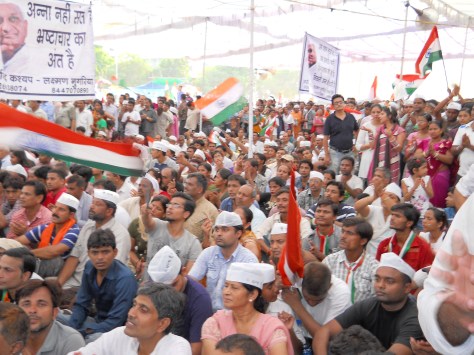
We went to Ramlila Maidan yesterday, the four of “us” considerably swelling the numbers of about a lakh and a half of people there by 6.30 pm, when we left. They were either sitting inside, milling about outside all around its walls, or pouring in having walked from India Gate.  (Is the media exaggerating the numbers? In our opinion it is underestimating them considerably).

Continue reading If only there were no people, democracy would be fine…

We should be there: The Left and the Anna moment

My head has been in a whirl the past few days with a single question – how do we on ‘the Left’ manage so unerringly to be exactly where ‘the people’ are not, time after time?

At this moment I don’t mean the organized Left, for the Left parties  have been cautious about criticizing  the current upsurge; they strongly defended the right to democratic protest when Anna Hazare and his colleagues were arrested, and now have launched a Third Front initiative on the issue of corruption and the Lokpal Bill; the students’ front of CPI (ML), AISA, has been organizing militantly on the issue for a very long time now, and is very much part of the campaign.

I mean the few hundreds who form my own community, the people with whom I have organized protests and run campaigns and sat on dharna and drafted petitions;  struggled against communal violence and sexual harassment,  for queer freedom and workers’ rights, against the nuclear bomb and nuclear energy, in support of reservations and against the moves in our universities to hold up appointments to reserved posts. Many of these people I know personally, some are among my closest friends, and many more I know as part of the broad Left/secular non-party tendency in the country’s politics, where I feel most at home.

Continue reading We should be there: The Left and the Anna moment

NAPM Extends Support to Anti-Corruption Movement and Demand for an Effective Lokpal

[The statement was issued by the National Alliance of People’s Movements on 14 August. Much has happened since then – the arrest of Anna Hazare – accopanied by silence and often ridicule poured by the radical elite, but in the face of what is perhaps one of the most widespread mass movements in India after Independence. Over the past few days, we have been witness to innumerable demnstrations and marches in almost every colony in Delhi – where no TV camera ever reached or was even expected to when the ‘real’ action is going in in central Delhi. Contrary to the general propaganda and even our own earlier impression, this is no more simply a middle class movement. I am reproducing it here, somewhat belatedly, because it still touches on some of the post important points at issue in the ongoing struggle. – AN]

Anna Hazare Ji and manyothers across India will be starting their fast from August 16th in Delhi demanding an effective Lokpal. NAPM supports the people’s movement for a corruption-free India and urges the citizens of the country to plunge into this struggle. NAPM, along with other organisations is holding relay fast, human chains, public meetings and other programmes, in Chennai, Pune, Mumbai, Narmada Valley, Hyderabad, Guwahati, Bhubaneshwar, Bangalore, Mysore, Mou, Balia, Allahabad, Muzzafarnagar and other places. We urge our members and supporters to join this call and challenge the corrupt and defensive governments at the Centre and the states.

We strongly disapprove of the way in which government has been trying to put severe restrictions on holding peaceful protests in the capital, and Delhi Police under the garb of implementing the Supreme Court’s Guidelines is imposing unnecessary conditions on protests, as it did early this month on SANGHARSH anti-land acquisition protest, AISA-DYF anti-corruption protest and others. For an independent democratic country like ours, imposition and insistence on police permission and strict guidelines for holding peaceful protests and Sataygraha seems completely contradictory and only shows shrinking spaces for democratic freedom of expression and curb on fundamental rights of its citizens.

Continue reading NAPM Extends Support to Anti-Corruption Movement and Demand for an Effective Lokpal

The Lokpal- NCPRI approach: the right to differ

In the midst of the overwhelming focus on Anna Hazare and the campaign around a bill that lacks consistency or clarity, both legal or ethical, below is a letter from Aruna Roy drawing our attention to an alternative approach to the Lokpal. It is an existing process for us to partake in, agree, disagree and/or rally behind.

Click here for more information on this alternative.

A letter from Aruna Roy

We write to you on a matter of mutual and common concern, the
Lokpal bill, now in Parliament. The context of this letter is
explained below.When the Joint Drafting Committee of the Lokpal was working on the Jan
Lokpal ,  the NCPRI had written to the Chair, Shri Pranab Mukherjee,
and the co-chair Shri Shanti Bhushan, enquiring about the TORs and the
process of and participation, in public consultation. Both assured us
that there would be formal public consultation. It did not happen.

When the government bill went to cabinet with the intention of placing
it in the monsoon session of parliament, the NCPRI decided to make its
position known. The NCPRI is continuing with its deliberations and
consultations and has  prepared an approach paper and a set of
principles for circulation. This is a work in progress.

The belief in consultations and discussion is the reason why we write to you. Continue reading The Lokpal- NCPRI approach: the right to differ

Onwards to the Independence of the Corrupt!

Let us pledge this 15th of August, that we will tirelessly work towards the independence – nay dictatorship – of the corrupt. We must tirelessly fight every attempt to raise  corruption as an issue – by gullible people who do not understand that corruption is not a real issue. We will not allow such people to be misled by demagogues and fascists who are  interested only in power – even if they do not show their hunger for power by contesting elections. Indeed, precisely because they do not contest elections.

Is the new mantra of democracy? How else do we understand the deafening silence on the series of dictatorial measures adopted by the government, on the part of all those who have been vocal, indeed strident, in their attack on the Anna Hazare movement? It is one thing to be opposed to the Anna Hazare movement but the silence – from parties as well as intellectuals, democratic rights groups and self-righteous editorial commentators of the Indian Express – on the desperate measures being adopted by one of the most corrupt governments ever, is inexplicable. It is as if the only threat to democracy today comes from a group of people who want to raise their voice in civil disobedience against public money being looted by elected representatives acting at the behest of powerful corporate interests.

First the Delhi Police simply refused permission to Anna Hazare and the India Against Corruption fast. Then they asked them to hold their protest in Burari! That is to say on the border of Haryana. This was but another way of disallowing it. Then they came out with a novel idea – a set of preconditions that include an undertaking that there will not be more than 5000 people and that the fast will be wound up in three days. Clearly, no self-respecting set of protestors will agree to such conditions and so ‘Team Anna’ refused to sign the undertaking.

Continue reading Onwards to the Independence of the Corrupt!

In Defence of Asif Ali Zardari: Abdullah Zaidi

Guest post by ABDULLAH ZAIDI

What comes to your mind with the mention of Asif Ali Zardari? “A cunning, vile, and corrupt man,” said my 19 year old cousin. This was a good summation of what the urban middle-class thinks of him. The more I hear people talking about him the more I am convinced of the power of propaganda. “Give the dog a bad name and hang him,” Zardai once said about himself. That is what is at work here.

Despite what has been said about him, Zardari did have a political background. His father Hakim Ali Zardari entered politics well before Partition and was a member of the Khaksaar Tehreek in 1931. He was first elected to the National Assembly in 1970s. All this talk of Zardari as a political orphan who hogged the Bhutto dynasty upon marriage with Benazir, is a non-starter. In Benazir’s husband, the Bhutto family wanted someone who would remain loyal to her. That is exactly what they got in him. For Zardari, family would always come first. This was the case at the time of Benazir’s death, when he kept the family together. Benazir would often tell close aides that despite his failings, Zardari always remained loyal to the family. Continue reading In Defence of Asif Ali Zardari: Abdullah Zaidi

Parliamentary Sovereignty or an Active Citizenry? V. Krishna Ananth

Guest post by V. KRISHNA ANANTH*

The political class, cutting across the spectrum, is now being haunted by a spectre. Anna Hazare has captured the imagination of a cross section of the people and his campaign is certainly gathering support. It remains to be seen if this support translates into a movement on the streets and more so against the state machinery that is threatening to pull all the stops. The people have shown such courage in the past. That is another matter.

Team Anna’s decision to go ahead with protests against the draft Lok Pal Bill, as approved by the Union cabinet, has spurred a debate. The proponents of the draft bill as well as sections in the political arena who claim to oppose the Government are united against another round of fast by Anna Hazare; they call it blackmail and an attempt to usurp Parliament’s power to legislate. They also claim that the principles of democracy shall not be sacrificed.

A number of them are on record that the draft proposals are subject to amendments and that the power to propose amendments and decide on them shall rest with the elected representatives of the people. It is another matter that the Prime Minister, who heads the cabinet, qualifies as a representative of the people only because membership of the Rajya Sabha is considered as good as being a member of the Lok Sabha to remain a minister under Article 75(5) of the Constitution. In any case, the fact is that Dr. Manmohan Singh has claimed, in an affidavit, that he is ordinarily a resident of Assam! We all know the truth but that too is besides the point.

Continue reading Parliamentary Sovereignty or an Active Citizenry? V. Krishna Ananth

Deconstructing The NAC : Ruchi Gupta

Guest post by RUCHI GUPTA

The past couple of months have seen a renewed attack on the National Advisory Council (NAC). The NAC has been decried as an unconstitutional, undemocratic, “super-cabinet” where unaccountable “jholawalas” hatch harebrained schemes guaranteed to run the government aground. Another line of criticism has focused on the process of the formation of the NAC, its space within the Indian Constitution, and its capacity to influence policy. The two criticisms merge with the demand to disband the NAC on the count that the NAC does not have to face the outcome of its recommendations, and by virtue of it being chaired by the head of the ruling Alliance, can arbitrarily force the implementation of its recommendations.

There is however, a need to examine how the NAC has functioned, what it has done, as well as understand the space it occupies in the policy-making paradigm of the country. While the concerns about the legitimacy of the NAC relate to important issues of Constitutionality, the criticism about the nature of its policy recommendations is motivated by ideology and is of much less relevance to its impact on democratic processes.

It is true that the NAC is an entity created to give the leader of the ruling alliance a role in policy making. Nevertheless, partly through the kind of members chosen, and the norms of functioning it has evolved, it has opened up the otherwise closed and secretive processes of formulation of law and policy, beyond its own membership to citizens groups and people with expertise. It can, in fact with some effort become a platform to further a more just and participative democracy. In this essay, we deconstruct the NAC and situate it in its political context to understand both its pitfalls and potential.

Continue reading Deconstructing The NAC : Ruchi Gupta

Dear Manmohan Singh: BPL households don’t think cash transfers will be better than the PDS

Given below is the text of a letter written by research scholars and student volunteers to the Prime Minister of India. Given below the letter is a table listing the findings of the survey that the letter speaks about.

21 July 2011

Dr. Manmohan Singh
Prime Minister of India

Respected Prime Minister,

We are a group of research scholars and student volunteers who have just spent three weeks surveying the Public Distribution System (PDS) around the country. We are writing to share a few thoughts on the National Food Security Act in the light of this experience.  Continue reading Dear Manmohan Singh: BPL households don’t think cash transfers will be better than the PDS

New Phase in Struggle for Release of Political Prisoners in West Bengal: Biswajit Roy

Guest post by BISWAJIT ROY

Civil society, including human rights groups, in Bengal are now divided on Mamata Banerjee government’s ‘open and hidden’ conditions regarding the release of political prisoners who have been jailed during the Left front rule as well as talks with Maoists and Maoist-backed Peoples Committee against Police Atrocities in Bengal’s tribal hinterland, known as Junglemahal.

Mamata and her ministers have rejected the demands for unconditional release of all political prisoners, immediate withdrawal of joint forces from Junglemahal and public announcement on non-enforcement of the draconian central law, the Unlawful Activities Prevention Act. Maoists and PCPA have accused Mamata of eating up her pre-poll words on those demands. A large section in the human rights movement including the intellectuals and activists who actively joined the Mamata-led campaign for regime-change now supported these demands. But some of their fellow travellers have differed on political and legal grounds.

The differences revealed contradictions between the pre-poll and post-poll positions of Mamata as well as chinks in the armour of human rights groups on the attitude to the new government, Maoists and PCPA. Tension among all the stakeholders in the process— Mamata, Maoists, human rights groups and individuals— was well-known within the concerned circles for quite some time. But none of the stakeholders dwelt on it in public before the assembly polls when they had made common cause against the CPM, particularly, the atrocities by CPM-joint forces combine.

I would like to dwell on post-poll dilemmas and fissures in the pro-Paribartan civil society in Bengal later. But this piece is primarily aimed at reporting the increasing manifestations of the hitherto latent tension.

Continue reading New Phase in Struggle for Release of Political Prisoners in West Bengal: Biswajit Roy

The Values of Property

The recently announced Rajiv Awaas Yojana (RAY) has brought back an old ghost to debates on how to allow the urban poor a foothold into the city and the possibility of upward mobility. The central policy initiative of the Ministry of Housing and Urban Poverty Alleviation is the most significant contemporary attempt to address urban poverty through providing housing to the urban poor. The “slum-free city” is back. Now more than ever, then, it is time to ask: what is a “slum-free city”?

Continue reading The Values of Property

Can Kingly Mortals Donate to the Gods?

Our fair but humble town of Thiruvananthapuram has been in a tizzy since it was discovered that our benign presiding deity, Lord Sree Padmanabha, had been resting on a huge treasure-trove, so fantastic that no one has been able to stop talking of it since then. This seems to have changed drastically the way we have perceived our past — or rather, the historical amnesia which we have been suffering from has been drastically accelerated. In the decades after independence, very few people, except the upper caste retainers of the Travancore royal family and the accolytes of the regime, thought that rajabharanam was a good thing. There were stories about the days immediately following the accession of Travancore to India, of how people gathered outside the Padmanabhaswamy temple, and when the Travancore Maharajah, Chithira Tirunal Balarama Varma arrived there for his daily visit, reminded him of their equality with him as citizens of India, addressing him personally and intimately … ‘Hey, Balaa’! That seems to have gone for a toss and we are back to His Golden Majesty, Ponnutampuran, though such a tampuran has no place in our political system. Continue reading Can Kingly Mortals Donate to the Gods?

The Lord’s riches are not the Lord’s riches

Photo credit: Press Trust of India

Giving a historical background of why the Sree Ananta Padmanabha Swamy temple in Thiruvananthapuram came to have these riches, Malavika Velayanikal writes in DNA:

True, the bags of gold coins, diamonds, precious stones, 18-feet-long gold necklaces, jewellery weighing many kilograms, and solid-gold statues of gods and goddesses landed in the vault via the king. But in reality, the temple treasury was nourished by the sweat and blood of the masses as well.

One of the main sources of the royal income was taxes. They were incredibly high for the lower castes, with marriages, childbirth and even death being taxed. Country boats, ploughs, carts, umbrellas, headscarves, why, even a moustache, were taxed. Mothers were allowed to breastfeed their newborns only after they paid the ‘mulakaram’ (breast-tax) to the local lord, who would then grant permission. [Must read]

But you won’t hear this said too often because, as Appu Esthose Suresh reports in Mint:

“If the government makes any move, then the believers will protest and BJP will support the people,” he (a temple staff member) was quoted as saying by news agency PTI.

It is precisely the fear of antagonizing a section of the Hindus that is forcing the state government to be cautious.

“This government does not have the courage to go against Hindu sentiments,” said P.R.P. Bhaskar, a political observer. “It will move in a direction which will accommodate the royal palace.”

“The Left Front gained Hindu votes for two reasons. Firstly, its traditional vote base consists of Hindus and a perception that Christian and Muslim votes are moving towards the Congress and its allies had led to a consolidation of Hindu votes. This might help the government change that perception a bit,” he added. [Link]

Hindu appeasement. That’s what will come in the way of a just, fair, pro-people decision about what should be done wit the temple wealth.

Counting the Cost: Industrialism, Capitalism, Socialism

Guest Post by SHASHANK KELA

Years ago, after the fall of the Berlin wall and the collapse of communism, a faux philosopher announced the end of history. What he meant was the permanent victory of capitalism and its correlate, liberal democracy. Unfortunately history has an unkind habit of rolling right along, throwing a sucker punch at intervals – remember Gordon (No Boom and Bust) Brown? The triumph of laissez faire capitalism has been celebrated since the ’80s (when the term Reaganomics was coined for redistributive policies that blithely transferred wealth to the rich). Until the crash of 2008-09 set the cat amongst the pigeons; and sent the semi-converted scurrying back to Keynes – and Marx (especially in Germany where the sales of his books suddenly soared). However after a state bailout of unprecedented proportions, that had the satisfactory effect of restoring the position of the wealthy, especially the bankers and financial whiz kids who had caused the crash, the dust settled down. In the industrialized west, discontent seethes beneath the surface, but the dictum that the experts – the bankers, the CEOs, the policymakers (who swap roles seamlessly) – are right still holds. The majority must accept a decline in their standard of living and the prospects, such as they were, of job security so that growth can continue and the minority prosper even more opulently. This, of course, has long been the received wisdom in India, where, ever since the ’80s, full consensus was reached on the fact that the middle-class is the only class that matters – the rest can go hang. Continue reading Counting the Cost: Industrialism, Capitalism, Socialism

Cities and Infrastructure – The Road Widening Saga in Bangalore

This evening, I was sitting in a coffee shop and writing about the sociology of information, how information is mired in relationships and how trust, suspicion and social relations develop in the course of circulation and exchange of information. As I was beginning to disentangle the complex web of legitimacy and regulations surrounding information, a friend called to inform that some activists and citizens had been arrested for protesting against the tree felling and road widening at Sankey Road in the northern part of Bangalore. In the last few days, the conflict regarding road widening and tree felling at Sankey Road got strong coverage in the media because citizens began gathering around the trees and the roads to prevent authorities from felling the trees. Despite this, the authorities went about felling the trees for widening the roads. The activists and protestors were clearly becoming a nuisance for the government officials and institutions who have not been able to execute the works. Hence, today, at some point, some of our activist friends were arrested on the false charges that they had assaulted public officials in their conduct of ‘government’ duty. The charges were filed under section 343 or 353 CrPC which also implied that the arrest was non-bailable. Over the course of the evening, news went about on FaceBook and Twitter about these arrests, and people from in and around Sankey Road were called to silently protest at the Aiyyappa Temple where the trees were being felled for enabling the road widening. The arrested activists and citizens were released from jail and all the charges against them were ‘dropped’ at about 6 PM. The court also granted a stay order on the tree felling around the same time, with further hearings and orders to arrive on Monday. Continue reading Cities and Infrastructure – The Road Widening Saga in Bangalore

‘Can someone be a Brahmin and not be acting as a Brahmin?’

Over at the excellent India Site, Rahul Pandita asks a thought-provoking question:

As a Brahmin, does it make me less sensitive to the plight of the poor or the marginalised? Why is it such a big deal that I can wear my Janeu, recite my Hanuman Chalisa, and yet go to Bant Singh’s house in Bhurj Jabbar, thirstily gulp down a few glasses of water, and tell his story? Where is the contradiction? [‘A Brahmin Heart’]

And the ever-sharp Kufr has the best answers there can be to that question:

when rahul pandita says he’s a brahmin, he’s making a claim on a lot of indian history. when bant singh rebels against his present, he is also rejecting pandita’s history, his claim on privilege. if pandita doesn’t see that, he shouldn’t have undertaken the trip to bant singh’s home. [why bant singh can’t go to rahul pandita]

The Singur Act and the Deontological Reaction: Prasanta Chakravarty

Guest post by PRASANTA CHAKRAVARTY

The remarkable Singur Land Development and Rehabilitation Bill, passed in the West Bengal Assembly on June 14 became an Act on June 20. The Act scrapped the previous Left Front government’s deal with Tata Motors and has provisions to return land to unwilling farmers. Consequently, Singur land was taken over by the State government prompting Tata Motors to legally challenge the whole Act and a judicial battle has ensued between them and the newly elected State government. The State government may continue to return land in right earnest since there is no legal bar to that as of now. One would think that by many standards, this is a landmark bill that challenges and confronts policy consensus in issues of land transfer, models of enclosing and a concomitant notion of development that marks our nation at this point of time.

Reactions to this enactment have been thick and fast—alarmist and cautious to generous and triumphant. Continue reading The Singur Act and the Deontological Reaction: Prasanta Chakravarty

“Report the news. It is not news that there are poor people in India.”

In the morning today The Independent‘s Asia correspondent, Andrew Buncombe, blogged his disagreement with Arundhati Roy’s statement that foreign journalists in India have been asked not to report bad news. As a foreign journalist in Delhi he had faced no such censorship from his editors or the government here.

Buncombe made his case strongly: Continue reading “Report the news. It is not news that there are poor people in India.”

Coke Studio India – the first six songs

So the unanimous verdict is that Coke Studio India (first aired on the Friday that went by) is no match for Coke Studio Pakistan [Wikipedia]. For some it’s been like an India-Pakistan match – I’ve seen Indian congratulate Pakistanis on Twitter for the ‘Coke Studio victory’ and others ask Indian musicians and singers to listen to Pakistani singers and hang themselves. For most, this was not surprising – Coke Studio Pakistan has showcased some of the best music you’ve heard in recent times and it raised the bar too high for Coke Studio India. There’s also the problem of Bollywoodisation of music in India, of dumbing down, producing music aimed at the marriage market and livening up the moods of those stuck in traffic. A celebrity culture has taken the passion out of music in India – it does not seem to come from deep within. New popular music in India leaves you with the kind of feeling that a mall does. Loud and empty.

Continue reading Coke Studio India – the first six songs

Of Fakes, Duplicates and Originals – the Tale of Ration Cards and the Trail of Transparency in Governance

On 2nd May 2011, the front page of the Times of India (TOI) beamed and screamed: “Don’t pay a bribe, file an RTI application – Equally Effective in Ensuring Service”. Two doctoral candidates at Yale University’s political science department had conducted field experiments in the bastis in Delhi in the year 2007 regarding poor people’s experiences in making applications for ration cards. The researchers – Leonid V Peisakhin and Paul Pinto – found that persons who paid bribes had their ration cards processed faster. However, those who filed an RTI request to know about the status of their ration card application, were “almost as successful”, the TOI report claimed. (The details of the study and the outcomes can be accessed through Peisakhin and Pinto’s paper “Is transparency an effective anti-corruption strategy? Evidence from a field experiment in India.” The paper was published in 2010 in Regulation and Governance Journal, volume 4, pp 261-280.) The researchers had also put people in two other control groups – one which neither paid a bribe nor followed-up and a second group which had filed their applications along with a letter of recommendation from the local NGO. Both these groups were not as successful as the former two groups in obtaining their ration cards. The researchers’ analyses veered towards two conclusions: first, that the RTI Act serves the poor who are usually denied/deprived of information. Secondly, reforms/laws which give more ‘voice’ to citizens and allow them to scrutinize the functioning of officials and elected representatives are more effective in ensuring transparency and gaining access to public services. Continue reading Of Fakes, Duplicates and Originals – the Tale of Ration Cards and the Trail of Transparency in Governance

These rapes aren’t rapes? Amrita Nandy

Guest post by AMRITA NANDY

Like the French, Mona, a 30-year old sex worker in Delhi, is intrigued and amazed over the hullabaloo around the DSK sexual assault case.  From her one-room shed, she has been keenly following television channels for the latest on the scandal. She asked me if I had any updates, adding: “That man may be in jail for 25 years! Really? Unbelievable. For us, being assaulted at work is a regular part of it. I tolerate some of it and ignore the rest. But you see… I cannot complain if I am harassed. A sex worker is a doll in the hands of her customer. No one will play with the doll if she complains!”

While Mona’s fatalism may have helped her cope, the risks at work are especially dire for non-brothel sex workers.  Some have nearly been killed.

Continue reading These rapes aren’t rapes? Amrita Nandy