Category Archives: Ecology/Environment

Who cares about the environment? Some notes on the ecological crisis in India: Shashank Kela

Guest post by SHASHANK KELA

The past few months have been exceptional, in one respect at least, for the Indian press: a serious structural problem has actually been given the attention it deserves. The Economic Times continues to play a prominent part in discussing air pollution in Delhi – there is no other city in the world where it is so bad. Nor is this all: including Delhi, India now boasts thirteen out of twenty cities with the worst air. More recently, the uproar over supposedly high levels of lead in a brand of junk food led to a (very) few articles on groundwater contamination: after all, the reason why lead and other poisons get into food is because they are present in the soil in which crops grow. Another piece, in the Guardian this time, speculated that the recent Sahelian heat wave in the Deccan might be a symptom of climate change (an “extreme” climate event of the kind likely to become all too common).[1]

These stories are only a tiny fraction of those that could be reported, for we are already in the throes of an unprecedented environmental crisis. Large swathes of our agricultural soils are contaminated or saline. Pesticide residues and heavy metals form part of our food. The air of our major cities is unfit to breathe. Freshwater availability is declining; most rivers, especially in the south, do not flow at all, or only seasonally, since their runoff is impounded in dams and used for irrigation (with very high rates of seepage and evaporation loss). Groundwater tables are falling as a consequence of over extraction and the disappearance of vegetative cover enabling percolation. The pattern of weather is being reset with gaps and lags – the available evidence indicates that the onset of the monsoon is changing and precipitation becoming more uneven. Our offshore seas are denuded of marine life thanks to trawler fishing at ever greater distances. Himalayan glaciers are shrinking with obvious long-term consequences for the hydrology of river systems dependent upon snow-melt. Sudden, destructive floods, exacerbated by embankments and dams, the building over of river valleys and floodplains, have become a regular occurrence. Continue reading Who cares about the environment? Some notes on the ecological crisis in India: Shashank Kela

Cities, Smart or Self Reliant? Rajendra Ravi

Guest post by RAJENDRA RAVI

The incumbent government has reportedly resolved to build a hundred smart cities in near future. And the concept seems to have taken our world by storm offering little space, if any, for a dissenting voice. Of course, a few tremors of resistance have emerged from areas where the lands are being acquired or have been marked for acquisition. For, resistance is something that is perennial: it never fails to strike back when the forces of eviction and deprivation come together to uproot people from their habitats. Human history stands witness to the fact that it is the mass protest and organized resistance that have compelled the development machinery to re-evaluate its orientation. Arguably, the tendency has actually reinforced and deepened the institution of democracy.

However, let us not overlook the fact that every community or a social group on this globe has taken the course of migration in its quest for development either as a conscious decision or compulsion. As a consequence, the phenomenon has substantially influenced the nature and configuration of habitats, leading the small hamlets to become large villages and bigger villages morphing into towns. Eventually, these very towns end up being cities. This has been quite a predictable trajectory of human development. Historically speaking, the process has involved efforts both at the level of government and the society at large. But, at the same time, we cannot ignore the fact that the government has a far more crucial role to play in it – a role, which is always informed by the ideological outlook of various political parties and governments. This role is also conditioned by the fact whether or not the parties and governments in question seek to build an egalitarian and democratic society. Continue reading Cities, Smart or Self Reliant? Rajendra Ravi

Nepal – An Earthquake Diary : Mallika Shakya

This is a guest post by MALLIKA SHAKYA

The earthquake in Nepal had been overdue for a while. At one level everyone knew that the 7.9 Richter scale jolt came from the continuing collision between the Indian and Himalayan plates. At another level, Nepalis internalized this seismic science by counterposing 2015 with personal memories of the 1934 earthquake which was the last big one in a seismic belt that shuddered every seventy or so years. Every family had stories about how some or other grand old person in the family perished under the rubble while someone else had a narrow escape, how a particular house needed to be rebuilt from scratch while another could be just mended in parts, or how one brave grand uncle mustered the courage to walk into the rubble to pull out a sack of rice so that the family could eat, so on and so forth Continue reading Nepal – An Earthquake Diary : Mallika Shakya

An Encounter in the Forest: Bharath Sundaram and Nitin Rai

Guest post by BHARATH SUNDARAM and NITIN RAI

The labelling of the Seshachalam incident as a ‘law and order’ problem by State actors obfuscates the larger underlying problem deriving from lopsided notions of the human-environment relationship, and flies in the face of ecological concerns and social justice

The massacre of twenty people in the Seshachalam forests in a joint operation by the Red-Sanders Anti-Smuggling Task Force (RSASTF) of the Andhra Pradesh Police and the Andhra Pradesh Forest Department is reflective of the hegemonic control of natural resources by an increasingly militarised state. It is particularly shocking that such a massacre occurred just as calls are being made nationally for a democratic forest management approach that gives local people more rights and powers to manage forests.

Encounter killings in Seshachalam forests
Encounter killings in Seshachalam forests, courtesy Hindustan Times

While the state has chosen to depict the killing of 20 people in the Seshachalam forests as a response to a law and order issue, such a draconian response to the cutting of trees by peasants is indicative of a much deeper malaise in the governance of natural resources in India. On the evening or night of 6th of April, 2015, twenty people, purportedly smugglers of red sanders, were shot to death by ten officials of the RSASTF and one official from the Andhra Pradesh Forest Department. The shooting and killing (using automatic weapons) was supposedly an act of ‘self-defence’ precipitated by an attack on the officials by more than 100 people who ‘rained stones and hurled sickles’ during the raid. Three days after the incident, ‘country weapons’ and ‘firearms’ were added to the list of weapons used by the smugglers. That would work in their favor, because who better than the smugglers to know where to buy AK 47 Rifles and assault weapons.

Observer accounts mention that several of those killed were shot in the face, chest, or back. Nobody was apprehended in an injured state. Official post-mortem reports of those killed remain unavailable. No government officials were reported injured immediately after the operation, although mysteriously, all eleven officials involved were placed in isolation in the A-Class ward of a government hospital four days after the incident occurred. Human rights activists, led by the Coordination of Democratic Rights Organization have labelled the incident as a staged encounter, questioned the use of brute force, and have pointed out several inconsistencies in the official version of events. Continue reading An Encounter in the Forest: Bharath Sundaram and Nitin Rai

Jalsatyagrah at Omkareshwar MP – Appeal to PM: Narmada Bachao Andolan

Statement for wider endorsement, sent by Narmada Bachao Andolan

jalsatyagraha_650x400_61429559020

Ousted for Narmada’s Omkareshwar Dam, Farmers on Jalsatyagraha in Madhya Pradesh (NDTV)

The jalsatyagrah at Omkareshwar M.P. going on to its 26th day now, with around 24 people in water for 24 hours, under deteriorating health conditions, protesting the proposed raise in the height of the dam and the complete disregard of promised R&R policy by the authorities.

The situation at the Omkareshwar-dam site is very serious as the voices, land and and livelihood of the people are being drowned.

We urge you to pledge your support in a petition to Prime Minister Narendra Modi, as the project is a joint venture with 51% central government stake and 49% state control. Despite repeated attempts, we have not received any response from CM Shivraj Singh Chouhan.

Please send your endorsement to this email address nba.khandwa@gmail.com.

TEXT OF STATEMENT

The people of the Narmada valley are in battle once again, this time, for their land rights and against the forcible and illegal submergence being brought in the Omkareshwar dam by the Madhya Pradesh government and the project company NHDC Limited since the 11th of April 2015.

Continue reading Jalsatyagrah at Omkareshwar MP – Appeal to PM: Narmada Bachao Andolan

Occupational Hazard- Militarisation and Disaster Vulnerability in Jammu and Kashmir: J&K Coalition of Civil Society

Guest post by JAMMU AND KASHMIR COALITION OF CIVIL SOCIETY 

Jammu and Kashmir Coalition of Civil Society recently released a report called ‘Occupational Hazard: The Jammu Kashmir Floods of September 2014. The full report is available at jkcss.net. The following is a short executive summary. 

The Jammu and Kashmir floods of September 2014, occurred in the most densely militarized occupied territory in the world, located in one of its most ecologically fragile– the Western Himalayan region—called the ‘third pole’ for its enormous glacial reserves of fresh water. Warfare, armed conflict and prolonged occupations are widely considered among the most environmentally destructive activities known to mankind. Yet the role of the massive military deployment, and the militarised governance structures of Jammu and Kashmir has not received much attention in this analysis. The military occupation of J and K has included the expropriation, and weaponization of huge areas of land, the building of large scale permanent military installations, and the creation of militarised infrastructure in the ecologically fragile Himalayas, which have contributed directly to the region’s disaster vulnerability. The occupation of civic amenities, public buildings and community spaces has also had a direct impact on emergency preparedness, evacuation and humanitarian response. Using official documents, news reportage, case studies, and oral narratives, the report explores the causes and impacts of the flooding, and local community responses, in terms of survival, rescues and relief. It also presents an analysis of the dominant media framing of the disaster, and the local resistance to media narratives of the militarised humanitarianism of the Indian occupying forces. This report thus raises questions of accountability, governance, media representation, political participation and democracy in the backdrop of a militarised occupation, at the disputed borders of a security state.  Continue reading Occupational Hazard- Militarisation and Disaster Vulnerability in Jammu and Kashmir: J&K Coalition of Civil Society

Updating of “National Register of Citizens” and Recent Political Developments in Assam: Abdul Kalam Azad

Guest post by ABDUL KALAM AZAD

On 21st July, 2010 one of my close family relatives, Mydul Mullah (25) was one among the thousands of marginalized Muslims of Barpeta district who were demonstrating in front of Deputy Commissioner’s office at district headquarter demanding an error-free fresh NRC (National Register of Citizens). Eventually, police brutally cracked down on the picketers and fired upon them for the ‘crime’ of exercising their democratic right to peacefully protest. After the police firing Mydul Mullah along with his three comrades Khandakar Matleb (20), Siraj Ali (27) and Majam Ali (55) succumbed to the bullet injuries. The Tarun Gogoi led Assam government was forced to suspend the faulty NRC pilot project due to unprecedented public outrage.

The question of ‘illegal migration’ from Bangladesh has been one of the most significant and emotive topics in the political milieu of Assam for almost half a century now. .

The six-year long movement (1979-1985) against illegal immigration, popularly known as the Assam Movement, spear headed by All Assam Students Union claimed itself to be a secular and nonviolent new social movement of ‘indigenous’ people to drive out the illegal immigrants. But analyses of scholars and social scientists like Prof. Hiren Gohain, Prof. Monirul Hussain, Dr. Debabrata Sarma, Diganta Sarma etc. reveal that as soon as the Assam movement accommodated right wing RSS workers into its leadership, the whole movement turned against Muslims of Bengali origin in Assam. Heinous massacres like that of Nellie, Chaolkhuwa, Nagabandha etc. were orchestrated against Muslims of Bengali origin and in broad day light thousands of people were killed. After six years of deadlock, the movement culminated in the signing of the ‘Assam Accord’ with the Government of India in 1985. The accord says that the immigrants, who came to Assam after 25th of March, 1971 will be detected and deported from Assam. One of the mandates of the accord was to update the 1951 National Register of Citizen to facilitate identification of illegal immigrants from Bangladesh in Assam.   Continue reading Updating of “National Register of Citizens” and Recent Political Developments in Assam: Abdul Kalam Azad

CPDR Statement on Maharashtra Cow Slaughter Ban

Committee for the Protection of Democratic Rights, Mumbai
THE MAHARASHTRA ANIMAL PRESERVATION (AMENDMENT) ACT, 1995
18 March 2015

As if the 1976 Maharashtra Animal Preservation Act banning the slaughter of cows, including the male and female calf of the cow, enacted by the Shankarrao Chavan-led Congress government during the Emergency was not enough, the Devendra Fadnavis-led Bharatiya Janata Party-Shiv Sena government is elated that the 1995 Maharashtra Animal Preservation (Amendment) Act, enacted by a previous BJP-Sena led by Manohar Joshi, that extends the ban to include slaughter of bulls and bullocks, has now received presidential assent. Despite the BJP’s claims justifying the ban on agro-economic grounds, among others, the driving force behind the prohibition is the ideology of Hindutva, presented as “a way of life” rooted in the central beliefs of neo-Vedantic Hinduism, of which cow slaughter and beef eating are supposedly anathema.

Continue reading CPDR Statement on Maharashtra Cow Slaughter Ban

The Land Ordinance (now Bill) is Bringing Back the Colonial Legacy: NAPM

Statement from National Alliance of People’s Movements

The Real Battle is between Farmers and Land Grabbing Corporates and BJP, not between Bharat and Pakistan!

16633316162_2fcb9a5538_n

Protest Against Land Ordinance, February 2015 Delhi

Image courtesy Joe Athialy

Forcible land acquisition has always been an issue of life and death for millions of people in India, not only farmers but also agricultural laborers and fish workers. With the Land Ordinance it has become a political hot potato. More than 350 people’s organizations gathered at Parliament Street on February 24th, with 25,000 people from Gujarat to Orissa to Assam, and from Himachal Pradesh to Tamil Nadu and Kerala. This show of strength has forced the political parties to take a stand on the issue, leading to heated debates and discussion on the floor of the Parliament. The Ordinance, now Bill, reflects the anti-farmer and anti-poor move of un-democratically amending the 2013 Act on Land Acquisition and Rehabilitation, killing its very spirit and purpose.

The Ordinance brought in by the NDA government just after the Winter session of the Parliament came to an end was an obvious imposition on the country’s common people, of the colonial legacy of a perverted vision of development through an unjust and undemocratic modus operandi. The Ordinance is an attempt to open up the land that is the life support, source of livelihood and shelter for India’s toiling masses, to wealthy investors, including big corporations and builders. Its intention is to forcibly divert India’s agricultural land at the cost of food security, giving a free hand with no ceiling to the private companies as well as private entities i.e. private trusts and expensive profit-making educational and health institutions. The intention is to benefit private interests in the name of public interest.
Continue reading The Land Ordinance (now Bill) is Bringing Back the Colonial Legacy: NAPM

AAP Victory and the Challenges of a New Politics

Let me say it once again, the AAP victory cannot be understood outside the post-ideological moment. I have argued earlier on Kafila (here and here), that one of the key features of AAP was its post-ideological character – one that moved relentlessly beyond many verities of 20th century ideologies and binaries like state versus market, or religious/communal versus secular and so forth. To reiterate, this formation represents the spirit of the moment that is itself post-ideological.

At Ramlila maidan, courtesy New Indian Express

But it is also time perhaps, to underline that post-ideological does not mean post-political. At least, not any longer. There is no doubt that a politics of AAP is gradually and clearly coming into view – but it is a politics whose edifice is being built from the bottom up. It does not derive from any settled ideological blueprint that comes ready-made – a blueprint around which a politics is then sought to be constructed. That was the project of all 20th century ideologies, which had already divided the world into neat camps and made the divisions into permanent battle lines. Ideologies became repositories of Truth – universal and unchanging, taking away from politics the very contingency and fluidity that defines it. Ideology, in other words, was fundamentally anti-political. In parenthesis, it may be relevant to point out that that is why, perhaps, Marx himself celebrated the Paris Commune by underlining that the workers “had no ideals to realize, no blueprints to which the world must conform”; they merely had to set free the new forces that were challenging the old order. Socialism in the 19th century was not yet an ideology in that sense. Continue reading AAP Victory and the Challenges of a New Politics

Climate Change – Keep the Climate, Change the Economy: Sagar Dhara

Guest post by SAGAR DHARA

Contrasting outcomes of recent global warming meetings

Two recent meetings on global warming, one scientific and the other political, are of great public interest as they have a bearing on human society’s future course to become a sustainable global community. The meetings stand in sharp contrast with each other in terms of the clarity of their outcomes.

The first meeting was held by the Intergovernmental Panel on Climate Change (IPCC), a body of over 2,000 scientists. IPCC released its fifth assessment’s synthesis report in Copenhagen end-October 2014. The report states unequivocally that “Human influence on the climate system is clear.” Further, it warns that the emission of another 1,000 Giga tonnes1 (Gt) of carbon dioxide (CO2), referred to as the carbon space, is likely to raise average global surface temperatures by 2oC above pre-industrial times. This is considered dangerous to the environment and human society.

Since the industrial revolution began in the mid-18th Century, humans have used 35% of the known 1,700 Gt of conventional fossil fuel reserves, and cut a third of the then existing 60 million km2 of forests to emit 2,000 Gt CO2. The consequent 0.85oC average global temperature rise over pre-industrial times has triggered significant changes in the physical, biological and human environments. For example, rainfall variation has increased, extreme weather events are more frequent, pole-ward migration of species is noticeable and their extinction rate is higher, human health, food and water security are at greater risk, crop yield variations are higher, a 19 cm mean sea rise and a 40% reduction in Arctic’s summer ice extent have occurred over the last century, glaciers have shrunk by 275 Gt per annum in the last two decades, and social conflicts have increased. Continue reading Climate Change – Keep the Climate, Change the Economy: Sagar Dhara

The Success of Nilppu Samaram: The Victory of Democracy

This is a guest post by ASWATHY SENAN
The Nilppu Samaram (Standing Strike) by the Adivasis demanding their land rights started on 9-7-12 under the leadership of Adivasi Gothra Maha Sabha (AGMS). The protesters stood for 162 days in front of the Secretariat, Thiruvananthapuram. This protest saw the support and intervention of people from all age group from various caste and religious communities (not under the banner of any particular political party or religious organisation) most of whom came to the protest space and stood with them to mark their solidarity. The government had to budge at the end under the pressure of the non-violent democratic protest of the adivasis backed by the civil society and on the 163rd day the ended their standing after the Government of Kerala agreed to all their demands on paper.

Continue reading The Success of Nilppu Samaram: The Victory of Democracy

The deadly land policies planned by Modi’s advisers and the links to Ukraine and Honduras: Aditya Velivelli

This is a guest post by ADITYA VELIVELLI

One year after the Land Acquisition Act was passed in Parliament with bipartisan support, commerce minister Nirmala Sitharaman stated that changes will be made to the Act during the upcoming Winter Session of Parliament.

The earliest indication that this would happen, came from of all people, a first-time MP and microfinance lobbyist Jayant Sinha. Sinha had mentioned in a CNBC interview right after BJP’s win that land acquisition policy was the first priority. For those wondering why CNBC interviewed Sinha and allowed Sinha to lay out the new Government’s priorities, and why Sinha has been appointed junior finance minister, they should refer – Who is guiding Modi’s economic thinking and what is their background? Continue reading The deadly land policies planned by Modi’s advisers and the links to Ukraine and Honduras: Aditya Velivelli

B Hridayakumari in My Garden: A Loving Memory

I cannot write the standard obituary. The obituary is expected to hold back grief in sedate, decorous ways, remember the departed person’s best qualities with quiet dignity, and forgive her less admirable aspects gracefully. When I try to write an obituary, I usually trip over my own grief and the terrible ache that the memories of the deceased one’s physical presence produce — the turn of the head, the peculiar contortion of lips forming a smile, the wave of a hand.(I cannot write obits for people I don’t feel for). To get away from that, I quickly turn to the personality, and here I find myself mired, completely unable to separate neatly those qualities that drew my admiration and those which I hated and hurt me. Far from sounding dignified, the obituary ends up structured quite like intensely physical mourning, only that it will be composed in words.

Continue reading B Hridayakumari in My Garden: A Loving Memory

The Majestic Parvati Valley – Paradise Lost: Ujithra Ponniah

Guest Post by UJITHRA PONNIAH  

In what is known as the heart of Shiva, the majestic Parvati Valley in Himachal Pradesh, a trekker writes about a chance encounter with a Russian man and the impending destruction of the valley. 

My growing alienation with Delhi and city life in general has been buttressed by my frequent, life breathing trips to the mountains. One such getaway took me on a week long trek to the beautiful Parvati valley in the Kullu district of Himachal Pradesh along with a friend. The valley is home to majestic waterfalls tucked away at every turn, lush green forests with the promise of thriving wildlife, unique flowers and a well marked trekking trail. The waterfalls are generous and since we went in the rainy season every shade of green was visible in the forest. The forests are generously sprinkled with their share of marijuana plants that provides a living to many locals and keeps the travellers, especially a large number of Israelis in states of bliss.

Untitled

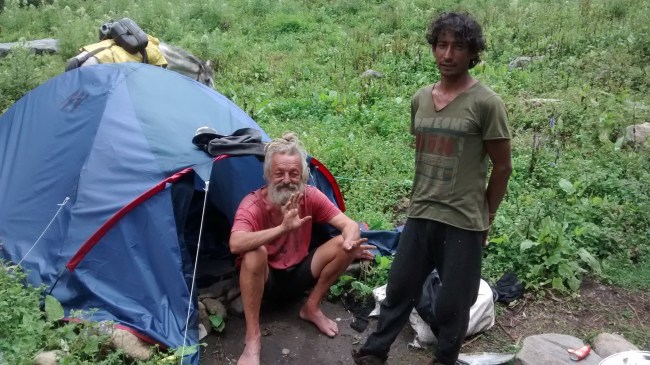
Russian Baba with Prem

The trek to Kheerganga begins from Barshani village, which is the last motorable point. It is a 14km uphill trek through the forest.  The forest is alive and buzzing with life and the Parvati River accompanies you through your walk. Having recuperated from our long trek to Kheerganga and enjoyed the dip in the hot spring and rejuvenating sight of the first layer of snow on the surrounding mountains, we trekked further with the hope of reaching Tunda Bhuj, a place adorned with a wide variety of sub-alpine forests. About half way into our journey it began to get dark and started pouring. The mist was setting in impeding our vision and we were happy to see a couple of tents in the middle of the forest, next to a small brook. When we stopped by we were warmly greeted to join in for a cup of hot tea. This is where we met a foreigner, in his late 60s and his two companions – Prem and Mansingh (both from Nepal). The initial round of niceties revealed that the foreigner was from Russia and I realised this is the ‘Russian baba’, we had heard about in Kheerganga. He had dreadlocks in his hair, a pair of torn shoes, a torn t-shirt and a bundle of beedi that he constantly drew on. He could not hear too well and retained a thick Russian accent. Continue reading The Majestic Parvati Valley – Paradise Lost: Ujithra Ponniah

Swachh Bharat Abhiyan: Too Many Erasures

The Hindu Social Order is based upon a division of labour which reserves for the Hindus clean and respectable jobs and assigns to the untouchables dirty and mean jobs and thereby clothes the Hindus with dignity and heaps ignominy upon the untouchables.

(The Revolt of the Untouchables, Excerpted from Essays on Untouchables and Untouchability : Dr Babasaheb Ambedkar, Writings and Speeches, Vol 5 (Mumbai : Govt of Maharashtra, 1989, 256-58)

1.

The inauguration of the Swachh Bharat Abhiyan, (Clean India Campaign) with much fanfare, with ministers, bureaucrats and others holding Jhadoos evoked an interesting reaction from a ragpicker Sanjay who lives in Mehrauli with his parents. “These are the same people from whose houses we pick up garbage every day. This is part of our life. We don’t really understand why they are making it such a big deal,” Continue reading Swachh Bharat Abhiyan: Too Many Erasures

Vicious cycle of ‘Development’, Displacement and Death

Gujarat Oustees jump into Narmada Canal 

Kashinathbhau Mohite, Wang Marathwadi dam affected activist, commits suicide 

7th October, Narmada Dist/ Satara /New Delhi: False promises; snatching away of  rights  and even hope; continued mistreatment and harassment at the hands of police and administration; physical, psychological and emotional exploitation- these are not just sporadic instances but a common pattern of grave injustices seen where people have been displaced in the name of ‘development’.

On 6th October, 12 oustees of Sardar Sarovar Dam from Gadher village in Narmada district of Gujarat, jumped into Narmada canal to awaken the administration to their plight of 22 years. The official claim is that they were ‘rehabilitated’ in 1992, however in reality, they still have not been given alternate land and government job to one family member at the time of acquiring their land, which is clear and outright non-compliance of Narmada Water Dispute Tribunal Award 1979, Rehabilitation policy of Government of Gujarat and orders Hon’ble Supreme Court.  After 22 long years, they still await justice and were left with no other option but to resort to this form of protest. On one hand, the Government of Gujarat has always justified Sardar Sarovar Project and glorified the Narmada Canal as the ‘lifeline of Gujarat’, but  on the other, it turns a complete blind eye to its own people of Gujarat who have been so severely affected by  the displacement caused by this very project. Why this apathy? Whose interests are being served? Continue reading Vicious cycle of ‘Development’, Displacement and Death

After the Flood: Sabah Hamid

Guest Post by SABAH HAMID

The pilot announces we’re approaching Srinagar. I have a window seat near the right wing, and I lean forward to look down. I always do this, trying to catch a first glimpse of the city I call home despite having lived away for more than half my lifetime now. Today, for the first time, I’m afraid of what I’ll see. The entire valley was flooded two weeks ago when the river Jhelum and then the Dal Lake spilled over. This is not the first flood to hit Kashmir, but nothing of this magnitude has been experienced in living memory. As we descend, I see a lot of large muddy tracts wherever I look. The elderly gentleman sitting in the aisle seat next to me mutters something, probably a prayer, and I turn to look at him. He shrugs resignedly, and I shrug back.

There are an unusual number of Indian passengers in the plane, and at the baggage carousel I am reminded of this again. It’s odd to have tourists so soon after the floods. I cannot make sense of it. Catching sight of a pair of fashionably dressed young women I wonder if they are the relatives of armed forces personnel stationed in the Valley.  It does not matter. I collect my lone suitcase, shoulder my backpack, and head to the pre-paid taxi counter. My parents live close by, just two kilometres away, and I am hoping to hitch a ride with someone if no taxis are available.

Exactly two Sundays ago though, when my parents, sister and young cousin landed in Srinagar, those two kilometres turned out to be very long indeed. Continue reading After the Flood: Sabah Hamid

A God by Any Other Name: Sumbul Farah

Guest Post by SUMBUL FARAH

The move from ‘Khuda Hafiz’ to ‘Allah Hafiz’, which Shireen Azam sees as a move towards Arabisation of subcontinental Islam is problematized by Nandagopal Menon when he questions if ‘Arabised’ Islam is an Islam ‘we do not like’. Menon’s argument provides some important ways of thinking about cultural assimilation, territorially bounded nationalisms and notions of piety central to Islam. However, it misses out on the important point that the project of ‘correcting’ belief is often premised on an exclusivist understanding of religious interpretation.

To emphasize the ‘correct’ usage might well in be accordance with Islamic notions of ‘islah’ and piety but unless we stop and question as to who is it that determines ‘correctness’ we risk aligning ourselves with the hegemonic narratives within Islam. The issue underlying the usage of ‘Khuda’ versus ‘Allah’ is not that the Indian version of Islam is somehow more desirable than an Arabised one owing to some notion of cultural nationalism, which is premised on modern nation-states; it is a questioning of the processes through which traditionally acceptable usages and idioms become marked out as ‘incorrect’ in the light of a hegemonic narrative. Particularly in the context of Islam, there is a tendency to seek a return to a supposedly ‘pure’ version of Islam, which in turn, means privileging the Arabian interpretation of Islamic beliefs and practices. Continue reading A God by Any Other Name: Sumbul Farah

High Level Committee of Ministry of Environment and Forests and Climate Change walks out of Public Consultation in Bangalore: Press Release

High Level Committee of Ministry of Environment and Forests and Climate Change walks out of Public Consultation in Bangalore

The High Level Committee headed by Mr. T. S. R. Subramanian, former Union Cabinet Secretary, constituted by the Union Ministry of Environment and Forests and Climate Change to review environment, pollution control and forest conservation laws, invited the public at large for a consultation between 12 and 1.30 pm today (27th September) at Vikas Soudha, the high security office complex of the Government of Karnataka. Advertisements to this effect had been issued by the Karnataka Department of Forest, Ecology and Environment in various newspapers on 21st September 2014, followed up by various press releases inviting the public to interact with the Committee.

When various individuals and representatives of public interest environmental and social action groups turned up for the meeting, the police prevented their entry at the gates. It was only following a spot protest that the police consented to allow them to participate in the consultation. Despite this indignifying experience, all who gathered proceeded to the meeting hall with the intent of engaging with the High Level Committee.

Continue reading High Level Committee of Ministry of Environment and Forests and Climate Change walks out of Public Consultation in Bangalore: Press Release

Remembering Maqsood Pardesi

Shiite_Calligraphy_symbolising_Ali_as_Tiger_of_God

On 23rd September 2014 Maqsood Pardesi lost his life. He had gone to the National Zoological Gardens in Delhi to meet a tiger. The tiger killed him. He was 20 years old. Maqsood worked as a daily wage laborer and lived with his family under the Zakhira flyover in central Delhi. He is survived by his father Mehfuz Pardesi, his mother Ishrat, his brother Mehmood and his wife Fatima.

There are conflicting reports as to how Maqsood found himself en face a tiger. Several reports state that, despite being discouraged by a guard on two occasions, he managed to climb into the tiger’s enclosure when the guard’s attention wavered. Some reports suggest that he accidentally fell into it. The authorities have vigorously denied the possibility of accidental entry and contested the assignation of blame on the zoo, or the tiger, for Maqsood’s death. Other reports have dwelt on Maqsood having a history of mental illness. Some state that he was drunk when he entered the enclosure. Some claim that he threw stones at the tiger, lost his balance and fell. Like the dissection of Maqsood, there has been speculation about Vijay, the tiger. The zoo authorities defend against charges that Vijay is aggressive. The tiger is not at fault many say: how can it be held responsible for the death of a man who enters its enclosure? The head zoo keeper has said, “Maqsood was mentally unstable otherwise why would a sane person jump into the tiger’s enclosure.” Why indeed? Continue reading Remembering Maqsood Pardesi