The predominant emotion with which jingoistic Indians and Pakistanis view each others’ misfortunes is schadenfreude. They count each other’s conflicts and rebellions to keep score. The Indian will talk about sectarian violence in Pakistan, and the Pakistani will ask about the treatment of Dalits in India. The Pakistani will complain against Indian atrocities in Kashmir and the Indian will point fingers at Balochistan.
We are Anonymous. It has come to our attention that you have blocked filesharing websites in India. We also know you are in the process of making a Great Indian Firewall, to censor the internet in India. Anonymous believes, however, that pursuing this direction is a sad mistake on your behalf. Not only does it reveal the fact that you do not seem to understand the present-day political and technological reality, we also take this as a serious declaration of war from yourself, the Indian government, to us, Anonymous, the people. Continue reading Open Letter from Anonymous to the Government of India→
Some say such attacks (hacking and defacement of Web sites) could be used by the political class to actually strengthen their argument in favour of control and regulation of the Internet. What do you say to that?
Anamikanon: People on the ground are vulnerable to people with a lot of power and no problems misusing it. Anonymous can’t be found to defame, threaten, suppress, stall…. wrong means? Ok. Worth it.
Netcak3: I say the more they censor the Internet, the bigger we become. We strive in users from across the world. Pro tip: Once an idea has been made, you cannot kill it.
Anamikanon: In my view, these are the means that can be safely used without risking life, limb, careers, reputations, family…
Gummy: Defacing is like posting a nill which is illegal and can be removed. Like people post their advertisement bill (poster) at the back of buses and other public places.
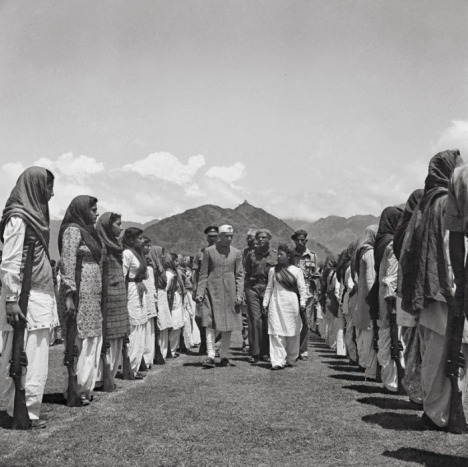
Circa 1948, this photograph shows Jawaharlal Nehru inspect a women’s militia in Kashmir. Via andrewwhitehead.net
On 13, October 2010 a team of interlocutors was appointed by the Government of India to hold dialogue with all the sections of the society in Jammu and Kashmir. The team of interlocutors consisted of journalist Dileep Padgonkar, educationist Radha Kumar and the former Information Commissioner M. M. Ansari. After almost one and a half years the report was released on 24 May 2012 by the Ministry of Home Affairs (.pdf here). The report calls for formation of a Constitutional Committee to review the extension of central laws to the state of J&K from 1952 onwards. Some of the major recommendations are: changing the temporary nature of Article 370, dividing the state into three Regional Councils and appointment of the Governor but after consultation with the state legislature. The Report further says that the findings of this Constitutional Committee shall be binding on all the ‘stake holders’ in the State. Continue reading If ‘temporary’ meant special, what would ‘special’ mean?: Gazala Peer→
Any moment now I expect India’s litfest mafiosi to describe this article on the ‘Essar Kahani Utsav’ by Akshay Pathak as an ‘attack on free speech’:
Money was not the only thing coloured there. Long pieces of cloth in different colours hanging outside the venue— in classic Teamwork Productions style (the event management company organising this festival)—conjured a sense of celebration. The packaging was good. It mostly is—like that of the DSC Jaipur Literature Festival, also organised by the same company.
The mood inside, though, didn’t match. That is, if you set aside the sight of visibly uninterested festival organisers and district administrators finding ways to pat their backs. And there was certainly no festive air around the 600-odd Adivasi children who had travelled hours on foot and buses to hear stories on an empty stomach—“the district administration miscalculated the numbers”, the organisers explained to me later, and so they had run out of food for the children. [Read the full article.]
Delhi, Or Dilli has been a city and a capital for a long time and even when it was not the capital, during the Lodi and early Mughal period, and later between 1858 and 1911, it continued to be an important city. We are of course talking of what is historically established and not of myths and legends. During this period there have been 7 major and several minor cities within the territories now identified as the National Capital Territory of Delhi (NCR-Delhi). New Delhi is the eight city. This piece marking the hundred years of the shifting of the colonial capital to Delhi from Calcutta in 1912, will talk about both Shahjahanabad and New Delhi. We will see how Shahjahanabad the once most powerful and rich city of its time and the last capital of the Mughals was gradually ruined, plundered and virtually reduced to a slum while next door arose, a new enclave of Imperial grandeur known now as New Delhi. Continue reading Delhi 1803-2012: A Brief Biography→
This release comes from theJAMMU KASHMIR COALITION OF CIVIL SOCIETY
2 May 2012: The recent Supreme Court judgment in the Pathribal case is very disappointing.
Fake encounters, along with various other human rights violations, have been a reality for the people of Jammu and Kashmir over the last twenty two years. In 2008, according to media reports, Supreme Court Justices Aftab Alam and G.S. Singhvi made observations in court in relation to the practice of fake encounters for rewards in Jammu and Kashmir. With about 8000 persons disappeared, 70,000 persons killed, numerous cases of torture, rape and other human rights violations, Jammu and Kashmir has seen institutional denial of justice. Continue reading …and now Judicial Impunity?: JKCCS→
This press release comes fromAMNESTY INTERNATIONAL
1 May 2012
Special powers that allow India’s armed forces suspected of involvement in extra-judicial killings to sidestep the civilian courts have been reinforced in a disappointing court ruling over the notorious killings of five Kashmiri civilians 12 years ago.
India’s Supreme Court has contradicted a reported statement by its Justices in February 2012 that army personnel suspected of murder should be placed in front of a civil judge.
Instead it opted to give military authorities eight weeks to bring about the court martial of eight army officials allegedly responsible for the unlawful killing of five youths in Pathribal, in March 2000. Failing that, the Central Bureau of Investigation (CBI), may apply to prosecute the army personnel. Continue reading Pathribal ruling a setback for justice in Jammu and Kashmir: Amnesty International→
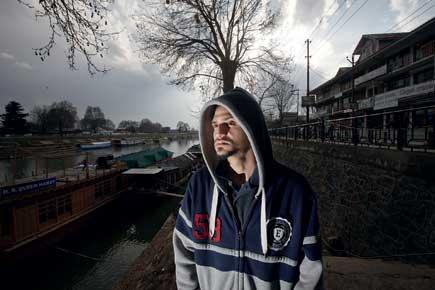
MC Kash - Photo by Ashish Sharma / Openthemagazine.com
It is not every day that you wake up to find your Twitter timeline flooding with the assertion that Kashmir – of all places – is happy. Dangerous? Of course. Beautiful? well, yes, the postcards are pretty enough. Angry? Sure, they look it. Radical? Oh god, yes. Happy?
If you ask Manu Joseph, author of Serious Men and editor of Open, the answer is yes. In this article, he talks about his interactions with “regular” people in the valley – the non elite, the non journalist, the non artist, the non writer – and is convinced that Kashmir is ready to move on. That it has already moved on. That Kashmir is happy. As proof, he offers these exhibits: (a) record high tourism numbers, (b) 2010 IAS topper Shah Faesal (who tells him “commonsense is finally winning”), (c) a meeting of a District Magistrate with elected leaders of a village (“not a word about politics”, says the DM to Mr. Joseph, “They want to talk about things that matter to them and their families”) and (d) the desire for city life (“we want KFC”).
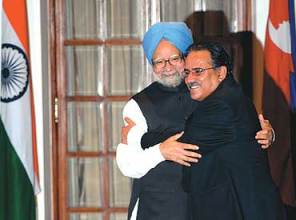
Prashant Jha interviews the Nepali Maoist leader Prachanda:
All of us reviewed the situation. I presented a document in my party last April stating that the 12-point agreement must be the basis, and we must conclude the peace and the constitution process. India then changed the way it viewed Maoists, and realised it must help the process succeed. It was a realisation that we must revert to the environment of trust that existed during the 12-point pact.
Would it be right to say that Nepal’s peace process and the constitution would not have been possible without Indian support?
Definitely. Saying that the 12-point understanding was signed in Delhi means that there was India’s active support — otherwise it was not possible. CA elections would not have been possible. There could have been problems with the declaration of a republic. Now also, to take peace and the constitution to a logical conclusion, without Indian support, it will be very complex and difficult. [Full interview]
Update: Tata Sons has clarified that Mr Ratan Tata does not hold a diplomatic passport. See comments section.
*
Is he an Indian diplomat?
“After all, you have given Ratan Tata a diplomatic passport. He always travels with the red passport,” the American continued.
[…]
The American told him that he had once travelled first class with the industrialist, he had seen Tata’s diplomatic passport and when they both alighted at New York, Tata went to the special immigration enclosure for diplomatic passport-holders .
When S.M. Krishna became external affairs minister in May 2009, one of his earliest discretionary decisions was to issue a diplomatic passport to Tata, recognising his emergence as a global investor and industrialist who has to travel extensively worldwide, some of those trips on behalf of the government or representing his country. [KP Nayar]
And that is not the only shocking thing there. There’s also the revelation that the Maharashtra government allowed an American government group to fly out without security check!
The Indian state is India’s biggest embarrassment.
Its now post-Geneva in Sri Lanka. Prime Minister of neighbouring Bharat Ganarajya, the Republic of India, Dr. Manmohan Singh thus wrote to His Excellency the President of Sri Lanka on 24 March, to say, “Your Excellency would be aware that we spared no effort and were successful in introducing an element of balance in the language of the resolution” and the Indian delegation to the UNHRC had been advised to keep close contact with its Sri Lanka counterparts “in an attempt to find a positive way forward”. The implied message is that New Delhi played its role to hook Sri Lanka to a US sponsored resolution in Geneva, over post war reconciliation and rehabilitation and on accountability during war.
Thousands of Tamils from across Europe protested in front of UN headquarters in Geneva Monday demanding the creation of an international tribunal to try “war crimes” committed in Sri Lanka…. [AFP report, 6 March 2012]
The battle is raging. It will go on till about the 23rd of March, 2012. In Geneva. The battle is against the Rajapaksa regime in Sri Lanka and not against Sri Lanka itself. It’s a battle over “war crimes and accountability” during the Sri Lankan war, in particular its final stages. Delhi’s vacillating position of “not right to interfere on a country basis” as regards the US Resolution to the United Nations Human Rights Council’s Session 19, is being challenged firmly in Chennai by the two major political parties in Tamil Nadu, the DMK and the AIDMK firm. Beijing and Moscow are clear about the issue. They will vote against the US Resolution, and also muster up support amongst other countries to vote with them. If they could collect 24 votes in total, they will have had their say and the Sri Lankan regime will not have to worry about Geneva anymore. Continue reading Why Geneva and not Matara, Jaffna or Batti?: Kusal Perera→
If we cut the entire forest down, where will we live?’- Muria adivasi, Warangal, Andhra Pradesh
I don’t even know how to begin addressing a story as blindly biased in its premise as this one in the Wall Street Journal, which draws an obtuse line between loss of forest cover and land usage by adivasis, when it is land grab by industrialization that is endangering all we have left.
So I’m going to do this paragraph by paragraph.
India’s forest cover decreased by 367 square kilometers between 2007 and 2009, and it was primarily tribal and hilly regions that were to blame.
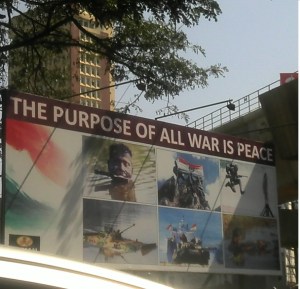
This poster on M.G.Road in the heart of Bangalore, reminded me uncannily of the lines in the marvellous scene in the Mel Brooks film To Be Or Not To Be where he sings All I Want is Peace:
Guest post by BRINDA BOSE and PRASANTA CHAKRAVARTY
Haruki Murakami’s much-hyped IQ84 that released worldwide in translation a couple of months ago is (Our) Big Fat Japanese Novel, three volumes in one. Closer home, Amitav Ghosh is in the process of completing the definitive South Asian Maritime Novel in trilogy. Young, prize-winning, promising writers from around the world – New Zealand, Malaysia, Bangladesh – are pledged to regale us with long large narratives that will tell us everything we ever wanted to know about their cultures, societies, lives – in trilogies and quartets. Intriguing? Indeed. Coincidental? Perhaps not.
Even as new literary canons are continually in consolidation, interrogation and re-formation, Franco Moretti – acclaimed, revered, preeminent theorist of the Novel and World Literature (which enjoy an odd synecdochic relationship) – has systematically constructed a blueprint for ways to appreciate the worth of such a grand, if loose, canon as World Literature by a particular reading technique he calls ‘distance-reading’.
In approaching Martin Luther King Jr., Day, I inevitably think about the politics of figures and the generation of King and Malcolm X. That generation and the Black politics they engendered had a lasting impact on the US and the World more broadly. Coming with decolonisation in Africa and elsewhere, King, Malcolm X, the radical youth they inspired and their contemporaries such as Frantz Fanon and C.L.R. James transformed our conceptions of race and class, advancing anti-imperialist and anti-colonial visions to engage formidable questions of Black politics in the West. In a piece written with Jinee Lokaneeta as part of the monthly column ‘Beyond Boundaries’ of the South Asia Solidarity Initiative (SASI), in theSouth Asian Magazine for Action and Reflection (SAMAR), we began with Manning Marable and C.L.R. James, and the importance of a turn towards critical solidarity engaging questions of race and class.
Here, I want to think about the contributions of South Asian intellectuals, or more specifically Lankan intellectuals in the context of Black and Third World politics. In fact, there are two major Lankan intellectuals belonging to that generation of King and Malcolm X, who are increasingly not known to the younger generations of Lankans. A. Sivanandan, the editor of Race and Class and Director of the Institute of Race Relations in London and the late Archie W. Singham, long-time intellectual and professor based in New York are two such figures who have made a major mark in Black politics. Indeed, they can give us a sense of the possibilities of political struggle and the historical and philosophical potential of Black politics. It is my contention that engaging the politics of Sivanandan and Singham is all the more important at the current moment, as South Asians in the Diaspora are increasingly becoming agents of Western power despite the shifting terrain of politics in the West with the global economic crisis. Continue reading Engaging Lankans in Black Politics on MLK Day→
Some musings here about the liberation of Goa from Portugese rule by India:
But the interaction between Portugal and India also produced vibrant cultural hybrids in architecture, music and food. Among the state’s most famous dishes is the spicy vindaloo, a curry whose name is thought to be a contraction of the Portuguese phrase “vinho de alho,” or garlic wine. Besides, as Mr. deSouza pointed out, Goa was where the influence of the Enlightenment and the Renaissance in Europe was felt much before it reached other parts of India. As a result, the practice of sati – or widows immolating themselves on their husbands’ funeral pyres – was abolished in Goa 200 years before the British banned it in the rest of India. [Naresh Fernandes]
And on Portugese language, 50 years after the Portugese were sent back to Portugal:
The popular history of the Portuguese period in Goa has largely been restricted to the gory tales of the initial conquest of the island of Goa, of the Inquisition, and the dramatization of the anti-colonial episodes in the territory’s history. To a large extent, this nationalist history dissuades Hindus from subaltern castes from studying the language. This has ensured that it is solely dominant-caste narratives that are incorporated into the histories of the territory, preventing alternative and liberatory narratives to emerge from a re-reading of the texts and narratives of the period of Portuguese sovereignty over the territory. It is little known for example, that the knowledge of Portuguese is critical to the bahujan challenge to Hindu upper-caste groups’ monopolistic control of the Goan temples. This monopolistic control of the temples was forged in particular through these latter groups’ knowledge of Portuguese. [Jason Keith Fernandes]
This release comes from theJAMMU AND KASHMIR COALITION OF CIVIL SOCIETY, the Bund, Amira Kadal, Srinagar 190001, (www.jkccs.net)
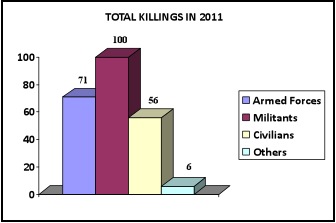
TOTAL KILLINGS
Year 2011 has just passed, and many have declared this year, a peaceful year in Jammu and Kashmir. Of course assertions of peace by various quarters are relative. Enforced silence cannot be construed as peace. Despite the hype of peace, people of Jammu and Kashmir have witnessed unabated violence, human rights abuses, denial of civil and political rights, absence of mechanisms of justice, heightened militarization and surveillance. The figures of violent incidents suggest that 2011 as usual has been the year of loss, victimization, mourning and pain for the people. Continue reading Human Rights Review – Jammu and Kashmir in 2011: JKCCS→
Nilanjana Roy moderating the prize ceremony; Jamil Ahmad in the background via Skype. Photo courtesy: The Shakti Bhatt Foundation
There is this world among the many worlds of Delhi, the world of book events. You show up for a reading followed by a conversation between the author and some other prominent member of the fraternity. Afterwards you drink wine and exchange news with everyone you know there. And you know everyone there. The scale of some of these events would make you think books actually sell. But the greater riddle for those of us who show up is this: Why do we show up? To see friends, to socialise and occasionally to celebrate books, or perhaps the very existence of books irrespective of quality; to register our support for words and stories bound by charming jackets; to toast these objects of desire in a simulated bubble where they shine on undeterred. Debatable as their meaning might be, for most part these events are mere rituals. On the 21st of December, however, for a brief moment I was made to see that they could be more than that. The man who made that apparent was not even physically present in the room. Continue reading When the Wandering Falcon came to Delhi: Pragya Tiwari→
This release comes from the ASSOCIATION OF PARENTS OF DISAPPEARED PERSONS, the Bund Amira Kadal, Srinagar, Jammu and Kashmir
28 December 2011: Callousness of the government continues vis-à-vis victims of human rights abuses and in particular against the family members of those who have disappeared in the last two decades in Jammu and Kashmir. The relatives of more than 8000 persons continue to wait for the government to probe all the cases of disappearances, deliver justice to the families of the disappeared and punish the perpetrators. Continue reading J&K government has buried the SHRC report on unmarked graves in Kashmir: APDP→