Category Archives: Everyday Life

Shuddhikaran of Hindu Mahasabha by Lovers of Love in Delhi

Well, they tried, and more power to them.

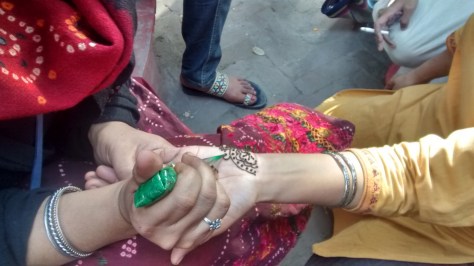
shuddhikaran of that hate-filled, divisive, toxic organization (and others of the Hindutva brigade) would have considerably reduced pollution in the only vasudha we have, which is our kutumb, but the attempt was foiled by a compliant Delhi Police. However, Parliament Street Police Station was very shuddh indeed by the end of the day, its noxious atmosphere cleansed by the cosmic vibrations of music, dance and “marriages” among all sorts of human beings.

IMG_20150214_152622113_HDR

Mehndi ceremony inside parliament Street Police Station

Image courtesy feminisminindia.com

This hilarious subversion of the idea of marriage, with which Hindu Mahasabha threatened lovers, is in fact a deeply political gesture against the institution of patriarchal, heterosexual marriage with all its violent hierarchies of age and gender, in which disobedient women and younger people are in the custody, much like prisoners in jail, of the patriarchs of the family, which include compliant women. There are no honour killings – these are custodial deaths, when families violently separate couples who chose to marry outside their caste or religious community, often killing one or both of them.

Continue reading Shuddhikaran of Hindu Mahasabha by Lovers of Love in Delhi

A Daughter’s Plea For A Better Way to Die: Gowri Parameswaran

This is a guest post by Gowri Parameswaran on behalf of her mother Sulochana

“Life changes in the instant, the ordinary instant” wrote Joan Didion in her book The Year of Magical Thinking. Didion wrote about her attempts to cope with her husband’s death and her reference was to the moment of his passing. I had picked up the book in JFK and had completed it by the time I reached Chennai. I needed the sustenance that the book seemed to offer; I was coming to see and take care of my mother (Amma we called her) who had been admitted to the hospital with decompensated lungs for the third time in two months. Her heart was too sluggish to pump her blood through the arteries and the fluid had backed up into her lungs; her lungs were decompensated. I remembered the ominous prognosis that one book on Heart Failure had spelled out about this turn of events in her health – that this was a seminal indication that the heart had reached the end of the road. She seemed so normal when I left her in October. The doctor had pronounced her heart healthy under the circumstances.

“Life changes in the instant,

The ordinary instant”. Continue reading A Daughter’s Plea For A Better Way to Die: Gowri Parameswaran

Fact-Finding Committee on Lay Offs at Tata Consultancy Services Releases Report

The following is the text of the report released by the Fact Finding Committee that investigated the issue of lay-offs at the Tata Consultancy Services. The committee, which released its report on 6 February in Chennai, consisted of the following members:

Fact finding committee press conf , Chennai

Mr. BRP. Bhaskar, Senior Journalist and Human Rights Activist, Thiruvananthapuram;

Dr. M.Vijayabaskar, Assistant Professor, MIDS, Chennai;

Adv. Bobby Kunhu, Legal Expert, Salem;

Ms. Chandrika Radhakrishnan, Software Professional and Labour Rights Activist, Chennai

Continue reading Fact-Finding Committee on Lay Offs at Tata Consultancy Services Releases Report

My elections days, 2015: Sivamohan Sumathy

Guest Post by SIVAMOHAN SUMATHY

campaigning, exciting, tense, nervous, delirium-invested, holding training sessions on the verendah for the immediate neighbouhood, as nobody but appa had voted in any previous presidential election, strangely agreeing with appa on politics for once, passing on all the wild gossip about the mr family, nightmare riddled pre election nights, sleeplessness, inducing drinking, exhilarating, liberating, cautionary, educating vasuki’s children about the elections ( they are keenly interested), near addiction to fb and quarellling with totally unknown friends on it, while another plethora of unknown persons writing in to befriend me, baila sessions, holding candle lit vigils for assassinated journalists, being connected to the universe on election night through thiru, who was on every tweet, every note, every social bleep, planning, writing, tasking for the future, doubts, setting off crackers, taking to singing, questions, pondering profound political questions on the nature of the state, reforms or revolution, gramsci’s historic bloc, not stopping at paradigm shift as most liberal commentators have done with this over used and abused term, not bothering with muslim bashing in europe over charlie whatever, in fact, just a wee bit short of visionary.

no paradigm shift,
no revolution, it is toward …….

they cut the jak tree down in our backyard,
the day after elections.
the parrots displaced again.

Storm in a Kahwa Cup: Organizers of the Kashmiri Food Counter at the International Food Festival, JNU 2015

Guest Post by Organizers of the Kashmiri Food Counter at the International Food Festival, JNU 2015

Universities are supposed to be the centers of free inquiry, speech and expression. However, in the recent months universities and other democratic spaces have been under attack from right wing fascist elements across India. University authorities under the influence of right wing forces have increased surveillance on sections of students and have started to monitor and control campuses. As a premier institute of learning Jawaharlal Nehru University (JNU) has always has preserved its democratic culture and has resisted such attacks tooth and nail. However, in recent days even JNU is experiencing pressures from the right wing fascist forces.

Every year, JNU organizes an International Food Festival (IFF) where students from diverse cultures and nations displaying their flags come together to offer global cuisines. This year on 20thJanuary, a group of students from Kashmir booked a counter at the IFF. After completing necessary formalities and depositing security amount the festival organizers allotted space for Kashmir food counter along with the Tibet food counter. However, International students association (ISA), body that organizes the festival started receiving threats from the ABVP goons. The president and other members of the organization were harassed and intimidated. The organizers received open warnings from ABVP threatening them with disrupting the festival in case Kashmiris were allowed to open their food counter. International students who organize the festival were threatened with legal action and deportation. Just two days before the festival the booking for Kashmiri food counter was cancelled by the organization. Continue reading Storm in a Kahwa Cup: Organizers of the Kashmiri Food Counter at the International Food Festival, JNU 2015

Farmers’ Suicides and Fatal Politics: Vasanthi Srinivasan

Guest Post by VASANTHI SRINIVASAN

With depressing regularity, the newspapers have been reporting farmers’ suicides in many states. Recently, P Sainath wrote on BBC that around 296,438 farmers have committed suicide since 1995. He also mentions that cash crop cultivators of cotton, sugar cane, vanilla, pepper, groundnut etc account for the bulk of those suicides. According to a PIL heard by the Supreme Court in December 2014, around 3146 farmers in Maharashtra have committed suicide this year. Of course, farmer’s suicides only account for a fraction of all suicides reported in India. Besides, farmer’s suicides are a global phenomenon. The litany of woes is also familiar to readers, namely rising indebtedness, crop failures, falling prices, natural disasters etc.

And yet the meaning of these suicides, if any, is worth reflecting upon.

Politicians, who are used to massive debts, seem to think this is an ‘extreme step’ on the part of farmers. In 2003, the then Union Minister for Agriculture hinted that indebtedness alone may not be causing the ‘extreme step’, and that ‘family problems’ may also be a reason. In Karnataka, the Veeresh committee report had earlier identified depression, alcoholism and marital discord rather than the rising debt as the relevant causes. Never one to lag behind, the hi-tech Chief Minister of Andhra Pradesh Chandrababu Naidu  announced compensations and proposed to get psychiatrists to rural areas. One scholar has pointed to the increasing isolation of cultivators and high levels of anxiety about failure suffered by some farmers [1]. These attempts at ‘personalizing’ the farmers’ problems may be necessary but not sufficient as long as other factors remain unexplored – increasing cultivation costs, crop failures, water shortages and falling product price. Citing the high figures of suicides (204) in Maharashtra for 2014 until April, followed by Telangana (69 until October), the Times of India  (dated Nov 26, 2014), reported that the present Central government admitted indebtedness as a possible factor.  There are also calls to increase monetary compensation to families affected by such suicides.   Continue reading Farmers’ Suicides and Fatal Politics: Vasanthi Srinivasan

The Other America: Martin Luther King

January 19th was Martin Luther King Day. To honour him, here is the recording of his famous The Other America speech at Stanford in 1967.

Too many, far too many tragic resonances with 21st Century India. 

There are literally two Americas. One America is beautiful for situation. And, in a sense, this America is overflowing with the milk of prosperity and the honey of opportunity. This America is the habitat of millions of people who have food and material necessities for their bodies; and culture and education for their minds; and freedom and human dignity for their spirits. In this America, millions of people experience every day the opportunity of having life, liberty, and the pursuit of happiness in all of their dimensions. And in this America millions of young people grow up in the sunlight of opportunity. But tragically and unfortunately, there is another America. This other America has a daily ugliness about it that constantly transforms the ebulliency of hope into the fatigue of despair. In this America millions of work-starved men walk the streets daily in search for jobs that do not exist. In this America millions of people find themselves living in rat-infested, vermin-filled slums. In this America people are poor by the millions. They find themselves perishing on a lonely island of poverty in the midst of a vast ocean of material prosperity.

The one difference being that in 21st Century India, there are lonely islands of prosperity in the midst of a vast ocean of deprivation, human misery and injustice.

Trampling on Workers’ Rights in Sriperumbudur: Ramapriya Gopalakrishnan and Bobby Kunhu

Guest post by RAMAPRIYA GOPALAKRISHNAN and BOBBY KUNHU

On January 2nd this year, management officials at the Sriperumbudur factory of NVH India Auto Parts Ltd, the Indian subsidiary of a Korean auto parts manufacturing company manhandled the company’s striking workers. The shocking visuals of the Korean managers of the company dragging workers on the floor and a manager standing over a worker holding him between his feet sparked outrage amongst civil society groups and caught the attention of the mainstream media.

Literally trampling workers!

The trigger for the strike was the suspension of 15 workers which their union alleges was without any reason. Several other issues festering for a long time also gave an impetus to the workers to go on strike. These include the lack of adequate toilet facilities. Apparently, there are only 6 toilets in a factory where more than 700 workers are employed of which only 4 are in usable condition. In a juvenile twist, the workers have to seek and secure the permission of the management officials each time they need to use the toilet. If this rule is violated in cases of emergency, warning letters are issued to workers alleging that they were found missing from their work spot. Another issue is the lack of a regular and sufficient supply of drinking water in the factory. The workers were also miffed at being under the glare of surveillance cameras all the time during their work hours. A very important issue that was a sore point was the management’s use of trainees and contract labour to perform production work of a regular nature. The workers were also upset at the attitude of the Korean management and the way they treat them.  They allege that there are instances of physical abuse where the management officials hit and slap workers and spit on their faces. Over and above all this, the permanent workers in the factory were peeved at the failure of the management to grant recognition to the union they had joined in 2013 and negotiate with the union.

Continue reading Trampling on Workers’ Rights in Sriperumbudur: Ramapriya Gopalakrishnan and Bobby Kunhu

Love in the Time of Military Courts: Fawzia Naqvi

Guest Post by FAWZIA NAQVI

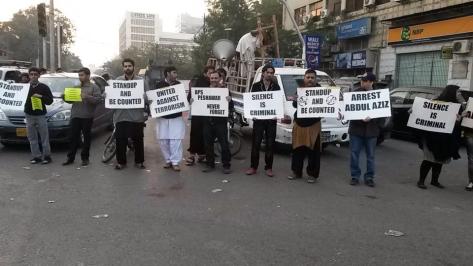
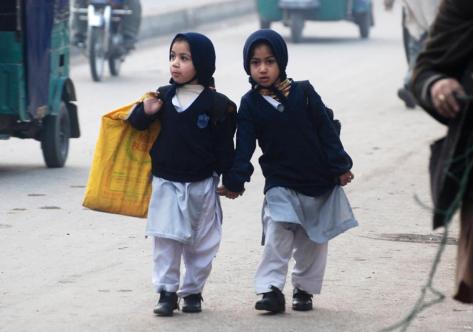
[ This guest post marks one month of the 16th December massacre of school-children by Islamists in Peshawar, Pakistan ]

Fawzia 1 

Pakistan has become a euphemism for insanity.  Doing the same thing over and over again and hoping for a different outcome. There are though some incredibly brave, thoughtful, humane and patriotic Pakistani men and women who have decided enough is enough and they are determined to chart a different future for the country. Continue reading Love in the Time of Military Courts: Fawzia Naqvi

Swachchh Bharat – Beyond Charity and Symbolism to Legal Rights and Duties: Sujith Koonan

Guest post by SUJITH KOONAN

Sanitation and cleanliness seems to have become buzzwords. Celebrities and political leaders have started talking about sanitation. The call for Swachchh Bharat by the Prime Minister of India was welcomed by many taking brooms in their hands. Several institutions have uploaded prestigiously the photographs of its employees carrying brooms. All of a sudden, the sanitation consciousness seems to have increased in the country. Indeed, it is a good sign that we have started thinking and talking about the ‘unmentionables’ – shit and dirt.

Many of these actions and responses are symbolic and rhetoric in nature. While it may be acceptable to begin with symbolism, the seriousness needs to be demonstrated through concrete long term plans and actions. One can hope that the government will take such steps. One way to show that the ongoing sanitation talk is serious, and the state is sincere about it, is to recognise the legal aspects of sanitation. There are mainly three issues where the government has been a failure in fulfilling its constitutional and legal duties and these are supposed to be at the forefront of the Swachchh Bharat Mission (SBM). Continue reading Swachchh Bharat – Beyond Charity and Symbolism to Legal Rights and Duties: Sujith Koonan

Caste, Class and the ‘Classical’ – FAQs about the Urur Olcott Festival, Chennai: Nityanand Jayaraman

Guest post by NITYANAND JAYARAMAN

Print

On 15-16 January, 2015, a much talked about festival of dance and music, that intends and promises to be different, is to be held in Chennai. The Urur Olcott Kuppam Margazhi Vizha means different things to different people. But for those who do not know what Urur Olcott Kuppam is or what the Tamil phrase Margazhi Vizha means, the Vizha may have no significance. These answers to FAQs (Frequently Asked Questions) is for such people, and for those who know what it means and have sent many bouquets and a few brickbats my way for being engaged in the organising of this Vizha. The views expressed here are personal and do not reflect a consensus within the group of organisers. However, the process of organising, the event and post-event engagements are itself likely to provide a platform for discussing such views and counterviews.

Carnatic-musician-TM-Krishn_0

T.M. Krishna performs at Besant Nagar beach as a part of the Urur Olcott Kuppam Margazhi festival

What is Urur Olcott Kuppam?

Urur Olcott Kuppam is a centuries-old fishing village in South Chennai. By rights, the Kuppam ought to be the landmark for Besant Nagar as in — “You know Besant Nagar, that newly settled neighbourhood near Urur Olcott Kuppam?” But that’s not how it is. Besant Nagar’s residents are predominantly upper class, upper caste. Urur Kuppam’s are predominantly from the fisher community of Pattinavar. The hip and happening Besant Nagar is well-known; the kuppam is invisible. The injustice doesn’t stop with geography. Dominant history also begins where dominant geography begins – with Besant Nagar. Ask Besant Nagar residents what existed 40 years ago in this area, and people are likely to say “Nothing” or “Nothing but the beach.” It’s as if the fishing villages did not exist before the government decided to carve residential plots for middle and high-income people out of sand dunes carpeted with cashew, palmyra, casuarina and screwpine.  Continue reading Caste, Class and the ‘Classical’ – FAQs about the Urur Olcott Festival, Chennai: Nityanand Jayaraman

What does one write today?

It’s the kind of moment that makes you reach for poetry, for words that convey what can scarcely be written. It’s the kind of moment where you must write for it is writing that is itself at stake.

The debates on Charlie Hebdo are wide and varied. There is, as Joe Sacco so beautifully drew, before anything else, a deep yet horrifically dull sadness. Few and fewer in the world have the privilege to still be “shocked” by violence, to not have its banality be its true horror. There is solidarity, some of the most meaningful of which comes from cartoonists in the Arab world.  There is a wide agreement that no justification is possible for returning any measure of offence with death yet there is an insistence on the ability to critique even that which one defends. As Teju Cole eloquently argues: “moments of grief neither rob us of our complexity nor absolve us of the responsibility of making distinctions.” There are important, vital debates about what it means to “insult everyone equally” when everyone is not equal, reminding us that we must begin and ask our questions in place, in history; that we must remember that the power to criticise is a freedom but also a privilege. There are the universal debates on the limits to absolute speech, pointed to by Sandip Roy who reminds us that the French Government itself banned the earlier incarnation of Charlie Hebdo for printing a mock death notice of the then French PM De Gaulle. There are fears of the Islamophobia this violence will re-incarnate as, that Hari Kunzru argues is one intent of the attackers.

I write with a different intent today. I write not to enter these debates about Charlie Hebdo but to insist on what these deaths must provoke us to do: to translate our solidarity, our empathy, our fear, and our resolve into the real work of protecting the freedoms of speech, satire, offence, and expression in India. That is the tribute to Charlie Hebdo that matters, that transcends all our debates.

Continue reading What does one write today?

An old RC ruminates on his ‘Pseudo-Secularist’ roots: Hartman de Souza

Guest post by HARTMAN DE SOUZA

The background and context to this not-so-enigmatic title is very simple. By today’s standards, I am old – I get a hefty discount travelling by train which I am still hooked on, and I am still counting the years and sniffing my coffee. The ‘RC’ is a lot simpler:

Travelling by train from Mumbai to Delhi many, many moons ago, a man in the compartment, in his thirties, got into conversation with me. After I had answered his opening bullet shot questions – You are from? You are doing what? Your father is doing what? – he told me I spoke English like a ‘foreigner’.

I was still fresh from Kenya those days, where I was born, so I got a lot of grief from having a different accent that no one could place.

This was of course much, much before you could study for an undergraduate degree in India (where you were born) and then, if you had the means and the SATs, go and study in the US for a few years. There, in the land of beef and honey, as we now note with pride, many Indians also discovered the ‘free market’ and their ‘authentic’ Hindu roots – then came back to spew communal venom with a makeshift American accent and the dollars to back it.

As if it was stamped on my bloody forehead, he then asked: “You are Christian?” He pronounced this as “Kir-tchin’.

I pretended I hadn’t heard. So he repeated the question. I nodded, hoping he would disappear and let me get on reading my book.  He did not. Instead had a broad grin on his face, like he knew in which bag he could drop me in.  “You are RC!” he said, almost triumphantly.

For a few seconds, he almost had me stumped. I raised my eyebrows.

Ro-maan Catholic,” he offered.

I shook my head and smiled back. “No,” I replied “Retired Catholic…”

He didn’t get the joke. Guys like that still can’t. Continue reading An old RC ruminates on his ‘Pseudo-Secularist’ roots: Hartman de Souza

Pondicherry Ashram Suicides and The Spiritual Surrender: Bobby Kunhu

Guest post by BOBBY KUNHU

On 17th December there was a dramatic sequence where, the youngest of a family of aged parents and five sisters who were inmates of Sri Aurobindo Ashram, Pondicherry attempted suicide by jumping off a water tank. The police rescued the woman, booked her and her sisters for attempt to suicide and released them on bail. This was following a Supreme Court order evicting them from the ashram at the end of a decade long struggle against the ashram. Their demand was simple that the management of the Ashram be taken over by the State to contain the corruption within. On the morning of 18th December, the family of seven decided to walk into the sea. Three died, four were rescued. Amongst the four who were rescued, one was allegedly raped by two men in her state of unconsciousness.

The South Asian spiritual landscape perhaps is the most diverse – ranging all hues and shades of spirituality cutting across religions and castes and has attracted followers internationally including celebrities like the Beatles, Isaac Tigrett (the founder of Hard Rock Café) and many others. Without exception, all of these spiritual groups ask for “total” surrender, though the terms of this surrender would differ from group to group. And many have willingly surrendered! For a non-believer it might be difficult to understand this leap of faith. But, for the believer this becomes the single most important event in her/his life. Even more important than birth marriage, love or death! And, when the terms of surrender is breached – though all hell breaks loose, people cling on to their faith. Despite “Sexy Sadie”, Paul McCartney held that Transcendental Meditation was a gift The Beatles had received from the Maharishi at a time when they were looking for something to stabilise them. In the BBC documentary The Secret Swami Tigrett stated that he believed that there was truth to the rumors of Sai Baba’s actions of pedophilia and sexual abuse towards some of his young male followers, but also such rumours would not change his belief in the Baba. Continue reading Pondicherry Ashram Suicides and The Spiritual Surrender: Bobby Kunhu

Converting Religion, Converting law: Rajshree Chandra

Guest Post by RAJSHREE CHANDRA

The right to freedom of religion  (Art. 25 of the Indian Constitution) in a country like India has a burden so extensive and a content so capacious that the same right functions both as an instrument of individual liberty As well as a mode through which the state intervenes to discipline and curtail religious freedom. It has a history so diverse and conflicted that the right often become a mode of settling quid pro quo battles between religious publics, and law often becomes hostage to the principle of ‘historical correction’.

There have been various modes of historical corrections. If the demolition of Babri Masjid was one, ghar wapasi – a return home to one’s religion – is another. The recent ghar wapasi episode in Agra, where RSS affiliate Bajrang Dal converted 57 Muslims to Hinduism; the proposed and then withdrawn conversion of Muslims and Christians in Aligarh on 25th December 2014 by the RSS’s Dharm Jagran Samiti; and the scheduled holy dip of an expected 50,000 “reconverts” (of the last five years) in the Godavari during the Kumbh at Nashik next August are instances and signs of the “re-conversion” rhetoric steadily mainstreaming itself. The question is how does the state and law respond to this?

‘Re-conversions’ are not new in Indian history. Katju & Sikand document instances of mass conversions of Muslims into Hinduism from 1947 onwards, and more forcefully and openly from the 1990s onwards, as part of the Shuddhi (purification) movement. The VHP, an adjunct of the Sangh, extols the practice of ghar wapasi and had claimed that over 200,000 Christians had been converted to Hinduism. The re-conversion argument – of shuddhi and ghar wapasi – is invoked by the various factions of the Sangh Parivar as a modus that aims to correct the history of conversions away from Hinduism.  Continue reading Converting Religion, Converting law: Rajshree Chandra

Remembering 1992: School of Media and Cultural Studies, TISS Mumbai

Dislocation

Hardening Divides

Remembering 1992 is a site that seeks to revisit and remember the violence that the city of Bombay/Mumbai experienced in December 1992 and January 1993. This site includes 6 films, video interviews and transcripts, news clippings, reports and other resources. The project started with the films that were made by students (Class of 2013) and faculty and used as a part of the campaign Bombay ki Kahani Mumbai ki Zubaani, held between December 2012 and January 2013.

In a political and social context where the memory of this violence has been rewritten and all but erased, it is crucial to remember, to explore the contours of normalised prejudice and to understand how the survivors have struggled with the denial of justice. It is also necessary to think about how and why the memory of such a watershed event gets erased and who benefits from this erasure.

The website explores different kinds of memory, organised around themes and uses a timeline and map to list the events of the 1992-93 riots,based on the Justice Srikrishna report.

Before the Killing, the End of Honour: Rina Ramdev and Debaditya Bhattacharya

Guest Post by RINA RAMDEV AND DEBADITYA BHATTACHARYA

For daring to elope and marry outside the dictates of caste-community honour codes, a young Delhi University undergraduate came to a brutal death at the hands of her family. The incident since then has become part of public discourse, thanks to our newspaper-educated sensibilities. But the ‘popular’ set of responses that this event has generated from our newsreaderly selves is worth some reviewing. While there has been a large-scale condemnation of this incident from ‘civilized’ quarters of the media-enlightened, the most commonly employed terms of this debate have veered around an imagination of a ‘civilizational modernity’ versus an ‘aggressive-savage primitivism’. Are we still in the Dark Ages, most have asked. Is not ‘love marriage’ a civilizational mandate of the age of the modern, others have comfortably posed and then gone on to conclude that the fact that we – as a ‘society’, metropolitan-converts in this case – have not yet made our peace with a civil code of morality relegates us to a ‘rustic-primitive mindset’. The muse of Indian judicial processes and imaginations of penal justice – ah! the “collective conscience” – has spoken thus and gone back to catching up on Ramzaadas and terror attacks on national ‘honour’. And just while we were conveniently conceding to the relative insignificance of an undergraduate girl’s ‘honour’ compared to the prime-time rhetorical spectres of ‘national honour’ in Jammu & Kashmir, a leading English daily attempted to bring back a few ‘dark’ images from Bhawna Yadav’s past.  Continue reading Before the Killing, the End of Honour: Rina Ramdev and Debaditya Bhattacharya

Stop Manual Scavenging in JNU: Forum Against Manual Scavenging

Authors’ Note:

The Chennai based Forum Against Manual Scavenging, (FAMS) can be contacted at famschennai@gmail.com. We have tried to create some awareness on this issue especially among student community (with the assistance of some of the Professors/Faculty based in Chennai) in which we were guided by Safai Karamchari Andolan, Rashtriya Garima Abhiyan, Tamil Nadu Untouchability Eradication Front, Janodayam Social Education CentreRepublic Trade Union of IndiaRed Flag Union of Tamil Nadu and other similar organizations (in and outside Chennai) struggling on this issue which are led primarily by the Dalit Women from the community itself.  

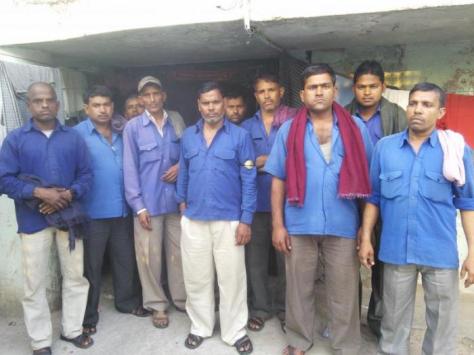
A documentary, ‘Sahar se Pehle’ (Before the Dawn) on sanitation workers in Jawaharlal Nehru University (JNU) campus in Delhi was made by some students of the university. The JNUSU has been consistently raising the issue of abysmally bad condition of sanitation workers in JNU for quite some years now. Earlier in 2012, JNUSU had also participated in a signature campaign against manual scavenging (signed by the then JNUSU President). The documentary shows the manual scavenging is still prevalent in the premier university even after the ban on manual scavenging by the Delhi government (sanitation is a State subject according to the Constitution of India) and after the enactment of “The Prohibition of Employment as Manual Scavengers and their Rehabilitation Act, 2013.”

This documentary was also selected for the Canadian Labour International Film Festival, 2014, and was available online on YouTube and other sites from February 2014, but was not widely circulated on mainstream media or social media. We also came to know about it only a fortnight ago because the write-up attached to it does not explicitly mention manual scavenging.

The JNU student community has started a campaign called Stop Manual Scavenging in JNU, with the message “Use hashtag #StopMSinJNU to SPEAK OUT against the inhuman practices of manual scavenging and hazardous cleaning in #JNU.”  Continue reading Stop Manual Scavenging in JNU: Forum Against Manual Scavenging

Is Standing with Young People Yet Another Fad? Reflections on the Young and Kiss Protests in Kerala

My arguments supporting young people in some recent debates, notably, the ones around the International Film Festival of Kerala and the ongoing Kiss protests, have apparently irritated a number of people, especially friends who belong to my own generation. From more than one source (hardly ever directly, though) I hear that they grumble that I am biased towards the young. That, apparently, is the latest fad. And Devika, it appears to them, has a tendency to support fads. Continue reading Is Standing with Young People Yet Another Fad? Reflections on the Young and Kiss Protests in Kerala

A Women’s Charter for Delhi Elections: Women against Sexual Violence and State Repression

Guest Post by Women Against Sexual Violence and State Repression

The elections in Delhi are approaching.

Violence, as well as discrimination against women, and sheer denial of women’s dignity and rights, has been a huge concern for Delhi’s citizens.

This is the time when women are looking towards the political parties, to see what place women’s rights and freedoms have on their agenda.

We are disturbed to see that while most parties pay lip service to the cause of women’s rights, they blithely field candidates accused of violence against women, and they play to the patriarchal gallery on a range of issues, ignoring the voices of the women’s movement.

We, the undersigned would like to put the following concerns on the agenda of the Delhi elections, and we ask the political parties contesting Delhi elections to respond to them with urgency and seriousness. We appeal to all women voters to place this charter before every candidate and every party campaigner, and ask them for a clear position on each of its points.

1. We are alarmed at the spiralling of communal violence towards the Delhi elections. We are shocked that, instead of nabbing those who are fuelling the violence in a planned way, the Delhi Police has instead beaten up and brutalised innocent women in Trilokpuri. Above all, we are appalled at the attempts to justify communal, caste, racial or homophobic/transphobic violence in the name of ‘protecting women’. We assert that women are invariably rendered most unsafe by such violence. We seek a commitment that no party will promote leaders – either as candidates or as campaigners – who are accused of stoking violence against women, as well as communal, caste, racial or homophobic/transphobic violence. Specifically, we do not want the notorious 1984 duo Jagdish Tytler and Sajjan Kumar, we do not want to see Gugan Singh (who made communal speeches in Bawana) or Sunil Vaidya (who incited riots at Trilokpuri), or Somnath Bharti (charge-sheeted for racist and anti-women violence at Khirki) to be candidates or campaigners. Continue reading A Women’s Charter for Delhi Elections: Women against Sexual Violence and State Repression

Appeal to Stay the Execution of Surinder Koli: Concerned Women, Individuals and Groups

Guest Post by Concerned Women, Womens’ Groups and Others against the Death Penalty Awarded to Surinder Koli

To,

The President of India

Rashtrapati Bhavan, New Delhi, India.

2 December 2014

Subject:  Execution of Surinder Koli Would be a Travesty of Justice:
Plea for Mercy from Women’s Groups, Lawyers, Academics, Students and Activists

As women who have been engaged in the struggles for women’s rights and justice, (and their allies) we appeal to you to commute Koli’s death sentence or at least to stay his execution till the completion of the other cases involving other Nithari victims in which he is an accused. 

Continue reading Appeal to Stay the Execution of Surinder Koli: Concerned Women, Individuals and Groups