Category Archives: Everyday Life

Who is a Dilliwala?

Chhat Puja at India Gate, Delhi. Photo credit: S. Subramanium / The Hindu

For most residents of New Delhi, the region known as Old Delhi falls within the realm of the unknown. Aside from business people and those who earn a living inside the walled city only a few from outside the walled city used to venture into, what is derisively called Dilli 6. At least this was the picture till very recently.

With the introduction of the Metro entry into and exit from the heart of the city, it has become less daunting. More and more people from outside the “walled city area” have begun to tentatively explore the narrow winding lanes of Shahjahanabad. Except for those who come to explore ‘history and heritage’ and their numbers are small, consisting mostly of fair skinned tourists, most others arrive to explore the fabled flavours of the street food of Old Delhi or Shahjahanabad to give the place its correct name.

Continue reading Who is a Dilliwala?

Irom Sharmila is in love

…which in these dark times is so life-affirming:
I can spot a Khushwant Singh, a Khalil Gibran and a Chetan Bhagat in the pile of books. “Most of these books have been gifted to me by my lover,” she says. This is the first I’ve heard of a man in her life. I hesitate, but Sharmila is clearly keen to talk about him. A Britisher based in Kerala, he got to know about Sharmila after he read Burning Bright, a 2009 book on the Manipuri struggle written by Deepti Priya Mehrotra and published by Penguin. “He wrote me a letter after he read the book. We have been exchanging letters since then,” she says shyly. Continue reading Irom Sharmila is in love

‘Snakebite or sunstroke?’: An extract from Siddhartha Gigoo’s novel, ‘The Garden of Solitude’

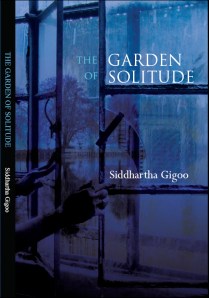
SIDDHARTHA GIGOO‘s The Garden of Solitude [Flipkart / Amazon] is the first novel in English by a Kashmiri, on Kashmir. As it starts arriving in bookstores, I am grateful to him for sharing an extract.

‘Life teaches us that there is beauty in ugliness,’ Sridar said.

Then Pamposh said something that Sridar was not prepared for.

‘Every day I lead the life of a centipede. I crawl. I lick. I hide. I sting. I wake up to the fumes of kerosene in the morning and the sting of speeding ants, feeding ravenously on the sugar spilled on the floor of the tent. It feels as if I have never had a morsel of rice for ages. I wake up hungry and go to bed hungry. I lead the life of a centipede, I crawl. All around the camp, there is stench of human excrement and waste. People wake up in the morning, hungry and muddled.

Continue reading ‘Snakebite or sunstroke?’: An extract from Siddhartha Gigoo’s novel, ‘The Garden of Solitude’

The Dead Need No Reification: Vasanth Kannabiran

Guest post by VASANTH KANNABIRAN

Kannabiran died on 30 December 2010. As per his wishes and ours, and based on previous discussions we declared that the last rites would be simple, speedy and secular. The secular part we ensured. There were no flowers, no lamps, no mantras, no ceremonies. But the clamour for progressive “traditions” was what I found troubling in the extreme. In doing away with religious orthodoxy, all we have done is replaced it with other orthodoxies. Continue reading The Dead Need No Reification: Vasanth Kannabiran

Trysts at Midnight: Calcutta, Now: Prasanta Chakravarty

This is a guest post by PRASANTA CHAKRAVARTY

[The Bangla film Sthaniya Sambaad (Spring in the Colony, 2009) was recently released. The film, by way of mapping the diurnal workings of a refugee colony in contemporary Calcutta, asks important questions about the changing cityscape, of the new, emerging world of land grabbers and fly-by-night investors and of the bemused young and old who are outside of this world and yet are sucked within its machinations. This is a conversation about education, humanities and the nature of artistry in the age of modularization—between MOINAK BISWAS, one of the directors of the film (with Arjun Gourisaria) & Reader, Film Studies, Jadavpur University, Calcutta and PRASANTA CHAKRAVARTY, Associate Professor of English, University of Delhi.]

Prasanta: Your film got a commercial release finally, which is wonderful. Among the initial reactions, in reviews, internet discussions and so forth, one notices a lot of interest in the polyvalent nature of your craft. I would like to take one particular strand of the film and probe a little: that is, its quite sharp critique of the phenomenon of vocationalization of education. This is a constant and niggling thread, right? Now, one fundamental argument for modular training, especially in humanities and social sciences, at this point, is a democratic one: that it will provide competence to a large number of the unemployed, ensure jobs and help in national growth. Continue reading Trysts at Midnight: Calcutta, Now: Prasanta Chakravarty

KG Kannabiran (1929-2010)

Guest post by ANANT MARINGANTI

I was on my way to the Basheerbagh Press Club at 5.45 pm Thursday, December 30 when my mobile rang.

“Have you heard the news ?” I knew what that ominous question meant. But who was it?

The friend who called was one of the listed speakers at the Free Binayak Sen meeting at the Press Club where I was going. It had to be someone both of us knew intimately. “Kannabiran. I am on my way. I can pick you up,” he said quickly. Continue reading KG Kannabiran (1929-2010)

Why is it so difficult to free India of manual scavenging?

Guest post by BEZWADA WILSON

Safai karamcharis from across India declared their liberation at a function in Delhi on 20 December

Over the years, there have been many changes in the Safai Karamchari Andolan movement. The biggest change we have seen has been in the safai karamchari community’s outlook. There was a time when safai karamcharis were ashamed to admit they did manual scavenging. It was not uncommon for even family members to be unaware that someone was involved in the practice of manual scavenging.

Continue reading Why is it so difficult to free India of manual scavenging?

Contract Workers in IIT Kanpur: Raj Sahai

Link to full fact-finding report by RAJ SAHAI.

Link and background note below sent to us by AMIT SINGH.

[This follows the report by Rashmi Singh on the condition of contract workers in JNU – another institution of higher learning.]

Background

The practice of employing contract workers by IIT Kanpur started increasing at the expense of direct regular employees during the past two decades and presently the figure of the contingent workforce is estimated to be around 2,500. For its normal functioning, the Institute relies upon these contract workers not only for temporary construction works but also for perennial
works such as messing (food preparation, serving and cleaning of kitchen and dishes), civil maintenance, electrical maintenance, horticulture, sanitation and sewer cleaning. The Ministry of Labor and Employment, Government of India, views that inferior labor status, casual nature of employment, lack of job security and poor economic conditions are the major characteristics of contract labor.[1] These most vulnerable workers have been provided unequivocal legal protection by different laws, mainly,
Contract Labor (Regulation and Abolition) Act, 1970 [CL(R & A) Act, 1970], Minimum Wages Act, 1948 [MW Act, 1948], The Payment of Wages Act, 1936 [PW Act, 1936], Workmen Compensation Act & Apprentices Act 1961, and Inter-state Migrant Workmen Act, 1979 [ISMW Act, 1979].

Continue reading Contract Workers in IIT Kanpur: Raj Sahai

Conditions of contract labourers in JNU: Rashmi Singh

This is a guest post by RASHMI SINGH. This article is based on the research conducted by the author on informal labour, for AMAN Trust.

The recently concluded Commonwealth Games have exposed the government’s contempt towards the working class in Delhi.Even though some sections of the media did highlight the terrible working conditions of the labourers, much of it got lost in the noise about corruption scandals and nationalist jingoism. In the aftermath of the games, the so-called fourth estate continues to focus its energies on the question of corruption, while everyone seems to have forgotten about the lakhs of construction workers who built the very edifice of the Games. Indeed, the dusty secrets of labour code violations during the Games have been relegated to just that – the dust of the city.

Continue reading Conditions of contract labourers in JNU: Rashmi Singh

Apocalypse in Our Time: Ravikumar

Guest post by RAVIKUMAR

Waking is Another Dream: Poems on the Genocide in Eelam, a slim anthology edited by Ravikumar, will be launched by Navayana on Wednesday, 8 December 2010 at 6 p.m. at The Attic, 36 Regal Building, Connaught Place, New Delhi.

[At a time when the Eelam issue is the news again owing to Channel 4’s coverage leading to the cancellation of Mahinda Rajapaksa’s talk at Oxford, citing emerging evidence of his war crimes, Navayana presents a volume of powerful poetry translated for the first time from Tamil into English. Says poet Cheran, “The lack awareness in a city like Delhi on the fallout of the genocidal war in Sri Lanka is appalling. People here who seem concerned about Palestine or even Kashmir seem utterly indifferent to the problem in India’s own backyard.”

Continue reading Apocalypse in Our Time: Ravikumar

City in Terror: Dilip D’Souza

Guest post by DILIP D’SOUZA

Starting today eighteen years ago, for much of December and January (and then March 12), Indian killed Indian on the streets of my city. Terror at its most elemental: I felt it then. I saw it then. Others told me about it then.

Some memories of those weeks, in no particular order but they all still make my hair stand on end.

Public statement condemning the recent incidents of sexual assault on women from North East India

The endorsements are still coming in. Protest demonstration at Jantar Mantar, Delhi at 5 pm tomorrow, December 1, 2010. Please send endorsements to:

nirantar.mail@gmail.com

As women’s groups, child rights groups, sexual rights groups, Lesbian, Gay, Bisexual, Transgender and Queer rights groups and other progressive groups, academicians and concerned individuals, we are shocked by the repeated incidents of sexual assault on women from the North East in the capital of India in recent months. The incident of rape of a 30-year-old woman in Dhaula Kuan on 23rdNovember has again pointed to the failure of the Delhi government to ensure safety of women and especially of women from the North East. Continue reading Public statement condemning the recent incidents of sexual assault on women from North East India

On the November Massacres in Assam: Aruni Kashyap

This is a guest post by ARUNI KASHYAP

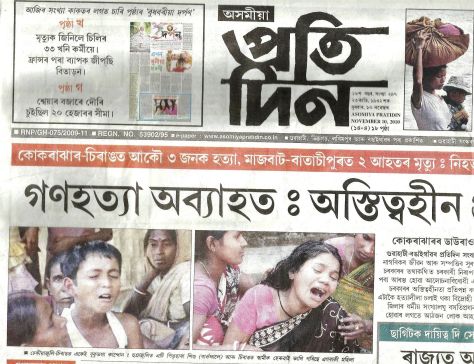
The front page of Asomiya Pratidin on 10 November

In the beginning of this month, the anti-talks faction of NDFB carried out a state-wide massacre of non-Bodos, mostly Hindi speaking settlers in Assam in a revenge-killing spree after Mahesh Basumatary, who allegedly was a cadre of NDFB, was killed by the Indian security forces in Assam’s Sonitpur district. The Bodo militant organisation claimed that the person was an innocent civilian and wasn’t linked to their organisation in any way while the security forces claimed otherwise. A recent report aired in a local television news channel DY365 records the victim’s family and his resident village’s viewpoint that matches with the claims of the NDFB. Continue reading On the November Massacres in Assam: Aruni Kashyap

Volunteers needed to transcribe all 104 Radia tapes

See Reading Radia

As you know, Open and Outlook magazines have put out legally taped telephone conversations of several people with lobbyist Niira Radia. Open put out only a few audios, and transcribed them all, where as Outlook put out a somewhat different set. However, Outlook was kind enough to put out all the audios they had on their website. There’s a lot of muck in there, and it’s not just about Barkha Dutt and Vir Sanghvi, it’s not just about the 2G scam. It’s very crucial that we transcribe ALL these tapes so that the words are on Google, se we can access the content of all tapes more easily. The media should have done this by now but the media is silent to save the skin of their own. So we need to become the media, you and I. Just 15 minutes of your time needed. To volunteer, please leave a comment on any post which says a volunteer is required to transcribe this one.

Thanks!


Memories of another time: Dilip D’Souza

Guest post by DILIP D’SOUZA

The anniversary began, for me, with a phone call. Someone I haven’t heard from in some years, mother of a soldier who died fighting for India in Kashmir. Her voice faltered several times during our conversation, and I could hear her tears. “Look at the tamasha,” she said, “over remembering the people who died on November 26 2008. Yet do we remember my son? Do we remember so many others” — and here she named several soldiers — “who died facing bullets on our border? Really do we remember people who died for no reason?”

“If we have a remembrance for one,” she said, “I want it for all. I want it for everyone who dies like this. Otherwise we wonder, what did our sons die for?” Continue reading Memories of another time: Dilip D’Souza

Hope you’ve listened to all the Radia tapes?

If you haven’t, you’ve missed out on a lot. These five links lead you to all the phone calls, and you can even download them. This is history. The tapes are revelatory about the corporate media, but more than that, about the corporates. They have come out due to corporate wars. Internecine corporate wars seem to be our only hope for transparency and accountability in this nation. Please listen to every pause in every audio to for a clear insight into what today’s India is. And lament this Manmohan yug, ghor Manmohan yug. Also see Sevanti Ninan’s excellent analysis of the media black-out of the story.

Four transcripts that were submitted to the SC along with a total of eight recordings in May 2009 covering the cabinet formation, DMK politics and who’d get telecom portfolio
The conversations with M.Karunanidhi’s daughter M. Kanimozhi about keeping Dayanidhi Maran out from negotiations with the Congress and to get the telecom portfolio for A. Raja
In these Radia wants Sanghvi to tell the Congress not to negotiate with Dayanidhi Maran. He tells her that while he has been meeting Rahul and can’t “get into Sonia in the short term” he would “try and get through to Ahmed”
Recordings of conversations with the likes of Ratan Tata, Ranjan Bhattacharya, Barkha Dutt, Shankar Aiyar, Sunil Arora etc
The other big ‘national resource’ story involves the virtual who’s who: Ambani V/s Ambani V/s Tata, gas and power sector war involving big name journos, politicians, babus, corporates – this has the largest number of tapes, and perhaps the most important ones.

This Chhath Puja, Ram ke naam: Mahtab Alam

Guest post by MAHTAB ALAM

Last week, after a gap of almost 12 years, when I was asked by my family members to accompany them to see Chhatth Puja, an ancient Hindu festival dedicated to Surya, the Sun God, I could not resist myself and readily agreed to join them. As a school going boy, I had always enjoyed watching the festival and devotees performing the rituals observed for the Puja in my hometown Supaul, a district of Bihar, which borders the Tarai region of Nepal. In the last 12 years, I couldn’t get a chance to do so due to the mobile nature of work I am involved in. The Puja, most elaborately observed in Bihar, Jharkhand and the Terai regions of Nepal in modern times, and those areas where migrants from these regions have a presence. Chhath, usually observed six days after Diwali, was observed on 12 November this year. Continue reading This Chhath Puja, Ram ke naam: Mahtab Alam

Islam Colony Riders vs. Ward 2 Worriers [sic]

You are a young politician in Delhi and you want to make a mark in an area, in a seat. You want to be known, you want to be a leader, you want followers, you want to be taken seriously. You want votes. You have the right kind of Delhi first name – Mahender rather than Mahendra – and an even better surname – who better than a Chaudhary to be your leader? But there would be many Mahender Chaudharys. What can you do? You can get basic work done – permissions and pipelines and land conversions and garbage clean-up. But anyone with the right contacts can do that. Anyone can become a protege of a Congress leader like Yoganand Shastri. In a city like Delhi, in a city of migrants, in a city whose citizens think they have the right to be treated better than the rest of India, in a city that does not seem to be ‘politicised’ like the seemingly distant world of the ‘real’ India, in a city that is a state – how do you begin being taken seriously as someone with political ambitions? One Mahender Chaudhary has this poster put up all over Mehrauli (which was once all there was to Delhi). Check it out: Continue reading Islam Colony Riders vs. Ward 2 Worriers [sic]

The Blue Line Bus Saga: Aman Trust

The article is based on AMAN Trust‘s research on informal labour in Delhi.
Sent by Jamal Kidwai

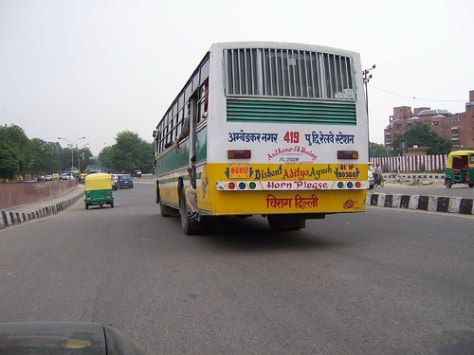
The Delhi government has announced a phasing out of nearly 3000 blue line buses from the streets of Delhi in the next few months. These buses will be replaced by nearly new 1000 low floor buses purchased to ferry athletes and dignitaries for the Commonwealth games. According to the Delhi Transport minister Arvinder Singh Lovely the phase out will be enforced under section 115 of the Central Motor Vehicle Act that deals with the emission norms. The decision has been taken even despite a petition pending in the Delhi High court regarding the decision to phase out 600 routes. According to Lovely “We will apprise the High Court about the decision and I am confident that the court will accept our proposal.”

Continue reading The Blue Line Bus Saga: Aman Trust

Let Delhi have its thali

Guest post by HILAL MIR

During the convention, Azadi the only Way, at LTG auditorium on Thursday, a potbellied man was standing on the aisle, listening intently to the speech of professor of history at Jadavpur University Sugata Bhadra. The man, I reckon, might be easily burdening earth with nearly 130 kilograms of his fair, north Indian bulk.  The professor was stripping the Indian state to its bare minimum and the audiences clapped. The man could stand it no more. I soon found out his voice was equally weighty, and gravelly—a cross between Shatrugan Sinha and Kulbushan Kharbanda. Quite audibly he said jis thali ma khatey hai usi main chaid kartey hain. In Bollywood films this saying condemning treachery is reserved for domestic helps who fall in love with the pretty daughters of their employers. Here, the context was different. A Maoist sympathizer was sharing the dais with a Kashmiri pro-freedom leader who was sharing the dais with a Sikh secessionist who was sharing the dais with a Naga human rights defender…A veritable thali of secessionism and dissent indeed. No wonder Arnab Goswami was hysterical. Continue reading Let Delhi have its thali

Lovely’s Lane: Alok Rai

Guest post by ALOK RAI

It was bound to come sooner or later. The wonder – the absolute, outrageous, impudent surprise of it all is that it has come so soon. The Games have barely limped to their pathetic conclusion – and those of us who are waiting for the post-Games reckoning are waiting but impatiently, inadequately consoled by the sound of the sharpening of the knives, the braiding of the hangman’s rope – or, most likely, the Japanese water torture of the promised Shunglu probe. And in the midst of this unfolding fiasco, this still-running disaster, the lovely Mr Arvinder Singh Lovely, Delhi’s Transport Minister, has made the suggestion that the insult of the Games lane, the closing off to the public of a significant part of the road which has been made with public money, be made permanent. This – as we were told in full-page ads paid for by us – was done with threats of  a hefty fine or, worse, far worse, being exposed to the courtesies of a Delhi cop. The ineffable experience of crawling along patiently (but proudly, always proudly!) while sundry others flashing CWG insignia whizzed past in the CWG lane – an experience that so many of us chose to miss, could now become a permanent feature of the metro experience. I can’t wait!

Continue reading Lovely’s Lane: Alok Rai