Category Archives: Everyday Life

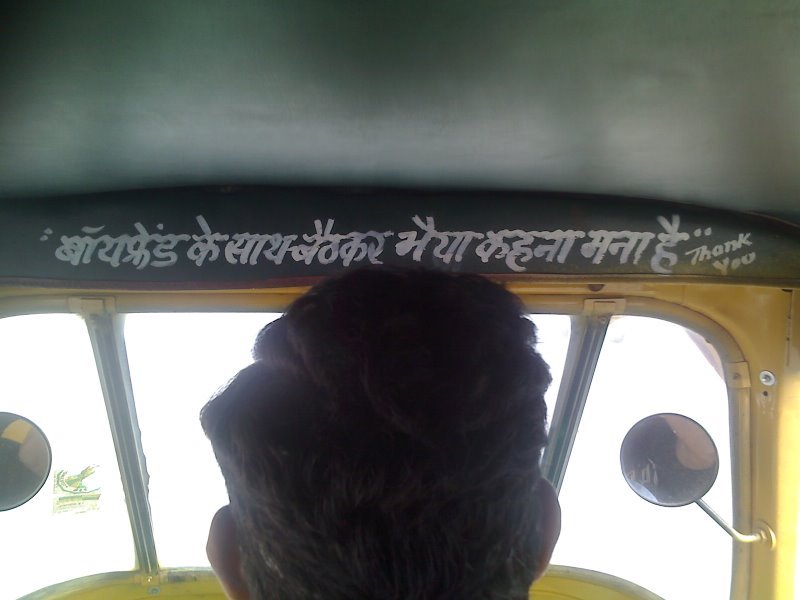
Moral police in OUR autos!

“It is forbidden to sit with your boyfriend and claim he is your brother”

My sister sent me this one…

The Idea and the Practice of a Slum

“Right there, right there!”
“Where? I can’t see the damn station. Where is it?”
“Right there, you walk past that little lane, you will hit the station.”
Grudgingly, I walked through the lane and lo and behold! I was at the platform of Govandi railway station. It just took me a little row of settlements and some open drains running by them to get to that wretched Govandi station (not to forget to mention, passing by some of the children playing around and that sole bhaiyya woman sitting idly).
Did I say wretched? Yes, wretched is the feeling I get when I am at Govandi station. Perhaps in my life, I must have been to Govandi station exactly six times. Of the four of those six times, I have traveled in the east of Govandi, towards the Tata Institute of Social Sciences (TISS). But the last two times, I have actually experienced the wretchedness of Govandi station, when I have had to get off platform number 1 and then go past all the squatter settlements, till I eventually get to the infamously famous Lallubhai Compound.

Continue reading The Idea and the Practice of a Slum

Under Development: Singur

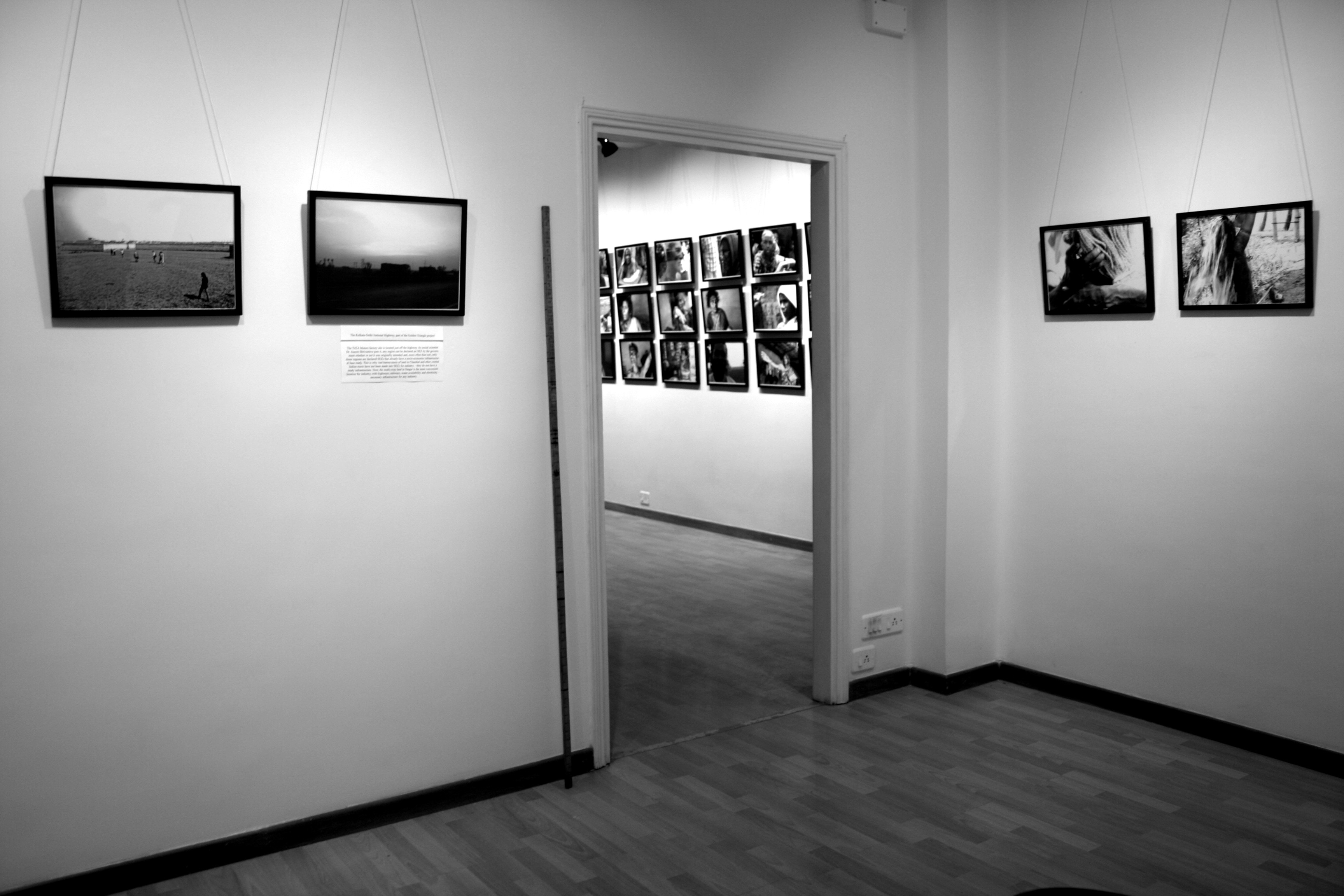
If you are in Kolkata between 27 June and 2 July, you may do well to visit the Seagull Arts and Media Resource Centre, Kolkata, for an exhibition of photographs of Singur. There will also be a panel discussion and a film festival. Continue reading Under Development: Singur

An epitaph for the bull-hull economy

S. Anand draws his own conclusions from a trip to Azamgarh, about which Aditya Nigam had earlier written a post on Kafila.

While the urban elite, who can afford to indulge the growing fad of organic slow-food, would now happily pay a premium price for the hard bread (appreciating its high-fibre content) that Dalits were forced to eat owing to denial and deprivation, the rural Dalits are forced into the maida economy of Maggi Continue reading An epitaph for the bull-hull economy

Gomti Nagar to Bundelkhand

It has been over a year since Mayawati came to power in UP and I am absolutely sick of seeing news reports beginning with the comment, “In a state ruled by a Dalit chief minister, a Dalit youth was killed…” This hostility towards Mayawati is ironically couched in the language of ‘Dalit empowerment’, the phrase used so loosely its is completely devoid of meaning. Where were all these reporters and their editorialising and their concern for Dalits when Yadavs were running the state?

What has Mayaywati been doing for Dalits? That question will be answered again and again without talking to a single Dalit. But if you do go looking for something, you will find it. The redoubtable Nilanjana Bose reports: Continue reading Gomti Nagar to Bundelkhand

Claims and Space – Thoughts from the Feet

Fort,
Bombay – 400 001.

Clean footpaths,
Spic and span,
Bombay – 400 001. Continue reading Claims and Space – Thoughts from the Feet

Boutique Owner Brutally Tortures 13 Year Old Boy: (Don’t Worry, She’s Fine)

In yet another shocking incident reflective of the declining standards of morality and respect for property rights amongst the young, a 13 year old boy was accused of stealing money from a shop.

However this story is special for the amazing presence of mind displayed by the boutique owner Pinki. With that special sixth-sense that only mothers are gifted with, Pinki intuitively realised that the boy had nothing to do with the stolen money whatsoever and immediately proceeded to beat him up. Not one to leave a job half done she then shaved his head, stripped him naked and as a final touch (reminiscent of her attention to detail as a fashion designer) inscribed “I am a Thief” on his stomach and back. The boy was then paraded naked in the market place.
Continue reading Boutique Owner Brutally Tortures 13 Year Old Boy: (Don’t Worry, She’s Fine)

Judging Women

The honourable judges of the honourable judiciary are on an honourable roll…

Anuradha Roy of Permanent Black sent out the following:

On the 9th of February 2008, remarks by two eminent judiciary members the Chief Justice of Karnataka, Cyriac Joseph and State Human Rights Commission Chairperson Justice S.R.Nayak, stating that immodest dressing was the cause of increasing crimes against women were reported in the press.

The Hon’ble Chief Justice further elaborated his statement by mentioning that “Nowadays, women wear such kind of dresses even in temples and churches that when we go to places of worship, instead of meditating on God, we end up meditating on the person before us” and that the “provocative dresses that women wear in buses” put the “men travelling in the buses” in awkward situations and hence “women must dress modestly.”

The Chairperson, State Human Rights Commission, speaking on ‘Human Rights and the Lawyers Role’, gave his opinion on the Mumbai New Year molestation issue, when two women had their dresses torn off by a mob
of men outside a nightclub: “Yes, men are bad… But who asked them (the women) to venture out in the night…Women should not have gone out in the night and when they do, there is no point in complaining that men touched them and hit them. Youth are destroying our culture for momentary satisfaction.”

Anuradha sent this out without comments. I understand her mood. I’m done too. No witty commentary, no smart asides. I’m just plain exhausted.

giving girls orgasms
olsen twins still virgins
birthday party for ninety years old
chubby young girls
old guy ffm
cute little boobs
stock option exercise stock swap vs self funding tax benefit
furry artwork adult
sylvia saint interracial
toronto district school board
ffm threesome picture galleries
massive female bukkake squirt orgy
smoking zyban
msn photo swap messenger problem
lolitas blog
hidden up skirt pics
drawstring nylon bag
ashley olsen naked
adult halloween party ideas
horny collage girl
milwaukee county zoo ala carte
fatman scoop cartoon
tattoo skull art
free nude midgets pics
tiffany towers mpeg
double cock suck
dp anal
sex flexible
cfnm handjob movie galleries
hairy pussy closeup
premature ejaculation and zoloft
fertile cunt orgasming sperm
interracial fuck orgy
naruto fighting dirty
my wifes clit
oral whores
gay male videos
squirt lessons
bi porn incest
moms wearing thongs
horniest twinks
money over bitches
easy pornstars
gay male bondage
women masturbating alone
enormous cum shots
sexy toys
Obscene Behavior CD-1
filipina escorts
deep vaginal contractions at 35 weeks
reality sex outdoor
handjob pantyhose
horny mom get banged
Private Life Of 43 Life of Maria Belucci CD-1
enormous penis gallery
teen femdom
backseat blowjobs
clit erection
female masturbate
shit asian
lesbian threesome orgy
chief executive officer ceo
the big swallow brandi
animated teen chat rooms
hot hunks in the shower
cute dog names
sexy piercing
youn girl and big stud
jamaican pussy
dog obedience school
free pantyhose samples
crazy sluts
Squirt Queens-12 CD-2
forced sex stories
big breast amateurs 4
my girl korean tv series
nude female celebs
facial rejuvenation ct
nude stud factory
rachel weisz paparazzi
naked chick videos
bad girls short skirts
nude athletes
vagina images
slutty chicks
student apartment search
anel sex
2 dicks in 1 chick
effects of masterbation
young girls oral sex
free paris hilton porno
black moms id like to fuck
anal sex beads
free wives gallery
college coeds in thongs
silvia saint hardcore gallery
blowjobs in public free
gothic hairy vaginas
jackass party boy
marine sight navigation cd
kelly handjob
swallow jism
my first sex teacher videos
fuck the shit out of her
teen girls sucking cock
hentai rape porn
free galleries pregnant nude women
lauren lane nude paparazzi pictures
women have sex with dog
nude swim
free classic and retro porn video mpegs
monster cock anime
first anal pain
fat indian girl
slut wife glory hole
home video xxx
free college sluts
anime school sex
adult spanking free video
ca military relief fund

Mother

Have you ever guzzled
the last drop of alcohol
and raped your mother?

This is what we do
when we read
the morning news
about a woman’s rape
and sip our tea
leisurely.

© 2006 Dan Husain

Taslima Nasreen and the Spirit of Islam

It is said that after he announced his Prophethood Hazrat Mohammed suffered severe persecution in Mecca. The vitriol and calumny extended from the verbal to the physical. There was one woman who would always throw filth on him whenever he passed by her house. He would unfailingly take the same route everyday and she would equally invariably throw filth on him. He never protested. One day as he passed her house, she was missing. He inquired after her and learning that she was sick he went up to her room, and finding her bed-ridden, tended to her. I grew up listening to a lot of stories from my grandmother about the Prophet Mohammed. Told in an anecdotal form, the stories largely avoided his image as a conqueror and concentrated instead on his personality, specially his grace under hardship. I narrate this story especially to remind my compatriots about what they might do when faced with hostility, or criticism.

I write this particularly in the context of Taslima Nasrin, whose vise expires this week and she still does not know whether it will be extended or not. Taslima Nasrin must be given an opportunity to stay on in India, and must be provided that opportunity not as a grace or favor but because she is, as a South Asian, as a fellow human, fully entitled to it. My appeal rests not merely on a liberal idea of freedom of expression, or on making this a litmus test for India’s pluralism. India’s pluralism, where it exists in practice, is not dependent on appeals or testimonials from intellectuals. Our pluralism does not, and has not, precluded violent confrontations between different social groups. However, we also have countervailing traditions of coming to a working adjustment with each other, which, as an aside, partly explains why the word ‘adjust’ is so popular in all Indian languages.

Continue reading Taslima Nasreen and the Spirit of Islam

Climaterror, boredom and media

The pressing, in fact the overpowering need to keep people perpetually agog with false excitement, generated by the fear of impending doom, played out in all its gory details over the last three days across the gossip channels that go in the name of News Channels and Glamour sheets that try to pass of as Newspapers.

26th January had come and gone, Sarkozy had come and gone without giving us the nuclear fuel that would have overnight made the greatest democracy into the second or third or fourth or the nth most happening country in the world.

Continue reading Climaterror, boredom and media

Charu Gupta on Om Shanti Om and Saawariya

Like many other lovers of Bollywood cinema, I too was caught up since October this year in the countdown to the battle of all battles, with the release of Om Shanti Om (OSO) and Saawariya on 9 November 2007. Reams have been written, debated and analysed on the two films in newspapers, television networks, and everyday discussions. They have been depicted as films catering to very different sensibilities, and representing vastly diverse forms. The verdict seems to have declared both as average films, though OSO seems to be faring better than Saawariya at the box office. I enjoyed the first half of OSO particularly and thought Saawariya as a film with great form, but not much content. 

However, as a fan of Bollywood popular cinema, what struck me most was one striking similarity between the two films. I thought both the films offered great visual pleasure and feast for the female spectators, where the spectacular and stylish nude male bodies and images of both Ranbir Raj Kapoor and Shahrukh Khan, though very different from each other, were the prime objects of desire and erotic spectacle. Both OSO and Saawariya have urban heroes, whose bodies are produced and carved, rooted in providing a voyeuristic visual treat especially to most straight women and gay men. The identity of both the heroes in these films in centrally tied to the consumption of their nude bodies by the viewer. The films in some senses signify the coming of age of a new genre of Bollywood cinema, where it is not so much the female body but the male body which circulates and is on display, offering a sexualised imaginative anatomy. They also signify that the language of discourse of Hindi films has undergone a dramatic post modernist change in its conception of desire, where most of it is conducted not through the soul but through the body. There is no central heart, but a decentring of emotions at play here. In the recent past too, nude male bodies of Hrithik Roshan and Salman Khan have been offered to the viewer. It perhaps is also a reflection of the fact that more and more women are crowding the cinema halls and form at times the major chunk of spectatorship, and they are a vital part of the cinematic experience. 

Continue reading Charu Gupta on Om Shanti Om and Saawariya

That day 15 years ago

Read Asad Mustafa on his memories of the day the Babri Masjid was demolished.

In many ways it is just like any other Lucknow winter day. Sun has come up and my mother is watching her pickles dry on the roof. Our neighbor, Shukla-ji’s daughter has come for a lazy winterBabri Masjid afternoon conversation with my mother and is oiling her hair. I am struggling with unsolved papers from previous years’ JEE tests. This year’s JEE is going to be my first big test in the real world.

Lahori topi

I was going to Lahore for the first time, and took a taxi to the IG International airport in Delhi. My local taxi stand had sent a driver whom I didn’t know, and there was another lad in the front seat with him. At some point, as the driver swerved to avoid a vehicle that overtook from the right, he said to me – “Madam, aap bahar ja rahi hain. Bataiye, hamare desh mein aur bahar ke deshon mein kya farak hai”.

It was probably an opening gambit for a diatribe on how uncivil hamare log are as compared to gore log, but I replied – “Vaise main Pakistan ja rahi hoon, mujhe nahin lagta hai ki koi khaas farak hoga.”

At this, he responded, “Pakistan ja rahi hain? Hamare liye ek topi le ayengi?”

Me: “Zaroor. Lekin koi khas kism ki topi chahiye kya?”

Him: “Nahin, hamare musalmanon wali topi. Mere dadaji pehnenge.”

Continue reading Lahori topi

The Hafta Bazaars of Delhi

The earliest known urban settlement in Delhi, aside from the mythological Indraprasth, called Inderpat by Sayed Ahmad Khan in his Asaar-us-Sanaadeed (1865) and by Bashir-ud-Din Ahmad in his Waqiyat-e-Daar-ul-Hukumat Dehli (1920) (probably to go well with Maripat, Sonipat, Panipat and Baghpat), is believed to have been at or near the present day Mehrauli.

The large number of exiting structures and ruins, both religious and secular, testify to rigorous building activity in this area going back to almost a thousand years or more and continuing during the colonial period. The Quila Rai Pithora, The Shrine of Qutub-ud-Din Bakhtiyar Kaaki, (disciple and successor of Moin-ud-din Chishti and the Peer of Baba Fareed Ganj-e-Shakar), whose presence in this area gave it the honorific Qutub Saheb, the Tomb of Altamash and of Balban, the Hauz-e-Shamsi, the Gandhak ki Baoli and the Rajon-ki-Baoli, Jamali-Kamali or the tomb and mosque of Jamal-ud-Din and Kamal-ud-Din, Adham Khan and Quli Khan’s Tombs, the Rang Mahal, the adjacent mosque and the large number of colonial structures, including several tehsil buildings, a municipal dispensary, the so called Tamarind Court and the Qutub Colonnade are evidence of a thriving Urban settlement.

Continue reading The Hafta Bazaars of Delhi

The Fascinating Triumph of Rakesh Belal

I bet you’ve seen Rakesh Belal. He is ubiquitous. An 18-year-old dropout, the sort found in trackpants and a fake Nike t-shirt outside shantytown video parlours and ramshackle gyms anywhere across the country. But this is not how we found him. It was the summer of 1996, and we were setting off from New Delhi railway station, going to Ghazipur for Muharram. We were in our compartment, when we noticed a boy, scavenging for food. The innocence of his face captured Mom’s heart. She gave him something to eat, and Dad gestured at him to come inside. Once with us, he settled down as if he had always been part of the family. When the train moved, Mom and Dad found it hard to send him away. And soon Rakesh Belal was en route to Ghazipur too.

Belal was not his real name. He was Rakesh Singh from a village in Uttar Pradesh called Hauwwapura. He had no clue where it was, but knew that the nearest city was Agra. His father’s name he gave as “Jungli Singh” — which we later found out to be Jungani Singh — and his mother’s name was Shanti Devi. His father was dead and his mother had left home. He had lived once with an aunt, but she ill-treated him, pushing him to leave home. In Delhi, he found refuge at a constable’s home, but was mistreated there too. Having fled that place as well, he was caught later by the authorities and thrown into a correction facility — an abysmal institution, where the rooms were cramped, the food miserable and the older kids were vicious to the younger ones. Finally he escaped, and that’s when we found him on the platform.

Continue reading The Fascinating Triumph of Rakesh Belal

Jantar Mantar

JantarMantar

In the strange, caged, and bound space of “protest” that Jantar Mantar in Delhi has now become [been reduced to?], there are moments when some voices still rise wrechingly above the din.

A Modest Proposal to End All Controversies on Freedom of Expression in India

(apologies for cross posting on Commons Law and Reader List)

As we know well by now from the freedom loving sentiments (that are expressed loudly and frequently) by all sections of the guardians of social order in India, (that is Bharat, that is Hindustan), the real reason why certain insignificant documentary independent and student films, contemporary art exhibitions in university campuses and performances are banned, and their heinous perpetrators arrested has to do with the general populations right to sleep undisturbed each night and not to see anything other than cricket matches, news about cricket matches, election analyses, kaun banega crorepati, Abhishek Bacchan’s wedding, and yoga on TV.

Why should anyone in their right mind want to see, read, listen to or even think about anything else?

Consider the folly that some students in Kottayam have recently contemplated, making a film on of all things ‘Homosexuality’ .

Or, of the students in the Fine Arts Department of M.S.University in Baroda who went ahead and organized an exhibition of student work that contained offensive erotic imagery.

Both of these moves have been met with swift and timely responses. The offending students in Kerala have been expelled by the Christian educational institutition where they were enrolled, and the offending art student in Vadodara, one Chandramohanm has been arrested by the local police at the urging of Hindutva minded citizens.

There are only two things we need to learn from incidents of this nature. The first is as follows –

Actually, all that people need to do is to insist that only the self appointed guardians of public morality (of all stripes and shades) have the right to appear in any broadcast, exhibition, film or other forms of mediated communication. We need every channel to broadcast morally cleansed reality TV all the time. How else will this nation boldly venture where none other has gone before – into that heaven of bliss and freedom known as ennui for the billions.

Continue reading A Modest Proposal to End All Controversies on Freedom of Expression in India

Devastating Looks: Smirks, Quirks and Judicial Authority

Devastating Looks: Smirks, Quirks and Judicial Authority

Raoul Vaneigem, the Belgian philosopher writes that “The economy of everyday life is based on a continuous exchange of humiliations and aggressive attitudes. It conceals a technique of wear and tear which is itself prey to the gift of destruction which it invites contradictorily”. In an incredible story in his chapter on humiliation, Vaneigem says that one day, when Rousseau was traveling through a crowded village, he was insulted by a lowly peasant whose insults delighted the crowd. The great philosopher Rousseau was completely taken aback and flushed with anger, but could not think of a single thing to say in reply and was forced to take to his heels amidst the jeers of the crowd. By the time he had finally regained his composure and thought of a thousand possible retorts, any one of which would have silenced the joker once and for all, he was at two hours distance from the village.

Vaneigem then says “Aren’t most of the trivial incidents of everyday life like this ridiculous adventure? but in an attenuated and diluted form, reduced to the duration of a step, a glance, a thought, experienced as a muffled impact, a fleeting discomfort barely registered by consciousness and leaving in the mind only the dull irritation at a loss to discover its own origin?”
Continue reading Devastating Looks: Smirks, Quirks and Judicial Authority

What if there is no water?

I was reading Lisa Peattie’s work on Planning this morning. She says:

… every telling represents a way of seeing. We see from where we stand; and why would we look unless we care about how the story comes out?

Telling represents a way of seeing;
We see from where we stand …

Continue reading What if there is no water?