Category Archives: Excavation

Are Ikhwanis back in Kashmir?

A report by Pradeep Thakur in the Times of India today has stunned a lot of people in Kashmir. The report says that the Ministry of Home Affairs and the Indian Army are reviving Ikhwan units in Kashmir to quell the anti-India movement. Some Kashmiris living in Kashmir feared the era of Ikhwani terror and blackmail will be back. The stunning bit is how openly the effort of the MHA and the Indian Army is being acknowledged in creating a renegade political pro-India militia force in today’s political environment in Kashmir. What is not surprising is that this is happening at all, because it has happened before. At worst, this seemed like a stupid move to publicise an overt political operation of the sort Kashmir has seen no dearth of.

The story, titled, “Two pro-India parties floated in J&K with Army, MHA help” by Pradeep Thakur reads: Continue reading Are Ikhwanis back in Kashmir?

Ravinder Tyagi of Batla House (in)fame in yet another frame up!: JTSA

This release comes from the JAMIA TEACHERS’ SOLIDARITY ASSOCIATION

10th February 2011

Ravinder Tyagi of Batla House (in)fame in yet another frame up!

Veteran of fake encounters must be suspended immediately!

It seems there is no end to Special Cell’s gallantry. One of its most celebrated and decorated heroes, Ravinder Tyagi, also the key architect of the Batla House ‘encounter’ has been found guilty of yet another frame-up of innocents as terrorists. The additional sessions judge Virendra Bhat yesterday absolved and acquitted seven men accused of terrorism in a case dating back to 2005; while pronouncing four officers of the Delhi Police guilty of manufacturing a fake story about an ‘encounter’. The Police had claimed to have recovered AK-47 assault rifles, fake currency and ammunition from the men they claimed were ISI agents—a brazenly false claim. Continue reading Ravinder Tyagi of Batla House (in)fame in yet another frame up!: JTSA

Remembering Shahid Azmi, the Shaheed: Mahtab Alam

Guest post by MAHTAB ALAM

It must have been around nine pm on 11th February last year. The nightfall and Delhi’s infamous wintry chill ensured that I stayed indoors at the mercy of closed walls and work for company. Sure enough, I was seated warmly in my setting of a cyber cafe of Jamia Nagar in Okhla. Okhla, an area I had migrated to as a 14 year boy from my hometown, to pursue my further education, like many other Muslim students from other parts of this country. As Basharat Peer has rightly observed, ‘India’s Muslims don’t move to Delhi; they move to Okhla’. Continue reading Remembering Shahid Azmi, the Shaheed: Mahtab Alam

‘How Leaving the Internet Fueled Our Revolution’

For those who worry themselves sick about laptop radicalism, this is essential reading:

The web is in many ways a more modern, much larger version of the kinds of public spaces and forums that have made citizenship possible throughout history. Losing it for a week didn’t stop Egyptians from protesting or airing their frustrations; we still know how to use physical public spaces, after all. But it did remind us that a forum for the open exchange of words and ideas is central to any sustainable democracy; alternatively, we end up in a perilous cycle of control and chaos. Instead of expressing pent-up opinions with fists and bullets, as is happening now in the streets of Cairo, people who can express them freely in conversation, even in a virtual one, have a chance to hear one another and deliberate together about the future. Never mind the vacant symbolism of “Twitter revolutions” and Youtube activism: losing the Internet at the hand of our own government simply offers us a powerful reminder of why we actually want the Internet to begin with, and why we’re doing any of this. [Read the full article by Haisam Abu-Samra]

Excellent as the al-Jazeera coverage is, if you’re tired of it, see videos from Egypt on YouTube, created and uploaded by the people whose revolution it is. It will give you the closest possible feel of what it’s like to be there. Not even al-Jazeera can manage that!

And if you’ve been watching the events in the Arab world and consoling yourself that it’s not that bad in India, consider this: India recently gave Hosni Mubarak an award in Nehru’s name for ‘international understanding’ and Vice President Hamid Ansari addressed him thus:

Your support for regional and international efforts to promote and maintain peace in the West Asian region is eloquent testimony to your commitment to the promotion of international peace and goodwill. I feel deeply privileged to convey my warmest greetings to you. [Press Information Bureau]

Death of a River

This was first presented as a paper in a seminar on “The River” organised by the Max Muller Bhawan on 11 and 12 December 2010. Photo credits: Gigi Mon Scaria, Himanshu Joshi and Sohail Hashmi. Maps: The coloured map of Delhi is the restored version of an 1850 map; restoration is by E Ehlers and T Krafft. The black and white map is based on an 1807 map of the draingage of Delhi, made by a British cartographer. The three current three maps have been drawn by Shela Hashmi Grewal. You can stop at any image in the silde show above, by using the controls that you will discover once you hover the cursor over the slideshow.

This slideshow requires JavaScript.

The Final scene in the epic tragedy of the Jamna is being enacted at these very moments and the agencies that have wrought this havoc continue to initiate decisions that will permanently erase all signs of the river that has sustained the city that you and I call Hamari Dilli.

Before coming to my understanding of what needs to be done to save the Jamna, instead of what is being done to destroy it. I would like to draw your attention to certain geographical features of the land around Delhi, in order to better understand the factors that contributed to the location of the several Delhis and their relationship to the river. Continue reading Death of a River

Tahrir at Midan Tahrir

This slideshow requires JavaScript.

These six photos come to Kafila from an art collective in Cairo. Photographs by artist HR and other members. They do not want their identities revealed for their safety. Note how that gas canister says Made in USA!

Also see this video doing the rounds, perhaps its not the only effort that brought about the 25 January uprising in Egypt but may still be an important one.

Previously on Kafila: A Phone Call From Alexandria

The Birth of God: Siddhartha Gigoo on Pt Bhimsen Joshi (1922-2011)

Guest post by SIDDHARTHA GIGOO

It was on a nice summer evening in the year 1996 that I first got to attend Pandit Bhimsen Joshi’s concert.

I was studying literature at the Jawaharlal Nehru University in New Delhi. Those were terrible times for me. I struggled with my studies. Good grades evaded me. Failure stared at my face and the world mocked me. It was difficult to trudge through the endless days and the nights. Reading books became a cumbersome task because one had to present seminars and write the boring term papers at the end of the semesters. Some of us slept during the days and idled during the nights. There seemed to be no respite in sight. Life, what atrophy? I laboured somehow from one book to another, sometimes seeking enjoyment and sometimes to broaden my experience and understanding of life and the world. I had heard somewhere that one must not seek knowledge. Some said knowledge didn’t exist, while others argued that knowledge was a perilous trap from which there was no escape. I was perhaps frantically looking for a reprieve from my fears and imperfections. Continue reading The Birth of God: Siddhartha Gigoo on Pt Bhimsen Joshi (1922-2011)

‘As followers pushed to get close, the pole broke in several places and the flag tumbled down onto Mr. Joshi’

History repeats itself, and we learn so little from it. Or rather, we learn too much from it. I am excerpting below about half the text of a report dated 27 January 1992, written by EDWARD A. GARGAN in The New York Times, describing in detail Murli Manohar Joshi’s hoisting of the Indian flag in Srinagar’s Lal Chowk. Wish I had a picture!

He [Murli Manohar Joshi] had begun his trek, which he named Pilgrimage for Unity, 44 days before at India’s southernmost point. But the inability of the security forces to protect even their highest officials made it clear that there was no way, despite the presence of several hundred thousand troops in the Vale of Kashmir, to protect a convoy of cars and buses filled with zealous Hindus. So Mr. Joshi and a small contingent of his closest supporters were flown here on Saturday night. Continue reading ‘As followers pushed to get close, the pole broke in several places and the flag tumbled down onto Mr. Joshi’

“These are not stones these are my feelings”

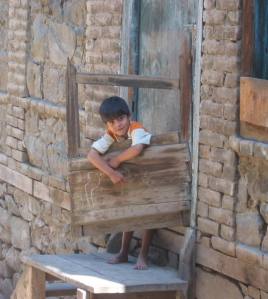
An image taken in downtowon Srinagar.

Given below is a note written by a Kashmiri student from downtown Srinagar who calls himself ‘Kale Kharab’, meaning ‘hot headed’. Taken from his blog, the note reads like a personal manifesto, a statement of purpose, a testimony more telling than what the most patient interviewer can elicit. This note gives you more insight into what is happening in Kashmir than a lot of what you may have read or seen on TV news about the killing of 115 protestors across Kashmir in 2010 by Indian forces. This testimony, written early on during the uprising, on 30 August 2010, shows how irredeemably India has lost the plot in Kashmir all over again, with a new generation of Kashmiris.

How and why I became a stonepelter

by KALE KHARAB

I am from downtown srinagar born in 1991. I was admitted to one of the best school of valley. As a child I had dream to became engineer. Whenever somebody used to ask me about my aim I would proudly say engineer. As I started to grow up I started to became familar with many words which everyone used to talk about that among them few were “azadi” (freedom), “hartal” (shutdown) but I was unable to understand the meaning of these words. I loved the word hartal as it was holiday, so I always wished for hartal. As I grew up I came to know about mujahids. I used to listen stories of mujahids. I would oftenly ask my elders to tell me about mujahids. They told me stories of many mujahids like Issac, Ishfaq, Jan Malik which I liked to share with my friends.  Continue reading “These are not stones these are my feelings”

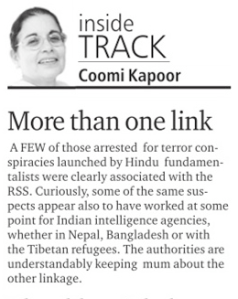
Is the cat out of the bag?

Veteran journalist Coomi Kapoor wrote this small snippet in the Indian Express yesterday. Hope it is only the beginning of more information on what this country’s intelligence agencies have been up to in the name of its citizens.

“I Am Still Alive”: Amitava Kumar

Guest post by AMITAVA KUMAR

Till a few days ago, I hadn’t heard of Aqeel Shatir. A friend sent me a link to a report in the Indian Express on December 20 about a poet who had been asked to pay for an anti-Narendra Modi remark in his anthology, Abhi Zindaa Hoon Main (I Am Still Alive). I got in touch with the reporter, in Ahmedabad, who had filed the story and soon after that spoke on the phone with Shatir.

Aqeel Shatir is his takhallus or literary alias. The name his parents gave him was Aqeel Ahmed. His ustad offered him a choice of two pen-names. One was Aazar, which means a sculptor, someone who carves beautiful forms from marble. The other was Shatir, whose literal meaning is chess-player but denotes someone who possesses cunning. Continue reading “I Am Still Alive”: Amitava Kumar

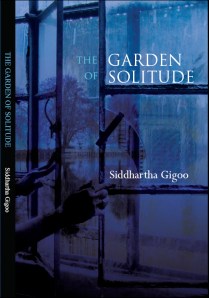
‘Snakebite or sunstroke?’: An extract from Siddhartha Gigoo’s novel, ‘The Garden of Solitude’

SIDDHARTHA GIGOO‘s The Garden of Solitude [Flipkart / Amazon] is the first novel in English by a Kashmiri, on Kashmir. As it starts arriving in bookstores, I am grateful to him for sharing an extract.
‘Life teaches us that there is beauty in ugliness,’ Sridar said.

Then Pamposh said something that Sridar was not prepared for.

‘Every day I lead the life of a centipede. I crawl. I lick. I hide. I sting. I wake up to the fumes of kerosene in the morning and the sting of speeding ants, feeding ravenously on the sugar spilled on the floor of the tent. It feels as if I have never had a morsel of rice for ages. I wake up hungry and go to bed hungry. I lead the life of a centipede, I crawl. All around the camp, there is stench of human excrement and waste. People wake up in the morning, hungry and muddled.

Continue reading ‘Snakebite or sunstroke?’: An extract from Siddhartha Gigoo’s novel, ‘The Garden of Solitude’

Full text: The Binayak Sen Judgement (English Translation)

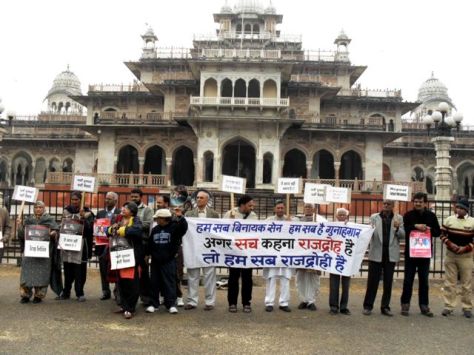
Protest in Jaipur

(Given below is the full text of the judgement sentencing Dr Binayak Sen for life. It is a translation from the Hindi. The translation has been done by the Free Binayak Sen Now campaign. You can download here (.pdf) the Hindi original. For updates on the Free Binayak Sen Now campaign, see BinayakSen.net. If you are on Facebook, you can join the Binayak Sen Solidarity Forum.)

Continue reading Full text: The Binayak Sen Judgement (English Translation)

Hallowed precincts: The Viceregal Lodge of Shimla

This slideshow requires JavaScript.

Text and photographs by Sohail Hashmi
First published in
Terrascape

Those driving to Shimla through National Highway 22, reach a bypass known as Tuti Kandi, it is here that one has to decide if one wants to continue uphill to the former summer capital of colonial India or to avoid the busy, traffic jammed Shimla and carry on ahead to Kufri and beyond.

Continue reading Hallowed precincts: The Viceregal Lodge of Shimla

Look who’s talking (to whom): FBI and Special Cell

This note comes from Manisha Sethi of the JAMIA TEACHERS’ SOLIDARITY ASSOCIATION

Wikileaks has exposed that there existed secret channels of communication between the US agency FBI and our very own Delhi Police Special Cell. FBI—which has witchhunted American democratic and civil rights organizations and leaders (including Martin Luther King Jr.), raids the homes of anti-war activists, and helps the overthrow of popular governments around the world—and Special Cell whose personnel have been indicted in the past, by none less than the CBI, for manufacturing ‘terrorists’ out of thin air by planting false evidence; an organization often accused by rights activists of killing in cold blood, a.k.a. ‘encounters’, for medals and promotions. What possible information were they sharing in secret? Who to frame and fix next? Or the merits of water-boarding over indigenous torture techniques?  Continue reading Look who’s talking (to whom): FBI and Special Cell

Noor Sahab in Horror Land: Gowhar Fazili

Guest post by GOWHAR FAZILI

Some old memories came to mind when Noor Mohammed Bhat, a college lecturer in Kashmir got arrested for asking in an examination, “Are the stone pelters real heroes? Discuss.”

I studied at Burn Hall, a missionary school in Srinagar. In the mid-‘80s, they would make us recite the national anthem in the morning assembly on one of the week days. Interestingly, while the little kids would do as they were told, the ‘big’ ones who had just crossed their sixth grade, would for some strange reason go off tune so that Jana Gana Mana… would start sounding like “Jaaaaaanaooauea maaaoAAAonaa gaooooOOnaannNNaaaA…”, like it were a sound coming out of an audio tape that was stuck or a damaged gramophone record! This bad behaviour invited corporal punishment. Shah Sir and Mohinder Sir (P.T. Masters) used to lurk behind the assembly and surreptitiously appear and whip on our legs at lightning speed. They would lash at the whole queue in a single run and be gone before we knew it. While the tune in the queue that was being freshly hit would get restored, the queues furthest from the P.T. Masters would go really off the tune! They would keep running about madly like this from one end to another but the cycle (orchestra) would continue till the whole song was over. It used be maddening for them. Though they were quite ferocious if one were to encounter them in person, (having been used regularly to instil fear and maintain ‘discipline’) somehow as a collective, we dared them in this manner week after week and year after year. Continue reading Noor Sahab in Horror Land: Gowhar Fazili

800 new Radia tapes!

It keeps getting better. The promise of more emperors losing their clothing, the promise of more political gossip and media wars and conspiracy theories. More light will be thrown at crony capitalism, sorry I mean economic growth. Outlook is putting out another 800 Radia tapes in the next few hours. There are a total of 5,000 and they’ve already put out 140.

Of those 140, some 36 yet to be transcribed.

Declaration of the Independence of Cyberspace

Governments of the Industrial World, you weary giants of flesh and steel, I come from Cyberspace, the new home of Mind. On behalf of the future, I ask you of the past to leave us alone. You are not welcome among us. You have no sovereignty where we gather.

No, that is not someone’s clever response to the attacks on WikiLeaks. It was written fourteen years ago.

The article by John Perry Barlow of the Electronic Frontier Foundation was quoted by Operation Payback which has done some great things recently! And Barlow says, “The first serious infowar is now engaged. The field of battle is WikiLeaks. You are the troops.” The MasterCard story of course runs deeper.

Operation Payback is the brainchild of pro-piracy hacker group 4chan, which incidentally has a Bollywood connection!

Why is WikiLeaks doing what it’s doing?

The answer may lie in this poster they’ve put out:


Julian Assange explains The WikiLeaks Manifesto, and reveals more about WikiLeaks here.

Volunteers needed to transcribe all 104 Radia tapes

See Reading Radia

As you know, Open and Outlook magazines have put out legally taped telephone conversations of several people with lobbyist Niira Radia. Open put out only a few audios, and transcribed them all, where as Outlook put out a somewhat different set. However, Outlook was kind enough to put out all the audios they had on their website. There’s a lot of muck in there, and it’s not just about Barkha Dutt and Vir Sanghvi, it’s not just about the 2G scam. It’s very crucial that we transcribe ALL these tapes so that the words are on Google, se we can access the content of all tapes more easily. The media should have done this by now but the media is silent to save the skin of their own. So we need to become the media, you and I. Just 15 minutes of your time needed. To volunteer, please leave a comment on any post which says a volunteer is required to transcribe this one.

Thanks!


Memories of another time: Dilip D’Souza

Guest post by DILIP D’SOUZA

The anniversary began, for me, with a phone call. Someone I haven’t heard from in some years, mother of a soldier who died fighting for India in Kashmir. Her voice faltered several times during our conversation, and I could hear her tears. “Look at the tamasha,” she said, “over remembering the people who died on November 26 2008. Yet do we remember my son? Do we remember so many others” — and here she named several soldiers — “who died facing bullets on our border? Really do we remember people who died for no reason?”

“If we have a remembrance for one,” she said, “I want it for all. I want it for everyone who dies like this. Otherwise we wonder, what did our sons die for?” Continue reading Memories of another time: Dilip D’Souza