Category Archives: Frontiers

When Che Guevara came to India: Om Thanvi

Update: The Hindu has acknowledged the problem with Mr Manash Bhattacharjee’s article not crediting the source of its information, and has edited his article online to give credit to Mr Thanvi. The paper has also added this note at the end of the article: “This article has been edited to include the original source of Che Guevara’s remarks on India, made during the revolutionary’s first visit to the country. All of his quotes have been drawn from Om Thanvi’s ‘The Roving Revolutionary,’ published originally in Hindi in Jansatta and later in English in Himal magazine in December 2007.”

Also see Mr Bhattacharjee’s response in the comments section of this post.

"Prime Minister Mr Jawaharlal Nehru welcoming Che Guevara in his Teen Moorti residential office on July 1, 1959)." Photo by Kundan Lal of Photo Division, Government of India.
“Prime Minister Mr Jawaharlal Nehru welcoming Che Guevara in his Teen Moorti residential office on July 1, 1959).” Photo by Kundan Lal of Photo Division, Government of India.

(In August-September 2007, Om Thanvi, editor of Jansatta, a Hindi daily of the Indian Express group, published in his paper a series of articles giving a vivid account of Ernesto ‘Che’ Guevara‘s historic 1959 visit to India. The articles were accompanied by a few photographs of Che in India: Che talking to peasants in a north Indian village; Che being interviewed by All India Radio at Hotel Ashok where Che and his six Cuban colleagues were staying; Che in a warm handshake with Prime Minister Jawaharlal Nehru at Teen Murti Bhawan, and so on. Jansatta even carried a sketch drawn by the famous cartoonist Abu Abraham, on which Che put his initials on the collar in 1962. Continue reading When Che Guevara came to India: Om Thanvi
Mayhem in March: Sameer Bhat

Guest post by SAMEER BHAT: The completeness of night’s silence is absolute in Kashmir. Earlier today another boy was put six feet under. Killed in cold blood in Baramulla by the Indian army. Apparently a small crowd was protesting against the hanging of Afzal Guru and driven by pure emotion, pelted a passing army truck with stones. Since Kashmiri blood costs next to nothing, the armymen quickly got down, cocked their machine guns and sprayed the protesting kids with bullets, instantly killing a kid – Tahir — in his 20s. Nothing much. His friends, too shocked to react, smeared his blood on their faces. Grown-ups wept. The army later issued a statement that they didn’t shoot the boy. Period. Continue reading Mayhem in March: Sameer Bhat

Kashmir: Civil society objections to proposed Police Bill

List of signatories at the end; statement put out on 25 February
Following a preliminary reading of the Draft Jammu and Kashmir Police Bill, 2013, made public on 15 February 2013, the undersigned condemn the attempt of the Government to formally put in place powers and structures that the Jammu and Kashmir Police have for long enjoyed and employed to carry out systematic human rights violations in Jammu and Kashmir. Further, specific sections of the Draft Bill that are seriously objectionable are listed. As an immediate step, the Government must extend the time allotted for feedback from people.  Continue reading Kashmir: Civil society objections to proposed Police Bill

The colonial legacy of capital punishment

G Mohan Gopal writes:

The British and their collaborators had made a similar mistake. They thought that the common people of India would be deterred and cowed down by the violence of the state. A young scholar from Columbia recently shared with me data collected from the National Archives showing that the British were hanging on average three people daily in the 1920s in a desperate bid to frighten Indians into obeying British rule. We know how that ended. The government should know how this will end too. [Frontline]

And Fahad Shah meets Maqbool Butt’s mother:

“Both Maqbool sahib and Guru sahib were innocent and on the right path. India thinks that this freedom movement will stop but it won’t stop. It will continue. There are so many Maqbools in Kashmir” [The Kashmir Walla]


On Ram Setu: ‘Mahakaal ka ling kiya hain?’

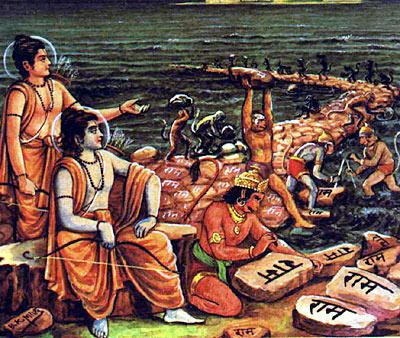
The Government of India again seems to be in the mood of going ahead with the Sethusamudram Shipping Canal Project that would reduce travel time for ships around coastal Tamil Nadu and Sri Lanka, and bring economic advantages to both countries. The project involves breaking limestone shoals that some regard to be the remains of the mythological Ram Setu. The controversy is an old one. In 2007, I had interviewed Hindutva ideologue Bharatendu Prakash Singhal, who was particularly vocal against the ‘destruction’ of the limestone shoals. Singhal is a former Rajya Sabha MP and a retired Indian Police Service officer. The bits from the interview that were directly about the Ram Setu controversy had appeared in Tehelka, but Singhal was more interested in talking about “mind, body and soul” than about Ram Setu. Here are the unpublished bits – though I had put them on my blog back then. Every word was transcribed faithfully from the recorded audio. Continue reading On Ram Setu: ‘Mahakaal ka ling kiya hain?’

What happens when a woman decides to walk to the sea in Karachi, all by herself?: Hira Nabi

This video post comes from HIRA NABI

http://vimeo.com/58865627

(Hira Nabi is a visual artist in Pakistan.)

22 Years after Kunan and Poshpora, Rethinking Kashmir: Abhijit Dutta

Guest post by ABHIJIT DUTTA; all photographs by the author unless otherwise mentioned

1-kunan 4

It looks like any other village in Kashmir.

You go past a wooden bridge, past open fields winter-barren and wet with rain. Past mountains with snow on their chin. Past wistful looking poplars. Past a brook with clear water. Past grumpy apple trees gnarled like a grinch.

Then the road narrows, and homes – of timber and brick – come into view. Some have fences, unpainted wood. Heaps of hay, dung cakes, piles of dried leaves left to smoke. Ditches and dykes choked with snowmelt. Leafless walnut trees and brunette willows. The chinars, wild redheads just months ago, now old and arthritic. There is a government school on the right, a madrassa on the left. A few houses of stone, fewer of concrete, tin roofs over all.

Before you walk any further, the village ends. The next village is Poshpora. Like Kunan before it, it looks like any other village in the valley. The two villages are so close that people no longer call them by their individual names. Everyone knows this two-in-one village as Kunan Poshpora. Continue reading 22 Years after Kunan and Poshpora, Rethinking Kashmir: Abhijit Dutta

India Slept Through a Revolution in Bangladesh: Richa Jha

Guest post by RICHA JHA

Dhaka, Bangladesh. 18th February 2013 -- A woman shouts on a microphone. -- A demonstration for the death penalty to be given to war criminals, is continuing at Shahbag crossroads, and has reached its fourteenth day,.
Dhaka, Bangladesh. 18th February 2013 — A woman shouts on a microphone. — A demonstration for the death penalty to be given to war criminals, is continuing at Shahbag crossroads, and has reached its fourteenth day,.

This morning, I changed the ‘sleep’ in the heading of this article to ‘slept’. I woke up to the news that Bangladesh’s nearly twenty days long mass uprising was now getting a structured exit. The most moving and visually spectacular part of the Shahbag movement was coming to an end. India, of course, slept through most of it. The past tense, suddenly, paints our selective insularity in even starker shades. Continue reading India Slept Through a Revolution in Bangladesh: Richa Jha

Footprints on a Timeline: Gayatri Ugra

Guest post by GAYATRI UGRA; photographs by JAYANT UGRA

1-20 _MG_2200

“I travel so that people will lose track of me. Then I write, so they can find me again.”

I read these lines by Pierre Foglia, and I know nothing else about him. I do know more about why I travel: to retrace lost tracks. And why I write: not for people to find me but for me to find my own self. The last journey I made was just that. A long walk back into my past, and from there to the present in Kashmir, a living, growing, tense reality that I had to visit.

Facebook never served a better cause than ours when we planned our trip last June. On the spur of a moment of nostalgia, I posted this message on my page: “A family holiday in Kashmir. Any takers? All we need now is a travel agent and a motivator.” I could not have anticipated the response: so many of us wanted to come, hoped to come. My brother Gopal took up the task of making travel plans, reservations, bookings for accommodation, and ultimately made it happen for the eight of us that finally went. Continue reading Footprints on a Timeline: Gayatri Ugra

Dear Sisters (and brothers?) at Harvard

Letter from  Indian feminists VRINDA GROVER, MARY E JOHN, KAVITA PANJABI, SHILPA PHADKE, SHWETA VACHANI, URVASHI BUTALIA and others, to their siblings at Harvard

We’re a group of Indian feminists and we are delighted to learn that the Harvard community – without doubt one of the most learned in the world – has seen fit to set up a Policy Task Force entitled ‘Beyond Gender Equality’ and that you are preparing to offer recommendations to India (and other South Asian countries) in the wake of the New Delhi gang rape and murder. Not since the days of Katherine Mayo have American women – and American feminists – felt such a concern for their less privileged Third World sisters. Mayo’s concern, at that time, was to ensure that the Indian State (then the colonial State) did not leave Indian women in the lurch, at the mercy of their men, and that it retained power and the rule of the just. Yours, we see, is to work towards ensuring that steps are put in place that can help the Indian State in its implementation of the recommendations of the Justice Verma Committee, a responsibility the Indian State must take up. This is clearly something that we, Indian feminists and activists who have been involved in the women’s movement here for several decades, are incapable of doing, and it was with a sense of overwhelming relief that we read of your intention to step into this breach. Continue reading Dear Sisters (and brothers?) at Harvard

I love the winter in your eyes: Uzma Falak

Guest post by UZMA FALAK

Winter of my eyes
took flight
Did you see?
These are not the same eyes
colors of which you would patiently decipher
sitting under the sun
for hours
gray dreams refusing to dissolve
in waters of Lethe. Continue reading I love the winter in your eyes: Uzma Falak

What is wrong with this picture? Carole Vance

Guest post by CAROLE VANCE

Two faculty members at Harvard, associated with gender studies, convene a Policy Task Force, designed to “to offer recommendations to India and other South Asian countries in the wake of the New Delhi gang rape and murder” and in this semester “to produce a working paper that advises on the implementation of the recommendations from the Verma Committee”.   This is not a student initiative, though a meeting with students is scheduled to invite their input, along with that of the larger Harvard community. Continue reading What is wrong with this picture? Carole Vance

Unintended consequences of feminist action: Prabha Kotiswaran

Guest post by PRABHA KOTISWARAN

Taking off from the debate here on the Harvard Task Force, I’d like to flag some  disagreements among feminists on law reforms. There are many strains to this debate – I will only engage with a few.

No feminist, whether of Indian origin or not, whether primarily located in India or not, is insecure about feminists/lawyers around the world working on rape in India. Circuits of feminist scholarship and activism become so inter-disciplinary and transnational that maintaining and policing turf (if at all that were possible) is an utterly useless endeavour. Continue reading Unintended consequences of feminist action: Prabha Kotiswaran

Harvard to the rescue!

Some good news for embattled and weary Indian feminists. All those endless submissions to the Verma Committee prepared and submitted, all those critiques of the Ordinance written and disseminated, all those street protests, all those meetings with students and the public, all those delegations to government officials, ministers…not to mention decades of efforts to amend the rape laws.

It’s been a long hard haul, so it’s a great relief that the Harvard Law School has stepped in to take this burden off our shoulders. Continue reading Harvard to the rescue!

When the Indian nation’s ‘conscience’ was satisfied: Gazala Peer

Guest post by GAZALA PEER

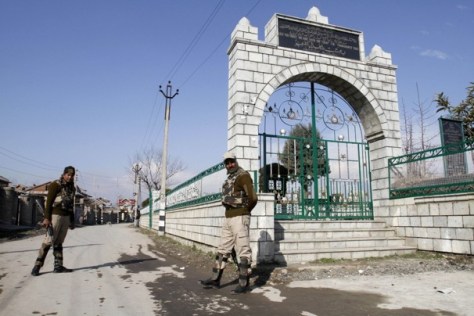
CRPF personnel stand guard at the martyrs' graveyard in Srinagar,preventing entry. The graveyard has a new empty grave, that of Afzal Guru. A similar empty grave waits for Maqbool Bhat, also buried in Tihar jail. Photo credit: Mukhtar Khan/Associated Press
CRPF personnel stand guard at the martyrs’ graveyard in Srinagar, preventing entry. The graveyard has a new empty grave, that of Afzal Guru. A similar empty grave waits for Maqbool Bhat, also buried in Tihar jail. Photo credit: Mukhtar Khan/Associated Press

People who mourn under siege are not supposed to write. We cry and beat our chests. Kashmiris have long faced such predicaments, always forced to find alternatives for everything. Anything that is normal and fair is denied to them! Like a fair trial, for instance. I am not sure if everybody knows Mohd. Afzal Guru’s story. I am not sure if I can be fair to him, but whatever I could gather from legal documents, commentaries and articles, is summarised here. Continue reading When the Indian nation’s ‘conscience’ was satisfied: Gazala Peer

Lessons from Delhi and Dhaka: Nagesh Rao and Navine Murshid

Guest post by NAGESH RAO and NAVINE MURSHID

Photo credit: AFP/Getty Images

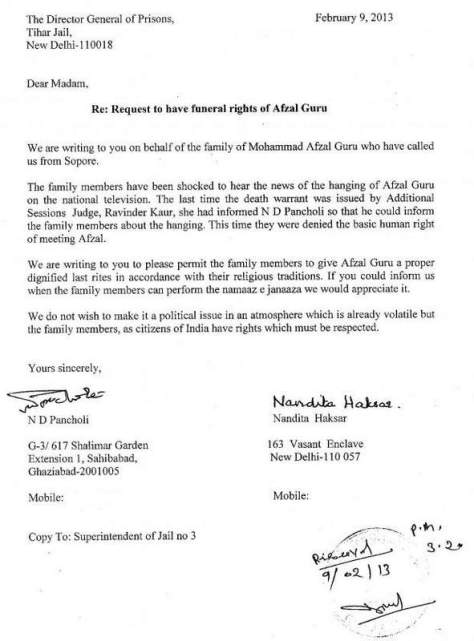
In the early hours of Saturday morning, a secret execution was carried out by the Indian government. Afzal Guru, a Kashmiri, was put to death for his alleged involvement in the 2001 attack on the Indian Parliament. Afzal’s family in Kashmir were cruelly denied a last visitation. They were informed that the Indian President had rejected his mercy petition, and of his imminent execution, by mail—the letter reached Afzal’s wife Tabassum two days after he was executed and buried in an unmarked grave inside Tihar Jail.

Meanwhile, across the border in Bangladesh, hundreds of thousands of Bangladeshis from all walks of life have occupied Shahbag Square near Dhaka University, outraged that a notorious war criminal might walk free after having been spared the death penalty by the Bangladeshi International War Crimes Tribunal. Abdul Quader Mollah, leader of the right-wing Islamist party Jamaat-i-Islami, and convicted of multiple counts of rape, torture and murder, was photographed flashing a victory sign as he left the court. Continue reading Lessons from Delhi and Dhaka: Nagesh Rao and Navine Murshid

Afzal Guru’s family demands his body

Do we have the right to a peaceful protest?: Warisha Farasat

Guest post by WARISHA FARASAT, who was present at the peaceful Jantar Mantar protest against the execution of Afzal Guru

We have been finally denied even the basic right to a peaceful protest. Two incidents over the last week have proven that only the right wing Hindutva groups have the right to protest in this country; the unbridled right to disrupt all other peaceful protests; and to ensure that the civil liberties groups are pushed even further against the wall. Two days ago, a peaceful student protest against Narendra Modi’s speech at Delhi University was met with brutal response, which has been reported extensively. Today, as Shuddhabrata Sengupta has poignantly pointed in his earlier post there were peaceful silent protests against the secretive hanging of Afzal Guru, and also for the abolition of the death penalty from the criminal statute books at Jantar Mantar. But what unraveled thereafter was shameful. The police watched and participated while young and brave University students, several of them Kashmiri, were beaten up. I saw young women with scarves, which were seen as a marker of their identity being targeted, groped, beaten, humiliated, abused, and finally arrested. Other respected civil liberties activists, lawyers, and even journalists were abused, kicked, beaten, and their faces blackened. Continue reading Do we have the right to a peaceful protest?: Warisha Farasat

Azaadi (Freedom) for ‘Pragaash’, an All Female Band from Kashmir

20130206-113749.jpg

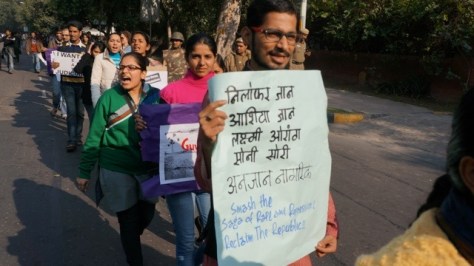
In the last month the streets of Delhi have echoed with a slogan familiar to many in Kashmir – ‘Hum Kya Chahtey ? – Azaadi !’ (‘What do we want ? – Freedom !’). Thousands of young women and men have chanted this slogan in Delhi while protesting against rape and sexual violence, and while doing so, they have also spoken out, with great courage and integrity, and carried explicit banners and signs about the fact that women in Kashmir have had to face rape and sexual assault by the AFSPA protected armed forces (the army, police, irregular counter-insurgents and paramilitary forces) of the Indian state. And no, the young people carrying these signs, and chanting these slogans, that talk about Nilofar and Aasiya Jaan, that name the atrocities and rapes that took place in Shopian and Kunan Poshpora have not been all Kashmiris. Some of them are Kashmiri students studying in Delhi University, JNU and Jamia Millia Islamia. But along with them, several of the young people who have been weaving the reality of Kashmir into the fabric of the protests in Delhi are not from Kashmir. Each time that they have walked with these signs and chanted these slogans – (and I have seen them in every gathering and every demonstration – their numbers are growing – as more young people in Delhi use the protests as sites of learning about the many complex realities of power and oppression) – they risk being branded as ‘traitors’ by the mainstream of Indian nationalist opinion, which can never question the Indian state’s conduct in Kashmir. They have tempered their sense of justice and deepened it with the substance of solidarity. Continue reading Azaadi (Freedom) for ‘Pragaash’, an All Female Band from Kashmir

Dear Pakistani friends, Put yourself in my shoes

I did not want to write this post.

There are enough Indian voices, from Times Now to Hindutva Online, who point fingers at Pakistan. Like M Ziauddin of the Express Tribune newspaper, I think that the two countries need more unpatriots – not people who ‘hate’ their own countries but who question their own nationalist narratives. People who ask: could we be wrong? Asking questions of yourself is difficult, and blaming the other is instant gratification of ego. Questioning yourself has long-term rewards in helping you make peace with yourself.

I am forced to write this piece because I continue to see well-meaning Pakistanis online continue to complain about the Bad Hospitality given by India to the Pakistani women’s cricket team in Cuttack in Orissa. The complainants online have included some of my Pakistani friends whom I know to be liberal, peace-loving and well-meaning, and who have clearly been influenced by some clever propaganda that is deliberately not showing them the full picture. Continue reading Dear Pakistani friends, Put yourself in my shoes

Our memories come in the way of our histories: Gowhar Fazili

Guest post by GOWHAR FAZILI

Our Moon Has Blood Clots by Rahul Pandita; Pages: 258; Vintage Books, Random House, India; Price: Rs 499

Rahul Pandita’s book Our Moon Has Blood Clots must be looked at both as a personal account of suffering as well as a political project that implicitly and explicitly makes use of that suffering towards a particular end. The undertaking is a legitimate one on both counts.  What the book manages to achieve on each, warrants a fair and dispassionate assessment.

His narration of events experienced by the Pandits is a welcome exposition of subjectivity around a range of traumatic events, humiliations, killings and betrayals undergone prior to and after the outbreak of mass political rebellion in Kashmir in 1989. The events thus narrated, especially the account of the personal experiences of trauma do make one strongly identify with the suffering of the families involved and agree with the wide swathes of subjective anger and hurt shared by the community.  The chilling accounts of individual and mass killings and the circumstances that made them possible, call for collective self-reflection, remorse and atonement. This account also calls for serious reflection on the fragility of human associations and trust in exceptional circumstances that we normally take for granted.

The book as well as the promotional interviews around the book push the claim that not only certain militants but also many ordinary people, including those personally known to the victims, were responsible for the exodus through their acts of omission and commission.  This claim is substantiated through a range of indictments based on personal encounters with individuals, shared nuggets of information, as well as the interpretation of the larger political symbolism and slogans which were seen as a deliberate attempt to intimidate Pandits, and Pandits alone.  While it is difficult to deny that a number of individuals took advantage of those anarchic times to gratify personal hate and lust for loot, it makes for an overstatement to underplay the equally frequent narrative of mutual support between individuals that one gets to hear during conversations between the members of the two communities privately. Such underplay does violence to those aspects of shared memory.  Continue reading Our memories come in the way of our histories: Gowhar Fazili