Category Archives: Genders

Implement Justice Verma Committee Recommendations Immediately: Freedom Without Fear Campaign

Guest Post from BEKHAUF AZAADI / Freedom Without Fear Campaign

UPA Government: Implement Justice Verma Committee Recommendations Without Delay!

The Report submitted by the Justice Verma committee marks an important measure of victory for the ongoing people’s movement against sexual violence, as well as for the decades of the women’s movement and democratic movement in India.

Continue reading Implement Justice Verma Committee Recommendations Immediately: Freedom Without Fear Campaign

Learning gender, learning caste: two reflections

We received two brief submissions separately sent by two women, reflecting on incidents in their childhood or youth that returned to haunt them more recently. Rethinking, reworking their own sense of self, they present before us questions both timely and urgent.

AYSHWARIA SEKHER looks back on her ignorance of caste, PRANETA JHA revisits a childhood game that taught her about sexual violence.

AYSHWARIA SEKHER

I was seventeen, and an undergraduate when I met this friend at hostel.  She was from a southern district of Tamilnadu almost near Kanyakumari. I was always amused by her southern dialect and teased her immensely, for it was very different from what I was used to speaking, being a northerner. She lived next door at hostel, so we got into conversations every time we bumped into each other. One evening she was sweeping her room and cleaning it.  I stopped by to see the way she swept so I could bully her.  As I observed I did realise that she was so much better than me at it and did it with ease. As we got talking, she revealed that she always did it at her home, and it was not a task for her.

Ignorantly I enquired why they did not have a help at home, which according to me was something that every household possessed. She looked at me, and brushed aside the question plainly, saying simply that they just didn’t have any help. I pestered with the question giving her no space. She stopped sweeping and rested her hand against the wall and said that people would not come to her house to work. I was amazed at why people would not go to a home for work.  So my cross questions persisted and she had no choice but to answer.

Continue reading Learning gender, learning caste: two reflections
Remembering Laxmi Orang and the Gender Question in Assam: Mayur Chetia and Bonojit Hussain

Guest post by MAYUR CHETIA AND BONOJIT HUSSAIN

The Delhi gangrape case has led to country-wide outrage, with young women and men still pouring out on to the streets to protest against the widespread culture of sexual violence. The outrage has not just stopped at Jantar Mantar, India Gate or university campuses; it has also led to a wave of intellectual reflection on the issue. For most protesters the demand for justice has not stopped with the Delhi gang rape victim, but has led to a demand for justice for all victims of sexual violence. These protesters have forced us to remember a litany of names that get buried by the TRP driven media and a public with a notoriously short attention span of memory. It is time to remember names that we are losing to public amnesia, names like Soni Sori, Manorama, Asiya and Neelofar. It is time we remember another forgotten name – Laxmi Orang.

 In the Interest of Remembering: Who is Laxmi Orang?

On 24th November 2007, Laxmi Orang, a young adivasi woman, was forcibly stripped naked, thrashed and paraded by a violent mob of “mainstream” Assamese [1] men. This took place just 100 meters away from State Legislative assembly, in the very heart of Guwahati, in the full glare of the media and police forces. As with her fellow protesters, it was her first trip to the city, the mythical land where the modern day Swargodeo’s [2] listen to their subjects, where appeals are heard, where miracles happen, where riches and wonders thrive. She had come to the city as participant of a protest organized by the All Adivasi Students’ Association Assam (AASAA) to demand Schedule Tribes status for the Adivasi community of Assam. Continue reading Remembering Laxmi Orang and the Gender Question in Assam: Mayur Chetia and Bonojit Hussain

Letting Go of Fear: Tenzing Choesang

Guest post by TENZING CHOESANG

Nine years ago, on a hot summer day, I was sitting in the New Delhi railway station waiting for a train to Dharamsala where I had planned to do my summer internship in a human rights organisation. There, I met a person who used to live in the same locality as I did when I was a child. He asked me where I was headed and I excitedly told him about the summer internship I was going for. He gave me a sympathetic look and said in Nepali “God, what all, daughters have to do these days”. I was taken aback by his statement but I knew where it was coming from. I come from Sikkim, a beautiful state in the foothills of the Himalayas. Students from Sikkim generally come to Delhi for graduation and after completing their higher studies most of them return back. After their return, they either start their own businesses or get into comfortable government jobs and live with their parents. This is how things work there. So, I think he felt bad for me since he thought that I was being made to “face the big bad world” when I could have gone back home happily. I didn’t agree to his logic then and have not till date. Continue reading Letting Go of Fear: Tenzing Choesang

From Delhi to Djakarta, Protests Against Sexual Violence Across Borders: Bonojit Husain

Guest post by BONOJIT HUSAIN

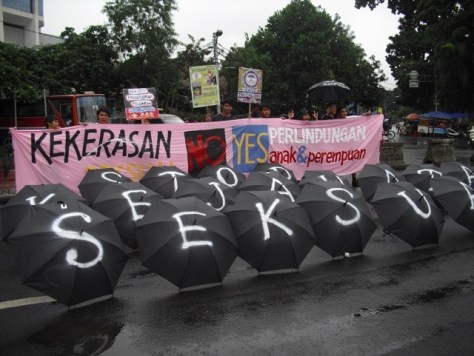
20130115-211244.jpg

(Photographs courtesy: Pipit Apriani who is a Jakarta based activist and a blogger)

Protests against sexual violence are spreading across Asia. Last week demonstrations against rape and sexual violence were held in Nepal, Bangladesh, Pakistan and Sri Lanka.

Inspired by the protests held in Delhi for last three weeks, hundreds of university students and activists march on the streets of Jakarta few hundred meters away from the Presidential Palace for a world free of sexual violence. The call for the protest march was given by a coalition of University Students’ Unions and civil society organizations in response to the death of RI, a 11-year-old girl, who died last week after suffering severe vaginal and rectal injuries due to repeated sexual assaults. Continue reading From Delhi to Djakarta, Protests Against Sexual Violence Across Borders: Bonojit Husain

Against Castration: Himika Bhattacharya and Deepti Misri

Guest post by HIMIKA BHATTACHARYA and DEEPTI MISRI

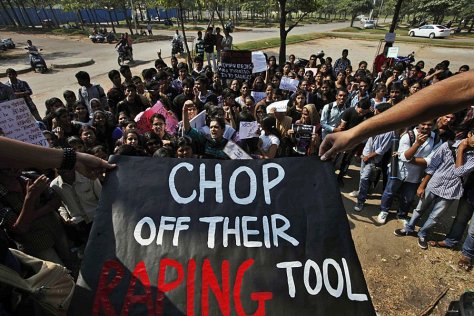
some-protestors-have-been-calling-for-rapists-to-be-castrated

The public preoccupation with both the death penalty and castration as punishment for rape continued last week, with the Pakistani activist Asma Jahangir reportedly suggesting that the rapists of the Delhi rape case be either punished with castration or else face the death penalty.[1] The consistent demand for punitive castration in India may be somewhat boosted by the Indian media reporting the following developments – last week, the South Korean court ordered Asia’s first chemical castration[2]; the Malaysian bar is pushing for castration[3] as a punishment for repeat sex offenders; and that such punishment has reportedly been long used in other countries[4]such as Germany, Denmark, and some states in the U.S. Continue reading Against Castration: Himika Bhattacharya and Deepti Misri

Stalking, Delhi Police and Memory – Another Encounter: Kavita Krishnan

Guest Post by Kavita Krishnan

I have been wanting to post about an experience with Delhi police since yesterday, but haven’t found the time yet… Here goes.

Some days ago, (early this month if I recall rightly), I got a call from a woman worker living in Usmanpur near Seelampur. She got my number through the son of one of our Trade Union comrades, who is a friend of her brother’s. She said she was being stalked by a man who made calls to her thretening an acid attack. She has 3 children and was concerned for their safety too. She told me she was scared to complain to the police, and asked for advice. I was reluctant to advice a police complaint without her being fully ready, knowing that it might not yield satisfactory results. So I suggested we meet and talk things over before deciding.

But soon after, she called again: feeling buoyed by a sense of hope arising from the ongoing movement, she had gone to the police station – alone – and written out a complaint, giving the stalker’s mobile number, the number of his bike, and offering to share recordings she had made on her phone of the threat calls. She said, though, that the police had not given her any proof of having received or recorded her complaint (in spite of her asking).

Continue reading Stalking, Delhi Police and Memory – Another Encounter: Kavita Krishnan

Some thoughts on rape, sexual violence and protest – responding to responses: Devika Narayan

Guest Post by Devika Narayan

Rarely does a city experience the sort of upheaval that Delhi is witnessing.  Everyone is talking about it. Everyone has an opinion. It is impossible to walk down the street without overhearing snatches of conversation. Issues that usually find brief mention in some obscure corner of the newspaper are now being subject to analysis by every passer-by. A rickshaw driver refuses to take any money when he realises I am on my way to a protest. I remember the old man at a photocopy shop who had looked up and asked no one in particular: do you think she will die? The receptionist at the doctor’s clinic is distraught, providing waiting patients her explanation for the recent events. Men huddled around tiny fires littered across the foggy city carp on about the state of politics, the police and the government. Everyone is invested in this moment of reckoning.

An opportunity, in the most brutal manner, has been thrust upon us to challenge, critique and reconstruct unjust social relations. This is an opportunity to pledge our commitment to a vision of a gender just society. Unless we assert in powerful ways that women are autonomous beings and equal citizens it will not end. Continue reading Some thoughts on rape, sexual violence and protest – responding to responses: Devika Narayan

Engendering the Sovereignty of the Islamic Republic of Pakistan: Afiya Shehrbano Zia

Guest post by AFIYA SHEHRBANO ZIA

431247-zafaraslamisl-1346769071-809-640x480

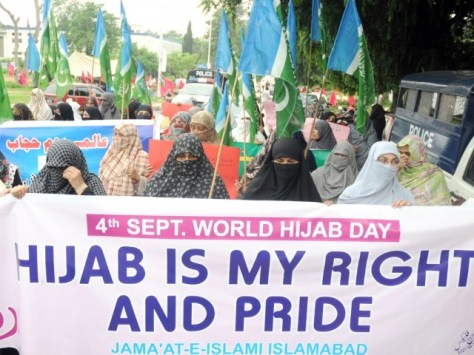
The Islamia College in Karachi is the hub of the Islami Jamiat-e-Tulba (IJT) [1]. Last year, the nationalist banners displayed near the college to mark Pakistan Defense Day (6th Sept), were strategically flanked by two complementary gendered messages. One such banner publicized the event (in Urdu) as ‘Hejab Numaaish’ (Parade of the Hejab – 4th Sept) and below it, in English ran the claim ‘Hejab is My Right and Pride’. The other banner declared simply, ‘Afia[2] is our Pride’. Both messages are signifiers and comments on the re-visitation of the themes of religious and nationalist agendas, played out across the body politic of women, in a post 9/11-Pakistan.

This essay discusses the resurgence of a new form of religious nationalism and its impact on the narrative of gendered politics in Pakistan. It also examines the worth of a recent body of Pakistani scholarship[3]that opposes the misguidedness of liberal-secular resistance to religious politics. Instead, such academic work invests hope in something termed, ‘Islamist secularization’. Continue reading Engendering the Sovereignty of the Islamic Republic of Pakistan: Afiya Shehrbano Zia

Male students, female teachers and patriarchy in the classroom: Snehlata Gupta

Guest post by SNEHLATA GUPTA

Smug patriarchal pronouncements about ‘dented and painted’ women and ‘rape in India and Bharat’ brought back to me an experience I faced in the classroom some years ago.

I teach English in grades 11 and 12 in a co-ed school in Delhi. That year I had this rather ‘difficult’ boy in class. I can’t remember now how the discussion really began. The discussion got to the point where students were talking about the amount of freedom available to girls and boys and why girls have far less ‘freedom’ than boys. It was somewhere at this point that this boy stood up (unlike the regular practice of standing to speak in the classroom, I insist students should sit and talk in my class) and stated with complete confidence that  ‘if girls dress so provocatively boys can’t help themselves.’

I remember being completely aghast at this blatant show of patriarchal arrogance. I went all hot and cold in the same moment. Continue reading Male students, female teachers and patriarchy in the classroom: Snehlata Gupta

Freedom in Three Acts: @Koinon3a

Guest post by @KOINON3A

New Friends Colony Park, 1996.

There’s a funny telepathy between people running or walking in opposite directions along a narrow jogging track. You both move to one side to avoid bumping into the other, only to find that the other person has moved in exactly the same direction you have. We exchanged half smiles at this long before we actually collided. As we approached each other, I smiled more widely as an acknowledgment of having managed to get it right and avoid each other.

His pockmarked face broke into a smile too. And in the moment he passed right by me, he reached out and grabbed my left breast hard and then moved on. Something I couldn’t have planned or thought about happened; I snapped like a brittle twig, swung around and went after him. His back was turned to me and he didn’t expect this. I hit him in the middle of his back with my fist, my keychain around my fingers giving him an additional gouge. He whirled around, surprised, the mouth now a quivering O, and went for my chest again.

Continue reading Freedom in Three Acts: @Koinon3a

Come Frolic with Me in the Streets of Delhi: Amrapali Basumatary

Guest post by AMRAPALI ‘TARA’ BASUMATARY

Another Report on the Gathering of the Night of 31st of December 2012/Ist January 2013 against Patriarchy in Delhi

It was 31st December 2012, city-Delhi, the same Delhi which has gained the infamy of being the Rape-Capital of a country called India, a nation whose ‘dignity’ has been maligned by the increasing cases of sexual assault on women. Around three hours before the clock struck the decisive moment of New Year, many of us gathered at the PVR Anupam complex in Saket to “take back the night”, back from the shackles of misogyny, sexual assault, patriarchy and above all from the banal and real fear of being subjected to crimes meted out by multifarious forms of male-supremacy and power. It was a night when ‘dented and painted’ females as well as males were showing that ‘denting and painting’ are not reasons that ‘invite’ rape or sexual assault and those ‘hormone driven gazes’. Continue reading Come Frolic with Me in the Streets of Delhi: Amrapali Basumatary

The Bitter Truth Regarding Delhi Police’s Womens’ Help-Line: Kavita

Guest post by KAVITA, an activist with the Stree Mukti League

Translated from Hindi by Shuddhabrata Sengupta

It would be natural to expect that in the wake of the barbaric Delhi gang-rape of December 16 and subsequent popular upsurge of anger the police and the state machinery would betray a modicum of sensitivity and alertness. The reality is just the opposite of what you expect. We have heard this from many women in the past few days, and a few evenings ago, came face to face with this sad fact ourselves.

For the last few days, we (activists of the Stree Mukti League) have been going to different places in Delhi to hold meetings, demonstrations and to distribute leaflets against sexual violence. The leaflet has a contact phone number for the Stree Mukti League. Since the evening of the 1st of January this year a perverted male individual has been continuously ringing that number, abusing us, threatening us, using obscene and unprintable language. He even said ‘I know all you girls, and you cannot escape me. What I will do to you will terrify people…’, and several other things which cannot be repeated. Continue reading The Bitter Truth Regarding Delhi Police’s Womens’ Help-Line: Kavita

Unlearning submission: Neha Dixit

Guest post by NEHA DIXIT

In the last fortnight, we unlearned submission. On December 16, a 23 year old girl, just on the brink of leading a socio-economically independent life was raped in a moving bus at 9.30 at night.

We saw protests, we saw outraged masses. It is the first time in the history of this nation, when people were out on the streets on the issue of gender. For more than two weeks in a row. And it continues. Figures have been thrown at us: every 20 minutes a woman is raped in India, every third victim is a child, according to the National Crime Records Bureau.

At one of these protest sites, the car parking contractor informed me that they have slashed the parking charges from 30 bucks to 10 bucks in solidarity with the girl and her family. This may be dismissed as a ‘simplistic’ contribution by those who have been accusing these protests of being ‘middle class’. But we need to hit the core, to understand the wider repercussions of the Parking contractor’s this simple act. Continue reading Unlearning submission: Neha Dixit

You were amongst those six; un chhay main tum bhi shamil thay: Swaang Songs

This song in memory of the unknown citizen is produced by Swaang, a Bombay based cultural group, whose members include actors, writers, music directors, musicians and producers “all in the grips of the market-driven Bombay film industry, but whose hearts continue to pull towards progressive politics!”

Composer – Rohit Sharma
Lyrics – Ravinder Randhawa
Singers – Rohit Sharma, Pankaj Badra, Pinky
Narration – Pravishi Das, Ravinder Randhawa

English translation of ‘Maa Nee Meri’

Mixed in every morsel,
What was that chant you kept repeating?
In the garb of concern and worry,
Why was fear the only virtue I learnt of your teaching?
Mother, I will not fear
Mother, I will not become you. Continue reading You were amongst those six; un chhay main tum bhi shamil thay: Swaang Songs

Notes from a bachelorette party in New India: Swathi Sukumar

Guest post by SWATHI SUKUMAR

Last week, I went to a bachelorette party. The party props were unbelievable to the point of being ridiculous—shot-glasses shaped like body parts, kinky trinkets, balloons in unmentionable shapes and sizes—and other items that would have made many women of another generation collapse in horror.

At the end of the party, everyone was slightly drunk and a good deal of time had been spent asking the bride-to-be embarrassing questions and cracking dirty jokes.  I realized that our revelry had a close parallel in the cult classic “The Hangover”, a story of four men who go to Las Vegas to celebrate a very eventful bachelor’s party. Our party shared common themes from the script of the movie, including inebriation and the obsession with bodies, both perfect and imperfect. We missed the tiger and the stripper from the movie, but I am told that strippers are a very common feature in bachelorette parties in India.

Tigers are not common, I hope. Continue reading Notes from a bachelorette party in New India: Swathi Sukumar

Justice for Soni Sori. Gathering at Jantar Mantar, 02/01/13

Protests against Sexual Violence continue in Delhi. Earlier this morning, there was a gathering to protest against the gruesome sexual violence committed on Soni Sori while in custody in Chhattisgarh under the supervision of Ankit Garg, Superintendent of Police, Dantewada. Ankit Garg was awarded with a presidential police medal on Republic Day (January 26) in 2012.

Soni Sori’s petition at the Supreme Court is due to be heard tomorrow. Continue reading Justice for Soni Sori. Gathering at Jantar Mantar, 02/01/13

The epiphanic moment of the lathi charge

At the Khan Market Metro station

The girl wasn’t aware that the Udyog Bhavan Metro station in central Delhi had been shut down. In the Metro going to Gurgaon, she needed to get down at Udyog Bhavan. Her friend was waiting in a car outside the station. She waited at the door. The train stopped too, but the gates didn’t open. The PA system — the annoying PA system of the Delhi Metro that never stops saying something or the other — – fell silent. The station was deserted. Not a soul in sight.

The girl asked fellow passengers — all of us men around her — which would be the nearest station that would be open. All the options were far off. Ramakrishna Ashram station on one end, for instance, was four kms. away. “Now what?” the girl asked her friend on the phone in a tone that blamed him, in a way only lovers can. “Now what?” she kept repeating. Continue reading The epiphanic moment of the lathi charge

Naye Saal Mein Azaadi – Freedom from Fear in the New Year

[ Click to play above Youtube video of young women and men, led by Com.Lokesh (‘Lucky’) of Stree Mukti Sangathan (Women’s Liberation Organization) articulate their desires on the ‘Take Back the Night’ night walk and street party from Anupam PVR Complex to the road outside Select City Walk in Saket, New Delhi on the night of the last night of 2012 and into the early hours of 2013. ]

Delhi took back the night as we moved into the new year. Took it back from fear, from patriarchy, from misogyny and a stupid state. They said it loud and clear. This is what I remember, roughly in this order. Continue reading Naye Saal Mein Azaadi – Freedom from Fear in the New Year

Notes from a Night Walk in Delhi University

[ B&W pictures, courtesy Chandan Gomes. Colour pictures and cell phone video footage, courtesy, Bonojit Husain, New Socialist Initiative ]

Dear young women and men of Delhi,

I am writing to you again because I have been listening to you. This is a strange time, when everybody is talking, and everybody is listening, and the unknown citizen, who could have been any one of you, has transformed us all.

I was with you last night, from five thirty in the evening to around nine at night, while we walked together from the Vishwavidyalaya (University) Metro Station to Vijay Nagar, Kamla Nagar and the North Campus of Delhi University. There were around twelve hundred of you. Several of you held candles. You made yourselves into a moving blur of light. As the shopkeepers of Vijay Nagar, as the rent collecting aunties of paying guest accommodations, as the men and boys and girls and women on the streets and in the verandahs looked at you in wonder, you looked back at them, many of you smiled and waved. I could see some people in the crowd lip-synch with your Hallabols.

[ video of the night march near Delhi University ]

Continue reading Notes from a Night Walk in Delhi University

In Memory of The Unknown Citizen

We may never know her name. But not every memory needs a name or a pile of stone. Her memorial need not claim space on a city street, or square, or on the river-front. Let the well-known Leader and the Unknown Soldier have their real estate, but for the Unknown Citizen, let us not fire gun salutes, fly flags at half-mast or build portals and pedestals. And let us not for even a moment imagine that instituting police measures against the people the Prime Minister calls ‘foot-loose migrants’ will mean anything remotely resembling justice.

We can think about what the contours of enduring justice can be without being hangmen. Only safe cities, safe towns and safe villages, and freedom for all men and women will mean justice. Justice does not come from the gallows. It springs from a freedom from fear, and the gallows only perpetuate fear. Hangmen will turn the bullies who rape into the cowards who will automatically murder so that there may not be a trace of their rape. It will make fathers who rape their daughters into fathers who rape and murder their daughters. Capital punishment will lead to less, not more convictions for rape and heinous sexual violence. That can never lead us to justice. Continue reading In Memory of The Unknown Citizen