Category Archives: Government

Making Mockery of Panchayati Elections : Shivnarayan Rajpurohit

This is a guest post by SHIVNARAYAN RAJPUROHIT : A school teacher in Rayapuram village of Mehabubnagar district (Andhra Pradesh) summed up the sentiment of the village: “Without a sarpanch [an elected village-chief], this village is like a rudderless ship. The implementation of government schemes has gone from bad to worse. The government has appointed special officers, who hardly have any bonding with villagers in each panchayat.” Recently, the state government of Andhra Pradesh (AP) decided to conduct the panchayati elections in April-May 2013, which have been overdue since July-August 2011. What were the reasons for this postponement? Continue reading Making Mockery of Panchayati Elections : Shivnarayan Rajpurohit

Crimes of Exclusion: Siddharth Narrain

Guest post by Siddharth Narrain.

It is anger on the streets that brought back to the forefront the neglected issue of sexual violence, energized a government appointed Committee to put together clear and well reasoned recommendations on law reform, and forced the government to table the Criminal Law Amendment Bill (2013).  It is public pressure and years of struggle by the women’s movement that is reflected in the more progressive parts of the Bill, passed recently by both Houses of Parliament.  Unfortunately, despite unanimity from a large cross section of society, that the definition of rape cannot be restricted to an outdated understanding of rape as perpetrated by men on women, the version of the Criminal Law Amendment Bill that was finally passed by Parliament retains this language. The law, if passed in this form will be a betrayal of the rights of millions of transgender persons, intersex persons and sexual minorities not born women.

Continue reading Crimes of Exclusion: Siddharth Narrain

Reject the National Food Security Bill: Right to Food Campaign

This release was put out by the RIGHT TO FOOD CAMPAIGN on 19 March 2013

More than 500 people of the Right to Food Campaign sitting at Jantar Mantar in New Delhi rejected the National Food Security Bill 2013 which was passed by the cabinet of the UPA Government today evening and will now be placed in the Parliament in this session.

NO TIME FRAME FOR IMPLEMENTATION

People were shocked to learn that according to the Bill that was passed, the law will not be applied in one stroke. The language of the law is that different dates may be appointed for different states and different provisions for the implementation of the Act.  This clearly means that there is no time frame for full implementation or objective criteria for phased implementation. It means the government in power has the choice to decide which state and what provisions need to be implemented. We condemn this as being against the fundamental rights of the people and the federal nature of the Indian state.  This also clearly shows that the Government is not really committed towards ensuring the end of food insecurity of the teeming millions of the country. Continue reading Reject the National Food Security Bill: Right to Food Campaign

On Narendra Modi’s strange bedfellows in Washington DC: Zahir Janmohamed

Guest post by ZAHIR JANMOHAMED

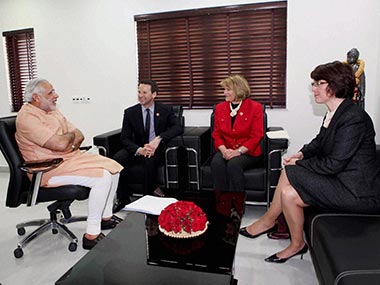
PTI photo
PTI photo

The headline on Zee News at 5:09pm today read: “America opens its gates for ‘very dynamic’ Narendra Modi.”

The Business Standard in an article posted a few minutes earlier, at 4:57pm, wrote: “After UK, now US softens stand on Modi.”
Indeed three members of the US Congress, along with a few US business leaders, did meet with the Gujarat Chief Minister today in Gujarat. But should we infer any shift in US policy towards Narendra Modi?

In short, no.
Continue reading On Narendra Modi’s strange bedfellows in Washington DC: Zahir Janmohamed

Lok Sabha committee tells Kapil Sibal to re-examine the Information Technology Rules 2011

SFLC.in has a quick summary:

The Thirty-first Report of the Committee on Subordinate Legislation (2012-2013) was presented in the Lok Sabha today on 21 March, 2013 by Shri P. Karunakaran, Chairman of the Committee.

The Committee examined the following rules:-

(i) The Information Technology (Reasonable security practices and procedures and sensitive personal data or information) Rules, 2011[GSR 313(E)]

(ii) The Information Technology (IntermediariesCommittee Report Guidelines) Rules, 2011[GSR314 (E)]

(iii) The Information Technology (Guidelines for Cyber Cafe) Rules, 2011[GSR315(E)]

(iv) The Information Technology (Electronic Service Delivery) Rules, 2011[GSR316 (E)]

The Committee made the following observations: Continue reading Lok Sabha committee tells Kapil Sibal to re-examine the Information Technology Rules 2011

A summary of the National Food Security Bill, 2013

This summary of the National Food Security Bill 2013 (revised version, as tabled in Parliament, 22 March 2013) comes to us via Jean Dreze

1. Preliminaries

The Bill seeks “to provide for food and nutritional security in human life cycle approach, by ensuring access to adequate quantity of quality food at affordable prices to people to live a life with dignity and for matters connected therwith and incidental thereto”.

It extends to the whole of India and “shall come into force on such date as the Central Government may, by notification in the Official Gazette appoint, and different dates may be appointed for different States and different provisions of this Act”. Continue reading A summary of the National Food Security Bill, 2013

Why the Delhi Police Special Cell will continue to manufacture terrorists: JTSA

This release was put out yesterday by the JAMIA TEACHERS’ SOLIDARITY ASSOCIATION

Last year, JTSA compiled and released a report documenting 16 cases where the Delhi Police, especially its Special Cell, had framed innocents as terrorists. An overwhelming number of these unfortunate men were from Kashmir. Despite the fact that we cited court judgements which reprimanded the Cell for refusing to join independent witnesses, for willfully violating established procedures, for illegally detaining accused and showing their arrests on later dates; for fabricating evidence and failing to provide an iota of evidence in support of their charges – neither the leadership of the Delhi Police nor the Home Ministry felt the need for any enquiry. Continue reading Why the Delhi Police Special Cell will continue to manufacture terrorists: JTSA

When rape survivor becomes victim: Sherin B.S.

SHERIN B.S. writes from Hyderabad: There is a constant demand for a change in the terminology from ‘rape victim’ to ‘rape survivor’ in the agenda of feminist concerns in discourses related to rape. But beyond the feminist investment on surviving rape, a systematic reading of public discourses presents the traumatic sustenance of layers of violence that follows rape. The Suryanelli girl has survived rape, but the violent experience of life after rape perpetrated by systemic structures of patriarchy places her at the receiving end of a system that consciously alienates, humiliates and hunts her down.

While referring to the Suryanelli rape case there are two kinds of discourses circulated widely. One is the question of legality of the crime involved, with a heavily prejudiced and unsympathetic legal frame work attempting to frame the girl as an eternal victim subject for whom justice is almost impossible, mediated through parallel machinery of the state, including law enforcement. The impossibility of justice is not the intention of the legal machinery but it comes through the operating forces of judgments, prosecution stands, law enforcing offices like police stations and officers, and questions of evidence, alibis and so on. Continue reading When rape survivor becomes victim: Sherin B.S.

Some Urgent Considerations on Genetically Modified Crops and Food Security: Neha Saigal

This is a guest post by NEHA SAIGAL: The Budget Session is upon us and we might be witness to one of UPA’s most ambitious flagship programmes, the National Food Security Bill (NFSB), becoming a reality. So it seems like Food Security is the flavour of this session with President, Mr Pranab Mukherjee, reiterating UPA 2’s commitment to food security in his maiden speech at the start of the Budget Session.

But this commitment comes under serious question when one of the responsible agencies of the Government dilutes the issue of food security and further misleads the debate on an important issue like hunger and malnutrition. I am referring to the Ministry of Agriculture (MoA) under Sharad Pawar mindlessly promoting GM crops as a solution to food security. Continue reading Some Urgent Considerations on Genetically Modified Crops and Food Security: Neha Saigal

The Great Right-Wing Convergence – Towards 2014: Ruchi Gupta

Guest post by RUCHI GUPTA

For those of us, whom the well organized Right on the internet describes as “sickular”, the prospect of Modi as Prime Minister is unthinkable. Congress is then a reflexive default – not a party of choice. Its secular credentials too are tarnished with 1984, but its communal capitulations are opportunistic (and thus contained) unlike the BJP with its official Hindutva party plank. Moreover with all its corruption and contradictions, the Congress has always had a strong left-liberal strand, providing some space for engagement to further progressive agenda, enacting for instance the landmark Right to Information Act, NREGA and FRA. However faced with a Rahul Gandhi versus Modi contest – the former a reluctant prince leading a dithering party, the latter the decisive machismo king of no-nonsense governance – it appears that Congress has decided to move so far to the Right that 2014 looks set to become a Modi versus ‘sickular’ Modi contest.

Continue reading The Great Right-Wing Convergence – Towards 2014: Ruchi Gupta

Nine prisoners at risk of execution in India: Amnesty International

Statement put out on 21 February by AMNESTY INTERNATIONAL

Following two recent secret executions in India, there is fear that the Indian authorities may execute nine other prisoners whose petitions for mercy have not yet been ruled on.

The mercy petitions of eight men and one woman are pending with either the Union Home Ministry or the President: Gurmeet Singh, Dharampal, Suresh, Ramji, Praveen Kumar, Jafar Ali, Sonia (f), Sanjeev, and Sundar Singh. Ministers have publicly stated that decisions on some of these petitions will be made soon, putting the nine in imminent danger of execution. Continue reading Nine prisoners at risk of execution in India: Amnesty International

The Hyderabad blast investigations are doomed to fail: JTSA

This release was put out today by the JAMIA TEACHERS’ SOLIDARITY ASSOCIATION

hyderabad-blasts-probe-feb2

In a grotesque replay of every investigation that follows a bomb blast, prejudice, misinformation and media blitz rules the direction of Dilsukh Nagar bombings investigation too.  The same suspects and shadowy organizations are being paraded as executors of the Hyderabad bombings.

But should we be surprised? A day after the Home Minister’s humiliating capitulation to the RSS-BJP, virtually giving them and their affiliates a clean chit, the message to the investigating agencies must have been crystal clear.  When the Home Minister himself discards the bulk of allegations and material pointing to the existence of Hindutva groups in planning and executing terror attacks, should we really expect the investigating agencies, whose past record inspires hardly any confidence, to sincerely pursue all possible angles and leads? This, when Messrs Aseemanand and company are being tried for the 2007 bombing of the Mecca Masjid.  By asserting that Hyderabad bombing may have been a reaction to the execution of Kasab and Afzal Guru, the Home Minister himself foreclosed any possibility of unbiased investigation. Continue reading The Hyderabad blast investigations are doomed to fail: JTSA

PUCL statement on Hyderabad blasts

This statement was put out today in Delhi by the PEOPLE’S UNION FOR CIVIL LIBERTIES
PUCL strongly condemns the serial  blasts in Hyderabad on 21.02.2013 which has resulted in loss of life and grievous injuries to many. PUCL extends its sympathies to the families of all those who lost relatives and hopes that the injured recover speedily.
PUCL  re-iterates its stand that all organizations – whether State or non- state players – functioning for the people and in the public arena are accountable and answerable for their acts. PUCL appeals to all organizations to refrain from acts of mindless violence, especially when they endanger innocent persons.  Violence can never offer a solution to any issue however genuine it may be.  Continue reading PUCL statement on Hyderabad blasts

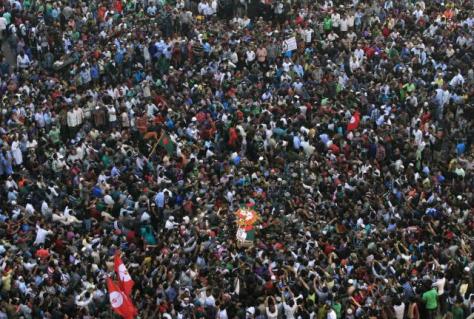
Shahbagh: The Forest of Symbols: Naeem Mohaiemen

This is a guest post by NAEEM MOHAIEMEN

Shahbagh_SyedLatifHossain
© Syed Latif Hossain

There is a particular way of lensing mass movements, when we are observing from within immediate tactics. In a fast moving situation, with opponents and allies squared off, the first thing to shrink is the space for internal critique. Professor Azfar Hussain uses the term “critical solidarity” for his approach to Shahbagh. A critique that seeks to help the movement, but also a critique some are not ready to hear yet.

For the last sixteen days, Bangladesh has been in an intense new political phase. The ground has shifted and been recast by the scale of the Shahbagh movement. The flash point was the sentencing of the “Butcher of Mirpur” (a war criminal who collaborated with the Pakistan army in 1971). But, by now, the demands have expanded to a call for a ban on the main Islamist party Jamaat-e-Islami, or even Islamist politics altogether. Older leftist thinkers like Badruddin Umar are daring to ask questions of the hallowed place of “state religion” in the constitution. Younger bloggers are urging all to make it clear that the movement is about war criminals, not religion. But of course, with war criminals conflated with the Jamaat-e-Islami, and that party eager to present themselves as standing for “Islam,” category errors will happen. Continue reading Shahbagh: The Forest of Symbols: Naeem Mohaiemen

People’s Watch Over Parliament: Bekhauf Azadi Campaign

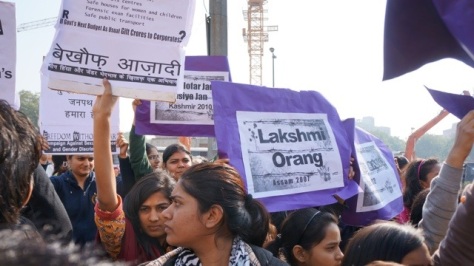
20130220-235633.jpg

  • Protestors at the ‘Freedom Parade’ Rally of the Bekhauf Azadi Campaign, New Delhi, 26 January, 2013

Guest Post by Bekhauf Azadi (Freedom Without Fear) Campaign.

People’s Watch Over Parliament: February 21, 1st Day of the Budget Session, Jantar Mantar
Gather in large numbers – 12 PM onwards at Jantar Mantar, New Delhi.
Are Our Lawmakers Ready to Listen to the Voice of the Movement Against Sexual Violence?

Continue reading People’s Watch Over Parliament: Bekhauf Azadi Campaign

Prof VK Tripathi and the fight for Schools in Juhapura: Zahir Janmohamed

Guest post by ZAHIR JANMOHAMED

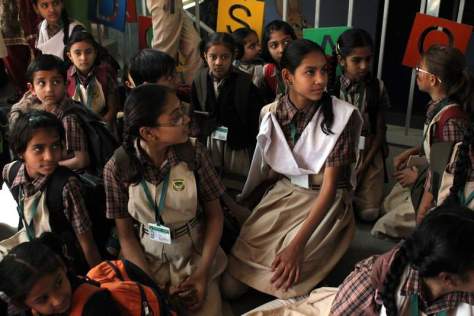
A school in Juhapura. Photo credit: Atish Patel

On Tuesday, February 19, the Ahmedabad Municipal Corporation ratified its budget and elected to build the first municipal school in Juhapura, the largest ghetto of Muslims in Ahmedabad. Juhapura was incorporated into the Ahmedabad Municipal Corporation five years ago and many residents wondered why the AMC took so long to build a school to serve Juhapura’s 350,000 residents. At the forefront of this struggle is IIT Delhi physics professor VK Tripathi. It was during a chance meeting with a sandwich shop owner in Washington DC that Professor Tripathi first learned about Juhapura. Continue reading Prof VK Tripathi and the fight for Schools in Juhapura: Zahir Janmohamed

Capital Punishment – An Agenda for Abolition: Yug Mohit Chaudhry

This is (a slightly modified) text of the second Shahid Azmi Memorial Lecture, delivered at the Indian Law Institute on 9 February 2013 by advocate YUG MOHIT CHAUDHRY. The lecture and its topic had been scheduled days in advance, but co-incidentally, Mohd. Afzal Guru was hanged in the morning of the day of the lecture. The Shahid Azmi Memorial Lecture has been instituted by his friends, comrades and students, who want to keep alive the memory of his inspiring work. Advocate was shot dead in his office on 11 February 2010, at the age of 32. At the time of his murder, Shahid was fighting several terrorism cases, including of those falsely accused in the Malegaon blasts and the 26/11 Mumbai attacks.You can read tributes to Shahid Azmi in Kafila archives by Mahtab Alam, Arvind Narrain and Saumya Una, and Susan Abraham.

In Furman v. Georgia (1972), where the U.S. Supreme Court struck down the death penalty, Justice Marshall said that if citizens were fully informed about how people are sentenced to death, they would find capital punishment shocking, unjust and unacceptable. However, research on the death penalty and public awareness of the exact nature of the death penalty have been the most neglected areas in the abolition campaign in India. The last three challenges to the constitutionality of the death penalty in India were rejected by the Supreme Court, inter alia, on the grounds that there is no empirical data to support the abolitionists’ claims. Unfortunately, the situation has not changed at all, and even now there is hardly any research on this subject. Therefore, the highest priority in any abolition campaign is to produce empirical research on the death penalty. That, and doing our utmost to stop each proposed execution and, failing that, to make it as difficult as possible for the state to carry out an execution, adopting all legal, political and social means at our disposal.   Continue reading Capital Punishment – An Agenda for Abolition: Yug Mohit Chaudhry

PUCL statement on the President’s rejection of the mercy pleas of four Veerappan associates

Press release put out on the evening of 16 February by the PEOPLE’S UNION FOR CIVIL LIBERTIES

CHENNAI: The PUCL strongly condemns the rejection by the President of India of the commutation petitions of Simon, Meesakara Mathayan, Bilavendran and Gnanaprakasam. Equally condemnable is the action of the Prison Authorities of Belgaum Central Prison, Karnataka who in the morning of 13.2.2013 merely intimated orally to the convicts of the rejection of their mercy petitions without giving them the written orders of rejection. In sharp contrast, signed acknowledgements of receipt have been obtained from all 4 convicts! Continue reading PUCL statement on the President’s rejection of the mercy pleas of four Veerappan associates

राष्ट्रवादी न्याय से करुणा की विदाई

“अगर हम ‘लोकतांत्रिक सरकारों के छिपे इरादों और गैरजवाबदेह खुफिया शक्ति संरचनाओं की जांच करने और उन पर सवाल उठाने से इनकार करते हैं तो हम लोकतंत्र और मानवता, दोनों को ही खो बैठते हैं.” पत्रकार जॉन पिल्जर का यह वाक्य आज हमारे लिए कितना प्रासंगिक हो उठा है! हमें नौ जनवरी को खुफिया तरीके से अफज़ल गुरु को दी गयी फांसी के अभिप्राय को समझना ही होगा. काम कठिन है क्योंकि इसे लाकर न सिर्फ़ प्रायः सभी संसदीय राजनीतिक दल एकमत हैं बल्कि आम तौर पर देश की जनता भी इसे देर से की गई सही कार्रवाई समझती है.

नौ जनवरी के दिन के वृहत्तर आशय छह दिसम्बर जैसी तारीख से कम गंभीर नहीं क्योंकि इस रोज़ भारतीय राज्य ने गांधी और टैगोर की विरासत का हक खो दिया है.अगर अब तक यह साबित नहीं था तो अब हो गया है कि भारत की ‘संसदीय लोकतांत्रिक राजनीति’ का मुहावरा उग्र और कठोर राष्ट्रवाद का है. और राजनीतिक दलों में इस भाषा में महारत हासिल करने की होड़ सी लग गयी है.

Continue reading राष्ट्रवादी न्याय से करुणा की विदाई

Secret hanging a major setback: Human Rights Watch on the execution of Afzal Guru

Statement put out on February 9 by HUMAN RIGHTS WATCH

(New York) –The hanging in New Delhi of Mohammad Afzal Guru makes it more urgent for India to reinstate its previous informal moratorium on executions as a step towards abolishing the death penalty, Human Rights Watch said today. Azfal Guru, executed on February 9, 2013, was convicted for his role in the attack on the Indian parliament in 2001.

In November 2012, India ended its eight-year unofficial moratorium on executions when it hanged Ajmal Kasab, convicted for his role in the 2008 Mumbai attacks. Continue reading Secret hanging a major setback: Human Rights Watch on the execution of Afzal Guru

Two Encounters with the Right Wing: Anonymous

Guest post by an ANONYMOUS student of DU who is afraid, not of the Right Wing, but of the university administration. We can be very proud of our democracy.
I
I have never been so scared of being a minority before. Today I saw two Kashmiris (a girl and a boy) being chased by a mob in what was to be a silent protest. I don’t know when and what circumstances will bring me to running from a mob to save myself. No one deserves to live in fear. Not me, not the two Kashmiris, not even a fiend.
Said a friend who witnessed the saffron mob at Jantar Mantar.
Today, no one can tell me that India is democratic, that India is secular. Today no one can tell me that India is free. Today I saw a glimpse, just a glimpse of what Hindutva truly is, and it was terrifying.
I went to Jantar Mantar for a silent protest against the hanging of Afzal Guru and for the abolition of capital punishment. We reached a little late, and by the time I reached, the number of people had reduced considerably. Why? Because the police had rounded up and detained a bus-full of protesters, mostly Kashmiri, and taken them to the police station.
When we got out of the metro station, all I could hear was cries of Bharat Mata ki Jai interspersed with Pakistan Haye Haye.
Bharat Mata ki Jai, because a man has been hanged. Not for his crimes, if they even exist, but for his identity.
Bharat Mata ki Jai, as we murder Indian Muslims, because that is our idea of nationalism. Continue reading Two Encounters with the Right Wing: Anonymous