I wrote recently about the surprising political maturity with which NCERT textbooks teach Indian students about the Partition. These textbooks were prepared under the National Curriculum Framework of 2005. This is of course not limited to the Partition chapter or indeed just the history textbooks. But I was particularly moved to see the Partition chapter. As you read it you realise what school textbooks can do in shaping how future generations see themselves, their own history and identity. I think a lot of people in both India and Pakistan would like to read it. Here it is:
The gruesome death/alleged murder of Ilavarasan, a Dalit youth, at the outskirts of Dharmapurai on the afternoon of 4th July has come as a shock to all those who have heard of his case. Murders, ironically called honour killings, and socially abetted suicides as outcomes of inter-caste marriages are of course as common as catching cold in most parts of India. However, what has made Ilavarasan’s case something that could penetrate the armour of the middle class everyday plated with trained nonchalance to extract a possible expletive under their breath is the fact that his case has been in the limelight for more than eight months now.
It was a few weeks after his marriage with Divya, a girl belonging to the caste of Vanniars, a Most Backward Caste in the official description of Tamil Nadu Government, in October 2012, Divya’s father was found dead allegedly having committed suicide due to the “dishonour” caused by his daughter’s marriage. Making the suicide an excuse, the Vanniyars organized riots in which three Dalit hamlets, about 250 houses, were destroyed. The scale of violent destruction caught the national attention and so did the love story behind the riots. The young couple earned a media profile while trying to live in peace beyond the reach of the raging Vanniyar caste men. It was fated that was not to be. The Vanniar caste leaders used Divya’s mother to temporarily separate Divya from Ilavarasan by using the well known tactics of emotional blackmail. They then broke the communication link between Ilavarasan and Divya. When Ilavarasan saw Divya in the court on the first of July, Divya told the court that she would live with Ilavarasan after convincing her mother. Divya’s lawyer, however, managed to make her tell the press that she is separated from Ilavarasan forever. Ilavarasan, on the other hand, told India Today, that he was highly hopeful of re-uniting with Divya. After two days, he was found dead near a railway track in broad daylight. Given this history, the news had some potential to shock people. Continue reading Ilavarasan: At a deadly new junction of caste and electoral politics: Rajan Kurai Krishnan→
Guest post by RIDDHI BHANDARI Photographs by SIDDHI BHANDARI
When I first reached Agra for fieldwork, one of the first things guides and shopkeepers around the Taj Mahal told me about was the Urs: “Urs ke liye zaroor rahiyega. You must stay for the Urs. The Taj is different and worth seeing.” Continue reading The Emperor’s Urs: Riddhi Bhandari→
Dalit youth E. ILAVARASAN, whose marriage to a Vanniyar girl had resulted in caste violence in Tamil Nadu last year, was found dead on a railway track yesterday. Given below is an interview Ilavarasan gave to KAVIN MALAR and was published in the Tamil edition of India Today magazine. This translation is by PRAKASH VENKATESAN.
Did you realise you were going to be in the headlines in TN when you got married?
No. Certainly not. I thought ours would be just like any other marriage. Divya thought so too. We thought they (Divya’s parents) would be angry initially but can be eventually reconciled. We simply did not expect these things would happen. I now can really understand the horrendous nature of caste and the heinous things it is capable of after falling in love.
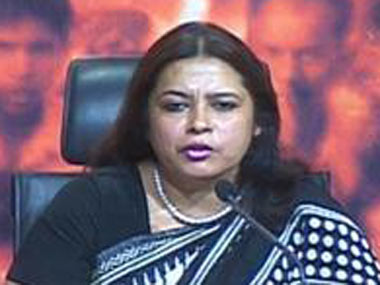
Over 115 women have signed a letter seeking an apology from Ms. Meenakshi Lekhi for her sexist slandering of deceased Ishrat Jahan in a television channel. The letter has also been sent to the Chairperson of the National Commission for Women for appropriate action.
As the noose is tightening around the conspirators who cynically and coldly planned and executed the killing of teenaged Ishrat Jahan and three other people in 2004, there is a concerted campaign – the final, last ditch bid to save their skins – by tarnishing the image of this college student. There have been planted stories in the media linking her to a terrorist group –all of them false and concocted, even as the Gujarat High Court has clearly said that the CBI’s mandate is to simply investigate whether Ishrat and others were killed in cold blood. Continue reading Women condemn Meenakshi Lekhi’s sexist slandering of Ishrat Jahan→
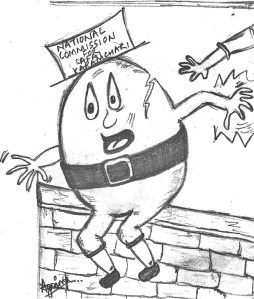
This is a guest post by AGRIMA BHASIN: No different from the caste hierarchy in India, the National Commission for Safai Karamcharis (NCSK) enjoys a marginal status, at the bottom, in the power hierarchy of commissions. “Why,” asked Former Prime Minister Narasimha Rao, “is it that the Commission for Safai Karamcharis is being subjected to the same discrimination as the safai karamcharis themselves? This is not something to be proud of.” He minced no words at the Conference of Welfare Ministers of States in 1996, to guilt the august gathering into recognising their culpability in deliberately weakening a competent commission. Continue reading Killing it softly over two decades: Agrima Bhasin→
In June 2013, a series of large demonstrations throughout Brazil have shaken up its main cities and political landscape. They have also perplexed politicians and analysts alike, many of whom found themselves without solid references to interpret the novelty and oscillated between silence and old discourses. It is always risky to interpret emerging processes. Minimally, we risk following secondary paths or, even worst, framing new events with the vocabulary made available by old interpretative models, exactly the ones that the new events are trying to displace. However, in order to reveal what is emerging it is necessary to risk, search for new hints, and follow signs already available. Several references that can guide us to interpret the June events have been around for quite a while; others are new, but we can trace their lineage and contextualize them.
The recent mob fury over the rumour of rape of a mentally challenged Garo girl and the consequent outburst of terror on migrant workers in Tura shouldn’t be read as a simple story of Garo men’s concern for women. If it was so, not so many labourers outside Tura would have been killed in cold blood by Garo miscreants. The claim that tribal society is free from the clutch of sexism, and that it is tribal women who face sexual abuse in the hands of non-tribals does not cut ice anymore. Continue reading Reading Violence in the Garo Hills : Rafiul Alom Rahman→
Given below is the text of a letter that was initially written by a group of individuals and sent as a rejoinder to the article written by Chetan Bhagat titled, ‘Letter from an Indian Muslim Youth’ published in The Times of India on 30 June 2013. The letter was sent to The Times of India The signatories include non-Muslims, because a large number of the emails read, ‘I am not a Muslim but I am equally disgusted by Chetan Bhagat’s letter’. Given below is the text of letter followed by more than 200 signatures:
A Letter to Mr. Chetan Bhagat from Indian Muslim Youth
Guest post by YUG MOHIT CHAUDHRY: On Friday, 8th September 2006, four bomb blasts occurred in Malegaon killing thirty-one persons and injuring three hundred and twelve others. The case was originally investigated by the Maharashtra Anti-Terrorist Squad (ATS). After re-investigating the case, the National Investigation Agency (NIA) has concluded that the ATS fabricated evidence against nine persons. This unprecedented acknowledgement raises important questions about how terrorist cases are investigated, police misconduct and the rule of law in India. It remains to be seen whether the government will take action against the ATS investigating officer, Assistant Commissioner of Police (ACP) Kisan Shengal, for fabricating evidence on a capital charge. Continue reading Will ACP Kisan Shengal of Mumbai ATS be prosecuted?: Yug Mohit Chaudhry→
This guest post by TAMER SÖYLER is the second of a three-part series on Istanbul’s Taksim Square protests for Kafila.
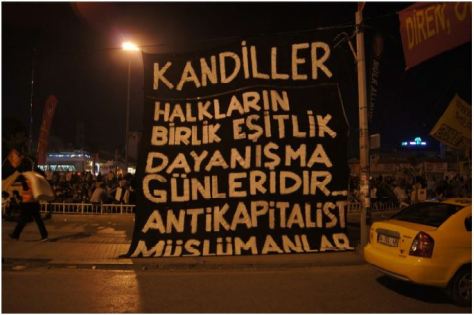
“Kandils are the times for equality, unity and solidarity – Anti-capitalist Muslims,” this banner reads. Kandil refers to the celebration of one of the five Islamic holy nights. While Erdoğan was accusing the protestors to be drinking beer and having some kind of a youth festival, anti-capitalist Muslims who were against the Taksim project from the very early on, wanted to give their support to the protestors. It was an interesting thing to witness. Socialists and communists were creating space for the members of the Anti-capitalist Muslims to perform a public prayer in the square. Clearly,the Taksim protests were not about secular vs. religious.
The first part of this commentary argued that as a part of his political strategy early Erdoğan had embraced a kaleidoscopic approach in governance by including various perspectives coming from citizens situated in different milieus. Erdoğan had given the impression to the citizens that his government was willing to hear the views of the citizens situated in all kinds of milieus. A simple strategy of inclusion proved to be extremely efficient for Erdoğan. Citizens who were not ideologically close to Erdoğan were quick to feel flattered by the symbolic gesture and did not hesitate to support Erdoğan.Continue reading For Erdoğan, you are with him or against him: Tamer Söyler→
It has been many months now since the Hazaras in Quetta were attacked. They were targeted during the month of January in 2013 and then only 36 days later in February, both times on Alamdar road where most Hazaras live – an area that has been termed an “open air jail”. Both times the banned Sunni organization Lashkar-e-Jhangvi claimed responsibility. In recent years, as many as 2000 Hazaras have lost their lives to similar acts of targeted violence in Balochistan. As power has been handed over from one civilian government to another for the first time in Pakistan’s history, the systemic nature of this kind of violence should be central to the concerns of Pakistanis – maybe even more than electricity, dare I argue? As Pakistanis think long and hard about what democratic change could mean, I write about the Hazaras now in order to point to the seemingly peripheral minorities as central to Pakistan’s issues. These attacks speak to the complex ways in which violence embeds itself into the everyday lives of some Pakistanis. In other words, the kind of structural issues that trying to wish a ‘naya Pakistan’ into existence will not assuage. Continue reading The Military and ‘Peripheral’ Violence in Naya Pakistan→
20+ years ago, I picked you up at the airport in Austin and you stayed at my home there for a few days. You had come there to deliver a lecture, as I’m sure you remember. We developed a friendship based on a degree of mutual respect and liking. I think you’ll agree? Several years after that I remember a stimulating afternoon sitting with you in Panchgani, catching up on many things and discussing various issues threadbare.
We haven’t met in some years now, but I’m going to call on the privilege of our 20+ years of friendship as I write these lines.
I have no problem at all with your desire to learn about Gujarat and Narendra Modi for yourself. Nor with your desire to see beyond what you’ve called the “targeting” of Modi. Nor with your speaking in support of Modi: if there are people who criticize Modi, I understand and accept that there are those who support him — it’s a democracy we live in after all. Nor with your speaking your mind: you have always done so and it’s the least I expect from you. (In turn, it’s the least you should expect from me). Continue reading Three questions for Madhu Kishwar: Dilip D’Souza→
As Pakistan battles with militancy, part of the war is also being fought in the arena of ideas.
In order to fight militancy, some argue, Pakistani society has to win hearts and minds back from extremists. It is the ‘fundamentalist’ thinking in our midst that prevents us from confronting militants wholeheartedly. On the other side of the talking divide stand those who feel that ‘liberals’ are forcing the state to declare a war on its own people under the guise of fighting militancy.
There is, however, at least one way in which both camps are similar. Regardless of who is right or wrong, the two sides view each other as being incompatible binaries with nothing in common. This is a flawed approach. No society, and especially not one as complex as Pakistan, can be divided so cleanly into two groups that do not overlap. Continue reading Pakistan beyond liberal and conservative: Ayesha Siddiqa→
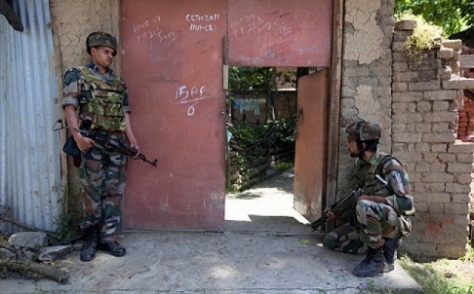
Indian Army soldiers at an encounter site with militants in Kashmir on Friday. AP photo
Guest post by JUSTIN PODUR: I spent a week in Srinagar, the capital of Kashmir, at the end of April 2013, talking to people among whom there was a wide range of opinion. While almost everyone supports freedom, some are resigned to India never letting Kashmir go, others believe that the struggle will go on and take different forms, some are just trying to survive. It seemed to me, at the end of a calm week during tourist season, that India is bringing about all of the things that it fears: Pakistani influence, violence, radicalisation of youth, political Islam, and hatred of India. Continue reading Eleven things India must do in Kashmir: Justin Podur→
We, the undersigned, strongly condemn the horrific massacre of leaders and workers of the Congress Party and the security forces accompanying them, carried out by the CPI(Maoist) in Chhattisgarh on Saturday. We also wish to express our deepest condolences to the families of all those killed in the convoy of Congressmen returning from an election rally at Sukma in Bastar dtrict.
The killing of senior state Congress leaders and their cadre is particularly barbaric and reprehensible as they had, in the course of the Maoist ambush, become captives or had surrendered voluntarily. This is tantamount to cold-blooded murder of prisoners in custody, an act that goes against all norms even in a state of civil or international war. The targeting of a political party in this fashion by the Maoists is also highly disturbing. Continue reading Statement condemning the Maoist politics of murder Chhattisgarh→
Guest post by KALYANI MENON-SEN: Ever since I came back from Dhaka on 12th April this year, I have been opening my mailbox every morning with a feeling of excitement and anticipation, confident that there will be a mail from Bangladesh with the latest news from Shahbagh. Just brief snippets – a slogan, a comment, a moment captured in a cellphone photo – but they are enough to bring back the feeling of being there, feeling the excitement and the energy, sensing the emergence of a new kind of political space – chaotic and confused, yet alive with radical possibilities.
I met Sarabjit Singh’s brave lawyer Awais Sheikh in Delhi some months ago, where his book was released. He was very confident Sarabjit wouldn’t be hanged. As was Justice (Retd.) Katju, who launched the book. Justice Katju said there was no point campaigning for Sarabjit’s release until the Pakistan elections were over. I got a similar impression of optimism from people who had been following the Sarabjit case.
An obituary by ZAHIR JANMOHAMED: I first met Asghar Ali Engineer in January 2002 in Mumbai. I was a fellow with the America India Foundation and a few weeks later I would be posted to work with an NGO in Ahmedabad.
A few minutes before his presentation, I noticed him standing off to the side in silence, staring at the ground. I walked up and introduced myself. I was young, in my twenties, and I did not know what to say.
“As-salaam alaikum,” I said.
“Wa-alaikum salaam,” he replied.
I am not sure what response I expected but I thought that perhaps because he and I share the same faith that we might have a special bond, that my greeting would spark a conversation. After all, I always thought phrases like these serve less as greeting and more as an announcement, as in, I am part of the same religion as you.
But Asghar saab just held my hand and then put his hand on his heart. “Nice to meet you,” he said, and then stared at the ground again in silence. I thought it was odd, rude even.
As I continued to meet Asghar saab, I realized that he had very little patience for superficial connections. I witnessed this when I saw him greet crowds after his lectures. If you told him you were from the same caste or city he would not be as excited as if you told him that you also believe that we must fight patriarchy with the same vigor that we must fight communalism. Continue reading Asghar Ali Engineer (1939-2013)→
A Pakistani soldier loads ballot boxes into a van in Rawalpindi. Authorities hope the app, combined with a fully revised voter list and an unprecedented level of public scrutiny, will help ensure the election will be the cleanest ever. Photograph: Farooq Naeem/AFP/Getty Images
Guest post by SAIM SAEED: Democracy in South Asia is its own animal, and has little resemblance with its counterparts in the United States and elsewhere. Gone are any kind of faultlines between liberals and conservatives, ideologies and the like; “Social Democrats” means little, and Greens, Communists and Freedom, even less.
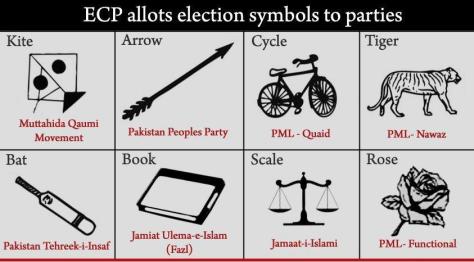
A widely held view is that political parties in Pakistan (and India) are based on ethnic lines. And there is good reason to believe that view. The PML-N, run by Punjabis, controls northern Punjab. The PPP, run by Sindhis, controls Sindh and parts of Southern Punjab. The ANP, run by Pushtuns, controls the Pushtun-dominated Khyber Pukhtunkhwa province in the North-West, and represents a few Pashtun-heavy neighborhoods in Karachi. Smaller parties run similarly. The MQM, a party founded as a Muhajir – immigrant – party, runs Karachi, the city with the largest Muhajir constituency. The BNP, founded as a Baloch pro-independence party is the most popular party in Balochistan. At various points, parties have tried to fashion themselves nationally, reflecting their larger ambitions. PPP’s official rhetoric talks of a national narrative. The MQM, originally short for Muhajir Quami Movement – National Immigrant Movement – changed to become the Muttahida Quami Movement (without any change to its initials), Muttahida meaning United. These changes have been cosmetic, however, and each party’s constituency remains more or less the same.
Guest post by AYESHA SIDDIQA: The renowned television anchor Quatrina Hosain was in tears. A day after the incident of her being sexually assaulted at a Pakistan Tehreek-e-Insaaf (PTI) jalsa by party workers in Wah Cantonement, she talked about how the bruises may heal but not her emotional scars. She was covering election rallies and got invited by a PTI candidate Mohammad Sarwar to his rally in Wah. It was a sudden plan so no one could have conspired to misbehave. This is important to note, as many PTI workers have subsequently tried to blame the incident on Pakistan Muslim League (Nawaz)’s workers. However, when confronted with facts, PTI workers tried to hide behind the argument that women should not provoke people by coming out and mixing with them. Continue reading Naya Pakistan, an old fable: Ayesha Siddiqa→

 This is a guest post by RAJAN KURAI KRISHNAN



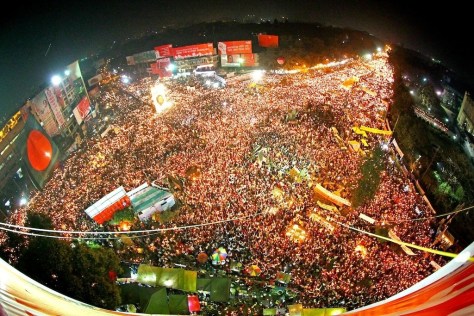 Guest post by KALYANI MENON-SEN: Ever since I came back from Dhaka on 12th April this year, I have been opening my mailbox every morning with a feeling of excitement and anticipation, confident that there will be a mail from Bangladesh with the latest news from Shahbagh. Just brief snippets – a slogan, a comment, a moment captured in a cellphone photo – but they are enough to bring back the feeling of being there, feeling the excitement and the energy, sensing the emergence of a new kind of political space – chaotic and confused, yet alive with radical possibilities.
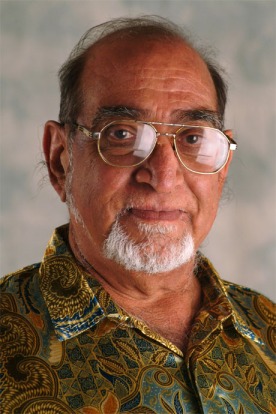 An obituary by ZAHIR JANMOHAMED: I first met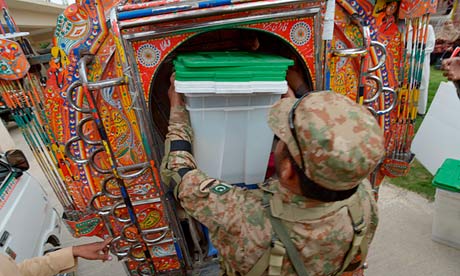
 KAFILA - COLLECTIVE EXPLORATIONS SINCE 2006