Category Archives: Identities

Do I look painDoo?

This post is dedicated to Nadeem F. Paracha.

Photo by 'Life Church Burnley' Flickr: "shoorkot road toba tek sing love this palce.but need much improvement"

[Photo by ‘Life Church Burnley’ on Flickr: “shoorkot road toba tek singh love this place but need much improvement”]

So on Facebook I saw a fellow Punjabi who lives in vilayat has listed his hometown as Toba Tek Singh, Pakistan, which I thought was very cool. Why didn’t I get this idea? Never mind, I thought, like all good ideas this must be stolen. My hometown on Facebook now is also Toba Tek Singh, Pakistan. It was only much after going mad over Manto’s story did I discover that Toba Tek Singh was a real place in west Punjab. Always wondered what its people thought about the story. Continue reading Do I look painDoo?

Cricket, Azadi and Pakistan: Mir Laieeq Ishtiyaq

Guest post by MIR LAIEEQ ISHTIYAQ

As all of India celebrated the well-deserved Indian victory in the cricket world cup finals, the mood in the Kashmir valley was different. Their favourite team was ousted in the semi-final itself. On the eve of the semi-final between India and Pakistan at Mohali, a friend asked on Facebook: “That Kashmiris don’t support the Indian cricket team is well understood, but why is there so much support for Pakistan? Seems INDEPENDENCE IS JUST A MYTH…” There are no simple answers to this question.

This slideshow requires JavaScript.

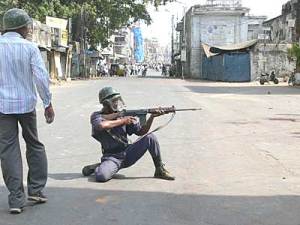
[Pictures taken in Kashmir during the India-Pakistan Mohali semi-final by ISHAN TANKHA for Open magazine.] Continue reading Cricket, Azadi and Pakistan: Mir Laieeq Ishtiyaq

Still Bangali: Reflections on a New Year: Jyoti Rahman

Guest post by JYOTI RAHMAN

Exactly ten years ago yesterday, upon arriving at a friend’s place, instead of ‘Shubho Nobo Borsho’ (Bangla new year greeting), I was greeted with: ‘Have you heard the news? Call home now. Hope family’s okay!’ Militant jihadis struck the new year’s dawn cultural events in Ramna, the major park at the heart of Dhaka, killing over half a dozen people. Since these events are attended by most of my family in Dhaka, and by most of my friends, we were worried. Frantic phone calls and MSN chats (or did we still do ICQ then, I forget) ensued. Fortunately, the families were safe. But this wouldn’t be the last time such phone calls were made.

Over the following years, militants bombed cinema halls, killed progressive politicians, carried out suicide attacks against judges, and tried to enforce shariah rule in rural northern parts of the country. Things got so bad that when a friend called to tell me about Muhammad Yunus winning the Nobel Peace Prize, upon hearing, ‘Have you heard about Yunus?’, my first reaction was ‘Oh no, another assassination’. Continue reading Still Bangali: Reflections on a New Year: Jyoti Rahman

Corruption has its Caste in the Judiciary: All India Confederation of SC/ST Organisations

This press release come from the ALL INDIA CONFEDERATION OF SC/ST ORGANISATIONS

New Delhi, April 4, 2011.

Dr. Udit Raj, National Chairman of All India Confederation of SC/ST Organisations, said that corruption has its caste. The way the former Chief Justice of India, K. G. Balakrishnan and former Chief Justice of Karnataka, P.D. Dinakaran, are being treated, there is no doubt that corruption knows the caste. Here argument is not to absolve these people but to expose hypocrisy and double speak. The Supreme Court hastened to admit petition against K.G. Balakrishnan but why not in other cases? Continue reading Corruption has its Caste in the Judiciary: All India Confederation of SC/ST Organisations

Why so serious?: Anuj Bhuwania

Guest post by ANUJ BHUWANIA

Cellphone videos of the celebrations at India Gate after India won the semi-final against Pakistan


So cricket is the opiate of the Indian masses, and India’s left-liberals (henceforth LLs) can’t deal with it. Or with popular cinema or religion, for that matter. All of which are things that these oh-so-serious people can’t quite seem to fathom. The only cinema you should enjoy are art house/multiplex films with the right ‘social message’, the only religion you can profess is Sufism and the only cricket you are allowed to enjoy is West Indies winning a test match, because CLR James has apparently said it’s ‘empowering’ or  ‘anti-imperialist’ or some such. These trivialities – cinema, religion, cricket – are just there to distract people from the really important issues. We should all only obsess about ‘important’ topics like nuclear energy, the 2G spectrum scam or the UID. Continue reading Why so serious?: Anuj Bhuwania

Mecca Masjid police firing report dumped in cold storage: Lateef Mohd. Khan

Guest post by LATEEF MOHD. KHAN

On Friday, 18th May 2007, the RSS terrorists planted bombs at historic Makkah Masjid and immediately after the bomb blast, a group of communal minded policemen started firing on the people who were helping the injured people in the blast. 9 people were killed and hundreds got injured in the blast. The sharp shooter policemen were chosen for firing on the people who came for prayers and who came forward to help the injured and this communal group of policemen was monitored by  the then Additional Commissioner of Police (Crime). Continue reading Mecca Masjid police firing report dumped in cold storage: Lateef Mohd. Khan

Why Bangladesh?: Jyoti Rahman

Guest post by JYOTI RAHMAN

Singing Amar Shonar Bangla with the whole stadium — the highest point during a cricket match attended by fellow blogger Rumi Ahmed.

For those of us born in Bangladesh, which turns 40 today, along with the red-and-green flag, there is an instinctive, natural identification with Amar Shonar Bangla. Less recognised is the fascinating history of the song, which also tells us the twists and turns in the history of the 20th century Bengal. Continue reading Why Bangladesh?: Jyoti Rahman

Bhagat Singh and the Hindu Rashtra: Mahtab Alam

Guest post by MAHTAB ALAM

“The communists’ ideologues conveniently ignore the truth that the roots of Bhagat Singh’s ideology lie in the very concept of Hindu Rashtra,” claims an article by Dipin Damodharan, published on this day last year. Damodharan, as introduced at the end of the article, is a student pursuing Masters in Communication and Journalism (MCJ) at the Calicut University of Kerala. He argues: “To my knowledge, he sacrificed his precious life for a noble cause, for the liberation of Bharat from the invaders, for nationalism. Undoubtedly Bhagat’s legacy belongs to every Bharati. But for the communists (experts in transforming sheep to dog), he died for communism and not for nationalism. They are incessantly advocating Bhagat as their poster boy, for several years they have been using Goebalsian tricks to claim Bhagat’s legacy.” The author further argues, “They are injecting fake stories about Bhagat into the blood of youth who are ignorant about Bharat’s history. Discarding the historical facts, the communists become angry with the Sangh inspired organizations for propagating Bhagat’s ideals”. Continue reading Bhagat Singh and the Hindu Rashtra: Mahtab Alam

Ghettoes of the Mind: Khalid Anis Ansari on ‘minority status’ for Jamia Milia Islamia

Guest post by KHALID ANIS ANSARI

Teri azaān mein nahin meri sahar ka payām. [Your call to prayer heralds not my dawn] – Allama Iqbal

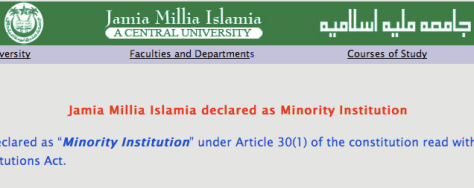
A grab from the university's website

The recent judgment of the National Commission for Minority Educational Institutions (NCMEI), favoring ‘minority status’ for Jamia Millia Islamia University, has generated vigorous debate. While it seems to me that most of the articulations have probably been reluctant in staging the immanent logics governing the entire controversy, I see this debate as offering yet another opening for democratic transformation within the Muslim community. While I will resist from taking a straightforward for/against position on the issue, it would be my endeavor to trace the discursive ruptures that instantiated the articulation around the ‘minority status’ for Jamia, and to indicate at the need to frame the Muslim ‘community’ now as a contested terrain with multiple sites of negotiations, cleavages and transformations.

Continue reading Ghettoes of the Mind: Khalid Anis Ansari on ‘minority status’ for Jamia Milia Islamia

What does it mean to be a Muslim in India today?: Mahtab Alam

Guest post by MAHTAB ALAM

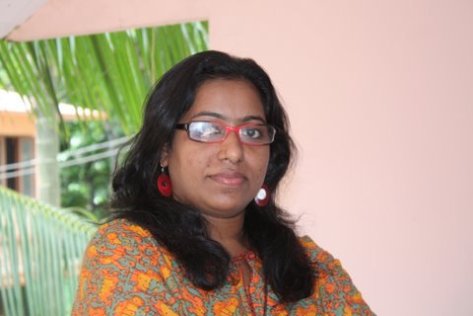
Shahina KK

Recently, Shanina K K, a journalist from Kerala, who worked with Tehelka news weekly and now works with Open magazine, received the Chameli Devi Award for being an outstanding woman journalist. While receiving the award she said, “See, I happen to be a Muslim, but I am not a terrorist.” What made her say that and what was she trying to convey or explain? It means, as she explains, “If you belong to the minority community, they will also profile you. It is very difficult to prove that you are not a terrorist. It is equally difficult to prove that you are not a Maoist in our life and times.” Continue reading What does it mean to be a Muslim in India today?: Mahtab Alam

You fill up my Census…

…quipped my brother Dilip in response to the following mail from my sister Pramada:

So the bell rings this afternoon. desperate clanging. i open the door and there is a man with forms in his hand and a general irritated demeanor. figured that this was the census man. he comes in and settles down. starts by wanting to know who the head of the household is. i say there is no one. he insists. i continue to say no one.

Census of India 2011 mascot

He proceeds to explain that if the parents live in the house, then they are the head of the household, if married then the husband is. I proceed to ask for definition and say that all three of us who live in the house are head of the household since we all earn and take decisions. he promises to erase what he has written since he was sure my mother was head of household.

He seemed to find my gender a bit dubious so questioned my mother if i was a boy or a girl and then repeatedly said “ladki” to me. having established that i indeed was a woman, he wanted to know date of birth, which was not difficult, but place of birth he found extremely challenging. he could not get his spellings right, or did not know districts or states in the country so tattamangalam in palghat district in kerala was as baffling as mysore in karnataka. calcutta was easy to deal with and he said calcutta was in calcutta!!! mother tongue caused him more angst because he had to write malayalam and again the spelling eluded him.

Continue reading You fill up my Census…

10% Anthology: Tarun Bhartiya

A review by TARUN BHARTIYA

The Oxford Anthology of Writings From North-East India : Poetry and Essays
Edited by Tilottoma Misra
Oxford University Press
New Delhi, 2011, 332 Pages / Rs. 595 ISBN 0-19-806749-6

If you are on the marginalisation trip, and India’s North East is your illicit high, you should be worried. In the last ten years, trying to make up for the dark fifty years of Indian ignorance, anthologies of literature from the region have begun to appear almost annually.

But before I get accused of an inside job, a disclosure that I am loathe to make:

I know many of the poets (some of whose biographies smell of Shillong) who feature in The Oxford Anthology of Writings From North-East India : Poetry and Essays. We share little magazines, anthologies, dark bye-lanes of love, anger, feuds, booze, and journeys to find our next fix.  So, I promise to dull my taste and leash my judgment. And only occasionally lapse into pointless gossip. Continue reading 10% Anthology: Tarun Bhartiya

Teaching Harmony, Practicing Disharmony

This was presented as a paper at a symposium on Peace Education organised as part of National Conference on Indian Psychology, on 6 February 2011 at the India International Centre.

This piece seeks to underscore the cleavages that exist in our society, explore the foundations upon which the edifice of intolerance has risen and to look at the tools, like education for peace and harmony, with which we try to dismantle this citadel of intolerance.

Peace education, you would agree, cannot be confined merely to teaching the message of Love and brotherhood, our text books have been teaching this message for as long as I remember and my memories of our text books go back, at least to my senior school days in the mid sixties, almost 45 years ago.

If telling students in their classes that we should all love each other because we are all Indians and that we are all equal was enough then we would not have many of the problems that we are confronting today. Continue reading Teaching Harmony, Practicing Disharmony

On the fuzziness of Personal Identity: UIDAI and the national identity card of India: Taha Mehmood

Guest post by TAHA MEHMOOD

I – The spread of Identity cards in Southasia:

An identity card virus seems to be spreading across south-Asia. The pathogen emerged long ago in 1971, when Pakistan established a paper based personal identity system. !971 was also the year when Pakistan was engaged with India in a military conflict which led to the creation of Bangladesh. In 1972, a year later, the Department of Registrations of Persons located at Colombo, Sri Lanka, was entrusted with the responsibility of issuing a national identity to citizens who were over sixteen years of age. In 1972 the name of the island was changed from Ceylon to Sri Lanka and Tamil Tiger leader Velupillai Prabhakaran formed the Tamil New Tigers (TNT), which later became LTTE or Liberation Tigers of Tamil Eelam. The state of Sri Lanka was at war with LTTE for the next three decades. Nothing new happened on the national identity card front for the next two decades. Continue reading On the fuzziness of Personal Identity: UIDAI and the national identity card of India: Taha Mehmood

Chitrasutram: Post-modern Cinema?

Months ago, while watching what was in effect a docu-hagiography about a prominent literary icon in Malayalam and wondering about its structure, I was enlightened by a little voice that piped up from a few rows behind. “Nyoosh” (news), it said. On screen, the literary icon appeared and began to talk. A few minutes later, the little voice trilled again, “Parshyam” (commercial). And lo! The icon dissolved, followed by what looked exactly like a commercial, a sequence of visual tricks, visual hallelujah to the wisdom of the revered sage. The little voice thus revealed to me that the structural rhythm of the docu-hagiography was effective precisely through its prayer-like repetitiveness; it also alerted me to the fact that it was extraordinarily similar that to the visual strategy of television (Truth-dream-Truth-dream…), which again is perhaps vital to its sway over viewers. Continue reading Chitrasutram: Post-modern Cinema?

‘i swear…i have my hopes’: Agha Shahid Ali’s Delhi Years: Akhil Katyal

This is a guest post by AKHIL KATYAL
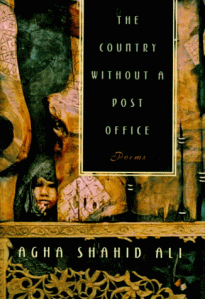
Born on 4th February, 1949, Agha Shahid Ali would have been 62 next month. The Kashmiri-American poet who spent the last half of his life in the States (he migrated to Pennsylvania in the mid 70s) died in the winter of 2001 due to brain tumour. The next year had begun with papers and journals in the States, and in Kashmir and India, remembering Shahid. ‘Your death in every paper,’ Shahid had written for his own idol the singer Begum Akhtar after she passed away in 1974, ‘boxed in the black and white / of photographs, obituaries.’ In his new absence, he similarly reappeared in the words of his friends as an insurmountably beautiful poet, a gregarious Brooklyner, a near perfect cook, an impossibly good teacher and a lasting friend. Apocrypha started building around him very soon after his death. One could say this was the final proof that Shahid’s name would abide – that stories began to be spun around him as soon as he was not around. The Pakistani novelist Kamila Shamsie, Shahid’s creative writing student at Hamilton College in New York and then at the University of Massachusetts in Amherst in the 90’s, and someone who always recounts his indelible influence on her writings (he coloured her drafts red), was one of the first to add to the stories that have multiplied since in this decade after Shahid’s death. Kamila’s friend, also a student of Shahid, had told her that some months after he was diagnosed with brain cancer, Shahid was riding the subway going to teach his class at NYU when he started to feel faint and began to black out. ‘For a moment,’ her friend told her, ‘he thought, “I’m dying,” and then he told himself, “No. First I’ll teach my class, then I’ll die.”’

Continue reading ‘i swear…i have my hopes’: Agha Shahid Ali’s Delhi Years: Akhil Katyal

‘As followers pushed to get close, the pole broke in several places and the flag tumbled down onto Mr. Joshi’

History repeats itself, and we learn so little from it. Or rather, we learn too much from it. I am excerpting below about half the text of a report dated 27 January 1992, written by EDWARD A. GARGAN in The New York Times, describing in detail Murli Manohar Joshi’s hoisting of the Indian flag in Srinagar’s Lal Chowk. Wish I had a picture!

He [Murli Manohar Joshi] had begun his trek, which he named Pilgrimage for Unity, 44 days before at India’s southernmost point. But the inability of the security forces to protect even their highest officials made it clear that there was no way, despite the presence of several hundred thousand troops in the Vale of Kashmir, to protect a convoy of cars and buses filled with zealous Hindus. So Mr. Joshi and a small contingent of his closest supporters were flown here on Saturday night. Continue reading ‘As followers pushed to get close, the pole broke in several places and the flag tumbled down onto Mr. Joshi’

The doom-sayers are wrong about Pakistan. Here’s proof


If you click on it, you can also see the rest 3 parts of the show with Veena Malik and a maulvi on Pakistan’s Express TV.

Un-Indianizing Kerala: How to defend K K Shahina

Like the unseasonal and tenebrous rain clouds that are hovering over Thiruvananthapuram in what should be a sunny, light-mist-adorned January, a pall of gloom, of impending danger, hangs around my everyday life in Kerala. This is not a general feeling. It is however shared by many of us who write and speak critically about the powers that be. The space to speak and write thus has been shrinking for a while now, but now there is a sense of dangerously teetering on the edge: the Indian state seems to be upon us, and with a vengeance. Continue reading Un-Indianizing Kerala: How to defend K K Shahina

“These are not stones these are my feelings”

An image taken in downtowon Srinagar.

Given below is a note written by a Kashmiri student from downtown Srinagar who calls himself ‘Kale Kharab’, meaning ‘hot headed’. Taken from his blog, the note reads like a personal manifesto, a statement of purpose, a testimony more telling than what the most patient interviewer can elicit. This note gives you more insight into what is happening in Kashmir than a lot of what you may have read or seen on TV news about the killing of 115 protestors across Kashmir in 2010 by Indian forces. This testimony, written early on during the uprising, on 30 August 2010, shows how irredeemably India has lost the plot in Kashmir all over again, with a new generation of Kashmiris.

How and why I became a stonepelter

by KALE KHARAB

I am from downtown srinagar born in 1991. I was admitted to one of the best school of valley. As a child I had dream to became engineer. Whenever somebody used to ask me about my aim I would proudly say engineer. As I started to grow up I started to became familar with many words which everyone used to talk about that among them few were “azadi” (freedom), “hartal” (shutdown) but I was unable to understand the meaning of these words. I loved the word hartal as it was holiday, so I always wished for hartal. As I grew up I came to know about mujahids. I used to listen stories of mujahids. I would oftenly ask my elders to tell me about mujahids. They told me stories of many mujahids like Issac, Ishfaq, Jan Malik which I liked to share with my friends.  Continue reading “These are not stones these are my feelings”

Blasphemy, Bigotry

From Kafila archives:

If blasphemy is an attempt to speak truth to power, bigotry is the reverse: an attempt by power to instrumentalize truth. [Mahmood Mamdani]

See also: Citizens for Democracy