Category Archives: Identities

‘Islamic secularism’ in Bangladesh: Jyoti Rahman

'Bengal's mothers and daughters are all freedom fighters'

Guest post by JYOTI RAHMAN

Bangladesh will mark its 40th year of independence in 2011.  The celebrations have already begun, and will continue until next December.  The TV channels are already playing patriotic tunes.  One such tune is Shona shona shona.  The song says the land, mati, of Bangladesh is better than gold, and under this land sleeps many heroes: Rafiq, Shafiq, Barkat, Titu Mir and Isa Khan.

Who are these heroes?  Rafiq, Shafiq and Barkat were killed by the Pakistani authorities during the language uprising of 1952 — a milestone moment in Bangladesh’s nationalism. Titu Mir defied the East India Company and organised a peasant revolt in the 19th century. Isa Khan was a Bengali chieftain who resisted the Mughals in the 16th century.

Notice how all of these heroes are Bengali Muslim men?

Continue reading ‘Islamic secularism’ in Bangladesh: Jyoti Rahman
Justice for Aasia Bibi; Speedy Trial of Salman Taseer’s Killers: New Socialist Initiative, Delhi

Statement from the NEW SOCIALIST INITIATIVE, Delhi

History is said to be made when humanity has tried to break asunder forces of unreason, irrationality, bigotry, intolerance and reaction which keep reappearing in newer forms in its onward journey. But what can one say when it tries to do the exact opposite, or prefer to go back on the path undertaken.

Pakistan, a country of 170 millions, stands at a similar juncture today.  Continue reading Justice for Aasia Bibi; Speedy Trial of Salman Taseer’s Killers: New Socialist Initiative, Delhi

Would the secession of South Sudan be good for Africa?

On January 6th, it is almost certain that a referendum in South Sudan will lead to a vote to secede from the rest of the country, thus paving the way to the formal inauguration of Africa’s 54th sovereign state. The vote comes after many years of discord between Sudan’s Arab-and-Muslim north and its black, animist and Christian south, and civil war in which almost 2m have died. Thus, divorce seems the only option in Sudan’s case. However, many in Africa, including the African Union, which has long inveighed in principle against secessionist tendencies in Africa, worry that it could set a trend that encourages other self-determination movements on the continent, potentially causing instability and worse. Others argue that the right of all peoples to self-determination must be allowed to hold good. In these terms, would the secession of South Sudan be good for Africa?

Well, you can cast your vote here.

See also: Celebrations across south as millions flock to polling stations.

Periyar on the Constitution

As a follow up to the earlier piece, here is a translation of excerpts from Periyar’s speech on the constitution soon after it was framed.

Here there is a need for a note on how we can read these historic documents. This is not a call to burn the constitution (Figuratively maybe a little bit but not literally. That would be a waste of paper. We’d rather recycle it en masse as a symbolic gesture! ). The purpose is to break down into details, this ‘nation’ that we often use as a default construct. We know it has a history and a not so long one. We also know that it has been contested by many from its very inception. Independence day should also be observed as ‘partition into india and pakistan day’ for starters. There have always been challenges ranging from debates over secession of regional kings when independence was declared, to demands for a separate nation that always existed and continue to do so. Continue reading Periyar on the Constitution

Ayodhya for Buddhists: All India Confederation of SC/ST Organisations

Press release from the ALL INDIA CONFEDERATION OF SC/ST ORGANISATIONS

Neither Hindus nor Muslims are entitled to the disputed land at Ayodhya. SLP filed in Supreme Court claming the title for the Buddhists.

New Delhi, 7th January, 2011

Dr. Udit Raj, Chairman of Buddha Education Foundation and the All India Confederation of SC/ST Organisations, told the press that Special Leave Petition (SLP) no. DC 466/2011 has been filed in the Supreme Court against the judgment of Allahabad High Court, Lucknow Bench in the much disputed matter of Ayodhya.

Continue reading Ayodhya for Buddhists: All India Confederation of SC/ST Organisations

“I Am Still Alive”: Amitava Kumar

Guest post by AMITAVA KUMAR

Till a few days ago, I hadn’t heard of Aqeel Shatir. A friend sent me a link to a report in the Indian Express on December 20 about a poet who had been asked to pay for an anti-Narendra Modi remark in his anthology, Abhi Zindaa Hoon Main (I Am Still Alive). I got in touch with the reporter, in Ahmedabad, who had filed the story and soon after that spoke on the phone with Shatir.

Aqeel Shatir is his takhallus or literary alias. The name his parents gave him was Aqeel Ahmed. His ustad offered him a choice of two pen-names. One was Aazar, which means a sculptor, someone who carves beautiful forms from marble. The other was Shatir, whose literal meaning is chess-player but denotes someone who possesses cunning. Continue reading “I Am Still Alive”: Amitava Kumar

‘Snakebite or sunstroke?’: An extract from Siddhartha Gigoo’s novel, ‘The Garden of Solitude’

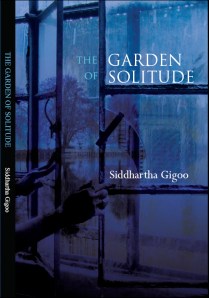
SIDDHARTHA GIGOO‘s The Garden of Solitude [Flipkart / Amazon] is the first novel in English by a Kashmiri, on Kashmir. As it starts arriving in bookstores, I am grateful to him for sharing an extract.

‘Life teaches us that there is beauty in ugliness,’ Sridar said.

Then Pamposh said something that Sridar was not prepared for.

‘Every day I lead the life of a centipede. I crawl. I lick. I hide. I sting. I wake up to the fumes of kerosene in the morning and the sting of speeding ants, feeding ravenously on the sugar spilled on the floor of the tent. It feels as if I have never had a morsel of rice for ages. I wake up hungry and go to bed hungry. I lead the life of a centipede, I crawl. All around the camp, there is stench of human excrement and waste. People wake up in the morning, hungry and muddled.

Continue reading ‘Snakebite or sunstroke?’: An extract from Siddhartha Gigoo’s novel, ‘The Garden of Solitude’

Trysts at Midnight: Calcutta, Now: Prasanta Chakravarty

This is a guest post by PRASANTA CHAKRAVARTY

[The Bangla film Sthaniya Sambaad (Spring in the Colony, 2009) was recently released. The film, by way of mapping the diurnal workings of a refugee colony in contemporary Calcutta, asks important questions about the changing cityscape, of the new, emerging world of land grabbers and fly-by-night investors and of the bemused young and old who are outside of this world and yet are sucked within its machinations. This is a conversation about education, humanities and the nature of artistry in the age of modularization—between MOINAK BISWAS, one of the directors of the film (with Arjun Gourisaria) & Reader, Film Studies, Jadavpur University, Calcutta and PRASANTA CHAKRAVARTY, Associate Professor of English, University of Delhi.]

Prasanta: Your film got a commercial release finally, which is wonderful. Among the initial reactions, in reviews, internet discussions and so forth, one notices a lot of interest in the polyvalent nature of your craft. I would like to take one particular strand of the film and probe a little: that is, its quite sharp critique of the phenomenon of vocationalization of education. This is a constant and niggling thread, right? Now, one fundamental argument for modular training, especially in humanities and social sciences, at this point, is a democratic one: that it will provide competence to a large number of the unemployed, ensure jobs and help in national growth. Continue reading Trysts at Midnight: Calcutta, Now: Prasanta Chakravarty

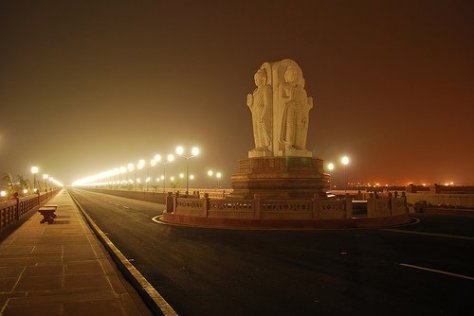
History in Stone and Metal

Photo by Bhanu Pratap Singh / Round Table India

A prominent Dalit academic once told me that when a Dalit entered the seminar room, the rest of them should feel uncomfortable. Given the monumental oppression Dalits face, this should be the least consequence of Dalits getting a voice.

I am reminded of this when I think of Mayawati’s gigantic Dalit memorials that have changed Lucknow’s landscape.

Continue reading History in Stone and Metal

Why is it so difficult to free India of manual scavenging?

Guest post by BEZWADA WILSON

Safai karamcharis from across India declared their liberation at a function in Delhi on 20 December

Over the years, there have been many changes in the Safai Karamchari Andolan movement. The biggest change we have seen has been in the safai karamchari community’s outlook. There was a time when safai karamcharis were ashamed to admit they did manual scavenging. It was not uncommon for even family members to be unaware that someone was involved in the practice of manual scavenging.

Continue reading Why is it so difficult to free India of manual scavenging?

Noor Sahab in Horror Land: Gowhar Fazili

Guest post by GOWHAR FAZILI

Some old memories came to mind when Noor Mohammed Bhat, a college lecturer in Kashmir got arrested for asking in an examination, “Are the stone pelters real heroes? Discuss.”

I studied at Burn Hall, a missionary school in Srinagar. In the mid-‘80s, they would make us recite the national anthem in the morning assembly on one of the week days. Interestingly, while the little kids would do as they were told, the ‘big’ ones who had just crossed their sixth grade, would for some strange reason go off tune so that Jana Gana Mana… would start sounding like “Jaaaaaanaooauea maaaoAAAonaa gaooooOOnaannNNaaaA…”, like it were a sound coming out of an audio tape that was stuck or a damaged gramophone record! This bad behaviour invited corporal punishment. Shah Sir and Mohinder Sir (P.T. Masters) used to lurk behind the assembly and surreptitiously appear and whip on our legs at lightning speed. They would lash at the whole queue in a single run and be gone before we knew it. While the tune in the queue that was being freshly hit would get restored, the queues furthest from the P.T. Masters would go really off the tune! They would keep running about madly like this from one end to another but the cycle (orchestra) would continue till the whole song was over. It used be maddening for them. Though they were quite ferocious if one were to encounter them in person, (having been used regularly to instil fear and maintain ‘discipline’) somehow as a collective, we dared them in this manner week after week and year after year. Continue reading Noor Sahab in Horror Land: Gowhar Fazili

Sinister designs behind Muharram ban in Kashmir: Zafar Mehdi

Guest post by ZAFAR MEHDI

Muharram, the month of epic action, has announced its arrival. Black banners symbolizing grief are fluttering around. A pall of gloom has descended. 1500 years later, the lessons of Karbala continue to be the beacon of inspiration for strugglers of truth and righteousness. Muharram, contrary to perception, is not an event, episode or chapter in history. It is a philosophy, a concept, a movement. As centuries roll by, the great uprising of Husain(as), the beloved grandson of Holy Prophet (saww), continues to drive believers to hurl defiance at the forces of evil. The final call Imam gave to humanity still lingers in the minds of millions of Muslims around the world. It teaches that notwithstanding the inadequacy of numbers, if you run down the gauntlet backed by the staunch faith in the Almighty, triumph will be yours.  Continue reading Sinister designs behind Muharram ban in Kashmir: Zafar Mehdi

Apocalypse in Our Time: Ravikumar

Guest post by RAVIKUMAR

Waking is Another Dream: Poems on the Genocide in Eelam, a slim anthology edited by Ravikumar, will be launched by Navayana on Wednesday, 8 December 2010 at 6 p.m. at The Attic, 36 Regal Building, Connaught Place, New Delhi.

[At a time when the Eelam issue is the news again owing to Channel 4’s coverage leading to the cancellation of Mahinda Rajapaksa’s talk at Oxford, citing emerging evidence of his war crimes, Navayana presents a volume of powerful poetry translated for the first time from Tamil into English. Says poet Cheran, “The lack awareness in a city like Delhi on the fallout of the genocidal war in Sri Lanka is appalling. People here who seem concerned about Palestine or even Kashmir seem utterly indifferent to the problem in India’s own backyard.”

Continue reading Apocalypse in Our Time: Ravikumar

City in Terror: Dilip D’Souza

Guest post by DILIP D’SOUZA

Starting today eighteen years ago, for much of December and January (and then March 12), Indian killed Indian on the streets of my city. Terror at its most elemental: I felt it then. I saw it then. Others told me about it then.

Some memories of those weeks, in no particular order but they all still make my hair stand on end.

Will the Insecure Male at the News Desk Please Stand Up?

K.K. Shahina, of the Tehelka, some feel, may be a terrorist. No prizes for guessing who. After all, Shahina has been working, despite pressures of all sorts, to unravel the impossible web of lies that the police, the media, and political parties have been weaving around the figure of Abdul Nasar Madani, who was arrested again as an accused in the 2008 Bangalore blast case and denied bail. Madani, as is well-known, had already suffered enormous injustice at the hands of the Indian state but to the chagrin of the Hindutva ‘nationalists’, he re-entered the political arena. Whether one agrees with him on Islam or other matters, or about his choice of alliances, is a different matter. Choosing to demand space in the political public, he exercised his right as a citizen, and thereby indicated a preliminary implicit willingness to place his views before a critical public. Continue reading Will the Insecure Male at the News Desk Please Stand Up?

Audacity of hypocrisy: Sameer Bhat

Guest post by SAMEER BHAT, written on 26 November in response to Kashmiri Pandits heckling the Mirwaiz in Chandigarh.

Aesop, the Hellenistic slave, narrated a profound tale in the winter of 6th century BC. The story is simple but the message remains relevant 2700 winters later. A Bee, queen of the hive, buzzed her way to Mt Olympus to present Jupiter some fresh honey. Jupiter, delighted with the offering, promised to give her whatever she wanted in return. The Bee thought for a while and then said, “Please give me a stinger, so that I can hurt whoever might come to take my honey.”  Continue reading Audacity of hypocrisy: Sameer Bhat

On the November Massacres in Assam: Aruni Kashyap

This is a guest post by ARUNI KASHYAP

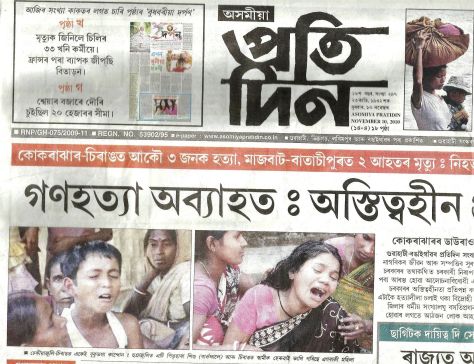
The front page of Asomiya Pratidin on 10 November

In the beginning of this month, the anti-talks faction of NDFB carried out a state-wide massacre of non-Bodos, mostly Hindi speaking settlers in Assam in a revenge-killing spree after Mahesh Basumatary, who allegedly was a cadre of NDFB, was killed by the Indian security forces in Assam’s Sonitpur district. The Bodo militant organisation claimed that the person was an innocent civilian and wasn’t linked to their organisation in any way while the security forces claimed otherwise. A recent report aired in a local television news channel DY365 records the victim’s family and his resident village’s viewpoint that matches with the claims of the NDFB. Continue reading On the November Massacres in Assam: Aruni Kashyap

This Chhath Puja, Ram ke naam: Mahtab Alam

Guest post by MAHTAB ALAM

Last week, after a gap of almost 12 years, when I was asked by my family members to accompany them to see Chhatth Puja, an ancient Hindu festival dedicated to Surya, the Sun God, I could not resist myself and readily agreed to join them. As a school going boy, I had always enjoyed watching the festival and devotees performing the rituals observed for the Puja in my hometown Supaul, a district of Bihar, which borders the Tarai region of Nepal. In the last 12 years, I couldn’t get a chance to do so due to the mobile nature of work I am involved in. The Puja, most elaborately observed in Bihar, Jharkhand and the Terai regions of Nepal in modern times, and those areas where migrants from these regions have a presence. Chhath, usually observed six days after Diwali, was observed on 12 November this year. Continue reading This Chhath Puja, Ram ke naam: Mahtab Alam

Whose Dishonesty? Arundhati’s or Media’s?: Mahtab Alam

Guest post by MAHTAB ALAM

‘Vicharon ki Be-imani (Dis-honesty of thought) cries the heading of the lead article of Dainik Bhaskar’s editorial page on 1st November 2010. The article is written by Venkateshan Vembu, foreign correspondent of DNA English daily, a newspaper published by the same group of publications. It was originally published on 27th October with the headline reading ‘Arundhati Roy is dangerously wrong on Kashmir’. The writer of the article claims that whatever Arundhati has said is not only dangerously wrong and beyond the tolerance level of any law-abiding citizen but, it also has the potential to arouse feelings of anger and violence among the masses. “Yeh kuch is tarah ki beimani hai, jo janmanas me krodh aur aakrosh ki bhawna upjati hai (This is a kind of dishonesty which generates feelings of anger and violence among the people”). Ironically, this turned out to be a ‘prophetic’ disclosure, as right after four days of publication of the original version in DNA, Arundhati’s house in Delhi was attacked by the writer’s ‘Janmanas’, the BJP’s women wing ‘Mahila Morcha’.

Continue reading Whose Dishonesty? Arundhati’s or Media’s?: Mahtab Alam

Islam Colony Riders vs. Ward 2 Worriers [sic]

You are a young politician in Delhi and you want to make a mark in an area, in a seat. You want to be known, you want to be a leader, you want followers, you want to be taken seriously. You want votes. You have the right kind of Delhi first name – Mahender rather than Mahendra – and an even better surname – who better than a Chaudhary to be your leader? But there would be many Mahender Chaudharys. What can you do? You can get basic work done – permissions and pipelines and land conversions and garbage clean-up. But anyone with the right contacts can do that. Anyone can become a protege of a Congress leader like Yoganand Shastri. In a city like Delhi, in a city of migrants, in a city whose citizens think they have the right to be treated better than the rest of India, in a city that does not seem to be ‘politicised’ like the seemingly distant world of the ‘real’ India, in a city that is a state – how do you begin being taken seriously as someone with political ambitions? One Mahender Chaudhary has this poster put up all over Mehrauli (which was once all there was to Delhi). Check it out: Continue reading Islam Colony Riders vs. Ward 2 Worriers [sic]

From New York, a letter to fellow Kashmiris

Guest post by MOHAMAD JUNAID

Dear fellow Kashmiris,

I’m writing this letter from New York, a place far away, yet so close to everything. This city can make you forget, by filching reality away from you. But it also reminds you perpetually, by bringing you close to a different reality, through the pain and suffering of others. There are exiled specimens from all over the world here (yes, mostly those permitted to come to the US). There are Irish and Greeks, escapees from famines and wars. There are Jews from Germany and Germans from Russia, ones who survived persecution. There are Latinos from El Salvador, Peru, Guatemala, and Bolivia, who fled Western-backed dictatorial regimes in their countries in the 1970s and 80s. There are Africans who narrowly missed genocide in Southern Sudan. There are Kurds from Turkey, and Berber from North Africa, driven out of their lands by years of conflict. And, then there are African Americans, who were forcibly brought hundreds of years before to slave for their White masters, and who, despite recent claims of dawning of an age of “post-racial America,” are still groveling at the bottom of the socio-economic heap. Their stories tell a similar conclusion: The world is shrinking for small nationalities and powerless minorities. Continue reading From New York, a letter to fellow Kashmiris