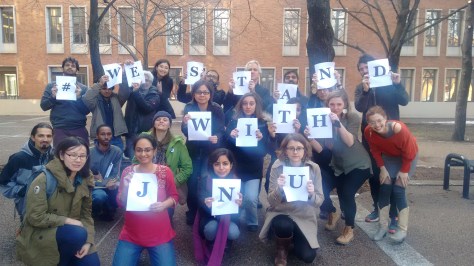
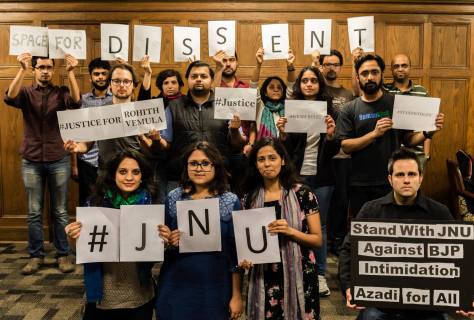
We, the undersigned, stand in solidarity with the students, faculty and staff of Jawaharlal Nehru University in New Delhi, India in their ongoing struggle against the anti-democratic incursions of the Indian state. We appeal to the elected Prime Minister Narendra Modi to uphold the Indian constitution, cease the repression of democratic protest across university campuses in India, and withdraw the spurious charges of ‘sedition’ against JNU Students’ Union President Kanhaiya Kumar. Continue reading Statement of Solidarity with JNU: University of Exeter (UK)
Category Archives: Images
Statement in Support of Students and Faculty at JNU From Faculty and Affiliates of the American Uniersity of Beirut, Lebanon
February 23, 2016
We, the undersigned faculty, students, staff, and affiliates of the American University of Beirut are highly concerned over the recent repression of free speech and undue police and legal interventions at Jawaharlal Nehru University (JNU), New Delhi. Continue reading Statement in Support of Students and Faculty at JNU From Faculty and Affiliates of the American Uniersity of Beirut, Lebanon
Statement on Behalf of Facultyand Students of O.P Jindal Global University in Solidarity With JNU
We, the undersigned Faculty and Students from the O.P Jindal Global University (JGU) in our individual capacity, condemn the police crackdown in Jawaharlal Nehru University- Delhi(JNU) and the apathy towards JNU demonstrated by State actors through their coercive actions. Continue reading Statement on Behalf of Facultyand Students of O.P Jindal Global University in Solidarity With JNU
Statement of Solidarity FromFaculty and Graduate Students at the University of Hawai’i, Manoa Against Police Ation on JNU Campus
To: Prof. M. Jagadesh Kumar
Vice Chancellor
Jawaharlal Nehru University
New Delhi-110 067, India
The India I Came Back To: Namrata Sharma
This is a guest post by NAMRATA SHARMA
I will start this piece with a painful but short flashback tirade about myself. I moved back to New Delhi in 2014, after six long years in New York and Singapore. My decision to move back to the motherland was predominantly attributed to issues that a twenty-something grapples with when he or she is away from home and family. However, familial ties and emotional reasons aside, there was one factor which deeply resonated with me and was the driving force behind my decision to move back. This factor was – the liberty to express my thoughts and views on a topic, any topic, in an indulgent and lenient space, which, by virtue of being an Indian citizen, was guaranteed to me in India and not in other places. In India, this liberty transcended predictable spaces like classrooms, newsrooms and sophisticated editorial pages of the morning newspaper and was very organically present in the form of arm-chair political banter amongst friends and political conversations with family over dinner. Continue reading The India I Came Back To: Namrata Sharma
#NoDissentNoCountry #StandWithJNU
Williams College Stands with JNU!
http://https://www.youtube.com/watch?v=AQm_SvFKiJ4
Kajri Jain, University of Toronto
Aarti Sethi, (JNU 2009), Columbia University
A complete Hindi transcript and video of Kanhaiya Kumar’s speech is available here.
A complete English translation may be accessed here.
Rohith Vemula’s last note may be accessed here.
An Appeal to the Academic Community of Delhi for February 23 Rohith Vemula March, “Chalo Dilli” by University of Hyderabad Alumni
5 Colleges Faculty and Student Statement in Solidarity with JNU
This is a statement sent by scholars at five universities in the U.S
We, the undersigned at the University of Massachusetts – Amherst, Smith College, Hampshire College, Mount Holyoke College, and Amherst College wish to express our solidarity with the students, faculty, staff and wider community of Jawaharlal Nehru University (JNU), India’s premier academic institution. We demand that all charges against all students being targeted as ‘anti-national,’ including JNU Student Union president Kanhaiya Kumar, be dropped immediately. We understand the arrest of Mr. Kumar, and the intention to arrest or interrogate another 50 students on some unspecified list of the Delhi Police, to be associated with a wider campaign to quell dissent in India’s universities, a campaign which includes the harassment faced by Hyderabad Central University student Rohit Vemula, resulting in Mr. Vemula’s suicide. We are concerned about the well-being of the students who continue to be debarred from all academic activities at JNU, without any due process or proof of wrong doing, and we condemn the scapegoating and media trial of Umar Khalid, based largely upon his identity as a minority. We demand that the Delhi police should withdraw from the JNU campus. We believe that the ultimate responsibility for the campaign of harassment against universities throughout the country lies with the present Indian Government and we demand that the government desist.
We are aware and are in agreement with the fact that the case against Mr. Kumar is false in every way. We are also in agreement with eminent economist Professor Prabhat Patnaik, that the government’s actions are nothing less than the beginning of a campaign to undermine the Indian Constitution itself. The events in Hyderabad, JNU, and most recently, Jadavpur University, all point to a pattern of harassment, wherein the central government has deployed campus-based student groups to silence dissent. We take the use of the state’s machinery to physically attack vocal and articulate students speaking against the government extremely seriously. We are particularly concerned by this government’s tacit approval of the violence exhibited by lawyers at Patiala house this week. As scholars and students based in the US, we have already witnessed efforts by representatives of the Hindu right to undermine academic debate and scholarship in the context of South Asian Studies in the US and in India. We collectively represent years of scholarly and activist experience in addressing threats to academic freedom, and see that these threats are part of a larger project to undermine democracy and to rationalize a fundamentally unequal society. Continue reading 5 Colleges Faculty and Student Statement in Solidarity with JNU
The Right to Reason and Imagine: Architects in Solidarity with the JNU Community
Guest Post by Architects from all over India and elsewhere
To: The JNU Teachers Association, JNU Students Union
CC: Vice Chancellor, JNU
We, the undersigned, are writing this in utmost shock and despair regarding the recent events and developments at your campus. We want to extend our full support to the JNU teachers association and the democratically elected JNU Student Union. We believe there is a difference between the nation, the state and the government of the day, and fully support your constitutional right to air your positions, as different or diverse as they may be, without illegal interference from any particular ruling ideology, party or state machinery.
As those engaged in architecture, we believe that imagination and reason are the highest of human faculties. This gift is what we constantly cultivate and rely on – in academia and in practice – when we question what exists, however natural, fixed and irreplaceable it may seem, and fearlessly posit alternatives. Indeed, there is little difference for us between possessing a moral imagination and being able to imagine such alternate worlds and other ways of being.
The inability therefore to envision life in another’s shoes, to disagree and to counter ideas with more aesthetic or eloquent ones without resorting to character assassination, violence and charges of anti-nationalism, betray to us an alarming lack of imagination, and we strongly condemn this in all its forms.
We condemn this absence of imagination and the physical and epistemic violence it has unleashed on the university community especially teachers and students. We stand with you in support of the university as a marketplace of ideas where all ideas and opinions are passionately argued, ripped apart, defended and critically re-imagined in ever new ways, leading to a more enlightened citizenry. This must be allowed to happen without fear or favor, risk of persecution or charges of sedition. If nothing else, the imagination of our founding fathers demands it, and we are in solidarity with your right to exercise it.
(This statement represents us in our individual capacities and not the institutions we are associated with.)
(In alphabetical order)
Continue reading The Right to Reason and Imagine: Architects in Solidarity with the JNU Community
Purdue University Stands in Solidarity with JNU
We, the undersigned faculty and students at Purdue University, strongly condemn the arrest of JNUSU President Kanhaiya Kumar. We oppose the systematic and deliberate attempts to humiliate, bully and terrorize the university’s community of scholars and political activists. It is unethical for a government to spread canards about students with the hope of distracting attention away from its over-zealous, slapdash interventions in academic institutions. We demand that this scapegoating and hounding of Umar Khalid, and all other students, cease immediately.
We salute the courageous JNU community that stands proud and resolute in the face of physical violence, media trials, and sectarian, antediluvian discourses that confuse students for enemies, and dissent – the cornerstone of democracy – for sedition.
More generally, we detect a pattern in this government’s deployment of the state machinery against young adults committed to addressing the inequities and discriminations so blatant in our country today. We insist, therefore, that the central government end its programmatic assault on public educational institutions and the spirit of free-thought. Institutions of higher education must be created and preserved as spaces where caste oppression, gender and minority-exclusion can be studied, and their resistance practiced. JNU exemplifies a dual commitment to combining academic rigor with a political-ethical conscience. We stand in solidarity with JNU’s vision of a diverse campus, charged with a robust polity, where no monolithic, auto-corrected version of the nation or patriotism dominates. We believe that university campuses, like society at large, can thrive only when celebrations of the myriad manifestations of the nation are accompanied by an honest and fearless capacity to criticize its inadequacies. Continue reading Purdue University Stands in Solidarity with JNU
Resolution in support of the student protests in India against the militant suppression of intellectual freedom and dissent by the BJP-government
This is a resolution passed by the Doctoral Students’ Council, City University of New York (CUNY)
WHEREAS, on 12 February, the Delhi Police raided student hostels at the Jawaharlal Nehru University (JNU) and arrested the JNU Students’ Union President Kanhaiyya Kumar on the arbitrary and anti-democratic charge of sedition; and
WHEREAS, this application of a draconian, colonial law which criminalizes dissent stands in stark contradiction to the very democratic character of the nation that affirms an individual’s right to free speech, however radical and unpopular the opinion; and
WHEREAS, this arrest of an elected student representative and the subsequent militarization of the campus with an overwhelming police presence is sanctioned and sponsored by the Bharatiya Janata Party (BJP) led ruling regime, in conjunction with its affiliate organizations RSS and ABVP, its student wing; and
WHEREAS, this coercive presence of the police on the university premises and elsewhere is compounded by their complicity in the physical assaults by lawyers of the Hindu Right on JNU teachers and students at the courthouse before Kanhaiyya’s hearing; and
Wanted Students Surface in JNU: JNUSU Vice President Shehla Rashid Shora and Umar Khalid Speaking to Students
[ In a dramatic new development, four students, Umar Khalid (ex-DSU), Anirban (ex-DSU), Rama Naga and Asutosh (AISA), from amongst the list of ‘students wanted by the police’ resurfaced on the night of Sunday, 21 February, and stayed with their fellow students till the early hours of Monday, February 22 on the JNU campus. Reportedly, they are still on campus, with their fellow students. One of them, Umar Khalid, spoke at a large gathering in front of the administration block, where all protesting students have been meeting. The gathering was also addressed by the Jawahar Lal Nehru Students’ Union (JNUSU) vice-president and All India Students Association (AISA) activist, Shehla Rashid Shora (against whom there are no charges made out by the police at the moment). The police, did not enter the campus at that time, given the very large number of students who had gathered in solidarity with their ‘wanted’ friends. The statements of the JNUSU vice president, Shehla Rashid Shora, and of Umar Khalid (who is one of students ‘wanted’ by the police), were recorded by a correspondent of the online portal, Catchnews.com during the early hours of Monday, 22nd February, as they addressed the gathered students. We are sharing those recordings, with thanks to Catchnews.com, with our transcript/translation of what was said by both Shehla and Umar. As is clear from both statements, the students are not in hiding, they are offering peaceful resistance, and the charges of sedition against them are utterly without foundation. Listen, and read, for yourselves.]
University of Minnesota Stands in Solidarity with Jawaharlal Nehru University
We, the undersigned at the University of Minnesota, strongly condemn the concerted attack on the students, faculty and academic culture of Jawaharlal Nehru University. At the behest of the government, the Delhi police has pressed sedition charges on unnamed students of the university. Reminiscent of the Emergency, the students’ union president Kanhaiya Kumar has been arrested, several students have been suspended and the Delhi police has been hounding students in hostels, homes as well as public spaces in the city. Sections of the mainstream media have launched a vicious campaign to declare JNU an “anti-national” university, and some journalists have gone so far as to spin lies about the “terrorist connections” of student activist Umar Khalid. As a consequence, mob violence against JNU students and faculty has spread across the city and even entered the courtrooms where the case against the JNU students’ union president was being heard. We strongly condemn this hate campaign and demand the immediate release of the JNU students’ union president. We also demand that the suspension of students is revoked and unsubstantiated sedition charges are withdrawn immediately.
Continue reading University of Minnesota Stands in Solidarity with Jawaharlal Nehru University
Sambit Patra Flying the Tricolour on Times Now, in JNU and on Iwo Jima – History Re-Imagined (Once Again) by the BJP
http://www.youtube.com/watch?v=rQNDEwBirLg
A recent ‘Newshour’ non-debate on Times Now on whether or not an order emanating from the Ministry of Human Resources Development to erect 207 feet high steel flagpoles and giant tricolour flags in Central Universities across India featured a wonderful intervention by Sambit Patra, BJP spokesman and digital magician extraordinaire.
#StandwithJNU: Solidarity Statement from the Institute for Gender, Race, Sexuality and Social Justice at the University of British Columbia
We, graduate students and faculty at the Institute for Gender, Race, Sexuality and Social Justice and the broader University of British Columbia community stand in absolute and resounding support of the students, faculty, staff and allies at Jawaharlal Nehru University (JNU). We condemn the political and legal clout being exercised by the Indian government in Kanhaiya Kumar’s arrest and subsequent reaction to protests. Not only is Kanhaiya’s arrest erroneous and suspect to begin with, the consequent unraveling of systematic hatred towards these “anti-national” scholars creates an environment where anyone perceived to be against ‘Hindu’-hence-Indian culture is at risk of personal harm meted out by the State.
It is deeply disturbing to note public debate around this on mainstream Indian media and TV news channels. The contention is that universities should not be spaces of political engagement, but of quiet scholarly repose. As students and researchers committed to the principles of transnational social justice, it is distressing to note this attempt to depoliticize the university space by dismissing students as undeserving of their spot for being actively engaged in the future of their country.
To term universities and institutions that foster alternative spaces of being and thinking ‘anti-national’ is commandeering an invective that is untrue and wholly vicious. Moreover, the violence meted out to Kanhaiya as well as journalists at Patiala Court is horrifying, especially noting Delhi police’s inaction and complicity in this, despite tight presence. It is precisely this sort of unprovoked violence by the State apparatus that is undemocratic. It is baffling to note the Delhi police’s apparent inability to track down the people who attacked Kanhaiya, while at the same time it launches a now country-wide witch hunt for another JNU student leader Umar Khalid (who allegedly organized the protest in question), based on completely false Islamophobic allegations.
We believe that universities are sites of active engagement, and using an old colonial remnant that is the sedition charge betrays intent to suppress the voice of a democracy. To hold debates and discussions is not anti-national, even more so when there is overwhelming testimony that Kanhaiya Kumar was not involved in the particular sloganeering for which he was arrested. An active and thriving student body presence is what makes JNU one of Asia’s premiere institutions. It is deeply disappointing to note the efforts by the current government to clamp down on this. It is with rising alarm that we register the chain of events that connect other established institutions like the Film and Television Institute of India (FTII) and the University of Hyderabad (UoH).
UNIVERSITY OF ILLINOIS STANDS WITH JNU

We, the undersigned students, faculty, staff, and other members of the University of Illinois community are in solidarity with students, faculty and staff at Jawaharlal Nehru University (JNU), India, against the ongoing anti-democratic actions by the Indian state. We demand an immediate end to the police action against students on campus, and withdrawal of all charges against Kanhaiya Kumar, President of the JNU Students’ Union. We unequivocally condemn the witch hunting of students, using archaic laws of sedition, who organized the cultural event questioning capital punishment and the deliberate vandalism and violence unleashed by those affiliated with Hindu Nationalist groups. We are also dismayed at the violence used by lawyers aligned with the government in their acts of vigilantism which are aimed at using the garb of patriotism to impose their ideology through violence.
We strongly believe that the charge of sedition against Kanhaiya Kumar, Umar Khalid and the other 6 students are based on spurious evidence. This arrest is an excuse for the state to root out dissenting voices on JNU campus, a move towards converting educational institutions like JNU into an arm of the authoritarian state. Attempts of a similar nature have been witnessed recently at other Indian educational institutions such as Film and Television Institute of India (FTII) and Hyderabad University. The growing threat to academic freedom and the practice of fundamental thinking and critique, posed by the current political climate is transnational, and extends beyond India to other parts of the world–it is a threat we face here in the United States, too.
STATEMENT OF SOLIDARITY WITH STUDENT ACTIVISTS IN INDIA: University of Pennsylvania & Philadelphia South Asian Collective
We, activists and academics in the Pennsylvania region, strongly condemn the attack on academic freedom at Jawaharlal Nehru University (JNU), New Delhi. The arrest of Kanhaiya Kumar, the President of the JNU Student’s Union, on charges of sedition has brought to light the intervention of the Union Government in the internal matters of the university. The repeated interference by police personnel at the behest of Vice Chancellors on university campuses is a draconian move. The charges against students were brought after an event organized by a section of students on campus premises to discuss the judicial execution of Afzal Guru. The JNU Students’ Union was subsequently held responsible for the “anti-national” slogans that were chanted by a group of students. We condemn these trumped-up and unconstitutional charges and stand in solidarity with the efforts to repeal capital punishment in India.
The events unfolding at JNU reveal disturbing similarities with instances of government repression on other campuses. We remember, with distress, the actions of the University of Hyderabad (UoH) administration in cahoots with the Central Government, actions that led to the death of a promising Ambedkarite student-activist, Rohith Vemula. The protests that arose indicted the discriminatory atmosphere prevailing in our universities as tantamount to the denial of the fundamental right to education to socially marginalized groups. Further, the murder of social thinkers like Govind Pansare and M.M. Kalburgi by hyper-nationalist elements under the tacit encouragement of the policies of the Central Government has shocked all advocates of free speech in India.
The charges of sedition against students participating in democratic discussion of public events is highly objectionable. The stifling of voices through intimidation and muscle power does not bode well for educational institutions.
Debate and dissent are integral parts of a strong democracy. Universities are critical public spaces that support these democratic practices to realize the values of social justice enshrined in the ideals of the constitution. International campuses like JNU, FTII and UoH bring together diverse group of students in the spirit of self-reflexive and deep intellectual engagement to ask fundamental questions of their social realities. An attack on these institutions is an attack on this precious pedagogical space. Student movements in India in alliance with other social movements in the country have historically been a resilient and sensitive force. The BJP government’s efforts to undermine them is nothing but an assault on Indian democracy. The government has failed to protect the rights of student bodies, and the highhandedness of the police highlights the insecurities of the present government.
In the United States during a presidential election year, we watch increasingly bigoted views against blacks, Muslims, and immigrants gaining ground. These events cannot be seen in isolation and we stand at the intersection of socio-political movements in the US and South Asia.
We stand in solidarity with students and faculty of JNU and demand the immediate release of the detained students. We appeal to all advocates for academic freedom in India and abroad to stand united against this state atrocity.
- Anannya Bohidar, Graduate Student, South Asia Studies, University of Pennsylvania
- Ammel Sharon, Graduate Student, South Asia Studies, University of Pennsylvania
- Meghna Chandra, Philadelphia South Asian Collective
- Ania Loomba, English, University of Pennsylvania
- Projit Mukharji, History and Sociology of Science, University of Pennsylvania
- Najnin Islam, Graduate Student, English, University of Pennsylvania
Letter of solidarity with JNU: Students, Staff and Faculty, Ashoka University
We, the undersigned—who study and work at Ashoka University, as well as the alumni of the Young India Fellowship, in our private capacity—write to voice our solidarity with the students and faculty at Jawaharlal Nehru University (JNU). Recent events at JNU, including the arrest of the JNUSU President over the charge of sedition, as well as other disproportionate measures, amount to a deeply troubling attack on academic and cultural freedom. We strongly condemn the display of brute force by the police, who were given free entry to the campus, including hostels, to question, detain and arrest students and faculty members. We protest the lack of police protection to those students and faculty, and condemn the use of State force against democratic expressions of dissent.
As proponents of liberal education, we believe that societies can only grow when they foster intellectual engagement with fundamental social questions and contemporary political issues through non-violent debate and argumentation. University campuses are, and should be, autonomous spaces where people can peacefully express as well as challenge dissent and opinions. However, the recent spate of events involving many university campuses across the country has posed a serious threat to the sanctity of such spaces as well as the democratic right to dissent and freedom of speech and expression. This includes the turn of events that led to Rohith Vemula’s death at the University of Hyderabad, the withholding of grants by the Ministry of Human Resource Development to Panjab University, and several instances of violent disruption of the screening of the film Muzaffarnagar Baaqi Hai in campuses across the country.
We condemn the State-backed misuse of the charge of sedition, a colonial era provision in the Indian Penal Code, against the JNUSU President, Kanhaiya Kumar. In the documented absence of any allegedly ‘anti-national’ actions or rhetoric on his part, we see the charge as an attempt to stifle dissent from the dominant order and silence critique of the State. We strongly believe that the provision against sedition, which was repealed in the United Kingdom itself in 2009, has no place in modern democracy. Most immediately, we strongly disapprove of the action of certain lawyers and a Member of the Legislative Assembly who physically attacked JNU students and faculty members as well as journalists outside the Patiala Court House premises on 15th February, 2016.
We fear that the continued State inaction against such instances of violence will foster an environment in which the label “anti-national” or “traitor” can be imposed on every voice of dissent.
We urge that:
– the JNU campus be restored to normalcy and the police be withdrawn from all parts of the campus.
– the JNUSU President, Kanhaiya Kumar be released from police custody immediately and all charges be dropped against him.
– such unconstitutional actions be denounced.
– we be allowed to nurture our universities as tolerant, democratic spaces where dissent and disagreement is respected, discussions are nurtured, and critical thinkers are born.
|
Faculty |
||
|
Ajit Mishra |
Bhaskar Dutta |
Malvika Maheshwari |
|
Alex Watson |
Debarati Roy |
Mandakini Dubey |
|
Anisha Sharma |
Durba Chattaraj |
Maya Saran |
|
Anunaya Chaubey |
Gilles Verniers |
Nayanjot Lahiri |
|
Anuradha Saha |
Gwendolyn Kelly |
Rajendran Narayanan |
|
Aparajita Dasgupta |
Jonathan Gil Harris |
Ratna Menon |
|
Aparna vaidik |
Kranti Saran |
Ravindran Sriramachandran |
|
Arunava Sinha |
Kunal Joshi |
Saikat Majumdar |
|
Aruni Kashyap |
M A Ahmad Khan |
Supriya Nayak |
|
Pulapre Balakrishnan |
Madhavi Menon |
Vaiju naravane |
|
Bharat Ramaswami |
Malabika Sarkar |
Vishes Kothari
|
|
Staff |
||
|
Adil Shah |
Kanika Singh |
Shiv D Sharma |
|
Aniha Brar |
Karuna |
Shreya Khedia |
|
Anu Singh |
Meena S. Wilson |
Sudarshana Chanda |
|
Anuja Kelkar |
Mercia Prince |
Suha Gangopadhyay |
|
Charu Singh |
Priyanka Kumar |
Sukanya Banerjee |
|
Chiranjit mahato |
Sarah Afraz |
Sushmita Nath |
|
Dr Maaz Bin Bilal |
Saumya Varma |
Swarnim Khare |
|
Harshita Tripathi |
Saurav Goswami |
Tanita Abraham |
|
Ishan de Souza |
Sayan Chaudhuri |
Zehra |
|
Sushmita Samaddar |
Surya Raman |
Sandeep Saraswal |
|
Apoorva Gupta |
Aditya Sarin |
Chandan Sharma |
|
Alumni |
||
|
Aafaque R Khan |
Kaavya Gupta |
Rishi Iyengar |
|
Akanksha |
Kande Sruthi Niveditha |
Ritesh Agarwal |
|
Akshay Barik |
Kaustubh Khare |
Rohini Singh |
|
Ananta Seth |
Maansi Verma |
Rupali Kapoor |
|
Antony Arul Valan |
Malini Bose |
Sai Krishna Kumaraswamy |
|
Anushka Siddiqui |
Mayank Sharma |
Sakshi Ghai |
|
Ashish Kumar |
Mrudula Nujella |
Shahzaib Ahmed |
|
Ashweetha |
Neil Maheshwari |
Shaleen Wadhwana |
|
Avni Ahuja |
Neelakshi Tewari |
Shashank Mittal |
|
Chaarvi Badani |
Nikita Saxena |
Shivangi Pareek |
|
Danish Ahmad Mir |
Nina Sud |
Shrestha Mullick |
|
Debanshu Roy |
Nipun Arora |
Shweta Subbaraman |
|
Deepika Ghosh |
Parushya |
Simeen Kaleem |
|
Devleena Chatterji |
Pavithra Srinivasan |
Simranpreet Oberoi |
|
Dhaneesh Jameson |
Poornima Sardana |
Sonal Jain |
|
Dhwani Sabesh |
Pragya Mukherjee |
Subhodeep Jash |
|
Hardika Dayalani |
Prama Neeraja |
Tanuj Bhojwani |
|
Harsh Mani Tripathi |
Rahul Sreekumar |
Taysir Moonim |
|
Harsh Snehanshu |
Rajat Nayyar |
Vaishnavi Viraj |
|
Himanshu Ranjan |
Ratul Chowdhury |
Venkat Prasath |
|
Jahanara Rabia Raza |
Rimjhim Roy |
Vishal Khatri |

Solidarity Statement for JNU by IIT Scholars
This is a statement issued by the undersigned, scholars of Departments of Humanities and Social Sciences of IITs across the country.
We, the undersigned, scholars of Departments of Humanities and Social Sciences of IITs across the country, condemn the police action in JNU and the arrest of the JNUSU President Kanhaiya Kumar on the charge of sedition. We also denounce the repeated acts of violence unleashed by some lawyers and others at the Patiala House Court against faculty, students and the media, as well as police inaction regarding the same.
In addition, we appeal for media and public trials to cease and for civil society to instead focus on debating issues in an amicable and reasonable manner, without slandering JNU or questioning the academic integrity or patriotic fervour of JNU and its supporters. We criticise the general atmosphere of fear and intimidation that is being created to target the entire university. Given the fast polarizing political atmosphere in the country, we appeal to the media organisations to display greater responsibility and conduct television debates in such a manner that no prejudicial public opinion is created while there is an ongoing enquiry into the entire episode by the authorities concerned. Resorting to jingoism and sensationalism may cause avoidable hazards. Continue reading Solidarity Statement for JNU by IIT Scholars
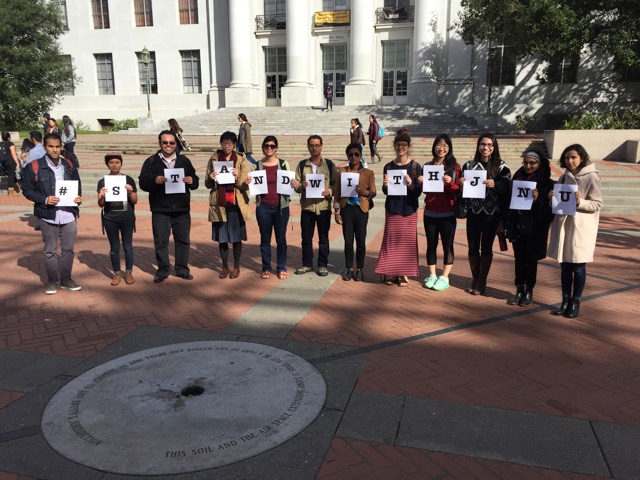
As The People’s Republic of New Delhi Marches in the Free Air Students of Berkeley #StandWithJNU
As the people of Delhi march, sing, run and dance to freedom’s call, as they cock a snook at the shackles of nationalism, casteism and authoritarian stupidity, a gift of love from afar. Look at them standing in the free air! Look at them standing around a piece of earth unbound from the myopia of nationalism!
The memorial the 1964 Free Speech Movement at the University of California, Berkeley, like the thing it celebrates, is both invisible and embattled. The monument appears to be a circle of concrete six feet in diameter, in the middle of the famed Sproul Plaza where thousands of students gathered to demand the right to free speech and academic freedom on one of America’s most prominent and celebrated public university campuses. But that monument is so much more than what can be seen. The concrete circle, bearing the inscription “This soil and the air space extending above it shall not be a part of any nation and shall not be subject to any entity’s jurisdiction,” encompasses a 6-inch wide indentation into the ground that reaches into the soil below and 60,000 feet upwards into the sky, to the limits of American airspace. That is, in fact, the monument to free speech at Berkeley: 60,000 feet and 6-inches of invisible insistence that to speak freely is not and cannot be a right granted by any sovereign, mandated by any state. The width of the depression in the ground is as large as a person’s two feet. The ground on which they stand. From which they speak. This is the lasting monument to free speech at Berkeley. From a space as wide as our stance, reaching in an unseeable column of air to the limits of the stratosphere. A monument of air that can never, like free speech itself, be contained, torn down, or granted by another. It lies, unassuming, built as it is out of the immateriality of inalienable rights, in the middle of a campus that grapples daily with the legacy of that now 50 year old fight for the right to claim the space of the university as one of protest, of politics, of resistance.
But Berkeley, we mustn’t forget, exists on occupied territory. Its celebrated monument digs into soil that was taken, without recompense or acknowledgement, from the Ohlone people who were stripped of their lands, their language, their culture, and their lives in what America today celebrates as its great westward expansion. Thus, the monument to free speech at the University of California, Berkeley, roots itself into a soil it claims belongs to no nation and also reifies centuries of the genocide of indigenous people and of settler colonialism. This too is the legacy of the Free Speech Movement. Of the student-led activism that created Ethnic Studies programs across California and the rest of the United States. To stand in the 6-inch wide memorial is to stand in land that is occupied and to nonetheless believe that no occupation, no nation, no state, mandates our ability and our right to speak, to protest, to imagine otherwise the world in which we live.
From Berkeley to JNU. With love and solidarity.
Poulomi Saha
University of California, Berkeley
“A Glorious Thing Made Up Of Stardust:” What Pat Parker & Rohith Vemula Ask Us to Consider Lata Mani
This is a guest post by LATA MANI
The first thing you do is to forget that I’m black
Second, you must never forget that I’m black
Pat Parker (1978)
In these opening lines of her poem, For the White Person Who Wants to Know How to be My Friend, Pat Parker names a paradox at the heart of challenging socially produced difference. Parker is speaking not to diversity in nature, nor to the diversity of nature. Not to the variations of appearance – size, shade, height, foliage, texture; or mode of expression – hoot, howl, accent, gesture, cultural practices. Her lines address a uniquely human phenomenon: prejudice. They speak to the poignant difficulty of challenging a spurious and malevolent construction of racial difference in a society still in the grip of its miasma.
I have recalled Parker’s lines many times in the days of sorrow, tumult and righteous rage that have followed Rohith Vemula’s suicide. “Rohith Vemula’s suicide.” I am holding off from saying “Dalit scholar Rohith Vemula’s suicide.” Or, as is now being said with good reason, “Dalit scholar Rohith Vemula’s institutional murder.” I defer by a couple of sentences a description of him that refers to the caste into which he was born; to honour if only symbolically his anguish that the contingent facts of his birth had indelibly defined his life.