
The ZeTo campaign organisers responded to Althea’s concerns expressed in an earlier post. We are delighted by and thankful for their willingness to dialogue, for we do believe that such an exchange of views is absolutely necessary for common ground to evolve on this issue, precisely because our readings of the political and social present in Kerala, are different.
Continue reading Zero Tolerance or Restorative Justice? Althea responds to ZeToCategory Archives: Law
Response to the Zero Tolerance Campaign against Sexual Violence in Kerala: Althea Women ‘s Friendship
Althea supports DrAsha Achy Joseph’s efforts to oppose the shielding of powerful men so that they may get away with the most egregious sexual violence and harassment.
However, we are wary of the implications of ‘zero tolerance’, given its ambiguous global history. Zero tolerance is not the same as “ending gender-based violence.” It can very quickly devolve into a superficial checkbox for institutions that sounds good on paper and in theory.
An Open Letter to Bhavana and Some Reflections on the Hostile Responses to it: Althea Women’s Friendship
[This letter was written by Gayatri Devi, as the opening segment of the series of analyses that Althea hopes to collectively publish in the wake of the atrocious judgement passed by the Ernakulam Principal Sessions Court, written by the controversial judge Honey M Varghese, exonerating Dileep aka Gopalakrishnan in the actor assault case of 2017. The reflections on Dileep-supporters’ responses to it were written by J Devika.
In 2017, a leading female actor was kidnapped on her way back from work and raped by six men in a moving vehicle on the roads of the city of Kochi. The lead-rapist claimed to her that he was hired to do it. The alleged role of the actor Dileep in commissioning the horrifying act of violence, which was also filmed, has been at the centre of public outrage from 2017 to this day. Dileep’s role seemed to be strongly indicated by circumstantial evidence, however in the course of the trial, the advantages that he enjoyed seemed to surface repeatedly. The whole trial appeared to be an extended punishment of the survivor, and the culmination of it therefore was hardly unexpected. Nevertheless, the public, overwhelmingly with the survivor, has not taken the judgment lightly.
We believe that it is our feminist political responsibility to develop a critical discourse on on the normalization in Kerala of the insecure masculine that Dileep and his supporters represent, over the past three decades. The material we hope to examine includes the judgement itself as well as the many films that Dileep starred in, from the so-called ‘serious’ film he acted in directed by Adoor Gopalakrishnan, to his many slapstick comedies which became popular. The series is anchored by Gayatri Devi, and others will also contribute. This is the first in the series.]
Dearest Bhavana:
When I first heard the verdict in your 2017 case, in my mind, I silently thanked the fortuitousness of your name, “Bhavana.” Your name “Bhavana” means “imagination.” I thanked your name, because I believed that the strength to process the disillusionment and dissatisfaction that beset you upon hearing the wrong verdict was contained in your name. You must remember this fact. You must not forget this fact. You own a precious name. Your name embodies a precious truth.
Continue reading An Open Letter to Bhavana and Some Reflections on the Hostile Responses to it: Althea Women’s FriendshipThe Elite Criminal Man and the Self-Curated Criminal Man: Criminality and Misogyny in the Dileep Case
The verdict in the actor-assault case of 2017, delivered a few day back in the Ernakulam Principal Sessions Court, did not surprise anyone, except the extremely naive. Not just because of the difficulties in proving conspiracies, but also because the trial court seemed so unbelievably biased against the survivor all through and actually in favour of the accused. The man accused of conspiring against the female actor and hiring a gang of thugs to abduct and rape her in a moving vehicle, Dileep aka Gopalakrishnan, is an actor in the Malayalam industry. But he is also accused of being a notorious fixer in the Malayalam movie industry, the go-to person for people who want to get things done — someone who bends things to their will, cuts through all institutional procedure and safeguards using invisible chains of influence and violence. The verdict convicted the six men who actually committed the crime – and declared that the prosecution had not proven Dileep’s involvement in the crime. In other words, the man escaped for entirely technical reasons — or the blind spots of the law.
Continue reading The Elite Criminal Man and the Self-Curated Criminal Man: Criminality and Misogyny in the Dileep CaseRemember the Children: The Palathayi Case in Kerala and the Need for Urgent Changes in POCSO laws: Althea Women’s Friendship
[The ‘Palathayi’ case refers to a shocking instance of child abuse — of a 10-year-old female child in Palathayi, Kerala, by her school teacher, K Padmarajan, a noted BJP leader. Not just the act, but also the way in which the police and the ruling CPM handled it contributed to the public outrage around it. Worse, the child counselors’ role in intimidating the child, bombarding it with invasive, sexualised and irrelevant leading questions, and the police’s long interrogations, revealed, once again, the terrible rot in Kerala’s child protection machinery. The police investigation proved extremely biased in favour of the accused, and the team had to be replaced after protests by activists including feminists, and the family’s pleas. Despite complaints by the child’s mother against the counselors, the higher authorities, including the much-romanticized Minister for Women and Children of that time, K K Shailaja, did little to deliver justice. The verdict of the court in this case which sentenced the accused to life imprisonment, condemned the counselors’ questioning and asked for immediate action against them. The counselor was suspended after the verdict, but suspension hardly suffices as a punishment form blatant verbal rape of a ten year old.
Althea has been raising concerns about the state of child welfare, especially of female children from historically-marginalized social groups and family circumstances in Kerala even before. It is apparent that we need to keep speaking about it, and we will. This statement appeared first in the Malayalam online journal Truecopy Think. This is a translation of the original Malayalam statement by Gayatri Devi, who is part of Althea.]
Continue reading Remember the Children: The Palathayi Case in Kerala and the Need for Urgent Changes in POCSO laws: Althea Women’s FriendshipBooks as Crime ? – Whether J and K High-court Will End the ’Unprecedented Situation’ ?
‘So you are the little woman who wrote the book that made this great (American) civil war’
— Abraham Lincoln to Harriet Beecher Stowe, author of Uncle Tom’s Cabin
The Writers’ Police !
Bruno Fulgini, a nondescript employee at the French Parliament, would not have imagined in his wildest dreams that his tedious and boring job at the Parliament library would lead him to a treasure hunt of another kind.
Nearly two decades back one witnessed him metamorphose into an author and editor, thanks to the sudden discovery of old files of the Paris police, which provided details of its surveillance work done way back in 18 th century. A report filed by AFP then, quotes Fulgini tell us that ’Beyond criminals and political figures, there are files on writers and artists. In some cases, they go far in their indiscretions.’….
It was clear to these protectors of internal security of a tottering regime that the renowned literati then viz. Victor Hugo, Balzac or Charles Dickens, might be writing fiction, but their sharp focus on the hypocrisy of the aristocrats or the livelihood issues of ordinary people is adding to the growing turmoil in the country. They knew very well that they might be writing fiction for the masses but it is turning out to be a sharp political edge that hit the right target and is becoming a catalyst for change.
The Parisian police was engaged in tracking down the daily movements of the writers, was more subtle in its actions; its present-day counterparts in the West do not seem to have such patience.
The strongest democracy in the world namely the US has of late become a site of an ’unprecedented’ ’Multi-level barrage of US book bans’ as per PEN America [1]….
And now there are indications that the biggest democracy in the World namely India is keen to follow the footsteps of the strongest democracy ?
Or it is too early to say that .[ Read the full article here : http://mainstreamweekly.net/article16227.html
Punjab: Why Proposed ‘Law Against Blasphemy’ Needs to be Discarded
The CCG’s concern that the proposed PPOHS Act is ‘unconstitutional’ and is an ‘open invitation to ‘oppressive misuse’ needs to be heeded.
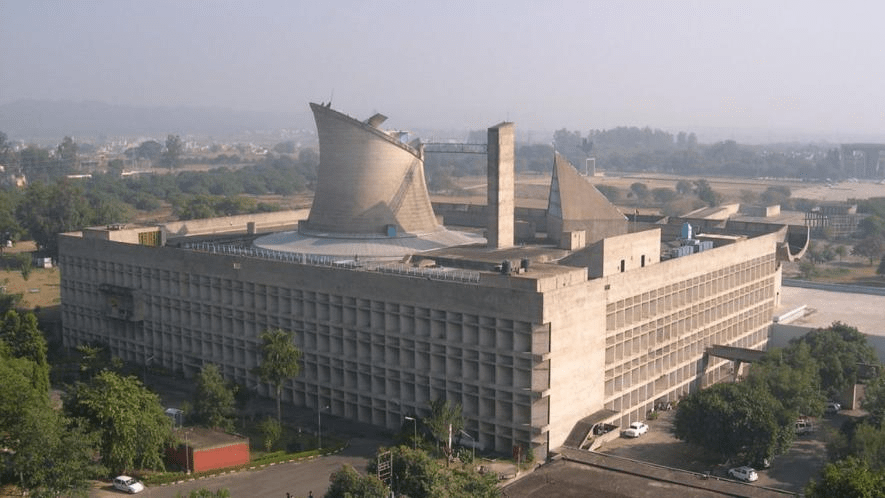
Image : Courtesy Fiickr
Whether history will repeat itself, that is the question being asked about Punjab government’s renewed attempt to enact a law supposedly against ‘sacrilege’?
Anyone who is a keen observer of the social-political developments in the state knows very well that it has a history of such efforts (2015 and 2018) where similar attempts were made to amend laws related to sacrilege, and both attempts proved unsuccessful as they failed on the yardstick of constitutionality.
As per reports, the proposed Punjab Prevention of Offences against Holy Scriptures Bill, 2025 (PPOHS Act), which was recently referred by the state legislature to a committee for further discussion, has come under the scanner of experts of the Constitution and concerned citizens.
A leading voice among them, namely the Constitutional Conduct Group (CCG) — a platform of retired civil servants and diplomats– has in an open communication underlined how Punjab government’s proposed ‘PPOHS Act’ is ‘unconstitutional’ and is an ‘open invitation to oppressive misuse’ .
[ Read the full article here : https://www.newsclick.in/punjab-why-proposed-law-against-blasphemy-needs-be-discarded]
Not Another Salacious Sex Scandal, Please: Althea Women’s Collective Statement on Mainstream Public Discussions of Complaints against Rahul Mankoottathil
[ A translation of the statement from the Kerala Feminist Forum is appended to ours. Both are translated by Gayatri Devi, a member of Althea.]
The way political parties and mainstream media in Kerala have framed the public discussion on the complaints against Rahul Mankoottathil comes as a real shock to anyone who sees Malayali women as citizens with equal rights and equal dignity, and to those who are committed to the welfare of children.
Continue reading Not Another Salacious Sex Scandal, Please: Althea Women’s Collective Statement on Mainstream Public Discussions of Complaints against Rahul MankoottathilWhen Police Comes Visiting Bookshops!
How saffron forces weaponise ignorance and stigmatise intellectauls

Silence gives consent
[Qui tacet consentire videtur – In Latin]
“Intellectual terrorists” are “more dangerous than cross-border terrorists”
These were the pearls of wisdom of the then Human Resource Development minister, who was addressing a conference of the Bharatiya Janata Yuva Morcha (December 19, 2001). Murli Manohar Joshi had even asked the ‘nationalist youths’ to counter ‘both types of terrorism effectively.’
…It would be 25 years soon since these objectionable remarks were targeted at India’s topmost historians, scholars, public intellectuals, even provoking followers to deal with them effectively’ like the way they deal with ‘cross border terrorists.’
Later commenting on these controversial remarks, the legendary historian Romila Thapar had famously said: ‘And then the government fell. But the books continued!”
Time for Thought Police?
As everybody can see, there is a sea change in the situation since the past more than a decade in this part of South Asia…
…..The target of attacks has now become broader, more expansive and more unpredictable. It is no longer restricted to ‘leftist’ ‘progressive’ writers, historians.
The recent move to ban 25 books on Kashmir history at a single go ‘for propagating false narrative and secessionism‘ — written by a spectrum of national and international scholars — which even do not share a similar world view, books which had been in circulation for years, even decades together is a case in point.
This list of authors includes, A G Noorani, Arundhati Roy, Anuradha Bhasin, Sumanta Bose, Victoria Schofield and several others… [Read the full article here : https://www.newsclick.in/when-police-comes-visiting-bookshops]
Citizens as Infants? – Judiciary ‘Schools’ People in Patriotism
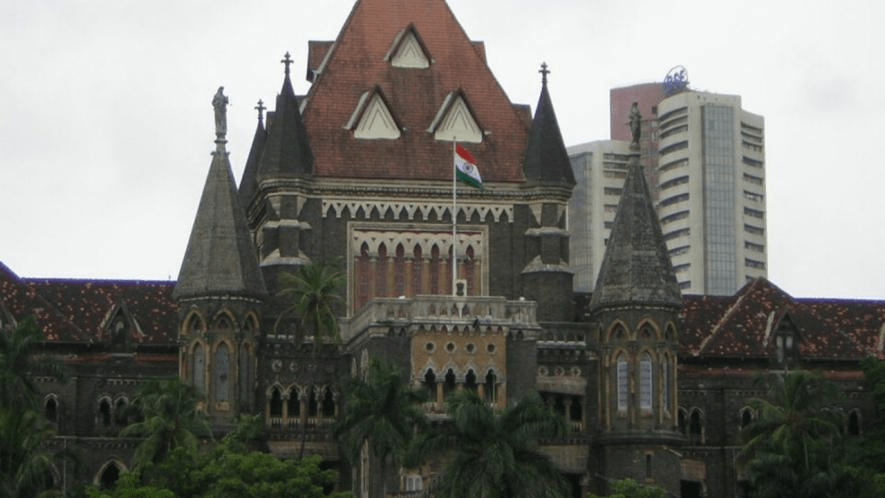
Could it be argued that Bombay HC’s highly debatable decision on a peaceful rally against Gaza genocide is an attempt not to inconvenience the ruling dispensation?
It was the year 1763, when Genevaís ecclesiastical assembly ordered one Robert Covelle to genuflect and listen to a reprimand for having fathered an illegitimate child. Covelle refused to kneel and turned to Voltaire for help.
Voltaire, a leading light of enlightenment, outraged at the very idea that religious authorities daring to make a citizen kneel, wrote a pamphlet against genuflection comparing the act with a tyrant punishing slaves or pedant correcting children. The rest of the philosophes rallied behind Voltaire and after six years of agitation, the Genevaís ecclesiastical assembly was forced to abolish genuflection from its code
Meera Nanda, writer and historian of science discusses, this episode in one of her monographs
Rereading this episode and seeing if around two-and-half centuries ago, the Church could be compelled to see incongruence, injustice and unreason in its own ruling, can a a similar thing be possible vis-à-vis the judiciary in the 21st century in the ‘biggest democracy in the world’?
This poser is related to a recent debatable decision of the Bombay High Court, which has rightly received enough opprobrium.
( Read the complete article here : https://www.newsclick.in/citizens-infants-judiciary-schools-people-patriotism_
Democracy For The Few ?
Is Bihar being turned into a test case of disenfranchising people?
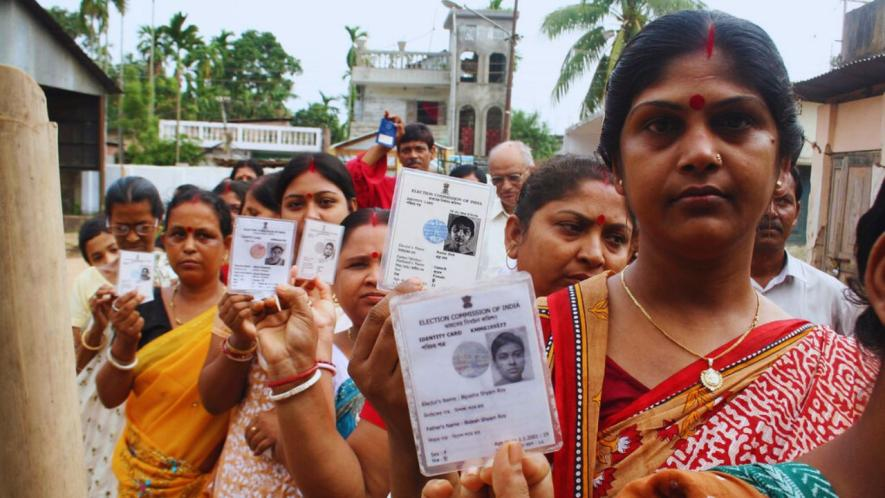
Representational Image. Image Courtesy: Flickr
India pledged to usher in a democracy with universal adult franchise.
It was the late 1940s, when India, a newly independent nation, whose less than 10% population was then literate, embarked on this unique experiment, unheard of in those times.
The architects of Independence rejected all the Western prescriptions that openly said that .’.. India had no democratic future‘ (Winston Churchill) or ”monarchial arrangement best suited the Asian people‘ (British Prime Minister Clement Attlee to Nehru, 1949), and (to quote a student of history) ‘met the imperial argument on direct terms, firmly believing in the possibility of creating democratic citizens through democratic politics.’ (India’s Founding Moment: The Constitution of a Most Surprising Democracy by Madhav Khosla)
What is worth emphasising is that all those great leaders who shaped a forward-looking Constitution were on the same page when it came to granting the right to vote. For example, B.R Ambedkar, who was chairman of the Drafting Committee of the Constitution, firmly believed that ‘To limit the franchise, was to misunderstand the meaning of democracy ... ‘
None of them dithered over this provision despite knowing well that even the Western countries had not fully adopted universal adult franchise. Remember, Switzerland granted the right to vote to women only in 1971.
Much water has flown down the Ganges, the Jhelum, the Brahmaputra, the Godavari or the Kaveri.
A good 75 years after the adoption of the Constitution (1950), today we are faced with a challenge that at first looks unbelievable, the present ruling dispensation seems to have embarked on a journey in an exactly reverse direction. [Read the full article here : https://www.newsclick.in/democracy-few]
Assam: Arms Licenses to ‘Vulnerable Citizens’
How saffrons are engaged in militarising Indian society not so surreptitiously.

Representational Image. Image Courtesy: Flickr
“…though this be madness, yet there is method in it“?
-Polonious, in ‘Hamlet’ by William Shakespeare
Pushback of ‘alleged foreigners’ It was May end, when the Assam government led by Bharatiya Janata Party’s (BJP) Himanta Biswa Sarma, was in the news for its policy of pushback where it was found literally pushing what it termed as ‘illegal foreigners’ into Bangladesh.
What was noticeable was that when its controversial pushback policy came under the scanner of national and international human rights organisations, the Assam government approved another scheme that has raised new questions?
This was a ‘special’ scheme to make the border areas, especially those inhabited by indigenous people living in “vulnerable and remote areas”, safe. ..
.. ..it was basically to give arms licenses to people and those along the border with Bangladesh to “help them protect themselves.” [ Read the full article here : https://www.newsclick.in/assam-arms-licenses-vulnerable-citizens]
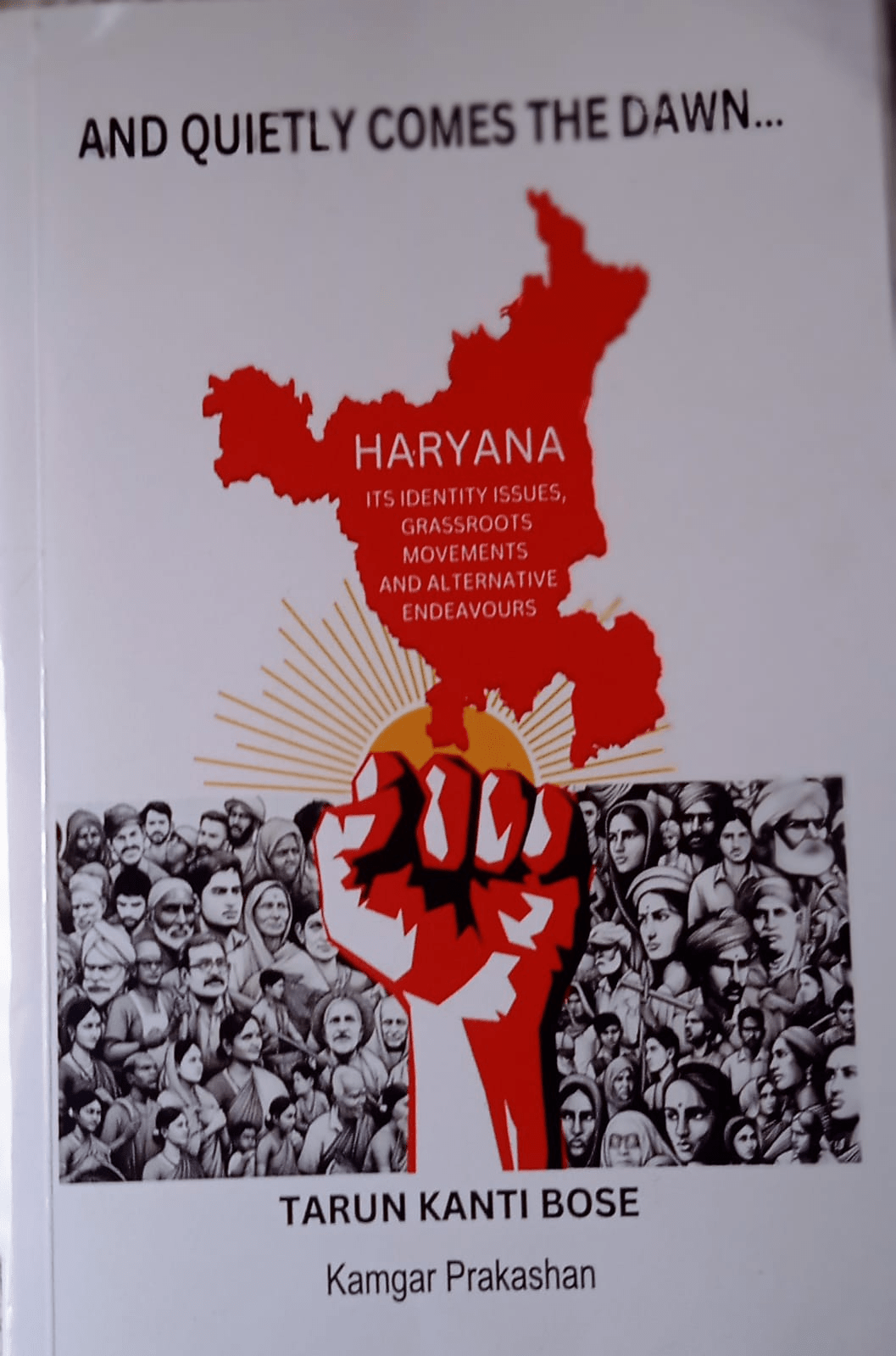
Review : ’And Quietly Comes the Dawn’
The ‘Other Haryana’ Which Rarely Gets Discussed
BOOK REVIEW
And Quietly Comes the Dawn:
Haryana —Its Identity Issues, Grassroots Movements and Alternative Endeavours
by Tarun Kanti Bose
Kamgar Prakashan | https://kamgarprakashan.com
What image does one conjure up when Haryana finds mention anywhere !
It is the image of the millenium city Gurgaon – with offices of leading MNCs or neighbouring Nuh – the Muslim majority district with one of the lowest literacy rates in India or the dominant Jat peasantry, the growing gender imbalance in the society which even gets reflected in the phenomenon of purchasing of brides from Bihar or other areas, etc
Various cases of dalit oppression add another gloomy layer to the not so bright picture.
Rarely does one find voices of the ’other Haryana’ getting reflected in the public discourse.
….Writer, journalist, left activist Tarun Kanti Bose’s new book, ’ And Quietly Flows the Dawn : Haryana— Its Identity Issues, Grassroots Movements and Alternative Endeavours breaks a new ground in this dominant discourse and brings before us many such unheard voices.
( Read the full review here : https://www.mainstreamweekly.net/article15848.html )
Why a 3-Year-Old Child’s Death Will Haunt us For a Long Time
Keeping aside disagreement about customs like ‘Santhara’, one can at least agree that only an adult can make a decision to opt for death voluntarily in times of sickness.

Men never do evil so completely and cheerfully as when they do it from religious conviction.
Blaise Pascal (1623–1662)
French mathematician, physicist, inventor, philosopher, and Catholic writer
Namrata (name changed), the three-year-old daughter of IT professionals from Indore, is dead.
She had brain tumour which was successfully operated upon in January in Mumbai but it relapsed in March, and within less than a week, she breathed her last.
Apropos nothing seems amiss in her story.
The child got the best treatment available, and for her parents, belonging to Jain community, money was never a problem.
Despite all these relevant details, it is rather difficult to forget or disremember the past few hours of her life when she was still alive, when she must have been in tremendous pain and the way she was made to undergo some ritual to ‘improve her next birth’ — as impressed upon her parents by their spiritual leader.
We learnt that instead of hospital bed, where she should have been given palliative care, the child was shifted to the ashram of one Maharaj, a Jain monk, who had convinced his gullible disciples – her parents – to opt for Santhara “to decrease her suffering and improve her next birth”.
And these young IT professionals, barely in their 30s, had no qualms in shifting their dying daughter to the ashram, despite knowing full well that she was in tremendous pain and any sudden change would exacerbate her death. [ Read the full article here : https://www.newsclick.in/why-3-year-old-childs-death-will-haunt-us-long-time]
No French Revolution Lurking Ahead, Comrade Baby!
There is a huge difference between democratic struggles outside Kerala, and those which unfold inside the state at the moment. While elsewhere they strive to make democracy integral to the system, in Kerala we are struggling desperately to keep alive, at least, the traces of something that we had, a fairly democratised society and a tolerably responsive state.
Continue reading No French Revolution Lurking Ahead, Comrade Baby!A Proposal for a Brahmanical Governance Index (in the background, the chorus: ‘Kerala Number One!’)
Today morning, the newspapers reported that the Kerala government has increased the dearness allowance of state government employees from twelve per cent to fifteen per cent. This group includes government employees, teachers, staff of aided schools, private colleges, polytechnic training colleges, full-time contingent employees and employees of local self-government. Dearness allowance increase is also applicable to service pensioners, family pensioners, ex gratia pensioners and ex gratia family pensioners…
I am told that people are jumping for joy in whatsapp groups of retired teachers etc.
Land purchase facilitation committees are going to be set up at the local-body level to identify land to build houses for families identified as ‘extremely poor’ (64,006 houses).
Yet another report in The Hindu, Thiruvananthapuram edition, claims that inflation rates are highest in Kerala and TN, and one of the chief reasons is the influx of migrant labour (who are clearly purchasing food and other essentials).
The ASHA workers on strike have been demanding their elected government’s attention to two things: their inability to survive on a daily wage of Rs 232 at a time of soaring inflation, and the disgusting feudal-colonial culture of the Kerala Health Department which treats them like female servants under the brahmanical order, the bhrtyas.
The government can quickly turn budget promises into government orders, it seems. It will feed the well-off and make alluring promises of welfare to the (reliably-docile) poorest. But it will not respond to workers demanding fair pay — only they must slave under feudal conditions.
———————
Yes, our government scores high on two indicators of brahmanical governance: ashritha vatsalyam and daanadharmam. Benevolence to the King’s dependents, and giving unto the indigent.
Maybe we should create an index of brahmanical governance too, and start our measuring exercises soon. Our government scored high, in 2017 (during the Hadiya case) and in 2021 (the Anupama Chandran case) on a third indicator of brahmanical governance, pratiloma naashaka, or the annihilating of hypogamy. The only indicator we fall behind is the mleccha naashaka, or the destruction of muslims/ historically underprivileged groups of christians. But given that our handling of ongoing ASHA workers’ struggle has increased our bhrtyaa-mardana rates, and as we have done middling-to-well in our twisting and mishandling of the WCC’s pleas, and so our kulina-damana rates are not so bad, we could be in the race for at least one of the top five slots in Indian brahmanical governance, unless some envious RSS fellows assign an impossible high weight to the mleccha-naashaka indicator!!
Nevertheless, it is tough. Other Indian states are ahead of us in most of these, what we can do is hang tight to aashritha vatsalya and daanadharma, and protect our progresss on bhrthyaa-mardana and kulina-damana. If we can convince the UN that the first two must be assigned a total of ninety per cent weight in the BGI, then it is YAY! Kerala Model Version 2!
In the protest-site, three women are on indefinite hunger strike.
One of the workers gathered there tell me: When I came here first, I was weeping all the time… afraid but not knowing what to do if the government refused us … now that it’s been over a month, my fear has vanished. We have nothing to lose. I prefer to die than live like this. Once you have nothing to lose, you too, won’t be afraid.
Another worker told me about her superior: I am an educated person. I have a college degree and I am trained in accounting software. Now, once when we had to do a survey in the local school with the JPHN, I remember, I suggested that we divide up the work, and that I will write down in the notebook all the data that we need… to which she said, no, you shouldn’t , as we have to give it to the superiors… hinting that I can’t write well…! It stung me, but I didn’t respond, but no more… I am not that meek person anymore.
A third worker recalled : It was a polio day, and I had gone to the booth straight from church that morning, and was wearing a plain white salwar suit. The JPHN looked at me and got all riled up. Why was I wearing a white suit, she wanted to know. That was the nurse’s uniform, she insisted — and that we shouldn’t wear it! There’s no such rule, for sure — it is this feeling in her that we are just ‘workers’, unworthy creatures! I swear, from now, I will not be silent …
From ASHA to Aparajitha, I thought. Just what we need to smash brahmanical patriarchal governance.
[Tearful apologies to Dr K N Raj and all the others who taught us to hold knowledge and empathy together in social research and Srinarayana Guru who showed us that arivu and anukamba can only go together and that in the absence of the other, the one gets irretrievably corrupted.]
Breakthrough in the Technology of Lie-Recycling: News from the ASHA workers’ strike in Kerala
I am not particularly fond of reviewing the writing of party-hacks or hired guns or mediocrities trying to fill their bellies. But citizens watching the struggle of the striking ASHA workers in Kerala’s capital city might be interested in how the ruling government’s toadies engage in logic- and plain fact-denying gymnastics to serve their masters. That is the only reason why I am taking apart this Facebook post by the (future) Secretary of the (yet to be formed) CITU-affiliated Kerala Fallacy-Peddlers and Outright and Recycled Lie Vendors Union (a post that surely must be reward for the production of such egregiousness-guaranteed discourse in ample quantities).
Continue reading Breakthrough in the Technology of Lie-Recycling: News from the ASHA workers’ strike in KeralaKerala’s Disgrace: ASHA workers to begin indefinite fast in Kerala
Yesterday, the summer rain struck Thiruvananthapuram city with the fury of thunder and lightning and wind. Those of us whose hearts are in that small protest-space in front of the State Secretariat open to the skies, where the police forbid even a temporary tarpaulin shelter, trembled as lightning tore through the skies and the skies poured, each drop a bucket. The striking workers continued to sit under the branches of old trees by the roadside. What if one of those ageing branches collapsed? What if lightning struck? The roads filled up with rainwater rapidly. The workers sat with their feet in the rushing rivulets of rainwater on the ground under the branches of great old trees, with the lightning swishing above.
Continue reading Kerala’s Disgrace: ASHA workers to begin indefinite fast in KeralaThe Ant-Lion Survey is the Only One Left for Us to Do: ASHA Workers Lay Siege to the Kerala State Secretariat
After the undeniably successful six-hour blockade of the Kerala State Secretariat in Thiruvananthapuram today, the ASHA workers’ struggle for fair remuneration and humane working conditions enters another phase. The whole morning today when more than a thousand workers blocked the main thoroughfare in front of the Secretariat, the heat was unbearable. Eight workers collapsed and had to be hospitalised. At noon, clouds gathered and there were heavy downpours. The workers persisted with umbrellas and holding tarpaulin sheets over their heads. More than eight hundred police personnel were deployed — almost the same numbers as the protestors, some said. TV channels interviewed the protestors non-stop — each and every worker said with unambiguous determination that they intended to return home only after their demands were met.
Continue reading The Ant-Lion Survey is the Only One Left for Us to Do: ASHA Workers Lay Siege to the Kerala State SecretariatASHA workers lay siege to the State Secretariat in Kerala
On the thirty sixth day of their strike, ASHA workers surround the State Secretariat in Thiruvananthapuram, determined to make the government hear them. Thousands have gathered there. The NHM made a last minute announcement of a palliative care training for today to deter workers from participating, but it doesn’t seem to have worked well enough. Meanwhile, news reporters have been speaking with some ASHAs who are attending the training, and they openly declare that they are with the striking workers.
The striking workers are determined to lay siege the whole day, blocking the M G Road in front of the Secretariat.
Gomati, the leader of the Pomblai Otrumai, addresses the strike, below:
Neither Angels not Devis: Pongala at the ASHA Workers’ Strike in Kerala
The scorching sun in Thiruvananthapuram has been unrelenting. Usually, the festival day of Attukal Pongala, on which thousands of women set up temporary hearths outside their homes and on the roads of the city to cook sweet payasam for the goddess of the Attukal temple, ends with cooling showers. This time the skies were cloudless.
Continue reading Neither Angels not Devis: Pongala at the ASHA Workers’ Strike in Kerala KAFILA - COLLECTIVE EXPLORATIONS SINCE 2006