Category Archives: Law

A Critique of Binayak Sen’s Judgment

This note critiquing the judgement that setences Binayak Sen for life has been written by ILINIA SEN, SUDHA BHARADWAJ and KAVITA SRIVASTAVA

Raipur, 26 December, 2010

As you are aware the Second Additional District and Sessions Judge of Raipur Sh. B. P. Verma convicted Binayak Sen, Pijush Guha and Narayan Sanyal for rigorous life imprisonment on the 24 December, 2010. A ninety two page judgement was delivered by Judge BP Verma on the 24 December, 2010. What follows is a quick analysis of the facts of the case and the judgement that has finally been delivered. Continue reading A Critique of Binayak Sen’s Judgment

The Trial: State of Chhattisgarh versus Pijush Guha, Binayak Sen and Narayan Sanyal

bbc.co.uk

On Christmas Eve, the Raipur Sessions court delivered a surprisingly harsh sentence in the case of The State of Chhattisgarh versus Pijush Guha, Binayak Sen and Narayan Sanyal, where B.P. Verma sentenced all three to life imprisonment for “conspiring to commit sedition.”

This latest ruling on a sedition case isn’t so much about the narrowing of the space of expression in India (there are far more illustrative cases here, here and here) but more about the wide  application of the sedition law to convict when the supporting evidence is questioned by the defence.

Prosecution teams seem to have figured out that in cases involving “Maoist issues” – a poor investigation can easily be supported by planting “seditious” documents and pushing for sedition.

Through the course of this post, I shall try to collate some my coverage over the last two weeks to give you all a sense of how the trial proceeded. As always, I this piece serves as a starting point for further discussions. I would urge readers to post comments with links to articles that they found interesting (along with their own thoughts of course).

Continue reading The Trial: State of Chhattisgarh versus Pijush Guha, Binayak Sen and Narayan Sanyal

Why is it so difficult to free India of manual scavenging?

Guest post by BEZWADA WILSON

Safai karamcharis from across India declared their liberation at a function in Delhi on 20 December

Over the years, there have been many changes in the Safai Karamchari Andolan movement. The biggest change we have seen has been in the safai karamchari community’s outlook. There was a time when safai karamcharis were ashamed to admit they did manual scavenging. It was not uncommon for even family members to be unaware that someone was involved in the practice of manual scavenging.

Continue reading Why is it so difficult to free India of manual scavenging?

Look who’s talking (to whom): FBI and Special Cell

This note comes from Manisha Sethi of the JAMIA TEACHERS’ SOLIDARITY ASSOCIATION

Wikileaks has exposed that there existed secret channels of communication between the US agency FBI and our very own Delhi Police Special Cell. FBI—which has witchhunted American democratic and civil rights organizations and leaders (including Martin Luther King Jr.), raids the homes of anti-war activists, and helps the overthrow of popular governments around the world—and Special Cell whose personnel have been indicted in the past, by none less than the CBI, for manufacturing ‘terrorists’ out of thin air by planting false evidence; an organization often accused by rights activists of killing in cold blood, a.k.a. ‘encounters’, for medals and promotions. What possible information were they sharing in secret? Who to frame and fix next? Or the merits of water-boarding over indigenous torture techniques?  Continue reading Look who’s talking (to whom): FBI and Special Cell

“Are the stone pelters real heroes? Discuss.” Hundred marks?

Noor Mohammed Bhat, a college lecturer in Srinagar, who decided to get creative with the English examination paper. Amongst his essay topics: “Are the stone pelters real heroes? Discuss.”

It also asked students to translate this Urdu-language text into English: “Kashmir is burning once again. The warm blood of youth is being spilled like water. Police and soldiers are beating even small children to death. Bullets are being pumped into the chests of even girls and women. People in villages and towns are crying in pain. Rulers continue to be in a deep slumber. It appears they’ve turned dumb, deaf and blind.” [Associated Press]

Although the AP report linked above says he has been charged with promoting secession, it’s not clear if he’s been charged with sedition. Kashmir Dispatch reports say he’s been charged under section 13 of the Unlawful Activities (Prevention) Act.

Ironically, the college where Bhat taught (he’s already been sacked) is named after Gandhi. Univesity spaces in Kashmir are heavily controlled to prevent political expression and student unions are banned. So much so that when Kashmiri students see campus politics at the Jawaharlal University in Delhi, they often remark that they are seeing for the first time what freedom looks like!

Meanwhile, Rohini Hensman says Kashmiris should not have azadi until they ask India and Pakistan for azadi in equal measure, or something like that.

Gift the CBI a sheet for their next cover-up!


CALL FOR ACTION  on CBI COVER-UP!

Let us Protest against CBI cover up report on Shopian Rape and Murder case

DEMAND  JUSTICE FOR NEELOFAR AND ASIYA!

A Public Event in New Delhi on 13th December, 2010 at 4 pm in front of CBI office, Delhi.

Come and participate with one white bed sheet with the words ‘TO THE CBI – FOR YOUR NEXT COVER-UP!!!’ written in huge letters across it with the name of the organisation/individual below.

Issued by: Women against Sexual violence and State repression (WSS), Delhi

For more details contact saheliwomen at gmail dot com

Continue reading Gift the CBI a sheet for their next cover-up!

On sedition: Sarim Naved

In this guest post, SARIM NAVED gives a chronological account of sedition in Indian law, and discusses the procedural aspects laid down for a magistrate to take cognisance of sedition

After the 1857 revolt, the Press Act of 1857 which prohibited all publications, without licensing, was passed. This Act known as Lord Canning’s Act  applied to all kinds of publication, including books in all languages and other printed papers in all languages. 1860 saw the enactment of the Indian Penal Code, which remains in force today in a relatively unchanged manner. The Indian Penal Code, while not directly dealing with the press, does incorporate provisions that impinge upon and regulate the activities of the press. The code dealt with issues ranging from offences against a person’s body or property to criminal breach of trust to offences like defamation and obscenity that directly concerned editors.  In the words of Rajeev Dhavan, “It was a comprehensive code. Not all these provisions were directed against free speech but virtually all could be used against it.” Amendments were later introduced to bring in the offence of sedition in 1870, the offence of promoting enmity between classes in 1898, the offence of outraging religious feelings in 1928 and imputations or assertions prejudicial to national integration, which were added by the government of independent India in 1972. Continue reading On sedition: Sarim Naved

Clamping down on the dissenting voice

Part 3 of a 3 part series by SIDDHARTH NARRAIN. First published on The Hoot.
 

While the Supreme Court’s decision lay to rest the debate on the scope and constitutional validity of the sedition law, the life of the sedition law is entangled with that of political dissent in the country. A brief search for reported High Court and Supreme Court cases on sedition gives us an indication of the kinds of situations where the sedition law is commonly used.

For instance, in 1967, the government prosecuted Ghulam Rasood Choari, the editor of an Agra based Urdu weekly called Ehsas for exhorting the Muslims of the country, especially the Muslims of Kashmir to violence against the government and bringing the readers of the paper into ‘hatred’ and contempt and dissatisfaction with the government (Ghulam Rasool Choari v. The State 1968 CriLJ 884).

Continue reading Clamping down on the dissenting voice

How Sedition crept into the constitution: Siddharth Narrain

Part 2 of a 3 part series by SIDDHARTH NARRAIN. First published on The Hoot

While in their Draft Constitution, the Constitutional Framers included ‘sedition’ and the term ‘public order’ as a basis on which laws could be framed limiting the fundamental right to speech (Article 13), in the final draft of the Constitution though, both ‘public order’ and sedition were eliminated from the exceptions to the right to freedom of speech and expression (Article 19 (2)).Commenting on this omission many years later, Justice Fazl Ali said: 

The framers of the Constitution must have therefore found themselves face to face with the dilemma as to whether the word “sedition” should be used in article 19(2) and if it was to be used in what sense it was to be used. On the one hand, they must have had before their mind the very widely accepted view supported by numerous authorities that sedition was essentially an offence against public tranquillity and was connected in some way or other with public disorder; and, on the other hand, there was the pronouncement of the Judicial Committee that sedition as defined in the Indian Penal Code did not necessarily imply any intention or tendency to incite disorder.

Continue reading How Sedition crept into the constitution: Siddharth Narrain

We are all seditious now, but when did this start?

I am afraid that unlike in Sholay, where the reply to Gabbar’s question and in our time, the reply to Nivedita’s question would have to be more than ‘Do sarkar’. But regardless of the rather large numbers, given the extreme nervousness which prompts a law like sedition, hopefully, they will still return to the sarkar, khaali haath.

As a part of the We Are All Seditious series, I am posting three guest posts written by SIDDHARTH NARRAIN which provides us with an overview of the history and the politics of sedition law in India.

These posts have been hosted by The Hoot, a highly recommended site for keeping track of the media in India. The first in the series looks at three major trials,  Gandhi’s trial and those of Tilak and Shiekh Abdullah. Continue reading We are all seditious now, but when did this start?

Report #3: Shooting the Messenger in Kashmir

This is the third of a series of fact-finding reports on the recent violence in Kashmir. The fact-finding has been conducted independently by a team of BELA BHATIA,VRINDA GROVER, SUKUMAR MURALIDHARAN and RAVI HEMADRI. For an introduction to this series, see here.

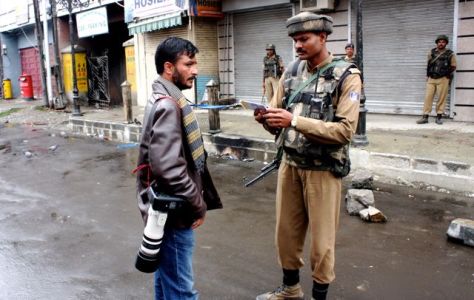
Daily movements for news gatherers has become an ordeal with few security personnel willing to recognise their legitimate role

Continue reading Report #3: Shooting the Messenger in Kashmir

Report #1: Attack and killing on Pattan hospital premises

This is the first of a series of fact-finding reports on the recent violence in Kashmir. The fact-finding has been conducted independently by a team of BELA BHATIA, VRINDA GROVER, SUKUMAR MURALIDHARAN and RAVI HEMADRI. For a introduction to this series, see here.

View of the hospital ward ‐ staff think that Adil may have been on the bed with the red mattress when the CRPF incursion took place.

Continue reading Report #1: Attack and killing on Pattan hospital premises

Introduction: Fact Finding Team to Kashmir

This post introduces a fact finding team’s work on the recent violence in Kashmir. The contents of the report are being posted as separate posts and will be linked below as and when they’re posted.

Since June this year, the Kashmir valley has been torn by mass protests which have been met with overwhelming force by Indian security forces. Curfews and closures have been frequent, often shading into each other. No less than 111 deaths have been registered, of which a large number have been of students and youth in the age group of 8 to 25 years. There have besides, been hundreds of cases of injuries, of both protesters and those who just happened to be at the wrong place at the wrong time. An independent fact-finding team went to the Kashmir valley at the end of October to go into the totality of the situation, principally to inquire into the causes for the unconscionably large number of deaths that have occurred in the current phase of mass agitation. The team comprised of academic BELA BHATIA, advocate VRINDA GROVER, journalist SUKUMAR MURALIDHARAN and activist RAVI HEMADRI of The Other Media, a Delhi based campaign and advocacy organisation, at whose initiative the effort was organised. Each member of the team spent varying lengths of time in the valley, but in total, roughly about twenty-five person days were put in the fact-finding exercise. In groups or individually, the team met the families of almost 40 persons who had been killed since the beginning of the civil unrest. Several individuals who had suffered serious injuries were also met. The team worked out of the state capital of Srinagar, and visited villages and towns in five of the Kashmir valley’s ten districts: Baramulla in the north (Sopore and Baramulla tehsils); Anantnag (Bijbehara and Anantnag tehsils) and Pulwama (Pulwama tehsil) in the south; Badgam in the west (Chadura and Badgam tehsils) and Srinagar itself. Separate sessions were held with journalists and media practitioners, university teachers and students, doctors, lawyers and activists besides officials in the police headquarters and the civil administration. The findings of the team are being released in a series of short reports beginning with following two sections. Forthcoming reports will deal with various facets of the situation that civilians in the Kashmir valley face in a season of unabated turmoil.


Next in this series
Report #1: Attack and Killing on Pattan Hospital Premises
Report #2: Palhallan Under Siege
Report #3: Shooting the Messenger in Kashmir

Remembering Balagopal – Thought, Action and the Moral Imagination of Human Rights: Arvind Narrain

Guest post by ARVIND NARRAIN, based on a talk given at the Kannada book release of Inner Voice of Another India: The Writings of Balagopal, at National College Basavangudi, Bangalore, 30 October, 2010

Remembering Balagopal: Thought, Action and the Moral Imagination of Human Rights  [i]

Introduction

One  year after Balagopal’s death, what remains with us are memories of the number of times he spoke with such eloquence on  human rights issues on his numerous visits to Bangalore.  We also go back to his writings in the EPW  which show the clarity of his thought. Be it his speeches or his writings , it was clear that for Balagopal words were tools he used to express thought. Language for him was not something which served to obfsucate meaning and muddy concepts, but rather a tool which had to be used to clarify difficult ideas and cut through conceptual confusions. In George Orwell’s striking phrase, both his writing and his speeches had the clarity of a windowpane. Continue reading Remembering Balagopal – Thought, Action and the Moral Imagination of Human Rights: Arvind Narrain

Ayodhya Verdict: Does it provide closure?

Guest post by WARISHA FARASAT

I was a child when the Babri Masjid was desecrated. After the news of the demolition spread across Uttar Pradesh, we were huddled in buses and packed off home from our boarding school. We were happy that the school had announced the winter break earlier than usual. That apart, we didn’t think much of the episode. In fact, I think that we were oblivious, almost entirely, to the gravity of the incident.

Much later, when I read the Sri Krishna Committee Report on the Bombay riots of 1992-93, and about thousands who had lost their life in the aftermath of the demolition, memories of 1992 returned. I remembered whispers. I remembered the fear in the eyes of our teachers accompanying us home. I remembered the instructions to the bus driver not to stop the bus if we were mobbed. I remembered leaving school at three in the morning. And, I remembered being asked not to tell my real name if we were stopped. Continue reading Ayodhya Verdict: Does it provide closure?

Greed-Kerala Express, Anyone?

The panchayat elections in Kerala are over and the dust has settled in the battle-field. In the past weeks, I have been repeatedly asked, why aren’t you writing something on the elections? Well, I told them, I have many failings but I do not suffer from Schadenfreude.

Continue reading Greed-Kerala Express, Anyone?

The Restitution of the Conjugal Rights of the State

Despite the many thoughtful critiques of the relationship between family and the state, I have always found it a little surprising that there is very little commentary on the relationship between two strange legal fictions. The first is the idea of the restitution of conjugal rights (RCR), and the other is sedition. The restitution of conjugal rights basically consists of the right of a spouse to demand that his or her- though more often his than her- spouse cohabit with him after she has ‘withdrawn from his society’. Away from the misty world of legal euphemisms, we all know what this means: that you can be forced to sleep with a somewhat less than pleasant person against your wishes. A legal commitment to love in a marriage is a serious thing indeed which only warns us that we must proceed with such a choice very carefully.

But like many marriages, the question of choice is somewhat restricted for many people- as is indeed the case of the choice of loving your country. After all isn’t sedition a crime of passion, and the punishment of an offence of the withdrawal of love for your nation. It is interesting to see that while treason in Sec. 121 of the IPC is about the waging of war against the state, sedition is about a forced love. It is about the creation of ‘disaffection’. As Nivedita Menon points out in her post, disaffection means “the absence or alienation of affection or goodwill; estrangement”.

A legal commitment to love your nation is also a serious thing indeed, and what then is the punishment of sedition if not, the restitution of the conjugal rights of the state?

Sedition: ‘The highest duty of a citizen’

Sedition: the attempt “to excite disaffection towards the Government established by law in India”, a crime under Section 124 A of the Indian Penal Code, a provision introduced by the British colonial government in 1860.

The only revisions to this colonial legal provision since its passing have been over the years, to remove anachronistic terms like “Her Majesty”, “the Crown Representative”, “British India”, “British Burma” and “Transportation for life or any shorter term”.

But it seems “Disaffection towards the government”, the archaic usage notwithstanding, is a timeless crime. Section 124A, therefore, these few cosmetic changes apart, has remained unchanged for the last 150 years.

Continue reading Sedition: ‘The highest duty of a citizen’

Sedition provision gags free speech: Barun Das Gupta

This is a guest post by BARUN DAS GUPTA

The detractors of Arundhati Roy have found a fresh casus belli against her for her recent speech (Oct. 21) in New Delhi, on Kashmir. The participants in the polemics include such intellectuals as Swapan Dasgupta, a journalist and a BJP leader. The burden of their criticism is that Arundhati should be arrested for sedition because by her speeches she has caused hatred and disaffection towards the Government and actually championed the secession of a part of India, that is, Jammu and Kashmir.

Let us examine this matter of “creating hatred and disaffection” towards the Government, not from the legal point of view but from the political point of view. Section 124A of the Indian Penal Code says: “Whoever brings or attempts to bring in hatred, contempt or excites disaffection towards the Government shall be punished ……” Before proceeding further, let us note that the concerned section speaks of “disaffection towards the Government”, without specifying whether by “Government” the Central Government is meant or the State Governments. Since there is no explanation, it may be inferred that “Government” means both Central and State Governments. Continue reading Sedition provision gags free speech: Barun Das Gupta

Reading Ayodhya Judgement II: Biswajit Roy

Guest post by BISWAJIT ROY

In my earlier piece, I had noted Justice Khan’s pluralist-nationalist sentiments and his anguished pleas to Muslims to ‘avail the opportunity to impress others with the message’ of ‘peace-friend ship- tolerance’ by accommodating Hindu faith-based claims to the area under the central dome of the demolished mosque as Ram Janamsthan. But I failed to find similar sentiments or espousal of the need of inter-community reconciliation on equal footing in the ‘bulky’ exposition of Justice Agarwal, despite his concurrence to Khan’s order for three-way partition of the disputed land, as well as justice Verma’s judgment that had awarded entire place to Hindus.

Continue reading Reading Ayodhya Judgement II: Biswajit Roy

Reading the Ayodhya Judgement: Biswajit Roy

Guest post by BISWAJIT ROY

In this piece, I would like to share my reading of judgments on Ayodhya. I have only managed to go through the judgment of Justice Khan in detail and parts of justice Agarwal and Sharma’s expositions. Though the Lucknow bench of Allahabab High Court accepted the Hindu faith-based claims about Ram’s birth at the disputed site and the 2-1 verdict went for its three-way partition, all the three judges differed in their takes on the issues related to claims and counter-claims reflecting not only their individual subjectivity but also social loci. To be more candid, they hardly hide their community background and their stakes as insiders.

The bench has anchored its verdict it by referring to religious scriptures, medieval memoirs, foreigners’ travelogues, colonial records, and history books well as folklore and oral tradition. But the judges’ reading of these texts differed much less on legal nuances and more on interpretations and inferences based on their own religio-political understanding and beliefs.
Here is what I found interesting in Justice Khan’s judgment. He differed with other two judges on substantial points: the acceptance of disputed site, to be precise, the area under the central dome of the demolished mosque as Ram’s birthplace, Babar’s demolition of a pre-existing Hindu temple and the mosque’s validity as a proper mosque.

Continue reading Reading the Ayodhya Judgement: Biswajit Roy