The infamous infant-snatching case in Kerala has opened up too many harsh truths about this society. It is not easy to express the pain in acknowledging it. After all, for many of us who have stuck back here with the intention of participating in what was once a fairly vibrant political life, this monstrosity that looms over all aspects of life, private and public (as so terrifyingly evident in the experience of Anupama Chandran) is a daunting sight. Not that there weren’t glimmers of it earlier, but the full menace has become visible only now.
Continue reading Help Us Fight ‘Progressive ‘ Cyberlynching: An Appeal from KeralaCategory Archives: Left watch
Here Comes Papa!! In Kidnappers’ Own Kerala
GR Santhosh Kumar captured the crux of the unbelievable denigration of democracy by the ruling CPM leadership who are out to defend their local level leaders guilty of the grossest patriarchy that rivals any khap panchayat misogyny. The context is the ongoing struggle by a couple, Anupama Chandran and Ajithkumar, to find their baby who was abducted by her parents, both influential local-level leaders of the CPM, last year and given away illegally for adoption. The story of Anupama’s experience of unspeakable death threats, physical violence, cheating, exposure to health risk, forced confinement, denial of vital information and means of communication, casteist insults, and on and on strips off the claims of women’s empowerment which the left in Kerala has claimed for so long. On social media, thousands of left supporters have literally rubbished women’s rights and the Indian Constitutional morality itself, even as the AIDWA in Kerala has been largely struck dumb.
The cartoon is a spoof on Raja Ravi Varma’ famous mother-and-child painting ‘Here Comes Papa’ in which an aristocratic woman dressed in a way identifiable as ‘traditional’ holds her baby and points to it the unseen ‘papa’ . Though the cartoon is captioned ‘Know the pain of the adopting mother’, an obvious reference to the cry by CPM sympathisers on social media that the child need not be returned, and that the adopting mother was fitter, and though the protagonists here are Pinarayi Vijayan and Anupama’s father, Peroorkkada Jayachandran, who he has been defending, it has layers. Ajithkumar’s dalit status and his earlier marriage has, in the eyes of CPM supporters, rendered him unfit for fatherhood — of a child by the daughter of an influential CPM family. Papa, then, and Papa’s coming, continues to be our favourite obsession.
How Could You Allow This to Happen? Urvashi Butalia Writes to the Kerala Chief Minister
Dear Chief Minister
Throughout the terrible times we have seen these last two years, it is the news from Kerala that has helped so many of us to keep faith in governance – that a state can be honest, open, participatory, concerned for its people, focused on health, and not play politics, all of these have been remarkable and many of us, Keralites and non-Keralites alike, have drawn valuable lessons from the Kerala experience.
Rise Above Traditional and Conservative Misogyny — Open Letter to the Chief Minister of Kerala: Kalpana Kannabiran
Today morning we woke up to the news that the Child Welfare Committee has ordered that Anupama’s child must be brought to Kerala in five days for a DNA test.
However, the process is still overseen by the officials who directly connived to give the baby away for adoption. The family’s criminal acts are still under a very lax, lagging investigation. Anupama’s educational certificates are still in their possession and the police refuses to intervene to restore them to her.
Indeed, the evil that Prof Kannabiran identifies so excellently in this letter must still be fought, until justice is done. Just the return of the child to Kerala cannot replace justice. Anupama suffered tremendous domestic violence, deliberate endangerment, cheating, and illegal custody at the hands of her family. That cannot be papered over,
Continue reading Rise Above Traditional and Conservative Misogyny — Open Letter to the Chief Minister of Kerala: Kalpana KannabiranWomen’s Rights are Hard Won — An Open Letter to the Chief Minister of Kerala : V Geetha
… we are troubled that the state finds it hard to grant a woman the right to lead a life of her choice and to have custody over her child. These are hard won rights, and it has taken generations of struggle by women, many of whom are from your state, to secure both civil and legal acknowledgement for women’s rights to marriages of their choice, and for their right to motherhood, divorce, adoption and so on.
Continue reading Women’s Rights are Hard Won — An Open Letter to the Chief Minister of Kerala : V GeethaDo not let the injustice drag infinitely — Open Letter to the Chief Minister of Kerala — Dr Gayatri Devi
Anupama has committed no crime. She got pregnant. She did not murder anyone. She did not rob a bank. She did not betray the nation. She committed no terroristic threats or acts. She is not a smuggler, a thief, a rapist, or a crook. She got pregnant. Getting pregnant is not a crime. She got pregnant and decided to keep her baby. This is not a crime.
Continue reading Do not let the injustice drag infinitely — Open Letter to the Chief Minister of Kerala — Dr Gayatri DeviRestore Faith in Kerala’s Progressive Legacy — Open Letter to the Chief Minister of Kerala: Prof Mohan Rao
The strange case of ‘honour-baby-snatching”,: involving a local-level CPM leader in Thiruvananthapuram city, Peroorkkada Jayachandran is still haunting us despite every attempt by the CPM cyberwarriors to smother it. Mr Jayachandran still feels completely justified and hundreds of left supporters, including so-called progressive women, are ready to proclaim that this dastardly act is a ‘father’s right’. Mr Jayachandran’s nineteen year old daughter Anupama fell in love with a dalit man, a leader of the DYFI, got pregnant by him, and decided to keep the child. Anupama’s parents decided that there was loss of honour in this and proceeded to perpetrate unspeakable violence on the young woman, trying to force her to abort her baby, and finally by snatching away her baby days after it was born. They twisted the entire machinery of child protection and adoption and the police to give the child away without the consent of its parents.
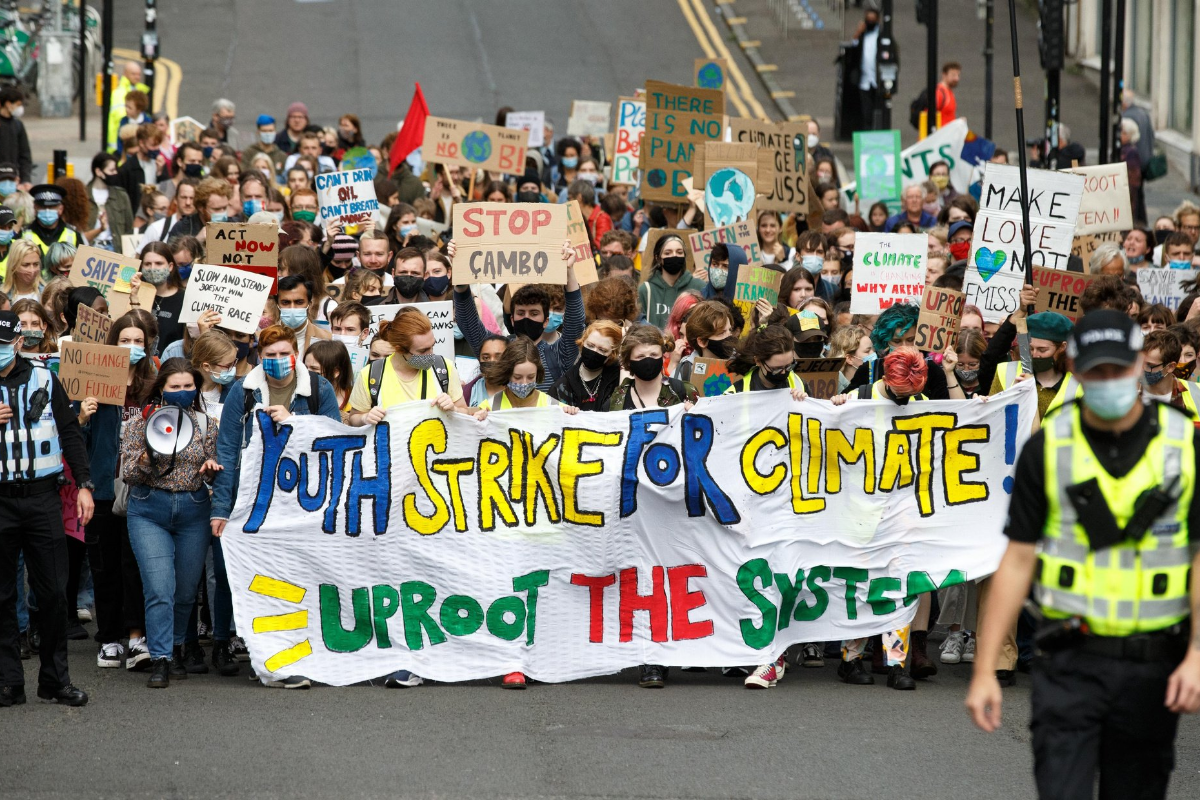
Continue reading Restore Faith in Kerala’s Progressive Legacy — Open Letter to the Chief Minister of Kerala: Prof Mohan RaoCOP(OUT)26, Climate Emergency and the Indian Left


We are in the midst of a climate emergency – and this is no longer a secret. In fact, in November 2019, 11,000 scientists declared in a signed statement, in no uncertain terms that “planet Earth is facing a climate emergency.” “Scientists”, they said, “have a moral obligation to clearly warn humanity of any catastrophic threat and to ‘tell it like it is’.” They noted that even 40 years after the First Climate Conference attended by over 50 scientists (in Geneva in 1979) had agreed that there were alarming trends of climate change that made it necessary to act, the situation has only worsened. “Alarming trends” have since given way to a full-on emergency. Although the 2015 Paris Agreement arrived at in COP 21 is considered a paradigm shift in that it produced a legally binding international climate treaty (adopted by 196 parties), the change since then has not been significant.
Continue reading COP(OUT)26, Climate Emergency and the Indian LeftThe Angry Young Woman and the Malayali (Progressive) Acchan -2 : The Second Season
I should be forgiven for this flippant-sounding title. But it is a living reality in Kerala that gender politics is increasingly reduced to soppy sentimental drama. Honestly, if there are CPM supporters out there, especially the Delhi-elite breed who call this title mere click-bait, I don’t give a flying fuck about what you think. You are not living this nightmare, we are.
Continue reading The Angry Young Woman and the Malayali (Progressive) Acchan -2 : The Second SeasonTime to dump ’empowerment’? Feminism, women and the state in kerala today
This reflection has been long coming: the whole idea of women’s empowerment has been steadily deteriorating in Kerala since some years now. Actually, even from the side of the government, there is much less talk about it, even though it flowed into Kerala in the 1990s through the government, somewhat neoliberalized already, after the Beijing Conference. The national environment has of course been especially hostile with Hindu majoritarian conservatives in power whose ideas about ‘Indian culture’ do not offer any prospect of expanding the resonances and meanings of women’s empowerment — the opposite being more likely. But in Kerala too, interest in it has decidedly shrunk. Among its former constituents, especially the women’s self-help groups, it means little other than income-generation and entry into local politics.
Continue reading Time to dump ’empowerment’? Feminism, women and the state in kerala todayresisting the papa state? E Bull jet brothers or hadiya?
In the recent controversy over the arrest of the travel vloggers Ebin and Libin who rode high on popularity with lakhs of subscribers through their Youtube channel E Bull Jet, it is very hard not to side with the two young men. The flamboyant pair whose hugely popular travel — or ‘van life’ — videos have a massive following especially among male adolescents and youth — are school drop-outs and have a history of rising from severe social disadvantage — literally, of pulling themselves up by their own bootstraps. The two young men, despite their excesses, pull at your heartstrings. Their smile, their slang, their sense of excitement on the road, the innocent gawking — all of it looks disarmingly innocent. It is also true that the crime they committed was not major; nor is justice handed out evenly. That is, such crimes around vehicles and driving are not new and it is not at all clear if the powerful who commit such crimes are tackled in the same way. Therefore the video which showed the brothers being hauled into the police van was painful for many of us (including me) — Ebin wept aloud, “adikkalle saare! Njaan onnum cheithilla … kolapaathakiyeppole enne kondupokunnu….” (don’t beat me please, sir. I didn’t do anything wrong . … I am being taken away like a murderer). That despondent wail somehow refuses to get out of my head; that is why I need to write this.
Continue reading resisting the papa state? E Bull jet brothers or hadiya?Untimely Explorations in a ‘Field’ Called ‘Marxism’


I am interested in ‘Marxism’ as a field or a force-field in the sense in which we think of electromagnetic or gravitational fields, where objects and bodies impact on other bodies and objects, and have effects, without necessarily coming into contact.
Ever since the 2008 financial crisis and the beginning of the end of the neoliberal order, when sales of Marx’s writings, of Capital in particular, went up dramatically, there have been prognostications of the ‘return of Marx’. Indeed, there has also been an attempt, for a much longer time now, especially after the collapse of Soviet-bloc socialism, of a ‘return to Marx’. Both the millennial expectation of Marx’s Second Coming and that of a ‘return to’, display a distinct theological orientation – insisting on a return to the pristine source, uncontaminated by the ‘deviations’ wrought by Leninist or Maoist-inspired practice in the underdeveloped regions of the world.
Continue reading Untimely Explorations in a ‘Field’ Called ‘Marxism’‘Joblessness’ In The Post-Employment World – Urgent Need for Paradigm Change


The ‘unemployment’ question, let us put it bluntly, is not just an innocent and neutral question today but a key arena of class war – the war of Capital on society at large. Capital has its plans but does “society” have one?
Enter the Post-Employment World
It was reported last week that top IT sector companies like TCS, Infosys, Wipro, HCL, Tech Mahindra and Cognizant are likely to slash 3 million jobs by next year. With large-scale resort to Artificial Intelligence (AI) based “robot process automation” (RPA), these companies, by shedding these jobs are expecting to “save a whopping USD 100 billion, mostly in salaries, annually” says the Indian Express report linked above. Citing NASSCOM (National Association of Software and Service Companies) the report tells us that the domestic IT sector employs around 16 million, of whom “around 9 million are employed in low-skill and BPO roles.”
“Of these 9 million low-skilled services and BPO roles, 30 per cent or around 3 million will be lost by 2022, principally driven by the impact of robot process automation or RPA. Roughly 0.7 million roles are expected to be replaced by RPA alone and the rest due to other technological upgrades and upskilling by the domestic IT players, while it the RPA will have the worst impact in the US with a loss of almost 1 million jobs, according to a Bank of America report on Wednesday.”
Continue reading ‘Joblessness’ In The Post-Employment World – Urgent Need for Paradigm Change‘No More Poor People In a Rich Country’ – What Will Peru’s Left Victory Mean?


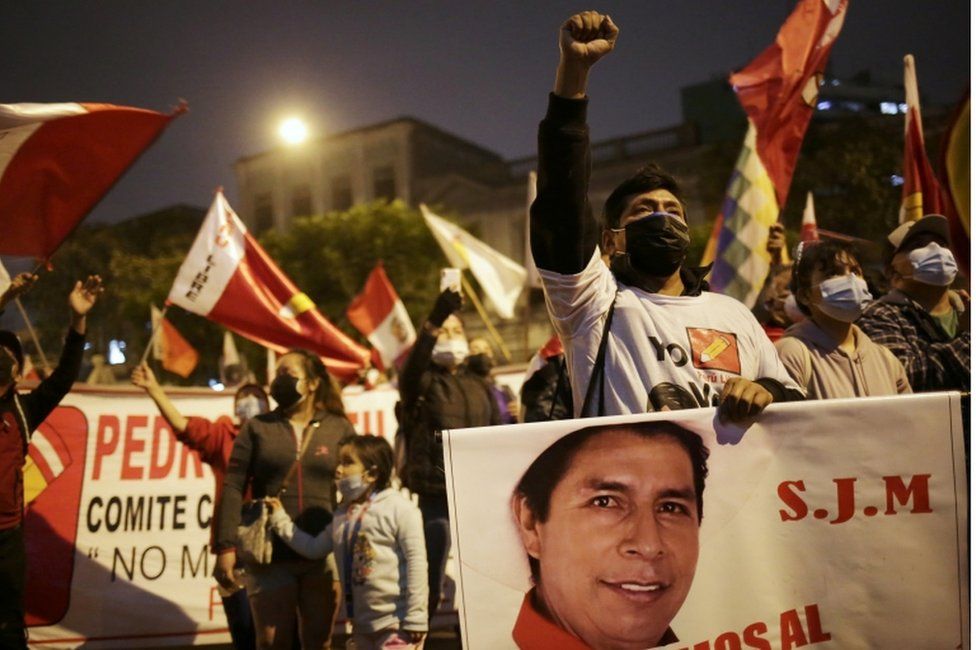
Supporters of Left Presidential candidate Pedro Castillo take to the streets, image courtesy BBC and Reuters
It seems quite clear from the latest reports coming in from Peru that the Left-wing candidate Pedro Castillo is all set to win in what has been described as the most polarized election till date. With over 99 percent of the ballots counted, Castillo had taken a lead of approximately 80, 000 votes (50. 2 of the total) over his Right-wing rival Keiko Fujimori. The counting process, reports say, has already been considerably slowed down as ballots seem to be still arriving from abroad as well as from the remote rural areas. Votes of expatriates arriving from abroad are mostly right wing votes for Fujimori whereas the ones from the rural areas are likely to be overwhelmingly for Castillo. There also seem to be a huge number of contested votes that might need to be recounted, further slowing down the process.
Continue reading ‘No More Poor People In a Rich Country’ – What Will Peru’s Left Victory Mean?CPI (M)’s History of Moving Away from Committed Leftism from its Birth: Sankar Ray
Guest post by SANKAR RAY
History apparently allows freaks, whims and hypocrisy, but only temporarily. After all, Hegel as very succinctly stated, ‘History is a slaughter house’. It spares none, not excluding India’s once most powerful Leftist party in the parliamentary arena, Communist Party of India (Marxist) that once had 44 MPs in the lower house of Indian parliament, Lok Sabha. It now faces a crisis of identity and existence. Hypocrisy and falsehood in politics and ideological positions have been two main reasons for the vertical decline of party’s influence and image.
Ten years ago, Indranil Chakraborty in his Master’s thesis –“The Market Odyssey: Why and How Was ‘The Market’ Discourse Incorporated in the Party Program of the Communist Party of India (Marxist) During the Days of the Communist Party of China’s ‘Market Socialism’?” referred to CPI(M)’s open criticism of ‘the development of the personality cult of Mao( Tse Tung) , and the problem of left adventurism during the Cultural Revolution. He pointed out that the criticism evaded ‘the question of the relationship between socialism and democracy, and the role of the Chinese people in deciding policy matters of the state’. He quoted Harkishan Singh Surjeet’s article in the party’s theoretical monthly, The Marxist in 1993 commemorating Mao’s birth centenary – ‘We cannot make a subjective analysis of a personality in cases where errors have been committed in the application of the theory to practice.’
Continue reading CPI (M)’s History of Moving Away from Committed Leftism from its Birth: Sankar Ray
Gouri the Deathless
My tribute to Kerala’s irreplaceable K R Gouri Amma. The brightest bolt of lightning that illuminated the dark skies of twentieth century Kerala.
Post-Election Musings -Federalism to the Fore: Nakul Singh Sawhney
Guest post by NAKUL SINGH SAWHNEY
Some observations and takeaways from State Assembly elections in Kerala, Tamil Nadu, West Bengal, and Assam in May 2021 – from an original Facebook post. The observations are in the form of informal reflections but they point towards certain developments that might open up new, anticipated spaces for the struggle for a democratic India.
Federalism: The Election verdicts of May 2, 2021, from Tamil Nadu, West Bengal, and Kerala scream ‘federalism’. The election results are so vastly different in the State Assemblies and Lok Sabha. The election outcomes of Delhi, Maharashtra, Haryana, West Bengal, Kerala are important examples of this phenomenon.
India is a country that naturally lends itself to federalism and greater state autonomy. While the Congress, by and large, didn’t allow for it, the BJP is hell-bent on a deeply centralized structure and crushing any aspiration for regional autonomy. If progressive forces don’t take up the question of federalism and state autonomy, then it runs the risk of slipping into the hands of crude chauvinists and xenophobes like Shiv Sena of yesteryears or secessionists like Khalistanis.
Continue reading Post-Election Musings -Federalism to the Fore: Nakul Singh Sawhney
Ominous Dark Clouds Over Bengal’s Skies…


As close to 8.5 lakh voters spread over 35 Assembly constituencies go to vote today in the last phase of Bengal’s elections, the line from the famous jatra Nabab Siraj-Ud-Doula from which the title of this post is extracted, haunts. The original ‘jatra pala’, written by Sachin Sengupta was staged in 1938 had a dialogue that announced the dark clouds collecting at Bengal’s horizons. The lines ‘Banglar akashe aaj durjoger ghanaghata/ Taar shyamal prantore rakter alpona’ have since resounded in the many iterations of the play, over the decades. The figures of Siraj-Ud-Daula and the traitor Mir Jafar have generally become part of Bengal’s political vocabulary but this time round the sense of Bengal being under attack from ‘outsiders’ has been pervasive. Along with that other episode of political folklore – repeated attacks by the borgis or the plunderous cavalrymen of the Maratha Empire, on Bengal has been recalled often. The attacks by the borgis were followed, only a few years later, by the Battle of Plassey (Palashi), in which Siraj-Ud-Daula was defeated after Robert Clive bribed Mir Jafar, his army commander, to betray the Nawab.
This time round too, it is widely believed, the aggression by ‘outsiders’ cannot and will not succeed but for the Mir Jafar’s who collaborate with the aggressors.
Sitalkuchi And After – A Flashback to CPI-M Rule in West Bengal


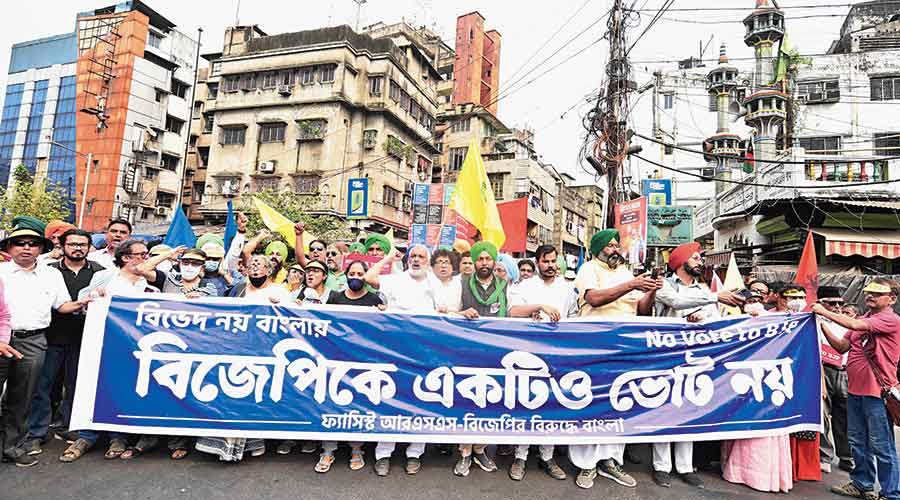
As the news of the killings of four youth in Sitalkuchi in Cooch Behar district by the Central Industrial Security Force (CISF) came in on 10 April, reactions of horror and anger became evident all around. This reaction among politically informed sections was only natural, for anybody with a little bit of common intelligence will tell you that the BJP is making an all out bid to capture power in the state. And anyone who has watched the Modi-Shah duo in action over the past few years, does not need to be told what this means. It is always ‘Heads I win; Tails you lose’ with them. It doesn’t matter what dirty trick you have to play, all is fair in this game of capturing power with them. They will form the government, no matter who wins but first, every effort has to be made to ‘win’ by any means. And that means by ANY means, ranging from killing people by engineering violent communal incidents to buying off opposition parties’ winning legislators. Despite the full battery of BJP’s star campaigners ranging from Narendra Modi and Shah to Yogi Adityanath making repeated visits to the state, their rallies have seen very low turnout and in some instances meetings had to be cancelled. So the desperation is growing. The first four of the unprecedented eight rounds in the state’s elections were to be in the areas where TMC is relatively weak. But even in these areas the reports were not very encouraging for the BJP. Thus, every child in Bengal could see what these killings meant. Except the CPI-M that is.
Soon the story of the killings was being given a typically BJP IT Cell spin: a mob of Muslim TMC people surrounded the CISF and tried to snatch their rifles. This was followed by identical tweets by a range of people describing how they could not sleep all night because of the sounds of the explosion of bombs, suggesting that things had been going on all night – and the CISF action in the morning was therefore, only justified.
Seasoned CPI-M stalwarts on Twitter apparently neither saw those tweets or more likely, jumped at them to immediately amplify the BJP narrative of provocation by TMC (Muslim mob is often implied). It is certainly not possible that anybody with a little bit of common sense would not have immediately seen this copy paste job for what it was – a BJP IT Cell operation. The CPI-M leaders and their social media warriors went on, willfully, to reinforce the ‘provocation’ narrative that was being circulated by the BJP.
Meanwhile, many people including poll analysts and former bureaucrats started asking that if there really was an irate mob attacking the CISF party, where was the footage? Was there any video evidence? No such question crossed the CPI-M leaders’ minds and from all appearances, from Biman Bose to Mohd Salim (and the pathetic Sujan Chakrabarty) pushed ahead with not-so-subtle ways of relaying the BJP narrative and indeed, it was not difficult to discern that they were in fact, gloating.
Continue reading Sitalkuchi And After – A Flashback to CPI-M Rule in West BengalNandigram – An Introduction to Political Analysis


Mamata Banerjee recently stirred up a fresh new controversy by accusing her former party colleague Suvendu Adhikari, now adversary in the Nandigram Assembly seat as BJP candidate, of being complicit in the 14 March 2007 violence. Had it not been for the complicity of the ‘father-son duo’ (Suvendu and his father Sisir Adhikari, both in the BJP now), she claimed in the heat of the electoral campaign, the police could not have entered Nandigram. She also asked rhetorically how it came to be that these two were spared by the police? To my mind, the claims seem difficult to sustain, if only because, the CPI(M) was at the height of its power and would have had little to do with these Trinamool Congress leaders. Listening to her speak, it did seem that she was quite rattled. Who would not be – with Amit Shah and central government on one side, the aggressive BJP goons in the state, her erstwhile collaborators now on the BJP side and, to cap it all, the aggressive, misogynist, patriarchal campaign against her from the CPI(M)? One meme by people obviously linked to the CPM, for instance, portrayed her witch-like, with a haggard and wicked expression, which was counter-posed to the young beauteous CPI(M) candidate Meenakshi Mukherjee. The meme describes Meenakshi as the ‘beloved daughter of Bengal’, while Mamata is described as the ‘old hag spinster sister-in-law’. (After a lot of hue and cry, this meme was taken off though the page continues to be on Facebook).
Continue reading Nandigram – An Introduction to Political AnalysisCommunist Manifesto, Late Marx and the Farmers’ Struggle
Spot the difference between the two quotations below.
“The bourgeoisie has subjected the country to the rule of the towns. It has created enormous cities, has greatly increased the urban population as compared with the rural, and has thus rescued a considerable part of the population from the idiocy of rural life. Just as it has made the country dependent on the towns, so it has made barbarian and semi-barbarian countries dependent on the civilised ones, nations of peasants on nations of bourgeois, the East on the West.” – [Marx and Engels, Manifesto of the Communist Party, 1848. Emphasis added]

“Hence, the historical movement which changes the producers into wage-workers, appears, on the one hand, as their emancipation from serfdom and from the fetters of the guilds, and this side alone exists for our bourgeois historians. But, on the other hand, these new freedmen became sellers of themselves only after they had been robbed of all their own means of production, and of all the guarantees of existence afforded by the old feudal arrangements. And the history of this, their expropriation, is written in the annals of mankind in letters of blood and fire.” – [Karl Marx, Capital Volume 1, Chapter 26, ‘The Secret of Primitive Accumulation’. 1867. All emphasis added]
Look closely at both, and if you have any doubts, you can return to the original texts from which these two passages have been extracted – the Communist Manifesto, by the youthful Marx and Engels, published in 1848 and Capital, Volume I, published in 1867. If the Communist Manifesto almost celebrates the ‘fact’ that capitalism has “rescued a considerable part of the population [i.e. the peasant] from the idiocy of rural life”, what does the text of Capital say? It underlines that precisely these people who had been thus ‘rescued’, “became sellers of themselves after they had been robbed of all their means of production“.
And if we take a step outside their context and read these lines in the context of contemporary India – from Singur and Nandigram to the ongoing saga of the epic farmers’ struggle – it is not difficult to see why the text of Capital insists that the history of their expropriation is written in “letters of blood and fire.” The big difference is that while literally millions perished in the storm of capitalist industrialization in the 17th, 18th and 19th centuries in Europe and simply disappeared into history; today, the peasants, farmers and indigenous people – all the so-called ‘pre-capitalist’ populations – are fighting back. There were no institutions of democracy, no language of struggle back then; it was the sheer exercise of naked power by the rising bourgeoisie that enforced the expropriation of agrarian and artisanal communities.
Continue reading Communist Manifesto, Late Marx and the Farmers’ Struggle