Category Archives: Media politics

Of journalist citizens

With Kashmiris forcing us to take note of them on Facebook and Twitter, with the internet noise on the Radia tapes making a mockery of the media’s radio silence over them, with WikiLeaks assuring us that we’re well into the age of information anarchy, the old, dogged question rears afresh its banal head: Are citizen journalists, journalists?

I was at a Google conference in Budapest in September, called ‘Internet at Liberty 2010’, which had bloggers, activists and policywallahs from 70 countries. At one of the theme dinners, we were asked how many of us identified ourselves as citizen journalists. No hand went up, even as we were all conscious that any one of us could be the first one to see a plane crashing and be the first to report it on Twitter. Continue reading Of journalist citizens

Clamping down on the dissenting voice

Part 3 of a 3 part series by SIDDHARTH NARRAIN. First published on The Hoot.
 

While the Supreme Court’s decision lay to rest the debate on the scope and constitutional validity of the sedition law, the life of the sedition law is entangled with that of political dissent in the country. A brief search for reported High Court and Supreme Court cases on sedition gives us an indication of the kinds of situations where the sedition law is commonly used.

For instance, in 1967, the government prosecuted Ghulam Rasood Choari, the editor of an Agra based Urdu weekly called Ehsas for exhorting the Muslims of the country, especially the Muslims of Kashmir to violence against the government and bringing the readers of the paper into ‘hatred’ and contempt and dissatisfaction with the government (Ghulam Rasool Choari v. The State 1968 CriLJ 884).

Continue reading Clamping down on the dissenting voice

The Media Barons and the Radia Tapes: Monobina Gupta

Guest post by MONOBINA GUPTA

The first formal discussion on the Radia-Media nexus by a section of top media professionals this Friday revealed the media’s general reluctance to put themselves through the same wringer of criticality that they so love to put others through. Barring Manu Joseph, editor of  Open Magazine, which put out in the public domain the tapes which had been lying  for days in the ‘safe’ custody of most media organizations, majority of the speakers argued that the controversy was not about Vir Sanghvi and Barkha Dutt; that there was no proof whether Sanghvi had actually written his ‘most read’ column as he had assured Nira Radia; that we do not know if Barkha Dutt had kept her word to Radia and passed on the message of the DMK’s internal dissensions to the Congress; that pressured by the minute-by-minute  demands of 24/7 TV channels, journalists have to make random promises (which they do not intend to honour!); that they have to play along with their sources to extract news etc. The list of extenuating circumstances offered by the media, now getting a taste of its own treatment, was quite revolting.

Continue reading The Media Barons and the Radia Tapes: Monobina Gupta

‘Editors as Powerbrokers’?: Vinitha Mokkil

Guest post by VINITHA MOKKIL

The good news first. On the morning of November 26, the Foundation for Media Professionals (an independent, not-for-profit organization) decided it was time to break the polite silence and hold a panel discussion on the topic, ‘Editors as Powerbrokers’ at the India International Centre (IIC), Delhi. The Nira Radia tapes, whose transcripts were first published by Open magazine a week ago, was the trigger for the discussion. The panelists included editors from prominent print and electronic media houses.

The auditorium was packed. Clearly, the nexus between the media, politicians and PR honchos, as revealed by the transcripts, had shocked people enough to bring them out of the comfort of their homes to the venue.

Continue reading ‘Editors as Powerbrokers’?: Vinitha Mokkil

The Fuhrer Reacts to the Radia Tapes

Hope you’ve listened to all the Radia tapes?

If you haven’t, you’ve missed out on a lot. These five links lead you to all the phone calls, and you can even download them. This is history. The tapes are revelatory about the corporate media, but more than that, about the corporates. They have come out due to corporate wars. Internecine corporate wars seem to be our only hope for transparency and accountability in this nation. Please listen to every pause in every audio to for a clear insight into what today’s India is. And lament this Manmohan yug, ghor Manmohan yug. Also see Sevanti Ninan’s excellent analysis of the media black-out of the story.

Four transcripts that were submitted to the SC along with a total of eight recordings in May 2009 covering the cabinet formation, DMK politics and who’d get telecom portfolio
The conversations with M.Karunanidhi’s daughter M. Kanimozhi about keeping Dayanidhi Maran out from negotiations with the Congress and to get the telecom portfolio for A. Raja
In these Radia wants Sanghvi to tell the Congress not to negotiate with Dayanidhi Maran. He tells her that while he has been meeting Rahul and can’t “get into Sonia in the short term” he would “try and get through to Ahmed”
Recordings of conversations with the likes of Ratan Tata, Ranjan Bhattacharya, Barkha Dutt, Shankar Aiyar, Sunil Arora etc
The other big ‘national resource’ story involves the virtual who’s who: Ambani V/s Ambani V/s Tata, gas and power sector war involving big name journos, politicians, babus, corporates – this has the largest number of tapes, and perhaps the most important ones.

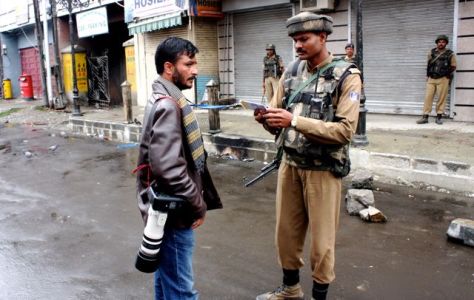
Report #3: Shooting the Messenger in Kashmir

This is the third of a series of fact-finding reports on the recent violence in Kashmir. The fact-finding has been conducted independently by a team of BELA BHATIA,VRINDA GROVER, SUKUMAR MURALIDHARAN and RAVI HEMADRI. For an introduction to this series, see here.

Daily movements for news gatherers has become an ordeal with few security personnel willing to recognise their legitimate role

Continue reading Report #3: Shooting the Messenger in Kashmir

“Inside the networks of lobbyists and power brokers that dictate how this country is run”

This is explosive – you’ve heard of Niira Radia’s role in the 2G spectrum scam for months, and also that of two high profile journalists. Now, Open magazine has put out the phone transcripts, and even the audio, for all of us to listen in and know, as they put it, “how this country is run”. Many must have had the tapes with them for some time now, and god knows how many hundreds of hard disks have the CBI papers that made these allegations to begin with. But it takes courage to put this out.

For context, also read this profile of lobbyist Niira Radia, also in Open. Also see this April 2010 post from a media blog.

Whose Dishonesty? Arundhati’s or Media’s?: Mahtab Alam

Guest post by MAHTAB ALAM

‘Vicharon ki Be-imani (Dis-honesty of thought) cries the heading of the lead article of Dainik Bhaskar’s editorial page on 1st November 2010. The article is written by Venkateshan Vembu, foreign correspondent of DNA English daily, a newspaper published by the same group of publications. It was originally published on 27th October with the headline reading ‘Arundhati Roy is dangerously wrong on Kashmir’. The writer of the article claims that whatever Arundhati has said is not only dangerously wrong and beyond the tolerance level of any law-abiding citizen but, it also has the potential to arouse feelings of anger and violence among the masses. “Yeh kuch is tarah ki beimani hai, jo janmanas me krodh aur aakrosh ki bhawna upjati hai (This is a kind of dishonesty which generates feelings of anger and violence among the people”). Ironically, this turned out to be a ‘prophetic’ disclosure, as right after four days of publication of the original version in DNA, Arundhati’s house in Delhi was attacked by the writer’s ‘Janmanas’, the BJP’s women wing ‘Mahila Morcha’.

Continue reading Whose Dishonesty? Arundhati’s or Media’s?: Mahtab Alam

Reflections on the Bigots of Embedded Media: Biswajit Roy

Guest post by BISWAJIT ROY

Now that the xenophobic and paranoid big media clamour for slapping sedition charges against Arundhati Roy and others for speaking up their mind on Kashmir, has temporarily subsided, it is time for some reflection.  This clamour has only underlined the increasingly shrill bigotry of a section of Indian journalists who are deeply embedded in the right-wing statist mission, a la Arnab Goswami. Their stakes in the race for Padma awards or Rajya Sabha nominations may be one of their personal motives for behaving the way they do – baying for the blood of the dissenters and whistle-blowers while ignoring the ground reality in Kashmir valley today. But there may also be corporate institutional compulsions. However, they are espousing bigotry at the expense of the media’s role as the protector and disseminator of dissent in public life as well as watchdog against excesses and abuses of power by the government and other wings of the State in the name of national security and national interests. As a media professional, I would like to share some of my encounters with these self-proclaimed guardians of Indian nationalism in media and frontiers of mainstream journalism.

The Kargil War: the self-proclaimed guardians of national interests Continue reading Reflections on the Bigots of Embedded Media: Biswajit Roy

The Restitution of the Conjugal Rights of the State

Despite the many thoughtful critiques of the relationship between family and the state, I have always found it a little surprising that there is very little commentary on the relationship between two strange legal fictions. The first is the idea of the restitution of conjugal rights (RCR), and the other is sedition. The restitution of conjugal rights basically consists of the right of a spouse to demand that his or her- though more often his than her- spouse cohabit with him after she has ‘withdrawn from his society’. Away from the misty world of legal euphemisms, we all know what this means: that you can be forced to sleep with a somewhat less than pleasant person against your wishes. A legal commitment to love in a marriage is a serious thing indeed which only warns us that we must proceed with such a choice very carefully.

But like many marriages, the question of choice is somewhat restricted for many people- as is indeed the case of the choice of loving your country. After all isn’t sedition a crime of passion, and the punishment of an offence of the withdrawal of love for your nation. It is interesting to see that while treason in Sec. 121 of the IPC is about the waging of war against the state, sedition is about a forced love. It is about the creation of ‘disaffection’. As Nivedita Menon points out in her post, disaffection means “the absence or alienation of affection or goodwill; estrangement”.

A legal commitment to love your nation is also a serious thing indeed, and what then is the punishment of sedition if not, the restitution of the conjugal rights of the state?

WikiLeaks, Azadi and Arnab Goswami: Monobina Gupta

Guest post by MONOBINA GUPTA

This Friday Dean Baquet, Washington Bureau Chief of the New York Times defended his paper’s publishing of explosive information gathered by WikiLeaks, putting the US intelligence and the military establishment squarely in the dock for the Iraq war. The largest ever classified military leak in history, the WikiLeaks revelations have exposed the complicity of the US military and civil administration in whittling down the number of civilian deaths/casualties as well as ignoring hard information about the torture of US soldiers in the hands of Iraqi forces.

Baquet said that his paper worked on stories culled from nearly 4,00,0000 documents furnished by WikiLeaks as “it would any other journalistic project.” He also pointed out that it is not often that reporters get to scrutinize documents testifying to the largest US intelligence leak ever.

Continue reading WikiLeaks, Azadi and Arnab Goswami: Monobina Gupta

Tehelka’s Populist Turn? Bobby Kunhu and Sudeep KS

Guest post by SUDEEP KS and BOBBY KUNHU

The magazine joins the Great Kerala Terrorist Hunt. This was sent as a rebuttal to Tehelka, but has not been published.

Kerala’s Radical Turn – cries the cover of the last issue of Tehelka (dated 9th October, 2010). The cover story by V K Shashikumar, that plays the familiar tunes of Islamophobia, hints at Tehelka‘s Populist Turn. It will be interesting to see where Tehelka goes from here, and what happens to its current reader base that distinguished the magazine from the likes of The Indian Express and The Times of India and India Today.

In the article, Here Come the Pious, Shashikumar lists some facts and his personal fears, on the eve of the Allahabad High Court judgment on the Babri Masjid land dispute. What is missing in the entire article is reason. The byline says that “A new Islamist body, the Popular Front of India, is causing alarm with its religious overdrive in the south.” After one goes through the article, however, what one gets is a glorified picture of the outfit. Whether the author likes it or not.

Continue reading Tehelka’s Populist Turn? Bobby Kunhu and Sudeep KS

Kashmir, September 2010. The Reichstag Fire (dispersed) Redux ?

(Apologies for cross posting on the Reader List)

As if by magic, those who had hidden themselves for the past few months in Kashmir are leading mobs and setting schools and public buildings on fire. And many more people have died tragic and unnecessary deaths. This time, unlike in the past, the blame must be squarely shared between those who fired the bullets, and some of those who led the incendiary crowds. Perhaps Kashmir has just entered a new and darker phase, brandishing a burning torch. This situation, in order not to be irreversible, needs the urgent and sane attention of Kashmiris themselves, and of all those who wish Kashmir and its people well.

We could do well by way of beginning by turning our attention to a surprising detail hidden within the reports of the recent events of arson. National Conference apparatchiks, who did not even dare appear in public till recently for fear of being attacked for their role in sustaining the occupation of Kashmir by India’s armed might, are now allegedly seen openly goading mobs of zealots to burn down a school in the name of the defence of religion. If this is true, the what we are witnessing is the realization by them of a wonderful opportunity to wear new costumes and speak new lines in the unfolding theatre of the moment.

Continue reading Kashmir, September 2010. The Reichstag Fire (dispersed) Redux ?

India and the Kantipur Saga

New Delhi is ranged against not only Nepal’s biggest political party but also its largest media house.

First published in The Hindu, 2 September 2010

The Indian Embassy in Kathmandu is in the middle of a controversy. It stands accused, yet again, of ‘gross interference’ and ‘attacking press freedom in another country’, and faces censure from a parliamentary committee, politicians across the spectrum, and civil society groups. Last week, sections of the media, including Kantipur television which is a part of the larger Kantipur group, reported that a product of Dabur Nepal was substandard and contained harmful substances. On August 27, the embassy said, “Indian joint ventures have informed the embassy they have been approached by such media houses for advertisement and are being threatened with negative publicity if those requests are not met.” It termed the news reports as ‘baseless adverse publicity against products of such ventures’ and said such allegations in the past had proven to be false.

Organisations representing media owners, which included the Kantipur publisher, immediately condemned the statement, said media is free to choose its content, and cautioned the embassy to ‘respect diplomatic norms and values of press freedom’. The embassy reacted again, saying the statement by media organisations would have been more credible if backed by a condemnation of unethical practices adopted in eliciting advertising revenue from Indian joint ventures. Since then, the Parliament’s international relations and human rights committee has instructed the government to seek a clarification from the Indian envoy for the embassy’s statements and termed it as blatant interference in free press.

Continue reading India and the Kantipur Saga

Why Kashmiris should speak to Indians, not India

On 28 May this year, the Economic Times, India’s leading business daily, carried a story titled, ‘Kashmir survey finds no majority for independence’. That is a curious headline. What is ‘no majority’? Either there is majority or there is not. Robert Bradnock conducted this survey for Chatham House, a leading British think-tank, Kashmir on both sides of the Line of Control. The survey was conducted in the autumn of 2009, and the copy mentioned that 44 percent in Azad Kashmir and 43 percent in Jammu & Kashmir favoured an independent Kashmiri nation state.

Similar was the reporting of the survey in other Indian papers. They omitted some details, though. They did not mention that the survey was conducted not just in Kashmir but also the Jammu and Ladakh regions. They did not mention that even after factoring in Jammu and Ladakh, the total support for India was 21 percent and for Pakistan 15 percent. So if there was a three-way poll, the whole region’s average figure of those supporting independence (43 percent) would win hands down. Most of the rest (14 percent) favoured making the LoC a permanent border, which means sealing the status quo, something India and Pakistan came very close to doing in 2007. This 14 percent comes only from Poonch (94 percent), Rajouri (100 percent) and Jammu (39 percent).

Further, they did not mention that in the district-wise results the greatest support for independence was in the Indian side of the Valley – an astounding 95 percent in Baramulla, 75 percent in Srinagar, 82 percent in Badgam, and 74 percent in Anantnag. Pulwama and Kupwara were not surveyed. The highest support for India was 80 percent in Kargil and 67 percent in Leh, 73 percent in Udhampur and 63 percent in Kathua. In Jammu district, it was 47 percent – ‘no majority’. In Azad Kashmir, 50 percent wanted to be with Pakistan.

Now read the ET headline again. ‘Kashmir survey finds no majority for independence’. The story does not tell us what they found a majority supporting. If we have to be polite, we can say that such manipulative reporting of a detailed survey amounts to the Indian media being in denial of the fact that Kashmiris don’t want to be with India. If we have to call a spade a spade, we can say that this amounts to telling us a lie. Read More

Have I Joined the Popular Front?

In the past few weeks, I have been asked over and over again, not always in jest, if I had joined the Popular Front. I am not surprised. The police investigation around the violence against the college teacher at Muvattupuzha has broken all previous records in not only the violation of human and civil rights, but also in the silence of Kerala’s enlightened intellectuals. If I recall right, only Nandigram evoked such a dense and deliberate silence from them. No wonder, anyone who speaks up against the manner in which the police is being armed and authorized against ‘bad muslims’ is immediately dubbed a supporter of the Popular Front. But I am intrigued by this simple question, by which the entire history of that person’s engagement with discussions around religion and the state is erased. Continue reading Have I Joined the Popular Front?

The Great Incendiary Hunt Takes Off in Kerala

I have been watching the whole drama that has been unfolding after the unspeakable and utterly condemnable act of violence at Muvattupuzha in central Kerala early this month, which has been widely interpreted as the first instance of ‘Talibanist’ violence here, with a sinking feeling in the pit of my stomach. A whole manhunt has followed it and this continues to be front-page news in many Malayalam newspapers, especially the Mathrubhumi. Continue reading The Great Incendiary Hunt Takes Off in Kerala

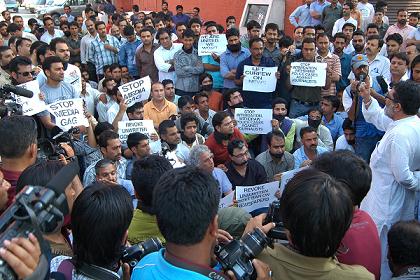
Curbs continue on Kashmir media; is it martial law in Srinagar?

Media persons stage protest at Press Enclave in Srinagar against Government’s decision to gag media. Habib Naqash/GK

Update 2 on 11 July: As was being feared, the state has begun to crackdown on Facebook users for ‘anti-India activiies’. I can already spot one Facebook account missing. Very soon they will ban eating, drinking, breathing and shitting and offer curfew passes to some for these activities.

Update: Appeals to the Indian government by the Committee to Protect Journalists and IFJ.

In a clear signal that it continues to dictate what we get to know about the ground situation in Kashmir, curbs on the local media in the Valley continue despite government claims that they have been lifted. At the same time, Delhi journalists are able to freely move around and report in Srinagar. This is yet another blatant example of how the Indian state considers Kashmir its private property and the rights of its residents are secondary. As the Delhi media continues to do the bidding of the Home Ministry, the best sources of news on what’s happening on the ground remain Twitter and Facebook. Those updating their profiles and pages with information are doing so with the apprehension of censorship, state reprisal, blocking of these sites and suspension of internet services altogether in Kashmir. Continue reading Curbs continue on Kashmir media; is it martial law in Srinagar?

Kashmir, Lies and Audio Tape

The disinformation war is underway. Kashmir’s local media has been BANNED (not censored but BANNED!) in the world’s largest democracy, and the Delhi media is being used to spread LIES.

A conversation in Sopore and other stories

The street that connects that Malaknag and Chheni Chowk areas of Islamabad/Anantnag in south Kashmir. Photo by Nasir Patigaru, via Facebook, posted on 27 June.

Which Indian has not heard of General Dyer? General Dyer opened fire on unarmed protesters. Hundreds died, the figures are disputed between Indian and British version to this day. A commission of enquiry was set up by the English. General Dyer told the Hunter Commission, “I think it quite possible that I could have dispersed the crowd without firing but they would have come back again and laughed, and I would have made, what I consider, a fool of myself.” Continue reading A conversation in Sopore and other stories