Category Archives: Metropolis

A Republic of Cities

From the Indian Express this morning.

Independent India was built, imagined and judged by its villages; by gram swaraj. The nation was rarely, if ever, imagined by its founders to be led (Chandigarh aside) by its cities. Cities were spaces of the other — of colonial empires and cantonments, of a modernity that had come first in the garb of colonialism — separate from the “inner” nation, which, authentic and unsullied, lived on in the villages. As Nehru once famously said: “we want to urbanise India’s villages; not take away the people from villages to towns.”

This ambiguity over the city and the reductive stereotypes it inhabits has had a long innings; and yet has begun to change. The urban has begun to rise not just demographically but politically, electorally, socially, culturally and economically to become the defining problem space of the ‘new India.’ Cities, for better and worse, have caught our imagination.

Let Them Eat Gobi

It seems the Planning Commission exists on a planet which is so far removed from anything we might call the real world, that one begins to wonder whether its staff have not been born, bred and spent the entirety of their lives within the corridors of Yojana Bhavan, with tubes up their noses for nutrition. How else does one make sense of new figures released by the Tendulkar Committee according to which an income of 560 rupees per month in urban India and 368 rupees per month in rural India is enough to fulfill a person’s daily nutritional needs (2,100 calories urban; 2,400 calories rural). This can only mean one of two things: either the Planning Commission has invented a time machine whereby everyone can access food at 1980 prices, or they have simply gone insane. Continue reading Let Them Eat Gobi

City Walls that Talk

[Part of  a Series. See For Movement]

Notes from a Metro (Pun Unintentionally Intentional)

Enter Delhi: The boy was about 13, perhaps less. He was riding a bike which was about three times his size. He swerved between the vehicles on the road at Karol Bagh, very much in the wrong in terms of which side of the road he ought to be on, and therefore also in terms of the traffic rules and regulations. But he could not care. I looked at him and wondered,

Dilli dilwalon ki hai – Delhi is a city of the large-hearted, of the daring, the bold and the courageous.

A few days later, one of the auto drivers remarked to me during a journey,

Kehte hai dilli dilwalon ki hoti hai. Lekin yeh jhoot hai. Sabhi log yahan paise ke peeche pade rehte hai aur har koi aapko lootne ki koshish karna chahta hai – It is a saying that Delhi is a city of the large-hearted. But this is false. Everyone here is behind money, and each person is out to loot/cheat you.

Continue reading Notes from a Metro (Pun Unintentionally Intentional)

A Tale of Two Mosques

Kalan Masjid all dressed up

Ferozeshah Tughlaq (1351-1388), the last significant ruler of the Tughlaq Dynasty, built his capital of Ferozabad on the banks of the river Yamuna. The ruins of the city, that came to be called Ferozeshah Kotla in later centuries, are located behind the Indian Express building and the perpetually under-renovation Ferozeshah Kotla Cricket grounds that derive their name from this 5th capital at Delhi. Continue reading A Tale of Two Mosques

SAHMAT press statement on prayers in protected monuments

SAHMAT
29, Ferozeshah Road, New Delhi -110001
Telephone-2 3070787,23381276
e-mail: sahmat@ vsnl.com

29.7.2009

Press Statement Continue reading SAHMAT press statement on prayers in protected monuments

Of Bhoomiputra and Housing

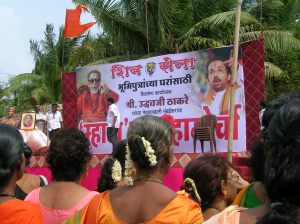
DSCN8740I was moving around Mumbai city on that weekend, mainly in the western suburbs. Several posters and banners were put up all over, announcing a call to a mass rally by Shiv Sena chief Uddhav Thackeray. Thackeray’s clarion call for that meeting was: “Housing for the bhoomiputra“. Bhoomiputra literally means son of the land. On an overt reading of the poster and slogan, one could conclude that the Sena is back to its advocacy of the sons of the soil theory which originally raised it to prominence in the 1960s. But when I attended the rally and noticed the people who attended it, I asked myself, so who exactly is this son of the soil that the Sena is talking about? Is it the Marathi manoos, the local underdog who the Sena argues has no social and economic space in his/her own city? If it is truly the Marathi manoos, then how do I interpret the presence of North Indian women, Bohra muslim women, perhaps even Dalit women, and many other women who I tried to mark but could not classify as either Hindu or Christian or any other particular else.  Hmmm …. Continue reading Of Bhoomiputra and Housing
Home, house

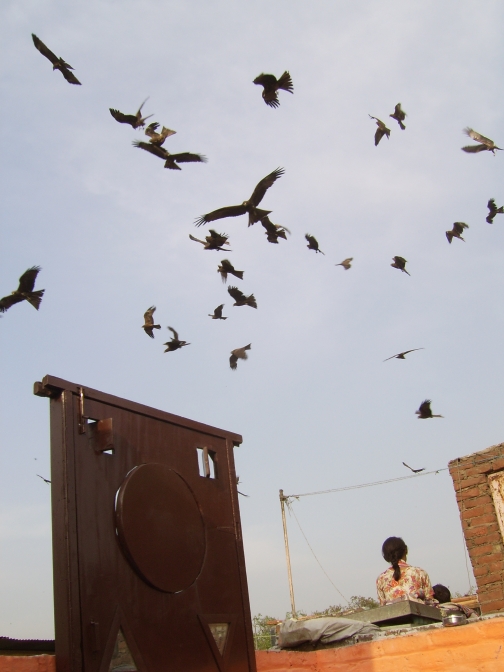
I entered Yunus’s house. He was allotted 150 square meters of land to build his home. Parts of the house were done up with brick and cement. The roof was still kutcha, raw – in the process of construction. You could see the incompleteness of the roof from the opening around the right hand side from which rain likely comes into the house (as does sunshine). I asked Yunus,

Ghar mein barsaat ka pani aata hai kya? Baarish se pareshaani nahi hoti? Continue reading Home, house

The Snub

[Part of  Series. Introduction: For Movement]

Tanger, Morroco, June 2009

Sometimes you just have to seek the travel moment. Yes, the best moments are unexpected, everyday, hidden. Sometimes though, the textbook travel guide moments, mass produced as they are, still work. Try this for a classic travel guide must-do: you drive down to the south of Spain, get to a ferry, put your car in the hold and cross the water in an hour long ride from Europe to Africa. West to.. well… not West. Continent to Continent. Universe to Universe. It’s a [good] travel writer’s worst nightmare and a travel publisher’s wet dream.

Continue reading The Snub

Spaces of Forgetting

[Part of a Series. Introduction: For Movement]

Lisbon, June 2009

From the outside, it looks like a lovely building. Broad and imposing, with a certain faded but still palpable elegance. Like all buildings are at some point in their lives in all cities, it is surrounded by construction gates. The sign says that it is to become, like more and more buildings in more and more cities, luxury condominiums. I think of a friend’s words at a conference a few days before. In the contemporary, he said, inequality is made through making the city. The Portuguese word for “building” is edificio, from the Latin aedis, or dwelling, which itself comes from the Sanskrit inddhh – to burn. Aedis and facere [to make] together make aedificium, to build a dwelling around a hearth, around fire. The word is close to aedes, or temple. It also skirts around aedificare and hence the English “edify” – to improve spiritually. A lot is built in building a building. Continue reading Spaces of Forgetting

Faith, religion, ritual, identity, dogma – how do I understand this?

I walked into Anjali’s  house. She lives in one of the Rehabilitation and Resettlement colonies in Bombay which were developed to provide housing for slum dwellers and railway slum dwellers affected by the creation of roads infrastructure in Mumbai. Her house is a one-room tenement. She has created a litte bedroom space by placing a large showcase unit which separates the living room and the bedroom. I sat down to talk with her when my eyes fell on the Mecca-Medina mosque photograph which was placed on the wall facing her kitchen, above her newly purchased washing machine. For a moment, I was not sure if I had seen correct. Then, while continuing the talking, I glanced carefully again. It was the Mecca-Medina mosque photograph which is usually found in the homes of Bohra Muslims, Shias, Iranis and Sunnis as some kind of a visible mark of religion or show of faith and practice (or perhaps something else, I am not sure). I was both intrigued and amused. Continue reading Faith, religion, ritual, identity, dogma – how do I understand this?

Why Delhi voted and Mumbai didn’t

These have been doing the rounds on Facebook.

Ten reasons why South Mumbai did not vote

by Abhinav Dhar

10. Clashed with Salsa class
9. Election whites not drycleaned
8. No candidate a hottie
7. Tony Jethmalani contesting from suburbs. Sigh
6. No valet parking at booth
5. Spotted servant in queue ahead of us
4. Driver not come
3. “Elections over dude, Obama won!”
2. No party tackling real issues, eg, reduce Gold Gym rates
1. No home delivery!

Why Delhi turned up to vote

By Madhavan Narayanan

1. They loved the Tata Tea ad
2. They saw the Chopras go out, and thought they must overtake the Lancer from left
3. Bunty’s girlfriend wanted it when they were going out for some Chinese
4. Diwan Saheb on second floor persuaded them. He is jaaaint saactry in DPCC
5. Without stable government, real estate will not revive
6. Election Commission directly asked Pappu. So nice of them
7. Grandfather started talking on Partition, and they had to run
8. Auntyji hoped some TV crew will come and take a soundbite
9. Baba Ramdev said it is good for health

And finally
10. They had to beat the Bambaiyaas. Izzat ka sawaal hai, hainji?

The Great House Hunt

A rather fierce debate has been raging at Kafila, the instigator is Zainab, a “Muslim” married to a “Telugu Brahmin” who discovered how deep is the hold of antediluvian ideas and practices in a city that has for sometime been touted as the hub of 21st century India.

She wrote a simple account of her experiences while searching for a house on rent in Bangalore. The piece also touched upon issues like communal profiling, stereotyping entire communities and such like. Some of those commentating on the piece have made ‘clever’ attempts at obfuscation by raising issues like loan quotas for Muslims and such other totally extraneous arguments. Never having studied economics, banking and/or commerce, never having had the resources to apply for a bank loan and not having my life enriched by the immensely educational experience of house hunting in Bombay and Bangalore, I will not try to take on Ipsita or comment on the secular practice of discrimination against all house hunters if they do not belong to the caste, religion, region, gender or economic status of the landlord. Continue reading The Great House Hunt

The Survey Unfolds

Guest post by SHVETA SARDA

lnjp1

Between 26 February, when it started and 6 March, yesterday, the survey of 220 houses has been completed in LNJP. There are roughly 1000 houses left to be covered. From the groundwork done end of last week by a group young women and men residents of LNJP, documents of many have been put in order, and the encounter with the survey teams this past week was much more confident. Continue reading The Survey Unfolds

The Survey Begins

Guest post by SHVETA SARDA

LNJP is an old settlement at the edge of old Delhi, opposite Turkhman Gate, beside the LNJP hospital, from which it gets its name. It began to be settled in the late ’60s, and is now home to about 12000 people. With the planned changes in the city ahead of the Commonwealth Games, LNJP, one of the oldest and last surviving settlements, has also now been earmarked for eviction and demolition.

The survey that precedes demolition has begun in LNJP. A survey is conducted by representatives from the Slum Department of the Municipal Corporation, to produce knowledge about the settlement to be demolished, in order to ascertain how many of its residents are eligible for resettlement. According to a Central Government order of 2000, all those who have lived in a settlement since before 1998 are eligible for resettlement; those who have lived there since before 1990 will be allotted plots of 18 sq m, and those who settled there between 1990 and 1998 will be alloted 12.5 sq m. Continue reading The Survey Begins

Slumdog as aesthetic

The Oscars have passed us by, leaving us with moments that op-ed writers could possibly only dream up: bollywood dancers on an Oscar stage; two of the three nominees for Best Song being sung in a language nearly the entire audience couldn’t even identify let alone speak; the English-speaking of the bevy of ‘India’s children’ translating the English questions into Marathi for the ‘kid from an actual slum’ in a we’re-all-one-across-the-ocean-moment; and, of course, the most harmonious moment of India-is-England-is-India convergence since the founding of the East India Company. It’s an embarrassment of riches.

So what does any of this have to do with slums? Let me be clear: this is not a tirade against the movie in any way. It actually isn’t about the movie at all. It is though about the one thing that the movie has brought back into our attention but that, somehow, no one actually seems to be talking about – that thing called the slum. Slumdog and the debates, protests, and celebrations around it, in equal measure, seem to beg a question: how do we, as Indians who are not Danny Boyle, think about the slum? How should we? Can Slumdog teach us a trick or two about our own backyards?

Continue reading Slumdog as aesthetic

Right to the City? Rethinking Urbanization, Urban Restructuring, Change and How the City is Accessed Physically and Symbolically …

David Harvey published his piece Right to the City in the New Left Review Issue of September-October 2008. Briefly, he describes the capitalist process and how the city has been the space for investing surplus capital. Specifically, this is done through the constant construction boom, be it housing or infrastructure creation. Harvey is suggesting that the global crises which has affected cities across the world (also because these cities were deeply implicated in the conditions that produced the crisis) is now offering an opportunity for the marginalized “classes” of the world to come together and take control of the “surpluses” which are generated at the expense of the cities. He proposes that if the marginalized people across the world were to unite, they could probably demand a human right to the city which goes beyond merely accessing individual urban resources. The right to the city involves re-creating ourselves in the process of re-creating our cities, in consonance with the higher values of equality and social justice. Continue reading Right to the City? Rethinking Urbanization, Urban Restructuring, Change and How the City is Accessed Physically and Symbolically …

Some images do not disturb

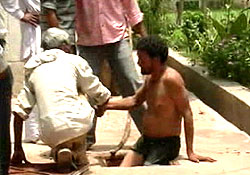
CBI-employed manhole workers in Noida

guest post by S. ANAND

There are times when our critical antennae do not perk up. We do not wish to decode certain signs because we are all implicated in them. Following the 14 September blasts in Delhi, suddenly the media found a new value in ragpickers, street vendors, auto drivers and others who live on the fringes of the city and are generally looked down upon by people who inhabit apartments, blogs, cars (and autos, I must add).

Suddenly, by 15 September, ragpicker Krishna was canonized as a ‘hero’ by the media, the police and the state (the Delhi government claims credit for saving some lives with its ‘eyes and ears’ policy). Yet, Times of India prefaced its report about Krishna thus: Continue reading Some images do not disturb

On dealing with fuss-tration

So for those of us who thought that frustrated, naive and aggressive car drivers are a caricature, Hey we at Kafila found one just for our readers.  He is loud, aggressive and fuss-trated as they come. Read on …

The wonderful thing about blogging, I am told, is that it allows everyone to publish their opinions.  At times however, forgive me for saying this, I wonder if everyone should.  My most recent reason for this harsh indictment of the blogging world, is based on this recent post titled “This is what the fuss is about (you twit)”. The title stems from a spot of witty wordplay on one of my recent posts.

The “you twit”, I might hasten to add, is not my addition. it is the author’s impression of my arguments.  While his post is reasonably, if somewhat naively, argued; his frequent abuse stems, perhaps, out of the need to get his blog read. Or maybe it is a style that is much appreciated by his readers.  I will however, thank him for his incisive – if somewhat excessively enthusiastic – critique of my work.

Continue reading On dealing with fuss-tration

Of “Killer” Buses and Car Lobbies: The Coincidental Death of the BRT

The sustained campaign by the elite press to jettison Delhi’s first mas transit bus system has been remarked upon and documented on Kafila. Today morning’s newspapers carries news of an accident in which 32-year old Poonam Sharma was killed as she tried crossing the road and was hit by an oncoming bus. Delhi’s record when it comes to road safety is abysmal and this is yet another instance of the the terrible and tragic fate that befalls many pedestrians every year on Delhi’s roads. What is interesting though is the way in which accidents on the BRT are reported compared to the reportage of other road fatalities. Here are some headlines from the recent past:

BRT Corridor Claims One More Life

BRT Delhi: Death Toll Continues, Pedestrians Blamed

Delhi BRT has it 10th Victim

BRT Claims another Life: Woman run over by Bus

Continue reading Of “Killer” Buses and Car Lobbies: The Coincidental Death of the BRT

Death of the Author(-ized)?

Or it is just another case of planning paranoia?

Although commonly understood to be a city of traders, Ravinder Singh Chowdhary*, is adamant that Delhi be understood as the abode of farmers.  Sitting adjacent to lush verdant fields of brinjal, rice, and spinach in the village Madapur Khadar in Delhi’s Badarpur Constituency, Chowdhary, explains how Delhi is paradoxically “a city of farmers.”  “From Kilokri and Kotla Mubarakpur in the South-East, to Karol Bagh in Delhi’s North-West, almost every new colony post-partition has been settled on farm land. Those settled by the Government were given water, electricity and drainage and became proper colonies; those settled by private individuals were denied these basic amenities and termed ‘illegal’ or ‘unauthorised’.”

In its most recent and controversial policy announcement, Delhi Government and the Union Ministry of Urban Development seem to take cognisance of Chowdhary’s understanding of the city’s settlements and have begun the process of issuing provisional regularisation certificates to about 1,500 unauthorised colonies that are mostly settled on agricultural land; a move that they claim will benefit approximately 40 lakh residents.
Continue reading Death of the Author(-ized)?