Category Archives: Movements

Bhakti Era in North India : Dr Ravi Sinha

Dr. Ravi Sinha, Marxist Scholar and author delivered a talk on ‘Bhakti Streams of Religious Movements in Medieval North India

Q  &  A session Part 2 : https://youtu.be/bEJjcto5P14?si=EU0XzkVih8O-8gis

Q & A session Part 3 :  https://youtu.be/Eihwjhj_HRM?si=29UwXGfNO-c8UPux)

A  brief outline of the talk is also shared below :

Theme : Bhakti Streams of Religious Movements in Medieval North India

Outline

The idea is to take up discussion of the Bhakti Movement as it moves to medieval North India. It is often stated that the Bhakti Movement was born in the Tamil land in the 6th-7th centuries and over the next millennium it made its way to the northern and eastern parts of the subcontinent. In his famous Patel Lectures of 1964, the famous Sanskritist Professor V Raghavan engagingly described the pradakshina yatra (clockwise circumambulation) of the Bharat Bhumi by Bhakti carried on the shoulders of singing saint-poets. Such a narrative, however, can contain only partially the historical truth. It is difficult to locate a singular source of a phenomenon that covered the entire subcontinent and took twelve hundred years to accomplish that. Given its scope and complexity and its temporal span, it is even more difficult to attribute to it a linear historical momentum that would carry it along an identifiable trajectory across the subcontinent. ..

( For full text and other details, please see :https://nsi-delhi.blogspot.com/2024/04/videobhakti-era-in-north-india-talk-by.html)

What is stopping the Government from Scrapping the Agnipath Scheme?

..‘Agnipath’ Still Simmers ..

‘The anger and anxieties over ‘Agnipath’ scheme – have not died down.

Gone is the period of open protests by youth and students and other ordinary people which rocked when the scheme was hastily announced (June 2022).

It does not mean that the youth are now happy about this scheme.

In an ambience of rising unemployment how is it possible to be happy about the fact that “[d]ue to the implementation of the Agniveer scheme, around 1.5 lakh candidates selected for the Indian Army, Air Force and Navy between 2019 and 2022 were allegedly denied joining.( 2)and all future possibilities of such an employment being closed forever.

Anyone who is keen to know how Agnipath has literally ‘destroyed’ thousands of jobs in military can take a tour of Kuchman City in Nagour ( Rajasthan) once a hub of more than 200 defence coaching academies preparing students from Rajasthan, Haryana and neighbouring parts of Western UP for entrance exams in Military..

…The anger and discontent of the Youth will continue to harm the ruling dispensation – whatever gloss they try to apply over the scheme. 

( Read the complete article here : https://countercurrents.org/2024/04/what-is-stopping-the-government-from-scrapping-the-agnipath-scheme/)

THE PEOPLE’S NATIONAL LIBRARY POLICY

This is a guest post by Purnima Rao and Mridula Koshy

[The Free Libraries Network (FLN) is a coalition of over 250 free libraries, librarians and library activists across India and South Asia. A member of the International Federation of Library Associations and Institutions (IFLA), FLN believes in universal access to reading materials and information. FLN offers a platform for sharing resources, best practices, and insights about free libraries in India. Although it does not own or operate libraries, FLN plays an integral role in coordinating and acting on policy issues related to access to knowledge resources. FLN actively advocates for a free public library system in India. The FLN believes that reading and access to information are a fundamental right. It is motivated by the conviction that a robust free public library system is a foundational bedrock of a just, equal, and democratic society.]

Free Libraries Network, is choosing the birth anniversary of Babasaheb Ambedkar to announce the completion of its work drafting the People’s National Library Policy. The date is fitting as Babasaheb’s love of books and reading and especially his belief in libraries gives us strength in our anti-caste work to argue for a public library system that is free and open to all. Our network of over 250 free libraries spread across nearly every state in India brings together library movement activists who recognise that without a publicly funded and locally autonomous library system, we will never realise the promise of Babasaheb’s great work, our Constitution. Our democracy suffers when the people do not have free libraries in which to have equal access to vital information.

At this time, we have every reason to fear that the long stagnant question of libraries and of library policy is being revived, but to serve narrow interests. We have seen the question raised in Rajya Sabha in 2022, and call issued from there to the Union Ministry of Culture for a national library policy; we attended the same Ministry’s Festival of Libraries in 2023, where the keynote speaker Vinay Sahasrabuddhe spoke of the “good” and “bad” books and where it was announced that the government would be shifting the library question from the State to the Concurrent list; and  we have visited a model library in Delhi, created by the Gautam Gambhir Foundation  and inaugurated by Amit Shah, which utilises best practices of modern library science such as open shelving with its impulse to freedom of choice to house a collection that can be characterised as propaganda.

The draft People’s National Library Policy is a counter to these threats and an attempt to revive the question of libraries in India. It recognises the pivotal role of public libraries in empowering communities and fostering societal progress, especially amongst those excluded throughout India’s history, including Dalit, Adivasi & Bahujan people, Backward Classes, women, non-binary & trans people, undocumented & refugee communities and persons with disabilities. Rooted in Dr Ambedkar’s ideals of equity and justice, the policy envisions a public library system that is freely accessible and relevant to all segments of society, transcending barriers of caste, class, gender and disability.

The PNLP will be released on 13th April 2024, at 5:00 PM, Press Club, New Delhi.

The full draft of the PNLP can be read here:

https://www.fln.org.in/library-reform-demanding-the-peoples-national-library-policy/

Mridula Koshy and Purnima Rao are members of the Research and Action Group, Free Libraries Network.

Towards Securing Himalayas From Disasters – People for Himalaya Demand Charter 2024

People for Himalaya campaign is an initiative of progressive groups, civil society organisations and activists from the region. The campaign is not affiliated with any political party. For the list of supporting organizations, please scroll to the bottom of the post.

[Last year we witnessed the hills of Himachal Pradesh, Uttarakhand and Sikkim in virtual revolt against the mindless development that they have been subjected to. It was against the backdrop of these frightening developments that discussions began among groups across the Himalayan states in February this year, leading to the adoption of the Charter for the Himalayas. We also just saw environment activist from Ladakh, Sonam Wangchuk sit on a 21-day hunger strike in freezing minus 10 degrees Centigrade, demanding that the Sixth Schedule of the Constitution be implemented in Ladakh and it be protected from being handed over to corporate interests for so-called Development projects. Wangchuk’s hunger strike was withdrawn but the movement continues with women continuing their sit-in and other sections of the population, especially youth, preparing to join in soon. The movement is not about one person’s hunger strike but to prevent Ladakh meeting the same fate as Himachal Pradesh, Uttarakhand and Sikkim. – AN]

  1. STRENGTHEN REGULATION, MONITORING AND PLANNING OF LAND USE, LAND-USE CHANGE AND FORESTRY (LULUCF)
  • A complete moratorium on all mega infrastructure projects like railway, dams, hydro projects and four lane highways, tunnelling, transmission lines – and conduct a 360-degree multi- disciplinary review of the impacts of existing projects
  • Democratic decision making through referendums and public consultation on large infrastructure by strengthening the Environment Impact Assessment Notification 1994 (Scrapping the EIA 2020 Amendments & FCA 2023 Amendments); Free Prior informed consent of Gram Sabhas to be mandatory for all developmental projects
  • Terrain Specific Disaster and Climate Risk Studies and land susceptibility assessments to be mandatory for land use change for urbanisation, commercial development and public infrastructure construction
  • Just Implementation of 2013 Right to Fair Compensation and Rehabilitation Act
  • To ensure participation of citizens, civic bodies and Gram Sabhas in monitoring pollution and land use change works like stone crusher, sand-gravel mining, mineral mining, debris dumping, construction of local roads and every commercial construction work.

2. GRANTING COMMUNITIES CONSTITUTIONAL, LAND AND FOREST GOVERNANCE RIGHTS

  • Strengthening of state laws and regulations that protect the private and community resource rights of nature dependent communities – example Van Panchayat Rules in Uttarakhand
  • Complete the Unfinished land reforms and land regularisation agendas to provide secure land tenure to landless and displaced communities to practice land based livelihoods – example Nautor rules in Himachal Pradesh
  • Just implementation of constitutional provisions and laws that support the decentralised, autonomous and democratic governance and decision making – example the Scheduled Tribes and Other Traditional Forest Dwellers Act 2006 and other constitutional provisions
  • Protection of pastoral communities especially minority communities like the Van Gujjars and Bakarwals in migratory routes
  • Strengthen floral and faunal biodiversity through Community Forest Resource Rights governance framework under FRA 2006 – convert pine monocultures into broad leaf forests to address fodder scarcity, forest fires and soil erosion. Five ‘f’ species should drive plantations i.e. fruit, fodder, fertilizer, fuel, fiber and medicinal plants. Weed eradication programs for pasture development.

3. TRANSPARENCY, KNOWLEDGE BUILDING, SHARING AND EXCHANGE

Continue reading Towards Securing Himalayas From Disasters – People for Himalaya Demand Charter 2024

Questions and Answers on Looking for an Idea of India for the Indian Left : Dr Ravi Sinha

75th year of Nakba – In solidarity with the Palestinian struggle

Yesterday, May 15, 2023 marked the 75th anniversary of Nakba or the dispossession of the people of Palestine by the Zionist state of Israel. This is the text of a talk delivered at an event organized by India Palestine Friendship Forum.

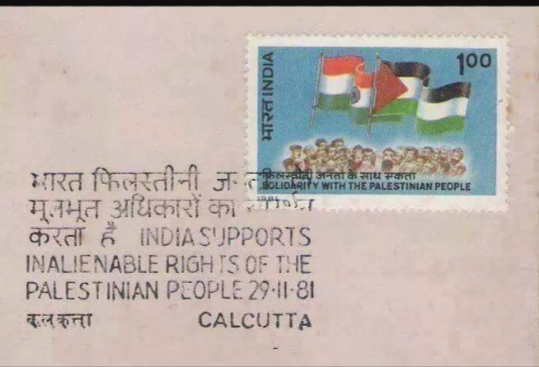
Stamp issued in 1981

In September 2012,  I had the incredible good fortune to visit Palestine. We stayed in Ramallah, visited and interacted with colleagues at Birzeit University and spoke at a conference organized by Muwatin, a research institute based in Ramallah. We met  a large number of inspiring people who pushed the frontiers of our minds, and we came away humbled and moved by the dignity of a people living through the brutal occupation of their lands by the  Zionist state of Israel, with limitless courage and bubbling sense of humour intact. Continue reading 75th year of Nakba – In solidarity with the Palestinian struggle

Hindutva Brigade Must Break Silence Over Espionage Allegation

The list of people associated with Hindutva outfits caught in damning revelations keeps growing.

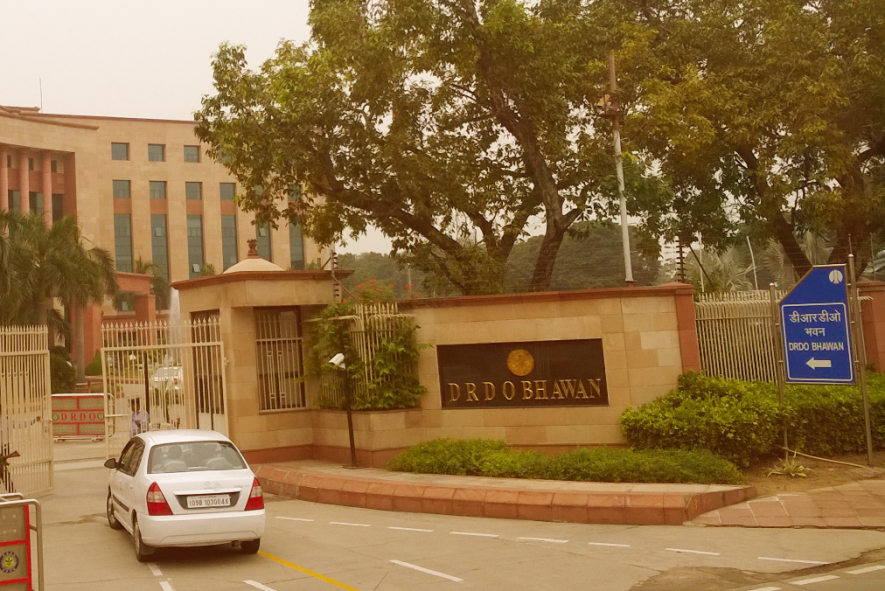
Recent revelations involving alleged espionage involving Prof Pradeep Kurulkar at the Defence Research and Development Organisation should have shaken up the establishment. After all, Kurulkar is said to have handled crucial projects related to India’s defence and reportedly was the lead designer or team leader for projects on missile launchers and subsonic cruise missiles.

Reports say Kurulkar was in contact, over WhatsApp, with a Pakistani Inter-Services Intelligence (ISI) agent late last year. His suspicious activities were reported to the police by DRDO, and in January, his laptop and two mobile phones were seized. The Maharashtra Anti-Terrorism Squad (ATS) is now handling the case. Kurulkar’s foreign trips are also under the scanner.

Such discoveries have long-term implications for India’s national security. Initial reports from ANI, a news agency known for its proximity to the ruling regime, did not mention Kurulkar’s name. The news agency did not initially mention his name in its tweets, though pictures of his face were circulating on social media and news outlets. The sequence of events left many wondering if the tweets deliberately concealed his name to create a doubt over his identity.

No doubt, Indian investigators will examine if the neighbouring country’s sleuths have penetrated India’s defence research sector and the extent to which Kurulkar has compromised India’s secrets. But it’s worth noting this case has not been handed over to the National Investigation Agency. Formed in the immediate aftermath of the 2008 Mumbai terrorist attack and supposedly more equipped and experienced to handle cases with cross-border ramifications, this agency has been busy filing plenty of cases—so, why not this one? ( Read the full article here)

भारत में अंतर्राष्ट्रीय मजदूर दिवस के 100 साल – तब और अब : माया जॉन

Guest post by MAYA JOHN

यह लेख इंडियन एक्सप्रेस में मई दिवस 2023 पर लिखे गए लघु लेख का हिन्दी रूपान्तरण है।

वो दिन ज़रूर आएगा जब हमारी खामोशी उन आवाज़ों से ज्यादा ताकतवर होगी जिनको आज तुम दबा रहे हो।

  • अमर शहीद अगस्त स्पाइज़ का हेमार्केट शहीद स्मारक पर उद्धृत कथन, अनुवाद हमारा

हर दिन मैं खुद को यह याद दिलाता हूँ कि मेरा अंदरूनी और बाहरी जीवन मृत और जीवित लोगों के श्रम पर आधारित है, और जो मुझे मिला है और मिल रहा है उसको उसी मात्रा में देने के लिए मुझे पुरज़ोर मेहनत करनी होगी।

  • अल्बर्ट आइंस्टीन, द वर्ल्ड एज़ आई सी इट (दुनिया मेरी नज़र में), अनुवाद हमारा

मई दिवस 2023 के साथ भारत में मई दिवस मनाए जाने के 100 साल पूरे हुए हैं। सिंगारावेलु चेट्टियार, जो कि भारत के स्वतंत्रता आंदोलन की बड़ी शख़्सियतों और जाति-विरोधी आंदोलन से जुड़े शुरुआती कम्युनिस्ट नेताओं में से एक थे, उनको भारत में सबसे पहले मद्रास शहर में 1 मई, 1923 को मई दिवस मनाने का श्रेय दिया जाता है। सिंगारावेलु ने भारत में मई दिवस की शुरुआत कर कोशिश की कि भारतीय मजदूरों के संघर्षों को वैश्विक-स्तर के मज़दूरों के प्रतिरोध के साथ जोड़ा जाए। शिकागो में मई 1886 में मजदूरों की रैली से शुरू हुए मई दिवस की तीव्र तरंगें जो भारतीय तट तक 1923 में पहुँचीं, उस संवेग को आज भी दुनिया के विभिन्न हिस्सों में महसूस किया जा रहा है।

Continue reading भारत में अंतर्राष्ट्रीय मजदूर दिवस के 100 साल – तब और अब : माया जॉन

Rewriting Biopolitics? The Kerala Sastra Sahitya Parishat and the Left

[This is a response to many who ask me why I chose to be part of the KSSP’s ongoing Kerala Padayatra, which seeks to highlight crucial issues in development and governance in Kerala.]

Continue reading Rewriting Biopolitics? The Kerala Sastra Sahitya Parishat and the Left

SL Govt – Stop Labeling Student Protestors and Activists as Terrorists! South Asian Feminists

Statement released by feminists from Sri Lanka, Bangladesh, Pakistan, Fiji, Malaysia and India, August 27, 2022

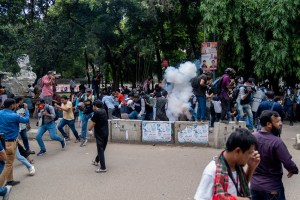
We are a group of feminists writing to call urgent attention to the extra-constitutional attempts of the Government of Sri Lanka (GoSL) to suppress dissent. Lacking a popular mandate, hunting down student protestors and activists, including a LGBTIQ activist has become a central strategy of the political élite to retain power. The latest move by the GoSL is to brand three student leaders and the student union they represent, the Inter University Student Federation (IUSF), as ‘terrorists’.

Wasantha Mudalige, Convenor of IUSF, Galwewa Siridhamma thero, Convenor of the Inter-University Bhikkhu Federation, and Hashan Jeewantha, a student activist, were among the 20 arrested on August 18, 2022, for participating in a peaceful protest led by the student movement. All three of them are prominent student leaders who have been at the forefront of struggles for socio-economic justice in Sri Lanka, particularly against numerous ongoing attempts to dismantle free education. Continue reading SL Govt – Stop Labeling Student Protestors and Activists as Terrorists! South Asian Feminists

The flag is ours! Azadi bhi!

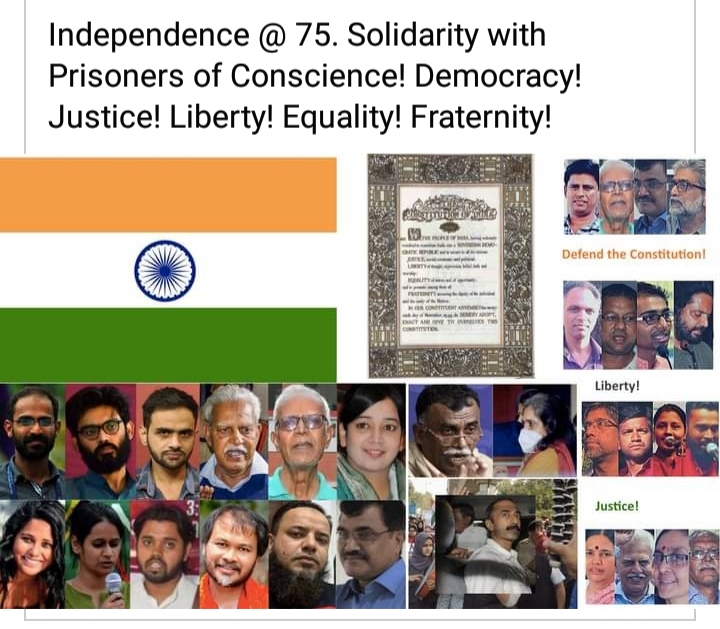
Students, journalists, writers, poets in jail on trumped up, false charges

Three potent symbols  – the Azadi slogan, the Constitution and the National Flag – have formed the core of the battle against Hindu Rashtra and capitalist expropriation over the last decade. Continue reading The flag is ours! Azadi bhi!

Debating Strategy for the New Phase of Janatha Aragalaya: MAYA JOHN

Guest post by MAYA JOHN

[This article is based on the discussions with activists of the Janatha Aragalaya and concerned Sri Lankan citizens. It is a humble contribution towards ongoing debates within the movement. As the French proverb goes: “De choc des opinions jaillit la vérité” – Truth arises from a conflict of opinions. – MJ]

With the deepening crisis of the world capitalist system, we see social upheavals erupting in one country after another. Most recently, Sri Lanka, a relatively small island country in South Asia that is enveloped by a staged debt crisis, has amply revealed circumstances which are infused with revolutionary possibilities. Resembling dark clouds that announce the gathering of a storm, Sri Lanka has shown how rapidly a revolutionary situation can develop.

Heading the floundering ruling establishment, and harbouring perpetual dismissiveness of the swelling discontent, the ruling family of Rajapaksas expectedly attracted massive public ire. Fighting hunger, spiralling inflation, long queues for fuel and rations, crumbling medical facilities, loss of employment, frequent and long power outages, angered citizens came to see the Rajapaksas as well as other mainstream politicians as creators and perpetuators of the grave crisis. Importantly, the distrust of the people has not been limited to individual politicians and ruling cliques whose moral right to govern is being openly challenged, but is a latent distrust for the system itself. At present, majority of the public rightfully views all established parties with deep suspicion and hostility. The majority perceives the rise to power of President Ranil Wickremesinghe as an epitome of the rot in the political system. They see his government as an illegitimate one.

Continue reading Debating Strategy for the New Phase of Janatha Aragalaya: MAYA JOHN

The Popular Uprising in Sri Lanka – What Next?

Guest post by MAYA JOHN

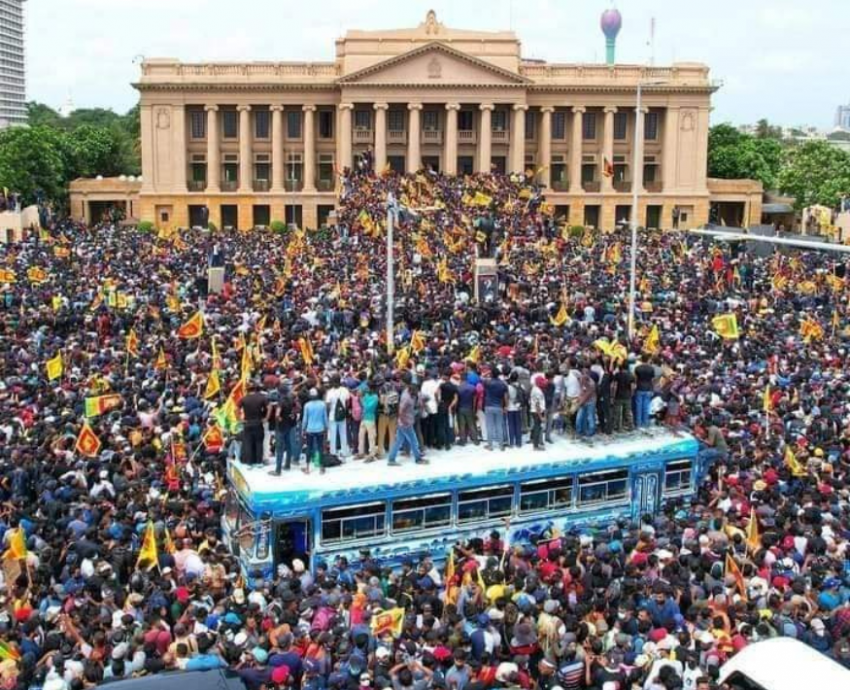
People converge at the Presidential building in Colombo, July 9, Photo: @UnionProtect/ Twitter, courtesy greenleft.org.au

A powerful Sri Lankan people’s movement, Janatha Aragalaya, has shattered the legitimacy of the ruling establishment of the country and has come to pose a serious challenge to the imperialist powers that have been backing the corrupt regime. Functioning from the Colombo’s Galle Face and numerous other centres which have surfaced across towns and villages, the movement amply reveals that the Sri Lankan people are questioning the misuse of the popular mandate by the country’s ruling elites. One can easily glean that the people’s aspirations go beyond the simply dethroning a few powerful politicians.

Continue reading The Popular Uprising in Sri Lanka – What Next?

Electoral Politics and the Left

Guest Post by Dr Ravi Sinha

(Opening remarks in an ongoing discussion within New Socialist Initiative (NSI) on Left’s approach to Electoral Politics in Contemporary India)

The Speaker :

Ravi Sinha is an activist-scholar who has been associated with progressive movements for nearly four decades. Trained as a theoretical physicist, Dr. Ravi has a doctoral degree from MIT, Cambridge, USA. He worked as a physicist at University of Maryland, College Park, USA, at Physical Research Laboratory, Ahmedabad and at Gujarat University, Ahmedabad before resigning from the job to devote himself full time to organizing and theorizing. He is the principal author of the book, Globalization of Capital, published in 1997, co-founder of the Hindi journal, Sandhan, and one of the founders and a leading member of New Socialist Initiative.

An Unprecedented Struggle, A Glorious Victory – Looking Ahead


The victorious farmers at Delhi borders, image courtesy NDTV

It is a time for rejoicing and celebration. It is a time for thanksgiving. For the victory of the farmers is not just theirs. Theirs was not just a struggle to protect their own livelihoods but also a valiant battle fought for all of us, so that we continue to get our food at affordable prices. It is a time for thanksgiving also because the movement has broken the hubris of an arrogant government that has absolutely no accountability whatsoever. It has given us some breathing space.

Even as this piece is being written, the victorious farmers camping at the Delhi borders for the last one year are preparing to leave for their homes. It has been a long haul for them in the course of which over 700 have died. It has been especially trying for the Punjab farmers who had started the stir months before they decided on their march to Delhi on 26 November 2020. Nobody had expected that the shifting of the venue to Delhi would end up being one long ordeal, continuing months on end, through the freezing winter, scorching Delhi heat and torrential rains. Not to mention an intransigent government that had already started the ground work for corporatization of agriculture and handing over parts of it to Adani and Ambani, even before the laws were formally promulgated.

Continue reading An Unprecedented Struggle, A Glorious Victory – Looking Ahead

Historic Triumph of the Farmers’ Movement — A celebration tinged with grave apprehensions: C.P. Geevan

Guest post by C.P. GEEVAN

What the farmers’ movement has achieved is nothing short of historic, even if the authoritarian government had not gone back on its intent for uncompromising implementation of the laws meant to reinforce major structural changes for facilitating corporate dominance of the farm sector. The inflexible approach of the government and the massive repression has claimed almost 700 lives since agitation began nearly one and half years back. Be it celebration or analysis, we must pay sincere homage and tributes to all those dead.

Continue reading Historic Triumph of the Farmers’ Movement — A celebration tinged with grave apprehensions: C.P. Geevan

The Trafficking Bill 2021 – Assault on Labour and Industry Rights: Rakesh Shukla and Aarthi Pai

Guest post by RAKESH SHUKLA AND AARTHI PAI

The Trafficking in Persons (Prevention, Care, and Rehabilitation) Bill 2021 scheduled to be tabled in the current session of Parliament has grave implications for workers and marginalised populations. Trafficking is a criminal offense and indisputably requires strict measures to combat unscrupulous persons who exploit the vulnerability of workers. Instead, the current draft ends up criminalising  vulnerable individuals in the absence of comprehensive policies, programmes and measures that address the factors that make persons vulnerable to trafficking. The aspiration to move and access better living conditions, poverty, lack of equal opportunity and skewed development policies force persons to move in an unsafe manner and accept work in a criminalised environment for instance in sex work, undocumented workers abroad or for organ trade. Continue reading The Trafficking Bill 2021 – Assault on Labour and Industry Rights: Rakesh Shukla and Aarthi Pai

Some Remarks about Movements

Guest Post by Ravi Sinha

Accountability is foundational to democracy and, ultimately, people are supposed to take those in power to account through democratic processes and mechanisms. But, then, we also know what often happens in democracy. Electoral competition gives rise to ‘technologies’ (often religious, cultural and identity-based) which turn citizens into “Bhakts” (devotees) and storm-troopers (remember Hitler’s “Brownshirts”). The dark side of democracy comes on top more often than the other side. India is witnessing that disaster. Trump was a testimony to the same phenomenon in the United States.

But what about movements? Are they also supposed to be accountable to someone or something? One would presume that movements are accountable to their own missions, values, objectives, arguments and strategies. Is anyone taking the movements to account on that score?

One would imagine that the left movement has been taken sufficiently to account all over the world. So much so that, for most people, there is no longer any need to take it to account. In many eyes, it is finished. Why waste time on something that is finished? And yet, the most curious thing is that the left remains the favourite whipping boy of most other movements and their intellectual luminaries. Here in India a favourite pre-occupation of Dalit intellectuals is to expose the Savarna (upper caste) hegemony over the left movement and many feminists focus on the misogyny of leftists. As if in a survey of the Indian society, leftists have come on top as the most likely and most numerous perpetrators of oppression and violence against Dalits and women! There is no denying that left must be taken to task for all its ills and all its failings. But, should a movement that is often pronounced dead be the prime example when it comes to evaluating movements?

The Bahujan Samaj Party (BSP) in Uttar Pradesh has declared that it would be the party that would actually build the Ram temple. This party is openly and loudly appealing to Brahmins as a caste to come into its fold. Babasaheb Ambedkar famously talked about annihilation of caste and declared that there is no scope of Dalit liberation under Hinduism. This irony is not confined to BSP. A Dalit is submissively the President under the current dispensation and an ex-Dalit Panther is a minister. All this can be explained away as pragmatic responses to the demands and rigours of democracy. But what about the movement itself? What about Ambedkar’s mission?

The question goes far deeper. Why is it the case that Hindutva has been able to make such inroads into Dalit communities? In what ways and to what degrees the ‘Hindu civilizational mind’ sits within the ‘Dalit cultural mind’? Why is it the case that in Gujarat carnage and elsewhere Dalits have been as much and as willing a part of the Hindutva “Brownshirts” as any other community? Why is it the case that an occasional Dalit leader who emerges as a fiery meteorite in the aftermath of a gruesome atrocity disappears as fast from the social and political horizon and the masters of the electoral machinations remain as much in control of the actual political arena?

One hopes that the theorists of social movements – from Columbia and Harvard Universities to JNU and Osmania – are earnestly grappling with this puzzle. We all know the simple and common-sense answers, but they do not suffice. The puzzle needs a deeper explanation. How long the intellectual prophets of the social movements remain content with celebrating the history and the survival of these movements? How long will Dalit writers remain content with asking the caste lineage of other (Savarna) writers and denouncing them for the surnames they use? How long will they be content with demanding monopoly over literary depiction and theoretical explanation of Dalit life and experience? Real questions and real challenges remain unattended.

(https://www.facebook.com/newsocialistinitiative.nsi/posts/2635781250063345)

Field report from protest against granite mining at Bodikonda: Chandra Sekhar

Guest post by Chandra Sekhar

All images courtesy the author

Background

Bodikonda is a monolithic stone hill in Lakshminarayanapuram village in Parvathipuram mandal in Vizianagaram district. This has been in the news on and off over the last two years or so, because local people have been protesting the lease given to private companies for mining colour granite, without their being consulted nor any sort of public hearing.

Three leases for quarrying coloured granite were granted and executed in favour of MSSS Srinivas for an extent of nine hectares, M Madhupriya for an extent of six hectares and Kishore Granites Pvt. Ltd. for another nine hectares ( total of 24.29 hectares) for a period of 20 years. This comprises almost 50% of the area of the total hill. These companies applied for a lease in 2010 to the Assistant Director of Mines and Geology, Vizianagaram, and new licences were given in December 2019.

Procedural Discrepancies Continue reading Field report from protest against granite mining at Bodikonda: Chandra Sekhar

A Poem For Umar, Khalid Saifi and Other Political Prisoners: Nabiya Khan

Guest Post by NABIYA KHAN

Our valiant young activists, defenders of democracy, continue to be in prison for almost a year – some a bit more and some a bit less. All under entirely framed charges, while the actual perpetrators of violence continue to roam free, spreading hate. Celebrating the commitment and courage of these activists, here is an offering by Nabiya Khan, courtesy Karwan-e-Mohabbat. The Devanagari and Urdu texts follow after the video

Continue reading A Poem For Umar, Khalid Saifi and Other Political Prisoners: Nabiya Khan

Hul Dibosh Convention by Ekusher Dak (Call of 21) Marks Anniversary of Santhal Rebellion

Poster in Santhali language for the Convention

We had reported earlier on the call for a convention to commemorate the anniversary of the historic Santhal Rebellion associated the immortal names of Sidhu and Kanu. The convention was organized by the recently constituted forum in West Bengal, Ekusher DakCall of 21 – which was formed in the run up to the recently held elections in the state. ’21’ of course, refers to the year 2021 when the elections were held and the initiative for a new/ different Left platform in the state was launched. But ’21’ also recalls the date 21 February 1952, the historic day of the Bhasha Andolan (the Language Movement) in what is now Bangladesh. It recalls the assertion of Bengali identity that overrides the religious divide that the BJP made every effort to exacerbate. The convention was held yesterday and really came like a whiff of fresh air. The film we embed below is a very short but powerful telling of the story of the revolt with graphics. Ekusher Daak Film Team – Arjun, Debalina, Maroona, Boro, Laboni, Malay, Mitali, Arundhati, Saikat, Baijayanta, and Swarnava -have produced the film. For those who would like to watch the proceedings of the Convention, the YouTube streaming link is here.

The film on Hul Dibosh