Category Archives: Movements

The Denigration of Women Workers Fuels State Neglect: Complaint Against the CITU (Kerala) to the WFTU

Attention:
General Secretary, WFTU secretariat@wftucentral.org
Women’s Committee women@wftucentral.org
Asia Pacific Regional Office wftuasiapacific@gmail.com; c.srikumaraidef@gmail.com


Subject:
Complaint against CITU and AITUC (Kerala, India) for their sexist remarks and non-cooperation with
KAHWA women workers in violation of WFTU Constitution


Reference (WFTU Constitution):

Continue reading The Denigration of Women Workers Fuels State Neglect: Complaint Against the CITU (Kerala) to the WFTU

Kerala Must Lead the Way : Kameshwari Jandhyala writes to the Kerala CM on the ASHA Workers’ Struggle

To

Shri Pinarayi Vijayan

Honourable Chief Minister

State of Kerala

Sir

Subj: Kerala Asha workers struggle for justice

I am writing to appeal to your sense of justice and support for workers’ rights especially with regard to the Kerala Asha workers struggle for timely payments, commensurate incentives and remuneration on par with other development workers.

The participation, unstinting labour and commitment of women has been central to several development initiatives in the country, including Kerala. The sad and ironic part is that these women workers are labelled as volunteers and their labour not given its due recognition, respect and remuneration commensurate with the ever-expanding portfolio of responsibilities they shoulder. To remind ourselves, during the Covid pandemic Asha workers across the country bravely, and at considerable personal risk, reached out support to their communities.

Many of us look to Kerala to take the lead to determine and protect the rights of all workers even those labelled as “volunteer workers”. And I am sure Sir, your government is all too aware that “volunteer” is a misnomer, as Ashas are doing full time work.

Once again, I appeal to you and your government to take a positive  to meet the demands of the Asha workers.

Kameshwari Jandhyala

Hyderabad, Telangana

Reflections on the Kafila Journey – Looking Back at a Tumultuous Experience

An expanded version of the presentation   at the panel on Kafila held as part of the W.I.P alt.FEST held in Bangalore and Delhi in  December 2024. While the first post in this series by Subhash Gatade is linked below in the text, the third by J. Devika can be read here.

Kafila was formally launched on 6 November 2006 at a session of the India Social Forum in Delhi, though its first post had gone up a couple of weeks earlier, on 19 October. However, there is a prehistory to the actual formal formation of Kafila which goes back to two earlier movements that had brought many of us together.

As rightly mentioned by Subhash Gatade in his reflections, the first of these was the movement against the relocation of polluting/ hazardous industries starting from late 1996. It was this movement that, perhaps for the first time in India brought the issue of workers’ rights into the discourse on urban pollution and environment. It took the discussions on urban planning, linking air and water pollution, zoning, transport policy and questions of workers’ occupational health, outside the charmed circles of urban planners. Initiated by the Indian Federation of Trade Unions, the formation of the Delhi Janwadi Adhikar Manch was the platform that had enabled this by bringing all of us together.

Continue reading Reflections on the Kafila Journey – Looking Back at a Tumultuous Experience

Concerns arising from the suicide of Atul Subhash – A feminist response: Naveddu Nilladiddare, Karnataka

Statement by Naveddu Nilladiddare, Karnataka, a state wide network of organisations and individuals concerned with issues related to women and all human rights

The tragic suicides of Atul Subhash and police constable, Tippanna Alagur in Karnataka have once again given rise to volatile debates on the ‘misuse’ of the laws related to gender violence specifically the (erstwhile) IPC 498 A and the Dowry Prohibition Act. It has provoked a PIL in the Supreme Court that seeks reform of these laws to “prevent harassment of Innocent husbands.”  It has also given space for irrational and dangerous fears being unleashed by men’s rights organisations and a sensational media about “greedy and exploitative” women who are a threat to the institution of the family with their rapacious demands for maintenance and alimony. Even the Home Minister of Karnataka has legitimised these fears stating that the suicide has “opened up a debate about men’s rights” in the country.  These statements and debates betray an ignorance of the processes of law in addition to a denial of violent patriarchy that continues to impact on the lives and deaths of women and men. 

Continue reading Concerns arising from the suicide of Atul Subhash – A feminist response: Naveddu Nilladiddare, Karnataka

Stop Arbitrary Detentions and Intimidation, Save Ecology & Uphold Democratic Rights in J&K and entire Himalayan Region: Statement by 250 organizations and individuals

Following is a statement issued by 250 organizations and individuals, including the National Alliance of People’s Movements (NAPM) against arrests and intimidation of activists raising concerns regarding the ecological impact of so-called “developmental” projects. The statement was issued on 13 November 2024

Stop Arbitrary Detentions and Intimidation of Social & Environmental Activists in Jammu & Kashmir

Save Ecology & Uphold Democratic Rights in J&K and entire Himalayan Region

National Alliance of People’s Movements (NAPM), along with other people’s organizations and concerned citizens from across India strongly condemns the arbitrary detention of social and environmental activists in Jammu & Kashmir under the Public Safety Act (PSA). Those detained under the provisions of J&K Public Safety Act, 1978, include Mohammad Abdullah Gujjar (resident of Sigdi Bhata), Noor Din (resident of Kakerwagan), Ghulam Nabi Choppan (resident of Trungi – Dachhan), Mohammad Jaffer Sheikh (resident of Nattas, Dool) and Mohammad Ramzan (resident of Dangduroo – Dachhan), trade union leaders from Kishtwar district.

Continue reading Stop Arbitrary Detentions and Intimidation, Save Ecology & Uphold Democratic Rights in J&K and entire Himalayan Region: Statement by 250 organizations and individuals

Urgent Letter to the DGP, Chhattisgarh Regarding Unlawful Detentions and Extra-Judicial Killings in Bijapur District : NAJAR

Following is a letter from the NATIONAL ALLIANCE FOR JUSTICE ACCOUNTABILITY AND RIGHTS regarding recent unlawful detentions and extra-judicial killings in Bijapur.

Urgent Letter to the DGP, Chhattisgarh Regarding Unlawful Detentions and Extra-Judicial Killings in Bijapur District 

13th Nov, 2024

To,

Director General of Police, Govt. of Chhattisgarh,  Raipur, Chhattisgarh 

Sub: Unlawful Detentions and Extra-Judicial Killings in Bijapur District – Seeking Immediate Release of all detenus and impartial inquiry – Reg

Sir,

We the undersigned, as members of a national collective of lawyers, law students, law professors, and other legal professionals, called National Alliance for Justice, Accountability and Rights (NAJAR) write to express serious concern regarding recent actions by security forces in Bijapur District, Chhattisgarh, on 8th Nov, 2024. The mass detention of individuals, including prominent activists, as well as reported killings, raises grave concerns about due process, excessive use of force, and adherence to legal standards.

Continue reading Urgent Letter to the DGP, Chhattisgarh Regarding Unlawful Detentions and Extra-Judicial Killings in Bijapur District : NAJAR

The New Janus of Sri Lanka: Revolution at the Gate? Maya John

Guest post by MAYA JOHN

[Maya John has been part of the Left Movement for the past two decades and this piece is in response to ongoing dialogues with Sri Lankan comrades.]

Anura Kumara Dissanayake, photo courtesy AP News

The recent presidential election has installed Anura Kumara Dissanayake (“AKD”) from the Janatha Vimukthi Peramuna (JVP)-led National People’s Power (NPP) alliance as the new president of Sri Lanka. This victory is seen as a result of rising popular hostility towards mainstream parties and rogue dynasts. Consequently, we find that AKD garnered an overwhelming share of the votes from those same electoral constituencies which had earlier voted in bulk for the corrupt Rajapaksas. Prior to this presidential election, the frustrated Sri Lankan masses, plagued by growing economic and political crises, generated the powerful people’s movement – the janatha aragalaya – that ushered in a huge legitimacy crisis for the ruling elites.

Continue reading The New Janus of Sri Lanka: Revolution at the Gate? Maya John

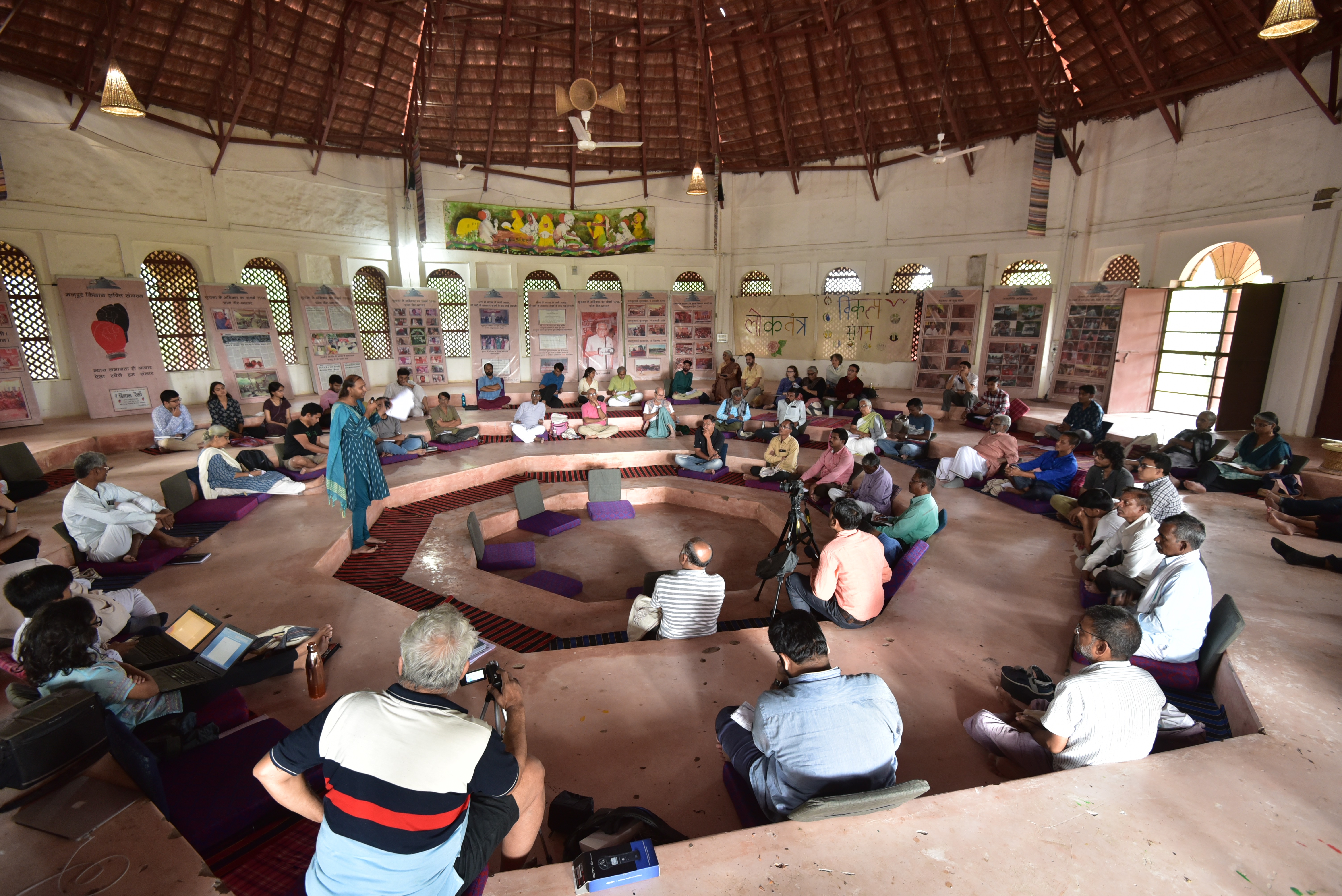
Vikalp Sangam – A Decade of Exploration on Alternatives in India: Ashish Kothari

Guest post by ASHISH KOTHARI

Abstract [1]

The multiple crises humanity confronts require fundamental shifts in how we relate to the Earth and to each other. This entails tackling the roots of these crises head-on, including the structures and relations of patriarchy, racism, colonialism, capitalism, statism, and anthropocentrism. This in turn needs to be done within the context of visions of the ideal society we want. This essay presents a process in India, Vikalp Sangam (Alternatives Confluences), that has attempted for a decade to document, visibilise, network, and create collaborations amongst movements and groups involved in alternative approaches for justice, equity, ecological sustainability. It describes the process and its various components, the challenges and opportunities of bringing very diverse groups from different cultural contexts together, the potential of a bottom-up and participatory visioning process, and the excitement of attempting to bridge conventional traditional-modern, practitioner-intellectual, urban-rural, and other divides.

Keywords: Democracy; Visioning; Alternatives; Environment; Civil society

Introduction: The Making of Vikalp Sangam  

A decade is not a short span of time – and yet, it is too short. These are the contrasting thoughts I have as I contemplate a process that I have been part of since its initiation, as I and my colleagues enter into a phase of reviewing whether it is on course to meeting the objectives it began with. This is Vikalp Sangam, or Alternatives Confluence, a national platform established in India in 2014.

Democracy Vikalp Sangam, School for Democracy, Rajasthan, October 2019
Continue reading Vikalp Sangam – A Decade of Exploration on Alternatives in India: Ashish Kothari

Twenty Days that Shook the World – Bangladesh Uprising II : Shahed Suvo

Guest post by SHAHED SUVO

This is the second part of the two-part article by Shahed Suvo, published earlier in Bangla in Ekak Matra on 10 August 2024. The first part appeared yesterday and can be accessed here. This part deals with the last days of the Sheikh Hasina regime and the transition that immediately followed. It has been translated for Kafila by ARUN SINHA.

Responding to the call of the anti-discrimination student movement, student-citizens gathered at Shaheed Minar on August 3. Young people continued to gather at Shaheed Minar with separate protest processions.  At this time, elderly citizens were also seen participating in the protest march with them. At around 5:30 PM in the afternoon, the coordinator of the organization leading the quota reform movement Md. Nahid Islam announced a one-point demand in a speech to the students-people gathered at Shaheed Minar – Prime Minister Sheikh Hasina and her cabinet must resign.

Asif Mahmud, another coordinator of the movement, announced the outline program of the non-cooperation movement.

Continue reading Twenty Days that Shook the World – Bangladesh Uprising II : Shahed Suvo

‘Motherland that is Dearer than Heaven’ – Bangladesh Uprising I: Shahed Suvo

Guest post by SHAHED SUVO

As a lot of motivated propaganda continues to be dished out about the uprising in Bangladesh, with weird and utterly nonsensical stories of it being ‘engineered’ by ‘the CIA’ at one end, and ‘the Islamists’ at the other, we reproduce here this article that gives a virtually blow by blow account of the developments. Published earlier in Bangla in Ekak Matra on 9 August 2024, Twenty Days that Shook the World in two parts, it has been translated for Kafila by ARUN SINHA. This is the first part. Part II can be read here.

Bangladesh protest before 5 August, image courtesy Ekak Matra

The students’ community revolution in July 2024 will be etched as one very important and characteristic event in the annals of history of deconstruction of state in Bangladesh.  After declaration of Pakistan as a state, the first voices of protest were raised against Jinnah’s policy of declaring Urdu as the state language. That was Bhasa Andolan (Language Movement) in 1952, then came the movement on 1962 education commission, the mass uprising in 1969 culminating in the glorious Liberation War in 1971. The student community always participated in bringing these momentous changes walking hand in hand with the people in Bangladesh. Whenever people lost their way and paths in independent Bangladesh, it is the movement of the students that showed the road ahead. Therefore, for the people of Bangladesh the student community has always been the symbol of truth and justice.

Continue reading ‘Motherland that is Dearer than Heaven’ – Bangladesh Uprising I: Shahed Suvo

Women’s Rights Now! Citizens Speak Out Against Brutal Cases of Sexual Violence Across India

[More than 900 organizations and individuals speak out against brutal rape and cultures of impunity from Kolkata and Manipur to Uttar Pradesh, Gujarat and other parts of the country. Published below is their statement issued on 26 August 2024.]

WOMEN RIGHTS NOW!

CITIZENS SPEAK OUT AGAINST BRUTAL CASES OF SEXUAL VIOLENCE FROM KOLKATA TO MANIPUR, GUJARAT, UTTARAKHAND, BIHAR, UTTAR PRADESH…

DEMAND URGENT, INDEPENDENT AND UNBIASED INVESTIGATIONS AND INSTITUTIONAL ACCOUNTABILITY!

NO MORE SHIELDING OF PERPETRATORS AND THEIR PROTECTORS

JUSTICE TO VICTIMS AND THEIR FAMILIES!

Continue reading Women’s Rights Now! Citizens Speak Out Against Brutal Cases of Sexual Violence Across India

STATEMENT BY INDIAN CITIZENS AGAINST BRUTAL STATE VIOLENCE AND IN SOLIDARITY WITH THE STRUGGLE IN BANGLADESH

[Even as the massive Long March in Dhaka’s Shahbagh is going on, reportedly with lakhs and lakhs of people demanding Sheikh Hasina’s resignation, rumours of her having already resigned are coming in. The statement is of course in support of Bangladesh’s struggle for democracy and against the brutal repression unleashed by her Awami League regime.]

We, the undersigned citizens of India, writers, artists, intellectuals and activists, express our deep concern over the recent developments in Bangladesh. As fellow South Asians, we share a common destiny and the destruction of democracy in any part of it is obviously a matter of concern for all of us. The current government that has unleashed massive violence on its own citizens has brazenly hijacked the elections three consecutive times in the last ten years.

The world has been watching in horror the violent crackdown on protesting students and youth in Bangladesh since mid-July. On 15th July, a peaceful protest by students of Dhaka University demanding reform in the quota system was violently attacked by a group of goons said to be from the student wing of the ruling party. The crackdown followed statements by the Awami League general secretary and an important minister that the Chhatra League would teach a lesson to the students, whom the prime minister, Sheikh Hasina had earlier labelled ‘razakars’ – a term used for the collaborators with the Pakistan army during the 1971 Liberation Struggle. Expectedly, the Bangladesh Police, rather than acting against the attackers, started a full-scale crackdown on protesters all across the country from the next day. On 16th July, the police killed Abu Saeed, a student of Begum Rokeya University, as he stood with open arms, without any weapon, in front of the approaching police forces who aimed their guns at the protesters. The murder of Abu Saeed, who posed no threat to the approaching police forces, manifests how the intention behind the crackdown on protesters was not to maintain law and order but to forcefully silence voices of dissent arising from all across Bangladesh.

Continue reading STATEMENT BY INDIAN CITIZENS AGAINST BRUTAL STATE VIOLENCE AND IN SOLIDARITY WITH THE STRUGGLE IN BANGLADESH

The Movement in Bangladesh is for a Radical Reform of the State – Interview with Sarwar Tusher

Interview with SARWAR TUSHER, writer and activist in Dhaka. Sarwar is one of the leading critical intellectuals associated with the important journal of political thought in Bangladesh, Rashtrochinta Journal and is also member of its editorial panel. In this detailed interview Sarwar explains not just the movement but also the larger politics of Bangladesh. The interview was taken by Aditya Nigam over email.

Turbulent July, Photo courtesy Rahat Karim

[After a round of massive repression and killings, the details of which the reader will find below, the movement is now back with renewed strength. This time it is not just the students and youth demanding an end to quotas but rather huge popular movement that is demanding nothing less than resignation of the Sheikh Hasina government and radical reform of the state. The conception behind this demand for “radical reform of the state” has been spelt out by Sarwar Tusher in detail below and the reader can see how it has grown in conjunction with mass movements of the past. Critical political thinking in tandem with the experience of mass movements has now led to the demand also of a new Constituent Assembly and the drafting of a fresh Constitution. It is also significant that “July” is no longer the name of a month but the name of the struggle itself as it reappears with greater vigour. I should add one more point here, which as to do with some misgivings in India about the quota and reservation question. Though Sarwar deals with it at greater length in different part of the interview, my own sense on reading his responses as well as following the discussions over the past one month, is that the situation is more akin to what might have been (and still is) in countries of state-socialism where the communist party certification was crucial in getting jobs and rising in the bureaucracy and other state institutions. The party certified whether you were “revolutionary” (muktijoddha) or “counter-revolutionary” (razakar) and it is not difficult to see why those regimes became so seriously unpopular (to put it mildly) in their own countries. AN]

Continue reading The Movement in Bangladesh is for a Radical Reform of the State – Interview with Sarwar Tusher

The End is Nigh – Bangladesh Report from Ground Zero: Shahidul Alam

This is a guest post by the well known Bangladesh photographer, SHAHIDUL ALAM. The article was earlier published in NEW AGE BANGLADESH and sent to us by SIMONE RUDOLPHI. The photographs are courtesy DRIK. Shahidul’s article actually answers many question that have been on Indian readers’ minds, including, not the least, the question of “quotas.” Interested readers may also find this article by academic Naveeda Khan useful, written as it is from within Dhaka, though she herself is based in the USA.

It would be a mistake to see this as simply a demand for more jobs. The quota movement, justified as it is, is simply the tip of the iceberg. A rampant government running roughshod over its people for so very long has led to extreme discontent. The quota issue has merely lit the fuse to this tinderbox. As citizens counted the dead and the injured, the prime minister fiddled, advising attendees at an aquaculture and sea food conference on tourism prospects in Cox’s Bazaar.

The original quota had been designed, shortly after independence in 1972 to be an interim arrangement to acknowledge the contribution of freedom fighters who constituted less than 0.25% of the population. Since a government known to be incredibly corrupt is responsible for creating the list of freedom fighters, over 50 years later the 120 fold allocation through a 30% quota has become an easy back door for party cadres to much sought after government employment. Confirmation came through senior Awami Leaguers saying, ‘just get through the initial screening and we’ll get you through in the viva’ and more tellingly, ‘government jobs will only go to party people.’

Continue reading The End is Nigh – Bangladesh Report from Ground Zero: Shahidul Alam

In Defense of the Bangladeshi Students’ Uprising


One of the innumerable anti-quota protests across Bangladesh, image courtesy Pressenza – International Press Agency

This post is dedicated to the innumerable young students of Bangladesh who have lost their lives in the last few days of struggle. This wasn’t supposed to be our first post on the Bangladesh students’ struggle because our friend Sarwar Tusher, one among the group of dynamic young critical intellectuals associated with the journal Rashtrochinta, was supposed to write a first hand analytical account. Meanwhile, from Thursday night (18 July) the Sheikh Hasina government enforced a total internet shutdown as the Army moved in to quell the protests. Tanks had already been seen moving in some streets and the protesters were expecting an exponential increase in state violence. Another Tienanmen Square seemed to be in the offing.

Continue reading In Defense of the Bangladeshi Students’ Uprising

Bhakti Era in North India : Dr Ravi Sinha

Dr. Ravi Sinha, Marxist Scholar and author delivered a talk on ‘Bhakti Streams of Religious Movements in Medieval North India

Q  &  A session Part 2 : https://youtu.be/bEJjcto5P14?si=EU0XzkVih8O-8gis

Q & A session Part 3 :  https://youtu.be/Eihwjhj_HRM?si=29UwXGfNO-c8UPux)

A  brief outline of the talk is also shared below :

Theme : Bhakti Streams of Religious Movements in Medieval North India

Outline

The idea is to take up discussion of the Bhakti Movement as it moves to medieval North India. It is often stated that the Bhakti Movement was born in the Tamil land in the 6th-7th centuries and over the next millennium it made its way to the northern and eastern parts of the subcontinent. In his famous Patel Lectures of 1964, the famous Sanskritist Professor V Raghavan engagingly described the pradakshina yatra (clockwise circumambulation) of the Bharat Bhumi by Bhakti carried on the shoulders of singing saint-poets. Such a narrative, however, can contain only partially the historical truth. It is difficult to locate a singular source of a phenomenon that covered the entire subcontinent and took twelve hundred years to accomplish that. Given its scope and complexity and its temporal span, it is even more difficult to attribute to it a linear historical momentum that would carry it along an identifiable trajectory across the subcontinent. ..

( For full text and other details, please see :https://nsi-delhi.blogspot.com/2024/04/videobhakti-era-in-north-india-talk-by.html)

What is stopping the Government from Scrapping the Agnipath Scheme?

..‘Agnipath’ Still Simmers ..

‘The anger and anxieties over ‘Agnipath’ scheme – have not died down.

Gone is the period of open protests by youth and students and other ordinary people which rocked when the scheme was hastily announced (June 2022).

It does not mean that the youth are now happy about this scheme.

In an ambience of rising unemployment how is it possible to be happy about the fact that “[d]ue to the implementation of the Agniveer scheme, around 1.5 lakh candidates selected for the Indian Army, Air Force and Navy between 2019 and 2022 were allegedly denied joining.( 2)and all future possibilities of such an employment being closed forever.

Anyone who is keen to know how Agnipath has literally ‘destroyed’ thousands of jobs in military can take a tour of Kuchman City in Nagour ( Rajasthan) once a hub of more than 200 defence coaching academies preparing students from Rajasthan, Haryana and neighbouring parts of Western UP for entrance exams in Military..

…The anger and discontent of the Youth will continue to harm the ruling dispensation – whatever gloss they try to apply over the scheme. 

( Read the complete article here : https://countercurrents.org/2024/04/what-is-stopping-the-government-from-scrapping-the-agnipath-scheme/)

THE PEOPLE’S NATIONAL LIBRARY POLICY

This is a guest post by Purnima Rao and Mridula Koshy

[The Free Libraries Network (FLN) is a coalition of over 250 free libraries, librarians and library activists across India and South Asia. A member of the International Federation of Library Associations and Institutions (IFLA), FLN believes in universal access to reading materials and information. FLN offers a platform for sharing resources, best practices, and insights about free libraries in India. Although it does not own or operate libraries, FLN plays an integral role in coordinating and acting on policy issues related to access to knowledge resources. FLN actively advocates for a free public library system in India. The FLN believes that reading and access to information are a fundamental right. It is motivated by the conviction that a robust free public library system is a foundational bedrock of a just, equal, and democratic society.]

Free Libraries Network, is choosing the birth anniversary of Babasaheb Ambedkar to announce the completion of its work drafting the People’s National Library Policy. The date is fitting as Babasaheb’s love of books and reading and especially his belief in libraries gives us strength in our anti-caste work to argue for a public library system that is free and open to all. Our network of over 250 free libraries spread across nearly every state in India brings together library movement activists who recognise that without a publicly funded and locally autonomous library system, we will never realise the promise of Babasaheb’s great work, our Constitution. Our democracy suffers when the people do not have free libraries in which to have equal access to vital information.

At this time, we have every reason to fear that the long stagnant question of libraries and of library policy is being revived, but to serve narrow interests. We have seen the question raised in Rajya Sabha in 2022, and call issued from there to the Union Ministry of Culture for a national library policy; we attended the same Ministry’s Festival of Libraries in 2023, where the keynote speaker Vinay Sahasrabuddhe spoke of the “good” and “bad” books and where it was announced that the government would be shifting the library question from the State to the Concurrent list; and  we have visited a model library in Delhi, created by the Gautam Gambhir Foundation  and inaugurated by Amit Shah, which utilises best practices of modern library science such as open shelving with its impulse to freedom of choice to house a collection that can be characterised as propaganda.

The draft People’s National Library Policy is a counter to these threats and an attempt to revive the question of libraries in India. It recognises the pivotal role of public libraries in empowering communities and fostering societal progress, especially amongst those excluded throughout India’s history, including Dalit, Adivasi & Bahujan people, Backward Classes, women, non-binary & trans people, undocumented & refugee communities and persons with disabilities. Rooted in Dr Ambedkar’s ideals of equity and justice, the policy envisions a public library system that is freely accessible and relevant to all segments of society, transcending barriers of caste, class, gender and disability.

The PNLP will be released on 13th April 2024, at 5:00 PM, Press Club, New Delhi.

The full draft of the PNLP can be read here:

https://www.fln.org.in/library-reform-demanding-the-peoples-national-library-policy/

Mridula Koshy and Purnima Rao are members of the Research and Action Group, Free Libraries Network.

Towards Securing Himalayas From Disasters – People for Himalaya Demand Charter 2024

People for Himalaya campaign is an initiative of progressive groups, civil society organisations and activists from the region. The campaign is not affiliated with any political party. For the list of supporting organizations, please scroll to the bottom of the post.

[Last year we witnessed the hills of Himachal Pradesh, Uttarakhand and Sikkim in virtual revolt against the mindless development that they have been subjected to. It was against the backdrop of these frightening developments that discussions began among groups across the Himalayan states in February this year, leading to the adoption of the Charter for the Himalayas. We also just saw environment activist from Ladakh, Sonam Wangchuk sit on a 21-day hunger strike in freezing minus 10 degrees Centigrade, demanding that the Sixth Schedule of the Constitution be implemented in Ladakh and it be protected from being handed over to corporate interests for so-called Development projects. Wangchuk’s hunger strike was withdrawn but the movement continues with women continuing their sit-in and other sections of the population, especially youth, preparing to join in soon. The movement is not about one person’s hunger strike but to prevent Ladakh meeting the same fate as Himachal Pradesh, Uttarakhand and Sikkim. – AN]

  1. STRENGTHEN REGULATION, MONITORING AND PLANNING OF LAND USE, LAND-USE CHANGE AND FORESTRY (LULUCF)
  • A complete moratorium on all mega infrastructure projects like railway, dams, hydro projects and four lane highways, tunnelling, transmission lines – and conduct a 360-degree multi- disciplinary review of the impacts of existing projects
  • Democratic decision making through referendums and public consultation on large infrastructure by strengthening the Environment Impact Assessment Notification 1994 (Scrapping the EIA 2020 Amendments & FCA 2023 Amendments); Free Prior informed consent of Gram Sabhas to be mandatory for all developmental projects
  • Terrain Specific Disaster and Climate Risk Studies and land susceptibility assessments to be mandatory for land use change for urbanisation, commercial development and public infrastructure construction
  • Just Implementation of 2013 Right to Fair Compensation and Rehabilitation Act
  • To ensure participation of citizens, civic bodies and Gram Sabhas in monitoring pollution and land use change works like stone crusher, sand-gravel mining, mineral mining, debris dumping, construction of local roads and every commercial construction work.

2. GRANTING COMMUNITIES CONSTITUTIONAL, LAND AND FOREST GOVERNANCE RIGHTS

  • Strengthening of state laws and regulations that protect the private and community resource rights of nature dependent communities – example Van Panchayat Rules in Uttarakhand
  • Complete the Unfinished land reforms and land regularisation agendas to provide secure land tenure to landless and displaced communities to practice land based livelihoods – example Nautor rules in Himachal Pradesh
  • Just implementation of constitutional provisions and laws that support the decentralised, autonomous and democratic governance and decision making – example the Scheduled Tribes and Other Traditional Forest Dwellers Act 2006 and other constitutional provisions
  • Protection of pastoral communities especially minority communities like the Van Gujjars and Bakarwals in migratory routes
  • Strengthen floral and faunal biodiversity through Community Forest Resource Rights governance framework under FRA 2006 – convert pine monocultures into broad leaf forests to address fodder scarcity, forest fires and soil erosion. Five ‘f’ species should drive plantations i.e. fruit, fodder, fertilizer, fuel, fiber and medicinal plants. Weed eradication programs for pasture development.

3. TRANSPARENCY, KNOWLEDGE BUILDING, SHARING AND EXCHANGE

Continue reading Towards Securing Himalayas From Disasters – People for Himalaya Demand Charter 2024

Questions and Answers on Looking for an Idea of India for the Indian Left : Dr Ravi Sinha

75th year of Nakba – In solidarity with the Palestinian struggle

Yesterday, May 15, 2023 marked the 75th anniversary of Nakba or the dispossession of the people of Palestine by the Zionist state of Israel. This is the text of a talk delivered at an event organized by India Palestine Friendship Forum.

Stamp issued in 1981

In September 2012,  I had the incredible good fortune to visit Palestine. We stayed in Ramallah, visited and interacted with colleagues at Birzeit University and spoke at a conference organized by Muwatin, a research institute based in Ramallah. We met  a large number of inspiring people who pushed the frontiers of our minds, and we came away humbled and moved by the dignity of a people living through the brutal occupation of their lands by the  Zionist state of Israel, with limitless courage and bubbling sense of humour intact. Continue reading 75th year of Nakba – In solidarity with the Palestinian struggle