Category Archives: Movements

Parliamentary Sovereignty or an Active Citizenry? V. Krishna Ananth

Guest post by V. KRISHNA ANANTH*

The political class, cutting across the spectrum, is now being haunted by a spectre. Anna Hazare has captured the imagination of a cross section of the people and his campaign is certainly gathering support. It remains to be seen if this support translates into a movement on the streets and more so against the state machinery that is threatening to pull all the stops. The people have shown such courage in the past. That is another matter.

Team Anna’s decision to go ahead with protests against the draft Lok Pal Bill, as approved by the Union cabinet, has spurred a debate. The proponents of the draft bill as well as sections in the political arena who claim to oppose the Government are united against another round of fast by Anna Hazare; they call it blackmail and an attempt to usurp Parliament’s power to legislate. They also claim that the principles of democracy shall not be sacrificed.

A number of them are on record that the draft proposals are subject to amendments and that the power to propose amendments and decide on them shall rest with the elected representatives of the people. It is another matter that the Prime Minister, who heads the cabinet, qualifies as a representative of the people only because membership of the Rajya Sabha is considered as good as being a member of the Lok Sabha to remain a minister under Article 75(5) of the Constitution. In any case, the fact is that Dr. Manmohan Singh has claimed, in an affidavit, that he is ordinarily a resident of Assam! We all know the truth but that too is besides the point.

Continue reading Parliamentary Sovereignty or an Active Citizenry? V. Krishna Ananth

Democracy, Populism and the ‘Middle Class’: The Return of ‘Anna Hazare’

[This is a considerably expanded version of an article that was published in Himal May 2011. It is being re-published, elaborated and updated, in the context of the farcical draft of the Lokpal Bill roduced by parliament and the threatened round 2 of the movement. – AN]

Corruption – a Systemic Affair?

Let me start with an ’emperor’s new clothes’ kind of question: What is a systemic understanding of ‘corruption’? What is a political understanding about corruption as opposed to say, a touchy-feely ‘moral’ problem? Yes, some of these phrases are straight from Arundhati Roy’s ‘When Corruption is Viewed Fuzzily’, published in the Indian Express on 30 April. But my question is not directed only at her. She represents – at least on this issue – a much wider consensus among sections of the radical intelligentsia.

Roy herself has left nothing to the imagination as to what she means:

“Among the millions of understandably furious people who thronged to Jantar Mantar to support Anna Hazare and his team, corruption was presented as a moral issue, not a political one, or a systemic one — not as a symptom of the disease but the disease itself. There were no calls to change or dismantle a system that was causing the corruption. Perhaps this was not surprising because many of those middle-class people who flocked to Jantar Mantar and much of the corporate-sponsored media who broadcast the gathering, calling it a “revolution” — India’s Tahrir Square — had benefited greatly from the economic reforms that have led to corruption on this scale.”

To her, the system that lies at the root of corruption is embodied in the ‘economic reforms’, which have led to corruption on this scale. I have no way of measuring the scale – though I might be inclined to agree with her that in my living memory, I have not seen so much compressed into such little time-space – from CWG to l’affaire Niira Radia to Adarsh Housing scam and the Bellary brothers – not to speak of the daily corruption in land acquisitions that dot the landscape of the country. Nonetheless, I do remember that something like the Bofors scandal or the ‘irresistible rise’ of Dhirubhai Ambani – all predate the ‘economic reforms’. And of course, I will not even try to mention the innumerable cases of corruption from Nagarwala onwards – including political corruption that led to big mass movements in Gujarat and Bihar in the 1970s. Those were the days when Mrs G proclaimed that ‘corruption is a global phenomenon’. To me saying corruption is systemic and must be analyzed ‘politically’ (whatever that means), sounds pretty much the same.  So, if neo-liberalism is responsible for corruption, how do we explain the instances mentioned above? How do we understand the great socialist states which secreted corruption from every pore? What does a ‘systemic analysis’ of corruption really tell us?

However, Arundhati Roy was making this point, it seems to me, not in order to analyze the phenomenon of corruption but to comment on the Anna Hazare movement and its ‘character’:

“When corruption is viewed fuzzily, as just a touchy-feely “moral” problem then everybody can happily rally to the cause — fascists, democrats, anarchists, god-squadders, day-trippers, the right, the left and even the deeply corrupt, who are usually the most enthusiastic demonstrators.”

Continue reading Democracy, Populism and the ‘Middle Class’: The Return of ‘Anna Hazare’

The Unending Struggle of Dalit Christians and Dalit Muslims for Equality: S. Japhet and Y. Moses

On the sidelines of a protest at Delhi's Jantar Mantar today

Guest post by S. JAPHET and Y. MOSES

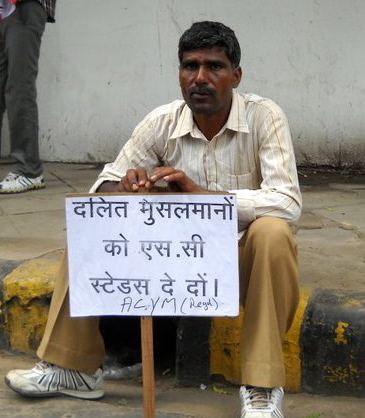
Religious minorities, both Christians and Muslims from different parts of the country have converged in Delhi to demand reservations for Dalit Christians and Dalit Muslims. This is part of a long standing struggle demanding the Government to introduce a bill to amend the constitution to include Dalit Christians and Dalit Muslims in the scheduled Castes list. The Christian community has been agitating since the promulgation of the Presidential Order Government of India 1950 that effectively prevents those professing religions other than Hinduism from being considered as Scheduled Castes. It has been argued that the 1950 Order violates Article 15 that prohibits discrimination on grounds of religion, race or caste and Article 25 that gives the right to all citizens to profess and practise any religion according to his or her choice. The demand is that affirmative action or positive discrimination of dalits, providing reservations in government jobs, educational institutions and representation in Parliament and state legislatures should be extended to all dalits irrespective of whatever religion they may profess and practise. Continue reading The Unending Struggle of Dalit Christians and Dalit Muslims for Equality: S. Japhet and Y. Moses

New Phase in Struggle for Release of Political Prisoners in West Bengal: Biswajit Roy

Guest post by BISWAJIT ROY

Civil society, including human rights groups, in Bengal are now divided on Mamata Banerjee government’s ‘open and hidden’ conditions regarding the release of political prisoners who have been jailed during the Left front rule as well as talks with Maoists and Maoist-backed Peoples Committee against Police Atrocities in Bengal’s tribal hinterland, known as Junglemahal.

Mamata and her ministers have rejected the demands for unconditional release of all political prisoners, immediate withdrawal of joint forces from Junglemahal and public announcement on non-enforcement of the draconian central law, the Unlawful Activities Prevention Act. Maoists and PCPA have accused Mamata of eating up her pre-poll words on those demands. A large section in the human rights movement including the intellectuals and activists who actively joined the Mamata-led campaign for regime-change now supported these demands. But some of their fellow travellers have differed on political and legal grounds.

The differences revealed contradictions between the pre-poll and post-poll positions of Mamata as well as chinks in the armour of human rights groups on the attitude to the new government, Maoists and PCPA. Tension among all the stakeholders in the process— Mamata, Maoists, human rights groups and individuals— was well-known within the concerned circles for quite some time. But none of the stakeholders dwelt on it in public before the assembly polls when they had made common cause against the CPM, particularly, the atrocities by CPM-joint forces combine.

I would like to dwell on post-poll dilemmas and fissures in the pro-Paribartan civil society in Bengal later. But this piece is primarily aimed at reporting the increasing manifestations of the hitherto latent tension.

Continue reading New Phase in Struggle for Release of Political Prisoners in West Bengal: Biswajit Roy

Mediation, Middle Grounds and Meddling – The Medley of Middlemen

[Dedicated to Sankarshan Mukhopadhyay on account of “receiving ends”]

Couple of weeks ago, I was attempting to rent out the apartment that my mother and I own in an urban sprawl in South Bangalore. Among others, a broker – referring to himself as a ‘property consultant’ – approached me with a client. I met the client and conducted some negotiations. Eventually, however, I rented the apartment to persons who had approached me before the broker and his client saw our place. I politely refused the broker’s client. The broker contacted me soon thereafter and began issuing threats for not renting the place to his client. He threatened that it would be dangerous for me to spoil my business with him. Initially, I was also nervous and upset because I was unsure if the broker had an office in the neighbourhood and whether he was powerful enough to spread false rumours about our property which could potentially devalue the property and/or spoil my relations with the new tenants who had just come in. He then came to the apartment complex where the flat is situated and created a small ruckus. Finally, failing on all counts, he threatened to lodge a false police complaint against me for allegedly taking a deposit from his client without issuing a receipt. The broker’s threats turned out to be empty and damp squib as him. He never showed up after that dramatic afternoon of back-and-forth(s). Continue reading Mediation, Middle Grounds and Meddling – The Medley of Middlemen

The Singur Act and the Deontological Reaction: Prasanta Chakravarty

Guest post by PRASANTA CHAKRAVARTY

The remarkable Singur Land Development and Rehabilitation Bill, passed in the West Bengal Assembly on June 14 became an Act on June 20. The Act scrapped the previous Left Front government’s deal with Tata Motors and has provisions to return land to unwilling farmers. Consequently, Singur land was taken over by the State government prompting Tata Motors to legally challenge the whole Act and a judicial battle has ensued between them and the newly elected State government. The State government may continue to return land in right earnest since there is no legal bar to that as of now. One would think that by many standards, this is a landmark bill that challenges and confronts policy consensus in issues of land transfer, models of enclosing and a concomitant notion of development that marks our nation at this point of time.

Reactions to this enactment have been thick and fast—alarmist and cautious to generous and triumphant. Continue reading The Singur Act and the Deontological Reaction: Prasanta Chakravarty

Goodbye UN, Hello Sarpanch: Jahangir Rana

Guest post by JAHANGIR RANA

It has now become an established trend for the Indian political establishment to beat the drums of ‘victory’ after every electoral process in Kashmir. Almost invariably, prior to an election, this establishment maintains that the issue of resolution is not linked to elections in the disputed state. However, as soon as the electoral process is over, the same establishment is out to cash the participation in elections as an implicit approval for the status quo.

In an interview last week, senior Congress politician Mani Shanker Aiyer went as far as claiming that Azadi can be attained through Panchayat, pointing at the recent participation in Panchayat elections. These bombastic claims are now bordering on the absurd. To assume that the twenty-year resistance in Kashmir has been about devolution of power and development at grass roots, Aiyar and his colleagues within the establishment continue to live in denial. Continue reading Goodbye UN, Hello Sarpanch: Jahangir Rana

Women Against Sexual Violence and State Repression condemns crackdown on anti-corruption protesters

WSS strongly condemns the midnight crackdown on thousands of people staging a ‘Satyagraha’ and hunger strike at Ramlila Maidan with Baba Ramdev for demands related to corruption and black money.

We are astonished at Mr Manmohan Singh’s defense of police action saying that there was no alternative. The attack on the protesters was absolutely unwarranted as the ‘satyagraha’ was neither causing any law and order problems nor was it disrupting the peace of the city in any manner.

We are not supporters of Baba Ramdev but clearly see the role of dissent in upholding a democratic society. Continue reading Women Against Sexual Violence and State Repression condemns crackdown on anti-corruption protesters

Make Delhi Metro safe for women! Please Mend The Gap

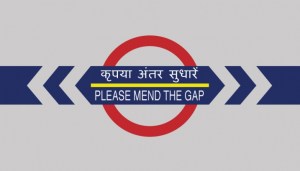
PLEASE MEND THE GAP is a citizen- led initiative to promote gender equality and commuter safety in public spaces. 

Follow these two links for some background:

A few weeks ago, a friend was molested on the Yellow line of the Delhi Metro

A flash mob of citizens got together to protest against the Delhi Metro, claiming that it is promoting a gender divide.

Sign PMTG’s Petition to Chief Minister and DMRC

We believe that a majority of women do not feel safe while travelling in the Delhi Metro. We have spoken to a cross-section of Metro commuters who have shared with us their experiences most of which include instances of verbal and physical harassment mostly faced by women, specifically in the women’s-only compartment. In fact, a few days ago, some of the members of our group who were traveling at night observed that the women’s-only compartment was populated with men who had occupied almost all the seats forcing the women to stand, leaving them with no choice but to actively demand the seats they were entitled to. The men were unapologetic and dismissive. Most shrugged off the women’s protest by claiming falsely that the women’s-only compartment turns general post 9 p.m..

Women who choose to travel in the general compartment are also harassed. There have been many instances where men have told women that they are not welcome in this compartment and should use the compartment reserved for them. This attitude has become so deeply entrenched in commuters’ mindsets that most accidentally refer to the general compartment as the ‘men’s compartment’. There have been times when authorities have driven out men from the women’s-only compartments, but without having imposed any fine whatsoever…

The situation needs to change. It is the duty of the State and the DMRC to spearhead this change.

Read the full petition and sign.

A major victory for the agitating workers in Gorakhpur

A major victory for the agitating workers in Gorakhpur

Dismissed workers taken back

Factory owners buckle under pressure – Locked out mills to start from June 3

New Delhi, June 2. Workers in Gorakhpur achieved a major victory in their struggle when the factory owners agreed to start the two locked out mills from June 3 and take back the dismissed workers. 12 of the 18 workers will join work immediately and the remaining 6 will be taken back after a domestic enquiry. The workers also forced the owners to accept that no one from the management will be in the enquiry committee; it will have two members from the office staff and one workers’ nominee.

The decision was taken at negotiations held till late night at the district magistrate’s residence. The two owners of the VN Dyers and Processors yarn mill and textile mill, the district magistrate and deputy labour commissioner and seven workers’ representatives were present at the meeting.

These two mills in the Bargadwa area of Gorakhpur were illegally locked out since April 10. Around 500 workers work in both of these mills owned by the Ajitsaria family having an annual turnover of more than 150 crores. 18 workers of these two mills were dismissed by the owners. The workers were agitating for reinstatement of their colleagues and restarting the factories.

Continue reading A major victory for the agitating workers in Gorakhpur

The Power of Crowdsourcing

Two years after the war: justice, reconciliation and the UN Panel Report

I am posting the Editorial of the latest issue of dissenting dialogues, a social justice magazine on Sri Lanka. The lengthy Editorial discusses the situation two years after the war and the much debated UN Panel Report on accountability for crimes committed towards the end of the war in Sri Lanka.

The May 2011 Issue also has an interesting article by Kanishka Goonewardena on the political economy of World Cup cricket titled, Space, time and cricket: from M.C.C to M-C-M’. The article engages the work of C.L.R. James, David Harvey and Giovanni Arrighi while discussing the shift of cricket (and) capital to India.

The entire Issue No 3, May 2011 of dissenting dialogues can be downloaded as a pdf file from the Sri Lanka Democracy Forum website.

Continue reading Two years after the war: justice, reconciliation and the UN Panel Report

‘The situation in Ngaba is getting worse’: An interview with Tsewang Rigzin of the Tibetan Youth Congress

Guest post by T RIYAS BABU

Lobsang Sangay meets Tibetan activists in Delhi

It all started on March 16 this year when a Tibetan monk named Phuntsok set himself ablaze in protest against China marking exactly three years since the bloody crackdown by Chinese troops on the people of Ngaba County of Tibet in 2008. Chinese government tightened security and its stronghold on Ngaba in general and Kirti monastery in particular. Tibetans allege the authorities even blocked food supplies to the monastery in an attempt to starve around 2,500 monks. They say many have been arrested and a large number are missing. Continue reading ‘The situation in Ngaba is getting worse’: An interview with Tsewang Rigzin of the Tibetan Youth Congress

Putting the “Jan” into the Lokpal Bill: Nikhil Dey and Ruchi Gupta

Guest post by NIKHIL DEY and RUCHI GUPTA

For many who quite rightly guessed that the Lokpal Bill drafted by the Government would be a non-starter, the alternative merited automatic support. However, little was known about the contents of the two Bills, except that the alternative being proposed by ‘India Against Corruption’ had the prefix of being a “peoples” Lokpal. The consequences are too important to leave to the expertise of the drafting committee. The people must comprehend, and play their part in ensuring that there will be an Act that will empower them to fight corruption- not make them surrender their hopes to yet another anti-corruption organization. How people-centric is the Jan Lokpal Bill (JLP)?

While the JLP is going through rapid revisions – 12 so far – the basic framework and some principles have remained constant. Broadly the Bill can be divided into four sections: the mandate and scope of the Lokpal; composition and selection of the Lokpal; powers of the Lokpal; and functioning of the Lokpal. The composition and selection of the Lokpal is substantively one of the least contentious sections – concerned largely with procedural matters and subjective preferences, rather than ideological or legal viewpoints. A discussion of the other three sections follows.

Continue reading Putting the “Jan” into the Lokpal Bill: Nikhil Dey and Ruchi Gupta

Har Qadam pe Zamin Tang Hoti Jayegi… (The Land Will Shrink With Every Step)

For the last few days, a few lines from Sahir Ludhianivi’s long poem Parchhaiyan, have been repeatedly coming back to me. A poem that I had read ever so often in my early youth and thought I had long forgotten, suddenly reappeared in a flash. Here go some of the lines (not really in the order in which they appear in the poem, but in the order in which they came to me):

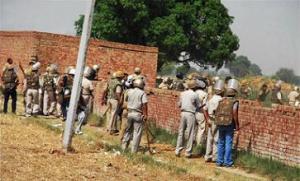
Noida farmers clash with police over land acquisition
Villages turned into police camps

चलो कि चल के सियासी मुक़ामिरों से कहें/ कि हमको जंगो-जदल के चलन से नफ़रत है

कहो कि अब कोई क़ातिल इधर अगर इधर आया/ तो हर क़दम पर ज़मीन तंग होती जाएगी

हर एक मौजे-हवा रुख़ बदल के झपटेगी…

ये खेत जाग पड़े, उठ खड़ी हुईं फ़सलें/ अब इस जगह कोई क्यारी न बेची जाएगी

[Roughly translated: Come let us tell the political gamblers/ that we hate the business of war and strife

Let us tell them that if a murderer dares to come hither/ The land will shrink with each step

Every wave of the air will turn turn against you

These fields have come alive, with the crops swaying on them

No more shall even a bed (of the field) be sold]

Though Sahir’s poem was written as a protest against war, some of these lines resonate with other, more immediately relevant matters. Ironically, Sahir was protesting against the war mongers pillaging civilain populations but here we are, with the new war mongers of our times: what else is the neo-liberal dream but that of pillage and loot of civilian populations by armed forces of civilian governments. And as they, ‘is hammam mein sab nange hain‘! [All are naked in this  in this bathhouse]:  From Buddhadev Bhattacharya of West Bengal to Mayawati of Uttar Pradesh – spokespersons all of the oppressed! And it makes little difference whether it is a BJP-led NDA government in power at the Centre or a Congress-led UPA.

Continue reading Har Qadam pe Zamin Tang Hoti Jayegi… (The Land Will Shrink With Every Step)

‘मेरे लिए लेस्बियन होने का सबसे बढ़िया पहलू है मज़ेदार सेक्स’

Published originally in English  here

Translated by AKHIL KATYAL

मैंने हाल ही में एक डोक्युमेंटरी फिल्म देखी, प्रतिभा परमार की १९९१ में बनायीं हुई खुश, जो कि दक्षिण ऐशिआयि एल.जी.बी.टी (लेस्बियन, गे, बिसेक्सुअल, ट्रांसजेंडर)  लोगों कि अलग-अलग ज़िन्दगी के बारे में थी। एक लेस्बियन महिला से जब फिल्म में पुछा गया कि ‘लेस्बियन होने का सबसे बढ़िया पहलु क्या है?’ तो उसका जवाब था ‘मेरे लिए लेस्बियन होने का सबसे बढ़िया पहलु है पूरी तरह से ख़ुशगवार, मज़ेदार सेक्स!’ फिर वो महिला, पूरे नब्बे दशक के फैशन में सजी हुई, ऐसे मुस्कुराई,
कि लगा  कि वहीं उसी वक्त, उसी जगह, उसे अपने मज़ेदार सेक्स के सारे पल याद आ गयें हों।
मुझे, एक क्युइर एक्टिविस्ट के नाते, जो कि इस फिल्म के बनने के समय कुछ आठ साल कि थी और जो कि सार्वजनिक ढंग से एल.जी.बी.टी लोगों के बारे में न्यायालयों में और पत्रकारों से बोलती आई है, एक भी ऐसा पलयाद  नहीं आ रहा है, जब मैंने सेक्स के बारे में कुछ लिखा या बोला हो। Continue reading ‘मेरे लिए लेस्बियन होने का सबसे बढ़िया पहलू है मज़ेदार सेक्स’

Firing and Repression on Factory Workers in Gorakhpur

The workers of Ankur Udyog Ltd., a factory in the Bargadwa industrial area in Gorakhpur, eastern UP were attacked by goons called by the factory owner the morning of 3 May. At least seven workers were seriously injured in firing by the goons. Apparently, the factory owners of Gorakhpur have been very angry with the workers for attending the May Day rally at Jantar Mantar, Delhi and one of them suspended 18 workers as soon as they went to resume work. The workers protested against this and the factory owner sent hired goons who fired on the workers injuring 19 of them. The workers had cornered the goons inside the factory but the police came and took them away and let them free. FIRs have been registered from both sides.

may day rally
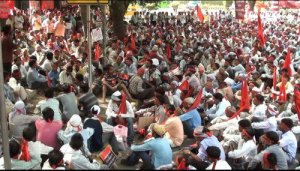
May Day rally- workers' charter movement

As the tension and repression of the factory owners and the district administration mounts, the workers have planned to go on Satyagraha from May 8 (tomorrow) and the administration is determined to not let it happen. We have received messages saying that trade union organizers fear for the life and safety of the workers and their leaders. The voice of protests from many forums and due to the incident being covered by the local media, the administration has refrained from taking any one sided action till now. But conspiracies are being hatched behind the scenes. Its not a distant reality that the leaders might be killed in fake encounters, or slapped with false charges or lynched by mobs instigated by the factory owners or Adityanath’s goons.

Continue reading Firing and Repression on Factory Workers in Gorakhpur

Two statements on the Environment Ministry’s ‘forest clearance’ to POSCO

In response to the Union Environment Ministry’s decision, given below are two press releases, from POSCO Pratirodh Sangram Samiti and Campaign for Survival and Dignity

POSCO PRATIRODH SANGRAM SAMITI

(based out of villages Gadkujang, Nuagaon and Dhinkia in Erasama block of Jagatsinghpur district, Odisha. )

A Mercenary Minister and a Lying Government Cannot Crush Our People
Money Worth More to Government than Truth, Law and Justice; but the Corrupt and the Criminal Will Not Triumph

2 MAY 2011: Today, in a sanctimonious order riddled with lies and distortions, the Environment Ministry allowed thePOSCO project to proceed. The livelihoods of 4000 families (over 20000 people) and the laws of the land have been sold to the highest bidder. Certain facts should be brought to the notice of the public: Continue reading Two statements on the Environment Ministry’s ‘forest clearance’ to POSCO

The Present of the Absent State

[An edited version of this review has appeared in Biblio.]

The Absent State: Insurgency as an Excuse for Misgovernance
by Neelesh Misra and Rahul Pandita
Hachette India, 2010
272 pages, 495 Rs

Indian journalists have written books on conflict as diaries of their years of reportage, putting together their stories and experiences. The task of looking at conflicts with a broader perspective has been left to the security experts who mostly write from, well, a security ‘angle’. It is great, then, to see a book by two journalists, on the conflicts in Kashmir, the north-east and the Maoist belt. Journalists won’t give you footnotes but at least they can write lucid prose. Continue reading The Present of the Absent State

Cultures of Corruption: Kalpana Kannabiran

Guest post by KALPANA KANNABIRAN

We are a country given to idolatry – both the erection and demolition of idols a favourite pastime that buries under the rubble questions of ethics and constitutional morality.   While this penchant for idolatry raises larger questions,  I will concern myself at this point with the effigy (or the idol upside down) called corruption.

While there has undoubtedly been a marked shift in the languages of corruption in the neo liberal era, calling for new and different strategies to combat it, the fight against corruption is not new.  When women’s groups campaigned decades ago against the testing of banned drugs and contraceptives on poor people by the ICMR, the question that was raised was about the nexus between pharmaceutical companies and state actors that involved deals for which poor and vulnerable communities were pushed to the guillotine.  With Bhopal, the question came up again on the deals between multinational companies (Union Carbide in this case) and the government that violated every principle of human rights, natural justice, constitutional morality and the ethics of care in governance.  Was the derailment of justice effected without corruption at every level? Apart from providing care to the affected, was not the struggle for justice in Bhopal a struggle against corruption?  When the People’s War Group (as it was then called) abducted an elected representative two decades ago (who was later released), the reason they gave to the negotiators was that he misused public funds in the district and asserted that theirs was a fight against corrupt representatives.

Continue reading Cultures of Corruption: Kalpana Kannabiran

Chronicle of a Bail Foretold: Saroj Giri

Guest post by SAROJ GIRI

Till very recently it was not possible to discuss Binayak Sen without referring to the corporate land grab and state repression in Chhattisgarh. Somehow Salwa Judum, the displacement of thousands of adivasis and the Maoist movement would come in the picture. Above all, what would come out is Sen’s work in the specific context of the suffering of the adivasis. Indeed soon after the bail order was granted, it came so naturally for Sen’s beaming wife to state that he will of course go back to resume his work in Chhattisgarh.

Upon his release from Raipur Central Jail on April 18 2011, Sen immediately called for a dialogue between the Maoists and the government and reminded us of so many other political prisoners languishing in the country’s jails. In the video showing Sen being greeted by his supporters after his release he enthusiastically joins in giving slogans saying, ‘Shankar Guha Niyogi Zindabad’. But the supporters soon after break into ‘Binayak Sen Zindabad’. You could immediately see this embarrassed look on his face, totally disapproving this iconisation.

Indeed, Sen seems very far off from celebrating his release as a major victory for democracy or a boost forIndia’s image as a modern democracy and so on. He seems really far off from the dominant discourse which seeks to cleanse the ‘Binayak Sen issue’ of the harsh realities of India’s dirty war, the inequality and the injustice towards the adivasis and their suffering. Continue reading Chronicle of a Bail Foretold: Saroj Giri