
This evening, I was sitting in a coffee shop and writing about the sociology of information, how information is mired in relationships and how trust, suspicion and social relations develop in the course of circulation and exchange of information. As I was beginning to disentangle the complex web of legitimacy and regulations surrounding information, a friend called to inform that some activists and citizens had been arrested for protesting against the tree felling and road widening at Sankey Road in the northern part of Bangalore. In the last few days, the conflict regarding road widening and tree felling at Sankey Road got strong coverage in the media because citizens began gathering around the trees and the roads to prevent authorities from felling the trees. Despite this, the authorities went about felling the trees for widening the roads. The activists and protestors were clearly becoming a nuisance for the government officials and institutions who have not been able to execute the works. Hence, today, at some point, some of our activist friends were arrested on the false charges that they had assaulted public officials in their conduct of ‘government’ duty. The charges were filed under section 343 or 353 CrPC which also implied that the arrest was non-bailable. Over the course of the evening, news went about on FaceBook and Twitter about these arrests, and people from in and around Sankey Road were called to silently protest at the Aiyyappa Temple where the trees were being felled for enabling the road widening. The arrested activists and citizens were released from jail and all the charges against them were ‘dropped’ at about 6 PM. The court also granted a stay order on the tree felling around the same time, with further hearings and orders to arrive on Monday. Continue reading Cities and Infrastructure – The Road Widening Saga in Bangalore
Category Archives: Politics
Mediation, Middle Grounds and Meddling – The Medley of Middlemen
[Dedicated to Sankarshan Mukhopadhyay on account of “receiving ends”]
Couple of weeks ago, I was attempting to rent out the apartment that my mother and I own in an urban sprawl in South Bangalore. Among others, a broker – referring to himself as a ‘property consultant’ – approached me with a client. I met the client and conducted some negotiations. Eventually, however, I rented the apartment to persons who had approached me before the broker and his client saw our place. I politely refused the broker’s client. The broker contacted me soon thereafter and began issuing threats for not renting the place to his client. He threatened that it would be dangerous for me to spoil my business with him. Initially, I was also nervous and upset because I was unsure if the broker had an office in the neighbourhood and whether he was powerful enough to spread false rumours about our property which could potentially devalue the property and/or spoil my relations with the new tenants who had just come in. He then came to the apartment complex where the flat is situated and created a small ruckus. Finally, failing on all counts, he threatened to lodge a false police complaint against me for allegedly taking a deposit from his client without issuing a receipt. The broker’s threats turned out to be empty and damp squib as him. He never showed up after that dramatic afternoon of back-and-forth(s). Continue reading Mediation, Middle Grounds and Meddling – The Medley of Middlemen
The Singur Act and the Deontological Reaction: Prasanta Chakravarty
Guest post by PRASANTA CHAKRAVARTY
The remarkable Singur Land Development and Rehabilitation Bill, passed in the West Bengal Assembly on June 14 became an Act on June 20. The Act scrapped the previous Left Front government’s deal with Tata Motors and has provisions to return land to unwilling farmers. Consequently, Singur land was taken over by the State government prompting Tata Motors to legally challenge the whole Act and a judicial battle has ensued between them and the newly elected State government. The State government may continue to return land in right earnest since there is no legal bar to that as of now. One would think that by many standards, this is a landmark bill that challenges and confronts policy consensus in issues of land transfer, models of enclosing and a concomitant notion of development that marks our nation at this point of time.
Reactions to this enactment have been thick and fast—alarmist and cautious to generous and triumphant. Continue reading The Singur Act and the Deontological Reaction: Prasanta Chakravarty
निनाद: कुलदीप कुमार
Guest post by KULDEEP KUMAR
जिन लोगों को यह ग़लतफ़हमी थी कि भारतीय जनता पार्टी हिन्दू धर्म और हिन्दुओं की बहुत बड़ी हितैषी है और व्यक्तिगत एवं सार्वजनिक जीवन में शुचिता की हिमायती है, उनकी यह ग़लतफ़हमी अब तो दूर हो जानी चाहिए. उसके शासन वाले राज्य उत्तराखंड में एक संन्यासी गंगा को स्वच्छ किये जाने और अवैध खनन को रोके जाने की मांग को लेकर अनशन करता रहा लेकिन पार्टी और सरकार के कान पर जूँ तक न रेंगी. गंगा का सभी भारतवासियों, विशेष रूप से हिन्दुओं, के लिए भावनात्मक महत्व है. अनशन भी शासन के विरोध में नहीं बल्कि एक सकारात्मक मांग को उठाने के लिए किया गया था. लेकिन स्वामी निगमानंद न तो राज्य सरकार का ध्यान अपनी ओर खींच पाए और न ही मीडिया का. जब उनकी ओर ध्यान गया तब तक बहुत देर हो चुकी थी.पंजाबी सूबे की मांग को लेकर अनशन करने वाले दर्शन सिंह फेरुमान की मृत्यु के बाद शायद यह पहला अवसर है जब किसी ने अनशन के कारण प्राण त्यागे हैं. Continue reading निनाद: कुलदीप कुमार
Of Fakes, Duplicates and Originals – the Tale of Ration Cards and the Trail of Transparency in Governance
On 2nd May 2011, the front page of the Times of India (TOI) beamed and screamed: “Don’t pay a bribe, file an RTI application – Equally Effective in Ensuring Service”. Two doctoral candidates at Yale University’s political science department had conducted field experiments in the bastis in Delhi in the year 2007 regarding poor people’s experiences in making applications for ration cards. The researchers – Leonid V Peisakhin and Paul Pinto – found that persons who paid bribes had their ration cards processed faster. However, those who filed an RTI request to know about the status of their ration card application, were “almost as successful”, the TOI report claimed. (The details of the study and the outcomes can be accessed through Peisakhin and Pinto’s paper “Is transparency an effective anti-corruption strategy? Evidence from a field experiment in India.” The paper was published in 2010 in Regulation and Governance Journal, volume 4, pp 261-280.) The researchers had also put people in two other control groups – one which neither paid a bribe nor followed-up and a second group which had filed their applications along with a letter of recommendation from the local NGO. Both these groups were not as successful as the former two groups in obtaining their ration cards. The researchers’ analyses veered towards two conclusions: first, that the RTI Act serves the poor who are usually denied/deprived of information. Secondly, reforms/laws which give more ‘voice’ to citizens and allow them to scrutinize the functioning of officials and elected representatives are more effective in ensuring transparency and gaining access to public services. Continue reading Of Fakes, Duplicates and Originals – the Tale of Ration Cards and the Trail of Transparency in Governance
Action Alert – Imminent Police Attack on POSCO Affected Villages
Update of anti-POSCO People’s Movement as on 10th June 2011, 12 noon.
· Police and protesting public are face to face now: Twenty platoon police forces with officers have already reached at the boarder of Govindpur village where more than 2000 villagers are protesting against the forceful land acquisition by government of Odisha for POSCO through 24X7 vigil.
· Protesters are determined to resist any use of force by the government and police forces. Even women and children have come to the forefront as they form the first two shields of protection.
· Senior police officers, with arms and weapons, are threatening people to dismantle through loud speakers. We will let you know the development here
Kindly call the following authorities to lodge your protest.
In solidarity,
Prashant Paikray
Mobile – 09437571547 Continue reading Action Alert – Imminent Police Attack on POSCO Affected Villages
Women Against Sexual Violence and State Repression condemns crackdown on anti-corruption protesters
WSS strongly condemns the midnight crackdown on thousands of people staging a ‘Satyagraha’ and hunger strike at Ramlila Maidan with Baba Ramdev for demands related to corruption and black money.
We are astonished at Mr Manmohan Singh’s defense of police action saying that there was no alternative. The attack on the protesters was absolutely unwarranted as the ‘satyagraha’ was neither causing any law and order problems nor was it disrupting the peace of the city in any manner.
We are not supporters of Baba Ramdev but clearly see the role of dissent in upholding a democratic society. Continue reading Women Against Sexual Violence and State Repression condemns crackdown on anti-corruption protesters
Pranayam was Never so Painful
(Please see an update made at the end of this post.)
I am watching the fog of tear gas shells descend on Ramlila Maidan on the live television feed on my computer. What was supposed to be a ‘yoga camp’ led by Baba Ramdev, and the fully-funded-free circus of his so-called ‘indefinite hunger strike’ against ‘Black Money’ has now turned into a tear-gas purgatory. It is midsummer, but inside that big tent it looks like a particularly foggy-smoggy night in a Delhi midwinter. It must hurt like hell, in the nostrils, in the lungs. With every breath that Ramdev’s disciples take (and how well they know the art and science of heavy breathing) their eyes must sting. Pranayam was never so painful. I hold my insomniac breath as I sit watching, riveted. Continue reading Pranayam was Never so Painful
Dominique Strauss-Kahn and the union maid: Dean Baker
A little-reported fact of the Dominique Strauss-Kahn case is that his accuser is a union member – with rights the IMF opposes, says Dean Baker in the Guardian.
But do listen to this song first!
“The reason that this is an important part of the story is that it is likely that Strauss-Kahn’s alleged victim might not have felt confident enough to pursue the issue with either her supervisors or law enforcement agencies, if she had not been protected by a union contract. The vast majority of hotel workers in the United States, like most workers in the private sector, do not enjoy this protection.“
Received via Mini Mathew
A major victory for the agitating workers in Gorakhpur
A major victory for the agitating workers in Gorakhpur
Dismissed workers taken back
Factory owners buckle under pressure – Locked out mills to start from June 3
New Delhi, June 2. Workers in Gorakhpur achieved a major victory in their struggle when the factory owners agreed to start the two locked out mills from June 3 and take back the dismissed workers. 12 of the 18 workers will join work immediately and the remaining 6 will be taken back after a domestic enquiry. The workers also forced the owners to accept that no one from the management will be in the enquiry committee; it will have two members from the office staff and one workers’ nominee.
The decision was taken at negotiations held till late night at the district magistrate’s residence. The two owners of the VN Dyers and Processors yarn mill and textile mill, the district magistrate and deputy labour commissioner and seven workers’ representatives were present at the meeting.
These two mills in the Bargadwa area of Gorakhpur were illegally locked out since April 10. Around 500 workers work in both of these mills owned by the Ajitsaria family having an annual turnover of more than 150 crores. 18 workers of these two mills were dismissed by the owners. The workers were agitating for reinstatement of their colleagues and restarting the factories.
Continue reading A major victory for the agitating workers in Gorakhpur
Growing Inequality and Deprivation in Telangana – Questions evaded by Srikrishna Committee: Bhim Reddy
Guest post by BHIM REDDY
[The movement for a separate Telangana state has been raging now for quite some time. At Kafila, we have not yet had the occasion for a discussion on the pros and cons of the issue. This post deals with one aspect – that of agricultural economy and its relationship to the perceptions of discrimination. We hope that this post will lead to some debate on a very important issue. AN]
Rural Telangana has experienced income declines for ninety percent of its population, increase in inequality and a drastic decrease in the class-size of cultivators accompanied by an increase in the class-size of agricultural labourers since early 1990s. This revealing evidence is presented in Srikrishna Committee (Committee for Consultations on the Situation in Andhra Pradesh, headed by Justice B.N. Srikrishna) Report based on NCAER (National Council of Applied Economic Research, New Delhi) surveys conducted once in the year 1993-94 and another in 2004-05. The Committee’s concern over this scenario, despite the purpose of its constitution being to study the situation in Andhra Pradesh state in the context of unrest in Telangana region, has not attracted any attention beyond its worry that the vulnerability of the deprived masses can be ‘used’ by political groups: “…most of the deprived communities in Telangana are facing hardship and therefore are vulnerable to mass mobilization on one pretext or the other, including political mobilization with promises which may or may not be met”. Beyond this shallow concern the Committee is indifferent to such evidence that any study characterised by objectivity and rigorous interrogation would be compelled to undertake a critical examination of the trajectory of economic development and state’s policy, and attempt to explain the cause of such deprivation and growing inequity.
The ‘Viral’ Revolutions Spread Across Europe
The New Democratic Upsurges
The mainstream Western media that celebrated the democracy movements in the Arab world not very long back, is relatively silent now. For, then it was the Arab youth’s striving for the ‘western values’ of democracy that it was celebrating. Now that the cry of ‘democracy’ is arising from its very midst, it does not seem to quite know what to do. From May 15 on, for almost two weeks Madrid and other Spanish cities have been witnessing some of the largest demonstrations in recent memory. Protesters have thronged the Puerta del Sol, virtually camping there. As government forces started cracking down, demonstrations began to grow in an ever expanding scale spreading to many other Spanish cities. When the government moved to ban demonstrations on May 20, in the run up to the regional and municipal elections, the protests acquired an even more militant form. A ‘snapshot’ of the rallies in defiance of the ban:
The initial protests against the planned multibillion euro bailout plan for banks, austerity measures and against high unemployment almost 45 percent among the youth), according to reports, were not very large but when the government responded by arresting several activists and demonstrators, things started going out of hand. That was the ‘spark that lit the prairie fire’. As Ryan Gallagher’s report in the New Statesmanput it:
A demonstration against the arrests was organised in the city’s main square, Puerta del Sol, and numbers soon snowballed when word got out over the internet. What began as a group of fewer than a hundred activists reached an estimated 50,000 within less than six days.
The protesters whose arrests had sparked the initial demonstration were released and immediately returned to the square. By the time they arrived, the demonstration was no longer just about their treatment at the hands of the police. It was about government corruption, lack of media freedom, bank bailouts, unemployment, austerity measures and privatisation.
Here is another video of a fierce battle being fought on the streets of Madrid: Continue reading The ‘Viral’ Revolutions Spread Across Europe
Old Left is Dying! Long Live the Left!
[Following the publication of the previous post – the statement on the future of the Left, we have received some important comments that seek to take the debate forward, alongside those predictable, invective laden rants that we know only too well by now. We need to keep the debate on the future of the Left in India going, irrespective of these comments that seek to derail any meaningful discussion. We must continue to assert that ‘the Left’ far exceeds the decadent and decrepit lot that now goes by the name of Left parties in this country. This post is a slightly modified and longer version of an article that appeared in Bengali yesterday in Ekdin.]
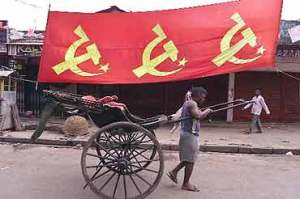
In a recent newspaper article, former Left Front finance minister Ashok Mitra, observed: “The Left Front, led by the Communist Party of India (Marxist), has not merely lost the poll in West Bengal, it has been made mincemeat of.” He was underlining the obvious, catastrophic significance of the results – at least from the Left Front’s perspective. The signs are there for everybody to see, especially when all important leaders of the LF government have faced resounding defeat and the overall vote share of the LF has declined by almost 9 percent since the last assembly election. Mitra’s reference is important as much was being made of the fact that he signed in support of the LF in the course of the election campaign.
But such was the state of drunkenness in power, that only a Biman Bose could say, when virtually everyone knew what was coming, that the LF would still gain a comfortable majority and those who were predicting their decline would have to “swallow their own spit.” More incredibly, even after the elections, indeed after the results came in, both Bose and Prakash Karat in Delhi focused on the fact that their votes had increased by 11 lakh votes in absolute terms. Of course, the minor detail they mentioned in passing was that the TMC alliance had increased its votes much more. The even more minor point that there had been as many as 4.8 million more votes polled this time as compared to 2009 was, of course, beside the point.
‘End of the Left’ in India? Statement by Leftists after recent election results
Text of statement by Jairus Banaji, Sukumar Muralidharan, Dilip Simeon, Satya Sivaraman and Rohini Hensman endorsed by 224 others.
In a minor replay of 1989 and the fall of the Berlin Wall, the Indian media have been gloating at the defeat of the Left Front in West Bengal especially and have repeatedly suggested that this signals the ‘end of the Left in India’. Even at the best of times our news channels tend to avoid serious analyses of the underlying trends within the country, since they have transformed the news itself into a form of entertainment on models surpassed only by the U.S. news networks.
For its part the CPI(M) leadership has been at pains to minimise the significance of the defeat (in Bengal especially) and said that it would be wrong to write off the Left. For them ‘the Left’ means the Left Fronts in Bengal and Kerala and of course chiefly the CPI(M) itself. They stress the fact that they still retain a considerable vote share, just over 40% in West Bengal for example, and there is indeed some truth in this claim.
Continue reading ‘End of the Left’ in India? Statement by Leftists after recent election results
Two years after the war: justice, reconciliation and the UN Panel Report
I am posting the Editorial of the latest issue of dissenting dialogues, a social justice magazine on Sri Lanka. The lengthy Editorial discusses the situation two years after the war and the much debated UN Panel Report on accountability for crimes committed towards the end of the war in Sri Lanka.
The May 2011 Issue also has an interesting article by Kanishka Goonewardena on the political economy of World Cup cricket titled, Space, time and cricket: from M.C.C to M-C-M’. The article engages the work of C.L.R. James, David Harvey and Giovanni Arrighi while discussing the shift of cricket (and) capital to India.
Continue reading Two years after the war: justice, reconciliation and the UN Panel Report
Why the Left Front did not Endure: Sharib Ali and Shazia Nigar
Guest post by SHARIB ALI and SHAZIA NIGAR
“But it is unlikely that such a review exercise will to lead to the kind of “reformed” Left that its critics are rooting for — a Left tamed by its defeat into accepting the set of economic policies that, in the name of growth, intensify and create new inequalities; a Left subdued… The relentless pressure being put on the Left today is precisely to give up its class approach, to adapt itself to neo-liberal realities represented by the set of policies popularly referred to by workers as LPG — liberalization, privatization, globalization”
The op-ed piece by Brinda Karat is a brave effort at self defense after almost 5 days of uncomfortable silence following one of the most humiliating defeats in the history of the left movement in India. The article, defensively titled ‘The Left will endure’, is revealing in a number of ways. One that the CPI (M) has nothing much left to say, and two, that most of what it says is an expression of many of the beliefs that the Left Front continues to hold, or at least professes to hold – even with all evidence against the same – in review of its performance in West Bengal.
But, before an analysis, it is necessary to point out that Karat’s use of the term ‘The left’ is also a little problematic as it cannot be said with certainty that all people or parties associated with the color red are willing to call the CPI(M) brand of politics their own, and, definitely, not all of them are necessarily in position at the moment to feel the need to say that ‘ the left will endure’.
What the article attempts is to argue:
- That the defeat of the Left Front in Bengal was somehow a defeat because of the values that the Left Front professes to hold – equal and sustainable growth, labor rights, class approach to issues, and its refusal to accept foreign capital, etc.
- That the critics have written the Left Front off, and are attempting to browbeat them into neo-liberal submission.
- That the Left Front record in Bengal has been most applaudable in terms of its commitment to people, secularism, growth, and maintaining a thriving democratic culture in Bengal inspite of the lack of a strong opposition.
Most of the above are only ‘theoretically’ true, and meet reality only at a tangent.
Continue reading Why the Left Front did not Endure: Sharib Ali and Shazia Nigar
Beyond the Bluster-Equity and Justice in West Bengal: Abusaleh Shariff and Tanweer Fazal
Guest post by ABUSALEH SHARIFF AND TANWEER FAZAL
One of the key issues being keenly watched in the recently concluded assembly elections in West Bengal was the direction in which the Muslim vote was going. Muslims constitute 25 per cent of West Bengal’s population. Despite such high concentration, the near absence of Muslims from public arena—art, culture, literature, public service, education—is alarming and should cause consternation in any polity, especially one that claims its legitimacy in the name of the poor and the marginalized. However, any suggestion that the long Left Front rule had rendered Muslims of West Bengal poorer and deprived than other social groups was taken as an affront to the so-called ‘exceptional’ record of the Left Front. Figures were trotted out, statistics read out in support of this track record. However, there is a difference between sops, assurances and promises made in an election year and the actual performance of a regime that has ruled a state for more than 30 years.
Young Women in Kerala : Between Empowerment and Death? — Part II
[With inputs from Sudeep K S]
Are there honour killings in Kerala? No, perhaps. However, like in everything else, Kerala has a way of telling the world that things can be done differently. Well, it appears that we can continue to claim another kind of exceptionalism — in national evils. Kerala has its own special way of ‘doing’ caste and patriarchy as well, which researchers and activists have forcefully argued recently. It is possible that the deadly consequences of stepping out of community-ordained boundaries in love and marriage can visit Kerala in ways that we cannot really detect with our usual instruments.
Continue reading Young Women in Kerala : Between Empowerment and Death? — Part II
वाम मोर्चे की करुण विदाई: ईश्वर दोस्त
Guest post by ISHWAR DOST
ममता की संघर्ष गाथा जीत का जश्न बन कर कोलकाता की जिस राइटर्स बिल्डिंग में प्रवेश कर रही है, उसके गलियारों में कुछ वक्त के लिए ही सही, सन्नाटा-सा तैर गया होगा। यादें उभर आई होंगी। चौंतीस साल का साथ पत्थरों तक के लिए कम नहीं होता। वे मूक दीवारें एक इतिहास की गवाह हैं। एक अपराजेय-से लगते लंबे दौर की; जिसने चुनावों के सात समंदर पार किए; अभेद्य लाल दुर्ग के तिलिस्म को खड़ा किया। अब लोकतंत्र में सबसे लंबे शासन का एक अंतर्राष्ट्रीय कीर्तिमान विदा हो गया। विदाई इतनी करुण और क्रूर कि पिछले मुख्यमंत्री विधानसभा की ड्योढ़ी तक नहीं पहुंच पाए। तैंतीस में से पच्चीस मंत्री विधानसभा से बेदखल हो गए। माकपा बंगाल विधानसभा में कांग्रेस से भी छोटी पार्टी हो गई।
2008 से एक के बाद एक पंचायत, संसद, नगरपालिका चुनाव हारने के कारण इस नतीजे में आश्चर्य की कोई बात नहीं बची थी। सड़क चलते राहगीर तक को पता था क्या होने वाला है। मगर व्यापक वाम से जुड़े बुद्धिजीवियों और पार्टी के भीतर के ही बौद्धिकों तक के आलोचनात्मक विश्लेषण माकपा की आंखें नहीं खोल सके। वाम मोर्चे को बंगाल में अपनी अपरिहार्यता के तर्क पर इतना यकीन था कि उसने अपने लिए आश्चर्य और धक्के का सृजन कर लिया। उसके लिए यह ‘अभूतपूर्व उलटफेर’ हो गया। आलोचकों को मुंहतोड़ जवाब देने की फितरत माकपा को आखिरकार जिस आश्चर्यलोक और रंजो-गम के गढ़हे में ले गई, उससे सावधान रहने की चेतावनी देते हजारों लेख अखबारों, पत्रिकाओं, ब्लॉगों में कदम-कदम पर बिछे थे।
We Are Where We Know Not What Befalls Us… in Bengal!
Ham wahaan hain jahaan se hamko bhee
kuchch hamaaree khabar naheen aatee
Roughly translated literally, this famous couplet of Ghalib’s would mean: “We are at that place from where we do not get any news about ourselves”. A somewhat surreal place to be in! It is not just that you are holed in, a place where you are cut off from the world and no longer get any news of the outside – say Plato’s Cave. This descent is into a Cave from where you get no news about yourself! You are in a state of incommunicability with your own self. Clearly, a Self that is deeply at odds with itself.
This is clearly the place where the Bengal communists have descended. Else, who could not have seen the avalanche coming? Even when they lost the 2009 parliamentary elections, they thought that they lost because those sitting in Delhi’s AK Gopalan Bhawan chased the chimera of the Third Front (and they have been repeating this till yesterday, everyone from Buddhadeb to Gautam Deb)! Of course that was a chimera but to delude yourselves that your defeat had nothing to do with your own doings, that ‘the people’ oh love you soo – that is only possible when you have descended into that surreal space. The interesting thing is that apart from the self deluding communists of the CPM brand, even the ordinary person on the street knew what was coming. Continue reading We Are Where We Know Not What Befalls Us… in Bengal!
The Fragility of Oppositional Civil Social Ecology and the Impact of V S
Now that most of us Malayalees are basking in the warmth of the global ban on Endosulfan,even enjoying a brief spell of ‘unity’ (yes, even the UDF folk have joined, if more warily), what I’m about to write will probably make me quite unpopular. Well, here goes — I have been watching the unfolding of events since last month’s elections to the Kerala State Assembly right up to the gathering of protest and the CPM-led charge against Endosulfan and it all looked like the ultimate festival of depoliticized mediatized dramatics. The dramatics during candidate-selection, the emotional performances of candidates, pretenders, leaders etc etc of various sorts for TV, the weepy complaints combined with nimble hopping across the LDF-UDF boundary by seekers of candidature, the lack of attention to manifestoes and the general attrition of discussion, all of this seemed to taper endlessly — exactly like the long-drawn-out daytime temple rituals during the Pooram at Thrissur. It was indeed a festival, consumed heavily and enjoyed immensely by the people — perhaps not in the sense of being a ‘festival of the people’.
Continue reading The Fragility of Oppositional Civil Social Ecology and the Impact of V S
 KAFILA - COLLECTIVE EXPLORATIONS SINCE 2006