Category Archives: Theory

A Shadowed Present and the Onus of Thought – Remarks, Non-Polemical or Otherwise: Sasheej Hegde

[This concluding essay of the series in Kafila titled Decolonial Imaginations. Links to the previous essays are given at the end.

The terms ‘decolonization’ or ‘decolonial’ have become quite critical now, given that the impulse of justice lies at the core of these concepts. Neither postcolonial nor decolonial perspectives are compatible with right-wing ideologies but the fact that Hindutva ideologues in India and the rightwing globally are now trying to appropriate that language makes it seem to some that the very idea of the postcolonial or decolonial is suspect. We believe that this demonizing of decolonial theory from a position defensive of the European Enlightenment needs to be unpacked in the interests of a mutually productive debate. Kafila has been publishing a series of interventions on what the idea of the decolonial imagination involves, locating decolonial theory as speaking from the margins, drawing attention to identities which the orthodox Left subsumed under ‘class’ and which the rightwing in India seeks to assimilate into Brahminism. Additionally the orthodox Left’s rejection of spiritual beliefs and inability to engage with them is also a factor that may have produced the space for right wing appropriations of a field marked “religion”. 

We hope that these interventions will clear the ground for productive conversations on the Left rather than polarised and accusatory claims that mark some spurious claims to ‘correctness’.]

Register

In a superbly crafted, and provocative, essay titled ‘In Defense of Presentism,’ the historian David Armitage (2023) has tried to re-present the prospects of ‘presentism’ for historians particularly (even though the essay has its lessons for various practitioners across domains, critical or otherwise).  As he notes: ‘Historians are trained to reject presentism: we are likely to argue that our duty is to the past and its inhabitants – and not to the present and certainly not to the future.’  But, as he shows with great analytical acuity and detail, historians are deploying the word ‘presentism’ in a variety of ways, which he then goes on to unravel, while making a case for what historians ought to be opposing and what about the present they can comfortably be accepting.  My brief is surely not to detail the intricacies of Armitage’s argument for my readers here – although I would urge them to read and absorb the essay themselves (even as my moves here have been made possible by it).  Rather, my effort is to quickly address some critical aspects of the ‘presentism’ that underwrites contemporary scholarship in India (and elsewhere) – although, again, for the purposes of this formulation, I shall limit myself to Meera Nanda (2025) and the terms of her critique of postcolonial and decolonial theory (henceforth PDT).  My own relationship with PDT has been an ambivalent one – and, hopefully, a recent contribution will clarify that (Hegde 2025) – and there are also aspects of the critique mounted by Meera Nanda that I agree with.  But this is not the ground that I will be traversing here in this short note. Continue reading A Shadowed Present and the Onus of Thought – Remarks, Non-Polemical or Otherwise: Sasheej Hegde

Left, Right, Left – Notes on Radical Post/De-Coloniality: Gita Chadha

[This post is the ninth – and penultimate – essay of the series in Kafila titled Decolonial Imaginations. Links to the previous essays are given at the end.

The terms ‘decolonization’ or ‘decolonial’ have become quite critical now, given that the impulse of justice lies at the core of these concepts. Neither postcolonial nor decolonial perspectives are compatible with right-wing ideologies but the fact that Hindutva ideologues in India and the rightwing globally are now trying to appropriate that language makes it seem to some that the very idea of the postcolonial or decolonial is suspect. We believe that this demonizing of decolonial theory from a position defensive of the European Enlightenment needs to be unpacked in the interests of a mutually productive debate. Kafila has been publishing a series of interventions on what the idea of the decolonial imagination involves, locating decolonial theory as speaking from the margins, drawing attention to identities which the orthodox Left subsumed under ‘class’ and which the rightwing in India seeks to assimilate into Brahminism. Additionally the orthodox Left’s rejection of spiritual beliefs and inability to engage with them is also a factor that may have produced the space for right wing appropriations of a field marked “religion”. 

We hope that these interventions will clear the ground for productive conversations on the Left rather than polarised and accusatory claims that mark some spurious claims to ‘correctness’.]

Much has already been said in this set of essays on the difference between two kinds of Indian responses to colonial western modernity. These responses can be classified as the left leaning post(de)-colonial theories and the right-wing responses that may also be classified, by some, as post(de)-colonial theory. This set of essays are in conversations around the allegation that the former feeds into the latter. It is evident to many of us doing post(de)-colonial theory on the left that the difference between the two is unmistakable. Yet, this is missed by many on the left, leading to much misrepresentation; and by many on the right, leading to much appropriation. We also know that the responses to modernity from post(de)-colonial theories on the left are fractured on multiple axes, religion and faith being a major one. Due to the common worlds we inhabit, it is indeed possible for much confusion to occur. I think the act of demarcating the players, the fields, and the actions of the oeuvres, the right and the left is important, especially for a pedagogic purpose.  Each generation seeks clarification in the classroom on several of these confusions and debates. While demarcating the difference regularly and rigorously is an important intellectual exercise for everyone in the discourse, doing this is also an ethical responsibility, particularly for those who do not wish to be either misrepresented or appropriated, which is basically those who are not bedfellows with the orthodox left and definitely not with the orthodox right. The demarcation is required to be done in multiple domains of theory as well as practice. This set of essays seeks to precisely do that. Continue reading Left, Right, Left – Notes on Radical Post/De-Coloniality: Gita Chadha

When Decolonisation turns Inward – On the Dangers of Methodological Nationalism: Sabah Siddiqui

[This post is the eighth essay of the series in Kafila titled Decolonial Imaginations. Links to the previous essays are given at the end.

The terms ‘decolonization’ or ‘decolonial’ have become quite critical now, given that the impulse of justice lies at the core of these concepts. Neither postcolonial nor decolonial perspectives are compatible with right-wing ideologies but the fact that Hindutva ideologues in India and the rightwing globally are now trying to appropriate that language makes it seem to some that the very idea of the postcolonial or decolonial is suspect. We believe that this demonizing of decolonial theory from a position defensive of the European Enlightenment needs to be unpacked in the interests of a mutually productive debate. Kafila has been publishing a series of interventions on what the idea of the decolonial imagination involves, locating decolonial theory as speaking from the margins, drawing attention to identities which the orthodox Left subsumed under ‘class’ and which the rightwing in India seeks to assimilate into Brahminism. Additionally the orthodox Left’s rejection of spiritual beliefs and inability to engage with them is also a factor that may have produced the space for right wing appropriations of a field marked “religion”. 

We hope that these interventions will clear the ground for productive conversations on the Left rather than polarised and accusatory claims that mark some spurious claims to ‘correctness’.]

When I first encountered postcolonial theory as a young scholar, it felt like an opening into a new way of understanding the world. Much of my introduction came through Indian thinkers, some of whom were not located in India, yet their work spoke powerfully to questions of colonial legacies, subjectivity, and the politics of knowledge. These early engagements helped me grasp the goals of postcolonial scholarship: to make visible the structures of power that colonialism left behind and to explore the ways in which it continues to shape our systems of knowledge and self-representation. Over time, however, I noticed a subtle shift; the language of postcolonial studies seems to have receded somewhat, while the term decolonial has gained prominence as a way to address questions of knowledge and authority in the present moment. Other contributors to this blog series have traced the rise and relative decline of postcolonial thinking in South Asia. I still resonate with postcolonial analysis, and have used it within my own work, but for the purposes of reflecting on the current politics of knowledge in Indian universities, I am choosing to engage now with the decolonial project.

Continue reading When Decolonisation turns Inward – On the Dangers of Methodological Nationalism: Sabah Siddiqui

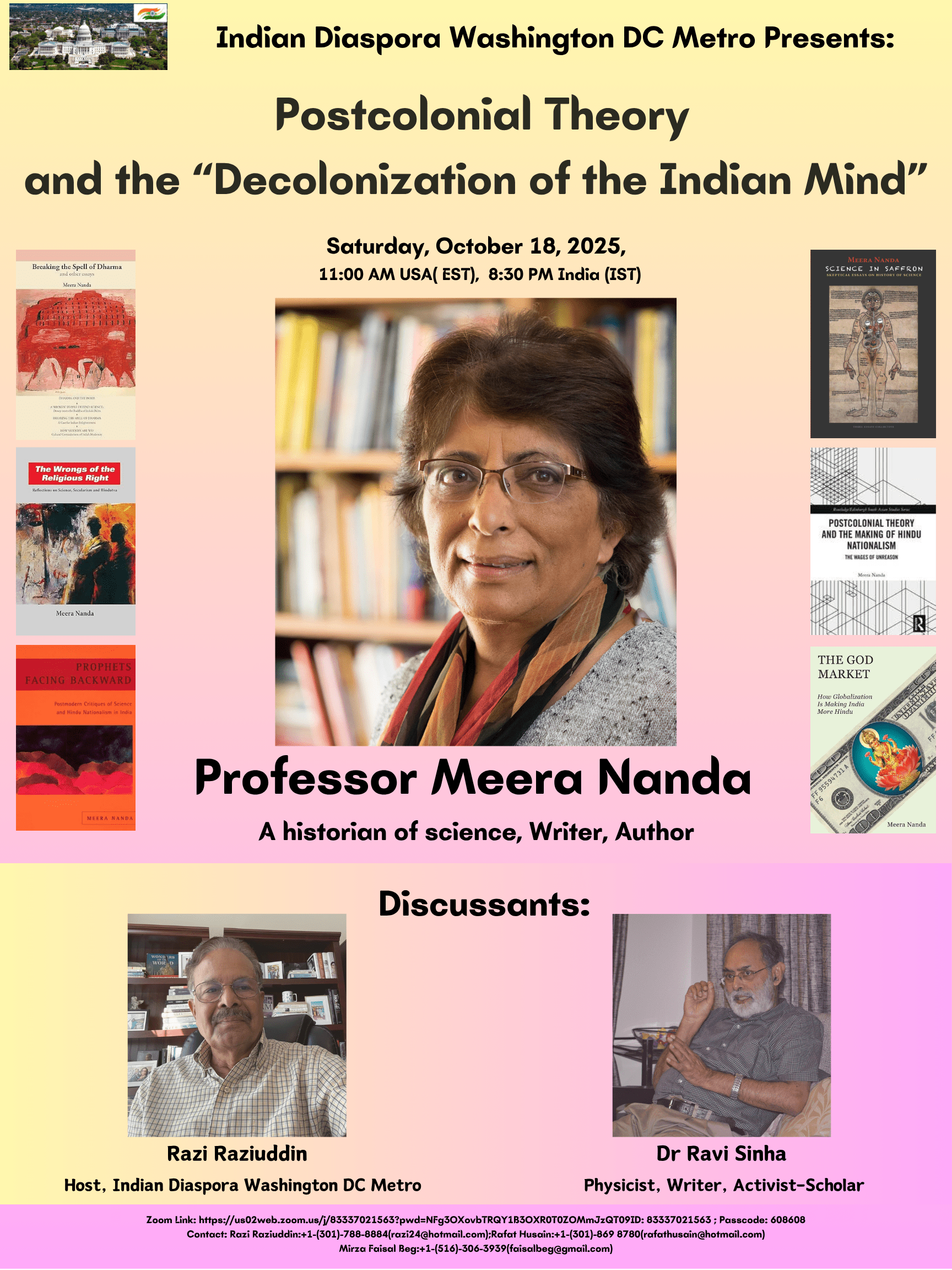
Postcolonial Theory and the “Decolonization of the Indian Mind” : Professor Meera Nanda

Indian Diaspora Washington DC lecture series

Topic: Postcolonial Theory and the “Decolonization of the Indian Mind”

Speaker: Professor Meera Nanda

Colonialism, Modernity and Science: K. Sridhar

[This post is the seventh essay of the series in Kafila titled Decolonial Imaginations. Links to the previous essays are given at the end.

The terms ‘decolonization’ or ‘decolonial’ have become quite critical now, given that the impulse of justice lies at the core of these concepts. Neither postcolonial nor decolonial perspectives are compatible with right-wing ideologies but the fact that Hindutva ideologues in India and the rightwing globally are now trying to appropriate that language makes it seem to some that the very idea of the postcolonial or decolonial is suspect. We believe that this demonizing of decolonial theory from a position defensive of the European Enlightenment needs to be unpacked in the interests of a mutually productive debate. Kafila will be publishing a series of interventions on what the idea of the decolonial imagination involves, locating decolonial theory as speaking from the margins, drawing attention to identities which the orthodox Left subsumed under ‘class’ and which the rightwing in India seeks to assimilate into Brahminism. Additionally the orthodox left’s rejection of spiritual beliefs and inability to engage with them is also a factor that may have produced the space for right wing appropriations of a field marked “religion”. 

We hope that these interventions will clear the ground for productive conversations on the left rather than polarised and accusatory claims.]

It is impossible to think of modernity and colonialism, without thinking of their third sibling – science. They are not just siblings, in fact, but a set of triplets which took birth within the same western context and period – and hence, the adjectives ‘modern’ and ‘western’ are used to qualify science, often by the colonizers themselves. Just as the notion of ‘savage native’ was a part of colonial construction, so was the idea of ‘modern science’. Not only did the colonial powers conquer people and knowledge systems across the world, but they also established hegemony within their own societies, colonizing them from within. This was done using complex mechanisms of power, control and appropriation. Continue reading Colonialism, Modernity and Science: K. Sridhar

Decolonizing the ‘Colonial-Brahmanical’ – Thinking outside Modernity: Sunandan K N

[This post is the sixth essay of the series in Kafila titled Decolonial Imaginations. Links to the previous essays are given at the end.

The terms ‘decolonization’ or ‘decolonial’ have become quite critical now, given that the impulse of justice lies at the core of these concepts. Neither postcolonial nor decolonial perspectives are compatible with right-wing ideologies but the fact that Hindutva ideologues in India and the rightwing globally are now trying to appropriate that language makes it seem to some that the very idea of the postcolonial or decolonial is suspect. We believe that this demonizing of decolonial theory from a position defensive of the European Enlightenment needs to be unpacked in the interests of a mutually productive debate. Kafila will be publishing a series of interventions on what the idea of the decolonial imagination involves, locating decolonial theory as speaking from the margins, drawing attention to identities which the orthodox Left subsumed under ‘class’ and which the rightwing in India seeks to assimilate into Brahminism. Additionally the orthodox left’s rejection of spiritual beliefs and inability to engage with them is also a factor that may have produced the space for right wing appropriations of a field marked “religion”. 

We hope that these interventions will clear the ground for productive conversations on the left rather than polarised and accusatory claims.]

This short essay builds on the articles published in this series and has already explored the various ways in which the concept of de-colonization is articulated, appropriated and adapted in various historical contexts in India and elsewhere. This note aims to map, in a preliminary fashion, the divergent engagements with questions concerning caste across three key groups – colonialists, nationalists (including the Hindutva nationalists), and postcolonial and decolonial practitioners in the last two centuries. This note does not purport to break new empirical ground but instead assembles and juxtaposes existing academic and public arguments to construct a focused framework for comparison.

It is important to begin with the now established argument that concepts are not static but dynamic entities, formed, transformed and deployed along historical processes. In larger Humanities and Social Science disciplines, historians, philosophers, anthropologists and linguists have increasingly shifted the question from ‘what does a concept or a category or just a noun mean’ to ‘what does it do’.  This shift posits that meaning is not a stable core but a secondary effect created from practice through a process of ‘densification’. We can observe this in Foucault’s inquiries into the concept of madness or Wittgenstein’s exploration of the performative nature of language. While the dominant forces have the power to deploy a category more widely and to limit its interpretations or in other words have the power to solidify and concretize the uses and effects of the category, they cannot guarantee to reduce this category to a singular use/meaning or limit its interpretation.  Hence the importance of the analysis of the travel and transformation of categories in various routes, its adaptations and mutations across various historical contexts and times.

Colonialism held divergent meanings and ‘affected’ differently for different groups of colonised, who in turn responded differently in varied temporal and spatial contexts. In what follows, I will briefly describe how colonialism affected the discourse and practice of caste and how different sections of the colonised reciprocated and acted on these colonial interventions. By doing so, I will demonstrate that, while colonialists, upper caste and Hindutva nationalists, and Leftists at some or other point have taken ostensibly anti-caste positions, their intentions or outcomes were not similar and all of them varied drastically from the radical project of annihilation of caste proposed by Ambedkar.

A parallel divergence exists within academic scholarship, where the analysis of caste from nationalist, postcolonial and decolonial perspective have criticized caste system but from different standpoints and with different objectives. It will therefore be both analytically trivial and politically dangerous to equate Ambedkar’s radical anti-caste position with Hindutva rhetoric against caste. Similarly equating a genuine decolonial position on caste with Hindutva’s strategic engagement with caste or about any other issues, can only stem from either a misreading or a cynical anxiety of losing one’s own relevance.

Colonial practice was never governed by a single monolithic principle; instead it was characterised by contradictions, ironies and exceptions that became the very norm of colonial rule. A pivotal moment in this history was the orientalist introduction of ‘Hindu’ as a unified religious category which fundamentally reshaped the colonial discourse on caste in India. Earlier, the category jathi dominated in the organisation of social practices and in the reflection of these practices. This does not mean jathi remained static in the precolonial period. As a dynamic system jathi underwent many transformations but remained hierarchical all through this period. The orientalists understood jathi as the essential principle of Hindu religion but also created a historical myth in which there existed a Hindu golden past which was destroyed by the Islamic invasions. This enabled many problematic concepts such as the idea that Hindu religion existed from the Vedic period onwards, and that all precolonial kingdoms were religious or something articulated as Sanathana Dharmam was part of this Hindu religion.

These notions are dominant even in contemporary debates and in common sense. The Hindutva history is completely premised on this colonial historical myth (not on the postcolonial or decolonial critique of these concepts) which the Hindutva propagandist will never admit. While they wholeheartedly embrace this part of colonial history, they vehemently oppose the theory of ‘Brahmanical despotism’ which was also an integral part of the colonial understanding of the Hindu religion.  In the so called ‘decolonisation project’ of the Hindutva only the latter part is to be decolonised. To be exact, even the other versions of nationalist history in the first half of the twentieth century – Gandhian, Ambedkarite, Nehruvian, Marxist – incorporated some or other elements of this colonialist orientalist interpretation. Decolonisation project attempts to point out not only the overlaps of the nationalist project with colonial one, but also focuses on how this enables the current forms of domination and subordination.

Postcolonial and decolonial histories challenged both colonial interpretation of caste and its nationalist adaptations as well. Nicholas Dirks explained how caste identities were re-constructed and even rigidified through various colonial governing practices. This was often misinterpreted as though he was arguing that caste was a pure colonial construction, which is clearly a Hindutva argument which, unlike Dirks, completely overlooks the inhuman caste domination and violence in the precolonial period. G Aloysius in his book Nationalism without a Nation analysed how caste was central to the nationalist political position of anti-colonialism. Lata Mani’s work on Sati (Contentious Traditions: The Debate on Sati in Colonial India) shows how colonialist and the upper castes together reconstructed ‘traditions’ which also became the basis for the reform narrative which attempted to separate good traditional practices from superstitions.

The idea that jathi was an exception that accidently emerged in the long history of Hindu religion was central to Hindu reform attempts and this was the exact point that Ambedkar rejected in his essay ‘Annihilation of Caste’.  While this essay premises existence of Hindu religion based on Shasthras (Orthodoxy), which one can now see as an orientalist construction, his arguments were anchored against the colonial and nationalist narratives of a Hindu golden past and against the possibility of an egalitarian reformed Hinduism as depicted by Hindu reformers of the period. The fact that the Hindutva propagandists attempt to make him one of the many Hindu reformers does not make him a ‘strange bedfellow’ or ‘enabler’ of Hindutva politics. On the contrary, his political philosophy has become the inspiration for anti-Hindutva politics in the twenty-first century.

Ambedkar’s critique focused on the social practices and political ideology of casteism embedded in Hindutva politics. Decolonial historians have extended this critique by analysing the role of caste not just in traditions but also in what is described as modern as well. This scholarship is inspired by feminist standpoint theories and black and queer feminist (many among them are scientists) critique of Science (Sandra Harding, Karen Barad, Chanda Prescod-Weinstein etc.), critique of modern forms of knowledge production from indigenous perspective (Linda Tuhiwai Smith, Dian Million, Candis Callison) and Indigenous critique of modernity and its genocidal developmental practices in India (Abhay Xaxa, Hansda Sowvendra Shekhar, Jacinta Kerketta) and so on. In a close reading of these works one could easily recognize that they are all part of a politics that challenges racist, casteist, patriarchal dominations and other right wing ideologies.

Ajantha Subramanian in her book Caste of Merit: Engineering Education in India shows how brahmanical notions of merit were embedded from the very beginning of IITs in India. Her analysis shows that the upper caste dominance in the so-called Nehruvian temples of modernity is not an exception but by design. The history of IIT Roorkee will also tell a similar story.   Started as Thomason College of Civil Engineering in 1847 to train Indians as engineers for the Ganga Canal Project, the engineering education here was based on the workshop model as it was in Europe and other places. However as most of the students in the first three batches were upper caste Bengalis, the learning based on doing was not successful. After an inquiry committee report it was decided that there should be a three tier system in which the top tier will be a fully theoretical (mental labour based) education in the classroom, the middle level will be half classroom and half workshop based and the lowest level will be fully in the workshop. This is the model that was replicated in technical education as the three tier system of Engineering College, Polytechnic, and ITIs. Here caste hierarchy was clearly mapped into the hierarchy of knowledge in which mental labour is separate from the manual labour and superior to the latter. This separation of theory from practice (mental labour from manual labour) is central to all forms of modern knowledge practices not only in India but everywhere in the world. Hence wherever these institutions emerged in the eighteenth and nineteenth centuries, they incorporated the local power hierarchies into their notion of knowledge. Considering this history, it is not an accident that the Science and Technology institutions and science and technology departments in Universities are the worst domains of caste discrimination and exclusion.  This is not to say that Social Science as a discipline or the departments are egalitarian. It is the same modernist and casteist notion that established the divide between theoretical Brahmins and empirical Shudras, a Gopal Guru has already pointed out.

In my book Caste, Knowledge and Power: Ways of Knowing in the Twentieth Century Malabar, I have demonstrated that caste discrimination in the domain of knowledge production in India is not just institutional but epistemological as well. Hence, I have argued that the dominant form of modernity in India in general and its forms of knowledge production in particular need to be understood not as Western, Scientific, Eurocentric or Universal but as Colonial-Brahmanical. Brahmanical understanding of jathi and gender are part of the epistemology and practices of all modern institutions. In other words, any attempt of decolonisation will be anti-colonial as well as anti-Brahmanical and will inherently be an anti-Hindutva project as well.

In conclusion, It is critical to recognise that the Hindutva appropriation of icons like Gandhi or Ambedkar, their attack on Nehru or their revivalist understanding of Science and Technology, should not circumscribe one’s own critique of Gandhi or Nehru or Science or be apologetic in fear of appropriation. An appropriate response would not be that ‘we are not abandoning rationality’ or ‘we are not relativists’ or ‘we believe in different kinds of Science’. Rather, we must reject the foundational role of the very binaries of – Rational/ irrational, absolute / relative, modernity / tradition – to advance a politics of equality and fraternity. The more productive analytical framework would be to ask what these concepts do: Do they enable and intertwine with other actions for a more democratic and equal world or do they reinforce social hierarchy?

Sunandan KN is Associate Professor, Azim Premji University, Bangalore. The opinions are personal.

Sleeping with the enemy? Postcolonialism, misread and misjudged: Shamayita Sen

Beyond philosophical gaslighting – seven theses on decolonization/ decoloniality: Aditya Nigam

Anti-colonial thought and the global right – an untenable alliance: Ishan Fouzdar

The Hopeless Quest for a Pure Incorruptible Knowledge – Decoloniality and its Discontents: Nivedita Menon

The Struggle for a ‘Coloured Modernity’: Meghna Chandra and Archishman Raju


The Struggle for a ‘Coloured Modernity’: Meghna Chandra and Archishman Raju
[This post is the fifth essay of the series in Kafila titled Decolonial Imaginations. Links to the previous essays are given at the end.

The terms ‘decolonization’ or ‘decolonial’ have become quite critical now, given that the impulse of justice lies at the core of these concepts. Neither postcolonial nor decolonial perspectives are compatible with right-wing ideologies but the fact that Hindutva ideologues in India and the rightwing globally are now trying to appropriate that language makes it seem to some that the very idea of the postcolonial or decolonial is suspect. We believe that this demonizing of decolonial theory from a position defensive of the European Enlightenment needs to be unpacked in the interests of a mutually productive debate. Kafila will be publishing a series of interventions on what the idea of the decolonial imagination involves, locating decolonial theory as speaking from the margins, drawing attention to identities which the orthodox Left subsumed under ‘class’ and which the rightwing in India seeks to assimilate into Brahminism. Additionally the orthodox left’s rejection of spiritual beliefs and inability to engage with them is also a factor that may have produced the space for right wing appropriations of a field marked “religion”. 

We hope that these interventions will clear the ground for productive conversations on the left rather than polarised and accusatory claims.]

The excerpt published in The Wire of Meera Nanda’s “Decolonising Ourselves into a Hindu Rashtra” argues that postcolonial and decolonial theorists bear the blame, at least in part, for the rise of Hindu nationalism in India. In eschewing “Enlightenment Secular Humanism”, Nanda argues, these theorists have opened epistemic space for right wing ideologues to justify reactionary politics. Furthermore, she argues that the ideas of postcolonial theory have their roots in the “neo-Hindu revivalist strains of anti-colonial nationalism.”, who she identifies with “Gandhi, Vivekananda, Aurobindo, and even Tagore”. These thinkers were apparently seeking an escape from the idea of modernity present in the “legacy of the British Raj”. This, apparently against the “enlightenment thinkers” of India in which she presents a bizarre counter grouping of “Ambedkar, Periyar, Nehru, M.N. Roy, and Narendra Dabholkar”. This opposition that Nanda sets up is so ludicrous to someone who has even spent a minimal amount of time studying our freedom struggle or any of these thinkers that it requires little comment.

Continue reading The Struggle for a ‘Coloured Modernity’: Meghna Chandra and Archishman Raju
The hopeless quest for a pure incorruptible knowledge – decoloniality and its discontents

[This post by Nivedita Menon is the fourth essay of the series in Kafila titled Decolonial Imaginations. Links to the previous essays are given at the end.

The terms ‘decolonization’ or ‘decolonial’ have become quite critical now, given that the impulse of justice lies at the core of these concepts. Neither postcolonial nor decolonial perspectives are compatible with right-wing ideologies but the fact that Hindutva ideologues in India and the rightwing globally are now trying to appropriate that language makes it seem to some that the very idea of the postcolonial or decolonial is suspect. We believe that this demonizing of decolonial theory from a position defensive of the European Enlightenment needs to be unpacked in the interests of a mutually productive debate. Kafila will be publishing a series of interventions on what the idea of the decolonial imagination involves, locating decolonial theory as speaking from the margins, drawing attention to identities which the orthodox Left subsumed under ‘class’ and which the rightwing in India seeks to assimilate into Brahminism. Additionally the orthodox left’s rejection of spiritual beliefs and inability to engage with them is also a factor that may have produced the space for right wing appropriations of a field marked “religion”. 

We hope that these interventions will clear the ground for productive conversations on the left rather than polarised and accusatory claims.]

Introduction

As Hindutva ideologues and the rightwing globally, appropriate the idea of “decolonising”, it seems to many opposed to these trends, that scholarship around decoloniality is itself the problem. Such arguments tie in with earlier ongoing attacks on postcolonial scholarship since the 1990s that virtually accuse it of directly contributing to the rise of the right. Decolonial scholarship is relatively a new arrival in the Anglophone world (since the 2000s), and ever since the rightwing started using that language, the same charges are laid at its door as well. Indeed, the implication (and sometimes outright allegation) is that decolonial/postcolonial scholars were secretly rightwing all along.

This charge I will address in a somewhat different way in the first section, by way of analogies with other bodies of knowledge.

The second section will address another related critique of decolonial thought, that it is “merely epistemic” and does not consider the materiality of structures of power

Finally we will ask the question – when Hindutva claims to be “decolonising”, what is it doing exactly? Continue reading The hopeless quest for a pure incorruptible knowledge – decoloniality and its discontents

Anti-colonial Thought and the Global Right – An untenable alliance: Ishan Fouzdar

Guest Post by ISHAN FOUZDAR

[This post is the third essay of the series in Kafila titled Decolonial Imaginations. Links to the previous essays are given at the end.

The terms ‘decolonization’ or ‘decolonial’ have become quite critical now, given that the impulse of justice lies at the core of these concepts. Neither postcolonial nor decolonial perspectives are compatible with right-wing ideologies but the fact that Hindutva ideologues in India and the rightwing globally are now trying to appropriate that language makes it seem to some that the very idea of the postcolonial or decolonial is suspect. We believe that this demonizing of decolonial theory from a position defensive of the European Enlightenment needs to be unpacked in the interests of a mutually productive debate. Kafila will be publishing a series of interventions on what the idea of the decolonial imagination involves, locating decolonial theory as speaking from the margins, drawing attention to identities which the orthodox Left subsumed under ‘class’ and which the rightwing in India seeks to assimilate into Brahminism. Additionally the orthodox left’s rejection of spiritual beliefs and inability to engage with them is also a factor that may have produced the space for right wing appropriations of a field marked “religion”. 

We hope that these interventions will clear the ground for productive conversations on the left rather than polarised and accusatory claims.]

Introduction

Anti-colonial thought is under attack. Some scholars have accused decolonial and postcolonial theories of nativism. Interestingly, the phenomenon that provoked this accusation is stranger than the accusation itself. The global North and the global South have witnessed an unlikely alliance of anti-colonial rhetoric and right-wing discourse. While the Hindu Right in India deems Muslims to be colonial invaders, the Right Wing in Europe constructs the influx of refugees as a colonial invasion, which will lead to a ‘great replacement’ of White Europeans by West Asian and African refugees. The solution – ‘decolonise’ by expelling the colonisers and reviving the ‘glorious’ ‘indigenous’ past. This invokes several questions: How do European right-wing groups lay claims on decolonisation? Are there common links between these right-wing ‘decolonisation’ projects? More importantly, does the presence of anti-colonial language in right-wing discourse automatically translate to the conclusion that postcolonial and decolonial theories are inherently nativist?

I undertake two broad tasks. First, I lay forth the ‘anti-colonial’ rhetoric of these right-wing projects. Secondly, I condense their similarities and use them to show why anti-colonial thought should not be seen to be irredeemably polluted by this misappropriation.

Before I trace the right-wing appropriation of anti-colonial language, a caveat about the usage of the terms anti-colonial, postcolonial and decolonial is in order. I use anti-colonial thought to broadly bundle postcolonial and decolonial theories. The reason being that both theoretical schools present varying critiques of the socio-cultural and intellectual legacies of colonialism. The difference in the kind of critique separates postcolonialism from decolonial theory. Continue reading Anti-colonial Thought and the Global Right – An untenable alliance: Ishan Fouzdar

Beyond Philosophical Gaslighting – Seven theses on Decolonization/ Decoloniality

[This post by Aditya Nigam is the second essay of the series in Kafila, titled Decolonial Imaginations. The first essay can be read here.

The terms ‘decolonization’ or ‘decolonial’ have become quite critical now, given that the impulse of justice lies at the core of these concepts. Neither postcolonial nor decolonial perspectives are compatible with right-wing ideologies but the fact that Hindutva ideologues in India and the rightwing globally are now trying to appropriate that language makes it seem to some that the very idea of the postcolonial or decolonial is suspect. We believe that this demonizing of decolonial theory from a position defensive of the European Enlightenment needs to be unpacked in the interests of a mutually productive debate. Kafila will be publishing a series of interventions on what the idea of the decolonial imagination involves, locating decolonial theory as speaking from the margins, drawing attention to identities which the orthodox Left subsumed under ‘class’ and which the rightwing in India seeks to assimilate into Brahminism. Additionally the orthodox left’s rejection of spiritual beliefs and inability to engage with them is also a factor that may have produced the space for right wing appropriations of a field marked “religion”. 

We hope that these interventions will clear the ground for productive conversations on the left rather than polarised and accusatory claims.]

The question of decolonization/ decoloniality keeps surfacing periodically in ill-informed writings and tracts. The target may be postcolonial studies or more recently, decolonial theory, but the attack is always launched in the name of “the Enlightenment” (notice the definite article). The idea behind making what was the European Enlightenment into “the Enlightenment” for the whole world is to claim – as has been done for a couple of centuries since – that the world was lying in “darkness” and “superstition” before the dazzling light of the Enlightenment rescued the inhabitants of the different continents. What were Latin Christendom’s (Europe) “dark middle ages” became the convenient and imagined dark ages of all societies in the world.

Continue reading Beyond Philosophical Gaslighting – Seven theses on Decolonization/ Decoloniality

Sleeping With the Enemy? Postcolonialism, Misread and Misjudged: Shamayita Sen

Guest post by SHAMAYITA SEN

[This post is the first of a series in Kafila, titled Decolonial Imaginations.

The terms ‘decolonization’ or ‘decolonial’ have become quite critical now, given that the impulse of justice lies at the core of these concepts. Neither postcolonial nor decolonial perspectives are compatible with right-wing ideologies but the fact that Hindutva ideologues in India and the rightwing globally are now trying to appropriate that language makes it seem to some that the very idea of the postcolonial or decolonial is suspect. We believe that this demonizing of decolonial theory from a position defensive of the European Enlightenment needs to be unpacked in the interests of a mutually productive debate. Kafila will be publishing a series of interventions on what the idea of the decolonial imagination involves, locating decolonial theory as speaking from the margins, drawing attention to identities which the orthodox Left subsumed under ‘class’ and which the rightwing in India seeks to assimilate into Brahminism. Additionally the orthodox left’s rejection of spiritual beliefs and inability to engage with them is also a factor that may have produced the space for right wing appropriations of a field marked “religion”. 

We hope that these interventions will clear the ground for productive conversations on the left rather than polarised and accusatory claims.]

This article comes as a response born from a deep sense of intellectual anguish and frustration. It is a rebuttal to a YouTube video titled The Left’s Accidental Gift to Hindu Nationalism posted by one of India’s leading independent news portals, The Wire on 14th August 2025. The video attempts to summarize Meera Nanda’s critique of Postcolonial Left as elaborated in her latest treatise, Postcolonial Theory and the Making of Hindu Nationalism: The Wages of Unreason (2025). While I have read the newly published work, including the excerpt published in The Wire which have been shared widely in popular social media platforms, this piece restricts itself to the Video which comprehensively outlines Nanda’s arguments. An extensive engagement with the critique that Nanda mounts is reserved for some other time.

Continue reading Sleeping With the Enemy? Postcolonialism, Misread and Misjudged: Shamayita Sen

South Asian Futures in a Tri-Polar World : Professor Pervez Hoodbhoy

Democracy Dialogues Series – Lecture 40
Organised by New Socialist Initiative

Theme :
South Asian Futures in a Tri-Polar World

Speaker :
Professor Pervez Hoodbhoy
Eminent Physicist, author, public intellectual

Time and Date :
6 PM (IST)
Sunday , 27 th July 2025

The lecture is also live streamed at facebook.com/newsocialistinitiative.nsi

Abstract:

The Cold War and the collapse of the Soviet Union are long behind us, and we’re now hurtling toward a tri-polar world dominated by America, Russia, and China. These three powers vy to shape global influence, often competing but sometimes colluding. As the saying goes, “When elephants fight, the grass gets trampled.” So, the central question for this lecture is: What path are the nations of South Asia—including Afghanistan and Iran—likely to take? What alternatives and tools do they possess to navigate this landscape? Most importantly, what vision of society and power should guide them toward a viable future?

Speaker :

Professor Pervez Hoodbhoy is a nuclear physicist, author, and a prominent activist who is particularly concerned with promotion of freedom of speech, secularism, scientific temper and education. He is the founder-director of The Black Hole in Islamabad and as the head of Mashal Books in Lahore, he leads a major translation effort to produce books in Urdu that promote modern thought, human rights, and emancipation of women.

Prof Hoodbhoy received his undergraduate and doctoral degrees from MIT and has taught  physics and mathematics at Forman Christian College-University in Lahore, at the Quaid-e-Azam University (QAU) in Islamabad and later at Lahore University of Management Sciences (LUMS).

He is a recipient of the Baker Award for Electronics and the Abdus Salam Prize for Mathematics. He was visiting professor at MIT, Carnegie Mellon University, and the University of Maryland. In 2003 he was awarded UNESCO’s Kalinga Prize for the popularization of science.

Here is a list of a few of his publications :

– Pakistan: Origins, Identity and Future, published by Routledge (London, New York), 2023.
– Confronting the Bomb – Pakistani and Indian Scientists Speak Out, (edited) Oxford University Press, 2013.
– Education and the State – Fifty Years of Pakistan, (edited) Oxford University Press, 1998.
– Islam & Science: Religious Orthodoxy and the Battle for Rationality, published by ZED Books, London, in 1991 with translations in Turkish, Malaysian, Indonesian, Arabic, Spanish, Sindhi, and Urdu.
– Proceedings of School on Fundamental Physics and Cosmology, co-edited with A. Ali, World Scientific, Singapore, 1991.

Indianity and Modernity : Dr Ravi Sinha

[ YouTube links of Ravi Sinha’s Informal talk in Lucknow in April 2025 on “Indianity and Modernity”.  Credits to Kumar Sauvir for recording, editing and posting. The title and intro are also by him ]

[ Ravi Sinha is an activist-scholar who has been associated with progressive movements for around five decades. Trained as a theoretical physicist, Dr. Ravi has a doctoral degree from MIT, Cambridge, USA. He worked as a physicist at University of Maryland, College Park, USA, at Physical Research Laboratory, Ahmedabad and at Gujarat University, Ahmedabad before resigning from the job to devote himself full time to organizing and theorizing. He is the principal author of the book, Globalization of Capital, published in 1997, co-founder of the Hindi journal, Sandhan, and one of the founders and a leading member of New Socialist Initiative.]

Class, Inequality, and the Current Political Moment in China and India : Prof Vamsi Vakulabharanam

Democracy Dialogues Series 39

Organised by New Socialist Initiative

Theme : Class, Inequality, and the Current Political Moment in China and India

Speaker : Prof Vamsi Vakulabharanam

Co-Director of the Asian Political Economy Program and Associate Professor of Economics at the University of Massachusetts, Amherst

Live streamed at Facebook ( facebook.com/newsocialistinitiative.nsi).
———————————-

Theme: Class, Inequality, and the Current Political Moment in China and India

This talk is based on a recently published book by the Oxford University Press – Class and Inequality in China and India, 1950-2010. China and India have seen a significant revival over the last three decades in terms of their place in the world economy. Two and a half centuries ago, they contributed 50 percent of the world output; after suffering a decline thereafter, their share fell to a paltry 9 percent in 1950 but has since resurged to over 25 percent today. Their growth and inequality experiences diverged for three decades following India’s independence (1947) and the Chinese revolution (1949). Thereafter, there are remarkable underlying similarities in the experiences of both countries, especially in terms of their rising inequality patterns analyzed through a class lens. Vamsi demonstrates that the mutual interconnectedness between Chinese and Indian growth and inequality dynamics and the transformation and evolution of global capitalism is key to understanding the within-country inequality dynamics in both countries over the 1950-2010 period. Based on this analysis of class-based inequalities, Vamsi reflects on the current political moment in both countries, from a political economy perspective.

Speaker : Prof Vamsi Vakulabharanam
Vamsi Vakulabharanam is Co-Director of the Asian Political Economy Program and Associate Professor of Economics at the University of Massachusetts, Amherst. He has previously taught at the University of Hyderabad (2008-14) and the City University of New York (2004-07). His recent research focuses on inequality in India and China and the political economy of Indian cities through the axes of gender, caste, class, and religion. In the past, he has also worked on agrarian change in developing economies, agrarian cooperatives, and the relationship between economic development and inequality. Vakulabharanam was awarded the Amartya Sen award in 2013 by the Indian Council of Social Science Research.

SANITISING THE SUPREMO : How RSS Is Trying to Rewrite its Own History One Step At a Time | 

,,The rewriting spree has not left untouched RSS’s own history itself.

The biggest manifestation of this exercise is evident in the way we have before us a new look Dr Keshav Baliram Hedgewar (1888-1940) founder member of RSS and its first Supremo.

He is being called as ’‘born patriot’’, one amongst the ‘great revolutionaries who fought for India’s independence, ’’social reformer’ , ’maker of Modern India’ etc etc. disregarding the fact that all his life he focussed his attention to build Hindu Unity, to usher India into a Hindu Rashtra and never once gave a call to the organisation he founded with others – namely RSS – that it joins the anti colonial struggle. He did go to jail during the anti colonial struggle but not as a member of the RSS but as a member of Congress Party.

Many monographs, books .. – are also before us which are trying to emphasise this new image, obliterating many inconvenient aspects of his tumultous life or maintaining tactical silences over them. The latest in series is the way he is being projected as a leader of the “jungle satyagraha” at Pusad, Maharashtra which was organised as part of the Civil Disobedience Movement led by Congress. [10]

What is noticeable that this ’rewriting’ of RSS history seem to begin at the beginning only. [ Read the full article here : https://www.mainstreamweekly.net/article15650.html]

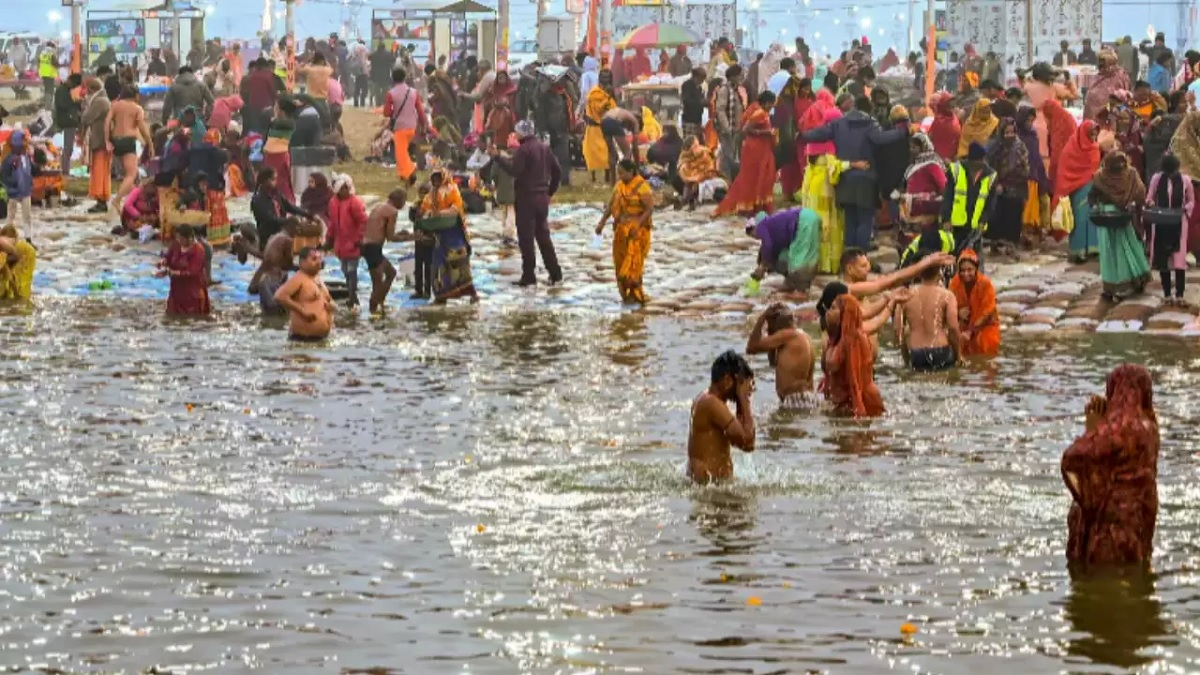
‘पवित्र स्नान’ का दूसरा पहलू :  क्या महाकुंभ में सरकारी लापरवाही से लोग बेहद गंदे पानी में नहाते रहे?

आस्था और गंदगी सहयात्री रहते आए हैं। आस्था के तमाम जाने-माने केन्द्रों पर या अपनी आस्था को सेलिब्रेट करने के नाम पर मनाए जाने वाले समारोहों में-प्रचंड ध्वनि प्रदूषण और रौशनी का प्रदूषण आदि के माध्यम से-इसकी मिसाल अक्सर देखने को मिलती है। प्लास्टर ऑफ पेरिस की मूर्तियों से भरे गंदे जलाशय-जिनकी मौजूदगी पानी के ऑक्सीजन की मात्रा पर विपरीत असर डालती है, पानी में ही फेंकी गयी सूखे फूलों की मालाएं आदि आदि से महानगर भी अछूते नहीं रहते हैं।

इस सम्बन्ध में ताज़ी मिसाल महाकुंभ के बहाने से उजागर हुई है, जब केन्द्रीय प्रदूषण नियंत्रण बोर्ड (CPCB)  की रिपोर्ट ने इस बात को उजागर किया कि किस तरह प्रयागराज के पानी में उन्हें उच्च स्तर पर मल के जीवाणु मिले हैं, जो किसी भी सूरत में नहाने योग्य नही है। इस सिलसिले में नेशनल ग्रीन टिब्यूनल ने उत्तर प्रदेश प्रदूषण नियंत्रण बोर्ड (UPPCB) के अधिकारियों को तलब भी किया है कि ‘प्रयागराज/इलाहाबाद में गंगा, यमुना के पानी की गुणवत्ता के उल्लंघन को लेकर-उन्होंने जो दिशानिर्दश जारी किए थे उस पर उन्होंने अमल नहीं किया है।

गौरतलब है कि राष्ट्रीय  ग्रीन टिब्यूनल (NGT) ने  उत्तर प्रदेश प्रदूषण नियंत्रण बोर्ड की इस बात के लिए भी आलोचना की है कि अपनी जो रिपोर्ट उन्होंने प्रस्तुत की है, उसके सैम्पल पुराने है और सभी 12 जनवरी के पहले के-अर्थात कुंभ मेला शुरू होने के पहले के है। ….

…निस्संदेह महाकुंभ के अवसर सीवेज युक्त पानी को लेकर उठे सवाल अब दबना मुश्किल है। सरकार जो भी प्रचार करे, अधिक से अधिक लोग अब इस बात का अनुभव करेंगे कि गंगा किनारे उन्होंने जो ‘पवित्र  स्नान’ किया उस वक्त वह पानी कत्तई शुद्ध नहीं था। यात्रियों का एक छोटा सा हिस्सा अब यह कहने का साहस भी जुटाएगा कि किस तरह सत्ताधारी समूह ने उनकी धार्मिक आस्था का दोहन किया है। [ Read the full article here :https://janchowk.com/beech-bahas/the-other-aspect-of-the-holy-bath/]

Anti-Colonial Constitutionalism and the Defence of India’s Democracy

Democracy Dialogues Series 37

Organised by New Socialist Initiative
Theme : Anti-Colonial Constitutionalism and the Defence of India’s Democracy

Speaker : Prof Sugata Bose

Gardiner Professor of Oceanic History and Affairs, Harvard University, ex Member of Parliament

Continue reading Anti-Colonial Constitutionalism and the Defence of India’s Democracy

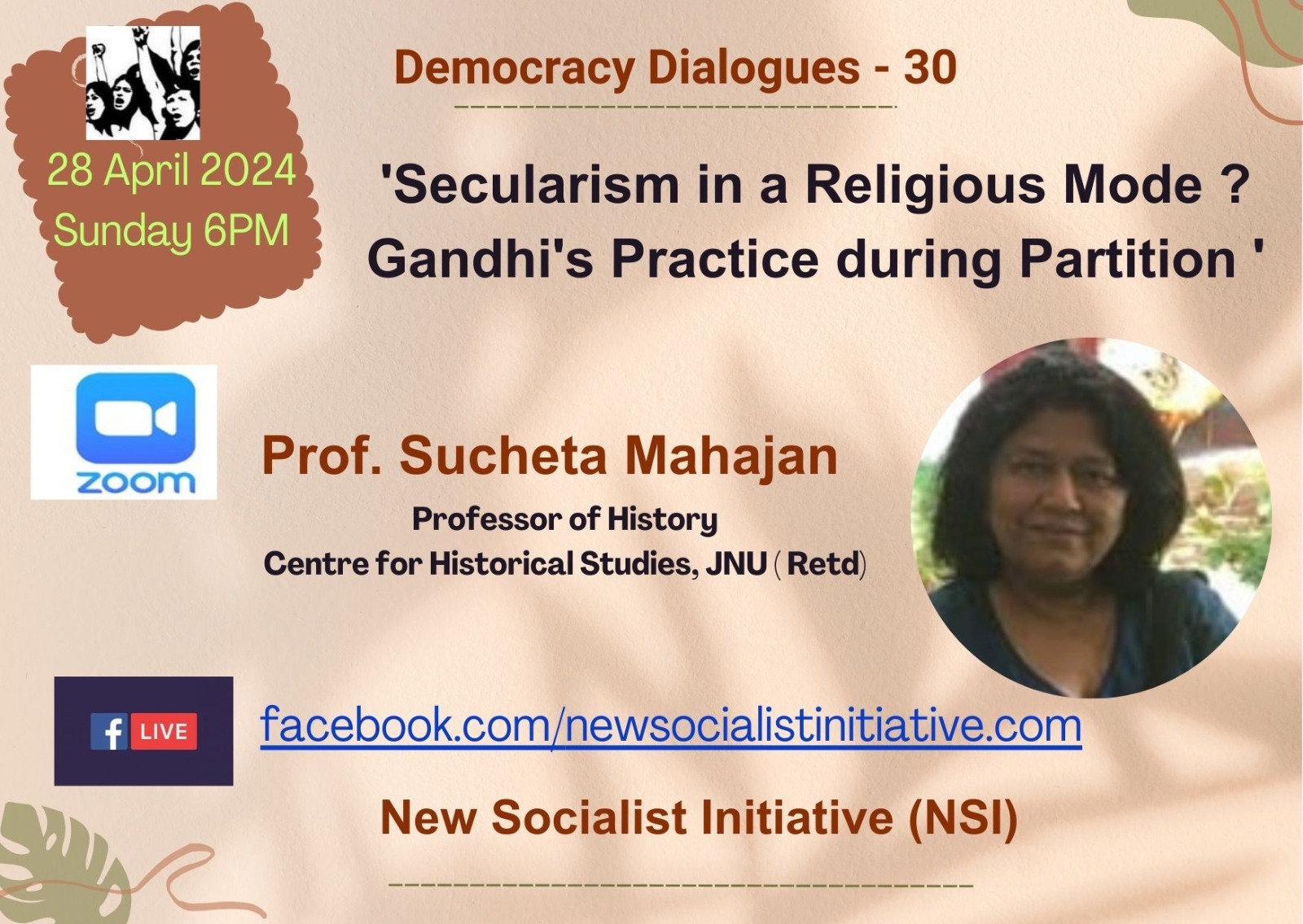
Secularism in a Religious Mode ?-  Gandhi’s Practice during Partition : Prof Sucheta Mahajan

Democracy Dialogues Lecture 30 :

Speaker: 

Professor Sucheta Mahajan

Centre for Historical Studies, JNU ( retd)

Date: Sunday, 28 th April, at 6 PM (IST)

Theme :

‘Secularism in a Religious Mode ?-  Gandhi’s Practice during Partition ‘

Join Zoom Meeting
https://us02web.zoom.us/j/81056829791?pwd=VnRpK2xtWDA3elArZGR5WnN0MGNDdz09

Meeting ID: 810 5682 9791
Passcode: 433470

The lecture will be live on facebook.com/newsocialistinitiative.nsi

Abstract :

The talk looks at the practice of Gandhi in his struggle against communalism in the years leading up to Partition. 

This is a hugely controversial subject with polarised positions taken by his followers and critics. 

The perspective of the talk emerges from Gandhi’s oft quoted but not heeded statement, My Life is My Message. The talk is a reading of a life text in this sense: Gandhi’s mission in Noakhali to mend the social fabric torn by communal riots and spread of communal ideology.

Gandhi’s search for a way out may offer some insights to those sharing his concern for a secular, plural society and polity today.

About the Speaker :

Professor at the Centre for Historical Studies, Jawaharlal Nehru University, till the end of February 2023, Professor Mahajan has been visiting professor and Fellow at different International and National  Institutions.

She was member of the prestigious international research projects such as SPECTRESS and CHCI-MELLON Crises of Democracy, Global Humanities Institute. She has authored and edited many books on India’s Independence Struggle, Partition, Challenge of Communalism, Composite Culture etc

Publications :

Towards Freedom: Documents on the Movement for Independence in India, 1947, Parts One
and Two, (edited and with an Introduction) OUP, 2013 and 2015.
Education for Social Change: MVF and Child Labour, National Book Trust, New Delhi, 2008.
RSS, School Texts and the Murder of Mahatma Gandhi- The Hindu Communal Project (with
Aditya and Mridula Mukherjee) Sage Publications, 2008.
Composite Culture in a Multi-Cultural Society (Co-edited with Bipan Chandra), Pearson India & National Book Trust, New Delhi, 2006. 
Rites of Passage, A Civil Servant Remembers: H.M. Patel, (ed.), Rupa & Co., New Delhi,2005.
Independence and Partition: The Erosion of Colonial Power in India, Sage Publications, New Delhi, 2000. 


Wokeism – the new whipping horse of India’s Hindutva Right & of the Global Right 

(This is another article on ‘Wokeism’ on Kafila, you must be familiar with earlier discussions on this theme here and here) 

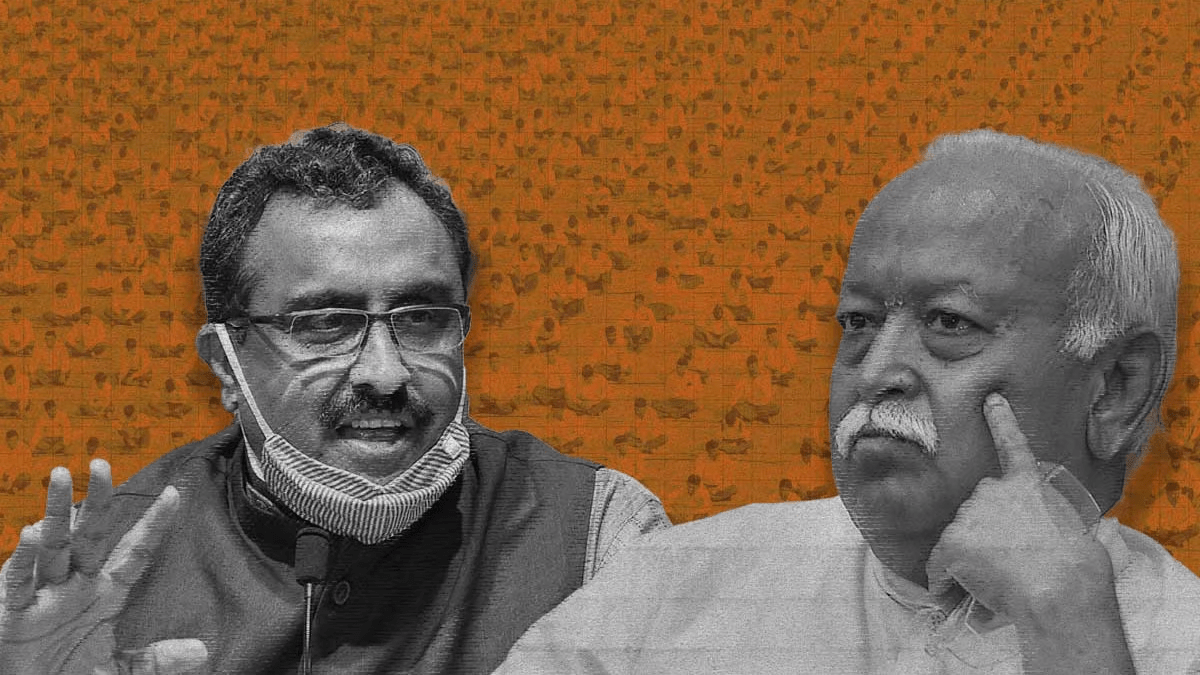
Ram Madhav and Mohan Bhagwat, Stylised by Jaseem ( Photo Courtesy : The News Minute)

The shrill voices of those who give orders
Are full of fear like the squeakings of
Piglets awaiting the butcher’s knife, as their fat arses
Sweat with anxiety in their office chairs….
Fear rules not only those who are ruled, but
The rulers too.

—Bertolt Brecht

The global right is ’terrified’ (at least that’s what it wants us to believe)

We are being increasingly told that it has finally discovered what could prove to be its nemesis.

Right from the likes of Donald Trump to the Indian origin American Vivek Ramaswamy – who has even written few tomes on this ’menace’ to the controversial hard right Florida governor De Santis, there are claims that the spectre of woke or wokeism haunts them. One can recall how De Santis had famously declared in his re-election victory speech that ’Florida is where Woke ideology goes to die’. [1]

What needs to be noted that this ’menace’ felt by the right is not limited to the Western World only.

There are newer converts to this movement.

Mohan Bhagwat, the Supremo of RSS ( Rashtriya Swayamsevak Sangh) – a Hindutva Supremacist Organisation – happens to be the newest entrant. Sometime back he joined this chorus by the global right, similarly expressing his anger against ’Wokeism’ and ’Woke People’ in no uncertain terms. For him these were ’forces’ who were ’spoiling Indian ethos’.

( Read the full article here )

Democracy and Religion in Modern India: Critical and Self-critical Reflections – Prof Rajeev Bhargava

Professor Rajeev Bhargava, noted political theorist will be delivering the 29th Democracy Dialogues Lecture on Sunday, March 31, 2024 at 6 PM ( IST)

Please reserve the time and date for the lecture. Details are given below

Democracy Dialogues Lecture 29:

Speaker: Professor Rajeev Bhargava

Date: Sunday, March 31, 2024, at 6 PM IST

Theme: 

Democracy and Religion in Modern India: Critical and Self-critical Reflections – Prof Rajeev Bhargava

– New Socialist Initiative

Abstract:

“It is widely accepted that ‘secular’ is an alien category in India. This is too simplistic a view. But even if we agree with it, how come no one has asked if ‘religion’ is alien to India? My claim is that it is or at least it is as foreign to India as secular is. What are the implications of this thesis? What have been the consequences of religionization on Indian society and polity? How has it shaped Indian democracy?  In my presentation, I shall expand these views and show why India  needs secularism and in what form.”

About the speaker :

Renowned political theorist and former director of  Centre for the Study of Developing Societies ( CSDS), Delhi Prof Rajeev Bhargava is currently an honorary fellow at the Centre and the director of its Parekh Institute of Indian Thought. He has taught at the University of Delhi and Jawaharlal Nehru University (Delhi) and has lectured, taught and held visiting professorships at several international universities. 

Prof Bhargava’s work on individualism and secularism is internationally acclaimed. His publications include Individualism in Social Science (1992), What Is Political Theory and Why Do We Need It? (2010) and The Promise of India’s Secular Democracy (2010). His edited works include Secularism and Its Critics (1998), Politics and Ethics of the Indian Constitution (2008) and Politics, Ethics and the Self: Re-reading Hind Swaraj (2022), Bridging Two Worlds : Comparing Classical Political Thought and Statecraft in India and China (2023) 

‘Cultural Marxism’: What Links Mohan Bhagwat and the ‘New Age Chain of White Terrorism’?

‘It was Norwegian far-right terrorist Anders Breivik, who killed over seventy people in a car bombing and mass shooting of children in 2011, who first brought the term “Cultural Marxism” to the world’s attention in his thousand-some paged statement of belief, which focused almost entirely on the concept.’ (Joan Braune, ‘Who’s Afraid of the Frankfurt School – “Cultural Marxism” as an Antisemitic Conspiracy Theory’, Journal of Social Justice, Vol. 9, 2019: 2)

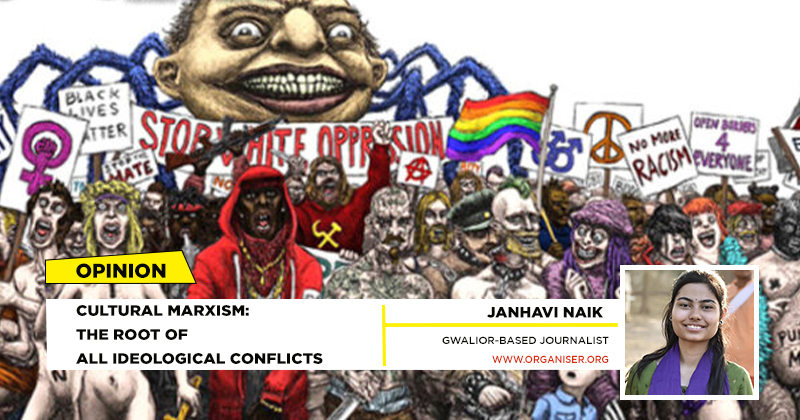
Image from RSS mouthpiece Organizer on ‘Cultural Marxism’

The ideology of Hindu supremacism is going global. Last Vijaya Dashami the RSS supremo Mohan Bhagwat had waxed eloquent on a new enemy, imported directly from White supremacist terrorist discourse, namely ‘Cultural Marxism’. The term is a New Right invention that has nothing to do with any specific tendency, Marxist or otherwise. It is the name of a right-wing conspiracy theory that blames all the different claims being made today as threatening to ‘traditional family values’ (read patriarchy) and to ‘traditional ways of living’ of the Whites, now threatened by growing demands of equality and multiculturalism from various quarters. As the quote above states, this term was first brought to the world’s attention by a mass murderer who killed 77 people in Norway some thirteen years ago. According to Paul Rosenberg, Brevik had used the term ‘cultural Marxists’ or ‘cultural Marxism’ 600 times in his 1500-plus page manifesto.

Continue reading ‘Cultural Marxism’: What Links Mohan Bhagwat and the ‘New Age Chain of White Terrorism’?