This intervew withSUDHA BHARADWAJof Chhattisgarh Mukti Morcha was conducted byJUSTIN PODURin Raipur on 5 March 2013
JP: As a lawyer and an activist, how do you see the relationship between legal work and activism?
SB: I see myself primarily as a trade unionist. I joined the union movement over twenty years ago, and it was the union that made me a lawyer. They felt that workers needed a good lawyer in their fight with the corporations. Our union is one of contract workers and has been striving to overcome divisions in the working class. Here, workers have a close connection with the peasants. So, we believe that working with the peasants is part of unionism.
When I got to the High Court, I found that all the people’s organizations were in a similar situation. The laws that give you rights are poorly implemented. When you fight, the status quo has many legal weapons, launches malicious litigation, etc. So we have a group of lawyers now (Janhit), and we work on group legal aid, not individual legal aid. The idea is that if you help a group, that can bring about some kind of change, create some space. I’ve also gotten involved with the People’s Union for Civil Liberties (PUCL), for which I am the General Secretary in Chhattisgarh. Continue reading The Bastar Land Grab: An Interview with Sudha Bharadwaj→
This piece is in response to Waled Aadnan’s post on Kafila titled ‘Because Presidency is an Idea – All You Need to Know about What Happened at Presidency University’ (dated 15 April 2013). Mr. Aadnan’s well-written and succinctly argued piece is not an isolated voice; it echoes a dominant way of thinking that has been noticeable among the various protests against the recent incident of vandalism in the Presidency University (erstwhile Presidency College). Let me begin by stating, like many others already have, that the vandalism that happened in Presidency on 10 April 2013 should be condemned in the harshest of terms. My discomfort lies in some of the ways in which these condemnations are being articulated in the public domain over the past few days. I would suggest that the majority of the protests emanate from a sense of hurt delivered to the idea of eliteness of the educational institution in question, which cannot unfortunately be supported because it tries to detach this incident from the broader socio-political forces of our times by sensationalising the issue. Continue reading Debating the Attack on Presidency University: Pratyay Nath→
A five year old girl is now in a critical condition in a Delhi hospital after being brutalized and raped by a neighbour. The Delhi police, which has dealt with the situation with its characteristic incompetence, first refused to file an FIR when her parents went to the police station, and then, tried to bribe the girls parents with two thousand rupees so as to ‘hush them up’. Subsequently,a young woman who tried to protest against the behaviour of the police at the Dayanand Hospital were the girl was initially taken for treatment was slapped by a policeman, an Assistant Commissioner of Police, in full public view. His actions have been recorded on video. It is believed that the policemen who tried to bribe the victim’s parents and the policeman who slapped the young woman have been suspended.
But can the suspension of a few individuals address what is obviously a deep rooted culture of misogyny and class prejudice (what else is it but class prejudice – would a policeman in a thana, say in an affluent South Delhi colony be able to offer two thousand rupees as ‘hush money’ to parents of an assaulted child with the same ease with which they could in Gandhi Nagar in East Delhi) within the Delhi Police? Is more severe and strict action that goes right to the top and to the source, not necessary in order to send a signal that this kind of behaviour within the police force cannot be tolerated? Must Delhi’s police commissioner not be compelled to resign, for his abysmal failure in terms of dealing with sexism and for failing to address the contempt for citizens who are not affluent that is now clearly endemic to the Delhi Police’s work culture?
Elsewhere on Kafila, we have published a 7000 word long response by Madhu Kishwar to Zahir Janmohamad’s open letter to her which appeared on 15 January, followed by Zahir Janmohamad’s response. Perhaps a few things need to be stated here clearly with respect to her ‘response’. It seems to me to violate every tenet of reasoned debate and argument and is replete with name calling and stereo-typing of not just the secularist ‘other’ [who is her real other, not the Muslim] but even of the adversary she is arguing with. So if Zahir is a Muslim, he has to be X, Y, Z and has to be believing in A, B, C. Everything starts and ends in bad faith. But then that is what distinguishes Madhu Kishwar from others. She is in her element especially in relation to those whom she disagrees with. With her there can be no disagreement – you have to be sneered and jeered at, irrespective of whether you are a Medha Patkar or an Aruna Roy. I suppose these are matters of personal style and I shall not dwell on them further.
Let me rather, turn to some of the more substantive issues raised in Madhu’s response. Zahir has answered most of them but it seems to me that a couple of vital questions still remain. Even here, though, a caveat is necessary. I have great admiration for Madhu Kishwar’s battle in defense of the rikshaw pullers in Delhi and have often said so openly to her as well as others. However, I do know that it is possible to talk to her when only we agree, which is very rare. On matters that we disagree about, I have decided that I do not want to enter into any kind of an argument with her. In any case, large parts of her ‘response’ are like Modi’s PR handouts, served to us without any sense of critical examination. Therefore, what follows below is not my reply to her but my reactions to a set of allegations she has raised about whosoever is opposed to Narendra Modi – all lumped together in a breathtaking move of reductio ad absurdum, first as secularists , who are reduced to Leftists/ NGO activists and finally to Congress-supporters (because, she says in her Modinama1, the Congress has been equally responsible for all the riots till date). I therefore, lay my cards on the table at the outset: I am an inveterate Modi-hater (and a Congress-hater as well, if that makes sense to anyone in her dichotomized universe) and Kafila is a forum with a certain, if very broad, politics that, at the minimum rules out being pro-Modi. Continue reading Spin Doctors, Propagandists and the Modi Make-over→
On 15 January, Kafila published an open letter to MADHU PURNIMA KISHWAR by ZAHIR JANMOHAMED. Three months later, Kishwar has sent us a response. Given below her response are comments by Zahir Janmohamed.
*
Dear Zahirbhai,
My apologies for the delay in responding to your “Open Letter” addressed to me through Kafila on January 11 2013.
Unlike most of those upset at my articles on Gujarat, you have been remarkably measured in your tone and tenor and also respectful in questioning my observations. However, the content of your letter annoyed me no end. I kept postponing my response in the hope that my annoyance at the absurdity of your chargesheet would subside over time. I honestly did not want to give you an angry or discourteous response so that the dialogic mode you established remained undisturbed.
However, as I began processing the enormous load of material I had gathered from Gujarat, my annoyance kept increasing at your jaundiced viewpoint. Therefore, I thought of letting the series of articles I am writing answer some of your questions. I had made it a point to ask all the questions you raised from Gujaratis I interviewed. At the end of my first series on Gujarat I would have written to ask you if you got your answers. Continue reading A conversation that didn’t take place in Juhapura: Madhu Purnima Kishwar and Zahir Janmohamed→
Guest post by WALED AADNAN: On 10th April, 2013, an unprecedented incident happened at Presidency University (erstwhile Presidency College), Kolkata. Now, unprecedented is a strong term when it relates to Presidency College, because it has, over its 196- year- long history, seen much. It has been broken in by rioting mobs in 1926; in the 1960s and 70s, it was the so-called headquarters of the Naxal movement in Bengal; it has nurtured Indian Nobel Prize and Oscar winners and consistently over its history. It has been one of India’s elite colleges and a hotbed of left-wing politics.
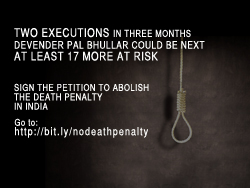
AMNESTY INTERNATIONAL lists some reasons why death penalty should be abolished in India:
Inconsistency: Three people, Harban, Kashmira and Jeeta were sentenced to death for a crime in which they played similar roles. But they met different fates. Kashmira Singh’s petition to the Supreme Court was accepted and his sentence commuted to life imprisonment. Harbans Singh was recommended by the court for clemency from the President. Jeeta Singh’s petition was dismissed and he was hanged.
Flaws: In August 2012, 14 retired judges wrote to the President of India, pointing out that the Supreme Court had wrongly awarded the death sentence to 13 people. They called the execution of two wrongly sentenced prisoners in 1996 and 1997, “the gravest known miscarriage of justice in the history of crime and punishment in independent India”.
Bias: “I thought I should get all these (capital punishment) cases examined from a normal citizen’s point of view in terms of the crime, intensity of the crime and the social and financial status of the individuals who were convicted and awarded capital punishment. This study revealed to my surprise that almost all the cases which were pending had a social and economic bias.” APJ Abdul Kalam.
To sign their petition to the Prime Minister of India, go here.
Press statement put out by the PEOPLE’S UNION FOR DEMOCRATIC RIGHTS on 12 April 2013.
PUDR strongly denounces the Supreme Court’s dismissal this morning of Devinder Pal Singh Bhullar’s plea for commutation of the death sentence awarded to him to life. The issues at stake in this dismissal are multiple, that of clemency, death penalty, miscarriage of justice and precedence.
Bhullar was sentenced to death in 2003 for carrying out a bomb blast outside the Delhi Youth Congress office which killed nine people in 1993. He has been deemed mentally unstable. The High Court’s decision of upholding the death sentence was not a unanimous decision. After he was given the death sentence by the Supreme Court, he appealed to the then President of India for clemency in 2003. The President, after a lapse of over eight years, dismissed his mercy plea in 2011. Bhullar had sought commutation of his death penalty to life sentence by the Supreme Court on the ground that there was inordinate delay by the President over his plea for clemency. Continue reading On the Supreme Court of India’s rejection of the mercy plea of Devinder Pal Singh Bhullar: PUDR→
This is a press release from the Parveena Ahangar-led ASSOCIATION OF PARENTS OF DISAPPEARED PERSONS on 11 April 2013:
The Association of Parents of Disappeared Persons (APDP) strongly refutes the recent claim of the police that Showkat Ahmad Paul, of Lawaypora, is part of a fidayeen squad of a militant group planning to carry out a strike in the civil lines area of Srinagar City. APDP states that the claim floated through a section of the media quoting police sources is utterly baseless and false. After having abducted and disappeared Showkat Ahmed Paul in 2003, this is a fabricated attempt by the security forces and state intelligence agencies to obfuscate and deny responsibility in the case of his disappearance. The family who are being harassed by the security agencies fear for the safety of their son who is in their illegal and unlawful custody since 2003. They fear that after branding him as a Fidayeen the security agencies now intend to murder Showkat, by staging an encounter or using some other extra judicial method. Continue reading Showkat Ahmad Paul is no terrorist: APDP→
We have watched with disgust and horror the brutal police assault on students during a peaceful demonstration organized by four Left students’ organizations on 2nd April, 2013 in Kolkata and the subsequent death of Sudipta Gupta, a participant in the demonstration, while in police custody. Sudipta was a bright student and a leading activist of the Students’ Federation of India. We are shocked to see the Chief Minister of the state absolve the police of any responsibility for Sudipta’s death before a proper enquiry had even been initiated. We do not perceive this incident as an isolated one but rather as the egregious culmination of a series of systematic attacks on the civil and democratic rights of the academic community in West Bengal over recent months. We strongly condemn this unprovoked singular attack on a peaceful students’ demonstration and the subsequent custodial death of Sudipta Gupta. We demand an immediate and impartial enquiry into the incident. Continue reading Statement by concerned academicians on the death of a student in police custody in Kolkata→
It is over two months since policemen and others allegedly molested women students of Delhi University as they protested against Narendra Modi’s presence at a college event within the University Campus. Not a word of support or concern has emerged from the Vice Chancellor. Instead, cases have been filed by the police against students and teachers who participated in the protest. The Vice Chancellor’s silence is probably among the less hypocritical responses that he could have had. At least students don’t have to hear assurances about their safety once more, and that lie has been laid to rest.
Sometime last year I happened to be present at an interaction between the local Delhi police and women hostel residents of Delhi University. The police had informed three hostels of a ‘meet the public’ programme at which we were required to be present and urge students to attend as well. The students, who were preparing for exams at the time, attended the event somewhat reluctantly, but in the course of the evening, provided the feedback that was asked for with unexpected vigour. A woman DCP and other police representatives who had been called to address us, chose to assure us that the city was in fact safe despite a lot of media noise to the contrary, and that the reliability of the police could be counted on in all instants. This did not go down well. Various students asked what they should do when the police leered at them, exposed themselves to the women, urinated deliberately in front of them, lolled in their chairs chatting with security guards while cars slowed down threateningly in front of the hostel gates. The DCP, flummoxed by this flood of complaints, finally said that the police were after all a part of society and would reproduce its problems. This rare if honest admission should be taken seriously as a sign of how women should regard the question of their own safety.
The New Socialist Initiative (NSI), Jamia Teachers’ Solidarity Association (JTSA), Nishant, Anhad, Krantikari Lok Adhikar Sangathan and the Stree Mukti Sangathan have put out this statement in advance of the demonstration tomorrow (9 April) 2 pm before the Bangladesh High Commission in Delhi.
The neighbouring country of Bangladesh is going through a new churning. Hundreds and thousands of people have hit the streets of Dhaka, demanding strict punitive action against ‘war criminals’ and their organisations, who forty-two years ago—at the time of the liberation struggle/war of the then East Pakistan (now Bangladesh)—colluded with the Pakistan army and committed untold acts of atrocities on the general public.
Basically, there are two main demands of the protesters: war criminals should be strictly punished and organisations like the Jamat-e-Islami, Bangladesh, should be banned and all commercial and other kinds of establishments run by it should be proscribed. Continue reading In Delhi for Dhaka: A solidarity vigil for Shahbagh→
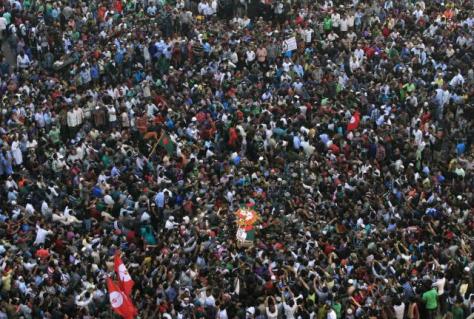
Being here at this moment, in Shahbagh (Projonmo Chottor, as it is now called) and on the streets with activists from the Gonojagoron Mancha – young people, academics, veterans of the liberation movement, singers, artists, writers, professionals and thousands of ordinary people – is a unique and inspiring experience.
Battle for the soul of Bangladesh – Rally in February against the killing of Rajab Haider, the blogger who was a key figure in the protests against Islamists
Guest post byDHRUBA JYOTI PURKAITandDEEPSHIKHA HOODA.
Sakhra (Yavatmal): Deep in the heartland of Maharashtra’s suicide-ravaged Yavatmal district, the Gond tribal settlement of Sakhra holds a surprise. “There are no husbands here, just children,” explains Kishore Tiwari, president of the Vidarbha Jan Andolan Samiti. A member of the VJAS accompanies us on the bumpy two-hour ride out of Pandarkawada.
We turn onto a dirt trail that runs through a forest clearing; an hour passes before we start spotting cotton fields. We stop and our guide calls out to two female labourers. Only then does it strike us. Most of the labourers picking cotton are women.
It has been 10 years since Laxmi, now 24, gave birth to a son. She met a rich, upper caste boy who had promised to marry her. “Pyaar jataya tha mujhse,” After the delivery, he refused to acknowledge the parentage of the baby. “Congressi tha woh,” she says.
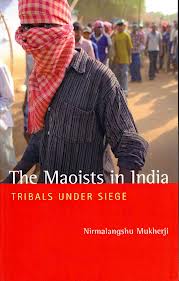
This is a review by JUSTIN PODUR of Nirmalangshu Mukherji’s book Maoists in India: Tribals Under Siege (Pluto Press 2012)
The Maoists in India, Nirmalangshu Mukherji
Central India is a place where all the fault lines of “development” in today’s world converge. Indigenous people, vast stretches of natural forest, mineral-hungry corporations; media, government institutions, and political parties heavily compromised by private interests; people’s struggles, armed insurgency, counterinsurgency, military occupation, paramilitarism – all are present, and until recently, it has all been a well-kept secret.
The struggles play out differently in different parts of Central India. In Orissa, indigenous people’s movements have battled mining companies and stalled projects for years, in Kashipur and Lanjigarh. In Chhattisgarh, in the northern Bastar region, one of India’s billionaires, Naveen Jindal of the Jindal Group (also a polo player and a Congress Party Member of Parliament for a different district), wields tremendous economic and political power. The mines use captive power plants, coal or hydro, so each mine causes massive ecological and agricultural damage. In a profile by Mehboob Jeelani in Caravan Magazine on March 1, 2013, Jindal explained his philosophy: “We don’t control all the raw materials, but we have captive mines for 60 or 70 percent. This is something my father really believed in—that we must control our raw materials. If we don’t, then other people control us. So we made a conscious effort to acquire coal and iron ore mines.” In southern Bastar in Chhattisgarh, a Maoist insurgency is fighting against government forces, police, paramilitaries, and vigilante groups, from bases deep in the forest, in a war that was largely unknown for decades.
In India, the secret of the insurgency was broken by a series of atrocities committed by a group called Salwa Judum, starting around 2005. Salwa Judum in the Americas would be called paramilitaries, but in India is called a vigilante group. Salwa Judum was organized by the state and headed by a Congress Party politician named Mahendra Karma. It burned hundreds of villages, committed murder and rape, and tried to channel the indigenous people of the forest villages into roadside camps, where their movements could be controlled. This was all done in the name of fighting the Maoist insurgency, and it largely failed on those terms: Maoist numbers increased, the indigenous people went deeper into the forest. But it was a human disaster, and that human disaster has continued. The objective is the lands where the indigenous people (in India called adivasis) live – specifically the minerals underneath those lands, which put them in the way of the extractive development model and hence, in the line of fire. Continue reading To Break a Siege: Justin Podur→
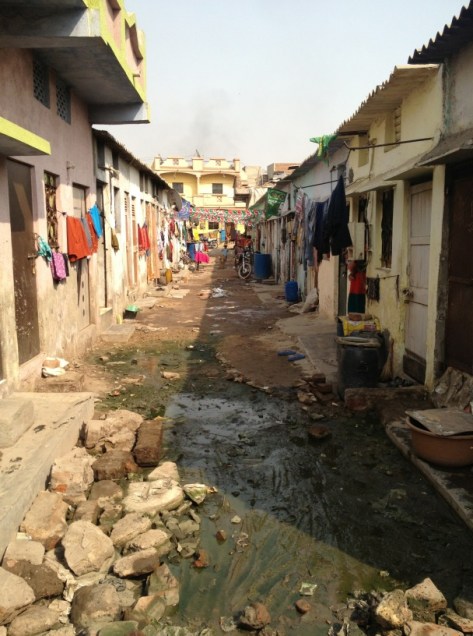
A colony of 2002 riot affected families in Ahmedabad. Photo by Zahir Janmohamed
This is a guest post by ZAHIR JANMOHAMED: This morning, April 1, Google announced its latest product: Gmail blue. It is email except for one critical difference—everything is blue.
“I can’t believe I waited so long for this,” a hilarious Google video says.
It works because it is funny and so obviously absurd—you would have to be, well, a fool to believe this April fool’s day joke. But the Google prank is also something else: harmless. It does not hurt anyone nor it does not trigger painful memories.
This is a guest post by ANONYMOUS: When elephants fight it is the grass that suffers, so goes an old Kenyan proverb. In the maelstrom of political hysteria unleashed by Jayalalitha and Karunanidhi ostensibly in aid of Sri Lankan Tamils, democracy, truth and solidarity have been the biggest casualties. Over the past few months, Tamil Nadu has witnessed attacks on Sri Lankan Buddhist monks and Christian pilgrims, and the government sanctioned blockade of Sri Lankan schoolchildren and sportspersons.
The latest salvo from Chennai regarding Sri Lanka is the Tamil Nadu assembly resolution calling upon India to press for a United Nations Security Council mandated referendum amongst Tamils living in Sri Lanka as well as Tamils of Sri Lankan origin in other countries on the question of carving out an independent Tamil Eelam in Sri Lanka. This is in addition to demands to declare Sri Lanka a ‘hostile state’, impose some form of sanctions etc. Continue reading Of imagined solidarities and real fears – The politics of the Sri Lankan Tamil cause in Tamil Nadu: Anonymous→
Guest Post by Maruti Suzuki Workers Union, Provisional Working Committee
Third Day of our Fast Unto Death – Police and Administration Gearing up for Further Repression of Our Struggle!
Friends,
Today is the third day of our fast unto death that began on 28th March. However it seems that the state is adamant on responding to our peaceful movement with increased violence and use of brute force. Today, when the local people of nearby villages and our family members came to lend their support to us at the site of the hunger strike, they were greeted by an increased number of policemen. When we tried to meet Haryana Industrial Minister Randeep Surjewala – we have been sitting outside whose residence for the last 6 days braving rains and the cold – he flatly refused to meet us. When the family members surrounded him demanding our rights then a large number of police men appeared at the site and the minister left the place using the police to disperse the people. Now there are 2 police vans stationed here and the small shopkeepers and tea stall owners in the area are being threatened by the administration to withdraw their support from our movement. When the administration realized that we are not going to abandon our struggle because of their threats then they put pressure on the owner of the plot where we are sitting and tried to use him force to us out. Continue reading Haryana Police and Administration Repress Ongoing Maruti Workers’ Struggle: MSWU→
It is anger on the streets that brought back to the forefront the neglected issue of sexual violence, energized a government appointed Committee to put together clear and well reasoned recommendations on law reform, and forced the government to table the Criminal Law Amendment Bill (2013). It is public pressure and years of struggle by the women’s movement that is reflected in the more progressive parts of the Bill, passed recently by both Houses of Parliament. Unfortunately, despite unanimity from a large cross section of society, that the definition of rape cannot be restricted to an outdated understanding of rape as perpetrated by men on women, the version of the Criminal Law Amendment Bill that was finally passed by Parliament retains this language. The law, if passed in this form will be a betrayal of the rights of millions of transgender persons, intersex persons and sexual minorities not born women.
Any death is regrettable and those who died due to police fire may also come under this category. What is interesting is Jamaat’s modus operandi. The lone survivor of 14 December mass murder of intellectuals described in a recent TV documentary how Al Badr killed Prof Munier Chowdhury and others. Some were bitten with iron bars to death and at the final point; they would insert such bars into the head of their victims to ensure death. Jamaat-Shibir reportedly did exactly the same couple of weeks ago when they killed some police constables and others. It shows Jamaat-Shibir’s Standard Operating Procedure has remained unchanged for the last four decades…
“The Pakistani soldiers unleashed a reign of terror on the soil of Bangladesh in 1971. They brutally killed innocent people, molested Bengali women and ruined the economy. The Jamaat leaders, Ghulam Azam and Matiur Rahman Nizami, issued the fatwa that those activities were permissible to save Islam” (Dr Mohammed Hannan, Page 252, Bangladeshe Fatwar Itihas, 1999).
I
What is common between Syed Md Nurur Rahman Barkati, Shahi Imam of Tipu Sultan Masjid, Kolkatta and Maulana Syed Athar Abbas Rizvi, imam, Cossipore Masjid or Md Qamruzzaman, general secretary, All Bengal Minorities Youth Federation ? Well, if media reports are to be believed then they would be the leading lights of a demonstration to be held on March 30 th in Kolkata demanding stepping down of Bangladesh Prime Minister Sheikh Haseena’s resignation. Continue reading Muslim Right: Baring Its True Fangs!→



 KAFILA - COLLECTIVE EXPLORATIONS SINCE 2006