Category Archives: Violence/Conflict

Israeli repression at The Gate of the Sun

Bab-AlShams

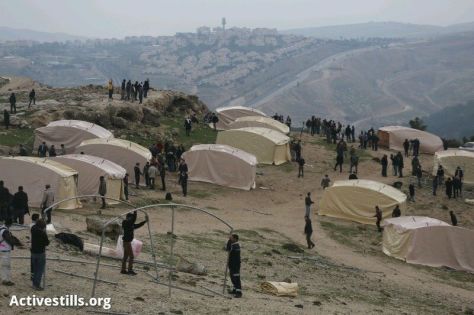
On January 11, 2013, 250 men and women from across Palestine established a new Palestinian village named “Bab Al shams” (Gate of the Sun).

They declared:

We, the sons and daughters of Palestine from all throughout the land, announce the establishment of Bab Alshams Village (Gate of the Sun). We the people, without permits from the occupation, without permission from anyone, sit here today because this is our land and it is our right to inhabit it.

A few months ago the Israeli government announced its intention to build about 4000 settlement housing units in the area Israel refers to as E1. E1 block is an area of about 13 square km that falls on confiscated Palestinian land East of Jerusalem between Ma’ale Adumim settlement, which lies on occupied West Bank Palestinian land, and Jerusalem. We will not remain silent as settlement expansion and confiscation of our land continues. Therefore we hereby establish the village of Bab Alshams to proclaim our faith in direct action and popular resistance. We declare that the village will stand steadfast until the owners of this land will get their right to build on their land.

Continue reading Israeli repression at The Gate of the Sun

In Multiples of Ten Ravanas

Some (more) thoughts on Indian and Pakistani soldiers beheading each other at the ceasefire line in Jammu & Kashmir

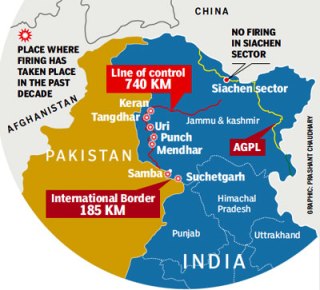
Hindustan Times Graphic
From the Hindustan Times

In the early hours of 10 January 2013, I published a post here that asked, “Was an Indian soldier decapitated at the Line of Control or not?” Soon thereafter, the family of Lance Naik Hemraj Singh of 13 Rajputana Rifles cremated his body and went on a hunger strike, demanding the government get the head. Several readers commented that now that it was clear a beheading did take place, I owe them an apology. I do not see why I owe them such an apology considering  I never said that an Indian soldier wasnot beheaded. I only pointed to the conflicting reports, the absence of official mention about whether or not a soldier was beheaded, a quoted a Reuters report that categorically said that according to the official spokesperson of the Northern Command, no soldier was beheaded, though the two soldiers’ bodies were mutilated. Despite such an official denial quoted in a trusted news source, I had written, “It is possible the anonymous sources are right, because this is not the first time both sides are blaming each other of showing disrespect to bodies of dead soldiers in violation of the Geneva convention.” Continue reading In Multiples of Ten Ravanas

Dear Barkha Dutt: The Buck Stops Where?

On the of latest edition, (telecast a few hours ago, on the evening of the 15th of January, 2013) of ‘The Buck Stops Here’, (a flagship news show on NDTV anchored by Barkha Dutt) – ‘India-Pakistan:Another Tipping Point‘, Admiral (Retd.) Ramdas, former chief of the Indian Navy said he knew that Indian forces have beheaded Pakistani soldiers in the past. Gen. (Retd.) V.P. Malik, former chief of the Indian Army contradicted him, and said this had never happened. Barkha Dutt was silent on this matter.

Below is a summary of some highlights of the discussion. Continue reading Dear Barkha Dutt: The Buck Stops Where?

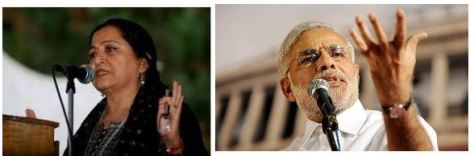
An open letter to Madhu Purnima Kishwar: Zahir Janmohamed

Dear Madhu ji,

I was very excited when I learned you were coming to Ahmedabad and I was honoured that you expressed interest in possibly meeting with me.

I was sitting with a journalist friend when I read your Tweet about visiting Ahmedabad and he told me you are a “pioneering feminist who did ground breaking work.” He also told me that in 2005 you signed a very strong petition calling for Gujarat Chief Minister Narendra Modi’s dismissal because of Modi’s role in the 2002 Gujarat riots. He also added that you have been very vocal on behalf of Kashmiri Pandits. After I witnessed the Gujarat riots in 2002, I returned to the United States—where I was born and raised—and I gave lectures for six months about the violence I saw. In each lecture, an audience member would inevitably shout at me that I have ignored the plight of the Kashmiri Pandits. It is true. I know very little about Kashmir, and for that matter Kashmiri Pandits, and I would have enjoyed and benefited from listening to your views on the conflict there.

I understand from your Twitter feed that you have left Ahmedabad. I know your days in Ahmedabad were limited and I fully understand that you were not able to meet. Therefore in this letter I will try to convey some of the things I had hoped to tell you in person, in particular about your Tweets. Continue reading An open letter to Madhu Purnima Kishwar: Zahir Janmohamed

A petition to end tensions at the Line of Control from citizens on both sides of the LoC

Signatures given at the end. Should you want to add your signature to this petition, write to Anuradha Bhasin at anusaba[at]gmail[dot[com]. The petition with the final list of signatories will be sent to the heads of state in both India and Pakistan.

To,
Indian Prime Minister Manmohan Singh and Pakistan President Asif Ali Zardari,

Dear Sirs,

We, the people of Jammu and Kashmir on both sides of the Line of Control, have been observing with great concern the escalation of tensions at the LoC that have been building up gradually since June 2012 and have suddenly taken an ugly turn since the first week of January, 2013.

We express grave concern at the loss of lives of the soldiers and any casualties to civilians on both the sides. At the same time, we are also concerned about the safety and security of the people of Jammu and Kashmir, particularly the people living at the borders, who are directly hit by sporadic incidents of shelling and firing. Continue reading A petition to end tensions at the Line of Control from citizens on both sides of the LoC

Stalking, Delhi Police and Memory – Another Encounter: Kavita Krishnan

Guest Post by Kavita Krishnan

I have been wanting to post about an experience with Delhi police since yesterday, but haven’t found the time yet… Here goes.

Some days ago, (early this month if I recall rightly), I got a call from a woman worker living in Usmanpur near Seelampur. She got my number through the son of one of our Trade Union comrades, who is a friend of her brother’s. She said she was being stalked by a man who made calls to her thretening an acid attack. She has 3 children and was concerned for their safety too. She told me she was scared to complain to the police, and asked for advice. I was reluctant to advice a police complaint without her being fully ready, knowing that it might not yield satisfactory results. So I suggested we meet and talk things over before deciding.

But soon after, she called again: feeling buoyed by a sense of hope arising from the ongoing movement, she had gone to the police station – alone – and written out a complaint, giving the stalker’s mobile number, the number of his bike, and offering to share recordings she had made on her phone of the threat calls. She said, though, that the police had not given her any proof of having received or recorded her complaint (in spite of her asking).

Continue reading Stalking, Delhi Police and Memory – Another Encounter: Kavita Krishnan

Suran: A poem by Uzair

This guest post is a poem by UZAIR, who grew up near the Indian side of the ‘Line of Control’ in Poonch

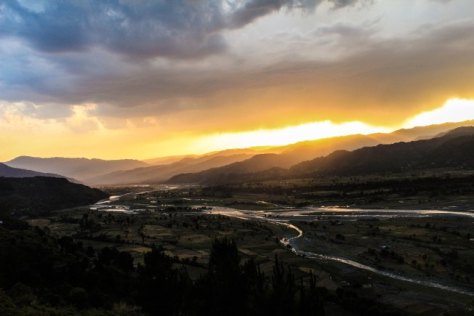
The poet took this photograph in Poonch by the river Suran last summer.Across the second ridge lies the Line of Control. Taken from the Indian side, the photo captures the sun setting on the Pakistani side.
The poet took this photograph in Poonch by the river Suran last summer. Across the second ridge lies the Line of Control. Taken from the Indian side, the photo captures the sun setting on the Pakistani side.

The river carries with it
Snow of distant peaks,
Floating memories
Twigs, leaves.

Only a few miles west
it would be stripped
at the border, asked
to produce a permit,
shot dead or may be not.

Waters were negotiated upon;
so the river travels seamlessly
only a few miles west
to another country.

On its bank, I heard
a cuckoo speak
“The sun shines during day
and stars illuminate the night sky
even across the border”

“And a few collect the twigs
like memories of childhood;”

“smell of dead wood, so familiar
grief and longing, so natural
decades of hope; still alive,
even across the border”

One day the river would flow
eastwards, said the old man
whose corpse floated across,
only a few miles west
and met his children
across the border.

(Uzair blogs at Untitled Untitled.)

See also:

Breaking the Collective – Notes from Jantar Mantar & Koodankulam: Vivek Vellanki

Guest Post by Vivek Vellanki

The death of the young girl brought incommensurable grief for the ‘Indian’ people. A national angst ensued with divergent voices seeking divergent ends: justice, death penalty, fast track courts, end to patriarchy, chemical castration, and a long list that cannot be spelt out here. There was a glimmer of hope that the discursiveness would ensue a quintessentially democratic process of debate, discussion, and deliberation amongst the people. The Indian state with its long-standing reputation wouldn’t allow for that to happen. It had to continue on its pet peeve of Breaking the Collective! The people’s movement in Koodankulam, the anti-corruption movement, the movement for seperate Telangana are some of the many instances that remind us of this pet avocation of the Indian state being pursued in recent times, almost, vocationally. However cynical it may sound, amidst the entire candle lighting and sloganeering, we failed to realise that the protest in Delhi was happening on the terrain that the government decided, in a manner that it wished for it to play out, and was party to the people it wanted to see there. I wish to argue that the closing down of the metro stations has a relation to the nature of the protests at Jantar Mantar. Furthermore it concurs with the tactics of chocking people’s movements logistically and stifling the collective by pathologizing the everyday life of masses. The tragedy of this lies in the fact that such actions of the state have become so recurrent that they have entered our common sense and they present themselves as normal and logical responses. Albeit they have been rationalized by invoking a specious reference to law, order, and safety, there is a need to unpack such a rationalization. My attempt is to extract these actions from that location of common sense and present them for public scrutiny. Through this essay, I would like to draw the connections between the democratic protests happening in locations across the country and state action in dealing with them. In doing so, I hope to bring to notice how the Indian state uses its machinery to purge protests of their democratic tenor and eventually, at least, attempts to break the collective. Continue reading Breaking the Collective – Notes from Jantar Mantar & Koodankulam: Vivek Vellanki

Was an Indian soldier decapitated at the Line of Control or not?

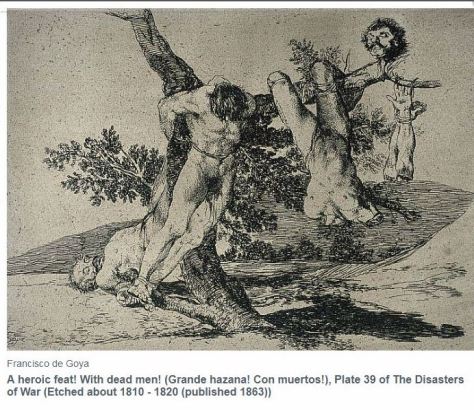
"In this sickening image, one of the most extreme in The Disasters of War series, the naked bodies of mutilated, tortured and castrated men are shown hung from a tree as a warning to others. Goya was one of the first artist to reveal the grim reality of warfare, stripped of all chivalry, romance and idealism. He captured something quintessential about modern war which has found resonance with succeeding generations of audiences. This print was controversially adapted in the 1990s by the artists Jake and Dinos Chapman. It formed the basis for one of their gory, three-dimensional tableaux, in which scenes from the series were recreated using dismembered mannequins covered in fake blood." - Image and caption via nationalgalleries.org
“In this sickening image, one of the most extreme in The Disasters of War series, the naked bodies of mutilated, tortured and castrated men are shown hung from a tree as a warning to others. Goya was one of the first artists to reveal the grim reality of warfare, stripped of all chivalry, romance and idealism. He captured something quintessential about modern war which has found resonance with succeeding generations of audiences. This print was controversially adapted in the 1990s by the artists Jake and Dinos Chapman. It formed the basis for one of their gory, three-dimensional tableaux, in which scenes from the series were recreated using dismembered mannequins covered in fake blood.” – Image and caption via nationalgalleries.org

*

In a skirmish on the Line of Control on Tuesday, 8 January 2013, did Pakistani soldiers behead an Indian soldier or did they not? Or did they behead two soldiers and take away the head of one of them? Or did they behead one and slit the throat of another? Reports in the Indian media have left me utterly confused. I’ll let you decide. Continue reading Was an Indian soldier decapitated at the Line of Control or not?

Indians and Pakistanis Condemn Exchange of Fire and Killings on LoC

List of signatories from both countries given at the end.

We, the undersigned Indians & Pakistanis, are deeply disturbed with the recent exchange of firings and killing of two Indian and one Pakistani soldier across the Line of Control (LoC). The incidence as reported is highly deplorable and no sane person or society can accept such unwarranted and gruesome incidences. The said incidences have a potential to derail the ongoing peace process that has shown remarkable progress in recent times in easing the visa regime, improving trade relations and securing many other confidence building measures that hold great promise for both the countries.

We are happy that the Director Generals of Military Operations (DGMOs) of both countries have spoken to each other after the incidents. We urge that suitable mechanisms must be evolved and implemented immediately to ensure that the concerned authorities on both sides are in constant touch to avert recurrence of any such incidence rather than meet after some damage is done. Continue reading Indians and Pakistanis Condemn Exchange of Fire and Killings on LoC

Posco – Building A Better Tomorrow with Steel: Madhumita Dutta

Guest post by MADHUMITA DUTTA

11TH_POSCO_SITE_655201g

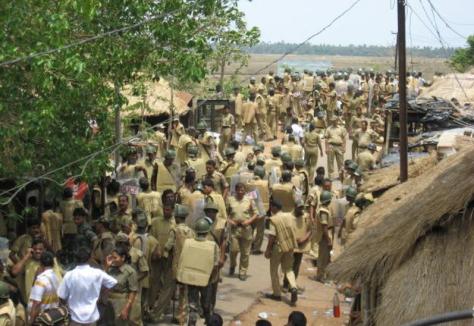
Policemen deployed at the proposed Posco site in Jagatsinghpur, June 2011

As I read the ‘sustainability-commitment’ page[1] on the website of Posco India Ltd, I was reminded of the images of a morning in a village square in the Ersama block of Jagatsingpur district in the Orissa. On April 1, 2008, Balithutha, a small village square, became the battle ground as hundreds of women, men, young and old tore down with their bare hands a 20 feet high bamboo barricade erected by the district police.  An act of defiance by people who came in hundreds, mustering whatever they had—courage, fear, rage—to battle a giant – Posco Steel company of South Korea and the state of Odisha. They came to say ‘we disagree, we oppose’ the plans to take over the lands that we have farmed for generations. That day the sound of their voices and ululations reverberated from the small village square of Balithutha to the offices of the powerful. Continue reading Posco – Building A Better Tomorrow with Steel: Madhumita Dutta

The muezzin’s last call at Babri Masjid: Krishna Jha and Dhirendra K Jha

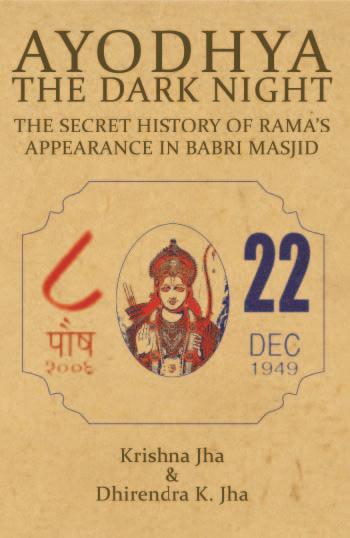
This guest post by KRISHNA JHA and DHIRENDRA K JHA is an excerpt from their book, Ayodhya: The Dark Night, about the original Ayodhya conspiracy of 22 December 1949

Published December 2011 by HarperCollins India;Rs 499; Pages 232
Published December 2011 by HarperCollins India; Rs 499; Pages 232

The sound of a thud reverberated through the medieval precincts of the Babri Masjid like that of a powerful drum and jolted Muhammad Ismael, the muezzin, out of his deep slumber. He sat up, confused and scared, since the course of events outside the mosque for the last couple of weeks had not been very reassuring. For a few moments, the muezzin waited, standing still in a dark corner of the mosque, studying the shadows the way a child stares at the box-front illustration of a jigsaw puzzle before trying to join the pieces together. Continue reading The muezzin’s last call at Babri Masjid: Krishna Jha and Dhirendra K Jha

You were amongst those six; un chhay main tum bhi shamil thay: Swaang Songs

This song in memory of the unknown citizen is produced by Swaang, a Bombay based cultural group, whose members include actors, writers, music directors, musicians and producers “all in the grips of the market-driven Bombay film industry, but whose hearts continue to pull towards progressive politics!”

Composer – Rohit Sharma
Lyrics – Ravinder Randhawa
Singers – Rohit Sharma, Pankaj Badra, Pinky
Narration – Pravishi Das, Ravinder Randhawa

English translation of ‘Maa Nee Meri’

Mixed in every morsel,
What was that chant you kept repeating?
In the garb of concern and worry,
Why was fear the only virtue I learnt of your teaching?
Mother, I will not fear
Mother, I will not become you. Continue reading You were amongst those six; un chhay main tum bhi shamil thay: Swaang Songs

A review of human rights in Jammu & Kashmir in 2012: JKCCS

This brief has been put out by the JAMMU AND KASHMIR COALITION OF CIVIL SOCIETY

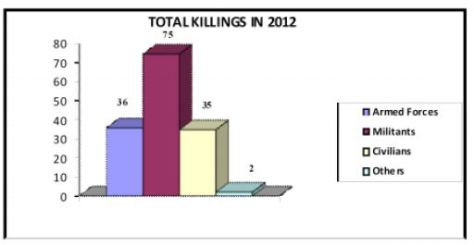
TOTAL KILLINGS

The year 2012 has just passed, and yet again like previous years, the government of Jammu and Kashmir has disgracefully claimed the year to be peaceful. This hyped peace is void of justice & peace and is packed with violence & injustice. In the year 2012 the people of Jammu and Kashmir in routine have witnessed unabated violence, human rights abuses, denial of civil and political rights, absence of mechanisms of justice, heightened militarization and surveillance. The figures of violent incidents suggest that 2012 as usual has been the year of loss, victimization, lies, mourning and pain for the people. Continue reading A review of human rights in Jammu & Kashmir in 2012: JKCCS

Akbaruddin Owaisi – You are an Enemy of Muslims (and Hindus)

Guest post by IRSHADUL HAQUE
Translated from Hindi by Shuddhabrata Sengupta

Akbaruddin Owaisi, you are an enemy of Muslims. You are the kind of adversary who lurks like a snake in the grass, ready to strike at the person who cares for that patch. Your desire to provoke a confrontation between India’s 25 crore Muslims and 100 crore Hindus reminds us of Muhammad Ali Jinnah. This is why Javed Akhtar has gone to the extent of calling you ‘the greatest enemy of Muslims’. I know that I am not alone when I find myself agreeing with this view. Many other Indian Muslims will be in agreement with me. Continue reading Akbaruddin Owaisi – You are an Enemy of Muslims (and Hindus)

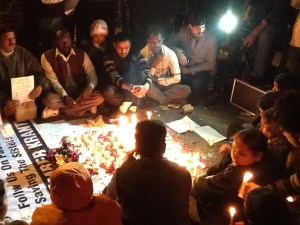
Justice for Soni Sori. Gathering at Jantar Mantar, 02/01/13

Protests against Sexual Violence continue in Delhi. Earlier this morning, there was a gathering to protest against the gruesome sexual violence committed on Soni Sori while in custody in Chhattisgarh under the supervision of Ankit Garg, Superintendent of Police, Dantewada. Ankit Garg was awarded with a presidential police medal on Republic Day (January 26) in 2012.

Soni Sori’s petition at the Supreme Court is due to be heard tomorrow. Continue reading Justice for Soni Sori. Gathering at Jantar Mantar, 02/01/13

Evening at Jantar Mantar.

Candles at,Jantar Mantar
The Wake
The Wake
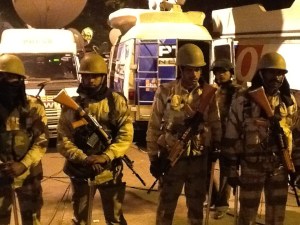
Armed, Cold, Bored
Armed, Cold, Bored

We must resist the cunning of judicial reform: Pratiksha Baxi

Guest Post by PRATIKSHA BAXI

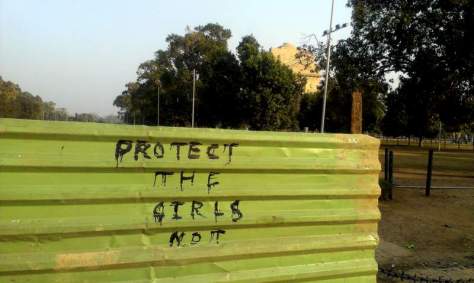
The death of the 23 year old woman following the brutal gangrape rape and assault on a moving bus on 16 December 2012 at a hospital in Singapore early this morning leaves all of us in states of deep mourning. This is a political death. Rape and murder of women is political violence against all women, whether or not, the political class recognises and accepts this. In the course of the last two weeks, many body blows have been endured. We felt a body blow after the political death of the 17-year-old gangrape victim in Patiala who took her life after she was humiliated and pressurised to compromise. The numbing list of such political violence continues.

We have seen the emergence of many kinds of publics. There have been many speeches and writing against the emergence of a retributive public, where the cry for death penalty or castration became a vocabulary of protest, also especially since the media initially focussed largely on this demand. Yet in the last few days there has been a perceptible shift from the focus on forming a retributive public moving towards a passionately reasoned and informed public on what the government needs to do to be accountable to rape survivors, and indeed, to all of us who reject the rape cultures in India.
Continue reading We must resist the cunning of judicial reform: Pratiksha Baxi

For Anonymous: Nilanjana Roy

Guest post by NILANJANA ROY

Photo: Ruchir Joshi
Photo: Ruchir Joshi

That girl, the one without the name. The one just like us. The one whose battered body stood for all the anonymous women in this country whose rapes and deaths are a footnote in the left-hand column of the newspaper.

Sometimes, when we talk about the history of women in India, we speak in shorthand. The Mathura rape case. The Vishaka guidelines. The Bhanwari Devi case, the Suryanelli affair, the Soni Sori allegations, the business at Kunan Pushpora. Each of these, the names of women and places, mapping a geography of pain; unspeakable damage inflicted on women’s bodies, on the map of India, where you can, if you want, create a constantly updating map of violence against women. Continue reading For Anonymous: Nilanjana Roy

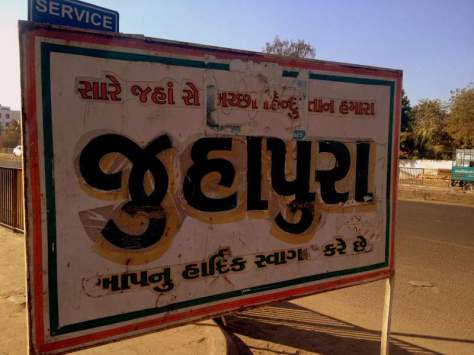
Seeing Pakistan from Juhapura: Zahir Janmohamed

Guest post by ZAHIR JANMOHAMED

Since I started conducting research in March 2011 about the aftermath of the 2002 Gujarat riots, I have learned that the worst way to begin a conversation with a Muslim here in Ahmedabad is to ask about the 2002 riots. I was an eye-witness to the riots in 2002 and I thought my experiences might make some Muslims in Gujarat feel more comfortable speaking with me. I was wrong.

Sometimes I had to interview a person four or five times before they felt comfortable speaking about the 2002 riots. The reasons are varied. Some feel there is no use speaking about the riots as they know justice will never come under Narendra Modi’s watch. Others feel exploited by NGOs and Islamic groups who have used their stories to raise funds for their organizations abroad. And others, as one rape survivor told me, do not want to “relive the trauma.”

But if you ask Muslims in Ahmedabad about Pakistan, chances are you will walk home with a notebook full of comments. Earlier this week I went around my neighborhood of Juhapura—an area pejoratively known as “mini Pakistan”—and asked residents for their comments on Pakistan. The answers are telling. Continue reading Seeing Pakistan from Juhapura: Zahir Janmohamed

What Do Men Have To Do With It?: Rahul Roy

Guest post by RAHUL ROY

I have been sitting quietly trying to finish my new film and had promised myself that I would not get side tracked and concentrate on the task at hand. But enough is enough. I am shocked and disappointed at the way men high jacked a protest that could have been and probably still is the most significant pouring out of women who may never have thought in their wildest dreams that they would be facing water cannons and cops giving them a chase with iron tipped sticks. I am sure it is a coming of age moment for many young women of the city of Delhi.

I am aware that there has been a fair bit of cynicism about middle class women running up and down Raisina Hill and whether it adds up to anything. It damn well does. The next time they see adivasis being chased down by the police in Chattisgarh or in Orissa a penny will drop. It already is, today there is an article by a 19 year old student form Lady Sri Ram College narrating her brush with Delhi Police at the Parlaiment Street Police station and quite significantly she adds that if they are capable of behaving the way they did with a group of ‘well connected’ college students in Delhi then what must be happening in the more remote areas of non metropolitan India. Continue reading What Do Men Have To Do With It?: Rahul Roy