Category Archives: Violence/Conflict

When the pseudo-sentiments of the pseudo-religious are pseudo-hurt

In neighbouring Pakistan, an Islamic cleric recently accused a young Christian girl, Rimsha Masih, of blasphemy, a charge punishable by life imprisonment. He said she had burnt some pages that contained verses from the Quran. The 14 year old girl hails from a poor family and suffers from Down’s Syndrome. An eyewitness to the event showed courage and told a magistrate the truth: it was the Muslim cleric who had put those burnt pages in Rimsha’s bag. The cleric has been arrested and is set, in turn, to be charged with blasphemy.

I have been thinking about the incident. Insulting somebody’s religion is bad. It may cause offence. Often it is intended to cause offence. If somebody insults Islam, by doing things like burning pages containing verses from the Quran, it is bound to outrage a Muslim. Continue reading When the pseudo-sentiments of the pseudo-religious are pseudo-hurt

India and Pakistan: Let people meet

This online petition has been put out by AMAN KI ASHA

The people of Pakistan and India, people of Indian and Pakistani origin around the world, and friends of India and Pakistan, are fed up of the visa restrictions that prevent them from visiting families in the other country. There isn’t even a tourist visa protocol between these two biggest neighbours of South Asia. People in the region want the right to travel and to trade, to walk along coastlines and roads that represent their collective past, to seek and spread harmony across a subcontinent not divided by politics and propaganda. In this modern age of interdependence, it is a tragedy that the citizens of India and Pakistan are left peering over a border made indomitable and intimidating. There is little space for the hand of friendship to be extended across this border. This must change.

The governments of India and Pakistan must:  Continue reading India and Pakistan: Let people meet

On the International Day of the Disappeared: APDP

This press statement was issued yesterday, 30 August 2012, by the ASSOCIATION OF PARENTS OF DISAPPEARED PERSONS, the Bund Amira Kadal, Srinagar – 190001, Jammu and Kashmir
 
Today on the occasion of the International Day of the Disappeared, the Association of Parents of Disappeared Persons (APDP) organized a seminar on the International Convention for the Protection of all Persons from Enforced or Involuntary Disappearances and Institutional Violence and Denial of Justice by India. Various members of the Civil Society addressed the importance of the ratification of the international Convention against Disappearances.
Further, the Association of Parents of Disappeared Persons (APDP) today submitted 507 cases of enforced or involuntary disappearances from Baramulla and Bandipora districts to the State Human Rights Commission (SHRC) for conducting investigations. Continue reading On the International Day of the Disappeared: APDP

Reading the Violence in Assam: Here and There: Musab Iqbal

Guest post by MUSAB IQBAL
… the fact that violence was not merely transitional, a birthmark or a departure, but a much more general and continuous aspect of modern life – Gyanendra Pandey

1.

The misreading or out of place reading of any local and contextual issue and putting it in a wrong frame can be very catastrophic. The recent episode of violence in Assam and the fury it triggered across the country is a classic example of such misreading. But apart from the misreading this complete episode is certainly indicator of certain other phenomenon underlying our fragile society.

Moreover it looks that this is not only adding to verbal construction of abuse but also a very controlled confusion working at someone’s behest. The rally and violence in Mumbai, Ranchi, and Jamshedpur whose motivating factor was this violence happening in northeast and cross border against “Muslims”. The other episode, which adds to cynicism, is through popular newspapers in South India and in Assam publishing that Assamese will be subject to target and then under the cloud of rumor and suspicion these residents of the state is forced to run.

Continue reading Reading the Violence in Assam: Here and There: Musab Iqbal

Another Onam – MB Manoj on Dalits, Onam and Malayali identity

Today is the first day of Onam – and MB Manoj reminds us about other histories of Kerala and other Malayali voices than those of the dominant Nair community.

The interview is entirely in Malayalam. But here’s a short account of what Manoj says in both videos below:

Reading Onam through the eyes of Dalits, the festival loses its “natural” association with the Malayali identity. In fact, in the words of Manoj – “Onam is a black day for Dalits, a day of murder, even as it is a day of happiness for the upper castes”. The coming of Onam also marks the coming of the caste system and slavery in Kerala. Manoj talks about Dalit cultural life in Kerala and its relation to Onam. There are folk songs which criticise the upper-caste nature of Onam and its vegetarianism. Similarly, there are songs which criticise the temple entry proclamation of Kerala. There is a realisation among Dalits that Onam is a celebration of the murder of their king by the upper castes. As part of this realisation, Dalit movements, and especially the Indian Dalit Federation, have observed hunger strikes during Onam days. Manoj reminisces participating in one of these hunger strikes in Idukki town in Kerala during his college days. Manoj stresses that most Dalits, tribals and backward castes eat meat during Onam and their culture fall outside the cultural milieu of Onam. Therefore, for the lower-castes, Onam is neither a cultural nor a national festival, but a festival of the upper-castes.


The Hidden Injuries of Race: A Response to Lawrence Liang: Rijul Kochhar

Guest post by RIJUL KOCHHAR

Turn on the television any given day now, and you will be greeted by the news-media in unison informing you about the psychosis of fear—“north east fear/scare” is a useful shorthand—that seems to have gripped some of our fellow citizens. The numerous characterizations, all of which are variations on a theme, are not only ill-informed, they are also wholly inadequate and directionless. What does it mean to say that north-easterners are in the grip of fear, running away herd-like to their corners of the home-world? The bovine image, though useful in the sense of visualizing the sheer numbers involved, doesn’t allow us to think beyond.

This piece is an attempt in that direction. The fear is real, it is palpable on the railway platforms and at airports of major cities, and it surely has had the potency to disrupt a large number of people in the steps and motions of their daily lives. Others, including on Kafila, have written about the contentious issue of borders and migrants, of numbers and mutable identities; The Hindu has featured a series of interesting articles under the Sunday Story section, delineating the central role of information-technology and communication—technology whose role itself has radically transmuted amidst the last few months of the troubles, where we have seen the emergence of the cellphone screen as the new, unchartered frontier of radical, affective simulacra. Fingers have been raised, especially by our ever-articulate military-intelligence-scholarly community, against the customary foreign hand, and many of their accusations, might, in the days ahead, speak their own truth.

Continue reading The Hidden Injuries of Race: A Response to Lawrence Liang: Rijul Kochhar

An Analysis of the Latest Round of Internet Censorship in India (Communalism and Rioting Edition): Pranesh Prakash

Guest post by PRANESH PRAKASH

How many items have been blocked?

There are a total of 309 specific items (those being URLs, Twitter accounts, img tags, blog posts, blogs, and a handful of websites) that have been blocked. This number is meaningless at one level, given that it doesn’t differentiate between the blocking of an entire website (with dozens or hundreds of web pages) from the blocking of a single webpage. However, given that very few websites have been blocked at the domain-level, that number is still reasonably useful. Continue reading An Analysis of the Latest Round of Internet Censorship in India (Communalism and Rioting Edition): Pranesh Prakash

How Delhi paper ‘Sahafat’ fell for fake images of violence in Burma

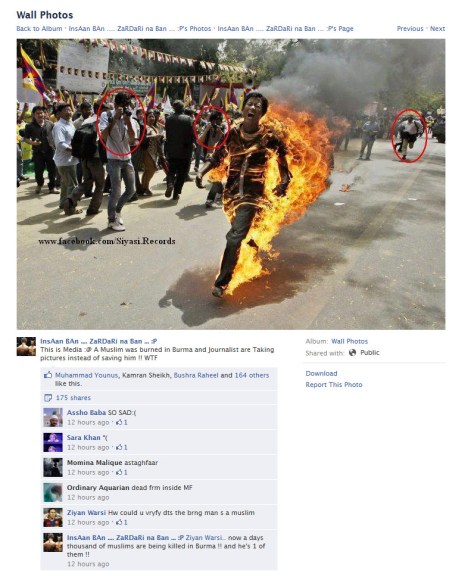
Yousuf Saeed wrote in Kafila on 13 August how fake images of violence against Muslim Rohingyas in Burma – images that were in fact, of, say, earthquake victims. In his post he mentioned how even some Urdu papers in India were fooled by the images,which provoked violent protests in Mumbai,and recently, Lucknow.

Now, CM Naim describes in detail how Sahafat, an Urdu newspaper published from Delhi, fell for these fake images. Naim translates large parts of two charged-up articles in Sahafat, one of which calls for the boycott of Buddhists in Delhi. One article was published on 10 August and one on 16 August. As Naim says, it’s time for the Press Council of India to take note. One excerpt: Continue reading How Delhi paper ‘Sahafat’ fell for fake images of violence in Burma

Iftar Party for Members of the North East Community hosted at Nilasandra: A Report

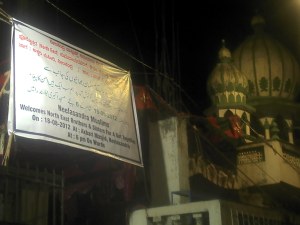
In the last few days the Nilasandra area in Bangalore has gained infamy across India as  it came up as the name touted over and over again as the most sensitive area in Bangalore and the one which featured in most  rumours about potential attacks against members of the north east community.

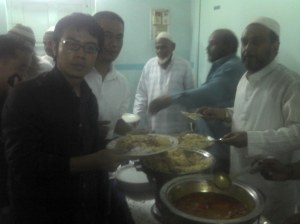
In a remarkable show of camaraderie and generosity the Muslim community called for an iftar party in the Akbari Masjid in Nilasandra and dozens of members of the north east community were invited along with members of the state administration. Over a thousand Muslims from Nilasandra, Anepalaya and Austin Town collectively vowed to safeguard the north east community living in Nilasandra.

In a touching speech one of the officials of the Akbari masjid Sadr Saab said that it was unfortunate that Nilasandra had shot to fame in this manner, and that residents of Nilasandra wanted to prove the world wrong by ensuring that there would be no violence of any kind in the days to come. A seventy year old man belonging to the Gurkha community similarly stated that he had lived for a long part of his life in Nilasandra and had never encountered anything unpleasant so far and did not expect to  in the future either.

There have also been similar exercises in trust building that have taken place in other parts of the city and lets hope that these gestures of friendship will contribute towards lessening the atmosphere of distrust and fear that currently exists.

Strangers in a Place They Call Home: Lawrence Liang

Publishing a post for Lawrence Liang who is unable to do so himself at the moment. This piece also appeared in the Hindu this morning. I flew in myself from Bangalore last night and scenes of departure, though not nearly similar to those at the train stations, were palpable at the airport as well. Let me add to Lawrence’s words below three more thoughts that are still forming in my head. The first is the weakness of the word of public institutions and officers in our cities and how little solace they seem to offer or reliability they seem to have, particularly for “minority” residents — (how that word seems to have lost all other meaning other than identifying targets). Panic is also evidence of the fragility of structures that are meant to protect difference rather than just tolerate it. As Lawrence says below, the empirics do not negate how real the fear itself is.

The second is the limits to ideas of “tolerance” in response to diversity versus a more affirmative and protective inclusion — what would it take for the space between rumour and panic to be wider, deeper and further so it is not so easy to bridge?  Here a range of global experiences on cities and their attempts to hold difference are well worth looking at — we are not the first and nor will we be the last to fight this battle which is, in a sense, as old as cities themselves. But, to take one example, would we tell a different story today if public services in Bangalore were framed in response to the diversity of the residents — where they were offered, in all the languages really spoken by residents including the hundreds and thousands of residents from the states of the Northeast? Would the word of the Law minister have more power then? Would panic hesitate? 

The third is a reminder of how Indian cities still belong to states. The supposed linguistic and ethnic organisation of our federal structure has scripted a different urban future for many of our cities — how can Lawrence’s desired anonymity and cosmopolitanism take root if Bangalore still belongs not to its residents but to the idea of Karnataka?  Onto Lawrence’s much more articulate thoughts.

Strangers in a Place They Call Home

Lawrence Liang

One of the underrated pleasures of living in a city is anonymity —guaranteed not by the fact that you look the same as everyone else but that no one really cares that you look different. And a truly cosmopolitan city is one in which everyone looks different. I have been fortunate that for the 30 or so years that I have lived in Bangalore I have not had to deal with the fact that I look different. Save for occasional reminders of my Chineseness, the city has given me enough space to be who I am — cinephile, bibliophile, foodie — without having to bother too much about questions of identity. It is therefore disconcerting to suddenly step out into public spaces self-conscious of my Mongoloid features. Paranoia is not a grand sensation and it manifests itself in the myriad minute gestures and encounters. It seems unbelievable that the experience of a city can change so rapidly because it is clear to me that the last few days in Bangalore have been precisely about that. A miasma of fear, doubt and anxiety has descended on the city. It is possible that much of this has been fuelled by rumours and hearsay; and while the rumours may be false the fear sadly isn’t.

Continue reading Strangers in a Place They Call Home: Lawrence Liang

The Myth of the Bangladeshi and Violence in Assam: Nilim Dutta

Guest post by NILIM DUTTA

Map credit: idsa.in

The recent spate of violence that began in the Kokrajhar district of Assam in the month of July 2012 and then spread to the adjoining districts of the Bodoland Territorial Council, primarily between the Bodos and the Muslim community of immigrant origin settled in these districts, has once again unleashed a vicious debate on the perils posed by alleged unrestricted illegal immigration from Bangladesh, this time even on the floor of the Lok Sabha.

The situation has been further complicated by a ‘protest’ in Mumbai against ‘violence on Muslims in Assam’ turning into a riot or by sundry attacks as ‘retaliation’ against people from North East elsewhere in India. Thanks to either shockingly uninformed or brazenly motivated opinions being aired around incessantly, much of it in the national electronic and print media, the dominant discourse that has evolved around the issue has created three distinct perceptions:

First, that illegal immigration of Bengali Muslim peasants from neighbouring Bangladesh into Assam has been continuing unabated, leading to skewed demographic profiles of Assam’s districts bordering Bangladesh and thereafter, turning several adjoining districts of Assam to Muslim majority. Continue reading The Myth of the Bangladeshi and Violence in Assam: Nilim Dutta

Celebrating Tyranny and Victimisation in Kashmir: JKCCS

This press statement comes from the JAMMU AND KASHMIR COALITION OF CIVIL SOCIETY

Srinagar, 15 August 2012: It is despicable that the police officers responsible for serious human rights violations are receiving awards despite the crimes they have perpetrated. Today’s awards to some of the Jammu and Kashmir Police officers are an act of celebrating tyranny and victimization.

Superintendent of Police, Altaf Ahmad Khan is one of the officers who has been awarded with the President’s Police Medal for Gallantry. Altaf Ahmad Khan is notoriously known for perpetrating human rights violations in the areas where he has served. Continue reading Celebrating Tyranny and Victimisation in Kashmir: JKCCS

Of Nationalism and Love in South Asia

The predominant emotion with which jingoistic Indians and Pakistanis view each others’ misfortunes is schadenfreude. They count each other’s conflicts and rebellions to keep score. The Indian will talk about sectarian violence in Pakistan, and the Pakistani will ask about the treatment of Dalits in India. The Pakistani will complain against Indian atrocities in Kashmir  and the Indian will point fingers at Balochistan.

When I see such Indo-Pakistani interactions online, I am reminded of these words: Continue reading Of Nationalism and Love in South Asia

How to start a riot out of Facebook: Yousuf Saeed

Guest post by YOUSUF SAEED

I am utterly shocked and pained to read about the violent rally that many Muslims took out at Azad Maidan in Mumbai on 11 August 2012 in protest against the recent communal carnage in Assam and Burma. More than the accidental death of two men and 50 injured in yesterday’s protest, what alarmed me was the public anger targeted on the media for “not reporting about the violence against Muslims in Assam and Myanmar”. Several vans of TV channels and their equipment were smashed or burnt besides a number of police vehicles destroyed. Of course, the authorities are still probing as to who really began the violence in an otherwise peaceful rally (and we are open to the results of such a probe). But my worst fear came true with this assertion of one of the protesters in a newspaper report: “Why is the media not covering Burma and Assam? We learnt about the incidents from videos posted on the Internet.” This seems to be a very disturbing statement on various accounts. Of course, the media can sometimes be biased, and the Muslims do feel victimised by it all the time. But are the random videos and images posted on the Internet any less biased or misleading? Continue reading How to start a riot out of Facebook: Yousuf Saeed

Rejoinder to story on Soni Sori in Indian Express: International Alliance for Defence of Human Rights in India

The  International Alliance for Defence of Human Rights in India (IADHRI) is based in the US and has participated in the campaigns for the release of Dr. Binayak Sen, Kopa Kunjam and now more recently Soni Sori and Lingaram Kodopi.

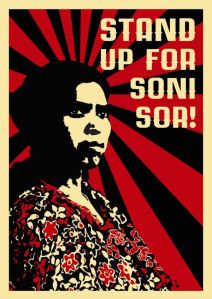
On August 5th, The Indian Express published a disturbing, supposedly investigative story on Soni Sori, implying both that she was guilty of the charge of being a Maoist as well as casting doubt on the activists in India and outside who support her, and who are mainly responsible for bringing into the open the fact that she was and continues to be tortured in prison.

The IADHRI has written this response to the story, rebutting it point by point.

That the media often compromises its integrity for corporate interests and the political elite is not news any more. The recent Sunday Express report titled ‘Soni’s Story’ is symptomatic of a belief that if a lie is repeated often, it becomes the accepted truth.  The report talks of Soni Sori, the Adivasi school teacher from Dantewada, Chhattisgarh, who has been arrested and accused of being a Maoist conduit. With a clever sprinkling of truth, a report can seem unbiased- the reporter appears to be the warrior fighting to find facts and settling for nothing less. It is, however, imperative that fallacies be broken down, and the casual picking and choosing of facts be exposed for what it is. Let us use the same structure that the story uses. Continue reading Rejoinder to story on Soni Sori in Indian Express: International Alliance for Defence of Human Rights in India

“It would have been better if you had given me Death Penalty” : Soni Sori

Translation of letter in Hindi written by Soni Sori from Raipur Prison on July 28, 2012.

(From kracktivist)

Letter in name of Supreme Court Judge  from Raipur Jail

Your Honour ,

Today I am alive , because of your verdict. You gave the order at the right time so that  I could be  medically treated again.  I was very happy during my treatment at AIIMS hospital in New Delhi, but  Your Honour ,  I have to pay for it now. I am being  harassed and tortured here, I request you to have mercy on me . Your Honor I am  suffering mentally .

1. I am made to sit on the Ground  ”Naked”

2. I am suffering from Hunger

Continue reading “It would have been better if you had given me Death Penalty” : Soni Sori

National contestation, not religion, responsible for the plight of Myanmar’s Rohingyas: Ayesha Siddiqa

Guest post by AYESHA SIDDIQA

This photo is a screenshot of a Facebook page that incorrectly shows the self-immolation of a Tibetan activist in Delhi as an image of Rohingya persecution in Myanmar. This is one of countless such images circulated in social media. Image credit: Express Tribune, Pakistan.

These days, the social media is abuzz with discussion on Myanmar. Interestingly, it is not even a constructive discussion but one which is meant for point scoring. The nature of the discourse has complicated the issue even more and thus calls for at least a couple of articles: one on the issue and another one meant to be an analysis of the situation of Burmese Muslims. It is important at this stage to disentangle the two dimensions to make sense of what is actually happening. Continue reading National contestation, not religion, responsible for the plight of Myanmar’s Rohingyas: Ayesha Siddiqa

APDP statement on Supreme Court’s suo-moto cognizance on Amarnath pilgrim deaths

This press release was issued by the ASSOCIATION OF PARENTS OF DISAPPEARED PERSONS on 31 July 2012
 
Today, 31 July 2012, Association of Parents of Disappeared Persons (APDP), held its regular monthly meeting where various issues confronting the struggle of the family members of the disappeared were discussed. Besides other issues, the recent suo-moto cognizance of the Supreme Court of India regarding the deaths of Amarnath pilgrims and its continued indifference towards the sufferings of the family members of the disappeared were raised.
On 15 July 2012, the Supreme Court took suo-moto cognizance of the deaths of 67 Amarnath pilgrims over the first 17 days of the Amarnath Yatra. Referring to a clear disregard for human life, the Supreme Court cited the constitutional rights to life [Article 21] and freedom of movement [Article 19(1) (d)] in India and issued notices to the Central Government, Government of Jammu and Kashmir and the head of the Amarnath Shrine Board. Subsequently, a high powered committee was constituted to investigate the reasons behind the deaths. Continue reading APDP statement on Supreme Court’s suo-moto cognizance on Amarnath pilgrim deaths

On the ongoing ethnic violence in Assam: A Statement

The following is the text of a Statement issued in Delhi on 27 July 2012, endorsed by a number of concerned organizations and individuals

We the people from various parts of northeast residing in Delhi, along with concerned individuals, university members, various students’, teachers’, trade union, women’s, civil and human rights organisations from Delhi, strongly condemn the ongoing ethnic conflict with serious communal undertone that has erupted in four districts (Kokrajhar, Dhubri, Chirang and Bongaigaon) of Lower Assam. This has been the most widespread and alarming conflict in the recent history of Assam.

In the last one week we have witnessed the tragedy of nearly 200,000 people belonging to the Bodo and the Muslim communities, being forced to flee from their homes and villages. Currently they stand internally displaced, and are scarred and traumatized. Official figures state that around 41 people have lost their lives so far, while unofficial estimates from the grounds are much higher. More than 400 villages have been torched down until now. Continue reading On the ongoing ethnic violence in Assam: A Statement

Maruti workers produced in district court: Anumeha Yadav

Guest post by ANUMEHA YADAV

In Manesar 25 July court

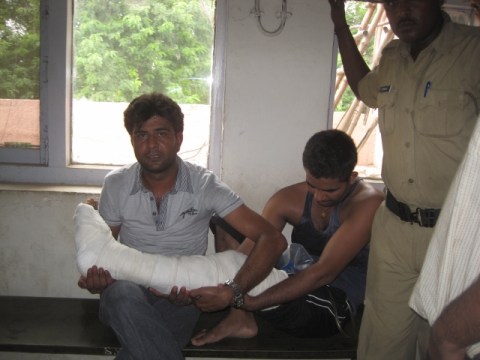
Satbir, a 28 year old worker, was among four workers from Maruti’s Manesar plant produced by Haryana police at the district court in Gurgaon on Wednesday afternoon. Satbir has multiple fractures in his left leg and was taken to the civil hospital from the court room. “I fell while trying to flee the plant. I was in the morning Shift A; we had stayed back because we heard the union leaders were meeting the management to negotiate the reinstatement of a worker,” he recounts. “The violence began after 7 pm, I don’t know why it started. Gate 1 was closed. I feared that I may get attacked in the rioting and the confusion. I and two of my colleagues tried to jump off the back wall but I fell,” he says. Continue reading Maruti workers produced in district court: Anumeha Yadav

Iranian filmmaking in Kashmiri autumn

Set in 2002, shot in 2009, Aamir Bashir’s film Harud will be in select PVR cinemas on Friday, 27 July. Harud is clearly inspired by Iranian films which manage to say a lot without saying much. Like a lot of Iranian cinema, a child is at the centre of the film. The brilliant acting by Shahnawaz Bhat, who plays the protagonist Rafiq, makes the film. In the expressions on his face there is ambiguity and wonderment as much as there is humiliation, helplessness and a desire to do something to change things around him. Here is a film about Kashmir that does not begin with beautiful landscape and does not end with a big encounter between militants and forces. This is not a film that seeks to explain the Kashmir conflict – rather, it takes you inside the lives of ordinary people and how they faced the madness of a conflict. Regardless of what your views on Kashmir are, Harud succeeds in making you empathise with Rafiq and others around him. That, for any narrative on Kashmir, is no small achievement.

Read more about the film in Time Out and ArtViewBlog. Here are some interesting interviews of the director.