Category Archives: Violence/Conflict

What do the Maoists want?

The media has by and large focused on the Maoist demand of release of some of their own in exchange of the Malkangiri collector and junior engineer. The list of the total 8 of 14 demands of the Maoists that the Orissa government has agreed to makes for interesting reading:

(1) Orissa government will write to Jharkhand and Chhattisgarh to take action on the extremists demand for release of Maoist central committee members Sheela di (jailed in Jharkhand) and Padma (in Chhattisgarh) owing to their ill-health; (2) ST status for the Konda Reddy and Nukadora communities categorized as OBCs; (3) stopping the multi-purpose Polavaram project of Andhra Pradesh; (4) ‘pattas’ (record of rights) to tribals dispossessed of their land in Malkangiri and Koraput; (5) irrigation in Maribada and Maniamkonda villages in Malkangiri; (6) compensation based on HC order to Tadangi Gangulu and Ratanu Sirika who died of disease allegedly due to torture; (7) relevant laws for mining operations in Mali and Deomali bauxite mines; (8) minimum displacement of tribals and adequate compensation. [ToI]

Are Ikhwanis back in Kashmir?

A report by Pradeep Thakur in the Times of India today has stunned a lot of people in Kashmir. The report says that the Ministry of Home Affairs and the Indian Army are reviving Ikhwan units in Kashmir to quell the anti-India movement. Some Kashmiris living in Kashmir feared the era of Ikhwani terror and blackmail will be back. The stunning bit is how openly the effort of the MHA and the Indian Army is being acknowledged in creating a renegade political pro-India militia force in today’s political environment in Kashmir. What is not surprising is that this is happening at all, because it has happened before. At worst, this seemed like a stupid move to publicise an overt political operation of the sort Kashmir has seen no dearth of.

The story, titled, “Two pro-India parties floated in J&K with Army, MHA help” by Pradeep Thakur reads: Continue reading Are Ikhwanis back in Kashmir?

Teaching Harmony, Practicing Disharmony

This was presented as a paper at a symposium on Peace Education organised as part of National Conference on Indian Psychology, on 6 February 2011 at the India International Centre.

This piece seeks to underscore the cleavages that exist in our society, explore the foundations upon which the edifice of intolerance has risen and to look at the tools, like education for peace and harmony, with which we try to dismantle this citadel of intolerance.

Peace education, you would agree, cannot be confined merely to teaching the message of Love and brotherhood, our text books have been teaching this message for as long as I remember and my memories of our text books go back, at least to my senior school days in the mid sixties, almost 45 years ago.

If telling students in their classes that we should all love each other because we are all Indians and that we are all equal was enough then we would not have many of the problems that we are confronting today. Continue reading Teaching Harmony, Practicing Disharmony

Why does the RSS dread the terror tag?

1.
Ram Madhav, the bespectacled ex-spokesperson of RSS is not known for his sense of humour.

It is a different matter that some of the media people just could not control their smiles when sometime back (second week of Feb 2011) in a press conference in the capital he enlightened the journos about l’affaire Aseemanand and the broader phenomenon of Hindutva terror.

Giving a completely new and almost unforeseen twist to the Aseemanand episode he said that he (i.e. Aseemanand) had in fact left the RSS in 2006. Of course, as a good spokesperson – although he has become an ex- he had the usual disclaimers in the beginning: RSS does not believe in violence and is a cultural organisation… One does not know whether much on the lines of the School Leaving Certificate, with which lesser mortals like us are more familiar with, Ram Madhav distributed photocopies of ‘Sangh Leaving Certificate’ of Aseemanand or anything similar to give authenticity to his claims or not. Continue reading Why does the RSS dread the terror tag?

Tragedy and Anguish: Can We Be True to Soumya?

There are no words to express the terrible anguish into which many of us have been plunged at the entirely-preventable fate of 23-year-old Soumya, raped and brutally murdered on her journey back home from work a week back. A criminal kicked her out of a slow-moving train between Shornur and Vallathol Nagar, robbed her, dragged her into the bushes, where he raped and wounded her fatally. After five days in hospital, she died. There were other passengers, men, who heard her cries. But none of them bothered to pull the chain, which would have saved her from both rape and murder.There are no words for anguish anymore in the Malayalam media. It has plenty of words to convey, to inspire craven fear and rancid sentimentalism, but none to express and pass on anguish. Continue reading Tragedy and Anguish: Can We Be True to Soumya?

Blasphemy, Sedition, Democracy

Have you ever wondered?

Why does our media get so worked up when someone in Pakistan is accused of or convicted for blasphemy but is not overly perturbed when someone is charged with or convicted for Sedition in India?

Is this differentiated response occasioned by the belief that a modern state should overlook things like blasphemy but give no quarter to sedition?

Do anti-Blasphemy laws encroach upon Individual freedom while anti-sedition laws protect national interests? Is convicting someone for blasphemy essentially undemocratic but doing the same for sedition not so?

Let’s for the time being leave these major issues aside and engage ourselves with more mundane issues. Continue reading Blasphemy, Sedition, Democracy

A Photo Album of Women of the Egyptian Revolution: Leil-Zahra Mortada

A photo collection by various photographers, compiled by Leil-Zahra Mortada

This is a homage to all those women out there fighting on the streets of Egypt, to those whose voices and faces were hidden from the public eye during the first days of the revolution! The album by now has traveled the world back and forth via online social networks, blogs and websites.
First and foremost the credit for this album goes to the courageous people of Egypt who are teaching us that freedom is taken and not given.
Second, to the women who by their courage, determination and strength are inspiring millions of us around the world.
Third to the photographers who took these photos and especially to those who have caused absolutely no problems when it came to copyright issues.


See the album and read more here

Thus Sudan Splits, What’s Next for the Aspiring Rest?: Tanmoy Sharma

Guest post by TANMOY SHARMA

Pro-separation activists hold signs and chant pro-independence slogans outside the Juba airport in southern Sudan, on Jan. 4, where Sudanese President Omar al-Bashir arrived. Photo credit: Pete Muller/AP/File

To add to the tumultuous political dynamics of Africa, the world is most likely to see a new country adorning its map by the middle of this year with the two-way split of the continent’s largest country, Sudan.  For Africa, which has again hit the international headlines for fresh troubles in Ivory Coast, Tunisia and most recently in Egypt, civil wars based on identity and protests against despotic governments are nothing new. However the larger question that has kept many wondering is whether the world is going to see a new era of a large-scale statebirth with the formation of South Sudan, a process that almost stopped barring the examples of Kosovo two years back or East Timor ten years back. As millions of jubilant south Sudanese in the city of Juba, went to vote in a long awaited independence referendum in the second week of January to see their war torn region emerge as a new nation, it will be important to revisit the troubling status quo of other regions of the world demanding secession. Continue reading Thus Sudan Splits, What’s Next for the Aspiring Rest?: Tanmoy Sharma

Branding Binayak: Balmurli Natrajan

Guest post by BALMURLI NATARAJAN

Writing on the history of insanity in the age of reason in seventeenth century Europe, French philosopher Michel Foucault notes: “People know what they do; frequently they know why they do what they do; but what they don’t know is what what they do does.” Foucault’s insight into the workings of power is an incitement for us to think boldly in public, sadly an endangered species in today’s India.

The recent judgment on the Guha-Sen-Sanyal case prompts one to wonder: Could state functionaries know what what they do does? Could ruling elites who watch silently or goad and guide the guardians of law and order to perform at their bidding know what what they do does? Could the state’s branding of Binayak and thousands of others as Naxalites, Maoists, terrorists or seditionists (terms that it conflates but without scholarly or legal basis) allow civil-liberties activists to create a brand Binayak? Continue reading Branding Binayak: Balmurli Natrajan

The Republic of Exploitation

On this Republic Day, while armoured tanks muscle across Rajpath in New Delhi, little ossified museums of culture called tableaux charm the assembled pass-holding citizenry and the Prime Minister sits like a barely-sentient caricature of himself behind a bullet-proof screen, it may do well to think about the other republic that remains hidden within the bosom of Superpower India – the republic of unfree labour.

This is a world where the laws of the upside world are inverted – where the more you work, the less you are paid, the more your company profits, the poorer you end up and if you find yourself the victim of an injustice and god forbid complain about it, the police put your family in jail. It’s a great irony of our times that we believe the choice before us is between loving the Nation and loving the Corporation, not realising that most of the time its the same person wearing two grotesque masks.  All those who believe that the world begins with their newspapers and television sets and ends at their white picket fences (and all those who don’t), please take a minute to go through the excellent documentation of the war that is raging for workers in this country, put together by the Gurgaon Workers’ Solidarity Group, the Faridabad Mazdoor Sangathan and several other exemplary organisations.

GurgaonWorkersNews – Newsletter 35 (February 2011)

Continue reading The Republic of Exploitation

‘As followers pushed to get close, the pole broke in several places and the flag tumbled down onto Mr. Joshi’

History repeats itself, and we learn so little from it. Or rather, we learn too much from it. I am excerpting below about half the text of a report dated 27 January 1992, written by EDWARD A. GARGAN in The New York Times, describing in detail Murli Manohar Joshi’s hoisting of the Indian flag in Srinagar’s Lal Chowk. Wish I had a picture!

He [Murli Manohar Joshi] had begun his trek, which he named Pilgrimage for Unity, 44 days before at India’s southernmost point. But the inability of the security forces to protect even their highest officials made it clear that there was no way, despite the presence of several hundred thousand troops in the Vale of Kashmir, to protect a convoy of cars and buses filled with zealous Hindus. So Mr. Joshi and a small contingent of his closest supporters were flown here on Saturday night. Continue reading ‘As followers pushed to get close, the pole broke in several places and the flag tumbled down onto Mr. Joshi’

Sound Enough: How to Enjoy the Jaipur Literature Festival: Revati Laul

Guest post by REVATI LAUL

“Excuse me, Mr. Farooqui, I just need a sound byte from you,” said a young reporter from the fairly young news channel News X. He was talking to my friend Mahmood Farooqui, author of Besieged: Voices From Delhi 1857, co-director of the Oscar nominated film Peepli Live and founder-revivalist of Dastangoi – the rich, medieval art of storytelling. Seeing that the setting was the beautiful and quaint Diggi Palace in Jaipur with a substantial gathering of the world’s literati for the Jaipur Literary Festival, Mahmood was preparing to hold forth on storytelling, culture, 1857…when this completely unexpected gem poured forth from the fearless reporter’s lips.

“Can you sum up what you think of literature in one word?” Continue reading Sound Enough: How to Enjoy the Jaipur Literature Festival: Revati Laul

“These are not stones these are my feelings”

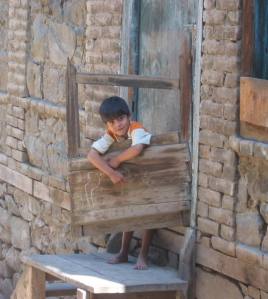
An image taken in downtowon Srinagar.

Given below is a note written by a Kashmiri student from downtown Srinagar who calls himself ‘Kale Kharab’, meaning ‘hot headed’. Taken from his blog, the note reads like a personal manifesto, a statement of purpose, a testimony more telling than what the most patient interviewer can elicit. This note gives you more insight into what is happening in Kashmir than a lot of what you may have read or seen on TV news about the killing of 115 protestors across Kashmir in 2010 by Indian forces. This testimony, written early on during the uprising, on 30 August 2010, shows how irredeemably India has lost the plot in Kashmir all over again, with a new generation of Kashmiris.

How and why I became a stonepelter

by KALE KHARAB

I am from downtown srinagar born in 1991. I was admitted to one of the best school of valley. As a child I had dream to became engineer. Whenever somebody used to ask me about my aim I would proudly say engineer. As I started to grow up I started to became familar with many words which everyone used to talk about that among them few were “azadi” (freedom), “hartal” (shutdown) but I was unable to understand the meaning of these words. I loved the word hartal as it was holiday, so I always wished for hartal. As I grew up I came to know about mujahids. I used to listen stories of mujahids. I would oftenly ask my elders to tell me about mujahids. They told me stories of many mujahids like Issac, Ishfaq, Jan Malik which I liked to share with my friends.  Continue reading “These are not stones these are my feelings”

‘Kashmir ho ya Guwahati, Apna desh, apni maati’: Mahtab Alam

This is a guest post by MAHTAB ALAM

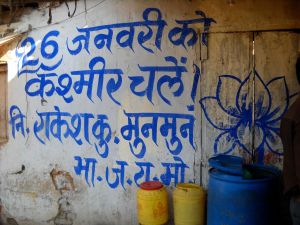
The graffiti reads: '26 Janwari ko Kashmir chalein. Nivedak: Rakesh Kumar Munmun, BJYM'. Trans: 'Let's go to Kashmir on 26 January. Appeal by Raksh Kumar Munmun, BJYM.''


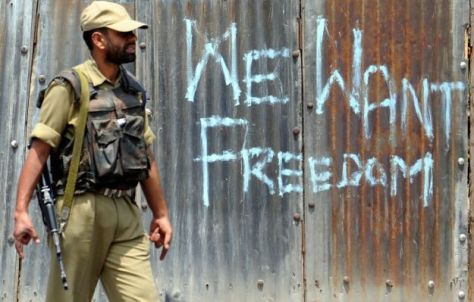
A policeman walks by a street in Kashmir, summer of 2010. Graffiti demanding azadi was all over the Valley this summer.

In Hazaribagh, one of the oldest cities of the newly formed state of Jharkhand, one is more likely to come across the word Kashmir than the name of the city itself these days. Kashmir, a place that most of the residents of Hazaribagh would have only heard of. At almost every nook and corner, teashop, wall of the city one would find an invitation to the ‘raashtriya ekta yatra’ from Kolkata to Kashmir to hoist the revered Indian flag at Lal Chowk. And this public invitation comes from none other than the youth wing of BJP, namely the Bhartiya Janata Yuva Morcha. Continue reading ‘Kashmir ho ya Guwahati, Apna desh, apni maati’: Mahtab Alam

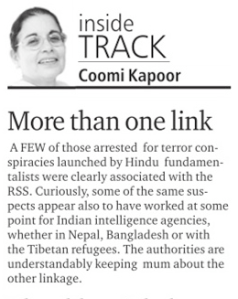
Is the cat out of the bag?

Veteran journalist Coomi Kapoor wrote this small snippet in the Indian Express yesterday. Hope it is only the beginning of more information on what this country’s intelligence agencies have been up to in the name of its citizens.

Blasphemy, Bigotry

From Kafila archives:

If blasphemy is an attempt to speak truth to power, bigotry is the reverse: an attempt by power to instrumentalize truth. [Mahmood Mamdani]

See also: Citizens for Democracy

Justice for Aasia Bibi; Speedy Trial of Salman Taseer’s Killers: New Socialist Initiative, Delhi

Statement from the NEW SOCIALIST INITIATIVE, Delhi

History is said to be made when humanity has tried to break asunder forces of unreason, irrationality, bigotry, intolerance and reaction which keep reappearing in newer forms in its onward journey. But what can one say when it tries to do the exact opposite, or prefer to go back on the path undertaken.

Pakistan, a country of 170 millions, stands at a similar juncture today.  Continue reading Justice for Aasia Bibi; Speedy Trial of Salman Taseer’s Killers: New Socialist Initiative, Delhi

Would the secession of South Sudan be good for Africa?

On January 6th, it is almost certain that a referendum in South Sudan will lead to a vote to secede from the rest of the country, thus paving the way to the formal inauguration of Africa’s 54th sovereign state. The vote comes after many years of discord between Sudan’s Arab-and-Muslim north and its black, animist and Christian south, and civil war in which almost 2m have died. Thus, divorce seems the only option in Sudan’s case. However, many in Africa, including the African Union, which has long inveighed in principle against secessionist tendencies in Africa, worry that it could set a trend that encourages other self-determination movements on the continent, potentially causing instability and worse. Others argue that the right of all peoples to self-determination must be allowed to hold good. In these terms, would the secession of South Sudan be good for Africa?

Well, you can cast your vote here.

See also: Celebrations across south as millions flock to polling stations.

Everything you wanted to know about the Binayak Sen judgement

Great job, Balaji Narasimhan and Jyoti Punwani.

My Name is Pandey

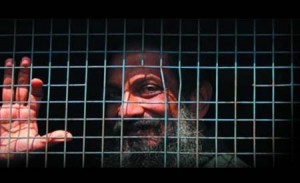
Swami Aseemanand

With so much talk of Hindutva terrorism (see Kafila archive), I as a Hindu want to clarify that:

  • Not all Hindus are terrorists.
  • Not all terrorists are Hindus.
  • Not all Hindus are Hindutvawaadis.
  • All Hindutvawaadis are Hindus.
  • Not all Hindutvawaadis are terrorists
  • All Hindus who are terrorists are Hindutvawaadis. Continue reading My Name is Pandey

Anees Ahmed Ganai, 17

And that’s only one of 115, only from one year of many years.