Suicide of a ‘Criminal’ or Murder of the Stigmatized? : Anuja Agrawal

This is a guest post by ANUJA AGRAWAL

Criminal sets self ablaze outside police station’, says a small news item in a local edition of a leading newspaper. The report suggests that a 22- year- old ‘criminal’ set himself ablaze outside a police station in Nanded district, Maharashtra, after some members of his family were arrested. It claims that the young man was a known ‘property offender’ with three cases against him and goes on to describe how the police had been assaulted by his family members when they had gone to investigate a case filed against him by a local trader.  Why a ‘hardened’ criminal should have committed suicide outside the police station would elude the readers if they pondered over the content of this news item. But by now most of us would have moved to the next ‘story’ Continue reading Suicide of a ‘Criminal’ or Murder of the Stigmatized? : Anuja Agrawal

An Open Letter to Mr Gajendra Chauhan by FTII Student

Guest Post by FTII student

As protests against the appointment of Mr Gajendra Chauhan as new chairman of the Institute gather steam, with students on an indefinite strike since 12th June and a joint protest being organised in Delhi on Tuesday at 11 am in front of I&B ministry in solidarity with the strike, here is an open letter written to the newly appointed Chairman by a FTII student.

Facts are also coming to the fore that not only Mr Chauhan but four of the eight members nominated under ‘Persons of Eminence’ category to the society also have saffron connections, further demonstrating how the Sangh Parivar is keen to change the very ethos and nature of these institutions and establish its regressive agenda.

Dear Mr Chauhan,

I am choosing to address you personally after listening to you respond on several TV news debates about the recent opposition against your appointment as Chairman at FTII. I am a student of FTII and part of the protest. Continue reading An Open Letter to Mr Gajendra Chauhan by FTII Student

Muslims, Yoga and the Empty Heart of Fanaticism: Kaif Mahmood

Guest post by KAIF MAHMOOD

As a Muslim, a student of Comparative Religion and a practitioner of yoga for over a decade, I believe that both those Muslims who object to the practice of yoga on religious grounds and those others who force the practice on the unwilling, trivialise their own traditions in the service of power and identity politics. Neither is Islam an inane system of punishments and rewards, nor is yoga an ancient version of a modern gym. Both groups are a parody of what their traditions were meant to be, and pose to us the question of how to be culturally rooted without assuming an isolationist, chest thumping fanaticism of the religious kind on the one hand, and of a culturally deracinated, materialistic kind on the other – two sides of the same coin. I attempt here a reading of both the religious traditions involved in a manner that is both philosophical and personal.

The recent objections by certain Muslims over compulsory yoga in schools brings to mind a scene from Richard Attenborough’s film Gandhi.

A group of RSS workers, waving black flags, stop Gandhi’s car and request him to not meet with Jinnah. Gandhi replies with a sorrowful agitation: “What do you want me not to do? Not to meet with Mr. Jinnah? I am a Muslim, and a Hindu, and a Christian, and a Jew, and so are all of you. When you wave those flags and shout, you send fear into the hearts of your brothers. That is not the India I want. Stop it, for god’s sake, stop it.” The car moves on, leaving the protestors, including Nathuram Godse, in anger and incomprehension.

The difference between one who breaks down walls of separation and one who creates them could not have been clearer. Continue reading Muslims, Yoga and the Empty Heart of Fanaticism: Kaif Mahmood

प्रचारक का स्त्री चिन्तन

जुबां फिसलती है और शायद बहुत अनर्थ करा देती है।

बांगलादेश की जनाब मोदी की ‘सफल यात्रा’ के बाद उनके हिमायती शायद यही सोचते हैं। यह अकारण नहीं कि ‘स्त्री होने के बावजूद शेख हसीना द्वारा किए गए कामों की तारीफ कर’ बुरी तरह आलोचना का शिकार हुए प्रधानमंत्री मोदी के चीअरलीडर्स का कहना रहा है कि यह जुबां फिसलने का मामला है और उसकी इतनी आलोचना ठीक नहीं है।

अगर सन्देह का लाभ देकर इस मसले पर बात न भी की जाए, मगर आप इस मौन की किस तरह व्याख्या करेंगे कि उन छत्तीस घंटों में उन्होंने एक बार भी सुश्री इंदिरा गांधी का नाम नहीं लिया, जो बांगलादेश की मुक्ति के वक्त भारत की प्रधानमंत्री थीं । अटल बिहारी वाजपेयी के नाम बांगलादेश सरकार द्वारा दिया गया पुरस्कार स्वीकार किया, मगर बांगलादेश की मुक्ति के बाद जिन वाजपेयी ने उन्हीं इंदिरा गांधी को ‘दुर्गा’ के तौर पर सम्बोधित किया था, उनका एक बार नामोल्लेख तक नहीं किया।

यह निश्चित ही भुलने का मामला नहीं था, अगर ऐसा होता तो उनके साथ इतना बड़ा दल गया था, वह उन्हें अवश्य याद दिलाता। दरअसल यह उपरोक्त नाम को लेकर जुबां को सिल देने का मामला था। पूछा जाना चाहिए कि क्या होठों पर कायम चुप्पी क्या राजनीतिक क्षुद्रता का प्रतिबिम्बन था ? या उसके कुछ और मायने थे। Continue reading प्रचारक का स्त्री चिन्तन

Cities, Smart or Self Reliant? Rajendra Ravi

Guest post by RAJENDRA RAVI

The incumbent government has reportedly resolved to build a hundred smart cities in near future. And the concept seems to have taken our world by storm offering little space, if any, for a dissenting voice. Of course, a few tremors of resistance have emerged from areas where the lands are being acquired or have been marked for acquisition. For, resistance is something that is perennial: it never fails to strike back when the forces of eviction and deprivation come together to uproot people from their habitats. Human history stands witness to the fact that it is the mass protest and organized resistance that have compelled the development machinery to re-evaluate its orientation. Arguably, the tendency has actually reinforced and deepened the institution of democracy.

However, let us not overlook the fact that every community or a social group on this globe has taken the course of migration in its quest for development either as a conscious decision or compulsion. As a consequence, the phenomenon has substantially influenced the nature and configuration of habitats, leading the small hamlets to become large villages and bigger villages morphing into towns. Eventually, these very towns end up being cities. This has been quite a predictable trajectory of human development. Historically speaking, the process has involved efforts both at the level of government and the society at large. But, at the same time, we cannot ignore the fact that the government has a far more crucial role to play in it – a role, which is always informed by the ideological outlook of various political parties and governments. This role is also conditioned by the fact whether or not the parties and governments in question seek to build an egalitarian and democratic society. Continue reading Cities, Smart or Self Reliant? Rajendra Ravi

Iceland Jailed Bad Bankers While Modi Govt Bails Out Defaulting Sugar Mills

In February this year, Iceland jailed four of its rogue bankers for market manipulation and for defrauding ordinary people. No, the heavens did not fall. Thunder and lightning did not strike. The wrath of God did not descend upon the people of Iceland. On 13 February 2015, Reuters had reported:

Iceland’s Supreme Court has upheld convictions of market manipulation for four former executives of the failed Kaupthing bank in a landmark case that the country’s special prosecutor said showed it was possible to crack down on fraudulent bankers. Hreidar Mar Sigurdsson, Kaupthing’s former chief executive, former chairman Sigurdur Einarsson, former CEO of Kaupthing Luxembourg Magnus Gudmundsson, and Olafur Olafsson, the bank’s second largest shareholder at the time, were all sentenced on Thursday to between four and five and a half years. –

In less than four months since this happened, Mathew Yglesias reported in Vox Business and Finance two days ago that the economy had in the meanwhile done quite well:

Yesterday, Iceland’s prime minister, Sigmundur Gunnlaugsson, announced a plan that will essentially close the books on his country’s approach to handling the financial crisis — an approach that deviated greatly from the preferences of global financial elites and succeeded quite well. Instead of embracing the orthodoxy of bank bailouts, austerity, and low inflation, Iceland did just the opposite. And even though its economy was hammered by the banking crisis perhaps harder than any other in the world, its labor didn’t deteriorate all that much, and it had a great recovery.

For those who have seen the brilliant documentary film Inside Job, which exposed the unscrupulous game played by the bankers and the financial oligarchy in defrauding millions of ordinary people and eventually triggering of the financial crisis in the US and the world at large, the story of Iceland’s descent into the dystopic neoliberal world must still be fresh in their minds. Continue reading Iceland Jailed Bad Bankers While Modi Govt Bails Out Defaulting Sugar Mills

June 1984 – 31 Years Later, Sikhs Are Mapping Their Stories: Ravleen Kaur

Guest post by RAVLEEN KAUR

When June 1984 comes up in conversation, the same talking points invariably arise – “it was the state’s burden to attack; they had no choice”, “Bhindranwale had to be taken down”, or “Punjab was already bleeding”.

What these oft-repeated phrases – a product of the tight PR messaging campaign on the part of the government – glide over is the scope of human suffering that occurred in June 1984 – and most glaringly, suffering that was perpetrated by those in power, by those who had been elected in a democracy to uphold the rights and dignity of the people who they killed in 1984.

Anthropologist Talal Asad has noted the “notorious tactic of political power to deny a distinct unity to populations it seeks to govern, to treat them as contingent and indeterminate.”

With the belief that every Sikhs who was alive in 1984 has a story to tell, the 1984 Living History Project is depicting the unity in trauma of a people, who, in 1984, felt attacked as a people. The 1984 Living History Project is working to give a platform to ordinary people who lived through the massacres of both June and November. The project was initiated in 2012 by Sikh millennials.  Realizing that the generation who experienced 1984 firsthand was getting older and that time was running out to capture their stories, they began a grassroots effort to capture as many stories and testimonies from Sikhs worldwide, one video narrative at a time. The first videos were their own parents and grandparents, recorded on smart phones and edited and shared rather seamlessly. The Project’s web platform allows easy Steps to make and share videos; something other Sikhs around the world have been doing through the 30th and 31st anniversary years of 1984.  Continue reading June 1984 – 31 Years Later, Sikhs Are Mapping Their Stories: Ravleen Kaur

Who can build Housing for All?

Policy slogans are usually fragments of a sentence. Make in India. Housing for All. Swatch Bharat. What’s usually missing in the fragment is that the verb has no subject to agree with. For slogans to become statements, missions, policies and actions, someone has to make in india, keep it swachh and build the housing. The big elephant in the room is: who?

For housing, this is a particularly important challenge. The numbers are daunting: a shortage of 18.78 million housing units in 2012. Over 95% of this shortage is for low-income households that make less than Rs 2 lacs total household income per year. Taking the Ministry of Housing and Urban Poverty Alleviation’s own formula that a household can afford a house five times its annual income, this means “Housing for All” needs to make nearly 17 million houses all under Rs 10 lacs. That’s the finish line.

So: who should build this housing? Continue reading Who can build Housing for All?

A Response to the Fading Queerness: Navadeep

NAVADEEP writes in Gaylaxy on the responses around the matrimonial advertisement for a gay man placed by his mother, in which she specified “Caste no bar, (though Iyer preferred)”.

It has been a few days since the first gay-matrimonial ad of the country has been out, and as expected, it has gathered a great deal of attention both from gay and straight people. Lack of available information would keep me from commenting on the reactions among the straight crowd. But being a part of the gay community, I have witnessed two different arguments emerging:

1. It is a great progressive step from a loving mother for her gay son and is also a potentially visible statement of the gay community in mainstream society.

2. While appreciating the aforementioned, a section of people in the community are extremely agitated about how the matrimonial ad mentions a preference of caste. This has lead to the debate of contesting the regressive part of the ad (where, of course, I find my place)….

Where does one’s choice start and where does it end? How absolute and independent an identity can this choice and preference claim? Is this choice/preference free from conditioning? Is it just an individual’s sole conscious choice/preference or product of the society he is part of? Do personal choices and preferences have no social and political connotations? Do they not have any historical and cultural context?

Read the rest of this thought-provoking piece here, and do read the comments section too, for an interesting debate.

Withdraw police case against Prof Kancha Ilaiah and revoke the ban on Ambedkar Periyar Study Circle : People’s Alliance for Democracy and Secularism

Public Statement issued by People’s Alliance for Democracy and Secularism (PADS) on 6 June, 2015

A case has been filed by the Hyderabad police against well known Dalit writer and academic Kancha Ilaiah on a complaint by Vishwa Hindu Parishad members for hurting their religious sentiments. The complaint was filed on the basis of Ilaiah’s article Devudu Prajasamya Vada Kada? (Is God a democrat?) published in a Telugu daily on May 9. In the said article Ilaiah had argued that the possibility of democracy, or its lack inside different religious groups depend on the conception of their God(s). The VHP activists have accused Prof Ilaiah of comparing Hindu gods with God in Christianity and Islam, and of ridiculing their worship. Police have filed a case under sections 153A and 295A which prescribe imprisonment upto three years for spreading enmity among groups of people and outraging religious feelings. The police action against Ilaiah has come around the same time that the IIT Madras has derecognised a student group Ambedkar Periyar Study Circle that organises discussions around socio-cultural and political issues. The group was derecognised after an anonymous complaint against it was filed with the central HRD ministry. While many political parties and groups have justifiably come out in support of the APSC, it is surprising that Prof Ilaiah has received little solidarity. Both these incidences are a proof of the aggressive intent of Hindutva forces to attack any discourse which publicly questions their castiest, Brahminical and majoritarian understanding of Indian society. Successes of Mr Narendra Modi in the recent elections have emboldened them further . Continue reading Withdraw police case against Prof Kancha Ilaiah and revoke the ban on Ambedkar Periyar Study Circle : People’s Alliance for Democracy and Secularism

No To Ambedkar-Periyar in ‘Modern Day Agraharam’?

Whether discussing issues of contemporary concern among students, raising debates around them on the campus – taking inspiration from the ideas of leading social revolutionaries of 20th century – should be construed as an act of creating ‘social disharmony’ or ‘spreading hatred’ ?

Any sane person would rather reject this weird proposal but it appears that the bureaucrats in the Ministry of Human Resources Development (MHRD) think otherwise. It was evident in the way they acted on an anonymous complaint regarding the activities of a group of students in IIT Madras which calls itself ‘Ambedkar-Periyar Study Circle’ (APSC) – which comprises mainly of dalit, bahujan and adivasi students. Perhaps they were worried that the particular students group, has been critical about PM Modi’s policies and has been raising issues of caste, communalism as well as corporate loot of resources and challenging the ‘development’ narrative which is popular these days among a section of people. The impetuosity with which they acted when they wrote to the management of the Institute can also be gauged from the fact that in this process they violated the recommendations of the CVC (Central Vigilance Commission) itself which has ‘barred’ organisations from taking action on such (anonymous) complaints.

As of now the issue of ‘derecognition’ of APSC by the IITM management, has snowballed into a major controversy, with issues of curtailment of freedom of expression, infringement of autonomy of educational institutions and dominance of caste in higher education all coming to the fore. Continue reading No To Ambedkar-Periyar in ‘Modern Day Agraharam’?

अटाली और हम

(यह ब्योरा पिछले शनिवार को दिल्ली के हरियाणा भवन के सामने अटाली की मुस्लिम विरोधी हिंसा पर रोष जाहिर करने को किए गए प्रदर्शन के बाद लिखा गया था.तब से अब तक स्थिति में काफी बदलाव आया है.कल ही खबर आ गई थी कि मुसलमान गाँव लौट गए हैं.शर्तें अभी बहुत साफ़ नहीं हैं.कहा जा रहा है कि हमलावरों पर कार्रवाई भी होगी और मस्जिद भी बनेगी. एक खबर यह है कि मुसलमानों को आश्वस्त किया गया है कि मस्जिद की चहारदीवारी प्रशासन बनवाएगा.यह भी कि हालात बेहतर होने पर दोषियों को पकड़ा जाएगा.गाँव में हिंदुओं का एक तबका है जो इस हिंसा से दुखी और शर्मिंदा है.लेकिन नौजवानों को लेकर आशंका है.फिर भी यह मुज़फ्फरनगर से ‘बेहतर’ तो है ही.

सवाल कुछ हैं:

  • क्या जांच की जाएगी कि यह हिंसा कैसे हुई?क्या यह स्वतःस्फूर्त थी या इसके पीछे एक तैयारी थी?
  • क्या हरियाणा में,और जगहों की तरह ही, मुसलमानों के अत्यंत अल्पमत में होने के बावजूद मुस्लिम-विरोधी वातावरण का निर्माण किया जा रहा है?
  • अटाली में जो मुसलमान लौटे हैं, उनके नुकसान की भरपाई का पैमाना क्या होगा?
  • हमलावरों पर कार्रवाई होगी या लौटने दिए जाने और फिर गाँव में शांति से रहने के एवज़ में मुसलमानों को शिकायतें वापस लेनी होंगी या कमजोर करनी होंगी?
  • क्या आस-पास के विश्वविद्यालय, राजनीतिक और सामाजिक संगठन मुसलमानों के लौटने की इस प्रक्रिया के बाद समाज में  इस विषय पर विवेकपूर्ण संवाद की कोई पहल करेंगे?)

हम हरियाणा भवन के सामने हैं. एक ‘वाटर कैनन’ सामने खड़ी है.दिल्ली पुलिस के जवान लाठियों के साथ तैनात.महिला-पुलिस भी.मई की बेरहम धूप है जो जलती चादर की तरह हमें लपेटे हुए है.सामने किसी पुराने कार्यक्रम के फ्लेक्स-बैनर की दरी बना दी गई है.उस पर पचीस-तीस औरतें-मर्द सिकुड़कर एक दूसरे से सटे हुए बैठे हैं.एक छोटा बच्चा गोद में.ऐसे मौकों पर दीखनेवाले दिल्ली के पुराने पहचाने चेहरे.शबनम हाशमी देख रही हैं कि पानी का इंतजाम ठीक है कि नहीं.नासिरुद्दीन पीछे बैनर सीधा करवा रहे हैं.प्रेस-फोटोग्राफर जमा हो रहे हैं.दरी पर इकठ्ठा लोग धूप से बचने को चेहरा लपेट रहे हैं. एक ने कहा, “शुक्र है, नीम की छाँव है.” फिर सर उठाया, वृक्ष जैसे उसकी नाजानकारी पर सर हिला रहा था. “नहीं, नहीं, नीम नहीं है. कौन-सा पेड़ है?” कोई दिल्लीवाला बता नहीं पाता.सालों-साल छाया देने के बाद भी उसे न पहचानने पर पेड़ छाया समेट नहीं लेता. उदासीन इंसानों की इस जमात पर रहम का साया बनाए रखता है. फिर पेड़ से मुँह मोड़ हम घड़ी देखने लगते हैं. वृक्ष से अपरिचय से मनुष्यता की योग्यता में कमी तो नहीं आती, इसका आश्वासन हमें है. Continue reading अटाली और हम

Saffron Emergency on Campuses! Ban for those who critique and impunity for those who silence dissenting voices: Sucheta De

This is a guest post by Sucheta De

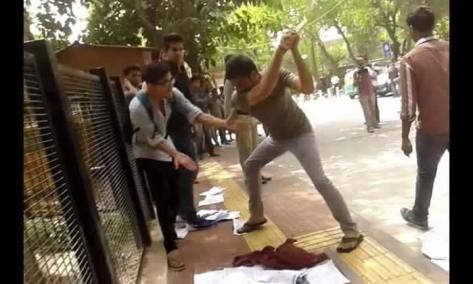
ABVP Beating up AISA activists at Delhi University May 2015

The task of higher education in any era besides imparting professional skills should also be to encourage critical consciousness among youth whereby they can critically perceive the surrounding situations and critically reflect on their actions and thoughts and thus contribute to the betterment of the society. Unfortunately, the onslaughts on affordable quality higher education that could inculcate such a consciousness just seem to increase with every passing day under the saffron regime. Today what we face in campuses across the country is a saffron emergency that is being ably executed through two key instruments- On one hand we have the obedient Vice Chancellors and Directors inside University offices who mutely nod their heads to each and every diktat of the MHRD and on the other hand there are the rod-wielding saffron activists on campus streets, ready to violently shut down any sound of protest. In the week that just got over, these twin instruments able demonstrated their functioning!!

Continue reading Saffron Emergency on Campuses! Ban for those who critique and impunity for those who silence dissenting voices: Sucheta De

The Modi Government’s First Year has been disappointing for Persons with Disabilities: Avinash Shahi

Guest Post by AVINASH SHAHI 

Arguably, the Narendra Modi-led NDA II government in the country seems least interested in addressing the woes of disabled people. Such indifference is not surprising. When the campaigning for the 16th Lok Sabha elections was at its peak, Mr Modi thundered from the podium that the “country does not want a deaf and dumb handicapped government”. His irresponsible reference to disability could have potentially accentuateed negative attitudes against the disabled. Fearing such a possibility and upholding their right to dignity as disabled persons, this group strongly condemned his statement. Continue reading The Modi Government’s First Year has been disappointing for Persons with Disabilities: Avinash Shahi

Imperial Ejaculations – Reflections on “Ten Books that Shaped Empire”: Dilip Menon

Guest Post by Dilip M. Menon

Unlike Salman Rushdie, I did not grow up kissing books, I merely collected them. From provision stores, sidewalks, and from booksellers who were eccentric enough to try and survive by selling second hand books, in the small towns and yet-to-become cities of post independent India. The books came with a fine patina of dust that no amount of smacking against one’s thigh or the flat of one’s palm could get rid of. Kissing them was out of the question. In what was called the mofussil, or the provinces, the detritus of empire and the war that ended it gathered, as the collections of effects of the British who departed, as much as those who stayed on and died, gathered in the auction houses and bookstores.

It was on a summer afternoon in 1973 that I cycled down to the local provision store in Pune and saw beside the sacks of rice, wheat and spices, a pile of books, periodicals and rather lurid posters of European women with very long legs and few clothes on. I had always imagined Europe to be a cold place. In the pile were old Penguins; books by Enid Blyton, Anthony Buckeridge, Capt. WE Johns, Rider Haggard; periodicals like Boys Own Weekly, Gem, and Magnet; and of course the war comics (the staple reading of Allied troops posted in India and South East Asia), from which I learnt my German. At school, during the break, we were always running through the corridors shouting Schnell, Schnell and calling our Kamerads Schweinhunds. But on that summer day, I found two authors that I had not heard of: George Orwell and Frank Richards. The former had written a book about some fat pigs and the latter, one about a fat boy, and being rather plump myself, I was favourably disposed.

{AC8E3D54-0D18-423F-A888-DAE1A6C73C6C}Img400 Continue reading Imperial Ejaculations – Reflections on “Ten Books that Shaped Empire”: Dilip Menon

Bread and Circuses? No sir, circuses alone will do.

Edited and updated version of the post.

I had the great fortune to be invited as an audience member to a live interaction with Union HRD Minister Smriti Irani last evening, televised live on Aaj Tak. I say “great fortune” because despite the fact that I walked out of this “interaction” in speechless disgust around an hour into the programme, I probably learned more about the state of politics and media in this country in one evening than I could have from years of academic study. And the irrelevance of academics was exactly what was on display last evening, never mind that the topic of the interaction was the state of higher education in the country.

I reached the venue – the auditorium of Khalsa College, Delhi University – at about 5.15 pm for a 5.30 pm programme. The mood was surprisingly charged, even electric for what I imagined would be a sober discussion on somewhat boring topics like syllabus formation, university infrastructure, promotions and pensions, the points system, and most importantly, the changes proposed under the Choice Based Credit System (CBCS). The auditorium was already packed – not so much with teachers and students – but with a large number of ABVP activists, BJP volunteers, and committed party supporters from within and outside the University. Nothing wrong with having a politically committed section dominating the audience of course. But if the resultant mix is innocently termed “the public” – the term the anchor used was “janta” – then that constitutes the first point of deception. I took a seat in the second row as instructed, surrounded by triumphant, pumped-up BJP supporters shaking hands with each other, suddenly feeling small and irrelevant, having come prepared with questions on Delhi University. At one point, turning to speak to the person next to me, I encountered a gentleman who introduced himself only as a “social worker” and asked me to elaborate on the problems with the university. As I began to list them however, he cut me short with a wave of a hand to say the government will prevail over all of them, and turned back to gaze admiringly at the life-sized posters of Modi all around us. I realised the person knew absolutely nothing about the University or teaching as a profession, and couldn’t care less.

Two anchors from Aaj Tak – Anjana Om Kashyap and Ashok Singhal – were on stage, interacting intermittently with the audience. At one point, Kashyap turned to the audience and said she was aware that there were many eminent professors in the first two rows who had been invited by Aaj Tak, but that she would begin the interaction with the Minister first with general questions on politics, and then move on to the topic of the evening – higher education. Nobody seemed happy with this, but having little choice, we vaguely nodded our assent. In walked Irani, striding up confidently on to the stage. Without so much as acknowledging the audience or making eye contact, she began to banter with the anchors, saying she only had half an hour and had not agreed to two hours, etc. While this time bargaining was going on, the crowd began to settle down somewhat, and the cameras began to roll. As planned and announced, Kashyap began with politics, asking Irani about her Twitter war with Rahul Gandhi and with her frequent visits to Amethi. As far as I or anybody who cares deeply about what is happening to Delhi University and other universities in the country was concerned, THAT WAS THE END OF THE EVENING.

Continue reading Bread and Circuses? No sir, circuses alone will do.

Telangana Politics: A Saga of Promises and Betrayals : Gaurav J Pathania

This is a Guest Post by GAURAV J PATHANIA

As the twenty-ninth Indian state, Telangana owes its formation to the half-a-century-long mass movement and countless sacrifices by its people. In the movement for separate statehood, thousands of university students lost their lives, families and careers.

After the initial upheaval in 1969, the movement peaked again in 2009, thanks to Osmania University students who spearheaded fresh activism, and rising to become the real heroes of the movement. Throughout these trying times, hundreds of students were arrested and jailed, yet the government could not break the spirit of the movement. And so, just before he took oath of office on June 2, 2014 as the first Chief Minister of the new Telangana state, K. Chandrashekar Rao (KCR), the head of the ruling party Telangana Rashtra Samiti (TRS), promised to rescind the police cases lodged against Telangana activists during the movement, as well as create one lakh jobs for the new state’s youth. Continue reading Telangana Politics: A Saga of Promises and Betrayals : Gaurav J Pathania

“New India’s’’ Inflexible Workforce – Caring is but Women’s Work: Shalini Grover, Ellina Samantroy, Nupur Dhingra Paiva

Guest post by SHALINI GROVER, ELLINA SAMANTROY and NUPUR DHINGRA PAIVA

A recent BBC article, ‘Why Motherhood Makes Indian Women Quit Their Jobs’ (http://www.bbc.com/news/world-asia-india-32377275), examines the factors that prompt large numbers of women to drop out of India’s workforce. Despite the country’s growing international reputation as the “new India,” with its allure of economic prosperity, globalized cities, and modern lifestyles, it is not clear how much of the female labour force is contributing to paid employment. Liberalization has indeed opened up opportunities for an entire cohort of young urban women who work in IT, outsourcing, hospitality, media, beauty parlours, cafes, and malls. Ironically, in a period of high growth and open markets, labour surveys such as those conducted by the National Sample Survey Office (NSSO) reveal an overall declining rate of female labour force participation, an issue that has become a serious concern for policy makers. A World Bank study (2013) found that only 27 per cent of Indian women over the age of 15 work outside the home. While such surveys have their limitations in that they often do not take into account informal employment, the World Bank study is significant because it indicates that India has the lowest rate of female participation in the workforce among the BRICS (Brazil, Russia, India, China, and South Africa) countries.

What makes the labour force in India so male dominated? And what makes the workplace so hostile to working mothers?

Continue reading “New India’s’’ Inflexible Workforce – Caring is but Women’s Work: Shalini Grover, Ellina Samantroy, Nupur Dhingra Paiva

विवादास्पद के पक्ष में:आई आई टी मद्रास के निर्णय के बहाने कुछ विचार

आई आई टी मद्रास में आंबेडकर-पेरियार स्टडी सर्किल(एपीसीएस) की मान्यता रद्द करने के प्रशासन के निर्णय पर बहस हो रही है. मानव संसाधन विकास मंत्रालय ने इस समूह पर घृणा प्रचार का आरोप लगाती एक बेनामी शिकायत संस्थान को इस अनाम टिप्पणी के साथ भेजी कि यह दुर्भाग्यपूर्ण है कि आई.आई.टी.का ऐसा इस्तेमाल हो रहा है. प्रशासन ने आव देखा न ताव, एपीसीएस की मान्यता रद्द कर दी, हालाँकि बाद में उसने कहा कि यह एक अस्थायी कार्रवाई है और समूह का पक्ष सुनकर ही अंतिम निर्णय लिया जाएगा.वैसे यह किसी ने न पूछा कि एपीसीएस  की मान्यता रद्द करने का क्या मतलब!वह कोई आईआईटी की बनाई संस्था तो है नहीं, वहाँ के कुछ छात्रों का स्वैच्छिक संगठन है .उसका जीवन आई आई टी प्रशासन के प्रसाद पर निर्भर नहीं.प्रशासन संभवतः उसे कोइ कार्यक्रम करने के लिए संस्थान की कोई सुविधा इस्तेमाल नहीं करने देगा. उसके नाम में ही जो दो नाम लगे हैं, उनसे उसके राजनीतिक ही नहीं समरस समाज में विभेद पैदा करने का इरादा साफ़ है!  यह अलग बात है, जो टेलीग्राफ ने बताई कि केन्द्रीय सतर्कता आयोग का निर्देश है कि किसी भी बेनामी शिकायत का मंत्रालय या विभाग संज्ञान न लें. तो मंत्रालय का यह कदम ही नियमविरुद्ध था. दूसरे, मंत्रालय के पत्र पर बिना किसी स्थानीय जाँच की प्रक्रिया के आई आई टी, मद्रास का यह अति उत्साहपूर्ण अनुशासनात्मक कदम दरअसल रघुवीर सहाय की याद दिलाता है जिन्होंने ऐसा दिमाग खोज लाने को कहा था जो आदतन खुशामद न करता हो. Continue reading विवादास्पद के पक्ष में:आई आई टी मद्रास के निर्णय के बहाने कुछ विचार

What’s wrong with these headlines? (Answer – It’s Election time, Stupid)

Another disputed mosque sparks Ballabgarh riots” (The Hindu)

Ballabhgarh Communal tension: At heart of dispute lie a temple and half-built mosque” (The Indian Express)

ballabgarh

Muslim families at Ballabhgarh city police station on Wednesday night after fleeing riots in their village.(Express Photo by: Gajendra Yadav)

This one image should be issued as a ceremonial postage stamp to commemorate one year of Modi’s rule. We have said it many times already, but here it is, once more, with feeling – this is a bloody, violent Hindutvavaadi regime, with a cool headed, coldly vicious master-mind at its head – he of the Swarovski eye glasses, the 10 Lakh Rupee Suit, the diamond Movado watch – he of the infinite silences on All That Matters.

Continue reading What’s wrong with these headlines? (Answer – It’s Election time, Stupid)

Press Release: Ambedkar-Periyar study circle IIT Madras

These are two press releases from the Ambedkar-Periyar Study Circle – An initiative by IITM students. The first one was in protest against the ban on the APSC, and the second one dated 8 June 2015 – APSC Press Release 8.6.15 – explains the position of the students’ organisation after the ban was lifted. It argues that it is important that the controversy about the ban and the subsequent lifting of the ban not be allowed to obscure the fundamental reason for the ban which remains as urgent as ever – the drastically shrinking space for critique under the Modi government and Hindutva forces.

apsc ambedkar logo

PRESS RELEASE

Ambedkar – Periyar Study Circle was created as an independent student body on 14th April 2014, by a group of students from IITM to promote Ambedkar – Periyar thoughts and to initiate debates on socio-economic-political and cultural impacts which affects common mass within academic fraternity. The student of IITM has a dictum of using APSC as a platform for the above mentioned issues. As IITM has a long history of being a platform for right wing groups alone to propagate their own ideology and train young minds for their intellectual wings through Vivekananda Study Circle, RSS Shakha, Hare Rama Hare Krishna, Vande Matram, Dhurva etc… With this motto, in the past one year, we organized Hall meets, Movie Screening and pamphlet distribution among students and ignited debates on issues like: Agriculture under threat – Coal bed Methane project, GM Crops – Impact on Agriculture, Factory disputes Act 1947 (Amendment) and creating devastating effect on the labor conditions, Language Politics in India: past and present based on Sanskrit week celebrations, MHRD’s overt attempt to have separate vegetarian mess halls in IITs and IIMs and IITM administration’s move in replacing the name board of the faculties and laboratories with Sanskritized Hindi. We celebrated the birthdays of Bhagat Singh and Ambedkar and organized talks on ‘Understanding Bhagat Singh’ and Contemporary relevance of Dr. Ambedkar’. (For more information check our facebook page -Ambedkar periyar study circle IITmadras) Though the platform created a space for the students of IITM to discuss and debate on issues directly affecting the peasants, labours and the common mass, APSC continuously faced threats from rightwing groups inside IITM. Even the administration tried to curtail the activities of APSC, in June 2014, the DoS Dr.M.S.Sivakumar directed us to change name stating that the names ‘Ambedkar and Periyar’ are politically motivated and thus the study circle should be renamed with some apolitical titles without any personolity’s name.

Continue reading Press Release: Ambedkar-Periyar study circle IIT Madras

DISSENT, DEBATE, CREATE