How Wikipedia Works: Bishakha Datta

BISHAKHA DATTA is on the Wikimedia Foundation Board of Trustees. In the wake of the shocking distortions found in the Wikipedia entry on Bhanwari Devi by an alert reader, Bishakha gives us a tutorial on how Wikipedia works.

1. Wikipedia is the world’s 5th biggest website, visited by almost 500 million readers each month – but created entirely by volunteers. We (meaning the Wikimedia Foundation in San Francisco/wikimedia chapters in 40 countries) do not pay writers or anyone to contribute to wikipedia; anyone contributing to wikipedia is called an ‘editor’. Currently, there are about 80,000 editors around the world creating wikipedias in 285 languages, of which 20 are Indian languages. To see English wikipedia being created in real time, click this link: https://en.wikipedia.org/wiki/Special:RecentChanges

Each line represents a change being made to an article. If you refresh the page, you’ll see how quickly new content keeps getting added.

2. This model of open knowledge has its own pros and cons. Biggest pro: it is a bottom-up grassroots model of gathering knowledge, based on the assumption that each of us has some knowledge (or ‘expertise’) that we can share with the world. The site is designed such that anyone who knows how to use a wiki can add content. So if you know how you can add facts, make it more accurate, correct spellings, add new information etc. This is how Wikipedia lives and grows and becomes better each day, through volunteer efforts. Continue reading How Wikipedia Works: Bishakha Datta
The untold tale of Soorpanakha: Drishana Kalita

DRISHANA KALITA’s subversive imagining of Soorpanakha’s version of the events that befell her, was one of the top 5 entries for June’s ‘Muse of the Month’ on Women’s Web. 

I am Soorpanakha. My name is synonymous with Sin for many, encased for eternity in the pages of the epic Ramayana. I am not the role model parents would point their daughters towards. Why is that? You may ask. Because I admitted to lust. My name was pitted against Sita, the embodiment of purity and womanly virtues. She was everything I was not and I was everything she was not.

She was beautiful and so was I. Do not believe those terrible sketches of me with sharp fangs and blood shot eyes. I was a peerless beauty with large fish shaped eyes, for which my mother had named me ‘Minakshi’ at birth. A single woman, independent enough to roam the forests alone. I was free.

My freedom was my sin, as was my open sexuality. I dared to invite a man, the exiled king of Ayodhya, to make love to me.

Read this wonderful retelling here.

And as a bonus, watch Harinarayana Ehat Edneer performing Shoorpanakha in Yakshagana – ‘Main swachhand bhraman karti hoon!” she declares – I wander at my will!

Wikipedia, Bhanwari Devi and the need for an alert feminist public: Urvashi Sarkar

Guest Post by URVASHI SARKAR

Until June 20th 2014, if you visited the Wikipedia entry on Bhanwari Devi — a women’s rights Dalit activist who was raped for taking on child marriage in an upper caste community in her Rajasthan village— you would have been in for a nasty surprise.

The following lines from the biography section of the article would have stood out starkly:

“Bhanwari, the young, illiterate potter woman…strutting about the village giving gratuitous, unctuous advice to her social superiors made attempts to persuade the family against carrying out their wedding plans. Standing unveiled in the street outside the house of the brides-to-be she loudly berated the elderly patriarch… flaunted her government appointment…and threatening them that she would stop at nothing to ensure their public disgrace by stopping the planned marriage.”

The citation for this paragraph was provided as ‘Bhateri Rape Case: Backlash and Protest’ by Kanchan Mathur published in the Economic and Political Weekly (EPW).

Not a single sentence from that paragraph features in the EPW article; but a preceding paragraph in the Wikipedia entry, which describes Bhanwari Devi’s work as a sathin or grassroots worker with the Women’s Development Project of the Rajasthan Government, is correctly attributed to the EPW piece. Continue reading Wikipedia, Bhanwari Devi and the need for an alert feminist public: Urvashi Sarkar

Collective struggle strengthens autonomy: Saroj Giri

Guest post by SAROJ GIRI, continuing the discussion on roll-back of FYUP in Delhi University. 

Earlier posts on this issue are listed and linked to here.

Here is one way to make sense of the core issue at stake in Delhi University today – this piece by Nandini Sundar arguing that the UGC directive amounts to hampering institutional autonomy of DU.

But this is a flawed position in the present context. It conflates the autonomy of DU with the autonomy of the VC. It construes DU’s autonomy in narrow institutional terms, overlooking the larger movement of teachers and students which is also ‘DU’ and which has consistently opposed the FYUP.

Sundar suggests withdrawal of the UGC directive, the setting up of a DU committee to overhaul the programme, and deliberation in the Academic Council, this time taking proper heed of anti-FYUP views. But do we need a fresh round of discussion on the pros and cons of FYUP?

Absolutely not. For there have been tons of deliberations over the FYUP. Just go back to the minutes and records of the many different meetings and Committees, or recall the many demos and dharnas. There is ample evidence of deliberation where the members of the University have given sound reasons why the FYUP is bad.

Indeed, the picture presented that it is the Ministry or the UGC imposing its diktat from above is simply not true. It is not some committee in the UGC or Ministry which on their own have decided to stall the FYUP. For it is force of the movement against FYUP and the many, many voices active since the last few years who have prevailed now – it is this which is reflected in the UGC directive. Continue reading Collective struggle strengthens autonomy: Saroj Giri

The Hindi Imbroglio – Videshi Nationalism? Rita Kothari

Guest post by RITA KOTHARI

Bqkh32sCcAAodoA

We live with multiple Hindis – one for instance, in railway and flight announcements, the other in cinema, a mixture of Hindi and Urdu, or Hindustani,  the kind Gandhi wanted India to adopt as its national language. The former kind – sarkari Hindi – survives only in its ceremonial avatar. This  was acknowledged in a rare moment of honesty when   the Rajbhasha unit of Ministry of Home Affairs issued an order in December 2011 to provide relief to beleaguered translators who came up with words like ‘Misil’ (for file) and sanganak (for computer). It suggested using English words or words from Indian languages instead of  coining new ones but to be written in the Devangari script. It is interesting that this remained unnoticed, for it was business as usual when it happened. How is language both incidental and central at the same time? I wondered.


Government Order dated May 27, 2014 on use of Hindi

Continue reading The Hindi Imbroglio – Videshi Nationalism? Rita Kothari

Aluthgama – Thinking about Co-existence and Resistance in a Time of Crisis: Mahendran Thiruvarangan

Guest post by MAHENDRAN THIRUVARANGAN

I come from a community that was both a victim and a villain in the thirty-year civil war that unsettled all of us. We were victims because the Sri Lankan state killed thousands of us, grabbed our lands and made us homeless; we were villains as we could not question the LTTE strongly when the movement massacred members of the Sinhala and Muslim communities and members of our own community who refused to conform to the movement’s ideology. We witnessed how the narrow nationalist politics that we romanticized, alienated us from the other communities on the island. We witnessed how our failure to criticize the decisions made by our leaders contributed in part to the death of thousands of Tamils in Mullivaikal in May 2009. We witnessed how our obsession with the particular—our language, our culture, our religion and our homeland—incarcerated us within the walls of purism and political decadence. It is true that there was no space for dissent when the LTTE ruled us. But we need to accept as a community that because the LTTE fought against a state that dominated us and persecuted us, many of us often, in our everyday conversations, justified its violence against other communities. Any community that clings to a narrow-minded nationalism has many a lesson to learn from the painful experiences that the Tamils in Sri Lanka went through during the war. When I read about the recent attacks on Muslims in Aluthgama, I remembered the Eviction of Muslims from the Northern Province by the LTTE and the violence that the LTTE directed at the Muslim community in the East in the name of Tamils. Continue reading Aluthgama – Thinking about Co-existence and Resistance in a Time of Crisis: Mahendran Thiruvarangan

Autonomy for what, from whom, and for whom?

It seems the unthinkable has happened – the Vice Chancellor of Delhi University has resigned over the UGC’s pressure to withdraw the Four-Year Undergraduate Programme (FYUP). I won’t go into the debate on the FYUP, which has been covered extensively on Kafila and elsewhere [1]. See particularly this post by Professors at the University. I am only interested in two issues that arise from the news coverage of the event as it has unfolded through the day.

One, the question of autonomy. Prima facie, as Apoorvanand and Satish Deshpande have argued comprehensively on Kafila, the resignation of a VC over pressure from the UGC seems to be evidence of bureaucratic or ministerial over-reach. Questions have been raised (rightly) over the timing of this pressure, coming as it does on the heels of a political shift of colossal proportions at the national level. It doesn’t take a rocket scientist (I find myself in agreement with Congress spokesperson Manish Tewari’s language on this) to figure out that the change in Delhi University has political backing. For one, rollback of the FYUP was on the BJP’s agenda/manifesto – that is as political as it gets! Second, it was this very UGC that had been so coy about commenting on the FYUP for the past one and a half years, a coyness that amounted to tacit support. Only very recently had it moved its mammoth bureaucratic feet on the matter, constituting a committee to look into complaints from students and teachers that had finally reached its mammoth bureaucratic ears. The VC, being well acquainted with elephants, would be able to explain the mammoth temporality of this apex organisation better than any of us, having benefited from it for a goodly amount of time. Even after the constitution of the committee, the VC continued to be lauded by the UGC for his efforts at implementation of former HRD minister Kapil Sibal and his successor Pallam Raju’s efforts at radical educational reform. The committee met at a leisurely pace, no doubt fortified by several hundred samosas and robust air-conditioning in the UGC’s Bahadur Shah Zafar Marg office in central Delhi, while anti-FYUP protestors enjoyed the blazing sun or freezing cold outdoors, as they had been enjoying for a year and a half.

Continue reading Autonomy for what, from whom, and for whom?

स्वायत्तता की फिक्र किसे है? अपूर्वानंद, सतीश देशपांडे

पिछला एक हफ्ता भारत के शैक्षणिक समुदाय के लिए, खासकर उनके लिए जो किसी न किसी रूप में दिल्ली विश्वविद्यालय और विश्वविद्यालय अनुदान आयोग से जुड़े रहे हैं, सामूहिक शर्म का समय रहा है. यह अकल्पनीय स्थिति है कि आयोग एक सार्वजनिक नोटिस जारी करके किसी विश्वविद्यालय के पाठ्यक्रम में दाखिले की प्रक्रिया के बारे में निर्देश जारी करे. आयोग ने दिल्ली विश्वविद्यालय के स्नातक पाठ्यक्रम में दाखिले के सिलसिले में अभ्यर्थियों को कहा है कि वे विश्वविद्यालय द्वारा विज्ञापित चार वर्षीय स्नातक पाठ्यक्रम में प्रवेश न लें. उसने विश्वविद्यालय प्रशासन को फौरन यह पाठ्यक्रम वापस लेने और 2013 के पहले के पाठ्यक्रम को बहाल करने का आदेश दिया है. उसने विश्वविद्यालय के सभी कॉलेजों को भी सीधे चेतावनी दी है कि उसका आदेश न मानने की सूरत में उन्हें अनुदान बंद किया जा सकता है. किसी विश्वविद्यालय को नज़रअंदाज कर उसकी इकाई से उससे सीधे बात करना अंतरसांस्थानिक व्यवहार के सारे स्वीकृत कायदों का उल्लंघन है. व्यावहारिक रूप से यह दिल्ली विश्वविद्यालय का अधिग्रहण है.यह भारत के विश्वविद्यालयीय शिक्षा के इतिहास में असाधारण घटना है और सांस्थानिक स्वायत्ता के संदर्भ में इसके अभिप्राय गंभीर हैं. Continue reading स्वायत्तता की फिक्र किसे है? अपूर्वानंद, सतीश देशपांडे

Growing up with the Cup (Part Two): Hartman d Souza

Second Part of Growing Up With the Cup by HARTMAN DE SOUZA.

Part One can be read here.

cliberofootball.com_garrincha-urss

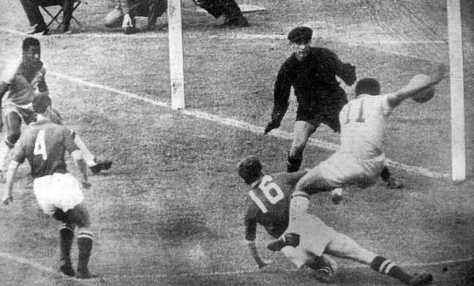
Brazil playing the Soviet Union in the 1958 World Cup, ‘stamping their imprint on the game’, as Hartman puts it below. (Image from here).

It is an interesting coincidence that my mother ended her part of the scrap book for me, with the World Cup in Sweden 1958: while I ended that scrap book in 1963 with the World Cup in Chile in 1962.

In both tournaments, for contrasting reasons, Brazil played an important role. So, at the outset, it ought to be said that the style of playing they gave the world – by virtue of stamping their imprint on the game in 1958 – continues to be the universal model aspired to.  You can always find reasons to deny this, rationalize matters, but when push comes to shove the whole world knows who plays authentic football!

This is largely because the Brazilians continue to bring their gifts and place them on a football field where everyone partakes, rival players as well as spectators. The élan with which they play is an inspiration that is duly acknowledged, respected, bowed to and imitated, in every single part of the world where they learn to love playing with a ball and get to see re-runs of Brazil’s old matches. While rival players may hate them with a vengeance, no spectators whose teams have lost to them ever bear them a grudge. Continue reading Growing up with the Cup (Part Two): Hartman d Souza

From Baghdad to Bolangir – Labour Laws in India: Saba Sharma

Guest post by SABA SHARMA

From the crisis in Iraq, a story is emerging of 40 construction workers in Mosul who have gone missing, some reports claim because they were trying to escape from the city and were captured by militants in the process. Many of these workers, feared kidnapped by ISIS, refused both their employers’ and the Indian government’s help to evacuate, as many have not been paid up to five months’ wages. Another report reveals that a group of 46 nurses from Kerala, working in a hospital in Tikrit, have refused to leave despite an offer from Delhi to help them evacuate. They need the money, as do their families back at home, so they would rather move to a safe zone in Iraq than return. Two nurses in the same hospital, who are on holiday in India, told the BBC that they would return despite the travel advisory issued by India advising citizens not to travel to Iraq. For them, failing to return means defaulting on loans taken to pay recruitment agents.

A few days before, on June 16, the NDA government announced that it was looking at liberalizing labour laws, primarily to make easier the retrenchment of workers. The UPA, and former PM Manmohan Singh in particular, also had labour law reform as an agenda, propelled by constant laments from industry saying ‘obsolete’ labour laws hindering growth and holding back the economy. The Vansundhara Raje government is already amending some state-level acts in Rajasthan to ‘liberate the corporate sector from the shackles of stringent requirements of the laws’, as one report put it.

Continue reading From Baghdad to Bolangir – Labour Laws in India: Saba Sharma

Eta Kolkata (This is Kolkata): Kaveri Gill

Guest post by KAVERI GILL

Today comes the surreal news that anyone painting their house or apartment white or sky blue in Kolkata can claim a waiver on property tax for a full year, a horror conjuring up a city that looks like a crumpled weave of Mother Teresa’s saree. Now, towns of Regency England and the Cornwall coast have uniform building and color restrictions to maintain historical continuity, but this idea is more in the perverse vein of babus suggesting that the burning ghats at Varanasi be “white-washed” for “freshness”.

The Chief Minister's radio and music in public places scheme
The Chief Minister’s radio and music in public places scheme

Thankfully, another Humphrey shot that idea down, yet the decimation of the architectural integrity of the façade of these famous ghats continues apace, with sealed air-conditioned buildings overlooking the burning bodies at Manikaran. Bengal’s Chief Minister has been known to remark that the colours “promote happiness” and accordingly, the Trinamool Congress (TMC) Mayor has incentivised citizens to embrace the “theme colours of the city”[1]. Coming on the heels of a general election, where the TMC won 34 seats out of 42, up from 19 in 2009, and compared to only 2 each for the Communist Party of India (Marxist) and the Bharatiya Janata Party (with 18% of the vote share, not to mention an almost win in the city), even discounting for dirty tricks appropriated by their cadres from the Left of old, the scorn must be tempered by what this result says about the contemporary citizen of this state and city. Continue reading Eta Kolkata (This is Kolkata): Kaveri Gill

Growing up with the Cup: Hartman De Souza (Part I)

Guest post by HARTMAN DE SOUZA

49c3c50e7

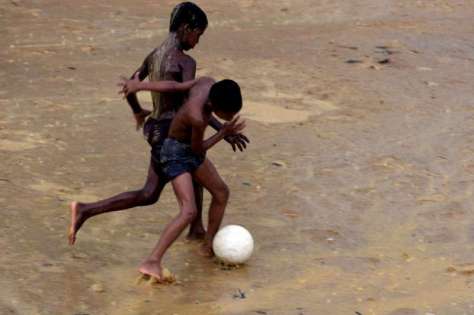
Boys playing football in Bangladesh. The only thing this has to do with Hartman’s post is that it has boys playing football. Also, it’s a lovely picture. (From the UNCHR Bangladesh website)

I only knew there was something called the World Cup courtesy an eccentric mother who kick-started a thick scrap book dedicated to football, to get me to start reading the newspaper. I was ten years old, and lived in Mombasa, on the coast of Kenya.

In it, my mother had gummed various newspaper and magazine articles and features on football. In 1960 when she handed it to me to continue, the last entry was her exhaustive coverage of the World Cup in Sweden in 1958, with reports of every one of the qualifying rounds and all the internationals friendly matches leading up to it. The very last clippings were news-items and commentaries talking about the next World Cup in Chile, in just two years time.

My tasks were cut out. Armed with a dictionary, I may have been one of the first ten year olds in Kenya if not the so-called Commonwealth, to discover Brian Glanville, a very bright and daring football columnist; a man who still writes about the game as if it was the only pleasure worth pursuing with passion.

I spent days and nights reading and re-reading my scrap book. I replayed countless matches in my head so that I could tinker with them and change the results. I always changed the results in my head, so logically the teams I supported always won. Continue reading Growing up with the Cup: Hartman De Souza (Part I)

A Renegade’s People: Rupam Sindhu Kalita

This is a guest post by Rupam Sindhu Kalita

What unites anti-homophobia campaigners, defenders of the poor’s right to clean water, university student collectives, women rights’ groups and academics under a premature summer sun in New Delhi on the 30th of March earlier this year? It is the unacceptable means employed by the Indian state in response to armed rebellions in North east India and the threat to civilian life that it has precipitated. The contagion of a military approach to a largely political problem was promulgated as an ordinance in 1958 under the presidency of Dr Rajendra Prasad to help quell the Naga movement and was developed into the Armed Forces Special Powers Act (Assam and Nagaland) later in the same year. The Armed Forces Special Powers Act (from here on AFSPA) persists in violating human rights in Kashmir and North east India despite its incompatibility with national and international human rights declarations. Over the years this Act has been sanctified in the inner sanctum of India’s centralised quasi-military administration. The government has been extremely guarded in its approach to growing popular demands for annulling this Act. The civil leadership’s reluctance to temper with the ritualized provisions of this Act has raised the disquieting question of who runs the country.

On 30th March central Delhi woke up to a motley group of protestors unified by a concern for violation of human rights under AFSPA. [Photo credit: V Arun Kumar].

Continue reading A Renegade’s People: Rupam Sindhu Kalita

PUCL Petition to NHRC Urges Inquiry in the Case of Human Rights Defenders Teesta Setalvad and Javed Anand

The following is the text of the PUCL petition to NHRC in the case of Teesta Setalvad, Javed Anand and the Citizens for Justice and Peace

PEOPLE’S UNION FOR CIVIL LIBERTIES

270-A, Patpar Ganj, Opposite Anand Lok Apartments, Mayur Vihar I, Delhi 110 091 Phone 2275 0014 PP FAX 4215 1459 Founder: Jayaprakash Narayan; Founding President: V M Tarkunde President: Prof. Prabhakar Sinha; General Secretary: Dr. V. Suresh

E.mail: puclnat@gmail.com; pucl.natgensec@gmail.com

7th June, 2014

TO: THE HON‟BLE CHAIRPERSON AND HON‟BLE MEMBERS,

NATIONAL HUMAN RIGHTS COMMISSION,

Manav Adhikar Bhawan Block-C, GPO Complex,

INA, New Delhi – 110023

SUB.: SEEKING AN INDEPENDENT REVIEW AND INTERVENTION IN RESPECT OF CONTINUING PERSECUTION AND PROSECUTION OF HUMAN RIGHTS DEFENDERS, TEESTA SETALVAD AND JAVED ANAND OF CITIZENS FOR JUSTICE AND PEACE AND OTHERS

Continue reading PUCL Petition to NHRC Urges Inquiry in the Case of Human Rights Defenders Teesta Setalvad and Javed Anand

When Are Foreign Funds Okay? A Guide for the Perplexed

The Intelligence Bureau has, as we know prepared a document, updating it from the time of the UPA regime (which had reportedly started the dossier) indicating large scale foreign funding for subversive anti-development activities. Such as claiming that you have a greater right to your own lands and to your livelihood than monstrous profit-making private companies. Or raising ecological arguments that might stand in the way of the profits to be made by private corporations and the corrupt state elite, from mining, big dams, multi-lane highways and so on.

The IB report, signed by IB joint director Safi A Rizvi — alleges that the “areas of action” of the foreign-funded NGOs include anti-nuclear, anti-coal and anti-Genetically Modified Organisms protests. Apart from stalling mega industrial projects including those floated by POSCO and Vedanta, these NGOs have also been working to the detriment of mining, dam and oil drilling projects in north-eastern India, it adds. 

Imagine – working against the interests of POSCO and Vedanta! Is there no end to the depraved anti-nationalism of these NGOs!

These folks must have made millions of dollars

narmada

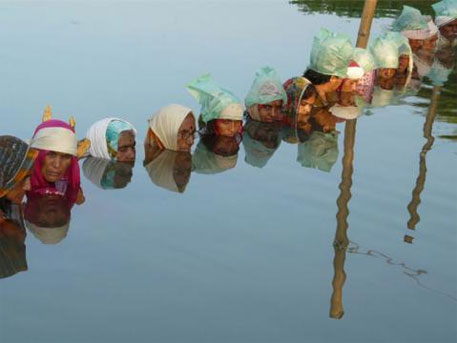
In 2012, people affected by the Omkareshwar and Indira Sagar dams protested the raising of dam storage levels by staying in neck-deep water for over a fortnight (Photo: Narmada Bachao Andolan). 

The average observer of Indian politics – being like me, not as sharp as the IB – might be a little befuddled by this apparently anachronistic allergy of two successive governments and its intelligence gathering organization, towards foreign funding, in an era in which the slightest slowing down of the pace of handing over the nation’s resources to multi-national corporations,  is termed as “policy paralysis”, and attacked as detrimental to the health of the mythical “Sensex”. Older readers might remember that the  inspiring slogan of the legendary Jaspal Bhatti’s Feel Good party was Sensex ooncha rahe hamara.

This post is just to help you figure out then, when it is Okay to applaud foreign funding and when it is not – because otherwise you might post something on your FaceBook page that attacks foreign funding when it is actually Okay – and then how stupid and anti-national you’ll look.   Continue reading When Are Foreign Funds Okay? A Guide for the Perplexed

Airing the unheard from Polavaram: Mohammed Omais Shayan

Guest post by MOHAMMED OMAIS SHAYAN 

As the Nation is welcoming its 29th state, Telangana is upbeat with hope of starting a new chapter of progress. Amongst the jubilations in Telangana, voices of people affected by the Polavaram dam are being lost. “Dam’ned”, a film by Saraswati Kavula is an attempt to air the unheard voices. It’s a must watch for all concerned as the movie touches the links of people, land, livelihood and development. The film aims to bring ground realities through interviewing the people of the affected region, technical and environmental experts. Before getting into content of the film, a very brief introduction of the project.

Polavaram project is going to be the largest dam in terms of number of people being displaced. The dam will be constructed at Polavaram village in West Godavari district of Andhra Pradesh. The dam aims to irrigate 2910 km2 of area in Andhra Pradesh [1]. It will also provide drinking water to Vishakapatnam City and many villages besides water for industries in Vizag. The project aims to transfer 80 TMC water from Godavari to Krishna basin. The dam will submerge 300 villages of Andhra Pradesh, Chattisgarh and Orissa. This submergence area will cover 3,500 acres of biodiversity rich forest and also partially submerge the Papikundulum wildlife sanctuary [2]. The people living in these areas are predominantly ‘adivasis’ belonging to Koya and Konda Reddy tribes.

Continue reading Airing the unheard from Polavaram: Mohammed Omais Shayan

Ideas to Occupy Economics – A Note on Michal Kalecki: Pranjal Rawat

Guest post by PRANJAL RAWAT

A revolution of sorts is on the cards for the students of economics amidst a great surge of international support for radical restructuring of the subject and its pedagogy. From the politically incorrect ‘Non-Autistic Economics’ movement to the Post-Crash Society in Manchester to the Jadavpur University Heterodox Economics Students’ Association (JUHESA) in Kolkata we see an underlying common theme. The narrowness of the neoclassical economics is being criticized. Take for instance what the preamble of JUHESA has to say about Neoclassical Economics, “Students have rightly found it appalling that a theory which could neither predict nor suggest remedies to the biggest recession in more than half a century, continues to be taught as the sole approach to economic analysis the whole world over.” This so-called revolution will remain just a source of media income and wash over without changing much, unless scholars of economics take it upon themselves to destroy the inertia and raise arms against the old order. Revolutions exists only in retrospect, the rest is all popular gossip. For that purpose, it would do well to draw strength from the life and work of Michal Kalecki (1899 – 1970), a post-keynesian economist, whose work has remained relevant for a period longer than it took for American economy to recover from the Great Depression only to crash in the Great Recession. Continue reading Ideas to Occupy Economics – A Note on Michal Kalecki: Pranjal Rawat

दीनानाथ बत्रा और उदार बुद्धिजीवी

दीनानाथ बत्रा की आलोचना में एक और टिप्पणी पहुँचने से किसी भी सम्पादक को कोफ़्त होगी:आखिर एक ही बात कितनी बार की जाए!लेकिन खुद दीनानाथ बत्रा और उनके ‘शिक्षा बचाओ आंदोलन’ को कभी भी वही एक काम बार-बार करते हुए दुहराव की ऊब और थकान नहीं होती. इसीलिए कुछ वक्त पहले वेंडी डोनिगर की किताब ‘एन अल्टरनेटिव हिस्ट्री ऑफ़ हिंदुइज्म’ के खिलाफ मुकदमा दायर करके और प्रकाशक पर लगातार उसे वापस लेने का दबाव डाल कर ‘आंदोलन’ ने जब पेंगुइन जैसे बड़े प्रकाशक को मजबूर कर दिया कि वह उस किताब की बची प्रतियों की लुगदी कर डाले और भारत में उसे फिर न छापे, तो आपत्ति की आवाजें उठीं लेकिन उसके कुछ वक्त बाद ही जब उन्होंने ‘ओरिएंट ब्लैकस्वान’ को 2004 में छापी गई शेखर बन्द्योपाध्याय की किताब From Plassey to Partition: A History of Modern India पर कानूनी नोटिस भेज दी और उस दबाव में मेघा कुमार की किताब(Communalism and Sexual Violence: Ahmedabad Since 1969) ,कई और किताबों के साथ,रोक ली गई तो कोई प्रतिवाद नहीं सुनाई पड़ा. यानी आखिरकार अभिव्यक्ति की आज़ादी के पैरोकार थक गए लगते हैं. Continue reading दीनानाथ बत्रा और उदार बुद्धिजीवी

Statement on the Murder of Three Young Persons in Badaun and Pune: P.A.D.S.

People’s Alliance for Democracy and Secularism (P.A.D.S.)  Statement on the murder of three young persons in Badaun and Pune
 
 
While introducing the Draft Constitution in the Constituent Assembly, Dr B. R. Ambedkar had observed, “Democracy in India is only a top-dressing on an Indian soil, which is essentially undemocratic.”  The same continues to hold true sixty four years later. A few weeks ago the people of India participated in the largest-ever election of their representatives in a largely free and fair process. However, other events since then have revealed the shallowness of this democratic top-dressing along with the tyrannical side of our society and polity.
 
On 27 May two girls aged 12 and 14 from an oppressed caste family of Katra Sadatganj in Badaun district of UP were sexually assaulted and killed when out to answer nature’s call. The rapists, belonging to the local dominant caste, hung their bodies from a tree in a public display of their power.
 
On 2 June in Pune, twenty-eight year old Mohsin Shaikh, an information technology professional was beaten to death by a group of men belonging to an outfit called Hindu Rashtra Sena. The killers even celebrated their cruelty in messages declaring that the ‘the first wicket is down’.  

Continue reading Statement on the Murder of Three Young Persons in Badaun and Pune: P.A.D.S.

“Trashy Tastes” and Permeable Borders – Indian and Iranian Soap Operas on Afghan Television: Wazhmah Osman

We apologize to readers for having to take down this guest post by WAZHMAH OSMAN, which was a chapter from her Ph.D thesis from New York University, Thinking Outside the Box: Television and the Afghan Culture Wars.

The author has since written to us that she does not have permission to reproduce the entire chapter. Apologies to everybody all round!

download

A young Afghan poster seller displaying Smriti Irani as Tulsi

Image: Reuters/Ahmad Masood 

History Scholars Write to UGC on Need to Radically Restructure NET

To:

The Chairman, University Grants Commission.

Dear Sir,

The University Grants Commission has mandated that an exam i.e. the National Eligibility Test, be passed as a requirement for the teaching of History at the undergraduate and post-graduate levels, except in the case where the candidate has a PhD. Those who score highly are given the Junior Research Fellowship which greatly strengthens their candidacy for the Ph.D. program.

We the undersigned, as teachers and researchers of History, believe that the NET exam as it exists does not measure competence in History as a discipline in any imaginable sense. The NET’s own understanding of History is fundamentally different from the practice of the discipline across the world. This understanding, as reflected in the question papers, holds History to lie solely in the memorization of facts. Therefore, in the NET’s version of History, the mechanical retention and retrieval of information appears to be the only competence required for the teaching of the subject.  Continue reading History Scholars Write to UGC on Need to Radically Restructure NET

DISSENT, DEBATE, CREATE