On the Death of Khurshid Anwar: Kalyani Menon Sen and Kavita Krishnan

Guest Post by KALYANI MENON SEN & KAVITA KRISHNAN

(Find Hindi translation below the English statement)

We are deeply shocked and saddened by the death of Khurshid Anwar.

As activists committed to ending violence against women, we have been trying to ensure the due process of law and justice in relation to the allegations against Khurshid Anwar. Continue reading On the Death of Khurshid Anwar: Kalyani Menon Sen and Kavita Krishnan

Statue of Unity – How the Varna Media is Loving It !

..The man who belonged to the whole country has now been abducted by Narendra Modi, a pracharak of RSS, the communal organization who the Sardar fought against throughout his life. ..The only purpose of the construction of the Sardar Patel statue which was declared by Narendra Modi after he was anointed as the BJP’s Prime Ministerial Candidate is to collect votes for the 2014 elections in the name of this leader of India’s freedom struggle. It is therefore a downright irony that the RSS pracharak is trying to build the facade of unity by erecting the statue of one of the staunchest opponents of RSS. (Facade of Unity – RSS Abducts Sardar Patel, Pratik Sinha October 31, 2013 |

I

History bears witness the fact that the attitude to appear ‘big’ or ‘tall’ so that even posterity remembers you is very evident in every megalomaniac. It is a different matter that due to a poor sense of history, such megalomaniacs cannot even comprehend that thanks to the way they subdued a population, or cleanse it of ‘others’, actually overwhelms the giant monuments they build or the memorials they erect to commemorate their bloody victories. The Halakus, the Chengiz Khans, the Menanders or the Mussolinis of the world are remembered today not as noble representatives of humanity but as its other. Continue reading Statue of Unity – How the Varna Media is Loving It !

खुर्शीद अनवर की आत्महत्या और कुछ सवाल

आखिर खुर्शीद अनवर ने ज़िंदगी से बाहर छलांग लगा ली.यह असमय निधन नहीं था. यह कोई बहादुरी नहीं थी. और न बुजदिली. क्या यह एक फैसला था या फैसले का अभाव? अखबार इसे बलात्कार के आरोपी एक एन.जी.ओ. प्रमुख की आत्महत्या कह रहे हैं. क्या उन्होंने आत्महत्या इसलिए कर ली कि उनपर लगे आरोप सही थे और उनके पास कोई बचाव नहीं था? या इसलिए कि ये आरोप बिलकुल गलत थे और वे इनके निरंतर सार्वजनिक प्रचार से बेहद अपमानित महसूस कर रहे थे? Continue reading खुर्शीद अनवर की आत्महत्या और कुछ सवाल

Khobragade’s Arrest – Labour Law Violation Issue, Not Foreign Policy Issue: Gharelu Kaamgaar Sangathan and NTUI

Guest Post by GHARELU KAAMGAAR SANGATHAN, (GKS) Haryana & New Trade Union Initiative (NTUI)

We express strong outrage at the Indian government’s reaction to the case of visa fraud and exploitation of her domestic worker against Deputy Consul General Devyani Khobragade in the United States. In its dealing of the case, the Indian government is only seeking to protect the dignity and honour of Ms. Khobragade, and has shown a complete lack of respect for the underlying issue – that of the abuse and exploitation of a domestic worker by a senior official. Ms. Khobragade’s father, Mr. Uttam Khobragade, is a politician and has a played a harmful role in suppressing the facts of the case and in diverting attention from it.

Continue reading Khobragade’s Arrest – Labour Law Violation Issue, Not Foreign Policy Issue: Gharelu Kaamgaar Sangathan and NTUI

Section 377 and the Love with Odd Edges: Pallavi Paul

A Guest Post by PALLAVI PAUL

It is like watching an 80’s slasher film on an old VHS. The gruesomeness of mangled bodies, extra slimy trails of thick blood, intestines plastered against the screen. Parts of the image are eaten up by the glitch-ghosts that hang above them.  The erased bits , however, intensify the onset of the apocalypse instead of putting it away. It is impossible to tell whether something is happening, happened or will happen. Time is put through a particle accelerator, and what follows is a journey through a dilapidated scene of crime, with pure tone for background score.

Continue reading Section 377 and the Love with Odd Edges: Pallavi Paul

Dear Supreme Court: Inder Salim

Guest Post by INDER SALIM

Dear Supreme Court,

I am personally glad that your recent verdict on Article 377 has sparked a debate on the nature of “SEX “in India.

Continue reading Dear Supreme Court: Inder Salim

Queering Christianity: Janice Lazarus

Guest Post by JANICE LAZARUS

While there have been several writings, posts and comments on the web and in the print about the connection between homosexuality and Hinduism, there has been almost nothing said about the outlook of Christianity on homosexuality. One of the petitioners in Kaushal vs. Naz case is the Utkal Christian Council represented by its Secretary; and so I feel that it is crucial to write about Christianity and the way in which in many parts of the world a Queer Theology is embracing those previously deemed sinful by the Church. While I am in no way a theologian, I do feel that the Bible is open to be read by all and can be interpreted differently by many (as do the different sects within Christianity).

Continue reading Queering Christianity: Janice Lazarus

An Incomplete Reunion – Ruining the Post-Partition Party: Archit Guha

Guest post by ARCHIT GUHA

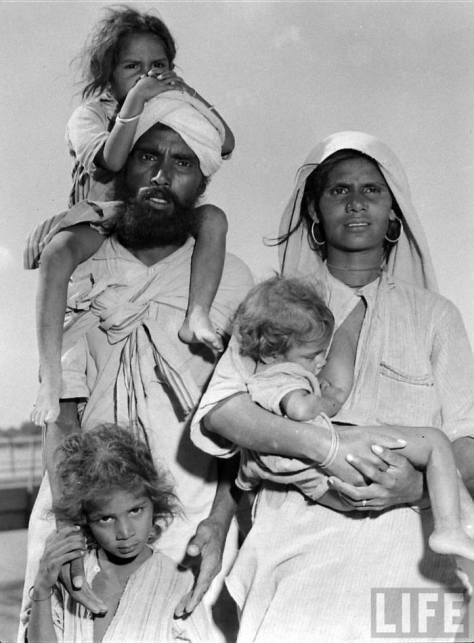
Reproduced without Permission from Life

By this point, every Indian, Pakistani, and their grandfathers has watched the Google Partition ad, tears welled up in their eyes. For the uninitiated, Google’s recent advertisement tugs at heartstrings, telling the tale of two chaddi buddies, separated by Partition, and reunited by their grandchildren nearly seventy years later. When the ad went viral via Facebook, sitting thousands of miles away in America, I bawled as I watched the granddaughter listening to her grandfather’s nostalgic retelling of the idyllic life he led in Lahore, eating jhajhariya, with his buddy Yusuf, and his granddaughter’s instant Google fixes to reunite him with Yusuf in Delhi. Continue reading An Incomplete Reunion – Ruining the Post-Partition Party: Archit Guha

People’s Participation in Planning Mumbai?: Hussain Indorewala and Shweta Wagh

This is a guest post by Hussain Indorewala and Shweta Wagh

Since the past six months in Mumbai, there has been an unusual convergence between urban activists, community groups, rights groups, unions, Non-Governmental Organizations and academics, who have come together to provide a theoretical critique of the city’s neoliberal development model, to formulate a more diverse and hopeful vision for the city than the one proclaimed by its power elite, and to present practical alternatives to plans and projects promulgated by faceless state bureaucracies and unaccountable private consultants.

On 22nd October 2013, more than 1500 people gathered at Azad Maidan to formally present “The People’s Vision Document for Mumbai’s Development Plan (2014-2034)” to the Municipal Corporation of Greater Mumbai (MCGM).[1] The People’s Vision Document (PVD)[2] is a remarkable collective vision statement, an outcome of discussions focused around specific issues in the city with more than a hundred grassroots and community groups, along with activists, experts and academics who participated in them. With this movement, the less advantaged residents of the city have announced and forced themselves into an exclusionary and secretive Development Plan process; refusing to be silent spectators, in a striking example of initiative, organizational ability and creative agency, they have asserted their right to the city’s future, whose owners and managers have done much to keep them out. To use the language of other social urban movements around the world, some of the most marginalized groups of the city are fighting for spatial justice, urban democracy, and have claimed their ‘right to be equal in diversity.’[3] Continue reading People’s Participation in Planning Mumbai?: Hussain Indorewala and Shweta Wagh

As a religious minority, I empathize with sexual minorities: M Reyaz

This is a guest post by M. REYAZ

The Apex Court judgment of December 11, putting aside the Delhi High Court order on decriminalisation of homosexuality, pertaining to Section 377 of the IPC has clearly divided into two ‘queer’ camps, where on one side besides LGBTS are those liberals extending their support to the LGBT cause, and on the other side, there are religious leaders and groups, who otherwise would not even see eye to eye with each other (what is ‘queer’ about this second camp is not so much its sexual orientation, as the strangeness of its banding together against queer people despite their antagonism toward each other).

Continue reading As a religious minority, I empathize with sexual minorities: M Reyaz

Ganguly Must Go – Chairs of Rights Bodies Must be Above Reproach

Statement from Women’s Groups Across India on 16 December 2013

Exactly one year ago, the gang-rape of a young woman triggered immense outrage across the board, putting freedom from rape and sexual assault at the forefront of public debate. From law reform to overhaul of institutions of justice delivery, from media sensitization to public awareness, women’s safety is now squarely on the public agenda, thanks to mass protests. Ironically, during those very protests, on 24 December 2012, a young lawyer revealed that a retired judge of the highest court in land had sexually harassed her while she was working with him as an intern, and that she was unable to speak about it only ten months later.

According to her statement, Justice (Retd) A.K. Ganguly currently the Chairman of the West Bengal Human Rights Commission said, “’You know that I’m attracted to you, don’t you? You must be thinking, what, this old man is getting drunk and saying such things. But I really like you, I love you’. When I tried to move away, he kissed my arm and repeated that he loved me.” This is not merely inappropriate behavior by a senior over junior staff or interns; it is not merely over-stepping of boundaries; it is not merely friendly overtures: such acts constitute a clear case of abuse of power and sexual harassment at the workplace.  Continue reading Ganguly Must Go – Chairs of Rights Bodies Must be Above Reproach

JTSA extends support to the LGBT community, calls for committed judicial activism: JTSA

Guest Post by JAMIA TEACHERS’ SOLIDARITY ASSOCIATION

On 11 December, 2013 a two judge bench of the Supreme Court of India (SC) ruled that section 377 of the Indian Penal Code (IPC), which considers homosexuality a criminal offence, does not ‘suffer from the vice of unconstitutionality’ and hence, legally valid.  By this highly regrettable ruling the apex court astounded and disappointed not only the LGBT community but the wider public at large.

Continue reading JTSA extends support to the LGBT community, calls for committed judicial activism: JTSA

Size does matter your lordships – A letter to the Supreme Court: Siddharth Narrain

SIDDHARTH NARRAIN based on his legal and extra legal expertise arrives at the conclusion that size does matter

A LETTER TO YOUR LORDSHIPS

Your Lordships have called us, LGBT Indians, a “miniscule minority”. Never mind that statistically we constitute at least four per cent of the population, which are over four million people. Your Lordships say that there are only 200 persons impacted by section 377 over the last 150 years. Never mind that there are millions of LGBT persons who have been under the shadow of this law over the last 150 years, discriminated against, blackmailed, harassed, outed to their families, driven to suicide, forcibly married, diagnosed as mentally ill, raped, assaulted, and disinherited.

Your Lordships say we are a “miniscule minority”. Since you are so fond of dictionaries, lets flip one open.

Miniscule: The adjective miniscule is etymologically related to minus, but associations with mini have produced the spelling variant miniscule. Continue reading Size does matter your lordships – A letter to the Supreme Court: Siddharth Narrain

Suresh Koushal v. Naz Foundation: Pratiksha Baxi

Suresh Koushal v. Naz Foundation directs law’s violence on the body of the Constitution of India. Proclaiming colonial law as constitutional, the Supreme Court negates its role in the making of postcolonial constitutionalism. It departs from the theatres of comparative constitutionalism in the post–colonies, which used Naz to strengthen their battles against Macaulay’s legacies. Today the Supreme Court is cited amongst the infamous precedents of injustice that mark Indian legal history. Dubbed as ADM Jabalpur 2, the judgment declares sexual emergency on LGBT communities. By breathing life into s. 377, the Supreme Court attaches a badge of stigma on the body of Constitution.

Taking a jurispathic turn, the Supreme Court asserts that equality is subservient to scale by claiming that the LGBT community is a “miniscule fraction of the country’s population”. Inventing the category of a miniscule minority, the Supreme Court implies that equality provisions will apply only to numerically preponderant body populations. Thereby, overwriting equality jurisprudence by the insidious politics of numbers.  Continue reading Suresh Koushal v. Naz Foundation: Pratiksha Baxi

The Anti-Rape Movement -The Political Vision of ‘Naari Mukti/Sabki Mukti’: Kavita Krishnan

Guest Post by KAVITA KRISHNAN

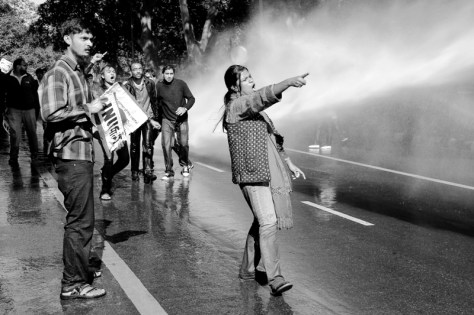
Anti Rape Protest at CM Shiela Dixit's House, Photo by Vijay Kumar
Anti Rape Protest at CM Shiela Dixit’s House, Photo by Vijay Kumar

A year ago, a massive movement erupted on the streets of Delhi and the country – against the brutal gangrape of a young woman on a bus, leading to her death. Looking back at that movement a year later, it is clear that the questions, concerns and above all the tensions and debates embedded in that movement are with us still – and are quite crucial to the political discourse around us.

Continue reading The Anti-Rape Movement -The Political Vision of ‘Naari Mukti/Sabki Mukti’: Kavita Krishnan

AAP’s Rise and Congress Rout – Some Obvious but Unconventional Questions: Sanjay Kumar

Guest post by SANJAY KUMAR

A Congress rout and the AAP success are the most obvious results of recent polls. Both are spectacular, in their own ways. Even BJP’s landslide victory in Rajasthan and Madhya Pradesh pales in comparison, for these two open up new possibilities.

Why a party whose legacy of anti-colonial struggle had lost sheen generations ago, whose top leadership is in the grip of a seemingly disinterested and incompetent dynasty, that lacks any organised cadre, coherent ideology, social base, and whose average leader appears more of a wheeler-dealer, and scamster, should continue to get close to thirty percent of votes from Indians even in worst of times, is a genuine mystery. That the Indian social analyses, barring a few exceptions, have tried little to unravel this mystery, is not only an indication of their intellectual limitations, but also of their ideological biases. The enduring success of Congress indicates seamier side of liberal democracy in general, which bourgeois social sciences try more to paper over than explore.

From voters’ perspective elections under liberal democracy are an exercise in choice, but not in freedom. When people vote, they are not acting as citizens shaping their social world, but as little men and women facing pre-existing structures of social power. The magic of elections under liberal democracy is precisely this. They offer a choice, the choice is not fake, its collective outcome is uncertain, yet the choice is already pre-determined in ways that by and large reproduce pre-existing power structures. That is why, exercising franchise is not necessarily a marker of democratic exercise, and leaders of fascist persuasion are often the loudest votaries of compulsory voting.  But that is not all. If elections were mere gears in a machine that simply revolved on and on, they would be quickly become a ritual, like those under state socialism in which the Party and leaders always got more than 95% approvals. Elections under liberal democracy in contrast provide flexible adjustment of state political functionaries to changing social conditions. They allow reflection of changes in public opinion, demography, gender politics, caste equations and balance of class forces, whose origins lie somewhere else, onto state politics. Punctuated adjustment with a time lag produces a sense of drama. Personae on stage appear as victors and losers, for voters there is enough stage space to allow their hope, vengeance or gratitude to play their part. For a time, and only for a time, the impersonal structure of state power becomes humanly palpable. Continue reading AAP’s Rise and Congress Rout – Some Obvious but Unconventional Questions: Sanjay Kumar

Section 377 and India Shining: Pronoy Rai

Guest Post by PRONOY RAI

It is 2004 all over again. India is shining. Such a difference a decade can make. BJP is on the verge of returning to power, Modi could be India’s next Prime Minister, and the many failures of the UPA could give a new lease of life to Hindutva, if it was dead at all. As India shines, the state (its judicial arm, in this case) has abandoned the queers, questioning their claim to the status of “minority”, rendering them vulnerable to brutality at the hands of the hetero-normative society and other arms of the state (police, for instance), in equal measures. Other minority groups, strangely, or perhaps not so strangely, fought against the claim to citizenship of a (sexual) minority group, decisively defeating them at the altar of justice. 

Some of us queers, who stuck to every single word that was written in 2004 that went on to show how agrarian distress, farmer suicides, and saffronization of education didn’t quite add up to a shining India, were left puzzled by the reaction of the BJP to the Supreme Court verdict upholding section 377 in its original, pristine self. You’d think that the shrewd right-wing would take on the first opportunity to invoke a very obvious ancient Indian “culture of homosexuality” to make a progressive argument in favor of decriminalization. You’d assume that in a ravaging hunger to return to power, they would try to bring on board every single group that they can, maybe only later to abandon them, but at least carry them along through elections. Alas, no. For the BJP, India is still shining, and this shining confidence is perhaps sufficient to help them march into 7 Race Course Road, next year.  Continue reading Section 377 and India Shining: Pronoy Rai

No Going Back: Siddharth Narrain

no going back


No Going Back

The Supreme Court’s decision in Suresh Kumar Kaushal v Naz Foundation has re-criminalized millions of LGBT persons, putting their lives at risk and subjecting them to the threat of violence, harassment and arrest. Despite this loss in court, we should not see this as a defeat. It is not a defeat because the mood of the country has changed, rising up in anger against prejudice masquerading as law. The public backlash against this decision has caught even LGBT activists by surprise. It is not a defeat because finally voices from the political establishment of this country have come out in support of LGBT rights. The top leadership of the Congress party, Cabinet Ministers, and spokespersons across the political spectrum have spoken out against the judgment. The BJP’s official stance supporting 377 appears out of step with reality, and there is a section of the party that does not support this view.

It is not a defeat because parents of LGBT persons have rallied around their children in this hour of crisis. It is not a defeat because friends, colleagues, students, teachers, and classmates have been shaken up by the injustice of this moment. The outrage and anger, the public show of solidarity and small gestures of support, has been overwhelming. The 377 judgment is not a defeat because commentators across the political spectrum have criticised the logic of the judgment. It is not a defeat because the legal community including the Advocate General of this country has questioned the rationale of this decision. Described as a judgment devoid of humanity and compassion, the Supreme Court’s decision has prompted many comparisons – A.D.M. Jabalpur, A.K. Gopalan, Mathura, Gian Kaur,  Dred Scott, Plessy, and Bowers. It is not a defeat because this judgment has spawned a new generation of activism.

The Supreme Court’s decision has emboldened the human rights movement in this country, brought together diverse groups on a common platform. The Delhi High Court’s 2009 judgment affirmed the constitutional rights of millions of Indian citizens. The Supreme Court verdict has reversed this, but it can never erase that moment of freedom from our past. The mood of this country has changed. Public discourse has changed. People have changed. The law must change. There is no going back.

In cities across the world, people are mobilizing protests against the judgment. Join the Global Day of Rage on Sunday, 15th December.

https://www.facebook.com/events/1374294672825321/

An anti-constitutional judgement: Johannes Manjrekar

Guest Post by JOHANNES MANJREKAR

The ruling by a two-member bench of the Supreme Court, striking down the judgement of the Delhi high Court which had held that Article 377 – a pre-Constitution, 19th century colonial-era law – violated the spirit and directive principles of the Indian Constitution, seems to break new ground in jurisprudence. In an era where governments worldwide have been engaged in systematically rolling back hard-won civil liberties and individual rights and violating constitutionally guaranteed freedoms and principles, one might be excused for believing that the most urgent duty of an independent judiciary endowed with a reasonable degree of conviction and courage, would be to curb the transgressions of governments against the principles laid down in their own constitutions. The recent ruling of the SC does little to encourage such a belief. Continue reading An anti-constitutional judgement: Johannes Manjrekar

Contempt of Citizens: Mayur Suresh

MAYUR SURESH   finds the Supreme Court guilty of contempt (of citizens)

Contempt: – The word ‘contempt’ comes from the Latin word “contemptus” and much like its modern counterpart, is the feeling that a person or a thing is worthless or deserving scorn.

Contempt is a feeling that is often felt by Lesbian, gay, bisexual and transgender people in India. It’s been meted out to LGBT people equally by the British who aimed to civilise us, and those today who seek to ‘preserve our culture’. An 1838 report on the Draft Penal Code called homosexual acts a “revolting subject” and said that the “frequency” of homosexuality in India “remained a stain on this land.” In 1934, the High Court of Sindh called a man who had consensual sex with another man “a despicable specimen of humanity”. Not to be left behind, those appellants who approached the Supreme Court reserved the choicest of contemptuous words for LGBT people in India: “disgusting”, “filthy”, “delinquents”.

Continue reading Contempt of Citizens: Mayur Suresh

On the SC judgement on Sec 377: Statement from TISS teachers

It is with deep shock and disappointment that we received the regressive judgment of the Supreme Court dated 11-12-13, on the reading down of Section 377 of the IPC related to the rights of queer (lesbian bisexual gay and transgender…) people in this country, which reverted the decriminalisation of non-normative sexualities following the Delhi High Court judgement in 2009.

The Delhi High Court had based its expansive judgement on the eloquent discussion of constitutional morality by the framers of our Constitution, especially Dr. Ambedkar. Constitutional morality, they argued is the basis for equality of citizens since public morality which is largely the morality of the dominant forces in society can never guarantee democracy, and perhaps even more importantly equality and dignity to its citizens, especially its most marginal citizens. Additionally, The Delhi High Court judgement evoked the spirit of dignity, inclusiveness and non-discrimination, thereby emphasizing equality of all citizens that Nehru spoke of during the Constituent Assembly debates, so necessary for the deeply hierarchical social fabric that our country represents. Continue reading On the SC judgement on Sec 377: Statement from TISS teachers

DISSENT, DEBATE, CREATE